WM_Clout

Our Lady’s Clout

Dear Friends,


A question that arrives in the inbox with surprising regularity is one that deals with the Blessed Virgin Mary and why we Catholics pray to her.

After all, isn’t Jesus the only Mediator between God and man? And isn’t it his death that won us redemption?

To both those questions, the Church answers with a resounding Yes.

So why pray to Mary? Why not cut out the middleman, so to speak?

One simple answer is that praying to Mary is very biblical.

For instance, the Israelites, on occasion, asked Moses to mediate for them before the Almighty. “You speak to us, and we will listen; but do not let God speak to us, or we shall die” (Exodus 20:19).

Then there was the centurion in the New Testament. “When he heard about Jesus, he sent elders of the Jews to him, asking him to come and save the life of his slave” (Luke 7:3).

And of course, there was Mary herself, whose intercession with Jesus at Cana spared the newlyweds the embarrassment of running out of wine for the wedding guests.

Why is it so hard for some to accept Mary as an intercessor? She is, after all, the Mother of Jesus. And how would the perfect Son ever deny his mom a favor?

This isn’t a matter of sentimental attachment. Mary’s heroic faith, from her Fiat at the annunciation to her standing by the cross on Calvary, opened the way to a divine plan that changed the world. No wonder she is such a powerful intercessor with Our Lord.

To cultivate a Marian devotion, it might be helpful to use our Retreat Guide on “Welcoming the Word”.

With Mary’s intercession, we too might have the confidence to open our hearts to do whatever Our Lord asks of us.


In Christ,

Father Edward McIlmail, LC

Ask a Priest contributor

Our Lady’s Clout Read More »

Regnum Christi Spirituality Center Uncle Eddy

St Hilary

Dear Hillary, Nothing should surprise you less than what you described in your last note.  Do you think the devil just stands idly by while someone like yourself – who has every necessary qualification to be a huge success in this crazy world – is discerning a call to the consecrated life?  Don’t be so naïve. I once knew a young man who had suffered an unrequited crush on a young woman for almost three years. As soon as he told his friends that he had decided to join the seminary, she came knocking at his door – do you think it was a coincidence?  But don’t take it just from my experience; look at the history books. Today’s saint is a perfect case. Exceptional in every way, and having received a top-notch education, Hilary had a future bright as gold.  Then one day his uncle showed up. His uncle happened to be St Honoratus, founder and first abbot of a nearby monastery.  Honoratus loved Hilary deeply and tried to convince him to put his many gifts into God’s service. Hilary laughed him off, relishing the prospects of a successful, prestigious, and lucrative career.  Honoratus gave up his arguments, returned to the abbey, and prayed earnestly for Hilary’s vocation. A couple of days later Hilary felt the call. It wasn’t a pleasant phenomenon. Here’s how he described it: “On the one side I felt that the Lord was calling me, whilst on the other hand the seductions of the world held me back… My will swayed backward and forwards, now consenting, now refusing.  But at last Christ triumphed in me.” And now St Hilary is remembered and revered as one of the pillars of the early European Church. In his few years of monastic life and then in his taking over the bishopric of a key city in southern France, he brilliantly and doggedly laid the groundwork for centuries of Christian growth throughout Western Europe. So if I were you, I wouldn’t be surprised if you still find it hard to see your vocational path as clearly as you would like.  Ask St Hilary to help you out, and then do whatever you think will please God most. Keep me posted, Uncle Eddy

St Hilary Read More »

26-05-05-DM

May 5, 2026 – Do Not Be Afraid!

Tuesday of the Fifth Week of Easter


John 14:27-31a

Jesus said to his disciples: “Peace I leave with you; my peace I give to you. Not as the world gives do I give it to you. Do not let your hearts be troubled or afraid. You heard me tell you, ‘I am going away and I will come back to you.’ If you loved me, you would rejoice that I am going to the Father; for the Father is greater than I. And now I have told you this before it happens, so that when it happens you may believe. I will no longer speak much with you, for the ruler of the world is coming. He has no power over me, but the world must know that I love the Father and that I do just as the Father has commanded me.”

Opening Prayer: Lord God, little by little I contemplate the vast tapestry of your Last Supper discourse. There is enough love there to feed me for a lifetime! As St. John reclined on your breast during that solemn night, so grant me to rest my heart mystically on your heart, fount of love and graces.

Encountering Christ:

  1. Do Not Be Afraid: “Do not let your hearts be troubled or afraid.” Two things about this statement surprise us. The first is that Christ commands us. The second stems from the first: If Jesus commands us not to be afraid (and not to be troubled), it’s because we have a choice about whether to allow ourselves to fear (and be troubled) or not. Jesus is right to command our peace of heart because giving into fear and interior disturbance does not sanctify us, except in that God pities our weakness and showers his mercy on us in order to dispel our fears. He knows we will fear, but he wants us to be at peace. Jesus can command peace because his word causes what it expresses (see yesterday’s meditation). It’s true that sometimes Jesus is “away,” and our soul flounders in insecurities, but he also promises, “I will come back to you,” and peace returns.


  2. So Much to Say!: Jesus’ Last Supper discourse is packed with meaning. In today’s excerpt alone, we have the assurance of peace, the promise of Jesus’ Ascension and subsequent return, the greatness of the Father, the purpose of Jesus’ warnings, the coming of the evil one, and the Son’s total devotion to the Father. This flood of ideas and feelings comes from Jesus’ wanting to say so much, and all at once! We have the advantage of having it all written down, so that we can sift through it at a contemplative pace. And yet, the only way to understand Jesus’ words is to observe his actions, to search out his motives, to note his gestures and expressions—in short, to live with him. We must spend time with Jesus (especially in the Eucharist) if we want to understand and be transformed into him.


  3. That Eucharistic Night: All of Jesus’ words in John 13-17 are in the context of the Eucharist. The reverse is also true: When we go to Mass and the Eucharist is consecrated following Jesus’ command, “Do this in memory of me,” we are also in the context of everything Jesus said that night. When we sit in the pew on Sundays, we are reminded of the gift of his Body and Blood, the institution of the priesthood, the law of charity, the washing of the feet—all the love, all the passion, his desire to save his friends, his human reluctance to die and yet complete adherence to his Father, and the mission of redemption. Just as Easter Sunday is our glory and Good Friday our strength, so should that night of love on Holy Thursday remain ever in our hearts, memories, and affections.

Conversing with Christ: Lord Jesus, if you command it, I will not let my heart be troubled or afraid. Give me the peace that comes from ardent love for you—not the worldly peace that comes from indifference. Speak to my heart as you spoke that night to your intimate friends.

Resolution: Lord, today by your grace I will read Psalm 27 with reverence. “The Lord is my light and my salvation; of whom should I be afraid?”

For Further Reflection: Jacques Philippe’s little book Searching for and Maintaining Peace. It is a marvelous aid in heeding Jesus’ command to rest in his peace.

Fr Erik Burckel, LC was ordained to the priesthood in 2022. He writes articles and short stories for diverse purposes and publications, and can be reached at eburckel@legionaries.org.

May 5, 2026 – Do Not Be Afraid! Read More »

What If I Feel as Though I’m Disappointing God?

Q: I have been working on being patient in my spiritual life, and I definitely am not the same person I was. But I still find myself constantly worrying if I’m good and can do better. I don’t know how or what to do but am trying to trust in God and his plan. I fear I am disappointing him, though I can see progress over the past few months. Any advice would be appreciated. — Jacob

Answered by Fr. Edward McIlmail, LC:

A: It’s great that you want to cultivate the virtue of patience. Sometimes the first person you need to be patient with is yourself.

Growth in the virtues isn’t something we achieve; rather, it’s something that God achieves in us if we are open to his grace.

For now, don’t worry about disappointing God. The fact that you have seen progress and are struggling to improve is a good sign in itself.

It would help to pray each morning for the gift of patience. Then, be prepared, because God will likely send plenty of opportunities to help you grow in the virtue.

These opportunities will come in the form of the guy at work who annoys you, the driver who cuts you off, the family member who didn’t show up for an important event.

All these will be chances to practice patience in real life. It might be a lifelong process, but that’s OK. 

Beyond that, remember that we don’t have to earn God’s love; he already loves us. We can be reminded of that every time we look at a crucifix and recall what Jesus was willing to do for you and me.

If you aren’t as advanced in virtue as you would hope to be, don’t panic.

God will help you grow in his time. In his wisdom he doesn’t make us “perfect” overnight since he knows that could easily lead to us to pride.

So, stay humble and patient, especially with yourself.

A key to all this is prayer.

A few resources that might help you are Part Four of the Catechism of the Catholic Church (beginning at No. 2558); Interior Freedom, by Jacques Philippe; and Opening to God, by Thomas Green, SJ.

I hope that some of this helps. Count on my prayers.

What If I Feel as Though I’m Disappointing God? Read More »

ECYD_Camps

Faith, Fun, and Adventure: ECYD Summer Camps 2026!

Discover faith, make new friends, and experience unforgettable adventures at ECYD camp this summer!

ECYD Camps are unique experiences for boys and girls in 5th to 12th grade to grow in their Catholic faith and make lasting friendships through fun and adventure. Running from May to July, ECYD offers over 30 camps each summer across the United States and Canada. Over the past two decades, ECYD Camps have hosted thousands of participants.

A Day in the Life of a Camper

At ECYD camps, campers ages 10-17 will have the opportunity to participate in a variety of fun and formative activities. They will enjoy prayer and spiritual growth through participation in Mass, spiritual talks and confession. Sports, games, workshops, team dynamics, exciting night activities, swimming, and fun in the sun are typical ECYD camp activities. Each camp staff is made up of a wonderful team of teen camp counselors and skilled adult volunteers, and parents are always encouraged to volunteer and participate at camp!

boyscampfire

Time for life-changing encounters

Donovan Novak is a member of the ECYD Life Department team, which serves and supports the growth and development of ECYD in the territory by offering help and resources to the local ECYD Directors, adult formators, team leaders and members. To Donovan, what makes ECYD camps so special is the time they allow for relationship to develop.

“ECYD is all about Encounters with our Lord that change a young person’s life, and most of the time, these life-changing encounters need more time to develop than what a standard weekly meeting or even weekend retreat can offer. ECYD Camps provide that kind of time where young people can have life-changing encounters with our Lord alongside their friends.”

Girls-summer-camp-1-scaled

And combining that time with the opportunity to spend several consecutive days away from their everyday routines, attending Mass and adoration daily, and receiving ongoing support from ECYD mentors can be truly transformative for the campers. Whether it’s a new “mountain view” as the Apostles received at the transfiguration, or a desert experience similar to Jesus’ preparation for his ministry, ECYD Camps give young people a chance to encounter Christ in a new and deeper way.

 “I have always experienced camp as a moment for kids to let their guard down, be themselves, and rest in the Lord. And the Holy Spirit always showed up to meet them where they were at!”

RC-900-x-506-px-1600-x-900-px-37

ECYD Summer Camps 2026

This year, there are 30 camps at 20 locations across the United States, including Alaska!

Find a camp near you!

Boys Camps

Girls Camps

To find out more about ECYD camps, visit their website.

ECYD is the Regnum Christi Charism lived by adolescents.

ECYD offers adolescents encounters with themselves, Jesus Christ, and others that can transform their lives. From these encounters, the adolescents then form convictions that become pillars in their lives. These convictions impel them to make decisions in their lives.

ECYD members make a pledge of friendship with Christ and with each other, to transform the world for Christ.

Discover ECYD

Faith, Fun, and Adventure: ECYD Summer Camps 2026! Read More »

Regnum Christi Spirituality Center Uncle Eddy

St Pelagia of Tarsus

Dear Polly, If you lay in the sun long enough you can easily get burned without even noticing.  The delightful warmth of the rays, the constant rumbling of the waves, and the gentle caress of the sea breeze lull you to sleep while you roast.  It occurred to me recently that social fads (involving clothes, music, and entertainment, for instance) can work in the same way. They lull us into thinking that certain styles, topics, and ways of expression are morally neutral just because they are so common.  I don’t mean to be prudish, but some of the girls in that yearbook you sent me are dressed so carelessly (I hope it’s carelessness, at any rate) that a few decades ago they might have been mistaken for ladies of ill repute; their clothes deliberately emphasize their sexual appeal instead of their personal beauty and good taste.  Of course, I can understand how young women who have no faith in Christ could make such a mistake (unfortunate as it is – the lack of faith, I mean, as well as the mistake of immodest dress), but you and your friends ought to be well beyond that. Has not God adopted you in Christ as his very own daughters? Therefore, your royal dignity ought to shine through even in your choice of clothes. I don’t know if you are familiar with St Pelagia of Tarsus. We have little historical data concerning her, but there seems to be a vein of truth in the story.  She was denounced to the Roman emperor as a Christian (which was illegal at the time) soon after she had been baptized – a baptism that had induced her fiancée to commit suicide (sounds like a soap opera, doesn’t it?).  Devastatingly beautiful as she was, the emperor offered to marry her if she would renounce her faith. Now, keep in mind that emperors back then were really emperors: just imagine the kind of promises and treats his offer would have included!  But, recognizing her dignity as a Christian, she decided to stay faithful to her Lord rather than win imperial acclaim.  So they encased her in a bronze statue of a bull, within which she was roasted to death. God forbid that you have to suffer any such torments, but perhaps this sister in Christ can remind you and your girlfriends of the honor that belongs to a daughter of the Eternal King – honor that should shine forth in a charming, elegant, and noble demeanor.   Best of luck on your exams, Uncle Eddy

St Pelagia of Tarsus Read More »

26-05-04-DM

May 4, 2026 – Count the Ways He Loves Us!

Monday of the Fifth Week of Easter


John 14:21-26

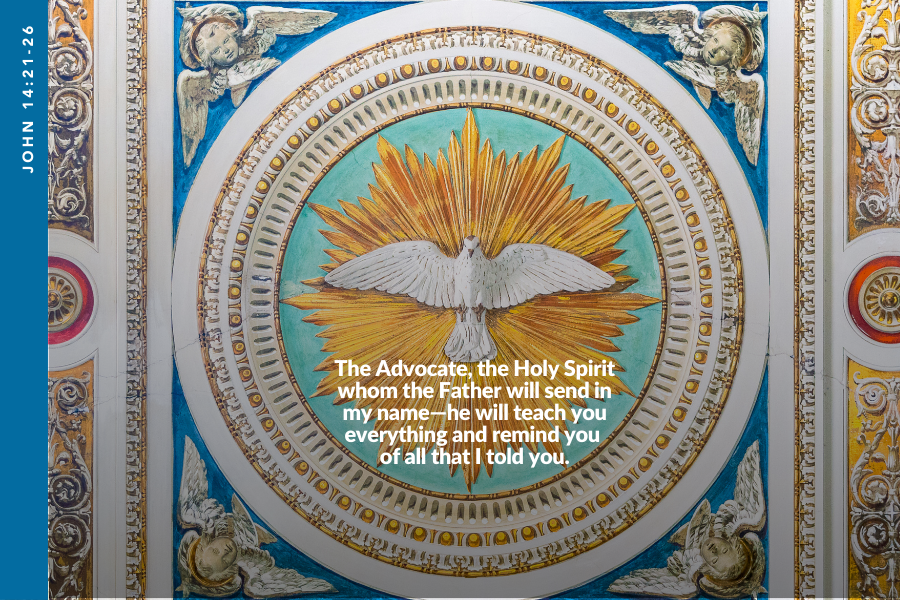
Jesus said to his disciples: “Whoever has my commandments and observes them is the one who loves me. Whoever loves me will be loved by my Father, and I will love him and reveal myself to him.” Judas, not the Iscariot, said to him, “Master, then what happened that you will reveal yourself to us and not to the world?” Jesus answered and said to him, “Whoever loves me will keep my word, and my Father will love him, and we will come to him and make our dwelling with him. Whoever does not love me does not keep my words; yet the word you hear is not mine but that of the Father who sent me. I have told you this while I am with you. The Advocate, the Holy Spirit whom the Father will send in my name—he will teach you everything and remind you of all that I told you.”

Opening Prayer: God my Father, I know that you love me. I love that you love me, and wish to love you more in return. Teach me to keep your word, remind me of all you have told me, and make your dwelling in me so that I cannot possibly not love you!

Encountering Christ:

  1. Words and Commands: First Jesus said, “Whoever observes my commandments is the one who loves me.” Then he said, “Whoever loves me will keep my word.” Are words and commands the same? For God they are. His words have the efficacy of divine commands: What he says comes to pass. “God said, ‘Let there be light,’ and there was light.” Christ also “pre-spoke” his own Resurrection; he predicted it. Sure enough, he rose again, thus confirming everything he had taught and preached. But there is one thing that God’s word cannot command: our free love.


  2. Overwhelming Love: There is no defect in divine power, but the nature of freedom is such that free love cannot be forced. Therefore, Jesus, loving us as he does, is “forced” to woo us. He asks, begs, pleads; he works, sacrifices, demonstrates his love by countless acts of devotion. His speech at the Last Supper is a torrent of lovesickness, promising wonders if only we return his love. “I will love him,” he says. “I will reveal myself to him.” “My Father will love him.” “We will come to him.” “We will make our dwelling with him.” Such beautiful promises, but what if I allow his love in? I pray, “Lord, I am not worthy that you should enter under my roof, but only say the word and my soul shall be healed.”


  3. Forever and Always and for Everyone?: Judas, struck by divine love, wanted the whole world to have Jesus, too. “Master, then what happened that you will reveal yourself to us and not to the world?” He seems to ask, “Is this only here and now, for us few disciples hidden in this room? Can we not universalize this marvelous love?” Jesus replied, “Yes,” after his manner. “The world has my word, the world has my commandments. The world also has you, Judas, and the other Apostles. And if they listen and heed my voice through you, my Father and I will dwell in them.” This love is for the whole world. With the aid of the Holy Spirit, hearts will requite the love of Jesus, the Father’s divine word.

Conversing with Christ: Lord Jesus, I love you. I love your words and commands. I love the Father who sent you. I love the Spirit of holiness who dwells in me. I love your Church and your Apostles. I love your love, and everything about you.

Resolution: Lord, today by your grace I will journal for a few moments, writing down the ways in which God loves me and I love God.

Fr Erik Burckel, LC was ordained to the priesthood in 2022. He writes articles and short stories for diverse purposes and publications, and can be reached at eburckel@legionaries.org.

May 4, 2026 – Count the Ways He Loves Us! Read More »

Regnum Christi Spirituality Center Uncle Eddy

St Philip and St James

Dear Phil, The great thing about the Apostles is how normal they were.  Jesus Christ always chooses ordinary people to become extraordinary saints.  You should keep that in mind, because it applies to you too. To do something magnificent for the Kingdom of Christ takes nothing more than the grace of God united to a generous, loving heart, like the hearts of Philip and James.  In the fourth Gospel, we get to know Philip pretty well. Remember when he first meets Jesus and our Lord invites him, “Follow me”? Then he goes to Nathaniel to tell him that he’s found the Messiah. Nathaniel doesn’t believe him, and Philip responds with the simplest, most appropriate answer an apostle can give: “Come and see.”  No highbrow theology there, just common sense and a lot of faith. Of course, it ended up killing him in the end – after spreading the gospel in northern Syria he was crucified upside down by the Romans, martyred just like all other Apostles (except for John, of course). James (this one is not John’s brother, but the son of Alpheus, a relative of Jesus, called “James the Lesser”) was the same way: matter-of-fact, straightforward, no-nonsense.  He took charge of the Church in Jerusalem, and under him, the Christian ranks swelled so quickly that the authorities stoned him to death in front of the Temple to try and stave off further growth.  He was called “James the Just” by the early Christians. He has some of my favorite lines in the Bible. In his letter, he writes: “Faith without works is dead.” (James 2:17) Pretty clear, isn’t it?  And then, “Nobody who fails to keep a tight rein on the tongue can claim to be religious; this is mere self-deception; that person’s religion is worthless.” (James 1:26) That’s no pie-in-the-sky, touchy-feely spiritual sedative; that’s a faith for real life.   You see, my dear nephew, Christianity is at the same time the most sublime of creeds (because in Christ we are made sharers in the very life of God) and the most practical, because Jesus Christ was both God and man, so nothing human is foreign to him.  Be like the Apostles then: keep your heart in heaven, and your feet firmly planted on the ground. Count on my prayers, Uncle Eddy

St Philip and St James Read More »

26-05-03-DM

May 3, 2026 – Focusing on the Essential

Fifth Sunday of Easter


John 14:1-12

Jesus said to his disciples: “Do not let your hearts be troubled. You have faith in God; have faith also in me. In my Father’s house there are many dwelling places. If there were not, would I have told you that I am going to prepare a place for you? And if I go and prepare a place for you, I will come back again and take you to myself, so that where I am you also may be. Where I am going you know the way.” Thomas said to him, “Master, we do not know where you are going; how can we know the way?” Jesus said to him, “I am the way and the truth and the life. No one comes to the Father except through me. If you know me, then you will also know my Father. From now on you do know him and have seen him.” Philip said to him, “Master, show us the Father, and that will be enough for us.” Jesus said to him, “Have I been with you for so long a time and you still do not know me, Philip? Whoever has seen me has seen the Father. How can you say, ‘Show us the Father’? Do you not believe that I am in the Father and the Father is in me? The words that I speak to you I do not speak on my own. The Father who dwells in me is doing his works. Believe me that I am in the Father and the Father is in me, or else, believe because of the works themselves. Amen, amen, I say to you, whoever believes in me will do the works that I do, and will do greater ones than these, because I am going to the Father.”

Opening Prayer: Lord, fill me with your Spirit. Fill the Church with the Spirit of truth. Guide us with your wisdom and lead us with your word.

Encountering Christ:

  1. Filled With the Spirit and Wisdom: The men that the Apostles wanted to appoint as deacons had to be filled with the Spirit and with wisdom. This implies detachment of one’s own will and attentiveness to what the Spirit wants. Our deacons today are also called to serve in God’s name and seek to do his will rather than their own. Wisdom is a virtue that begins with fear of the Lord. We’re not called to be afraid of him, but to be in awe of him, aware of his power and might. Wisdom is defined as “the quality of having experience, knowledge, and good judgment.” These virtues are not exclusive to deacons. We can all pray for them so that we can be better witnesses and contribute to the evangelizing mission of Christ and the Church.


  2. Devotion to Prayer and Ministry of the Word: The Apostles considered their primary task to be that of prayer and ministry of the word. They knew that any action, however well-intended, is less effective when not flowing from prayer as its source than when it comes from the very source of life and truth. The Apostles could not leave aside the essential element of prayer, no matter how many other seemingly good and important things arose. Rather than allow the demands of the apostolate to infringe upon their wellspring of apostolic action, the Apostles wisely trusted others to collaborate in the mission. How is their example applicable in our lives?


  3. The Word of God Continued to Spread: The Apostles were faithful to God’s invitation to do what was required of them—prayer and ministry of the word—and the number of followers increased. God blessed their efforts, and they rejoiced over the fruits of their labor. God is eager to act through us when we can remain docile and in tune with his will. When we become aware that our efforts, in conjunction with God’s grace, have extended the Kingdom here in our midst, our hearts can also rejoice.

Conversing with Christ: Lord, you are the source of all grace. When I feel overwhelmed and not sure how to balance everything, show me the way in prayer to resolve things according to the Spirit. 

Resolution: Lord, today by your grace I will take a quiet moment of prayer to ask you what essential thing you want me to dedicate myself to and what steps I must take to achieve that.

Renee Pomarico, CRC, is Communications Director for the Consecrated Women of Regnum Christi. She is from Philadelphia, Pennsylvania, has been consecrated to God since 2000, and is currently stationed in Rome.

May 3, 2026 – Focusing on the Essential Read More »

Scroll to Top

Events

Looking for another country?

Contact Regnum Christi near you

News & Resources

News & Resources

The Regnum Christi Mission

The Regnum Christi Identity

Alex Kucera

Atlanta

Alex Kucera has lived in Atlanta, GA, for the last 46 years. He is one of 9 children, married to his wife Karmen, and has 3 girls, one grandson, and a granddaughter on the way. Alex joined Regnum Christi in 2007. Out of the gate, he joined the Helping Hands Medical Missions apostolate and is still participating today with the Ghana Friendship Mission.

In 2009, Alex was asked to be the Atlanta RC Renewal Coordinator for the Atlanta Locality to help the RC members with the RC renewal process. Alex became a Group Leader in 2012 for four of the Atlanta Men’s Section Teams and continues today. Running in parallel, in 2013, Alex became a Team Leader and shepherded a large team of good men.

Alex was honored to be the Atlanta Mission Coordinator between 2010 to 2022 (12 years), coordinating 5-8 Holy Week Mission teams across Georgia. He also created and coordinated missions at a parish in Athens, GA, for 9 years. Alex continues to coordinate Holy Week Missions, Advent Missions, and Monthly missions at Good Shepherd Catholic Church in Cumming, GA.

From 2016 to 2022, Alex also served as the Men’s Section Assistant in Atlanta. He loved working with the Men’s Section Director, the Legionaries, Consecrated, and Women’s Section leadership teams.

Alex is exceptionally grateful to the Legionaries, Consecrated, and many RC members who he’s journeyed shoulder to shoulder, growing his relationship with Christ and others along the way. He knows that there is only one way, that’s Christ’s Way, with others!