Good_Potter

The Good Potter

Dear Friends,


Several years ago, during a lengthy silent retreat, I realized that I was frustrated with God. I’d just gone to confession, and found myself thinking about how many times I’d been to confession in the last twenty years (it numbered in the hundreds). The question—and the frustration—arose spontaneously. “Lord, why do I still need to go to confession? I’ve been to confession so many times—why haven’t you changed me? What, exactly, are you doing?”

God’s answer was simple. The goal of our lives is not sinlessness or self-perfection. The goal of our lives is not to never need God again. The whole purpose of our lives is union with the Lord: “Father… In this is eternal life. That they know you the only true God, and Jesus Christ whom you have sent” (John 17:1-3).  This is, from beginning to end, a work of grace. And therefore, God asks us to trust him. 

In the Old Testament, the Lord queries: “Does the clay say to him who fashions it, What are you making? or Your work has no handles?” (Isaiah 45:9).  When we don’t understand what the Lord is doing—or not doing—how much can we trust him? When “his work has no handles,” when we simply cannot grasp his purpose, how much can we trust him?

Then in John 5:17, Jesus promises us that he and the Father are always at work. He does not, however, promise us that we will see his work or understand it when, and as, we might wish.

When we find ourselves at a loss, when we cannot understand, when we realize that we are frustrated with God, might he be calling us to trustingly accept that he is the good potter, and we are the clay? And can we then share our inner world with him, and decide to say “yes” right now, with faith, with hope, and with love?

God bless,

Fr. John Pietropaoli  
The Good Potter Read More »

26-06-02-DM

June 2, 2026 – Moral Versus Civic Duty

Tuesday of the Ninth Week in Ordinary Time


Mark 12:13-17

Some Pharisees and Herodians were sent to Jesus to ensnare him in his speech. They came and said to him, “Teacher, we know that you are a truthful man and that you are not concerned with anyone’s opinion. You do not regard a person’s status but teach the way of God in accordance with the truth. Is it lawful to pay the census tax to Caesar or not? Should we pay or should we not pay?” Knowing their hypocrisy he said to them, “Why are you testing me? Bring me a denarius to look at.” They brought one to him and he said to them, “Whose image and inscription is this?” They replied to him, “Caesar’s.” So Jesus said to them, “Repay to Caesar what belongs to Caesar and to God what belongs to God.” They were utterly amazed at him.

Opening Prayer: Dear Lord Jesus, I thank you for the grace of coming before you in prayer. I thank you for the faith that has made me desire to pray, but I also ask you to increase my faith. May my contact with your word help me to rely ever more deeply on you and less on my own strength. Please open my mind and heart to hear what you wish to tell me.

Encountering Christ:

  1. Knowing Their Hypocrisy: The Pharisees called Jesus a good teacher, but they had no desire to learn. The Pharisees and the Herodians were laying a trap for Jesus—and a clever one it was. If Jesus affirmed that they should pay the Roman tax, he would lose the favor of the people who resented Roman rule. If he declared it unnecessary to pay the tax, they could accuse him before the Romans of being an insurrectionist. Either answer would serve their purpose of undermining Jesus’s message. Their flattery was insulting. However, their indifference to truth was the real tragedy. If we want to encounter Jesus and learn from him, we must approach him with a sincere heart.


  2. Bring Me a Denarius: Hypocrites are often guilty of the very thing for which they blame others. Jesus asked for a denarius, a Roman coin. He had none; they did. Carrying a regime’s currency is an implicit sign of support, even if begrudgingly. The Pharisees and the Herodians did not like the Romans; however, they did like the power the Romans allowed them to retain. Jesus was a threat to their moral authority, and thus ultimately to their power. That is why they wanted to be rid of him; hence their clever trap. Eventually, they would even cry, “We have no king but Caesar” (Jn 19:15). Conversely, Jesus in his poverty showed neither a dependence upon nor a fear of the Romans. He accepted the generosity and support of others, such as the holy women who provided for him, but his focus was elsewhere (cf. Lk 8:3). He even went so far as to forget to eat as long as he fulfilled his mission; that is, providing “food” of which the Apostles knew not (Jn 4:32).


  3. Repay to Caesar What Belongs to Caesar: Our Lord’s answer to his adversaries not only brilliantly foiled their clever trap, but it also laid the foundation for the Church’s relationship with temporal powers. The Church, following the model of her Lord, has always taught us to obey legitimate civil authority (cf. Rom 13:1-3). We should even pray for those in power (cf. 1 Tim 2:2). However, obedience to God must always take precedence over civil law when the two are in conflict. That is why, when commanded by the Sanhedrin to stop preaching in the name of Jesus, St. Peter replied, “We must obey God rather than men” (Acts 5:29). In the encyclical “God is Love,” Pope Benedict XVI teaches that Catholic social doctrine does not seek power over the state; rather, it seeks to contribute to society’s ethical formation (cf. n. 28). The Church does not so much seek to overthrow Caesar as to convert him from within.

Conversing with Christ: Lord Jesus Christ, help me to approach you repeatedly with a sincere heart. May I confess my sins to receive your mercy, and may I implore your help to receive your grace. Also, help me to be a good citizen who honestly and responsibly fulfills my civic duties. Let me remember that to serve my country well, I must first obey you. Help me to love my country and community while keeping my heart firmly rooted in heaven.

Resolution: Lord, today by your grace I will pray for the political leaders of my country.

For Further Reflection: Read the “Doctrinal Note on Some Questions Regarding the Participation of Catholics in Political Life” (Ratzinger, Dicastery for the Doctrine of the Faith).

Fr John Bullock, LC, was ordained in 2002 and works with Regnum Christi in Houston, Texas, his hometown. He has worked in youth work, college campus ministry, and as a chaplain to the Regnum Christi movement. He loves his faith, enjoys working with people, and loves riding his bike.

June 2, 2026 – Moral Versus Civic Duty Read More »

How Can a Man See Himself as Part of Christ’s Bride, the Church?

Q: I have been reading and listening to much commentary on the Song of Songs and other stories in the Bible about God and Christ being the groom and Israel and the Church being the bride. This is confusing to me as a straight male. How can I reconcile these images with being a heterosexual male. There is also much in the writings of the saints about intimacy with God. Please help. I feel as if my faith could be shaken. — Scott

Answered by Fr. Edward McIlmail, LC:

You raise a very interesting point.

The first thing worth noting is that this language about bride and groom comes from Scripture, which is inspired text. That means that these images are in the Bible because God wanted them there.

Now, there are four ways to read Scripture. Taken together, they help us to unpack the layers of truth that God transmits to us.

One of the ways of reading the Bible is the allegorical. Allegories are extended metaphors.

The case in point is God’s relation to his chosen people and Christ’s relationship to his Church.

This relationship is meant to be binding and permanent, similar to marriage. This is what leads to the “bride” metaphor in Scripture.

The idea here isn’t to focus on husbands and wives, per se, but to emphasize that the human soul is always “receptive” or “bridal” before the Lord, who seeks a marriage covenant with his people.

During the Middle Ages more commentaries were written about the Song of Songs than any other part of the Old Testament. Male religious, not just females, had no problem understanding that notion of receptiveness and the use of bridal imagery.

In modernity, by contrast, it might be harder for some people to accept this level of interpretation because they are used to a rationalistic view of communication; frankly, they might find it absurd to talk about the Church and the soul in bridal terms.

The key is to see these terms in an allegorical, not literalistic, way.

The upshot: There is no need to fret about the image of Israel and the Church as a bride.

For related reading, see this Aleteia post.

I hope that some of this helps.

How Can a Man See Himself as Part of Christ’s Bride, the Church? Read More »

Regnum Christi Spirituality Center Uncle Eddy

St Justin Martyr

Dear Marty, Do not be afraid of questions, my bright little nephew!  Neither the questions that you come up with yourself, nor the questions hurled at you by others.  God gave us minds, and he wants us to use them. Even if you don’t know the answers at first, be confident that there are answers, and that they all lead to God, for God is the author of all truth and of all things true, and he cannot contradict himself.  If you love the truth, every question for you will be the start of an adventure, of a “quest,” as the word itself implies. Far from shutting down our intellect, faith in Christ puts it into overdrive. Take a lesson from today’s saint, the first great Christian philosopher and apologist. Before St Justin came around, the Christians kept their doctrine off the public radar screen; they gained converts only by one-on-one exchanges, in the safety of private conversations.  St Justin, however, was convinced that many more Romans would embrace Christ if Christians made an effort to publicize their faith and their practices. He himself, for example, had been haplessly searching for the truth about God as he tried out every school of philosophy and religion that the Roman Empire had to offer.  Only a chance encounter with an old man on a beach spurred him to look into the teachings of Christ. If such was the case for him, he argued, surely it could work for many others. Besides, he did not want to be held responsible before God for hoarding the truth that leads to salvation. So he published explanations of Christian doctrine, worship, and morals (his two great “Apologies” – from the Greek for “explanation”), opened a school for Christian philosophy, and traveled the Empire engaging prominent teachers and philosophers in discussions about the faith.  His efforts gave a critical boost to the Church in the Age of Persecutions. They also put his neck on the chopping block. When he was turned in to the Roman prefect by one of his disgruntled opponents (academic envy is not something unique to modern times, you know), he refused to sacrifice to the pagan gods, boldly affirming (together with six other Christians on trial with him), “We ask nothing better than to suffer for the sake of our Lord Jesus Christ and so to be saved.” They all lost their heads and found heaven. So don’t take it from me, take it from St Justin, and ask him to support you with his prayers.  If you are a besieged minority there in the new paganism of college culture, rejoice in the chance to spread and defend Truth himself!  If you always seek and love the truth, you simply can’t go off track. Just be sure not to pursue knowledge in order to gain fame and prestige – that will also put you on track, but not the right track. Love, Uncle Eddy

St Justin Martyr Read More »

26-06-01-DM

June 1, 2026 – Payback Time

Memorial of Saint Justin, Martyr


Mark 12:1-12

Jesus began to speak to the chief priests, the scribes, and the elders in parables. “A man planted a vineyard, put a hedge around it, dug a wine press, and built a tower. Then he leased it to tenant farmers and left on a journey. At the proper time he sent a servant to the tenants to obtain from them some of the produce of the vineyard. But they seized him, beat him, and sent him away empty-handed. Again he sent them another servant. And that one they beat over the head and treated shamefully. He sent yet another whom they killed. So, too, many others; some they beat, others they killed. He had one other to send, a beloved son. He sent him to them last of all, thinking, ‘They will respect my son.’ But those tenants said to one another, ‘This is the heir. Come, let us kill him, and the inheritance will be ours.’ So they seized him and killed him, and threw him out of the vineyard. What then will the owner of the vineyard do? He will come, put the tenants to death, and give the vineyard to others. Have you not read this Scripture passage: ‘The stone that the builders rejected has become the cornerstone; by the Lord has this been done, and it is wonderful in our eyes?’” They were seeking to arrest him, but they feared the crowd, for they realized that he had addressed the parable to them. So they left him and went away.

Introductory Prayer: Lord, I come before you humbly. As one who has frequently fallen into sin, I am aware of my weakness. Your great love, though, assures me that your grace can keep me on the path to holiness.

Petition: Lord, let me be open to you and your messages.

  1. Stand Corrected: Being corrected hurts. Being corrected in public hurts even more. And having one’s whole way of life corrected—well, that really stings. And so it must have been for the group of leaders who approached Jesus. Our Lord, in a not-so-subtle way, tells them that they are wrong. Wrong about their self-righteousness, wrong about their narrow reading of Scripture, and wrong about how they think God works in the world. This blinded them to the Son of God when he came among them. We like to think we would have been different―we would not have rejected Jesus, we tell ourselves. Are we so sure? Aren’t we really like the leaders of Jesus’ time when we fail to listen to his messengers? Have I said no to Christ lately?
  1. Another Servant: God doesn’t give up on us after one try. He often sends a number of messengers into our lives, to draw us closer to him. Such is the illogic of a Father’s love. Where do we miss the clues that God sends us? It could be in something a child says; a line from a homily; an email from a friend in crisis―these are the ordinary means God uses to reach out to us. Old Testament prophets faced rejection by the people of God. Have things changed much? Could I be turning a deaf ear to a prophet? 
  1. “This Is the Heir”: The tenant farmers don’t seem very bright. They murder the son in order to get his inheritance. What father would give an inheritance to someone who killed his son? It doesn’t make sense. Then again, sin doesn’t make sense, either. Many times, we reject Christ in our life and then wonder why our prayers to God the Father go (seemingly) unanswered. What could we be thinking? How often do I offer up a sacrifice or an act of charity for a prayer intention?

Conversing with Christ: Let me live up to the demands of my faith, Lord. Let me realize that my dignity, as a Christian, demands that I try to live a life worthy of my baptism―that I not be satisfied living like everyone else.

Resolution: Lord, today by your grace I will offer up a decade of a rosary for a family member who is far from the faith.

For Further Reflection: Check out Fr John Bartunek’s YouTube video “Sent.”

Fr Edward McIlmail, LC, ordained to the priesthood in 2001, taught theology and Scripture at the then Mater Ecclesiae College in Rhode Island and is now a part-time chaplain at Overbrook Academy in Greenville, RI. He was an assistant publisher of the National Catholic Register and Faith & Family magazine and an editor of the Zenit news agency’s English edition.

June 1, 2026 – Payback Time Read More »

Regnum Christi Spirituality Center Uncle Eddy

Feast of the Visitation of the Blessed Virgin to her cousin Elizabeth

Dear Liz, If God isn’t a feminist, then I don’t know who is.  I mean a real feminist, one who champions true femininity and wants the light of its genius to bathe every aspect of human life and society with its enlivening warmth.  Take today’s feast for example, in which we commemorate Mary’s visit to her cousin Elizabeth after the Annunciation. You remember the scene, don’t you? The Archangel Gabriel appeared to Elizabeth’s husband, Zechariah, promising that he and Elizabeth would have a child, even though they were now past their childbearing years.  So Elizabeth indeed gets pregnant, and in her sixth month of pregnancy, Gabriel appears to Mary to announce that she will be the mother of Jesus. In the course of that conversation, Gabriel mentioned Elizabeth’s pregnancy – Elizabeth was a relative of Mary’s. So then Mary goes “in haste” to visit her cousin and take care of her until she has her baby, who turns out to be St John the Baptist.  Well, as soon as Mary shows up, John jumps for joy in Elizabeth’s womb, and Elizabeth blesses Mary, then Mary sings praise to God. It’s all quite dramatic if you think about it. Now, back to true feminism.  Have you ever wondered why God chose to send Jesus to the world through Mary?  And why the aging mother Elizabeth acknowledged Christ as Lord when he was still in Mary’s womb, but later on his Apostles didn’t even believe in him after witnessing numerous miracles as well as the resurrection?  Here we have two Jewish women of the first century, one’s a teenager and the other’s almost an octogenarian (that means “in her eighties”); one is carrying in her womb the greatest prophet ever to be born, and the other is carrying in her womb God himself.  They are intricately involved in the plan of salvation, following in the footsteps of Sarah, Rachel, Rebekah, Ruth, Judith, Esther and all the heroines of the Old Testament, and paving the way for the countless female saints adorning the history of the Church.  If you wanted to, you could write the history of Alexander the Great without making reference to prominent women (it would be incomplete, but would appear believable); you could write the history of the Roman Republic in the same way; you could even write the history of the foundation of the United States glossing over the role of women – but if you take women out of the history of salvation, you would have nothing to tell.  God created us “male and female,” and he has been faithful to that design throughout his work of redemption. Sorry for that digression.  I am aware that the Visitation means a lot more for the Church than equal dignity for women – but it certainly doesn’t mean any less.  You can rest assured that whatever God calls you to do for his Kingdom, it will be well worth the doing. Love, Uncle Eddy

Feast of the Visitation of the Blessed Virgin to her cousin Elizabeth Read More »

26-05-31-DM

May 31, 2026 – The Truth About God, the World, And Ourselves

Solemnity of the Most Holy Trinity


John 3:16-18

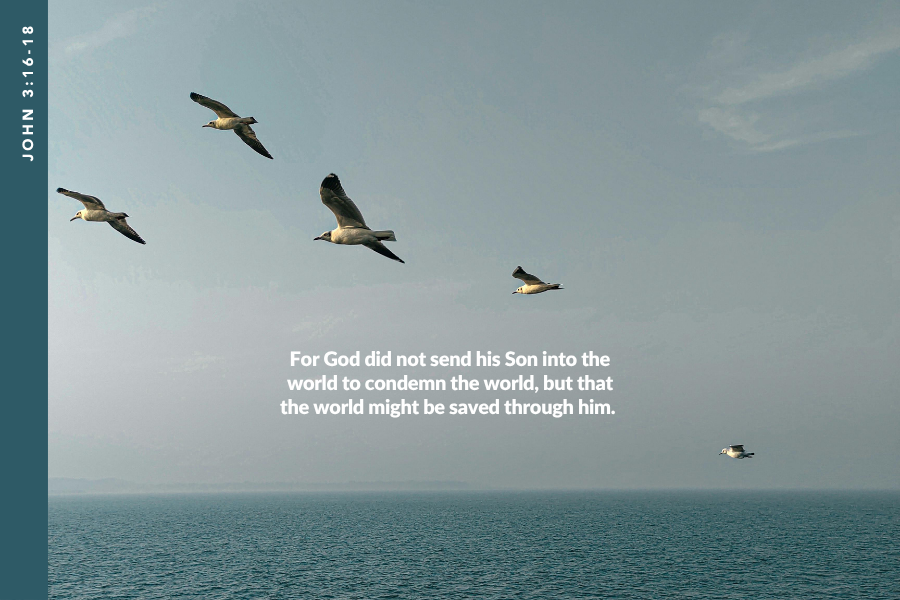
God so loved the world that he gave his only Son, so that everyone who believes in him might not perish but might have eternal life. For God did not send his Son into the world to condemn the world, but that the world might be saved through him. Whoever believes in him will not be condemned, but whoever does not believe has already been condemned, because he has not believed in the name of the only Son of God.

Opening Prayer: Father, I turn to you in my need and my weakness: Please grant me your grace this day, so that I can continue to grow in faith, hope, and love. Jesus, I turn to you as my friend and companion: Please keep me aware of your presence in my life today, of your smile and your eagerness to walk with me. Holy Spirit, I turn to you as my guide and protector: Pour out your gifts upon my mind and my heart, so that I can be docile to all your inspirations.

Encountering Christ:

  1. The Truth About God: The first verse of today’s Gospel passage is perhaps one of the most famous verses in the whole Bible: “God so loved the world that he gave his only Son, so that everyone who believes in him might not perish but might have eternal life.” In many ways, it is a summary of the entire Christian message. Within this single verse we find, in capsule form, the truth about God, about the world, and about ourselves. The truth about God has to do with his deepest identity, which is love (“God is love” [1 Jn 4:8]), and which was the motivation for Jesus’s incarnation (“God so loved the world…”). But for God’s deepest identity to be love, his deepest identity must also be personal and relational. After all, love always involves the generous acceptance of another person, as well as the generous giving of oneself to that person. And so we discover our first glimpse of the greatest mystery of the universe, the mystery the Church celebrates today in a special way: that God is a Trinity, and that from all eternity God is one divine nature and three divine persons, truly one God, but at the same time Triune in his divinity. We can never fully fathom the depths of this mystery. How can God be at the same time one and three? We cannot comprehend it fully. But we can contemplate it. And we can delight in knowing that God is not just some kind of a vague, impersonal force, as many New Age spiritualities claim; that eternity is not populated by hundreds, or thousands, or even millions of conflicting deities, as some pagan religious claim; and that God is not only all-knowing and all-powerful, not a grim and demanding taskmaster, but also all good. God is love! What idea of God dominates my mind, my attitude, my reactions to the ups and downs of life, when I pray?


  2. The Truth About the World: The truth about the world around us is also hinted at in this verse, when it tells us that life here has two possible endpoints: we can either “perish,” or we can enter into “eternal life.” This world is an arena in which each one of us, exercising the gift of our spiritual freedom, works out our everlasting destiny. This world is a war zone, and each one of our hearts is a battleground. God comes to our aid in Christ, and if we believe in him—in other words, if we accept the offer of his friendship and follow where he leads—all that is good and true and beautiful will triumph in us and we will make our way to greater and greater wisdom, peace, and joy in this life and forever in heaven. If we stubbornly resist the advances of God—his whispers in our conscience, his invitations to our hearts, his providential signs and encounters—we may be able to entertain ourselves for a while with the pleasures and delights of this world, but in the end God will respect our decision to separate ourselves from his friendship. And when our lives come to an end, we will suffer the everlasting frustration that comes from such a separation: We will “perish.” This world is not our true home or final resting place. This world is a place of journeying, fighting, and—we hope—growing to spiritual maturity.


  3. The Truth About Ourselves: This verse also reveals the truth about ourselves. We are loved; we are loveable; we are known; we are pursued; we are chosen; we are wanted; we matter. Many experiences we have in this fallen world, this battleground world, seem to contradict that. As children, adolescents, and even adults, the people around us often don’t treat us according to the dignity we possess in our very selves by having been created by God in his own image and likeness. And so, we find ourselves often belittled and abused, abandoned and ignored, objectified and neglected. These experiences cause us pain, and to deal with that pain we begin to believe lies about ourselves—that we are not worthy of being loved, that we don’t need to be loved, that our desires for fulfillment and connection are unreasonable and unfulfillable. Jesus came to shatter the darkness of those lies, to release us from the spiritual and emotional chains they forge, and to heal us of the wounds beneath them. This is what it means when St. John explains the meaning of Jn 3:16 in the following verse, Jn 3:17, “For God did not send his Son into the world to condemn the world, but that the world might be saved through him.” To save the world, to repair what is broken and redeem what is lost—that is why Jesus came. That is why Jesus continues to come, every day, through the working of the Holy Spirit, through the holy sacrifice of the Mass and Christ’s presence in the Eucharist, through the governance of all things by the Father’s providential wisdom. The Blessed Trinity is continuously unfolding a tapestry of salvation that includes the full restoration of our own broken and divided human nature. And that is why we can say, with today’s responsorial psalm: “Blessed are you, O Lord, the God of our fathers, praiseworthy and exalted above all forever” (Dan 3:52).

Conversing with Christ: O God, thank you for revealing to me the truth about yourself, about the world, and about me. I believe in all you have revealed. I believe with all my heart in Jesus, your Son, whom you sent into the world to be our Savior and Redeemer. I want to believe in him more fully and vibrantly every day, so as to spread in my own heart and in the hearts of those around me the everlasting life you have promised to everyone who accepts your offer of friendship. I am so easily distracted by the hustle and bustle of life, and I lose sight of the truth of things. Teach me to live more firmly and consistently in the light of your truth. Teach me to discover and delight in the evidence of your love as it is hidden beneath the surface of all things.

Resolution: Lord, today by your grace I will truly pray every time I make the Sign of the Cross (at Mass, before meals, in my own prayers, as I go to bed), turning that gesture into a heartfelt act of adoration and praise, a renewal of my commitment to follow Christ no matter the cost, and a petition for supernatural help in the struggles I face as your beloved child and disciple.

For Further Reflection: The Mystery of Eternal Love: A Retreat Guide on the Blessed Trinity, by Fr John Pietropaoli, LC. As always, this Retreat Guide is available in audio, video, and textual formats.

Fr John Bartunek, LC, is an author, speaker, and Creative Director at RCSpirituality.org, an online spirituality center providing a variety of resources for spiritual growth.

May 31, 2026 – The Truth About God, the World, And Ourselves Read More »

Weekly Digest of the Regnum Christi Daily Meditations: May 31 – June 7, 2026

WEEKLY DIGEST OF rc
DAILY MEDITATIONS

May 31, 2026 – The Truth About God, the World, And Ourselves

26-05-31-DM

Audio is unavailable at this time

Solemnity of the Most Holy Trinity

John 3:16-18

God so loved the world that he gave his only Son, so that everyone who believes in him might not perish but might have eternal life. For God did not send his Son into the world to condemn the world, but that the world might be saved through him. Whoever believes in him will not be condemned, but whoever does not believe has already been condemned, because he has not believed in the name of the only Son of God.

Opening Prayer: Father, I turn to you in my need and my weakness: Please grant me your grace this day, so that I can continue to grow in faith, hope, and love. Jesus, I turn to you as my friend and companion: Please keep me aware of your presence in my life today, of your smile and your eagerness to walk with me. Holy Spirit, I turn to you as my guide and protector: Pour out your gifts upon my mind and my heart, so that I can be docile to all your inspirations.

Encountering Christ:

  1. The Truth About God: The first verse of today’s Gospel passage is perhaps one of the most famous verses in the whole Bible: “God so loved the world that he gave his only Son, so that everyone who believes in him might not perish but might have eternal life.” In many ways, it is a summary of the entire Christian message. Within this single verse we find, in capsule form, the truth about God, about the world, and about ourselves. The truth about God has to do with his deepest identity, which is love (“God is love” [1 Jn 4:8]), and which was the motivation for Jesus’s incarnation (“God so loved the world…”). But for God’s deepest identity to be love, his deepest identity must also be personal and relational. After all, love always involves the generous acceptance of another person, as well as the generous giving of oneself to that person. And so we discover our first glimpse of the greatest mystery of the universe, the mystery the Church celebrates today in a special way: that God is a Trinity, and that from all eternity God is one divine nature and three divine persons, truly one God, but at the same time Triune in his divinity. We can never fully fathom the depths of this mystery. How can God be at the same time one and three? We cannot comprehend it fully. But we can contemplate it. And we can delight in knowing that God is not just some kind of a vague, impersonal force, as many New Age spiritualities claim; that eternity is not populated by hundreds, or thousands, or even millions of conflicting deities, as some pagan religious claim; and that God is not only all-knowing and all-powerful, not a grim and demanding taskmaster, but also all good. God is love! What idea of God dominates my mind, my attitude, my reactions to the ups and downs of life, when I pray?


  2. The Truth About the World: The truth about the world around us is also hinted at in this verse, when it tells us that life here has two possible endpoints: we can either “perish,” or we can enter into “eternal life.” This world is an arena in which each one of us, exercising the gift of our spiritual freedom, works out our everlasting destiny. This world is a war zone, and each one of our hearts is a battleground. God comes to our aid in Christ, and if we believe in him—in other words, if we accept the offer of his friendship and follow where he leads—all that is good and true and beautiful will triumph in us and we will make our way to greater and greater wisdom, peace, and joy in this life and forever in heaven. If we stubbornly resist the advances of God—his whispers in our conscience, his invitations to our hearts, his providential signs and encounters—we may be able to entertain ourselves for a while with the pleasures and delights of this world, but in the end God will respect our decision to separate ourselves from his friendship. And when our lives come to an end, we will suffer the everlasting frustration that comes from such a separation: We will “perish.” This world is not our true home or final resting place. This world is a place of journeying, fighting, and—we hope—growing to spiritual maturity.


  3. The Truth About Ourselves: This verse also reveals the truth about ourselves. We are loved; we are loveable; we are known; we are pursued; we are chosen; we are wanted; we matter. Many experiences we have in this fallen world, this battleground world, seem to contradict that. As children, adolescents, and even adults, the people around us often don’t treat us according to the dignity we possess in our very selves by having been created by God in his own image and likeness. And so, we find ourselves often belittled and abused, abandoned and ignored, objectified and neglected. These experiences cause us pain, and to deal with that pain we begin to believe lies about ourselves—that we are not worthy of being loved, that we don’t need to be loved, that our desires for fulfillment and connection are unreasonable and unfulfillable. Jesus came to shatter the darkness of those lies, to release us from the spiritual and emotional chains they forge, and to heal us of the wounds beneath them. This is what it means when St. John explains the meaning of Jn 3:16 in the following verse, Jn 3:17, “For God did not send his Son into the world to condemn the world, but that the world might be saved through him.” To save the world, to repair what is broken and redeem what is lost—that is why Jesus came. That is why Jesus continues to come, every day, through the working of the Holy Spirit, through the holy sacrifice of the Mass and Christ’s presence in the Eucharist, through the governance of all things by the Father’s providential wisdom. The Blessed Trinity is continuously unfolding a tapestry of salvation that includes the full restoration of our own broken and divided human nature. And that is why we can say, with today’s responsorial psalm: “Blessed are you, O Lord, the God of our fathers, praiseworthy and exalted above all forever” (Dan 3:52).

Conversing with Christ: O God, thank you for revealing to me the truth about yourself, about the world, and about me. I believe in all you have revealed. I believe with all my heart in Jesus, your Son, whom you sent into the world to be our Savior and Redeemer. I want to believe in him more fully and vibrantly every day, so as to spread in my own heart and in the hearts of those around me the everlasting life you have promised to everyone who accepts your offer of friendship. I am so easily distracted by the hustle and bustle of life, and I lose sight of the truth of things. Teach me to live more firmly and consistently in the light of your truth. Teach me to discover and delight in the evidence of your love as it is hidden beneath the surface of all things.

Resolution: Lord, today by your grace I will truly pray every time I make the Sign of the Cross (at Mass, before meals, in my own prayers, as I go to bed), turning that gesture into a heartfelt act of adoration and praise, a renewal of my commitment to follow Christ no matter the cost, and a petition for supernatural help in the struggles I face as your beloved child and disciple.

For Further Reflection: The Mystery of Eternal Love: A Retreat Guide on the Blessed Trinity, by Fr John Pietropaoli, LC. As always, this Retreat Guide is available in audio, video, and textual formats.

Fr John Bartunek, LC, is an author, speaker, and Creative Director at RCSpirituality.org, an online spirituality center providing a variety of resources for spiritual growth.

June 1, 2026 – Payback Time

26-06-01-DM

Memorial of Saint Justin, Martyr

Mark 12:1-12

Jesus began to speak to the chief priests, the scribes, and the elders in parables. “A man planted a vineyard, put a hedge around it, dug a wine press, and built a tower. Then he leased it to tenant farmers and left on a journey. At the proper time he sent a servant to the tenants to obtain from them some of the produce of the vineyard. But they seized him, beat him, and sent him away empty-handed. Again he sent them another servant. And that one they beat over the head and treated shamefully. He sent yet another whom they killed. So, too, many others; some they beat, others they killed. He had one other to send, a beloved son. He sent him to them last of all, thinking, ‘They will respect my son.’ But those tenants said to one another, ‘This is the heir. Come, let us kill him, and the inheritance will be ours.’ So they seized him and killed him, and threw him out of the vineyard. What then will the owner of the vineyard do? He will come, put the tenants to death, and give the vineyard to others. Have you not read this Scripture passage: ‘The stone that the builders rejected has become the cornerstone; by the Lord has this been done, and it is wonderful in our eyes?’” They were seeking to arrest him, but they feared the crowd, for they realized that he had addressed the parable to them. So they left him and went away.

Introductory Prayer: Lord, I come before you humbly. As one who has frequently fallen into sin, I am aware of my weakness. Your great love, though, assures me that your grace can keep me on the path to holiness.

Petition: Lord, let me be open to you and your messages.

  1. Stand Corrected: Being corrected hurts. Being corrected in public hurts even more. And having one’s whole way of life corrected—well, that really stings. And so it must have been for the group of leaders who approached Jesus. Our Lord, in a not-so-subtle way, tells them that they are wrong. Wrong about their self-righteousness, wrong about their narrow reading of Scripture, and wrong about how they think God works in the world. This blinded them to the Son of God when he came among them. We like to think we would have been different―we would not have rejected Jesus, we tell ourselves. Are we so sure? Aren’t we really like the leaders of Jesus’ time when we fail to listen to his messengers? Have I said no to Christ lately?
  1. Another Servant: God doesn’t give up on us after one try. He often sends a number of messengers into our lives, to draw us closer to him. Such is the illogic of a Father’s love. Where do we miss the clues that God sends us? It could be in something a child says; a line from a homily; an email from a friend in crisis―these are the ordinary means God uses to reach out to us. Old Testament prophets faced rejection by the people of God. Have things changed much? Could I be turning a deaf ear to a prophet? 
  1. “This Is the Heir”: The tenant farmers don’t seem very bright. They murder the son in order to get his inheritance. What father would give an inheritance to someone who killed his son? It doesn’t make sense. Then again, sin doesn’t make sense, either. Many times, we reject Christ in our life and then wonder why our prayers to God the Father go (seemingly) unanswered. What could we be thinking? How often do I offer up a sacrifice or an act of charity for a prayer intention?

Conversing with Christ: Let me live up to the demands of my faith, Lord. Let me realize that my dignity, as a Christian, demands that I try to live a life worthy of my baptism―that I not be satisfied living like everyone else.

Resolution: Lord, today by your grace I will offer up a decade of a rosary for a family member who is far from the faith.

For Further Reflection: Check out Fr John Bartunek’s YouTube video “Sent.”

Fr Edward McIlmail, LC, ordained to the priesthood in 2001, taught theology and Scripture at the then Mater Ecclesiae College in Rhode Island and is now a part-time chaplain at Overbrook Academy in Greenville, RI. He was an assistant publisher of the National Catholic Register and Faith & Family magazine and an editor of the Zenit news agency’s English edition.

June 2, 2026 – Moral Versus Civic Duty

26-06-02-DM

Tuesday of the Ninth Week in Ordinary Time

Mark 12:13-17

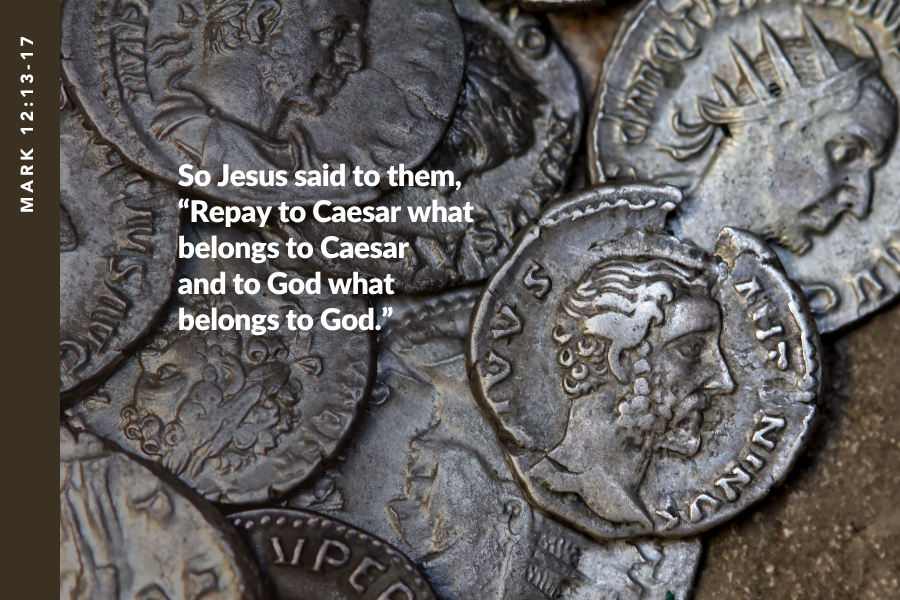
Some Pharisees and Herodians were sent to Jesus to ensnare him in his speech. They came and said to him, “Teacher, we know that you are a truthful man and that you are not concerned with anyone’s opinion. You do not regard a person’s status but teach the way of God in accordance with the truth. Is it lawful to pay the census tax to Caesar or not? Should we pay or should we not pay?” Knowing their hypocrisy he said to them, “Why are you testing me? Bring me a denarius to look at.” They brought one to him and he said to them, “Whose image and inscription is this?” They replied to him, “Caesar’s.” So Jesus said to them, “Repay to Caesar what belongs to Caesar and to God what belongs to God.” They were utterly amazed at him.

Opening Prayer: Dear Lord Jesus, I thank you for the grace of coming before you in prayer. I thank you for the faith that has made me desire to pray, but I also ask you to increase my faith. May my contact with your word help me to rely ever more deeply on you and less on my own strength. Please open my mind and heart to hear what you wish to tell me.

Encountering Christ:

  1. Knowing Their Hypocrisy: The Pharisees called Jesus a good teacher, but they had no desire to learn. The Pharisees and the Herodians were laying a trap for Jesus—and a clever one it was. If Jesus affirmed that they should pay the Roman tax, he would lose the favor of the people who resented Roman rule. If he declared it unnecessary to pay the tax, they could accuse him before the Romans of being an insurrectionist. Either answer would serve their purpose of undermining Jesus’s message. Their flattery was insulting. However, their indifference to truth was the real tragedy. If we want to encounter Jesus and learn from him, we must approach him with a sincere heart.


  2. Bring Me a Denarius: Hypocrites are often guilty of the very thing for which they blame others. Jesus asked for a denarius, a Roman coin. He had none; they did. Carrying a regime’s currency is an implicit sign of support, even if begrudgingly. The Pharisees and the Herodians did not like the Romans; however, they did like the power the Romans allowed them to retain. Jesus was a threat to their moral authority, and thus ultimately to their power. That is why they wanted to be rid of him; hence their clever trap. Eventually, they would even cry, “We have no king but Caesar” (Jn 19:15). Conversely, Jesus in his poverty showed neither a dependence upon nor a fear of the Romans. He accepted the generosity and support of others, such as the holy women who provided for him, but his focus was elsewhere (cf. Lk 8:3). He even went so far as to forget to eat as long as he fulfilled his mission; that is, providing “food” of which the Apostles knew not (Jn 4:32).


  3. Repay to Caesar What Belongs to Caesar: Our Lord’s answer to his adversaries not only brilliantly foiled their clever trap, but it also laid the foundation for the Church’s relationship with temporal powers. The Church, following the model of her Lord, has always taught us to obey legitimate civil authority (cf. Rom 13:1-3). We should even pray for those in power (cf. 1 Tim 2:2). However, obedience to God must always take precedence over civil law when the two are in conflict. That is why, when commanded by the Sanhedrin to stop preaching in the name of Jesus, St. Peter replied, “We must obey God rather than men” (Acts 5:29). In the encyclical “God is Love,” Pope Benedict XVI teaches that Catholic social doctrine does not seek power over the state; rather, it seeks to contribute to society’s ethical formation (cf. n. 28). The Church does not so much seek to overthrow Caesar as to convert him from within.

Conversing with Christ: Lord Jesus Christ, help me to approach you repeatedly with a sincere heart. May I confess my sins to receive your mercy, and may I implore your help to receive your grace. Also, help me to be a good citizen who honestly and responsibly fulfills my civic duties. Let me remember that to serve my country well, I must first obey you. Help me to love my country and community while keeping my heart firmly rooted in heaven.

Resolution: Lord, today by your grace I will pray for the political leaders of my country.

For Further Reflection: Read the “Doctrinal Note on Some Questions Regarding the Participation of Catholics in Political Life” (Ratzinger, Dicastery for the Doctrine of the Faith).

Fr John Bullock, LC, was ordained in 2002 and works with Regnum Christi in Houston, Texas, his hometown. He has worked in youth work, college campus ministry, and as a chaplain to the Regnum Christi movement. He loves his faith, enjoys working with people, and loves riding his bike.

June 3, 2026 – God of the Living

26-06-03-DM

Memorial of Saint Charles Lwanga and Companions, Martyrs

Mark 12:18-27

Some Sadducees, who say there is no resurrection, came to Jesus and put this question to him, saying, “Teacher, Moses wrote for us, ‘If someone’s brother dies, leaving a wife but no child, his brother must take the wife and raise up descendants for his brother. Now there were seven brothers. The first married a woman and died, leaving no descendants. So the second brother married her and died, leaving no descendants, and the third likewise. And the seven left no descendants. Last of all the woman also died. At the resurrection when they arise whose wife will she be? For all seven had been married to her.” Jesus said to them, “Are you not misled because you do not know the Scriptures or the power of God? When they rise from the dead, they neither marry nor are given in marriage, but they are like the angels in heaven. As for the dead being raised, have you not read in the Book of Moses, in the passage about the bush, how God told him, ‘I am the God of Abraham, the God of Isaac, and the God of Jacob?’ He is not God of the dead but of the living. You are greatly misled.”

Opening Prayer: Dear Lord Jesus, I come before you in prayer. I am grateful for this opportunity. Thank you for your willingness to listen to me. Help me to be confident in what I ask from you and attentive to what you tell me. Increase my love for you so that my deepest desire is simply to do what you ask of me.

Encountering Christ:

  1. “Whose Wife Will She Be?”: “For all seven had been married to her.” In the art of debate, one of the tools employed is the reduction to absurdity; that is, you take the other person’s argument to an extreme to show that if their argument were true, it would lead to consequences patently absurd or contradictory, and thereby false. However, this approach is often reduced to the mere mockery of someone’s argument. That is what the Sadducees attempted with Our Lord. They did not believe in the resurrection of the dead, so to disprove arguments for the afterlife, they thought of a ridiculous example. It was not enough to raise their objection with the example of two brothers having married the woman, but seven. Theirs was more of a “gotcha” question; they seemed little open to an answer.


  2. “Are You Not Misled?”: Jesus’ humility and concern for souls shone forth in his encounters with his enemies. Although keenly aware of their insincerity and verbal traps, he nevertheless took their questions at face value in order to teach them and lead them to conversion. He ignored the mockery and instructed their ignorance: “When they rise from the dead, they neither marry nor are given in marriage, but they are like the angels in heaven” (Mk 12:25). Jesus teaches as one with authority. He provided us with a profound pedagogical lesson. Whenever there is a question about the faith, even if couched in ridicule, we have an opportunity to give an answer. We should do so with as much clarity and charity as possible. Our confidence lies not so much in our delivery, important as that is, but in the power of truth and the subsequent work of the Holy Spirit.


  3. God of the Living: Our Lord revealed a profound truth that goes to the heart of the Sadducees’ disbelief in the resurrection of the dead, starting with what they did believe. They believed in God and in his revelation to Abraham, Isaac, and Jacob. They believed that God spoke to Moses. Therefore, if they believed in the God of Abraham, Isaac, and Jacob, they implicitly believed in man’s everlasting life. Jesus told them that God still “is” the God of Abraham, Isaac, and Jacob, not “was.” Therefore, not only does God still exist, but so do Abraham, Isaac, and Jacob. God is God of the living. God is the very source of life. God is never “stuck” in the past. Death does not have the last word with God. Our Lord’s Resurrection will make this truth even more abundantly clear.

Conversing with Christ: Lord Jesus Christ, with the aid of your Holy Spirit and the guidance of the Magisterium, continue to lead me from my errors and confusion into all truth (John 16:13). However, I want more than simply seeing clearly; help me to grow in my personal relationship with you. Increase my faith so that I may see your hand at work in even the smallest details of my daily life: a sunset, a flower, a child’s smile. May I have the humility to realize that I still have much to learn about my faith, and the generosity to share the truth about you with others.

Resolution: Lord, today by your grace I will read from either Scripture or the Catechism and then share what I learned with someone else.

For Further Reflection: Read “Please Explain the Difference between the Sadducees and the Pharisees in the Gospels.”

Fr John Bullock, LC, was ordained in 2002 and works with Regnum Christi in Houston, Texas, his hometown. He has worked in youth work, college campus ministry, and as a chaplain to the Regnum Christi movement. He loves his faith, enjoys working with people, and loves riding his bike.

June 4, 2026 – The Secret to Happiness

26-06-04-DM

Thursday of the Ninth Week in Ordinary Time

Mark 12:28-34

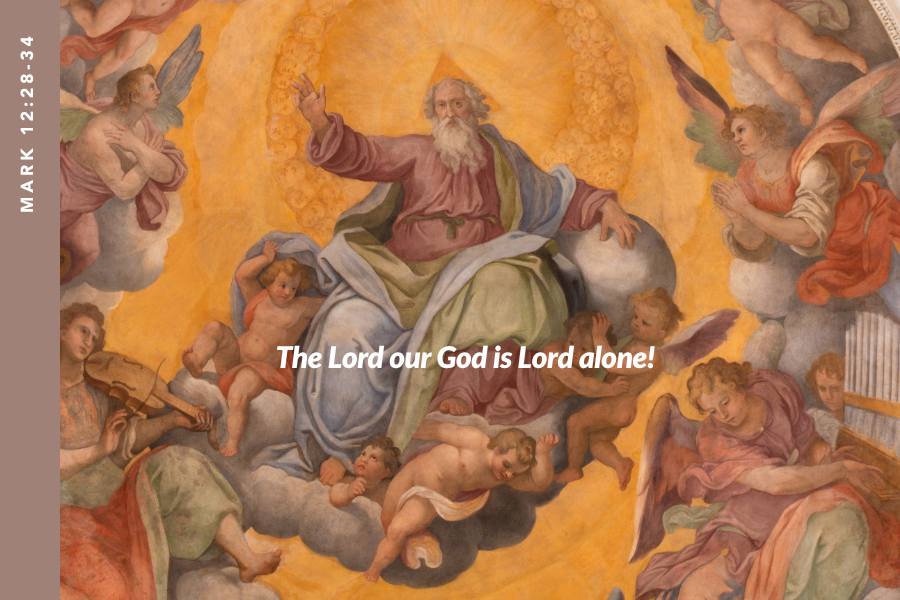
One of the scribes came to Jesus and asked him, “Which is the first of all the commandments?” Jesus replied, “The first is this: ‘Hear, O Israel! The Lord our God is Lord alone! You shall love the Lord your God with all your heart, with all your soul, with all your mind, and with all your strength.’ The second is this: ‘You shall love your neighbor as yourself.’ There is no other commandment greater than these.” The scribe said to him, “Well said, teacher. You are right in saying, ‘He is One and there is no other than he.’ And ‘to love him with all your heart, with all your understanding, with all your strength, and to love your neighbor as yourself’ is worth more than all burnt offerings and sacrifices.” And when Jesus saw that he answered with understanding, he said to him, “You are not far from the Kingdom of God.” And no one dared to ask him any more questions.

Opening Prayer: I know you are with me, Lord, as I come before you in prayer. I offer this time to you, because you deserve my praise, and I need your grace. I want to know you more clearly, to love you more dearly, to follow you more nearly (St. Richard of Chichester) today and every day. Enlighten and strengthen me, Lord. Help me to discover and accept what you want to give me today, and be pleased with the offering of my heart and mind to you through this prayer.

Encountering Christ:

  1. Sincerely Questioning the Lord: Unlike the Sadducees and Pharisees who have been questioning Jesus in the Gospel passages of the last few days, the scribe who comes to Jesus asks a sincere question. Scribes were experts in the Jewish law, in the biblical commandments and all the many norms and customs that had been derived from those commandments over the centuries. And there were hundreds of those commandments, customs, rules, and norms. A popular topic for debate among scribes had to do with which of those many commandments was the most important one. Knowing which was most important could make following God a lot simpler, a lot more focused. The scribe came to Jesus to test his wisdom, to see how Jesus would answer the question about the most important commandment. And the scribe responds to Jesus’ answer by showing that he understood the Lord’s wisdom and accepted it. We can see Jesus smile as he complements this inquirer on his humility, prudence, and sincerity: “You are not far from the Kingdom of God.” What question is on my heart today? What question do I want to ask Jesus today? What question am I sincerely seeking an answer to? Ask it now, and hear the Lord’s response.


  2. God’s Commandments as the Path to Life: From the biblical perspective, God’s commandments are not arbitrary laws set up as a kind of obstacle course to test people’s devotion to God. Rather, God’s commandments are a revelation of his wisdom and goodness; they unveil the path that will lead us to the fulfillment and fruitfulness we all yearn for in life. As today’s Psalm puts it: “All the paths of the Lord are kindness and constancy toward those who keep his covenant and his decrees” (Psalms 25:10, today’s psalm). When Jesus points out the two most important commandments, therefore, he is actually placing in our hands the secret to happiness. How many self-help books are published every single year claiming to have discovered that secret! And yet, those books keep getting published, and people keep seeking that elusive happiness that we all long for. Jesus’ answer remains the sure path, if only we would follow it. Loving God with all our heart, soul, mind, and strength means putting God in the center of our lives. It means giving top priority to spending time with God, getting to know him, and following his will by living lovingly the moral law, the teachings of the Church, and the duties of our state in life. And loving our neighbors as ourselves is a natural outpouring of loving God—this is why Jesus links these two commandments so closely. As St. John puts it in his first letter to all Christians: “If anyone says, ‘I love God,’ but hates his brother, he is a liar; for whoever does not love a brother whom he has seen cannot love God whom he has not seen. This is the commandment we have from him: whoever loves God must also love his brother” (1 Jn 4:20-21). Learning to love God with our whole selves and to love others as ourselves is our great task in life, and nothing else—nothing else—will satisfy our hearts.


  3. Healthy Self-Love?: One aspect of this discourse often overlooked is the how Jesus instructs us to love our neighbors: as ourselves. This means that there is a healthy way to love ourselves, and that is the model for how we should love our neighbors. There is also an unhealthy kind of self-love. We call that selfishness, self-centeredness, or self-absorption. The healthy kind of self-love is part of the virtue of humility. Humility recognizes that, as human beings, we all have basic needs and built-in limitations. Accepting our limitations and taking reasonable care of our needs is a way of acknowledging that we are not gods, that we are not self-sufficient. Many times, when we find it difficult to be patient with others, to forgive others, to be generous to others, the root of that difficulty can be found in a lack of humility. In a certain sense, then, we will only learn to accept, love, and value others (and thus treat them with Christ-like patience, mercy, and generosity) to the extent that we learn to accept, love, and value ourselves. As we learn to see ourselves through God’s eyes, our blindness will subside and we will also learn to see others through God’s eyes.

Conversing with Christ: Thank you for coming into this world and conversing with those of us who have questions, like the scribe in today’s Gospel. Thank you for caring enough about us to walk with us, to patiently instruct us. Thank you for giving us your commandments, and for giving us the grace to follow them. I want to learn more and more deeply how to love you with all my heart, soul, mind, and strength. And I want to learn to love my neighbor as myself. I know that learning to love is not something I will ever be able to check off my to-do list. I know that learning to love as you love is the great adventure of my life. Be my teacher, Lord, and my guide, and my inspiration: “Make known to me your ways, Lord; teach me your paths. Guide me by your fidelity and teach me, for you are God my savior” (Ps 25:4-5).

Resolution: Lord, today by your grace I will live out this Gospel passage by doing three things: 1) I will offer you some sort of gift as a sign of my love for you; 2) I will give something to myself that expresses a healthy awareness and acceptance of my own needs and limitations; 3) I will give some sort of a gift to neighbor, not looking for anything in return but just looking to love that person as I love myself.

For Further Reflection: Seeking First the Kingdom: 30 Meditations on How to Love God with All Your Heart, Soul, Mind, and Strength.

Fr John Bartunek, LC, is an author, speaker, and Creative Director at RCSpirituality, an online spirituality center providing a variety of resources for spiritual growth.

June 5, 2026 – Our Teacher and Master

26-06-05-DM

Memorial of Saint Boniface, Bishop and Martyr

Mark 12:35-37

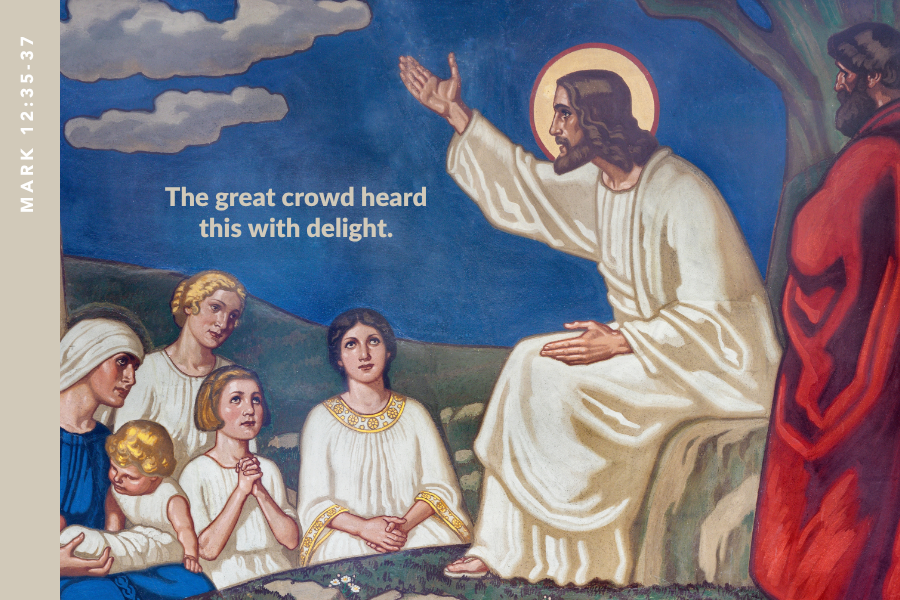
As Jesus was teaching in the temple area he said, “How do the scribes claim that the Messiah is the son of David? David himself, inspired by the Holy Spirit, said: The Lord said to my lord,‘Sit at my right hand until I place your enemies under your feet.’ David himself calls him ‘lord’; so how is he his son?” The great crowd heard this with delight.

Opening Prayer: Dear Lord Jesus, I come before you in prayer. I ask you to increase my faith so that I may hear and understand what you will tell me. May my understanding of your word and your mysteries lead me to a deeper love, and may that love move me to a greater obedience to you.

Encountering Christ:

  1. The Lord Said to My Lord: Jesus quoted Psalm 110:1, “The Lord said to my lord: ‘Sit at my right hand.’” The same psalm says, “Yours is princely power from the day of your birth” (Ps 110:3). Therefore, it was quite reasonable for the scribes to interpret this passage as referring to David’s royal lineage. It was true that Joseph, Jesus’ foster-father, was of the house of David (cf. Lk 1:27). However, their interpretation was incomplete. Jesus pointed to the mystery of the Incarnation. He is truly the son of David and truly the eternal Son of the Father. Our Lord’s person possesses each nature fully, both human and divine.


  2. Jesus the Pedagogue: Jesus asked the scribes about something they knew, the prophecy in Psalm 110, to reveal something they did not yet know about that same prophecy. That is how we learn. We build from that which we know to learn something new. So our knowledge of two plus two equals four lays the groundwork for grasping the sum of four plus four. Jesus is a master teacher. Either by familiar Biblical references or by simple imagery taken from daily life, Jesus taught his listeners about himself and his kingdom. One of the primary purposes of Our Lord’s Incarnation was to make God more accessible to man; this is not only true in his reality as God and man, but also in his teaching.


  3. The Crowd Heard With Delight: In what did the crowd delight? It would seem in part that they delighted in Jesus getting the better of the scribes, the Sadducees, and the Pharisees. This passage came after attempts by Our Lord’s enemies to entrap him. Now Our Lord asked them a question, and one they could not answer. Humility rejoices when truth prevails over insincerity. However, they also rejoiced in the vindication of Our Lord’s doctrine. They were excited that his teaching showed no fissures, contradictions, or weaknesses. Our intellect demands that ideas be coherent. Even though they could not fully grasp Jesus’ teaching, the crowd saw that it withstood all challenges. This reassured and delighted them.

Conversing with Christ: Lord Jesus, let me realize that your mystery constantly transcends me. Let me accept that your thoughts are not my thoughts, your ways not my ways (cf. Isa 55:8). Nevertheless, I ask for the gift of understanding to grasp better the truths of faith, so that in turn I may live more accordingly. I marvel that you stoop to my lowliness so that I may know, love, and serve you. I thank you, Jesus, for such constant signs of love.

Resolution: Lord, today by your grace I will try to communicate some aspect of the faith to a friend by way of imagery or comparison.

For Further Reflection: Read “Did the Incarnation Cause God to Change?” by Tim Staples.

Fr John Bullock, LC, was ordained in 2002 and works with Regnum Christi in Houston, Texas, his hometown. He has worked in youth work, college campus ministry, and as a chaplain to the Regnum Christi movement. He loves his faith, enjoys working with people, and loves riding his bike.

June 6, 2026 – What Jesus Wants

26-06-06-DM

Saturday of the Ninth Week in Ordinary Time

Mark 12:38-44

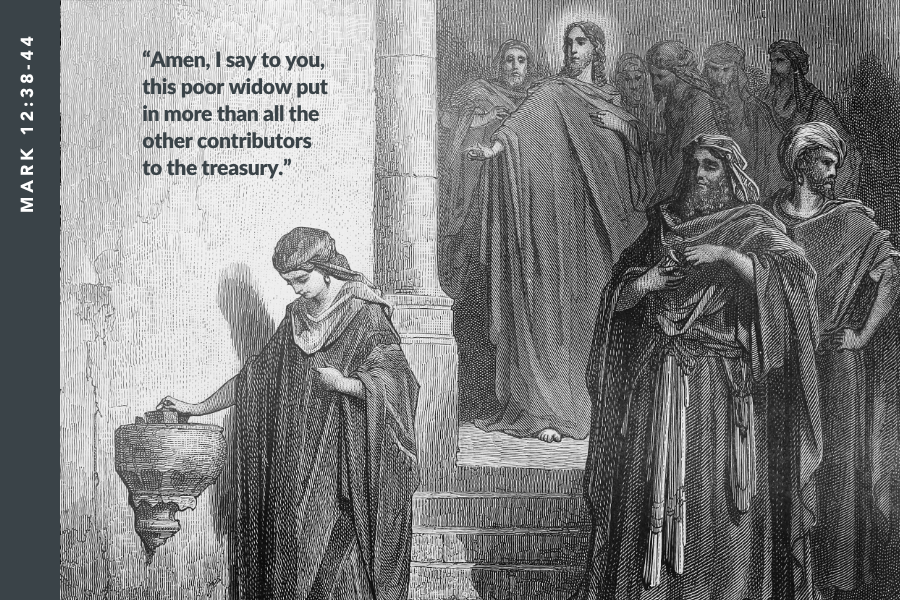
In the course of his teaching Jesus said, “Beware of the scribes, who like to go around in long robes and accept greetings in the marketplaces, seats of honor in synagogues, and places of honor at banquets. They devour the houses of widows and, as a pretext, recite lengthy prayers. They will receive a very severe condemnation.” He sat down opposite the treasury and observed how the crowd put money into the treasury. Many rich people put in large sums. A poor widow also came and put in two small coins worth a few cents. Calling his disciples to himself, he said to them, “Amen, I say to you, this poor widow put in more than all the other contributors to the treasury. For they have all contributed from their surplus wealth, but she, from her poverty, has contributed all she had, her whole livelihood.”

Opening Prayer: Lord, I know you are with me now, watching over me, glad that I am turning my attention to you in prayer. I offer this time to you, simply because you deserve my praise, and because I need your grace. Enlighten me, Lord, so that your Kingdom can grow in me and through me.

Encountering Christ:

  1. Jesus Cares: In the Temple area the Jewish faithful could find large receptacles available to receive their monetary offerings to the Lord. Jesus “sat down opposite” these receptacles and “observed how the crowd put money into the treasury.” Jesus is truly interested in our lives, just as he shows his interest in these people who are coming to make their offerings to God in the Temple. Our lives matter to him. Our choices matter to him. He always has his eyes on us, not like a judge at the Olympics, looking for all the flaws in a performance, but like a father and a brother and a friend. His eyes, as he watches us, are filled with the light and warmth of love, with the eagerness of someone who believes in us and hopes that we will live our lives well. As we make our way through each day, as ordinary and mundane as each day may seem on the outside, Jesus is with us, attentively accompanying us and deeply caring about every encounter, every decision, every challenge, every triumph.


  2. Jesus Sees the Heart: Jesus looks into our hearts, hoping to find there what he found in this widow’s heart: unlimited trust in God. She “from her poverty, has contributed all she had.” This woman had no income of her own, had no livelihood. We can easily imagine her concern and preoccupation at being in such a precarious situation—women in Israel at the time of Jesus didn’t have a lot of employment options. We can imagine the uncertainty with which she had to face each new day, simply not knowing how she was going to survive, not knowing where the next meal was going to come from. How did she deal with this weight of worry and concern? She went to the Lord, and she put what little she had into his hands, trusting that he would faithfully care for her, that he would not abandon her. She radically and literally lived out the injunction from the Psalms: “Cast your care upon the Lord, who will give you support” (Ps 55:23). The hardships of life had brought this widow into a deeper relationship with God, a deeper understanding of the basic truth that we so often forget: without God, we can do nothing (cf. Jn 15:5). The wealthier people who came to make their offerings to the Lord actually contributed less than the widow who only gave a couple of pennies, because “they have all contributed from their surplus wealth.” Jesus longs for us to lean on him, to let him be Our Lord. Anything—including wealth, success, and popularity—that inhibits us from doing that is a danger to our souls.


  3. St. Paul’s Warning and Advice: St. Paul exhorts Timothy to beware of just that kind of self-sufficiency. He points out how “the time will come when people will not tolerate sound doctrine but, following their own desires and insatiable curiosity, will accumulate teachers and will stop listening to the truth…” (2 Tim 4:3-4). It’s so easy to be led astray by the tinsel and tinkling of this world’s attractions, whatever form they take. It’s so easy for us to prefer immediate satisfaction and distracting titillation to the long and often trying journey of faith. God must be first in our lives. The truth of Christ must be the compass that guides our hearts, minds, and decisions in all the ups and downs of mission as Christ’s disciples and ambassadors in this darkened, needy world. That is the only sure path to the deep interior peace and lasting fruitfulness we yearn for. And so, St. Paul’s encouragement to Timothy can also serve as his encouragement to us: “But you, be self-possessed in all circumstances; put up with hardship; perform the work of an evangelist; fulfill your ministry” (2 Tim 4:5).

Conversing with Christ: When you sit and observe my daily life, Lord, what do you see? Is there anything that makes you sad? What makes you glad? You know that I want to follow you closely, to lean on you and find all my contentment and fulfillment in your friendship, your will, your presence. Am I trying to make my own happiness and giving you the leftovers, like the wealthy visitors to the Temple in today’s Gospel? Am I “casting all my cares” on you, like the widow? I want to become more like this widow. I want to give you all that I have, all that I am, all that I do. Touch my heart again with your grace, Lord, so that I can burn with the courageous fire of your love.

Resolution: Lord, today by your grace I will pay special attention to the situations or moments when I feel frustrated, fearful, insecure, or worried. As soon as I detect any of those feelings, I will pause and turn my attention to God, recalling his promise to take care of those who depend on him. Then I will try to let his goodness calm my soul by making an act of trust in him, even if it is as simple as the prayer the Lord taught St. Faustina: “Jesus, I trust in you.”

For Further Reflection: The Widow’s “Might”, a Retreat Guide on Jesus’ encounter with the widow at the Temple treasury. As always, this Retreat Guide is available in audio, video, and textual formats.

Fr John Bartunek, LC, is an author, speaker, and Creative Director at RCSpirituality, an online spirituality center providing a variety of resources for spiritual growth.

June 7, 2026 – Food for Our Spiritual Journey

26-06-07-DM

Solemnity of the Body and Blood of Christ (Corpus Christi)

John 6:51-58

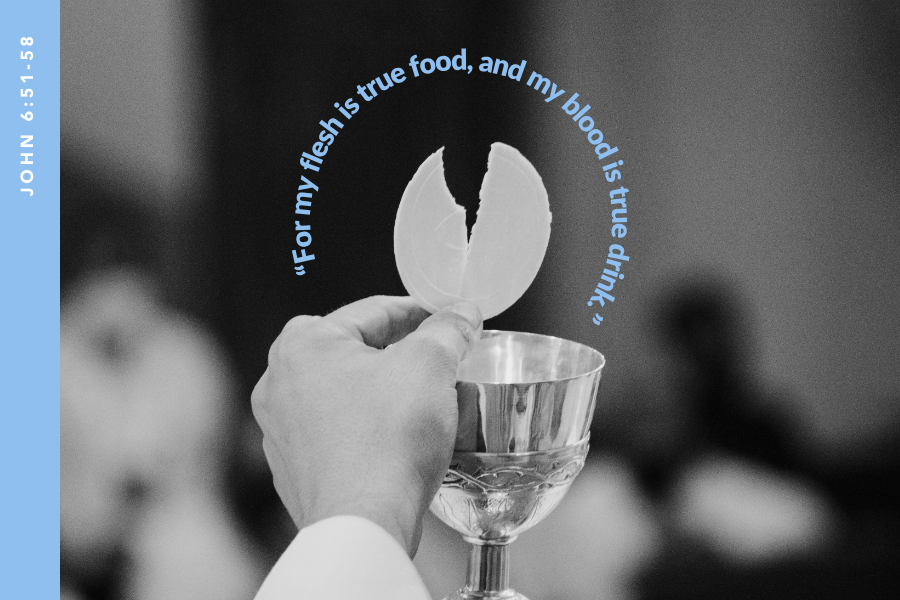
Jesus said to the Jewish crowds: “I am the living bread that came down from heaven; whoever eats this bread will live forever; and the bread that I will give is my flesh for the life of the world.” The Jews quarreled among themselves, saying, “How can this man give us his flesh to eat?” Jesus said to them, “Amen, amen, I say to you, unless you eat the flesh of the Son of Man and drink his blood, you do not have life within you. Whoever eats my flesh and drinks my blood has eternal life, and I will raise him on the last day. For my flesh is true food, and my blood is true drink. Whoever eats my flesh and drinks my blood remains in me and I in him. Just as the living Father sent me and I have life because of the Father, so also the one who feeds on me will have life because of me. This is the bread that came down from heaven. Unlike your ancestors who ate and still died, whoever eats this bread will live forever.”

Opening Prayer: Your goodness, O Lord, surrounds me like the atmosphere surrounds the earth. Your faithfulness is like the mountains, the snow-covered mountains—firm and constant and dependable. Your wisdom is like the ocean, always moving and murmuring, vast and inexhaustible. You are my God, my Father, my Savior. You are my refuge, my fortress, my hiding place. I come to you today to fill my heart with your grace and to praise you with the offering of my heart and mind. Blessed be your name, O Lord, for ever and ever. 

Encountering Christ:

  1. Bread From Heaven: Seven times in today’s Gospel passage Jesus tells us that eating his flesh and drinking his blood is the path to eternal life. What a strange thing to say! In fact, it was so strange that in the next few verses of this Gospel passage St. John explains how many of Jesus’s followers abandoned him that day. Maybe they thought he was crazy. And yet, in a certain sense, they should have understood. Throughout the Old Testament, God was preparing his people for the gift of the Eucharist, the sacrament of Christ’s true presence, the food of angels–as today’s sequence puts it–which is given to us as food for our journey into eternity. Think about it. So many times in the Old Testament food is central to the story. At the very beginning, Adam and Eve committed original sin through eating the forbidden fruit. Then, when God rescued his people from slavery in Egypt, he instructed them to have a ritual meal in which they ate the paschal lamb. While they were journeying through the wilderness, he fed them with manna from heaven—a miraculous food that kept them going on their journey to the promised land. All of these biblical references–and we could mention more–show that communion with Christ through the Eucharist was part of God’s plan for us from the very beginning. Somehow, as human beings who are a mysterious unity of body and spirit, our path to salvation includes this sacramental union with God through consuming the Eucharist. Seven times Jesus emphasizes this truth in today’s Gospel. Seven is the number of completion, of fullness. How much do I emphasize the Eucharist in my own life? How much do I value the communion I receive at Mass? Am I on the same page with Jesus about this mysterious sacramental gift?


  2. The Eucharist and the Mass: The Eucharist comes to us through the Mass. The words of the Mass, especially those of the Eucharistic prayers, make clear what happens at Mass. Mass is the perfect prayer, the perfect act of worship, the re-presentation of Christ’s own sacrifice on Calvary so that we can bring the grace and glory of that sacrifice into the here-and-now of our lives—every single day. Through the Mass, every day and every corner of the world is swept up into the story of salvation. Through the Mass, our own prayers and sacrifices are united to Christ’s perfect prayer and sacrifice and thus enhanced, elevated, and given the power to build up his everlasting Kingdom. And then, during the rite of communion, God responds to the offerings we gave him during the Eucharistic prayer by giving us in return the food of eternal life. When we receive Holy Communion we are receiving sacramental nourishment for our hearts and minds. If we receive Holy Communion worthily–with humility, gratitude, and an awareness of its true nature–our faith, hope, and love are strengthened by that sacrament and we become more like Christ. As St. Augustine put it centuries ago, normal food is transformed into the one who eats it, but the Sacrament of the Eucharist does the contrary: through it we are transformed more and more fully into Christ. How fully do I really understand what happens at Mass? How much have I studied the meaning and the history of the different parts of the Mass? How central a place does the Mass play in my own life and the life of my family? Without the Mass, we would have no access to Christ’s Kingdom, and we would have no Eucharist. The Celebration of the Eucharist at Mass truly is the “source and summit of Christian life” (CCC 1324), and so it should be the same for my life. What can I do to make sure it is?


  3. Christ’s Loving Invasion: Over the centuries, the Holy Spirit gradually guided the Church to an awareness of Christ’s ongoing sacramental presence in the Eucharist. As the Eucharist was reserved after Mass so that Holy Communion could be brought to the sick, we began to realize that we could extend the worship and praise, and the prayers of intercession and supplication, offered to God during the Mass by adoring the Lord in the Eucharist outside of Mass. Eventually churches constructed tabernacles where we could reserve the Blessed Sacrament. Gradually we developed the liturgical practice of Eucharistic exposition, adoration, and benediction. Today, it is impossible to know how many tabernacles there are in the world. So many parish churches, convents and monasteries, oratories and residences of religious orders! In every corner of the world–indeed, in every corner of time and space–Jesus is with us, wanting to accompany us and to be available so that we can come to him in the Eucharist and open our hearts to him. He is drawing the whole world into his Sacred Heart through his silent, respectful, loving, generous presence in countless tabernacles throughout the earth. What does this decision on God’s part tell me about his love and interest in my life? How have I responded to this gift? How would I like to respond from now on?

Conversing with Christ: Your gift of the Eucharist is too marvelous for me to comprehend, Lord! You give yourself to me as supernatural food. You stay with me and invite me to involve you in all that I am and all that I do. You, the Creator and the Redeemer of the universe, are always present in the little tabernacle of my parish church, humbling hoping that I will come and accompany you and let you accompany me. The Eucharistic host is so simple, Lord—small, fragile, so plain and tasteless and undramatic. And that is how you chose to remain with me. You don’t want to overpower me; you want to be with me. You don’t want to enslave me; you want to nourish and encourage me. I believe in your true presence in the Eucharist, Lord, and I bow down before you, amazed at your infinite goodness and wisdom, and full of a sincere desire to live my life as you would have me live it.

Resolution: Lord, today by your grace I will make an extra visit to a chapel or a church where I can be with you in the Eucharist. And I will take time there simply to enjoy your presence and thank you for all the things for which I am grateful. I will let you love me through your Eucharistic presence today, Lord, and I will pray for all those who haven’t yet discovered that you love them.

For Further Reflection: Food for the Journey: A Retreat Guide on the Sacrament of the Eucharist

Fr John Bartunek, LC, is an author, speaker, and Creative Director at RCSpirituality, an online spirituality center providing a variety of resources for spiritual growth.

Weekly Digest of the Regnum Christi Daily Meditations: May 31 – June 7, 2026 Read More »

Regnum Christi Spirituality Center Uncle Eddy

St Joan of Arc

Dear Joanne, My dearest of nieces, as you prepare for your graduation (this afternoon, I believe?) I am reminiscing here in my drab and almost comfortable cubicle/prison, recalling the highs and lows of your collegiate career.  You were a most comforting and faithful correspondent, exactly as your mother had been when we used to send our sibling letters back and forth during our own college days (no email back then, I’m afraid, just a lot of long waits and ink blotches).  Now you are finished. Off to conquer the world, no doubt. One thought keeps coming back to me: it can’t be a coincidence that you are graduating on the feast day of St Joan of Arc, your namesake. Has God ever given the Church a more heroic figure than St Joan?  A teenage girl, illiterate, of peasant stock, unable to ride and unschooled in war, receives a call from God to liberate a divided and corrupt France from the overpowering and almost completed English invasion.  No wonder she at first resisted the imprecations of her voices (i.e. the saints whom God sent to her as his messengers)! It was only when they told her “It is God who commands it” that she complied. And the world has never been the same.  She led armies, she outfoxed evil courtiers, she emboldened a cowardly king, she revived an entire nation, she befuddled the most learned clerics and lawyers of her day. Single-handedly (well, I guess she had the help of God) she reversed the fortunes of France and altered the history of Europe, enduring moral, physical, and psychological tortures of the cruelest brand.  Through it all, she suffered profoundly – confusion, exhaustion, betrayal… And why? “It is God who commands it.” She was given a mission by God, and she accepted it, even to the point of being burned at the stake, dying with the name of Jesus on her virgin lips. Well, do you have any doubt that God has a mission for you?  Is justice threatened any less in today’s world than it was in Joan’s world?  And are you any less likely a candidate to uphold the cause of Christ in the face of monstrous odds than Joan the Maid? (“Maid” was a term meaning “virgin,” not someone you hire to clean your house.)  Hardly. The only variable now is – when you hear his voice, will you take the risk of trusting him? … Oh, how I pray that you will, and I am sure your patroness is praying as well. Happy graduation; may it be the beginning of a glorious adventure.   God bless you always, Uncle Eddy

St Joan of Arc Read More »

Scroll to Top

Events

Looking for another country?

Contact Regnum Christi near you

News & Resources

News & Resources

The Regnum Christi Mission

The Regnum Christi Identity

Alex Kucera

Atlanta

Alex Kucera has lived in Atlanta, GA, for the last 46 years. He is one of 9 children, married to his wife Karmen, and has 3 girls, one grandson, and a granddaughter on the way. Alex joined Regnum Christi in 2007. Out of the gate, he joined the Helping Hands Medical Missions apostolate and is still participating today with the Ghana Friendship Mission.

In 2009, Alex was asked to be the Atlanta RC Renewal Coordinator for the Atlanta Locality to help the RC members with the RC renewal process. Alex became a Group Leader in 2012 for four of the Atlanta Men’s Section Teams and continues today. Running in parallel, in 2013, Alex became a Team Leader and shepherded a large team of good men.

Alex was honored to be the Atlanta Mission Coordinator between 2010 to 2022 (12 years), coordinating 5-8 Holy Week Mission teams across Georgia. He also created and coordinated missions at a parish in Athens, GA, for 9 years. Alex continues to coordinate Holy Week Missions, Advent Missions, and Monthly missions at Good Shepherd Catholic Church in Cumming, GA.

From 2016 to 2022, Alex also served as the Men’s Section Assistant in Atlanta. He loved working with the Men’s Section Director, the Legionaries, Consecrated, and Women’s Section leadership teams.

Alex is exceptionally grateful to the Legionaries, Consecrated, and many RC members who he’s journeyed shoulder to shoulder, growing his relationship with Christ and others along the way. He knows that there is only one way, that’s Christ’s Way, with others!