


“Ask a Priest: How Much More Do I Need to Do for My Ailing Husband?”
Q: How does one know to say, “It’s enough”? My husband got sick in Europe and received a kidney transplant and now is having a liver transplant. I’ve sent the money to Europe — his brother is looking after everything as I can’t fly. My husband is a truly a good man but he’s suffering. Am I doing wrong in our heavenly Father eyes if I say no more surgery after this one and no more money? I can’t take anymore of him suffering. This is so hard. Please, what does our heavenly Father tell us what to do in situations like this? – A.
Answered by Fr. Edward McIlmail, LC
A: I am sorry to hear about your husband’s health. It must be painful to know that the man you love is suffering so intensely. This must be a very heavy burden for you, indeed.
The short answer is that the Church does not require us to pursue disproportionate medical care just to keep a person alive. Patients do, however, have a right to basic, proportionate care, such as hydration and feeding.
The Catechism in No. 2278 says:
Discontinuing medical procedures that are burdensome, dangerous, extraordinary, or disproportionate to the expected outcome can be legitimate; it is the refusal of “over-zealous” treatment. Here one does not will to cause death; one’s inability to impede it is merely accepted. The decisions should be made by the patient if he is competent and able or, if not, by those legally entitled to act for the patient, whose reasonable will and legitimate interests must always be respected. [end quoted material]
The longer answer is: The question of whether more surgeries should be pursued is something that you and the family and your husband (if possible) need to decide, perhaps in consultation with doctors and a priest or reputable medical ethicist on the scene. This would allow the decision to be based on more than just a feeling of not being able to “take anymore of him suffering.”
What is extraordinary care in any given case depends on a lot of factors, such as a patient’s age, prospect of recovery and the costs? For more reading, see the National Catholic Bioethics Center posting at https://www.ncbcenter.org/publications/end-life-guide/.
Above all, this is a moment to intensify your prayers for your husband. Even if you can’t travel to accompany him, you can be close to him spiritually. You can ask the Holy Spirit to strengthen your husband. You certainly could ask that he receive the anointing of the sick if he hasn’t received it yet.
I hope some of this helps. Count on my prayers.
Keep learning more with Ask a Priest
Got a question? Need an answer?
Today’s secular world throws curve balls at us all the time. AskACatholicPriest is a Q&A feature that anyone can use. Just type in your question or send an email to AskAPriest@rcspiritual.wpenginepowered.com and you will get a personal response back from one of our priests at RCSpirituality. You can ask about anything – liturgy, prayer, moral questions, current events… Our goal is simply to provide a trustworthy forum for dependable Catholic guidance and information. So go ahead and ask your question…
“Ask a Priest: How Much More Do I Need to Do for My Ailing Husband?” Read More »

 The demonstration, which brought together about three thousand people with their sky-blue handkerchiefs, was convened by the Collective for the Two Lives, made up of or supported by 27 organizations including Testimonies for Life, the Women’s Movement for Reclaim, and Forever for Life. In the Argentine debate, those supporting the pro-life position repeatedly spoke of the two lives to show that abortion is bad for both mother and child.

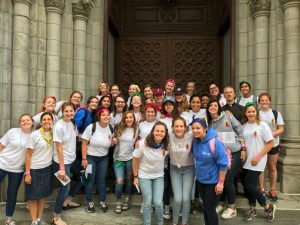 Maddie said the convention was informative and helped the young women go deep. For her, adoration was the most powerful experience. “It was amazing, but it was also cool to share that with others from around the country,” she said. “Even though we came from all over the country, it was amazing that, from such different backgrounds, we can come together and be ECYD.”
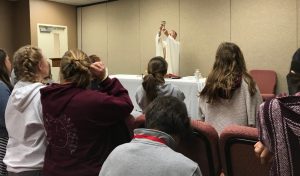 Maria Knuth said the participants seemed to have a great time. “They really enjoyed meeting other young women from around the country,” she said, “as it’s one of the first times they’ve met with other young ladies who had similar experiences and who they could built friendships with. They loved the sacramental life with daily Mass and adoration. A lot of them had deep Jesus moments.”

 Since then, six health and nutrition brigades have happened. Pediatricians, nutritionists and volunteers generously donate their time to care for the neediest through this program. Each brigade benefits, on average, 50 children. For each child, the missionaries provide a food ration consisting of milk, oats, incaparina (a native vegetable protein), beans, rice with soy, oil and sugar. They are sure to match World Health Organization’s (WHO’s) standards for children recovering from some degree of malnutrition.
 Thanks to the generosity of people and companies that donated the supplies, it was possible to bring all this help to the population of the community of Miramundo, as well as to the volunteers who served these children in need with great joy. There was the spiritual support of Fr. Néstor Fonseca, LC, who celebrated the Holy Mass for the people of the community, volunteers and members of Family Missions.


