The Novitiate Should Be a Home: Interview with a Novice Instructor

Recently, the Legionary Novitiate in Spain moved to a new location. With the move, the priest in charge of forming novices gave an interview. 

In April, Fr. Carlos Zancajo, LC , territorial director of Spain, announced that the novitiate would move from Salamanca to Madrid. Fr. José Félix Medina, LC, is the novice instructor and rector— in other words, he is in charge of Legionaries in this first and most important stage of formation. Fr. José Félix gave an interview about the change and what the novitiate means for Legionaries. 

Are we closing a chapter or opening another? 

Fr. José Félix: We close the geographical chapter of this house in Salamanca, which has welcomed the novices for 60 years, but there is continuity with the first novitiate of the Legionaries of Christ that has been changing headquarters, and now goes to Madrid, to the Reajo del Roble house. 

It is a very important step, because Madrid is located in the geographical center of Spain, where more young people from other parts of Spain can come and meet us. 

On the other hand, we must bear in mind that the novitiate in Salamanca is just too large a building to house only eight novices, since it was built to train more than 200 seminarians: including novices, humanists and formators. Today, the Church recommends that the formation of seminarians in the early stages be done in small communities, and that also implies that the novitiate should take place in a house with a size proportionate to the size of the community. This is something that we have included in our Ratio Institutionis after our renewal process. 

Why do we opt for Madrid? How will the new house help the novices? 

It is important to see it as a home that gives a sense of family, as I said before: a house proportionate to the size of the community. The novitiate in Salamanca for eight or nine people was too big. A house of spirituality with 20 rooms, chapel, library, dining room, sports field… gives us more guarantees of unity and coexistence. In addition, it is in the Sierra, with green areas and mountains, which offers us other possibilities. It is Madrid province, but it is not the city, which allows us to be half an hour away from our apostolate and school works, also facilitating the apostolate and life as part of Regnum Christi in the locality of Madrid. 

The truth is many members of Regnum Christi have a warm attachment to the Reajo del Roble house… What does this suggest? 

This [moving the novitiate] is a way to take care of the property and develop it. They are two buildings; the small building which we will use for groups and visits, so they can spend a few days with us. I was also the founder of Reajo del Roble in 1974, when we had the first Regnum Christi course for young people, attended by, among others, Fr. Ferrán. Reajo del Roble has also been a place of retreats and incorporations for numerous members. 

Fr. Zancajo mentioned in his letter that one of the virtues of the change is the vocations ministry that can be developed here in Madrid. How do you see this? 

All the apostolic activities that we did in Salamanca we can do in this area: catechesis in the surrounding villages, vocational weekends, campus ministry in our schools, ECYD work, work on vocation promotion… Having a smaller house does not mean having less apostolic life. 

It is important to maintain the spirit of recollection and prayer that is proper to the novitiate, and also the apostolate of our charism. We plan to go down to Madrid one day a week to collaborate in the schools, to do vocation work and to support Regnum Christi lay members 

I would like to make an invitation to all Regnum Christi members: come and see us, do not think of us as the hermits on the mountain! We will go to the center of Madrid to all the activities that we can: diaconate ordinations, etc., because we are part of the life of Regnum Christi in the locality of Madrid. 

You come from the reality of a large local church like Salamanca, and now you are inserted in the diocese of Madrid, in a municipality of the Sierra. How does this affect your ecclesial relationship? 

We have all the permissions from the ecclesiastical point of view, of course, both in Salamanca, where Bishop Carlos López says goodbye and has been visiting the novitiate this week, as well as in Madrid, since Card. Carlos Osoro is receiving us in his diocese. I also spoke with the parish priests of Navacerrada and Collado Mediano, which is the area of the province of Madrid to which we belong, to make ourselves available to them and to tell them to count on us in whatever we can to serve the people of God. We want to be a sign of ecclesial communion. It is a sensitivity and a duty of ours. 

Finally, reality helps us to be grateful and look forward, do not you think? 

Certainly the move has an aspect of sadness. I was a novice here in Salamanca, 50 years ago. Many of the Legionaries of Christ have been trained in this novitiate for many years. The bishop, parish priests, other ecclesial realities… the city of Salamanca… we are grateful for the journey we have made together, and we are going to miss them. 

But, on the other hand, Regnum Christi is still present here in a group of lay women. The ways of the Lord are inscrutable, they are the Providence of God, and we make this move confident that is what the Lord wants, and that he will send laborers to his harvest. 

You can read the original on the Regnum Christi site of Spain 

The Novitiate Should Be a Home: Interview with a Novice Instructor Read More »
How About a Minute with Mary?

Fifty-five percent of American adults pray daily, according to the Pew Research Center. 


To the credit of Catholics, their daily prayer rate is higher: 59 percent. But before you puff up with pride, the Catholic rate is well below the daily prayer rate for Evangelicals is 79 percent; for Mormons, 85 percent; for Muslims, 69 percent; for Jehovah’s Witness, 90 percent. 


Of course, the only thing these numbers show is how often people report that they pray. It doesn’t give a qualitative evaluation of the depth of their prayer. Of course, these statistics might make some readers feel a bit uneasy. Maybe you fall into the nearly one-fourth of adults who seldom or never pray. 


Whether you pray daily or have suffered from prayer avoidance syndrome, you may find a moment of peace in the daily practice of the Marian Minute. 


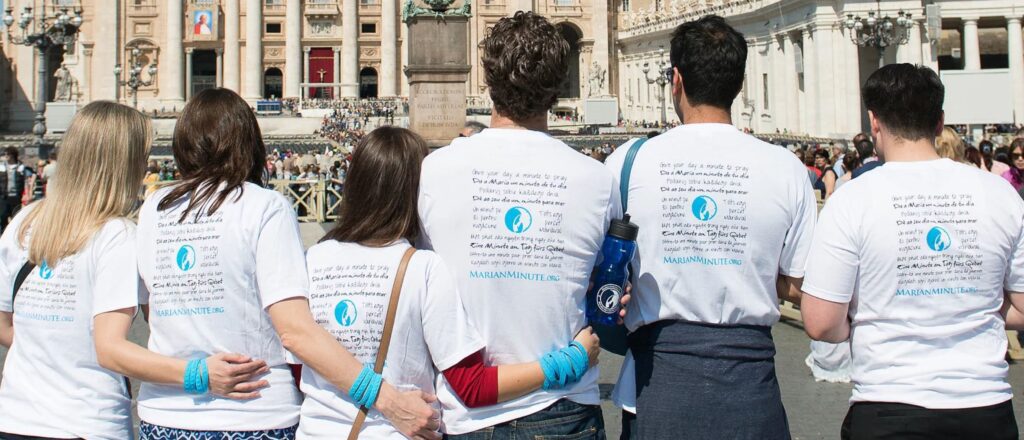
The Marian Minute is a project of The Marian Center of Dallas, which has the mission to assist young professionals in leading people worldwide into a growing relationship with Jesus Christ through our mother Mary reflected in activities that promote prayer campaigns and pilgrimages to Catholic shrines and destinations around the world.​ 


The Marian Center of Dallas was founded 1989. A group of young professionals founded Marian Minute in 2011 and assumed direction of the center after that year’s World Youth day in Dallas, Texas who wanted a simple way to foster devotion to Mary and help others build a relationship with her through a consistent life of prayer. 


From the beginning, the mission was to explore creative means and new technology to increase Marian devotion not only among the youth but to anyone seeking a deeper friendship with Our Blessed Mother. 


The first campaign was inspired by recognizing that young people are often too absorbed by the distractions of daily life to dedicate even one minute to pray. The founders set to launch an innovative campaign during World Youth Day in Madrid, Spain on the feast day of the Assumption of Mary. With one simple mission: to promote Mary and daily prayer. They distributed thousands of rosary wristbands inviting people to devote one daily Marian minute. The campaign quickly drew response from thousands of people from over 100 countries. 


Inspired by the first words spoken by Pope Francis from the balcony of St. Peter’s Basilica when he invited people from around the world to pray for Bishop Emeritus Benedict the XVI saying “Let us pray together for him, that the Lord may bless him and that Our Lady may keep him” before adding, “Pray for me” asking the faithful to pray that the Lord might bless him. The Marian Minute team set to launch its second campaign by distributing thousands of “prayer coins” featuring a portrait of Pope Francis meant to be passed along to friends after sharing a Marian minute of prayer for the pope, building a global prayer chain. Once again, the campaign drew great response from thousands of people all over the world. 


Other apostolates are on the horizon such as Marian pilgrimages and for our local community we have a speaker series centered on Marian spirituality and theology. 


Regnum Christi members Karla Alfaro and Horacio Gomez are two of the key people who founded and continue to lead the Marian Center and Marian Minute. 


“Since launching Marian Minute, my relationship with Our Lady has simply grown and grown,” Karla said. She was raised Catholic in a Mexican family and met Regnum Christi in Dallas. She was impressed with the apostolic zeal of the people she met in Dallas and wanted to be a part of it. “I really wanted to do something to bring people closer to Mary.”  


Horacio was born and raised is Guadalajara, Mexico, and moved to the United States for college. He attended Regnum Christi schools and the charism has been a part of his experience in a professional job that has taken him to many parts of the world. 


When Marian Minute was launched, the idea online prayer was new and one of the “techies” among the RC young professionals mentioned a website that challenged viewers to “do nothing” for two minutes.  


“We thought if someone can promote the idea of doing nothing for a couple minutes we ought to be able to attract people to pray for a minute,” Horacio said. “We especially wanted to reach out to millennials.” 


“The idea is to help young people build a habit of prayer,” Karla said. “Mary wants to keep it simple.” 


And simple it is. Go to the Marian Minute site, click on start, and pray for a minute. WARNING: Mary wants you to pay attention for a full minute, so if you move your computer mouse, the timer starts over. 


Karla said that they believed they had a good idea and in 2011 they were ahead of the “technology” curve. She was right; the first month of the Marian Minute website it had 100,000 visitors from 120 countries. Today, it has 500-1000 visitors a day and is offered in 10 languages. 


The group had another campaign for World Youth Day in Rio: Rosary stickers that are affixed to a cell phone. They are a reminder to pray – and of what is really important in life. 


They also decided to have a pilgrimage to that event, which grew to other pilgrimages – Marian Steps — to various Catholic destinations around the world – nearly a dozen to date – including Rome, Greece, France, and Spain. 


Horacio said he envisions the future of their apostolate including the growth of both branches: Marian Minute and Marian Steps pilgrimages. And he is looking for some help. 


No, this isn’t the place in the story where there is an appeal for money. Karla and Horacio are looking for ideas. 


Truth be told, in most Regnum Christi apostolates the ideas far outpace the resources. In the case of the Marian Center, there is seed money to fund ideas to increase prayer – especially by millennials.  So if you have entrepreneurial energy and a creative idea for promoting prayer, here is the place to contact. 

How About a Minute with Mary? Read More »

Regnum Christi Spirituality Center Ask a Priest

“Ask a Priest: How to Overcome Fear of Confession?”

Q: What are some concrete ways to get over my fear of confession? I know that priests can’t tell what I’ve confessed to others, and I’ve read about the importance of the sacrament. But I still can’t help feeling as though I’m being judged, especially if I go to a priest who knows me personally. – A.W.

Answered by Fr. Edward McIlmail, LC

A: It is good to remember that the one to whom you are really confessing is Jesus. And Jesus loves you so much that he was willing to suffer and die on a cross for you.

Jesus is happy when you come to confession. He is ready to embrace you with his mercy. It would be tragic if people didn’t take advantage of the sacrament of reconciliation and the redemption Our Lord won for us by his precious blood.

Remember, the priest is merely an instrument of God’s mercy. Don’t worry that the priest will think less of you. In fact, he will probably admire you more, for your sincerity and contriteness. In any case, you are free to go to priests who are strangers if that helps.

The important thing is to take advantage of the sacrament. You might find this short video helpful: https://www.youtube.com/watch?v=_fANl9vX5m8.

You also could get a lot out of this Retreat Guide on confession, available for free: From Sorrow to Joy.

Try praying to your guardian angel for help before confession. Or pray to the Blessed Virgin Mary. It would gladden Our Lady to see you draw confidently to the confessional to receive her Son’s mercy.

Keep learning more with Ask a Priest

Got a question? Need an answer?

Today’s secular world throws curve balls at us all the time. AskACatholicPriest is a Q&A feature that anyone can use. Just type in your question or send an email to AskAPriest@rcspiritual.wpenginepowered.com and you will get a personal response back from one of our priests at RCSpirituality. You can ask about anything – liturgy, prayer, moral questions, current events… Our goal is simply to provide a trustworthy forum for dependable Catholic guidance and information. So go ahead and ask your question…

“Ask a Priest: How to Overcome Fear of Confession?” Read More »

Regnum Christi Spirituality Center Ask a Priest

“Ask a Priest: Can a Sin Be Mortal If a Person Doesn’t Know It Is Grave?”

Q: If you do not know something is a mortal sin, could it possibly have been a mortal sin? Also, if there is any doubt that something is a mortal sin, does that mean it wasn’t a mortal sin? I read these definitions from various Catholic websites online and wanted to check with a priest to make sure. – R.L.

Answered by Fr. Edward McIlmail, LC

A: The most direct answer to your question is: No, a person cannot commit a mortal sin without realizing that it is a mortal sin.

The Catechism makes this clear by pointing out that one of the three conditions necessary to commit a mortal sin is “full knowledge.”

No. 1857 says, “For a sin to be mortal, three conditions must together be met: ‘Mortal sin is sin whose object is grave matter and which is also committed with full knowledge and deliberate consent.'”

The second part of your question opens up some other important issues — ones that can sometimes be difficult to clarify.

When there is real ignorance about an objectively grave sin, it might not be counted as a subjectively mortal sin. An example could be the case of contraception. It is objectively a gravely sinful act. Yet many spouses use it, never knowing that it undercuts the meaning of marital intimacy and can frustrate God’s plans for their marriage.

On the other hand, ignorance doesn’t take away all the effects of an objectively disordered act. In the case of a couple that uses contraception, even if they don’t understand the moral dimension of their act, they can still suffer the effects; for instance, a husband could start to become insensitive to his wife because he assumes she should be willing to be intimate whenever he wants.

Let’s turn to the case of a person who has doubts about whether something is a mortal sin. If the person doesn’t try to research the matter, and goes ahead and does the act, that very act could be a mortal sin, since he deliberately decided to risk a mortal sin, which could be a grave sin in itself. It shows a willingness to offend God gravely.

Similarly, some ignorance is culpable, or blameworthy, in itself. Ignorance can be the result of laziness or recklessness, for instance.

Take the case of a hunter who is out in the woods and sees a bush shaking. He opens fire, thinking there is a deer hiding behind it. If it turns out that he actually shoots another hunter, can he plead innocence based on ignorance? Hardly. He had the duty to be certain of what he was shooting at. His ignorance in this case was grossly, if not criminally, negligent.

So, if a person makes little or no effort to find out whether certain things are sinful, or if he ignores his conscience and doesn’t do any research, then his guilt would be culpable.

In cases where we later learn something we did was gravely sinful, we should mention that in confession. This helps us to put things behind us, leave them in God’s hands, and move on.

In any case, the ideal is that we learn our faith. We learn what the Church teaches about various topics. We are called to holiness, after all. We wouldn’t want ignorance to be an excuse for not going deeper into our faith.

Even amid ignorance there is often a little voice deep inside us that says something isn’t quite right. God alone knows the heart and mind of each person. God alone can judge when a person has sinned mortally.

For more reading, see the Catechism on the topic of moral conscience, starting at No. 1776, http://www.vatican.va/archive/ccc_css/archive/catechism/p3s1c1a6.htm. I hope some of this helps.

Keep learning more with Ask a Priest

Got a question? Need an answer?

Today’s secular world throws curve balls at us all the time. AskACatholicPriest is a Q&A feature that anyone can use. Just type in your question or send an email to AskAPriest@rcspiritual.wpenginepowered.com and you will get a personal response back from one of our priests at RCSpirituality. You can ask about anything – liturgy, prayer, moral questions, current events… Our goal is simply to provide a trustworthy forum for dependable Catholic guidance and information. So go ahead and ask your question…

“Ask a Priest: Can a Sin Be Mortal If a Person Doesn’t Know It Is Grave?” Read More »

Regnum Christi School Hosts Robotics League

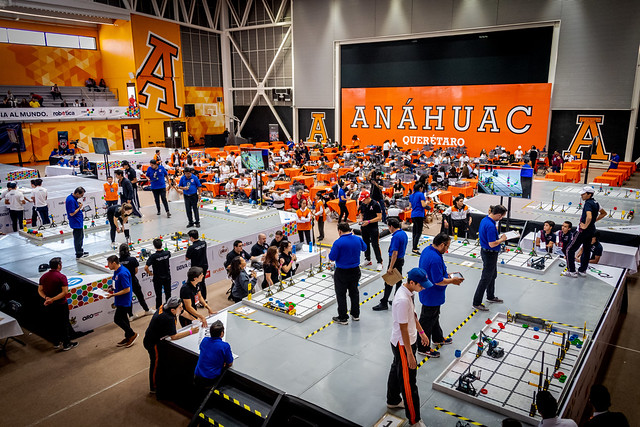
Instituto Cumbres Alpes Querétaro (the Heights-Alps School in Querétaro, Mexico) hosted both the XXIII Anáhuac International Baccalaureate Awards and the XI Robotics League competition at the same time in early May. The local Universidad Anáhuac Querétaro also helped with organize it. More than 3,500 people attended.

The events began with a Mass presided by Fr. Ricardo Sada, LC, territorial director of Mexico. The city mayor, the governor of the state and the bishop of Querétaro were present, along with other authorities and many from the network of Regnum Christi Schools in Mexico.

The Anáhuac International Baccalaureate Awards, according to their website “includes competitions that range from religious projects to scientific, through mathematics and architecture. The primary goal of this academic fair is for students to develop and publicly display projects of professional quality, and  develop skills, a sense of social responsibility and professional ethics.”

Likewise, the website explains that the Robotics League is “incorporated into the curriculum as a cross-training tool that supports and encourages the development of competences in other areas of the students. It is considered, increasingly, as part of the ‘new literacy’ along with reading, writing and arithmetic.”

Leadership that Leaves a Positive Footprint on Society

Fr. Benjamín Clariond, LC, director of the Insituto Cumbres Alpes Querétaro and its associated High School, commented: “In the different competitions we have seen passion, we have seen art, we have seen creativity, we have seen the ability to solve problems, to work in team, to improvise, to think, to structure a discourse. All those skills that prepare us to be able to face the challenges that we are going to have to work in during the 21st century.”

These competitions, Fr Benjamin explained, are about preparing young people “for the world, preparing them for university as well as ensuring that after university they have the tools they will need so that they can do things well and develop their leadership to leave a positive footprint in society.”

Luis Eduardo Álvarez, rector of the Anáhuac University Querétaro, recalling the difficulties and demands involved in preparing this type of event, said, “It is worth the effort to see the satisfaction of the participants and how each of these young people has grown, learned and lived in these days.”

You can see the original in Spanish on the Regnum Christi site. You can also see a photo gallery.


Embed video: https://www.youtube.com/watch?v=5aQN0gDtVuQ

Regnum Christi School Hosts Robotics League Read More »

Regnum Christi Spirituality Center Ask a Priest

“Ask a Priest: How Can I Help a Pair of Gay Friends?”

Q: I became Catholic when I was in undergrad, but before my conversion I met Joyce, who instantly became like an “adopted” mother to me. She was there for me in a time when I was separated from my family, and she and her partner became my “adopted” moms and I love them dearly. Over the past year my life has completely changed, and my relationship with God has grown immensely. Now I am on the discernment path of becoming a religious sister or a consecrated woman. Recently Joyce had a serious medical crisis, and it started to hit me about her and her partner living in sin as Catholics. What am I expected to say to them? Is it enough to love them and pray to God that God can transform their hearts and minds? If the answer is for me to share the concern, I am terrified of losing them because they have been such an important part of my life and really are “adopted” moms. I don’t know what to do. But I want to be living my life true to the Catholic Church and its teachings. Any thoughts you could share would be greatly appreciated. – C.

Answered by Fr. Edward McIlmail, LC

A: It is good to hear that your relationship with God has grown immensely.

You mention that Joyce and her partner helped you at a critical time of your time. Maybe now is the time when you can return the favor.

Obviously, you understand that their relationship is not within God’s plans. So it would be important not to give the impression that you support their lifestyle. You can love them as people without acquiescing to their domestic situation.

So where do you draw the line — should you dine with them? go on an afternoon outing with them? These decisions aren’t so easy.

Certainly, you would need to intensify your prayers for them and to ask the Holy Spirit for guidance.

You might try to consider whether one or the other is open to the Church’s teaching in the area of sexuality.

It might help to do some background reading first.

Two suggested books would be: Homosexuality and the Catholic Church and A Parent’s Guide to Preventing Homosexuality. While geared toward a specific audience, the latter book can give you insights into the roots of same-sex attraction. Also helpful could be a video “The Third Way.”

It is good to remember that when we truly love someone, we want the best for them.

Helping people to draw closer to Christ and to live the Gospel is a key way we show our love. So anything you can do to help Joyce and her friend move toward a chaste life would be a true act of charity.

In the short run you might want to see if there is anything you should change in your own behavior.

For instance, if you visit them frequently and eat with them, what kind of message are you sending? Do they interpret your visits as your way of reaffirming them in their lifestyle? Or do they understand your reservations?

If you want to broach the subject of the moral dimension of their relationship, but don’t feel comfortable doing it with both of them at the same time, you might consider a private meeting with Joyce first, to discuss your concerns.

You could remind her of your love for her and your gratitude for her support. You might share how your relationship with her helped you a lot. Perhaps some of this will help set the stage for the tougher topic you want to address.

And addressing it might be easier than you think. It could be as simple as asking the two of them how they, as Catholics, reconcile their homosexual lifestyle with the teachings of Jesus.

Sincerely asking that question and sincerely listening to their answer could be a fruitful step forward. You don’t have to “solve” everything right away.

For them to be open to hear what you want to say about it, they need to know that you are sincerely open to hear what they have to say — that you really care about them and respect them. Similarly, we can still be friends with people who are Hindu, even though we neither share nor endorse their religious beliefs.

Likewise, a friendship like the one you describe can — at least in theory — endure some strong disagreements. The important thing is for you to be able to be honest, and for you to understand why it is that their lifestyle choice is, in the end, not good for them.

Again, intensify your prayer in the meantime. Offer up Masses and rosaries, so that the Holy Spirit will open the hearts of Joyce and her friend.

And be prepared — your message might not be well-received. If it isn’t, keep calm. Give Joyce a chance to tell her side of things.

People in same-sex relationship often struggle with childhood memories of rejection (or perceptions of rejection) or even abuse. So it is crucial that Joyce senses that you are motivated by love and not by judgmentalism.

One other suggestion: Be sure that you are networking with faithful Catholics. It is easier to live the faith within a community of believers. This is especially important if you are considering a life of consecration.

I hope some of this helps. Count on my prayers for you and your friends.

Keep learning more with Ask a Priest

Got a question? Need an answer?

Today’s secular world throws curve balls at us all the time. AskACatholicPriest is a Q&A feature that anyone can use. Just type in your question or send an email to AskAPriest@rcspiritual.wpenginepowered.com and you will get a personal response back from one of our priests at RCSpirituality. You can ask about anything – liturgy, prayer, moral questions, current events… Our goal is simply to provide a trustworthy forum for dependable Catholic guidance and information. So go ahead and ask your question…

“Ask a Priest: How Can I Help a Pair of Gay Friends?” Read More »

Regnum Christi Spirituality Center Ask a Priest

“Ask a Priest: Why Complicate the Faith With the Old Testament?”

Q: This is a question I have as a practicing Catholic. Would the gentiles be required in the first-century Church to learn about the Jewish history in order to participate in the understanding of transubstantiation? I have a disconnect with the idea that the Gospel and salvation was opened up to all people, not just the Jews. That Jesus died for all people was not understood until later, with the apostles. Why would the Church “hang onto” the Jewish tradition of the Passover if the New Covenant included all people? This would simplify the Gospel message, wouldn’t it? Instead, we have to relearn the whole Old Testament and connect it to the New in order to fully receive the message of Christ in the Eucharist. I understand the typology approach, but it is difficult to do the New Evangelization with those that have never heard the Gospel as well as those well-trained in the Protestant faith. Thanks for your input. – P.R.

Answered by Fr. Edward McIlmail, LC

A: Strictly speaking, a person doesn’t have to know much about Jewish (or Israelite) history to become Catholic or even to understand the basics of the Eucharist.

What is vital is that a person believe that Jesus is present in the Eucharist, even if the person can’t explain things in scholarly terms. (By the way, the word “transubstantiation” came much later. It dates from about the 11th century and was first used in an official Church document by the Fourth Lateran Council in 1215.)

As for first-century gentiles (that is, non-Jews): Some might have learned varying degrees of Israelite history, though the important thing is that they believed the basics of the Christian faith, such as the Trinity, the divinity of Christ, the resurrection, the sacraments, etc.

This isn’t to downplay the importance of knowing the Old Testament. The OT helps us to go deeper into understanding the roots of the Church and the context of Jesus within history. This in turns helps us to understand our faith better — a process that can last a lifetime.

As for the idea of salvation being open to all: this was not totally new with the coming of Christ. Old Testament passages speak of it, such as Isaiah 49:6. “It is too little, he says, for you to be my servant, to raise up the tribes of Jacob, and restore the survivors of Israel; I will make you a light to the nations, that my salvation may reach to the ends of the earth.” So the idea of God’s universal salvific plan had been around for a while.

By the way, the Church didn’t “hang onto” the Passover; that feast was, in effect, superseded by the institution of the Eucharist. The Eucharist and Mass became the new Passover, so to speak.

While someone doesn’t have to be familiar with every detail of the Passover in order to be ready to receive Communion, the Old Testament nonetheless will help a person understand better the context of the Eucharist.

It’s good to remember that the Church had to decide early on whether to retain the texts of what we call the Old Testament. Under the guidance of the Holy Spirit the Church discerned that, yes, the OT was meant to be part of our Scripture. (For related reading, see “The Jewish People and Their Sacred Scriptures in the Christian Bible.”)

The Old sheds light on the New, and vice versa. The inclusion of the Old Testament didn’t complicate the Gospel but rather enriched it. The more we understand the Old Testament, the more we can appreciate what Jesus and the Church did in the New Testament, and how it was linked to what God did in the OT.

An analogy might help: Imagine a 6-year-old who was born and raised in the U.S. The child is an American citizen, even if he knows little or nothing about George Washington or the Constitution or the Bill of Rights. As the child grows toward adulthood, his growing knowledge (we hope) of U.S. history will help him to learn more deeply what it means to be an American. He will better understand the place of the U.S. in world history.

It’s a bit like the Catholic faith. As we mature, we ideally should learn more about its wider context and its place in history.

So what to do about the new evangelization?

Think of it as a process of sharing a great treasure with other people — a treasure that we ourselves are learning about more and more each day.

We can start with the basics: our example of charity, our simple explanations of why we pray, of why we have the sacraments, etc. As dialogue continues and questions arise, we can help connect Church teachings and practices to Scripture and help a person to understand the link with the Old Testament.

Some people might consider Catholicism too complicated. Much better is to think of it as incredibly rich. In any case, it is what it is: a work of God.

Keep learning more with Ask a Priest

Got a question? Need an answer?

Today’s secular world throws curve balls at us all the time. AskACatholicPriest is a Q&A feature that anyone can use. Just type in your question or send an email to AskAPriest@rcspiritual.wpenginepowered.com and you will get a personal response back from one of our priests at RCSpirituality. You can ask about anything – liturgy, prayer, moral questions, current events… Our goal is simply to provide a trustworthy forum for dependable Catholic guidance and information. So go ahead and ask your question…

“Ask a Priest: Why Complicate the Faith With the Old Testament?” Read More »

New Catholic Leadership Institute in Brazil

This April, Regnum Christi started the Catholic Leadership Institute in Brazil to help lay Catholics know their faith better and grow in their leadership.

The Catholic Leadership Institute (ICL) will initially offer three types of activities: free lectures on current issues; courses on various topics such as the Bible, Catholic leadership, meditation, Christian-inspired business models, gnosis and relativism, life purpose, etc.; and online videos with courses and training material. In addition, the institute will offer spaces for debate, conferences, marriage courses and special events.

More than 140 people – including CEOs and board members of businesses, religious leaders, social leaders, and communications leaders – attended the inauguration that took place on April 3. Dr. Ives Granda Martins gave his testimony at the inauguration, speaking about how his “professional career, marriage, family and formation were always built on the experience of God, who is someone real in our life.”

Fr. Rodrigo Hurtado, LC, director of the Institute, stressed that work will be done so that “all the people who come into contact with the organization will have an authentic experience of Christ and become yeast that transforms society with the testimony of their life and by the concrete apostolic action that God inspires to each one.” He also noted, “The secret of a fulfilling life is not something, but Someone.”

For Fr. Cleomar Ferronato, LC, territorial director of Brazil, the ICL is a concrete response to the needs of the Church in Brazil: “If we believe that the Gospel is the best thing for each individual and for our whole society, then we have to prepare the laity and the priests to understand and witness to the world. As the motto of the Institute says, it was time for Catholics to let our light shine (Cf. Matthew 5:16).”

Fr. Rodrigo went on to explain, “The leadership approach proposed by the Institute is born of the joy of being Catholic, of the discovery of each one’s life purpose and the desire to live it and witness it to the world.” He continued, “A leader is a father or mother of a family, a leader can be an entrepreneur or an official within a company, leaders can be priests, politicians, intellectuals, communicators, etc. If we lived all this with the spirit of the Gospel, with the same conviction and love of Christ, we would certainly set fire to the whole world, as St. Catherine of Siena said.”

You can read the original on SomosRC, the Mexican Regnum Christi site.

New Catholic Leadership Institute in Brazil Read More »

Anchored in Light | A Regnum Christi Retreat Guide on the Transfiguration with Fr. John Bartunek, LC

Anchored in Light: A Retreat Guide on the Transfiguration of the Lord

Contemplating the Mystery of the Transfiguration, and discovering what it has to say to each one of us, will be the task of this Retreat Guide, Anchored in Light.

  • The First Meditation unpacks the spiritual meaning behind each detail of this mysterious encounter.
  • The Second Meditation explores how those three Apostles who witnessed the Transfiguration applied that meaning to their lives.
  • And the Conference delves into how we can apply its meaning to our own lives through exercising the virtue of hope. To that end, we will also gather some valuable wisdom from the Old Testament book of Joshua.

The Personal Questionnaire/Group discussion questions are available in the Companion Guide Book or Small Group Companion Guide. Either download the PDF Companion Guide Book or purchase it. The Companion Guide Book is available for purchase as a paperback or on Kindle at Amazon. Pause the video at any moment to go to the Companion Guide Book or continue to the next meditation.

Video

Audio

Anchored in Light: A Retreat Guide on the Transfiguration of the Lord Read More »

Scroll to Top

Events

Looking for another country?

Contact Regnum Christi near you

News & Resources

News & Resources

The Regnum Christi Mission

The Regnum Christi Identity

Alex Kucera

Atlanta

Alex Kucera has lived in Atlanta, GA, for the last 46 years. He is one of 9 children, married to his wife Karmen, and has 3 girls, one grandson, and a granddaughter on the way. Alex joined Regnum Christi in 2007. Out of the gate, he joined the Helping Hands Medical Missions apostolate and is still participating today with the Ghana Friendship Mission.

In 2009, Alex was asked to be the Atlanta RC Renewal Coordinator for the Atlanta Locality to help the RC members with the RC renewal process. Alex became a Group Leader in 2012 for four of the Atlanta Men’s Section Teams and continues today. Running in parallel, in 2013, Alex became a Team Leader and shepherded a large team of good men.

Alex was honored to be the Atlanta Mission Coordinator between 2010 to 2022 (12 years), coordinating 5-8 Holy Week Mission teams across Georgia. He also created and coordinated missions at a parish in Athens, GA, for 9 years. Alex continues to coordinate Holy Week Missions, Advent Missions, and Monthly missions at Good Shepherd Catholic Church in Cumming, GA.

From 2016 to 2022, Alex also served as the Men’s Section Assistant in Atlanta. He loved working with the Men’s Section Director, the Legionaries, Consecrated, and Women’s Section leadership teams.

Alex is exceptionally grateful to the Legionaries, Consecrated, and many RC members who he’s journeyed shoulder to shoulder, growing his relationship with Christ and others along the way. He knows that there is only one way, that’s Christ’s Way, with others!