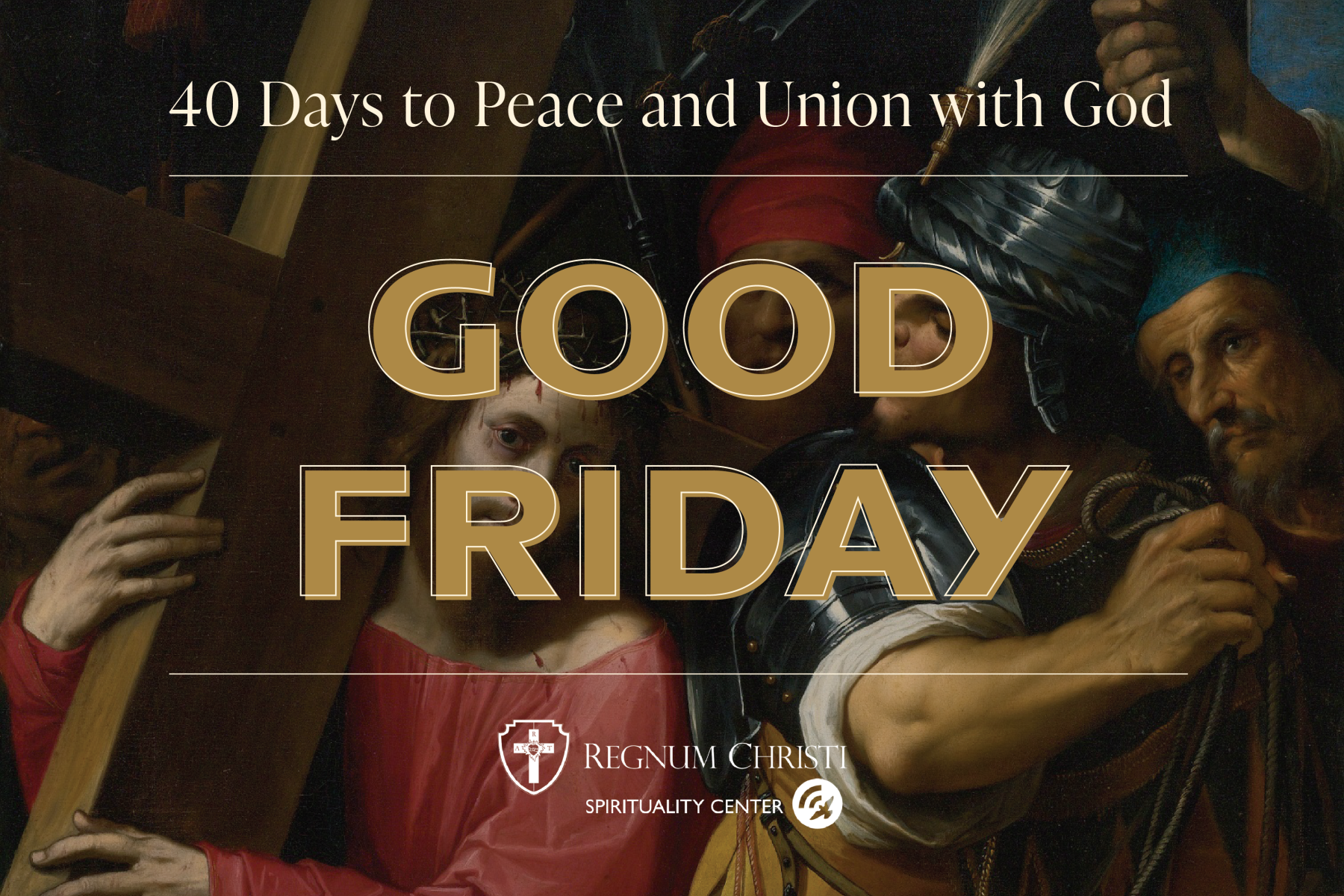
April 3, 2026

Regnum Christi Spirituality Center Uncle Eddy

Saints Agape, Chionia, and Irene

My dearest niece Irene, Life in this prison of a cubicle is often quite oppressing, but whenever I get sad, I just think of all the blessings God has given me, including a niece like you.  I do so wish that I had a Bible here, though. Not only did they take my tattered pocket version, but they have blocked all Internet access to on-line Scriptures. May God forgive them.  That reminds me of today’s saints (may they keep you in their prayers). They loved the Scriptures. One even died for them. In the year 303 that misguided Roman emperor Diocletian had made it a capital crime to possess even a page of the Christian Bible.  The three sisters Agape, Chionia, and Irene (they lived in Greece) happened to have some Biblical texts in their possession, so they hid them away. God permitted them to be arrested after they refused to eat meat that had been sacrificed to pagan gods. They were imprisoned and interrogated, but they wouldn’t budge; they valiantly defended the faith as the governor Dulcitius tried to make them abandon it.  Agape and Chionia were burned at the stake as punishment, but Irene was kept in prison (they hoped she would weaken after her sisters’ gruesome martyrdom). Meanwhile a search of their house uncovered the hidden Scriptures, and Irene was called again before the governor. Asked who had ordered her to keep the documents, in direct defiance of the emperor’s edict, she gave brave testimony: “Almighty God, who has commanded us to love him unto death.  For that reason we prefer to be burnt alive rather than give up the Holy Scriptures and betray him… They were hidden in the house, but we dared not produce them: we were in great trouble because we could no longer read them day and night as we had been accustomed to do.” What love for God’s Word those saintly young women showed! And how carelessly we treat the Bible, now that it is found in every bookstore and every hotel room and every church pew.  We have so many editions, translations, and versions, and we don’t read any of them! Ah, now I know how St Irene felt! I’m counting on your prayers, and keeping you in mine. Uncle Eddy

Saints Agape, Chionia, and Irene Read More »

26-Lent-Day-45

40 Days to Peace and Union with God: Day 45 – A Parting Gift

“Mary has truly become the Mother of all believers. Men and women of every time and place have recourse to her motherly kindness and her virginal purity and grace, in all their needs and aspirations, their joys and sorrows, their moments of loneliness and their common endeavors.”

READ: JOHN 19:17–30

Then they took charge of Jesus, and carrying his own cross he went out of the city to the place of the skull or, as it was called in Hebrew, Golgotha, where they crucified him with two others, one on either side with Jesus in the middle. Pilate wrote out a notice and had it fixed to the cross; it ran: “Jesus the Nazarene, King of the Jews.” This notice was read by many of the Jews, because the place where Jesus was crucified was not far from the city, and the writing was in Hebrew, Latin and Greek. So the Jewish chief priests said to Pilate, “You should not write ‘King of the Jews,’ but ‘This man said: I am King of the Jews.’ ” Pilate answered, “What I have written, I have written.” When the soldiers had finished crucifying Jesus they took his clothing and divided it into four shares, one for each soldier. His undergarment was seamless, woven in one piece from neck to hem; so they said to one another, “Instead of tearing it, let’s throw dice to decide who is to have it.” In this way the words of scripture were fulfilled: They shared out my clothing among them. They cast lots for my clothes. This is exactly what the soldiers did. Near the cross of Jesus stood his mother and his mother’s sister, Mary the wife of Clopas, and Mary of Magdala. Seeing his mother and the disciple he loved standing near her, Jesus said to his mother, “Woman, this is your son.” Then to the disciple he said, “This is your mother.” And from that moment the disciple made a place for her in his home. After this, Jesus knew that everything had now been completed, and to fulfill the scripture perfectly he said: “I am thirsty.” A jar full of vinegar stood there, so putting a sponge soaked in the vinegar on a hyssop stick they held it up to his mouth. After Jesus had taken the vinegar he said, “It is accomplished”; and bowing his head he gave up his spirit.

YOUR THREE-STEP GUIDE TO DAILY MENTAL PRAYER

REFLECT

Jesus is on the verge of completing His earthly mission. As He does so, the mission of the Church (represented in a special way by the “beloved disciple” because the Church is Jesus’ beloved) is just beginning. By explicitly transferring the care of the Church (the beloved disciple) to Mary’s motherly attention and entrusting Mary to John in a filial way, Jesus extends Mary’s mission. She had been the Mother of Christ, the head of the Church, and now she is to be the Mother of the whole body, the members of the Church. Christ had only one thing left to give as He breathed His last breath — His own Mother, and He didn’t grudge us even that. Each follower of Christ, to enter fully into God’s family and to have Christ as a true brother, has to follow John’s example: “And from that moment the disciple made a place for her in his home.”

Mary: I didn’t choose to become Jesus’ Mother; that was God’s choice. How could I have ever chosen for myself such an exalted role when I always knew that I was only a blade of grass in the foothills beneath the mountain of God? Only God in His wisdom and goodness can give one of His creatures such a sublime mission. And though I didn’t choose it, how much joy it gave me! Even the sorrow of His pain on Calvary filled me with a certain spiritual joy because it allowed me to suffer too; it showed Him in a new way that I would never leave Him or doubt Him. And I didn’t choose to become your Mother either; that, too, was His choice. How could I have presumed to take upon myself such an exalted task — to be mother to a child born of water and the Holy Spirit? Only God in His goodness could give me such a joyful and worthy mission. And now I watch over you just as I watched over Him; I accompany you just as I accompanied Him; I love you just as I loved Him. He made me Queen of Heaven so that I could be your refuge and solace.

RESPOND

Mary, how do you guide me? I don’t see your face or hear your voice. But I know you are faithful to God’s will, and it is His will for you to teach and nourish me as my mother in grace. How do you do it? You instruct me by your example: you stood at the foot of the Cross, firm and faithful because your love was true and total. Teach me how to embrace fully the will of God, even when it means embracing the cross.

REST

Nothing escapes your rule, Lord. Down to the tiny detail of a hyssop stick on Calvary, You govern every speck of the cosmos and every wrinkle of human history. You are the Lord. You are my Lord. Increase my faith, Lord. I want to rejoice in the peace of knowing You more deeply and trusting You more unconditionally.

RESOLVE

How can I carry this encounter with me into the day? (Write / Journal)

CLOSING PRAYER OF THANKSGIVING

Most Blessed and Holy Trinity, Father, Son, and Holy Spirit, thank You for Your love and Your grace in allowing me this time of prayer with You.

The world, the flesh, and the devil will all propose things I should focus on and run after today. I beg You to fill me with Your Holy Spirit and help me instead to know and embrace Your will. Help me to see what You desire of me each moment of this day. Give me the wisdom, strength, and fortitude I need to avoid distractions, discern Your will, and focus on and carry out that which Wisdom reveals. Help me to work and live at a pace of peace and prayerfulness, always attentive to You, able to hear Your voice and to say no to anything that hinders my journey to You and a complete yes to every Holy prompting from You.

Help me to humbly and purposefully live, light, and lead others to the path of union with You and to tell everyone about this way of life. Amen.

About the Author

Bartunek-headshotFr. John Bartunek was ordained in 2003. He has taught moral theology at various ecclesiastical institutions at the graduate and undergraduate levels, and has authored many books, including the Gospel companion, The Better Part, and Inside the Passion, the only authorized behind-the-scenes look at the film, for which he provided on-set spiritual support. His online retreat guides are available in multiple formats at RCSpirituality.org. Fr. John currently resides in Atlanta, where he is serving as territorial vicar for the Legionaries of Christ.

40 Days to Peace and Union with God: Day 45 – A Parting Gift Read More »

Ask a Priest: “Is It OK to Have Non-Catholic Friends?”

Q: Most of my friends are non-Catholic, and some are non-Christian. I’m very open and upfront about being religious, so I don’t think there’s many cases where I’m forced to compromise my faith when I’m around them. They all respect the fact that I don’t have premarital sex or drink alcohol or curse, etc., and while some of them do partake in those activities, they know that I would not approve (I don’t harp on it unless directly asked for advice). They are all very kind people, and we do various hobbies together and have a lot of interests in common. I was wondering if having deep friendships like this with non-Catholics and non-Christians is OK or not from a Catholic standpoint. I’ve read some articles, and it seems that while there’s no prohibition or anything, it’s discouraged. I’d imagine this is probably because a lot of friendships like that put people in danger of sinning when around their friends, since their end goals aren’t aligned. I know that the most intimate form of friendship is between man and God, or between two believers who both seek to help each other grow in virtue. But is it possible for a Catholic to have a solid and deep friendship with a non-Catholic? — Kaitlyn

Answered by Fr. Edward McIlmail, LC:

A: It’s great that you are open about your faith and that your friends understand and respect your views.

Part of our lives as Catholics is to share the faith with others and give witness by our example.

Some well-meaning people mistakenly think that we always need to keep our distance from others who don’t share our faith or who have no faith at all.

This isn’t how Jesus lived; he interacted with sinners and the marginalized. He went in search of the lost sheep.

If ever some of your friends might consider joining the Church, it might be in part because of what they see in you.

So, it’s OK to have friendships with people who don’t see 100% eye-to-eye with you.

That said, there are other things to keep in mind.

First, relationships and friendships can evolve, sometimes for the better, sometimes for the worse.

You would need to step back occasionally and evaluate how you and your friends are influencing one another.

Do they seem to be growing in virtue? Are you growing in virtue?

Or do you perceive that you are getting more tolerant about the objectively sinful behavior of others? Are you becoming more open about your faith or less so?

In a word, are you helping to convert them? Or are they converting you to the ways of the world?

This is the kind of thing that needs to be gauged constantly.

A related consideration is, to borrow a phrase from economics, opportunity cost.

That is, when we decide to do or buy something, we are giving up the opportunity to do or buy something else.

If you spend Thursday nights watching movies with your non-Christian friends, for instance, you might be giving up the chance to attend Eucharistic adoration at your parish.

Or if you spend a Friday night socializing with three friends who happen to be in less-than-chaste relationships with their boyfriends, you might be giving up an opportunity to socializing with a young Catholic adults.

You get the idea.

One suggestion: Whatever you do, give yourself goals.

Look for things that help you go deeper into the faith. This could include prayer or study or Eucharistic adoration or even consciously trying to help a friend learn more about the Catholic faith.

Having such a goal will help you to stay aware of the need for constant growth in holiness.

For related reading, see my colleague Father Bartunek’s book Go! 30 Meditations on How Best to Love Your Neighbor as Yourself.

I hope that some of this helps. Count on my prayers.

Ask a Priest: “Is It OK to Have Non-Catholic Friends?” Read More »

26-04-03-DM

April 3, 2026 – The Suffering Servant

Good Friday


John 18:1-40, 19:1-42

Jesus went out with his disciples across the Kidron valley to where there was a garden, into which he and his disciples entered. Judas his betrayer also knew the place, because Jesus had often met there with his disciples. So Judas got a band of soldiers and guards from the chief priests and the Pharisees and went there with lanterns, torches, and weapons. Jesus, knowing everything that was going to happen to him, went out and said to them, “Whom are you looking for?” They answered him, “Jesus the Nazorean.” He said to them, “I AM.” Judas his betrayer was also with them. When he said to them, “I AM, “ they turned away and fell to the ground. So he again asked them, “Whom are you looking for?” They said, “Jesus the Nazorean.” Jesus answered, “I told you that I AM. So if you are looking for me, let these men go.” This was to fulfill what he had said, “I have not lost any of those you gave me.” Then Simon Peter, who had a sword, drew it, struck the high priest’s slave, and cut off his right ear. The slave’s name was Malchus. Jesus said to Peter, “Put your sword into its scabbard. Shall I not drink the cup that the Father gave me?” So the band of soldiers, the tribune, and the Jewish guards seized Jesus, bound him, and brought him to Annas first. He was the father-in-law of Caiaphas, who was high priest that year. It was Caiaphas who had counseled the Jews that it was better that one man should die rather than the people. Simon Peter and another disciple followed Jesus. Now the other disciple was known to the high priest, and he entered the courtyard of the high priest with Jesus. But Peter stood at the gate outside. So the other disciple, the acquaintance of the high priest, went out and spoke to the gatekeeper and brought Peter in. Then the maid who was the gatekeeper said to Peter, “You are not one of this man’s disciples, are you?” He said, “I am not.” Now the slaves and the guards were standing around a charcoal fire that they had made, because it was cold, and were warming themselves. Peter was also standing there keeping warm. The high priest questioned Jesus about his disciples and about his doctrine. Jesus answered him, “I have spoken publicly to the world. I have always taught in a synagogue or in the temple area where all the Jews gather, and in secret I have said nothing. Why ask me? Ask those who heard me what I said to them. They know what I said.” When he had said this, one of the temple guards standing there struck Jesus and said, “Is this the way you answer the high priest?” Jesus answered him, “If I have spoken wrongly, testify to the wrong; but if I have spoken rightly, why do you strike me?” Then Annas sent him bound to Caiaphas the high priest. Now Simon Peter was standing there keeping warm. And they said to him, “You are not one of his disciples, are you?” He denied it and said, “I am not.” One of the slaves of the high priest, a relative of the one whose ear Peter had cut off, said, “Didn’t I see you in the garden with him?” Again Peter denied it. And immediately the cock crowed. Then they brought Jesus from Caiaphas to the praetorium. It was morning. And they themselves did not enter the praetorium, in order not to be defiled so that they could eat the Passover. So Pilate came out to them and said, “What charge do you bring against this man?” They answered and said to him, “If he were not a criminal, we would not have handed him over to you.” At this, Pilate said to them, “Take him yourselves, and judge him according to your law.” The Jews answered him, “We do not have the right to execute anyone,” in order that the word of Jesus might be fulfilled that he said indicating the kind of death he would die. So Pilate went back into the praetorium and summoned Jesus and said to him, “Are you the King of the Jews?” Jesus answered, “Do you say this on your own or have others told you about me?” Pilate answered, “I am not a Jew, am I? Your own nation and the chief priests handed you over to me. What have you done?” Jesus answered, “My kingdom does not belong to this world. If my kingdom did belong to this world, my attendants would be fighting to keep me from being handed over to the Jews. But as it is, my kingdom is not here.” So Pilate said to him, “Then you are a king?” Jesus answered, “You say I am a king. For this I was born and for this I came into the world, to testify to the truth. Everyone who belongs to the truth listens to my voice.” Pilate said to him, “What is truth?” When he had said this, he again went out to the Jews and said to them, “I find no guilt in him. But you have a custom that I release one prisoner to you at Passover. Do you want me to release to you the King of the Jews?” They cried out again, “Not this one but Barabbas!” Now Barabbas was a revolutionary. Then Pilate took Jesus and had him scourged. And the soldiers wove a crown out of thorns and placed it on his head, and clothed him in a purple cloak, and they came to him and said, “Hail, King of the Jews!” And they struck him repeatedly. Once more Pilate went out and said to them, “Look, I am bringing him out to you, so that you may know that I find no guilt in him.” So Jesus came out, wearing the crown of thorns and the purple cloak. And he said to them, “Behold, the man!” When the chief priests and the guards saw him they cried out, “Crucify him, crucify him!” Pilate said to them, “Take him yourselves and crucify him. I find no guilt in him.” The Jews answered, “We have a law, and according to that law he ought to die, because he made himself the Son of God.” Now when Pilate heard this statement, he became even more afraid, and went back into the praetorium and said to Jesus, “Where are you from?” Jesus did not answer him. So Pilate said to him, “Do you not speak to me? Do you not know that I have power to release you and I have power to crucify you?” Jesus answered him, “You would have no power over me if it had not been given to you from above. For this reason the one who handed me over to you has the greater sin.” Consequently, Pilate tried to release him; but the Jews cried out, “If you release him, you are not a Friend of Caesar. Everyone who makes himself a king opposes Caesar.” When Pilate heard these words he brought Jesus out and seated him on the judge’s bench in the place called Stone Pavement, in Hebrew, Gabbatha. It was preparation day for Passover, and it was about noon. And he said to the Jews, “Behold, your king!” They cried out, “Take him away, take him away! Crucify him!” Pilate said to them, “Shall I crucify your king?” The chief priests answered, “We have no king but Caesar.” Then he handed him over to them to be crucified. So they took Jesus, and, carrying the cross himself, he went out to what is called the Place of the Skull, in Hebrew, Golgotha. There they crucified him, and with him two others, one on either side, with Jesus in the middle. Pilate also had an inscription written and put on the cross. It read, “Jesus the Nazorean, the King of the Jews.” Now many of the Jews read this inscription, because the place where Jesus was crucified was near the city; and it was written in Hebrew, Latin, and Greek. So the chief priests of the Jews said to Pilate, “Do not write ‘The King of the Jews,’ but that he said, ‘I am the King of the Jews’.” Pilate answered, “What I have written, I have written.” When the soldiers had crucified Jesus, they took his clothes and divided them into four shares, a share for each soldier. They also took his tunic, but the tunic was seamless, woven in one piece from the top down. So they said to one another, “Let’s not tear it, but cast lots for it to see whose it will be,” in order that the passage of Scripture might be fulfilled that says: They divided my garments among them, for my vesture they cast lots. This is what the soldiers did. Standing by the cross of Jesus were his mother and his mother’s sister, Mary the wife of Clopas, and Mary of Magdala. When Jesus saw his mother and the disciple there whom he loved he said to his mother, “Woman, behold, your son.” Then he said to the disciple, “Behold, your mother.” And from that hour the disciple took her into his home. After this, aware that everything was now finished, in order that the Scripture might be fulfilled, Jesus said, “I thirst.” There was a vessel filled with common wine. So they put a sponge soaked in wine on a sprig of hyssop and put it up to his mouth. When Jesus had taken the wine, he said, “It is finished.” And bowing his head, he handed over the spirit. Now since it was preparation day, in order that the bodies might not remain on the cross on the sabbath, for the sabbath day of that week was a solemn one, the Jews asked Pilate that their legs be broken and that they be taken down. So the soldiers came and broke the legs of the first and then of the other one who was crucified with Jesus. But when they came to Jesus and saw that he was already dead, they did not break his legs, but one soldier thrust his lance into his side, and immediately blood and water flowed out. An eyewitness has testified, and his testimony is true; he knows that he is speaking the truth, so that you also may come to believe. For this happened so that the Scripture passage might be fulfilled: Not a bone of it will be broken. And again another passage says: They will look upon him whom they have pierced. After this, Joseph of Arimathea, secretly a disciple of Jesus for fear of the Jews, asked Pilate if he could remove the body of Jesus. And Pilate permitted it. So he came and took his body. Nicodemus, the one who had first come to him at night, also came bringing a mixture of myrrh and aloes weighing about one hundred pounds. They took the body of Jesus and bound it with burial cloths along with the spices, according to the Jewish burial custom. Now in the place where he had been crucified there was a garden, and in the garden a new tomb, in which no one had yet been buried. So they laid Jesus there because of the Jewish preparation day; for the tomb was close by. 

Opening Prayer: Jesus, who died on the Cross for me, have mercy on me, a sinner. Your Passion and Death overwhelm me with grief and sorrow for my sins. Grant me the grace to hear and respond to your word.

Encountering Christ:

  1. The New Adam: Jesus our Savior has died for us. In his life and death, he became the new Adam. In the Garden of Gethsemane, Jesus began to undo Adam’s original sin in the Garden of Eden. There Jesus bore the punishment God gave to Adam, who was cursed to toil by the sweat of his brow (cf. Gen 3:19). Jesus toiled and sweat until he bled: “He was in such agony and he prayed so fervently that his sweat became like drops of blood falling on the ground” (Lk 22:44). The thorns that the ground yielded because of Adam’s sin (cf. Gen 3:18) rose up to crown Jesus’ head in mockery. Finally, Jesus destroyed the eternal punishment for our sins, starting with the first sin when our first parents ate the fruit of the forbidden tree. Christ Our Lord became sin itself, hanging on a tree in a garden (cf. 2 Cor 5:21).


  2. Lamb of God: There on the Cross, Jesus reigns as our King. Throughout his Passion, he was interrogated, mocked, scourged, and vilified. The soldiers crowned him with thorns and wrapped him in a purple robe of nobility to mock him, but just as Isaiah prophesied, Jesus, the Suffering Servant, was meek and endured their abuse: “Though harshly treated, he submitted and did not open his mouth; Like a lamb led to slaughter or a sheep silent before shearers, he did not open his mouth” (Isa 53:7). Jesus, led like a lamb to slaughter, became our Paschal Lamb.


  3. Signs of Mercy: Christ’s final words from the Cross were a proclamation of his victory: “It is finished” (Jn 19:30). His mission of salvation through his Passion and Death was complete. Jesus, the Suffering Servant, “was pierced for our sins, crushed for our iniquity. He bore the punishment that makes us whole, by his wounds we were healed” (Isa 53:5). Immediately after he handed over his spirit, he was pierced, and the signs of God’s Divine Mercy were released: “One soldier thrust his lance into his side, and immediately blood and water flowed out” (Jn 19:34). Just as Adam’s bride was taken from a rib from his side during a deep sleep (cf. Gen 2:21-22), the bride of Christ—the Church—was born from the Blood of the new covenant and the waters of Baptism that gushed from his side when he was in the deep sleep of death.

Conversing with Christ: Jesus, today we roll the stone across your tomb. Grant us the courage to be stouthearted and wait, facing your tomb in the hope of your Resurrection and our salvation. Thank you for coming to save us and for dying for our sins in our place. Help us, your Church, to be your sign of mercy in the world.

Resolution: Lord, today by your grace I will conduct today’s fast and abstinence with prayerfulness, reverence, and contrition.

Carey Boyzuck is a wife, mother, freelance writer, and a lay member of Regnum Christi. She blogs at www.word-life-light.com.

April 3, 2026 – The Suffering Servant Read More »

Scroll to Top

Events

Looking for another country?

Contact Regnum Christi near you

News & Resources

News & Resources

The Regnum Christi Mission

The Regnum Christi Identity

Alex Kucera

Atlanta

Alex Kucera has lived in Atlanta, GA, for the last 46 years. He is one of 9 children, married to his wife Karmen, and has 3 girls, one grandson, and a granddaughter on the way. Alex joined Regnum Christi in 2007. Out of the gate, he joined the Helping Hands Medical Missions apostolate and is still participating today with the Ghana Friendship Mission.

In 2009, Alex was asked to be the Atlanta RC Renewal Coordinator for the Atlanta Locality to help the RC members with the RC renewal process. Alex became a Group Leader in 2012 for four of the Atlanta Men’s Section Teams and continues today. Running in parallel, in 2013, Alex became a Team Leader and shepherded a large team of good men.

Alex was honored to be the Atlanta Mission Coordinator between 2010 to 2022 (12 years), coordinating 5-8 Holy Week Mission teams across Georgia. He also created and coordinated missions at a parish in Athens, GA, for 9 years. Alex continues to coordinate Holy Week Missions, Advent Missions, and Monthly missions at Good Shepherd Catholic Church in Cumming, GA.

From 2016 to 2022, Alex also served as the Men’s Section Assistant in Atlanta. He loved working with the Men’s Section Director, the Legionaries, Consecrated, and Women’s Section leadership teams.

Alex is exceptionally grateful to the Legionaries, Consecrated, and many RC members who he’s journeyed shoulder to shoulder, growing his relationship with Christ and others along the way. He knows that there is only one way, that’s Christ’s Way, with others!