March 15, 2026

Regnum Christi Spirituality Center Uncle Eddy

St Longinus

Dear Lonnie, Unless I am mistaken, you leave tomorrow for your pilgrimage to Rome.  I do so hope you will keep me in your prayers as you visit those sacred sites.  Nothing would give me more pleasure than to be there with you, telling you all about the innumerable treasures of our faith to be found in the Eternal City.  But God has seen fit to send me on this other mission, and so I am sure he will take good care of you. While you visit the Basilica of St Peter, don’t forget to admire the remarkable (and often overlooked) sculpture of today’s saint; it’s in a niche under the northeast pillar of the dome.  It’s about fourteen feet high, so you really can’t miss it if you try to find it. The remarkable thing about it is the contrast. The figure is muscular and athletic, confident and strong, as any good Roman soldier should be. But the facial expression is full of confusion and amazement, doubt and wonder.  Here he was, on duty in Jerusalem on the first Good Friday. He and his buddies carry out the sentence of crucifixion and are waiting on the hill (Calvary) while the two thieves and our Lord die. Longinus must have had a sensitive soul, even though he was a rough and experienced soldier, because he noticed something different about Christ.  And when our Lord gave up his spirit and died, and the sun went dark, and the earth quaked, and all kinds of strange augers were unleashed (check out Matthew 27:51-54 for inspired details), Longinus let the grace of God enter his heart, and he believed in Jesus. Later, when they were ordered to take down the bodies, this same soldier took his spear and pierced the side of Jesus, to ensure that he was dead.  According to some sources, when the water and the blood flowed out of Jesus’ heart, some of the blood ran down the length of the spear and got on Longinus’s hands.  When he was cleaning it off, he got some of it on his eyes, which had long been going dim from cataracts. As soon as the precious blood touched them, his cataracts were healed, and he could see as clearly as ever. The reason his statue occupies such a prominent place in St Peter’s Basilica is much debated.  Some attribute it to the fact that the tip of his spear was preserved and brought as a relic to Rome, and it was installed underneath this sculpture.  But many other relics were also brought to Rome. Why would they put this one under the dome of the most important church in the world? I think the reason is deeper.  The blood of Christ always symbolizes his love, his self-giving for our sake. This love of God for each of us is the source of our salvation, the source of God’s revelation, the source of our hope.  It is our light, and with that light, we come to see clearly the meaning of all things – including our own life. Just as Longinus’s fading vision was restored when he touch the Savior’s blood, so our weak and selfish hearts are given new life every time we receive that same blood in the Eucharist… Anyway, don’t miss the wonderful sculpture, and don’t waste even the briefest moment of your pilgrimage – it’s the opportunity of a lifetime. Your loving uncle, Eddy

St Longinus Read More »

26-Lent-Day-26

40 Days to Peace and Union with God: Day 26 – A Blind Man Sees

“Let us carry bravely the shield of faith, so that with its protection we may be able to parry whatever the enemy hurls at us."

READ: JOHN 9:1–17

As he went along, he saw a man who had been blind from birth. His disciples asked him, “Rabbi, who sinned, this man or his parents, for him to have been born blind?” “Neither he nor his parents sinned,” Jesus answered, “he was born blind so that the works of God might be displayed in him. As long as the day lasts I must carry out the work of the one who sent me; the night will soon be here when no one can work. As long as I am in the world I am the light of the world.” Having said this, he spat on the ground, made a paste with the spittle, put this over the eyes of the blind man, and said to him, “Go and wash in the Pool of Siloam (a name that means ‘sent’).” So the blind man went off and washed himself, and came away with his sight restored.

His neighbors and people who earlier had seen him begging said, “Isn’t this the man who used to sit and beg?” Some said, “Yes, it is the same one.” Others said, “No, he only looks like him.” The man himself said, “I am the man.” So they said to him, “Then how do your eyes come to be open?” “The man called Jesus,” he answered, “made a paste, dabbed my eyes with it and said to me, ‘Go and wash at Siloam’; so I went, and when I washed I could see.” They asked, “Where is he?” “I don’t know,” he answered. They brought the man who had been blind to the Pharisees. It had been a sabbath day when Jesus made the paste and opened the man’s eyes, so when the Pharisees asked him how he had come to see, he said, “He put a paste on my eyes, and I washed, and I can see.” Then some of the Pharisees said, “This man cannot be from God: he does not keep the sabbath.” Others said, “How could a sinner produce signs like this?” And there was disagreement among them. So they spoke to the blind man again, “What have you to say about him yourself, now that he has opened your eyes?” “He is a prophet,” replied the man.

YOUR THREE-STEP GUIDE TO DAILY MENTAL PRAYER

REFLECT

Among the many lessons hidden in this passage, one deserves special mention. How odd that Jesus used spittle and mud to make clay, put the clay on the man’s eyelids, and told him to go to the pool of Siloam to wash! Did He have to perform the miracle like that? Certainly not: He could have merely snapped His fingers (He is God, after all). Yet it was appropriate to do so. Why? Besides the obvious reason that in ancient times saliva was often used in medical procedures, through this method of curing, the blind man felt Christ touching Him, heard His voice, and actively participated in the saving deed of God. In this way, Christ shows how He communicates God’s grace to us in ways appropriate to our human nature — which includes both body and spirit. Jesus wants to reach into our lives, to lower Himself to our level, to touch us, even physically. Christ’s touch gave the blind man hope and confidence, making the miracle into a personal encounter, not a magic trick. The Catholic Church, under the constant guidance of the Holy Spirit, has preserved this method of administering God’s grace through the sacraments. The priest’s words of absolution at the end of Confession provide the consolation we need to bring the reality of God’s forgiveness home to our hearts. The water of Baptism, the bread and wine of the Eucharist, the chrism — all the material elements of the sacraments — extend throughout time the reality of God’s eager desire to reach out and touch us. We are not purely spiritual beings; it suits us to encounter God through the mediation of physical realities. God became man not to despoil our humanity but to bring it to its fullness.

RESPOND

Too frequently, I take Your sacraments for granted. You are so humble and gentle; You want to pour the balm of Your grace into my life through signs that I can recognize and understand. I want to be grateful and attentive to Your gifts. I want to appreciate them as I should and teach others to do the same. Open my eyes, Lord.

REST

Never let me forget your majesty and your glory. This world seems to delight in watering down Your magnificence. But I believe in Your greatness and Your goodness. I want to live in the reality of Your presence, like the saints. I want to learn to hear Your voice calling out to me in all things, as I know You are doing, because You have promised that Your love for me is constant, personal, and determined.

RESOLVE

How can I carry this encounter with me into the day? (Write / Journal)

CLOSING PRAYER OF THANKSGIVING

Most Blessed and Holy Trinity, Father, Son, and Holy Spirit, thank You for Your love and Your grace in allowing me this time of prayer with You.

The world, the flesh, and the devil will all propose things I should focus on and run after today. I beg You to fill me with Your Holy Spirit and help me instead to know and embrace Your will. Help me to see what You desire of me each moment of this day. Give me the wisdom, strength, and fortitude I need to avoid distractions, discern Your will, and focus on and carry out that which Wisdom reveals. Help me to work and live at a pace of peace and prayerfulness, always attentive to You, able to hear Your voice and to say no to anything that hinders my journey to You and a complete yes to every Holy prompting from You.

Help me to humbly and purposefully live, light, and lead others to the path of union with You and to tell everyone about this way of life. Amen.

About the Author

Bartunek-headshotFr. John Bartunek was ordained in 2003. He has taught moral theology at various ecclesiastical institutions at the graduate and undergraduate levels, and has authored many books, including the Gospel companion, The Better Part, and Inside the Passion, the only authorized behind-the-scenes look at the film, for which he provided on-set spiritual support. His online retreat guides are available in multiple formats at RCSpirituality.org. Fr. John currently resides in Atlanta, where he is serving as territorial vicar for the Legionaries of Christ.

40 Days to Peace and Union with God: Day 26 – A Blind Man Sees Read More »

26-03-15-DM

March 15, 2026 – Christ: The Ultimate Friend

Fourth Sunday of Lent


John 9:1-41

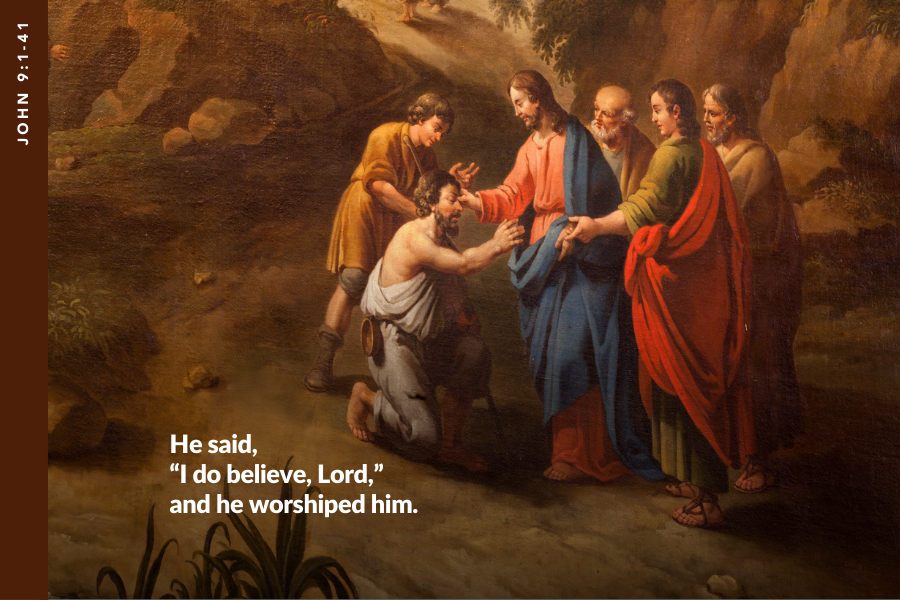
As Jesus passed by he saw a man blind from birth. His disciples asked him, “Rabbi, who sinned, this man or his parents, that he was born blind?” Jesus answered, “Neither he nor his parents sinned; it is so that the works of God might be made visible through him. We have to do the works of the one who sent me while it is day. Night is coming when no one can work. While I am in the world, I am the light of the world.” When he had said this, he spat on the ground and made clay with the saliva, and smeared the clay on his eyes, and said to him, “Go wash in the Pool of Siloam”—which means Sent—. So he went and washed, and came back able to see. His neighbors and those who had seen him earlier as a beggar said, “Isn’t this the one who used to sit and beg?” Some said, “It is, “but others said, “No, he just looks like him.” He said, “I am.” So they said to him, “How were your eyes opened?” He replied, “The man called Jesus made clay and anointed my eyes and told me, ‘Go to Siloam and wash.’ So I went there and washed and was able to see.” And they said to him, “Where is he?” He said, “I don’t know.” They brought the one who was once blind to the Pharisees. Now Jesus had made clay and opened his eyes on a sabbath. So then the Pharisees also asked him how he was able to see. He said to them, “He put clay on my eyes, and I washed, and now I can see.” So some of the Pharisees said, “This man is not from God, because he does not keep the sabbath.” But others said, “How can a sinful man do such signs?” And there was a division among them. So they said to the blind man again, “What do you have to say about him, since he opened your eyes?” He said, “He is a prophet.” Now the Jews did not believe that he had been blind and gained his sight until they summoned the parents of the one who had gained his sight. They asked them, “Is this your son, who you say was born blind? How does he now see?” His parents answered and said, “We know that this is our son and that he was born blind. We do not know how he sees now, nor do we know who opened his eyes. Ask him, he is of age; he can speak for himself.” His parents said this because they were afraid of the Jews, for the Jews had already agreed that if anyone acknowledged him as the Christ, he would be expelled from the synagogue. For this reason his parents said, “He is of age; question him.” So a second time they called the man who had been blind and said to him, “Give God the praise! We know that this man is a sinner.” He replied, “If he is a sinner, I do not know. One thing I do know is that I was blind and now I see.” So they said to him, “What did he do to you? How did he open your eyes?” He answered them, “I told you already and you did not listen. Why do you want to hear it again? Do you want to become his disciples, too?” They ridiculed him and said, “You are that man’s disciple; we are disciples of Moses! We know that God spoke to Moses, but we do not know where this one is from.” The man answered and said to them, “This is what is so amazing, that you do not know where he is from, yet he opened my eyes. We know that God does not listen to sinners, but if one is devout and does his will, he listens to him. It is unheard of that anyone ever opened the eyes of a person born blind. If this man were not from God, he would not be able to do anything.” They answered and said to him, “You were born totally in sin, and are you trying to teach us?” Then they threw him out. When Jesus heard that they had thrown him out, he found him and said, “Do you believe in the Son of Man?” He answered and said, “Who is he, sir, that I may believe in him?” Jesus said to him, “You have seen him, the one speaking with you is he.” He said, “I do believe, Lord,” and he worshiped him. Then Jesus said, “I came into this world for judgment, so that those who do not see might see, and those who do see might become blind.” Some of the Pharisees who were with him heard this and said to him, “Surely we are not also blind, are we?” Jesus said to them, “If you were blind, you would have no sin; but now you are saying, ‘We see,’ so your sin remains.”

Opening Prayer: Lord, you know how blind I am to your presence and your work in my life. In this time of prayer, I renew my faith—I do believe in your enduring presence. I renew my hope in your promise of eternal life. I love you for the work you have already done and are continuing to do.

Encountering Christ:

  1. The Works of God: Jews of the first century commonly regarded blindness (or any physical ailment, for that matter) a manifestation of sin. They asked Jesus, therefore, who it was who sinned. Jesus responded: “Neither he nor his parents sinned; it is so that the works of God might be made visible through him.” St. Paul recounted that the Lord once told him, “My grace is sufficient for you, for power is made perfect in weakness” (2 Cor 12:9). God’s power becomes perfectly manifest in the poverty and blindness of our human condition, especially when we are open to his grace and his work in us.


  2. The Transformation of Healing: After Christ healed the blind man, the Pharisees had trouble recognizing him: “Isn’t this the one who used to sit and beg?” The work of Christ in us, which heals and converts us, is a transformative work that can change the way we are perceived by others. The season of Lent is the perfect time to allow the Lord to perfect this transformation in us, but it can come at a cost. People who think they know us might be tempted to criticize us for our Lenten fasts or mortifications, claiming we’re no longer the same person. Are we willing to endure this criticism, if it means transformation into Christ?


  3. “Even If My Father and Mother Forsake Me…”: The transformation that Christ worked in the blind man had serious repercussions for him: people didn’t recognize him, and his own parents distanced themselves from him. “He is of age; question him,” his parents said. However, he was not totally forsaken. Jesus approached him and revealed himself to be the Son of Man. For the ex-blind man, the words of Psalm 27 came true: “Even if my father and mother forsake me, the Lord will take me in” (Ps 27:10). We need faith to seek out Christ when friends and family seem to misunderstand or reject us.

Conversing with Christ: Lord Jesus, enlighten the eyes of my heart, to see you for who you truly are: the Son of Man, the Savior of the world. Give me the strength to be able to cling to you, even when those I love seem to reject me or distance themselves from me.

Resolution: Lord, today by your grace I will extend my friendship to someone in my workplace or school who seems to be an outcast.

Brian Flanagan is a Regnum Christi member from Atlanta, Georgia.

March 15, 2026 – Christ: The Ultimate Friend Read More »

Scroll to Top

Events

Looking for another country?

Contact Regnum Christi near you

News & Resources

News & Resources

The Regnum Christi Mission

The Regnum Christi Identity

Alex Kucera

Atlanta

Alex Kucera has lived in Atlanta, GA, for the last 46 years. He is one of 9 children, married to his wife Karmen, and has 3 girls, one grandson, and a granddaughter on the way. Alex joined Regnum Christi in 2007. Out of the gate, he joined the Helping Hands Medical Missions apostolate and is still participating today with the Ghana Friendship Mission.

In 2009, Alex was asked to be the Atlanta RC Renewal Coordinator for the Atlanta Locality to help the RC members with the RC renewal process. Alex became a Group Leader in 2012 for four of the Atlanta Men’s Section Teams and continues today. Running in parallel, in 2013, Alex became a Team Leader and shepherded a large team of good men.

Alex was honored to be the Atlanta Mission Coordinator between 2010 to 2022 (12 years), coordinating 5-8 Holy Week Mission teams across Georgia. He also created and coordinated missions at a parish in Athens, GA, for 9 years. Alex continues to coordinate Holy Week Missions, Advent Missions, and Monthly missions at Good Shepherd Catholic Church in Cumming, GA.

From 2016 to 2022, Alex also served as the Men’s Section Assistant in Atlanta. He loved working with the Men’s Section Director, the Legionaries, Consecrated, and Women’s Section leadership teams.

Alex is exceptionally grateful to the Legionaries, Consecrated, and many RC members who he’s journeyed shoulder to shoulder, growing his relationship with Christ and others along the way. He knows that there is only one way, that’s Christ’s Way, with others!