


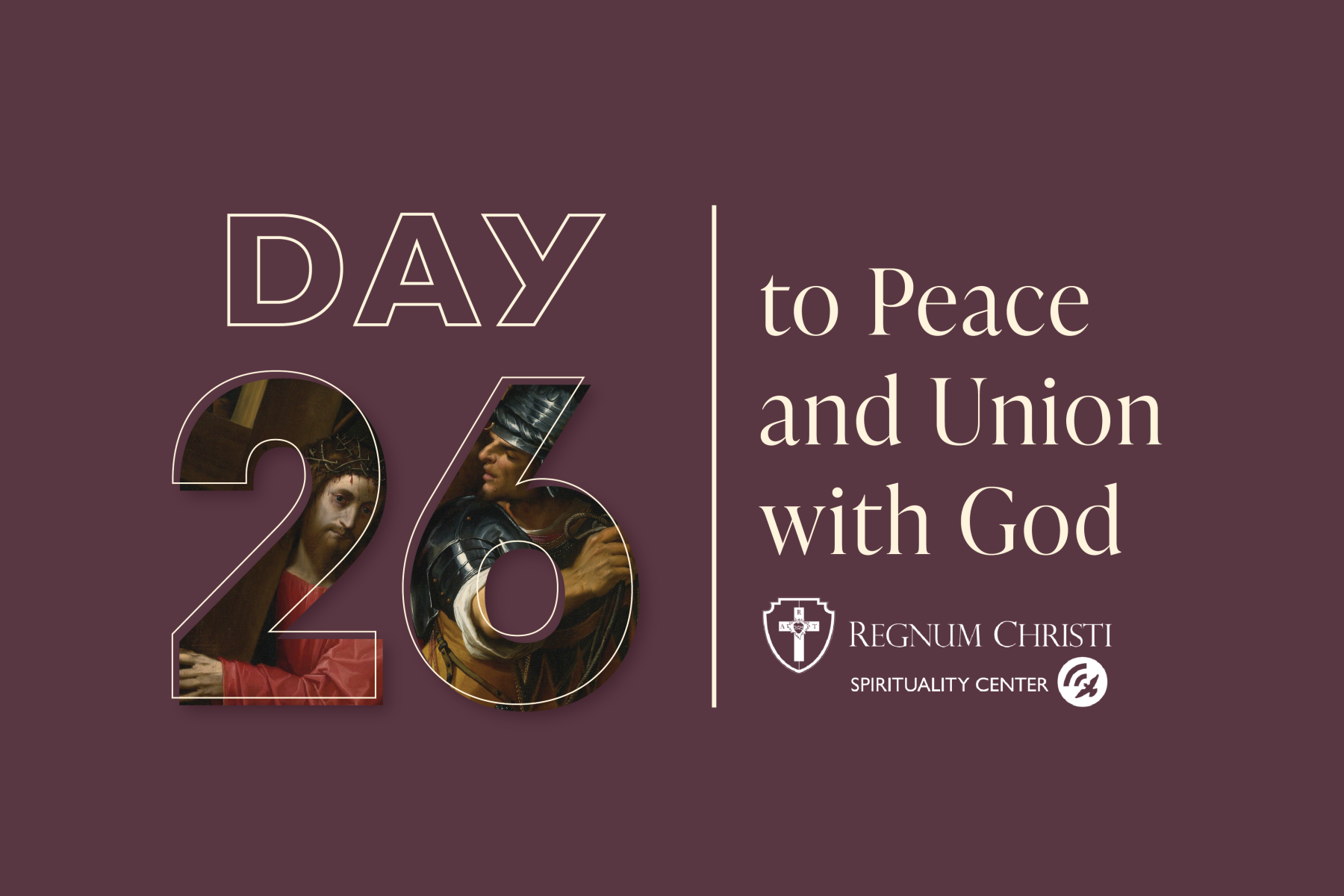
“Let us carry bravely the shield of faith, so that with its protection we may be able to parry whatever the enemy hurls at us."
- ST. CYPRIAN
READ: JOHN 9:1–17
As he went along, he saw a man who had been blind from birth. His disciples asked him, “Rabbi, who sinned, this man or his parents, for him to have been born blind?” “Neither he nor his parents sinned,” Jesus answered, “he was born blind so that the works of God might be displayed in him. As long as the day lasts I must carry out the work of the one who sent me; the night will soon be here when no one can work. As long as I am in the world I am the light of the world.” Having said this, he spat on the ground, made a paste with the spittle, put this over the eyes of the blind man, and said to him, “Go and wash in the Pool of Siloam (a name that means ‘sent’).” So the blind man went off and washed himself, and came away with his sight restored.
His neighbors and people who earlier had seen him begging said, “Isn’t this the man who used to sit and beg?” Some said, “Yes, it is the same one.” Others said, “No, he only looks like him.” The man himself said, “I am the man.” So they said to him, “Then how do your eyes come to be open?” “The man called Jesus,” he answered, “made a paste, dabbed my eyes with it and said to me, ‘Go and wash at Siloam’; so I went, and when I washed I could see.” They asked, “Where is he?” “I don’t know,” he answered. They brought the man who had been blind to the Pharisees. It had been a sabbath day when Jesus made the paste and opened the man’s eyes, so when the Pharisees asked him how he had come to see, he said, “He put a paste on my eyes, and I washed, and I can see.” Then some of the Pharisees said, “This man cannot be from God: he does not keep the sabbath.” Others said, “How could a sinner produce signs like this?” And there was disagreement among them. So they spoke to the blind man again, “What have you to say about him yourself, now that he has opened your eyes?” “He is a prophet,” replied the man.
YOUR THREE-STEP GUIDE TO DAILY MENTAL PRAYER
REFLECT
Among the many lessons hidden in this passage, one deserves special mention. How odd that Jesus used spittle and mud to make clay, put the clay on the man’s eyelids, and told him to go to the pool of Siloam to wash! Did He have to perform the miracle like that? Certainly not: He could have merely snapped His fingers (He is God, after all). Yet it was appropriate to do so. Why? Besides the obvious reason that in ancient times saliva was often used in medical procedures, through this method of curing, the blind man felt Christ touching Him, heard His voice, and actively participated in the saving deed of God. In this way, Christ shows how He communicates God’s grace to us in ways appropriate to our human nature — which includes both body and spirit. Jesus wants to reach into our lives, to lower Himself to our level, to touch us, even physically. Christ’s touch gave the blind man hope and confidence, making the miracle into a personal encounter, not a magic trick. The Catholic Church, under the constant guidance of the Holy Spirit, has preserved this method of administering God’s grace through the sacraments. The priest’s words of absolution at the end of Confession provide the consolation we need to bring the reality of God’s forgiveness home to our hearts. The water of Baptism, the bread and wine of the Eucharist, the chrism — all the material elements of the sacraments — extend throughout time the reality of God’s eager desire to reach out and touch us. We are not purely spiritual beings; it suits us to encounter God through the mediation of physical realities. God became man not to despoil our humanity but to bring it to its fullness.
RESPOND
Too frequently, I take Your sacraments for granted. You are so humble and gentle; You want to pour the balm of Your grace into my life through signs that I can recognize and understand. I want to be grateful and attentive to Your gifts. I want to appreciate them as I should and teach others to do the same. Open my eyes, Lord.
REST
Never let me forget your majesty and your glory. This world seems to delight in watering down Your magnificence. But I believe in Your greatness and Your goodness. I want to live in the reality of Your presence, like the saints. I want to learn to hear Your voice calling out to me in all things, as I know You are doing, because You have promised that Your love for me is constant, personal, and determined.
RESOLVE
How can I carry this encounter with me into the day? (Write / Journal)
CLOSING PRAYER OF THANKSGIVING
Most Blessed and Holy Trinity, Father, Son, and Holy Spirit, thank You for Your love and Your grace in allowing me this time of prayer with You.
The world, the flesh, and the devil will all propose things I should focus on and run after today. I beg You to fill me with Your Holy Spirit and help me instead to know and embrace Your will. Help me to see what You desire of me each moment of this day. Give me the wisdom, strength, and fortitude I need to avoid distractions, discern Your will, and focus on and carry out that which Wisdom reveals. Help me to work and live at a pace of peace and prayerfulness, always attentive to You, able to hear Your voice and to say no to anything that hinders my journey to You and a complete yes to every Holy prompting from You.
Help me to humbly and purposefully live, light, and lead others to the path of union with You and to tell everyone about this way of life. Amen.
About the Author
 Fr. John Bartunek was ordained in 2003. He has taught moral theology at various ecclesiastical institutions at the graduate and undergraduate levels, and has authored many books, including the Gospel companion, The Better Part, and Inside the Passion, the only authorized behind-the-scenes look at the film, for which he provided on-set spiritual support. His online retreat guides are available in multiple formats at RCSpirituality.org. Fr. John currently resides in Atlanta, where he is serving as territorial vicar for the Legionaries of Christ.


