September 26, 2025

Catholic Worldview Fellowship Article

An Unexpected Moment with the Pope: Adventures at Catholic Worldview Fellowship 2025

This summer’s Catholic World Fellowship just wrapped up with a record number of fellows—36 students—who spent three weeks at Schloss Wissen in Germany and one unforgettable week in Rome. One of the highlights? Meeting Pope Leo at Castel Gandolfo!

Catholic Worldview Fellowship Article

Catholic Worldview Fellowship is a month-long summer fellowship program centered in Germany and Italy designed to form, network, and empower Catholic college students who want to evangelize culture. Through academic instruction from an authentically Catholic approach, cultural pilgrimages throughout Germany and Rome, faith-filled community life, and spiritual formation that includes daily prayer and the sacraments, CWF provides a space for students to contemplate their lives from the standpoint of their faith. It is the hope that graduates of CWF will then go back to transform the culture of their own communities and campuses, empowered by this transformative experience of looking at history, the world, and their own lives in light of the Catholic Worldview.

The CWF program is open to students currently enrolled in undergraduate studies, including graduating seniors. Fellows spend the first three weeks of the program in Germany, staying at Schloss Wissen, while the last week of the fellowship takes place in and around Rome. CWF students receive three academic credits through the accreditation of Benedictine College.

Catholic Worldview Fellowship Article

Meet Jack Roach

Jack Roach is one of the students who attended the 2026 Fellowship Experience. When Jack first entered the program, he was hoping for more than just leadership training—he was looking for an experience that would form him in his faith, surround him with others striving for the same ideals, and challenge him to grow in his ability and courage to live out his Catholic values in daily life. Seeking clarity on what it truly means to be a leader, one rooted in service and integrity, Jack hoped to be able to take that new understanding home with him, and carry it into every aspect of his life.

Jack also prayed, before leaving for Germany, for something that he could offer up, a sacrifice that he could make throughout the trip to draw him closer to an encounter with Christ. His prayer was answered just a few days after his arrival when he was bitten by a spider, and by the time the group reached Italy, Jack could hardly walk.

When the CWF fellows made a visit to Castel Candolfo, where Pope Leo spent part of his summer, Jack had to use a wheelchair to avoid having to stand for hours in the hopes of catching a glimpse of the Pope. This placed Jack, and his young brother, Warren, in a special section near the front of the crowd. After praying the Angelus, Pope Leo went down to greet those in that section, and Jack and Warren were able to shake his hand. “It was unforgettable, not because he is the first American pope, but because it felt like God had answered my prayer in an unexpected way. What began as a suffering turned into a moment of immense gratitude and grace.”

Catholic Worldview Fellowship Article

Jack’s experience at CWF this past summer was unique and unforgettable, and not just because of the discomfort of the spider bite and the surprise of seeing Pope Leo up close. Spending the month in community, living and praying with peers who shared the same faith, created life-long friendships that shaped his experience. And, just as he had hoped, through the academic experience and spiritual accompaniment, Jack grew in his understanding on what it means to be a leader. “The month deepened my faith and taught me that true leadership is not about authority, but about modeling the way through service, humility, and joy.”

“It gave me a stronger sense of responsibility to live intentionally, and to lead by example in every setting.”

And Jack knows that this experience is one that will have a lasting impact on all areas of his life, including his studies, his career plans, and especially his pursuit of rowing—Jack competes as a Division I rower at the University of San Diego. “I am especially excited to bring what I have learned back to my rowing team, and to do so alongside my brother, creating a culture of accountability and encouragement.”

Originally from Connecticut, Jack grew up in a large Catholic family with seven siblings. Currently, he is a junior at the University of San Diego, where he is studying finance and rows competitively. Jack plans to continue building on the formation he gained this summer in his studies in finance and ultimately in a career in law, with the goal of practicing in the area of medical malpractice. “My hope is to live out what I gained at CWF by defending human dignity, carrying my faith into every part of my life, and leading with courage and integrity.”

Catholic Worldview Fellowship Article

2026 Fellowship Experience

Applications are now open for the 2026 Fellowship Experience, which will be held June 26-July 23, 2026. To find out more information about Catholic Worldview Fellowship, visit their website at catholicworldview.com.

To find out more about Catholic Worldview Fellowship, visit their website at catholicworldview.com or email info@catholicworldview.com for more information, or start your application here!

An Unexpected Moment with the Pope: Adventures at Catholic Worldview Fellowship 2025 Read More »

“Ask a Priest: Why Believe in Old Testament Miracles?”

Q: Since archaeological evidence does not directly point to historical evidence of the Exodus and Moses, I’m wondering if any archaeological evidence about the Old Testament indicates that supernatural events may have occurred. In Catholicism, we are blessed to have the Shroud of Turin, Our Lady of Guadalupe’s tilma, Eucharistic miracles, etc., and I know that those should not be the crux of our faith. But since we can’t even find the bodies of the Maccabees, let alone any of the prophets, I’m struggling to believe that the miracles of the Old Testament did happen. I wish that there was some evidence or artifact remaining from the Old Testament that has miraculous qualities, just as we have evidence of many miraculous occurrences from the New Testament until today — especially because it appears that so many Old Testament archaeologists lose their faith. Perhaps God intended for many of the events of the Old Testament to remain mysterious. I believe that the ark of the covenant was destroyed and that Moses’ burial won’t be found, correct? Thank you for your time! – Anna

Answered by Fr. Edward McIlmail, LC:

It’s not a good idea to put too much weight on a lack of archaeological evidence.

It’s understandable that some Old Testament events simply didn’t leave much trace, given the harshness of the desert. 

Also, the crossing of the Reed Sea (a better translation than Red Sea) obviously involved water, which would cover most traces of a people in transit. And who knows what future archaeologists might find?

The remains of the temple in Jerusalem (the Western Wall) certainly point to a huge complex that stood there in antiquity. This is no small piece of evidence for corroborating important parts of the Old Testament.

Some of the miracles recounted in the Old Testament — such as Elijah’s raising of the widow’s son to life (1 Kings 17:17-24) — won’t likely leave any archaeological remains. The same goes for many people mentioned in the Old Testament, including Moses and the Maccabees, as well as the fate of the ark of the covenant.

That said, the story of Moses and the Exodus has the ring of authenticity as a foundational story for Judaism.

Most foundational stories in antiquity had fantastic elements to them, such as gods slaying one another and using bodies to make the world (think of the Epic of Gilgamesh).

The stories in the Pentateuch, by contrast, are very human. 

The Hebrews in Egypt are depicted as slaves and as constant whiners in the desert — hardly the stuff of fantastic legends.

Then there is Moses, whose first recorded act in public is to murder an Egyptian. The next day he is dressed down by a fellow Hebrew (Exodus 2:14). This is hardly a flattering debut for one who was called to lead his kinsmen out of bondage. 

The Old Testament does at times incorporate elements of myths from the ancient world, yet it tells a warts-and-all history of the development of the Israelites/Jews.

Parts of the OT also use various literary styles. Books such as Job have qualities that give it the feel of a fable. But that doesn’t detract from its core message (about the mystery of evil in the world). For related reading about the OT, see this post.

It’s good to remember that a big reason why the Church accepted the Scriptures of the Jews (what would become our Old Testament) is because Jesus himself quoted from them and said that they foretold his coming into the world. “For if you had believed Moses, you would have believed me, because he wrote about me” (John 5:46).

In short, don’t be too quick to write off the OT as a fabrication. It’s not always meant to be read as a history textbook or science manual, but it does transmit messages that are meant to guide us in the moral life. Jesus certainly took the OT seriously, even as he came to fulfill and supersede it.

Moreover, the fact that the chosen people of the Old Testament are with us to this day is extraordinary.

By the way, we really don’t have archaeological evidence for the miracles in the New Testament. So why believe in the New Testament? 

A full answer could fill a book. Suffice it to say we have the Church that Jesus founded. And guided by the Holy Spirit it teaches and nourishes us on our way to eternity.

“Ask a Priest: Why Believe in Old Testament Miracles?” Read More »

September 26, 2025 – Faith Includes the Cross

Listen to the audio version

Friday of the Twenty-Fifth Week in Ordinary Time


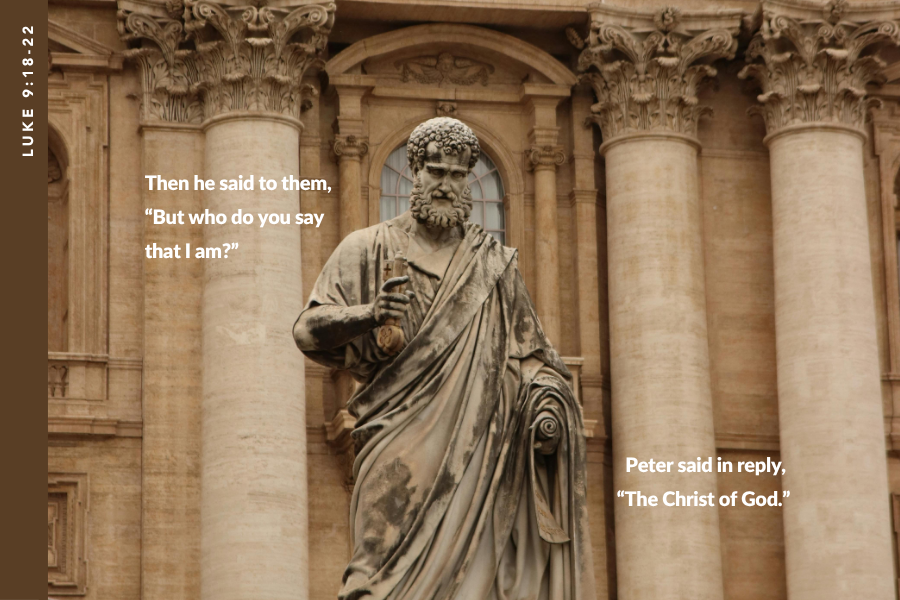
Luke 9:18-22

Once when Jesus was praying in solitude, and the disciples were with him, he asked them, “Who do the crowds say that I am?” They said in reply, “John the Baptist; others, Elijah; still others, ‘One of the ancient prophets has arisen.’” Then he said to them, “But who do you say that I am?” Peter said in reply, “The Christ of God.” He rebuked them and directed them not to tell this to anyone. He said, “The Son of Man must suffer greatly and be rejected by the elders, the chief priests, and the scribes, and be killed and on the third day be raised.”

Opening Prayer: As I come to my time of prayer today, Lord, bless me and strengthen me for the moments ahead when I will need your grace.

Encountering Christ:

  1. Speaking Up: When Jesus asked, “Who do the crowds say that I am,” the disciples showed by their answers that the crowds saw something special in Jesus, but that their vision was limited. They weren’t able to see beyond what they were comfortable with or what they understood. They were unable to see Jesus’ absolute uniqueness. In contrast, Peter recognized Jesus as “The Christ of God.” He spoke out in faith. We can sometimes find it difficult to follow Peter’s example and speak up when others challenge our faith. Nevertheless, each of us is called to “Always be ready to give an explanation to anyone who asks you for a reason for your hope” (1 Pet 3:15).

  2. Suffering Is to Be Expected: Jesus never gave the disciples room to imagine their lives would include power or prestige. He repeatedly reminded them that his life would include rejection and suffering and he taught them to expect the same. He said, “If the world hates you, realize that it hated me first” (Jn 15:18) and “If anyone wishes to come after me, he must deny himself and take up his cross daily and follow me” (Le 9:23). The Catechism acknowledges that this is challenging: “Our experiences of evil and suffering, injustice and death, seem to contradict the Good News; they can shake our faith and become a temptation against it” (CCC 164). But St. Paul encourages us: “Let us […] persevere in running the race that lies before us” (Heb 12:2).

  3. Suffering Out of Love: Jesus’s message of redemption included suffering. No one avoids suffering in this life, but by following Jesus’s example, our suffering can be an act of unconditional, self-giving love. What a blessing! Whether we choose suffering (as in a fast or practice of a virtue) or whether it falls upon us unwillingly, suffering is always an opportunity to love as Jesus did. We signify our willingness to suffer whenever we make the sign of the cross. “When suffering comes, the sign of the cross is a sign of acceptance. It’s remembering that Jesus became a man and suffered for us and that we participate in Christ’s suffering. The sign of the cross says, ‘I am willing to embrace suffering to share in Christ’s suffering’” (November 22, 2004, ZENIT).

Conversing with Christ: My Lord, my God, my Savior, my Refuge, I want to embrace all it is that you allow into my life as your instrument of salvation. I want to remember your cross as the sign of your love. Lord, help me grow in my trust in you and remember the words of the prayer of St. Padre Pio: “O Lord, we ask for a boundless confidence and trust in your Divine Mercy, and the courage to accept the crosses and sufferings which bring immense goodness to our souls and that of your Church…”

Resolution: Lord, today by your grace when I make the sign of the cross, I will do so reverently and thoughtfully, giving thanks for your sacrifice on the cross and asking for the grace to embrace the crosses and suffering of my own life with deeper faith and trust.

Janet McLaughlin and her husband, Chris, live on a mountain in rural northeastern Oregon. She puts her Master of Arts in Pastoral Studies to work as she shares the beauty and importance of the lay vocation in her writing, speaking, and teaching on spiritual topics.


September 26, 2025 – Faith Includes the Cross Read More »

Scroll to Top

Events

Looking for another country?

Contact Regnum Christi near you

News & Resources

News & Resources

The Regnum Christi Mission

The Regnum Christi Identity

Alex Kucera

Atlanta

Alex Kucera has lived in Atlanta, GA, for the last 46 years. He is one of 9 children, married to his wife Karmen, and has 3 girls, one grandson, and a granddaughter on the way. Alex joined Regnum Christi in 2007. Out of the gate, he joined the Helping Hands Medical Missions apostolate and is still participating today with the Ghana Friendship Mission.

In 2009, Alex was asked to be the Atlanta RC Renewal Coordinator for the Atlanta Locality to help the RC members with the RC renewal process. Alex became a Group Leader in 2012 for four of the Atlanta Men’s Section Teams and continues today. Running in parallel, in 2013, Alex became a Team Leader and shepherded a large team of good men.

Alex was honored to be the Atlanta Mission Coordinator between 2010 to 2022 (12 years), coordinating 5-8 Holy Week Mission teams across Georgia. He also created and coordinated missions at a parish in Athens, GA, for 9 years. Alex continues to coordinate Holy Week Missions, Advent Missions, and Monthly missions at Good Shepherd Catholic Church in Cumming, GA.

From 2016 to 2022, Alex also served as the Men’s Section Assistant in Atlanta. He loved working with the Men’s Section Director, the Legionaries, Consecrated, and Women’s Section leadership teams.

Alex is exceptionally grateful to the Legionaries, Consecrated, and many RC members who he’s journeyed shoulder to shoulder, growing his relationship with Christ and others along the way. He knows that there is only one way, that’s Christ’s Way, with others!