Friday of the Twenty-Fifth Week in Ordinary Time
Luke 9:18-22
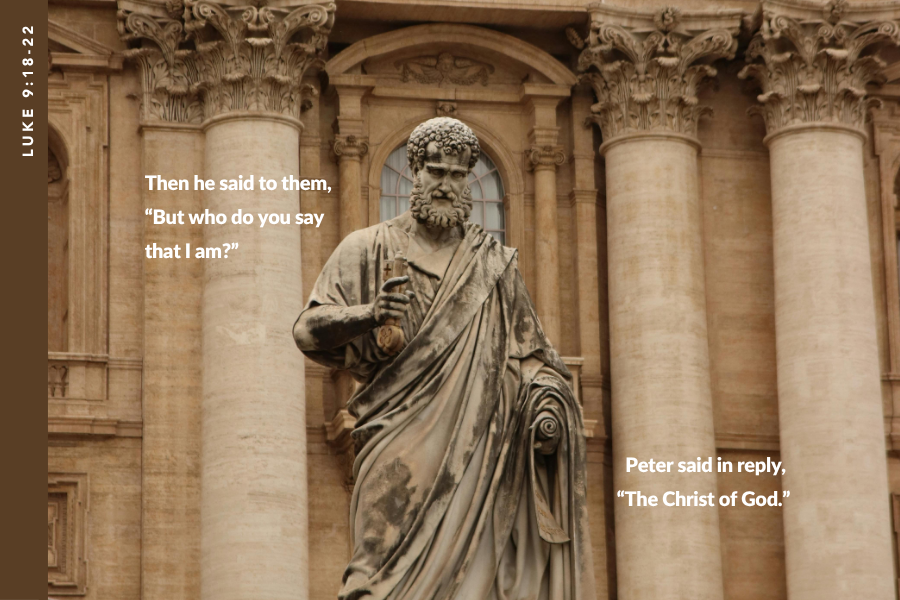
Once when Jesus was praying in solitude, and the disciples were with him, he asked them, “Who do the crowds say that I am?” They said in reply, “John the Baptist; others, Elijah; still others, ‘One of the ancient prophets has arisen.’” Then he said to them, “But who do you say that I am?” Peter said in reply, “The Christ of God.” He rebuked them and directed them not to tell this to anyone. He said, “The Son of Man must suffer greatly and be rejected by the elders, the chief priests, and the scribes, and be killed and on the third day be raised.”
Opening Prayer: As I come to my time of prayer today, Lord, bless me and strengthen me for the moments ahead when I will need your grace.
Encountering Christ:
- Speaking Up: When Jesus asked, “Who do the crowds say that I am,” the disciples showed by their answers that the crowds saw something special in Jesus, but that their vision was limited. They weren’t able to see beyond what they were comfortable with or what they understood. They were unable to see Jesus’ absolute uniqueness. In contrast, Peter recognized Jesus as “The Christ of God.” He spoke out in faith. We can sometimes find it difficult to follow Peter’s example and speak up when others challenge our faith. Nevertheless, each of us is called to “Always be ready to give an explanation to anyone who asks you for a reason for your hope” (1 Pet 3:15).
- Suffering Is to Be Expected: Jesus never gave the disciples room to imagine their lives would include power or prestige. He repeatedly reminded them that his life would include rejection and suffering and he taught them to expect the same. He said, “If the world hates you, realize that it hated me first” (Jn 15:18) and “If anyone wishes to come after me, he must deny himself and take up his cross daily and follow me” (Le 9:23). The Catechism acknowledges that this is challenging: “Our experiences of evil and suffering, injustice and death, seem to contradict the Good News; they can shake our faith and become a temptation against it” (CCC 164). But St. Paul encourages us: “Let us […] persevere in running the race that lies before us” (Heb 12:2).
- Suffering Out of Love: Jesus’s message of redemption included suffering. No one avoids suffering in this life, but by following Jesus’s example, our suffering can be an act of unconditional, self-giving love. What a blessing! Whether we choose suffering (as in a fast or practice of a virtue) or whether it falls upon us unwillingly, suffering is always an opportunity to love as Jesus did. We signify our willingness to suffer whenever we make the sign of the cross. “When suffering comes, the sign of the cross is a sign of acceptance. It’s remembering that Jesus became a man and suffered for us and that we participate in Christ’s suffering. The sign of the cross says, ‘I am willing to embrace suffering to share in Christ’s suffering’” (November 22, 2004, ZENIT).
Conversing with Christ: My Lord, my God, my Savior, my Refuge, I want to embrace all it is that you allow into my life as your instrument of salvation. I want to remember your cross as the sign of your love. Lord, help me grow in my trust in you and remember the words of the prayer of St. Padre Pio: “O Lord, we ask for a boundless confidence and trust in your Divine Mercy, and the courage to accept the crosses and sufferings which bring immense goodness to our souls and that of your Church…”
Resolution: Lord, today by your grace when I make the sign of the cross, I will do so reverently and thoughtfully, giving thanks for your sacrifice on the cross and asking for the grace to embrace the crosses and suffering of my own life with deeper faith and trust.
Janet McLaughlin and her husband, Chris, live on a mountain in rural northeastern Oregon. She puts her Master of Arts in Pastoral Studies to work as she shares the beauty and importance of the lay vocation in her writing, speaking, and teaching on spiritual topics.