March 18, 2025

The Resurrection of the Christ: Contemplations on the Risen Lord

At some point in the early hours of the sixteenth of Nissan, the seventh month of the Jewish Calendar, our Easter Sunday, something extraordinary happened to the body of Jesus of Nazareth. He had been executed by the Roman authorities and laid to rest nearby in the unused tomb of a wealthy man not much more than 24 hours before. His death had been so violent and gruesome that the words Isaiah once used to describe the Suffering Servant of God fittingly applied to him: “so marred was his appearance, (he was) beyond human semblance, and his form beyond that of mortals” (Isaiah 52:14). Flogging, abuse, and crucifixion had resulted in his total annihilation, leaving no inch of his body without its laceration, no element of his anatomy without its wound. According to the soldiers present at the scene – expert assassins – Jesus was beyond dead, his body a hopelessly mangled corpse. Any attempt at resuscitation, even with modern twenty-first century means, would have been useless; the damage was absolutely beyond repair.

The fact that his body went missing three days later – and was never found – and that his followers soon proclaimed him to be alive and well, full of grace and power, has no human explanation. It is true that they could have taken and hidden – or even destroyed – the body, but there is no way to account for their sudden change from complete apathy and hopelessness to undaunted audacity and brazen courage. They doubted and misunderstood him while he was alive. They abandoned him at the first sign of danger and failed to present themselves in the hour of his death. Why would they now, of a sudden, at the moment when his life and mission concluded in failure, usher forth from their hiding place and sacrifice their lives for him?

They had to have seen something.

Something portentous, earth-shattering, totally beyond human imagination had to have occurred.

The Resurrection of the Christ is the single, most important event of all history.

I hope my reflections on the Gospel passages pertaining to this mystery will help you come to know the Risen Lord and love him more deeply.

The Resurrection of the Christ: Contemplations on the Risen Lord Read More »

Regnum Christi Spirituality Center Ask a Priest

“Ask a Priest: What If My Aunt Is in an Invalid Marriage?”

Q: My question (I think) concerns fraternal correction and cooperating with sin. For context, both my parents have passed away, and one of my closest living relatives, an aunt, lives in the Midwest. I live in Texas. I was confirmed a few years ago, and my first visit to her since then was last summer. My aunt is “married” to a fallen-away Catholic (let’s call him Joe). Both have been married before. My aunt’s first husband recently died. To my knowledge my aunt was never confirmed, so I’ve focused my attention more on Joe, who hasn’t been to confession in over 30 years and has better understanding of the faith. During my visit, I tried to talk to him about the faith, but he won’t listen to me since I’ve only been Catholic for a few years. I’ve tried to mention vaguely that I don’t support divorce and remarriage but never addressed their situation specifically. My question is: What is my obligation to say something? Do I need to say something before I visit them again so it doesn’t appear that I approve of the situation? If so, do you have any advice on what to say? — S.

Answered by Fr. Edward McIlmail, LC

A: You want to avoid anything that implies consent for your aunt and Joe’s objectively gravely sinful domestic situation.

Here you would need to ask yourself whether your lodging under their roof implies your support for their situation.

It’s understandable that you want to keep in touch with your aunt, especially after the loss of your parents. And this might be an opportunity to help your aunt grow in her faith.

The sacrament of confirmation that you received gives you the grace to proclaim and defend the faith more boldly. Perhaps it is divine providence that brought you closer to your aunt’s orbit.

It might be good to begin a dialogue with her about the beauty of marriage and the need for unions to be blessed by God (through the Church). A U.S. bishops’ conference webpage has materials that might equip you with the right vocabulary.

You might ask your aunt if Joe has considered seeking an annulment and whether they would consider seeking a convalidation (“blessing”) of their union if the annulment is granted.

You might want to prepare for this dialogue ahead of your next visit.

In either case, at least you and she and Joe will know where everyone stands.

The alternative (not recommended) is to sweep things under the carpet and pretend there’s no problem. My guess is that you wouldn’t be at peace with that.

In the meantime, it would be good to intensify your prayers for your aunt and Joe. The Holy Spirit will be there to help.


“Ask a Priest: What If My Aunt Is in an Invalid Marriage?” Read More »

Lent 2025 – Day 14 – Building Well

Day 14

Building Well

Revelation teaches that the power to decide what is good and what is evil does not belong to man, but to God alone. Man is certainly free, inasmuch as he can understand and accept God’s commands. And he possesses an extremely far-reaching freedom, since he can eat “of every tree of the garden.” But his freedom is not unlimited: it must halt before the “tree of the knowledge of good and evil” (Genesis 2:16–17), for it is called to accept the moral law given by God. In fact, human freedom finds its authentic and complete fulfillment precisely in the acceptance of that law. God, who alone is good, knows perfectly what is good for man, and by virtue of his very love proposes this good to man in the commandments.

— St. John Paul II, Veritatis Splendor

Many post-modern ideologies and theories of human behavior tend to either over- or underemphasize the power of human freedom. These have seeped into popular culture at every level, and in some cases they have even affected how we understand the gospel itself. 

A Dangerous Disconnect

Behaviorist and immanentist schools of thought tend to blame all of our behaviors and choices on influences beyond our control. According to them, subconscious or unconscious complexes and urges or circumstantial and social pressures exercise so much influence on a person’s decisions that moral responsibility disappears. Some secularist and relativistic schools of thought, on the other hand, see the human mind as all-powerful. For them, not only can we freely determine what we choose to do, we can also freely and independently determine the very nature of good and evil. 

Both of those errors shatter the link between freedom and truth, between truth and goodness. If the human person is completely determined by urges and circumstances, then our dignity disappears, as does our capacity for spiritual creativity, friendship, loyalty, love, and any other moral virtue that would give authentic meaning to life. If, on the other hand, the human person is actually divine, unlimited in our capacity to create meaning and truth simply by willing to do so, then every individual becomes, in essence, a universe unto himself, and the possibility of true communion between persons (human and divine) disappears. In either case, the theoretical divorce between truth and goodness is a lie that, if accepted, makes interior peace, fulfillment, and authentic happiness impossible.

Jesus Believes in Us

Jesus freed us from these lies. In the first place, he acknowledged and accepted the complex influences that contribute to conditioning our freedom in this fallen world. This is why he commanded us not to judge the interior intentions and culpability of other people — we simply cannot know enough to make a full and accurate judgment about a person, even when a particular action is objectively wrong. Only God sees clearly the many circumstantial and subconscious influences that may be at work inside a person’s soul. It is enough for us to seek light regarding our own soul, without trying to manage the souls of others: 

“Stop judging, that you may not be judged. For as you judge, so will you be judged, and the measure with which you measure will be measured out to you. Why do you notice the splinter in your brother’s eye, but do not perceive the wooden beam in your own eye? How can you say to your brother, ‘Let me remove that splinter from your eye,’ while the wooden beam is in your eye? You hypocrite, remove the wooden beam from your eye first; then you will see clearly to remove the splinter from your brother’s eye.” (Matthew 7:1–5)

Our Lord, however, never exaggerated the role of external influences. He always believed in us. He always appealed to our spiritual ability to make good choices, to exercise our freedom in harmony with the truth, and in that way to achieve the maturity, wisdom, and holiness that we are created for. 

Yet he didn’t fall into the other trap either. He never exaggerated the power of our freedom, exonerating us from the duty to humbly obey the truth. We are called not to be gods, but to love God, and that includes following God’s plan for the human family in general, and for our individual life in particular. This conscious, free obedience to the truth promotes the fulfillment of our highest spiritual potential, and it alone leads to the meaning, fruitfulness, and happiness that will last. His respect for our capacity to do what is right and true, his hope in us, shines through in the finale of the Sermon on the Mount, a passage we have already seen:

“Everyone who listens to these words of mine and acts on them will be like a wise man who built his house on rock. The rain fell, the floods came, and the winds blew and buffeted the house. But it did not collapse; it had been set solidly on rock. And everyone who listens to these words of mine but does not act on them will be like a fool who built his house on sand. The rain fell, the floods came, and the winds blew and buffeted the house. And it collapsed and was completely ruined.” (Matt. 7:24–27)

The True and the Good 

The same tone fills the pages of the entire New Testament. In Christ, with him and through the gift of his grace, each of us has become “a new creation: the old things have passed away; behold, new things have come” (2 Corinthians 5:17). As a result, if we remain in the Lord and stay united to the vine, our collaboration with God’s grace can truly work wonders in us and through us: “I am the vine, you are the branches. Whoever remains in me and I in him will bear much fruit, because without me you can do nothing” (John 15:5).

We can learn to love God with all our strength. We can choose to follow Christ and travel the path of spiritual maturity. We can resist temptation and grow in virtue. We can make a difference in the world, building Christ’s kingdom and encouraging others to do the same. If we couldn’t, none of the New Testament letters would have been written, since they all contain passionate encouragement to make practical, daily choices worthy of our Christian calling. If knowing the truth were sufficient for our spiritual growth, and if we were not free to choose to live according to that truth, St. Paul, for example, would never have written this: 

Put to death, then, the parts of you that are earthly: immorality, impurity, passion, evil desire, and the greed that is idolatry. . . . Put on then, as God’s chosen ones, holy and beloved, heartfelt compassion, kindness, humility, gentleness, and patience, bearing with one another and forgiving one another, if one has a grievance against another; as the Lord has forgiven you, so must you also do. And over all these put on love, that is, the bond of perfection. . . . And whatever you do, in word or in deed, do everything in the name of the Lord Jesus, giving thanks to God the Father through him. (Colossians 3:5, 12–14, 17)

When our hearts desire God above all things, and our emotions are joyfully subject to an intellect enlightened by faith and a will strengthened and aligned by grace, we can truly love God with all our heart, soul, mind, and strength, just as Jesus commands.

Questions for Personal Reflection or Group Discussion

What idea in this reflection struck you most and why?

What is your knee-jerk reaction to the concept of “obedience”? Where does that reaction come from?

In what kinds of situations do you feel more acutely the temptation to accept the lie that truth and freedom are enemies instead of co-principles of spiritual maturity?

A visitor once asked Blessed Mother Teresa of Calcutta what he could really do to help the poor, since he felt so small and un-influential. She answered, “Pick up a broom.”  

What will you do today to obey Jesus better by putting your freedom at the service of the truth, to be a better “co-worker in the truth”? (3 John 8).

  • I will make a good examination of conscience and go to confession.
  • I will think about my own persistent unhealthy behavior patterns and try to figure out where their roots are. Then I will think of what kind of behaviors I could develop to correct those unhealthy patterns. I will talk to God about it and ask for his help.
  • I will read the explanation of the Ten Commandments in the Catechism.
  • (Write your own resolution) I will

Concluding Prayer

O Lord and Master of my life, grant not unto me a spirit of idleness, of discouragement ,of lust for power, and of vain speaking.

But bestow upon me, Thy servant, the spirit of chastity, of meekness, of patience, and of love.

Yea, O Lord and King, grant that I may perceive my own transgressions, and judge not my brother, for blessed art Thou unto ages of ages. Amen.

— St. Ephrem the Syrian

Lent 2025 – Day 14 – Building Well Read More »

WM_Surrender

A Season of Surrender

Dear Friends,


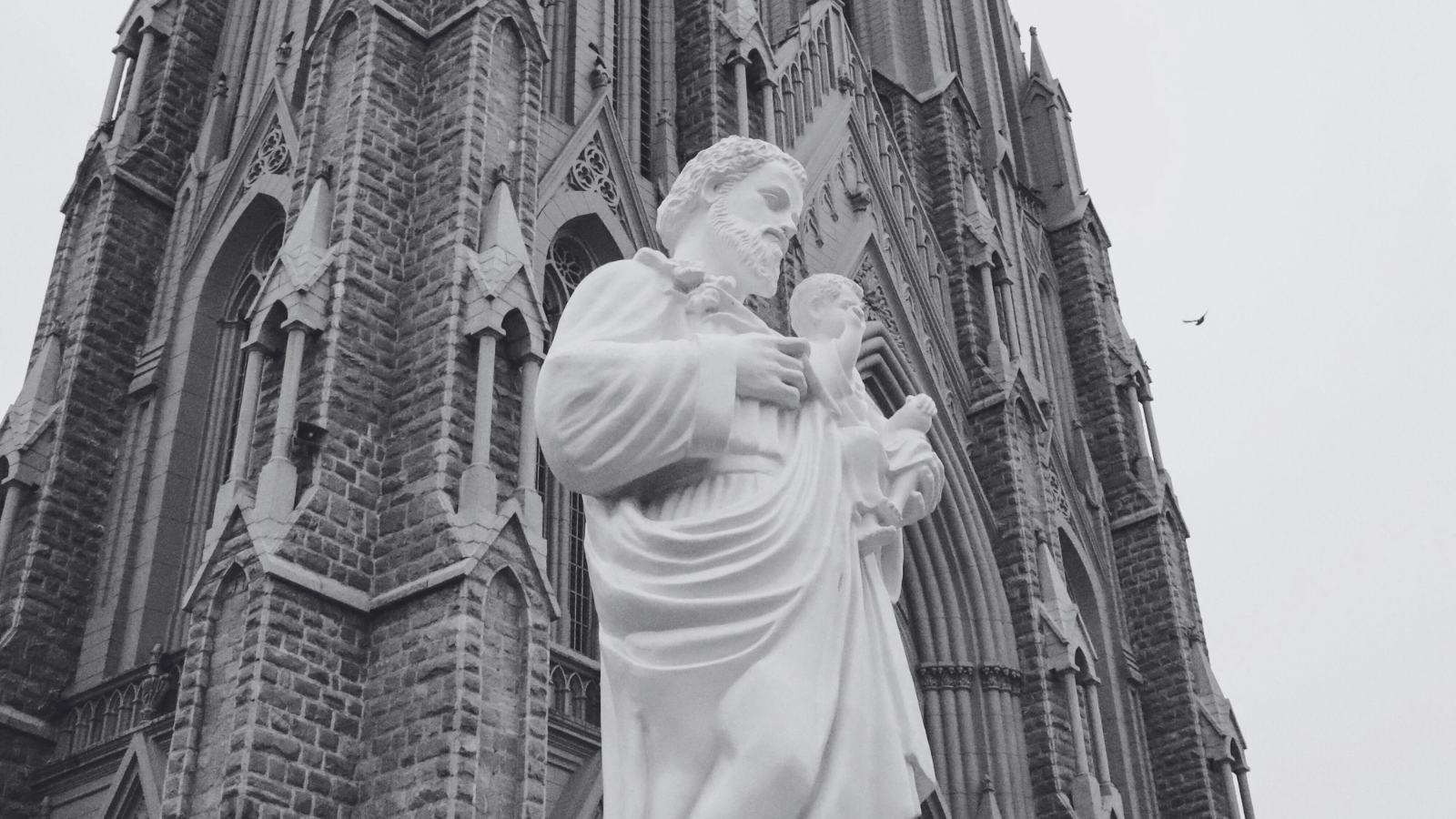
I found myself pondering the Feast of St. Joseph, celebrated on March 19, and its place within the Lenten season. There are many beautiful novenas asking for his intercession, and he has a lot of cool titles, like Terror of Demons, Diligent Protector of Christ and Patron of the Dying. A part of one popular novena I prayed reads:

O Glorious St. Joseph, spouse of the Immaculate Virgin,
obtain for us a pure, humble, and charitable mind,
and perfect resignation to the divine Will.

The word “resignation” caught my attention — it’s defined in a dictionary as “the acceptance of something undesirable but inevitable.” Yes, God’s will is inevitable, this is true. But I struggled with the concept that Joseph accepting God’s inevitable will was undesirable. Then, images of me white knuckling through a difficult situation came to mind. I pondered the heart of Joseph. How would he describe his heart with regards to God’s will? Would it be resigned, or would he willingly surrender his will for the will of God? The more I contemplated St. Joseph, the more that parallel of Lent and Jesus’ ultimate surrender seemed to align in my mind.

We can all resign our mind and our wills to something unwanted, but it takes surrender to move our hearts. St. Joseph surrendered his life, his plans and his heart to the will of God to serve as Jesus’ earthly father.  Lent is an opportunity for us to mortify our bodies in order to free our hearts to follow God’s will with a more perfect surrender.

I pray you live the remainder of Lent—not with resignation of your mind but rather—through your heart.

Yours in the Heart of Jesus,

Donna


A Season of Surrender Read More »

March 18, 2025 – Practice with the Master

Listen to the audio version

Tuesday of the Second Week of Lent

Matthew 23:1-12

Jesus spoke to the crowds and to his disciples, saying, “The scribes and the Pharisees have taken their seat on the chair of Moses. Therefore, do and observe all things whatsoever they tell you, but do not follow their example. For they preach but they do not practice. They tie up heavy burdens hard to carry and lay them on people’s shoulders, but they will not lift a finger to move them. All their works are performed to be seen. They widen their phylacteries and lengthen their tassels. They love places of honor at banquets, seats of honor in synagogues, greetings in marketplaces, and the salutation ‘Rabbi.’ As for you, do not be called ‘Rabbi.’ You have but one teacher, and you are all brothers. Call no one on earth your father; you have but one Father in Heaven. Do not be called ‘Master’; you have but one master, the Christ. The greatest among you must be your servant. Whoever exalts himself will be humbled; but whoever humbles himself will be exalted.”

Opening Prayer: Heavenly Father, you invite me into this time of prayer. Help me to quiet my mind and heart and recall that I am in your presence, that you dwell within me. I believe in you, I hope in you, and I love you. Increase my faith, and let me know you better. Increase my trust, that I may surrender myself to you in love.

  1. Preaching by Practicing: How many times in the Gospels did we find Jesus calling the Pharisees to conversion? He called out their hypocrisy and found himself exasperated at their hardness of heart. Still, Jesus recognized their authority as servants of the law he himself had given to Moses. It was their manner of living it out that separated them from the God they were called to serve. They lived inauthentically. Let us allow the Lord to look into our souls to root out any pharisaical tendencies there may be hidden within us.  

  2. To Be Seen: The Pharisees performed their works to be seen by man. We know that to be seen, to be looked upon and known, to be recognized, is a human need. How many orphans, homeless persons, or sick or marginalized persons speak of the greatest suffering, perhaps, as being unseen by others—not experiencing the gaze of another upon them, the reflection of recognition in the eyes of the other that you exist, and this is good. Jesus reminds us, however, that it is enough that the Father sees what we do. Doing things for human respect does not please Our Lord. So that we may be purified, let us turn within and realize we are under the gaze of our Father who sees everything that is hidden (cf. Mt 6:4).

  3. Master and Servant: Jesus is Master, and he teaches us to serve. Let us not seek to be called master, father, or teacher, but may it be enough that the Jesus who calls us to follow him, and who reveals his Father to us, is our Master, Teacher, and Father. The Catechism (CCC 786) reminds us that all Christians share in Christ’s kingly office precisely by sharing in his call to serve: “For the Christian, ‘to reign is to serve him,’ particularly when serving ‘the poor and the suffering, in whom the Church recognizes the image of her poor and suffering founder.’”

Conversing with Christ: Jesus, you have come to give us life, and how humbly you do so. You are so patient with my tendency to want to judge, measure, and be recognized and seen. Teach me by your example. May it be enough that you look upon me and see me. Teach me to live in the light of your gaze.

Resolution: Lord, today by your grace in my examination of conscience I will examine, with you, my purity of intention.

For Further Reflection: You may wish to read further in the Catechism on our sharing in Christ’s mission as priest, prophet, and king, as baptized Christians.

Beth Van de Voorde is a Regnum Christi Consecrated Woman, currently serving in pastoral ministry to families in Madrid and Valencia, Spain. When she’s not reading Ratzinger or humming along to some song or another, you may find her making her pilgrim way through Spain’s timeless history of faith, walking alongside the beautiful families and young people she’s there to serve.

March 18, 2025 – Practice with the Master Read More »

Scroll to Top

Events

Looking for another country?

Contact Regnum Christi near you

News & Resources

News & Resources

The Regnum Christi Mission

The Regnum Christi Identity

Alex Kucera

Atlanta

Alex Kucera has lived in Atlanta, GA, for the last 46 years. He is one of 9 children, married to his wife Karmen, and has 3 girls, one grandson, and a granddaughter on the way. Alex joined Regnum Christi in 2007. Out of the gate, he joined the Helping Hands Medical Missions apostolate and is still participating today with the Ghana Friendship Mission.

In 2009, Alex was asked to be the Atlanta RC Renewal Coordinator for the Atlanta Locality to help the RC members with the RC renewal process. Alex became a Group Leader in 2012 for four of the Atlanta Men’s Section Teams and continues today. Running in parallel, in 2013, Alex became a Team Leader and shepherded a large team of good men.

Alex was honored to be the Atlanta Mission Coordinator between 2010 to 2022 (12 years), coordinating 5-8 Holy Week Mission teams across Georgia. He also created and coordinated missions at a parish in Athens, GA, for 9 years. Alex continues to coordinate Holy Week Missions, Advent Missions, and Monthly missions at Good Shepherd Catholic Church in Cumming, GA.

From 2016 to 2022, Alex also served as the Men’s Section Assistant in Atlanta. He loved working with the Men’s Section Director, the Legionaries, Consecrated, and Women’s Section leadership teams.

Alex is exceptionally grateful to the Legionaries, Consecrated, and many RC members who he’s journeyed shoulder to shoulder, growing his relationship with Christ and others along the way. He knows that there is only one way, that’s Christ’s Way, with others!