THE WEEKLY DIGEST
OF REGNUM CHRISTI
DAILY MEDITATIONS

October 5, 2025 - Faith and Trust

DM 10-05

Twenty-Seventh Sunday in Ordinary Time

Luke 17:5-10

The apostles said to the Lord, “Increase our faith.” The Lord replied, “If you have faith the size of a mustard seed, you would say to this mulberry tree, ‘Be uprooted and planted in the sea,’ and it would obey you. Who among you would say to your servant who has just come in from plowing or tending sheep in the field, ‘Come here immediately and take your place at table’? Would he not rather say to him, ‘Prepare something for me to eat. Put on your apron and wait on me while I eat and drink. You may eat and drink when I am finished’? Is he grateful to that servant because he did what was commanded? So should it be with you. When you have done all you have been commanded, say, ‘We are unprofitable servants; we have done what we were obliged to do.’”

Opening Prayer: Loving Father, help me to trust in your providence. Increase my faith little by little so that my heart grows in love and trust in you.

Encountering Christ:

  1. Good Soil Leads to Increased Faith: Mustard seeds are tiny, but they grow into very large plants: “It is the smallest of all the seeds, yet when full-grown it is the largest of plants” (Mt 13:32). Likewise, the seed of faith may begin small, but we can cooperate with Jesus to increase our faith by ensuring that it has “good soil” in which to thrive. Some of the elements that make up the good soil of our spiritual lives are prayer, the sacraments, and Scripture reading. We can grow in faith by constantly caring for our spiritual lives. We can also pray and ask Jesus, just as the Apostles did, to “increase my faith.”


  2. Trust Versus Doubt: When we ask God to work in our lives, we demonstrate our faith by trusting that he will answer our prayers. “But he should ask in faith, not doubting, for the one who doubts is like a wave of the sea that is driven and tossed about by the wind. For that person must not suppose that he will receive anything from the Lord, since he is a man of two minds, unstable in all his ways” (Jas 1:6-8). Our God is good, and we are called to trust in him, even when we are praying for what seems to be impossible: “All good giving and every perfect gift is from above, coming down from the Father of lights” (Jas 1:17).


  3. Unprofitable Servants: As Christian disciples, we have an obligation to work to build up the Kingdom of God. It is our duty, not something we do to earn praise or thanks from others. Of course, when we have volunteered it is nice to be thanked, but this should not be the motivation for our service to the Lord. Our intention should be to fulfill our duty to love God above all things and love our neighbors as ourselves (cf. Mk 12:33). In this way, we will be “unprofitable servants” as Jesus exhorted us to be in this passage. We obtain the strength and willpower to do our duty when our goal is to love God with our whole heart. We do not serve for our own gain, but for God’s glory.

Conversing with Christ: Jesus, I believe that all things are possible with you (cf. Mt 19:26). Without you I know I can do nothing (cf. Jn 15:5). I am sorry for when I have failed to trust in your loving plan for me. Give me the grace I need to stay close to you in prayer, in the sacraments, and in your word so that my faith increases.

Resolution: Lord, today by your grace I will pray the Litany of Trust, written by the Sisters of Life.

For Further Reflection: Watch this video from Ascension Presents: What Does It Actually Mean to “Trust God”?

Carey Boyzuck, MTS, is a wife, mother, freelance writer, pastoral assistant, and lay member of Regnum Christi.

October 6, 2025 - Active, Generous, Merciful Love

10-06

Monday of the Twenty-Seventh Week in Ordinary Time

Luke 10:25-37

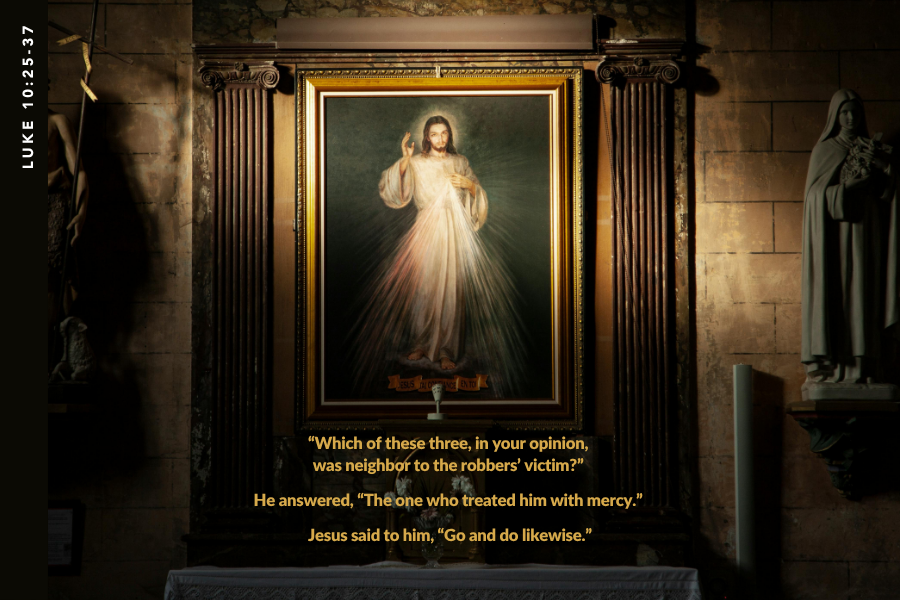
There was a scholar of the law who stood up to test Jesus and said, “Teacher, what must I do to inherit eternal life?” Jesus said to him, “What is written in the law? How do you read it?” He said in reply, “You shall love the Lord, your God, with all your heart, with all your being, with all your strength, and with all your mind, and your neighbor as yourself.” He replied to him, “You have answered correctly; do this and you will live.” But because he wished to justify himself, he said to Jesus, “And who is my neighbor?” Jesus replied, “A man fell victim to robbers as he went down from Jerusalem to Jericho. They stripped and beat him and went off leaving him half dead. A priest happened to be going down that road, but when he saw him, he passed by on the opposite side. Likewise a Levite came to the place, and when he saw him, he passed by on the opposite side. But a Samaritan traveler who came upon him was moved with compassion at the sight. He approached the victim, poured oil and wine over his wounds, and bandaged them. Then he lifted him up on his own animal, took him to an inn, and cared for him. The next day he took out two silver coins and gave them to the innkeeper with the instruction, ‘Take care of him. If you spend more than what I have given you, I shall repay you on my way back.’ Which of these three, in your opinion, was neighbor to the robbers’ victim?” He answered, “The one who treated him with mercy.” Jesus said to him, “Go and do likewise.”

Opening Prayer: Dear Lord, thank you for your endless, merciful love. You invite me to imitate your generous kindness as I love my neighbor as myself. Open my heart and mind so that I am able to hear, understand, and respond to your word.

Encountering Christ:

  1. Who Is My Neighbor?: In Jesus’ time, Jews and Samaritans were enemies. But, in this parable, the Samaritan came to the aid of the Jew in need. Part of loving our neighbors as ourselves is examining and possibly redefining the identities of our neighbors. St. John Paul II wrote, “A stranger is no longer a stranger for the person who must become a neighbor to someone in need, to the point of accepting responsibility for his life, as the parable of the Good Samaritan shows so clearly (Lk 10:25-37). Even an enemy ceases to be an enemy for the person who is obliged to love him (Mt 5:38-48; Lk 6:27-35), to ‘do good’ to him (Lk 6:27, 33, 35) and to respond to his immediate needs promptly and with no expectation of repayment (Lk 6:34-35). The height of this love is to pray for one’s enemy” (Evangelium Vitae, 41). Are there certain people or groups of people who we consider “not our neighbor,” such as those with different political ideas, those from different countries, or those with different religious beliefs? How is Jesus calling us to reevaluate who our neighbors are?


  2. Mercy Is Love in Action: There are people in this parable who harm and those who neglect; there is only one who helps. Jesus says that we should imitate the one who shows mercy to inherit eternal life. The source of this merciful love is not ourselves, but God: “We love because he first loved us. If anyone says, “I love God,” but hates his brother, he is a liar; for whoever does not love a brother whom he has seen cannot love God whom he has not seen. This is the commandment we have from him: whoever loves God must also love his brother” (1 Jn 4:19-21). How is Jesus calling us to imitate his divine mercy more closely?


  3. Generous Stewardship: Jesus is clear in this teaching: Love and mercy go hand in hand. The Good Samaritan saw the human dignity in the beaten man, and he ministered to him in a complete stewardship of his time, talent, and treasure. He spent his time going out of his way to care for and take the man to the inn. He offered his talent in treating his wounds with oil and wine. He spent his treasure on caring for the man, giving whatever it cost in order to ensure his complete healing. Moses taught: “… you shall not harden your heart nor close your hand against your kin who is in need. Instead, you shall freely open your hand and generously lend what suffices to meet that need” (Deut 15:7-8). We are called to be generous with the gifts God has given us, recognizing we are mere stewards of our time, talent, and treasure.

Conversing with Christ: My Jesus, help me to carry out this greatest commandment each and every day. Help me repent of any biases or prejudices I have about people who are different from me. Help me see your face in the face of both those I love and the strangers I meet on my journey. May I always be helpful, kind, and obedient to your will, Lord. Soften my heart and open my hands, so I am loving and generous like you.

Resolution: Lord, today by your grace I will discern one way that I can demonstrate an active love for you and my neighbor by doing a work of corporal or spiritual mercy today.

For Further Reflection: Read these lists of the corporal and spiritual works of mercy from the USCCB.

Carey Boyzuck, MTS, is a wife, mother, freelance writer, pastoral assistant, and lay member of Regnum Christi. She blogs at www.word-life-light.com.

October 7, 2025 - The Peace of Christ

10-07

Memorial of Our Lady of the Rosary

Luke 10:38-42

Jesus entered a village where a woman whose name was Martha welcomed him. She had a sister named Mary who sat beside the Lord at his feet listening to him speak. Martha, burdened with much serving, came to him and said, “Lord, do you not care that my sister has left me by myself to do the serving? Tell her to help me.” The Lord said to her in reply, “Martha, Martha, you are anxious and worried about many things. There is need of only one thing. Mary has chosen the better part and it will not be taken from her.”

Opening Prayer: Come, Holy Spirit, bring me your peace. Allow me to put aside any distractions and focus on your word. Allow it to change my heart to become more peaceful.

Encountering Christ:

  1. Wasting Time With Jesus: In this Gospel passage, Mary was sitting at Jesus’ feet and listening to him. This is the position of discipleship: humbly being taught by the Lord. It looked like inactivity and seemed like a waste of time to Martha, but we can be assured that nothing spent on Jesus is ever wasted. A weekly hour of adoration of the Blessed Sacrament is one way that we can lavish the gift of our time on Jesus. We may consider our schedules and think we do not have time to spend an hour doing nothing but praying at the feet of Jesus. However, the fruits of regularly spending time adoring Christ include having interior peace in the soul, a better awareness of God’s love for us, and less anxiety and stress, just to name a few. This is the “better part” that Jesus is calling us to. If your parish does not have perpetual Eucharistic adoration, you could choose a time each week to pray at the tabernacle in the sanctuary.


  2. Centered on One Thing: Sometimes this passage is interpreted as pitting prayer against work. This is not a teaching against working for the Lord. Instead, this passage is showing us how to work for the Lord more peacefully. Martha was “anxious and worried about many things.” Her heart was distracted by her to-do list, and she was overwhelmed by all the many tasks necessary in serving the Lord. The thorns of worldly anxieties choked out the presence of the Lord (cf. Mt 13:22). Now compare this to Mary, who sat peacefully at Jesus’ feet. Bishop Barron comments on this: “What Mary has chosen is…the focused life. She is anchored, rooted in the unum necessarium (one necessary thing).” Her whole being is centered on one thing: Jesus. The Benedictine motto ora et labora, pray and work, is a helpful way to think about this idea. We can prayerfully ground all the works we do in Christ, and he will bring us his peace.


  3. True God and True Man: Every Sunday we pray the Creed, and we publicly profess our faith in Jesus Christ as “God from God, Light from Light, true God from true God” who “was incarnate of the Virgin Mary, and became man.” Why would God, the all-powerful Creator of the universe, become man? Why would he lower himself to the point that he could be sitting in Martha’s living room and get involved in a squabble between sisters? Isn’t that kind of thing below the dignity of God? Maybe if you think of God in some other way, it would be. But the one, true God who has revealed himself in Jesus Christ clearly shows us that our most normal human experiences, even a squabble between sisters, even an impertinent outburst flowing from stress and worry, is meant to be a place of grace, a space to encounter and embrace Jesus in a new and enriching way. Jesus speaks directly into Martha’s complaint and points out a truth that we can live by. Jesus was so close to Martha and Mary that Mary felt comfortable sitting at his feet as he spoke in the living room, and Martha felt comfortable complaining and bringing him right into the nitty-gritty of her family affairs. Is Jesus that close to me? Am I that real in my conversations with him, or do I feel as if I have to put on some kind of show and hide my true self from the Lord? To what extent has Jesus truly become incarnate in my life?

Conversing with Christ: Jesus, I believe that you bring me the peace that the world cannot give (cf. Jn 14:27). Please increase that peace in my heart. When my heart is troubled and afraid, speak my name and calm my spirit. Help me to center my life on you completely so that all the work I do to serve you and others may be rooted in the gaze of your love.

Resolution: Lord, today by your grace I will pray the Peace Prayer of St. Francis.

For Further Reflection: Watch this short video “The Four C’s of Christian Meditation” in order to learn how to sit at Jesus’s feet and listen to his words.

Carey Boyzuck, MTS, is a wife, mother, freelance writer, pastoral assistant, and lay member of Regnum Christi. She blogs at www.word-life-light.com.

October 8, 2025 - Our Identity in Christ

10-08

Wednesday of the Twenty-Seventh Week in Ordinary Time

Luke 11:1-4

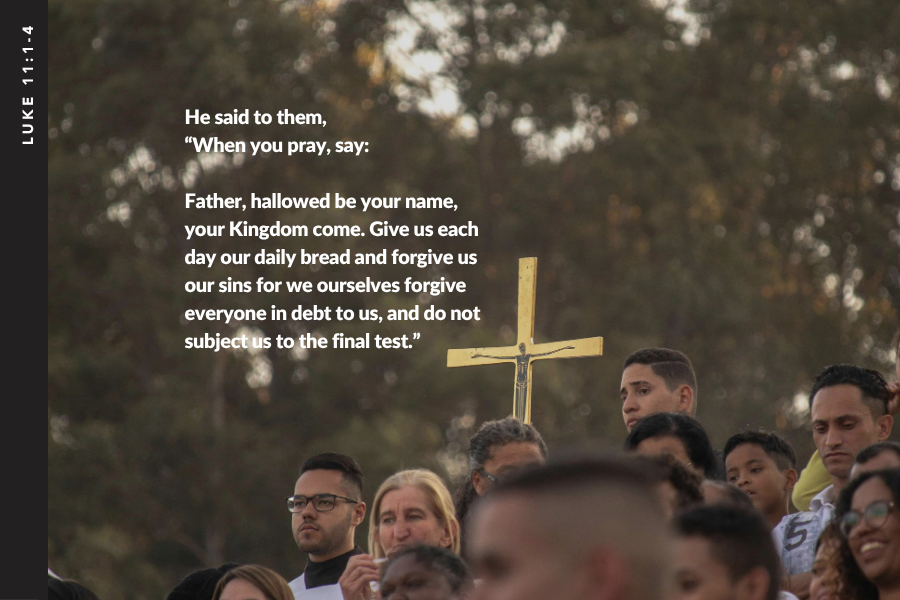
Jesus was praying in a certain place, and when he had finished, one of his disciples said to him, “Lord, teach us to pray just as John taught his disciples.” He said to them, “When you pray, say: Father, hallowed be your name, your Kingdom come. Give us each day our daily bread and forgive us our sins for we ourselves forgive everyone in debt to us, and do not subject us to the final test.”

Opening Prayer: Abba, Father! You are such a wonderful father. You provide all that I need for my earthly and spiritual needs. Open my heart to understand this prayer in an even deeper way.

Encountering Christ:

  1. Beloved Children of God: The Our Father is a simple but profound prayer. In it, Jesus teaches us our true identity. First of all, we who are baptized are beloved children of God. This is why we have the privilege of calling God our Father. We are “baptized into Christ” (Gal 3:27), which means that through our identification with Jesus we become his brothers and sisters, and therefore adoptive sons and daughters of the Father. St. Paul wrote that at baptism, through the Holy Spirit “… you received a spirit of adoption, through which we cry, ‘Abba, Father!’ The Spirit itself bears witness with our spirit that we are children of God” (Rom 8:15-16). Our deepest identity, our spirits, testify within us that we are beloved children.


  2. Hidden Sacraments: Because we are God’s children, we are called to trust him, just as a child trusts a good father who cares for and loves his children. This prayer also teaches us to rely on God the Father to provide for us in our needs, both earthly and spiritual. We ask for the most basic of needs: daily bread. This refers not only to the earthly food we need to sustain our bodies, but also for the spiritual food we need to sustain us: the Eucharist. One translation for the Greek word “daily,” epiousios, is “supersubstantial.” Our supersubstantial bread is the Eucharist, the Bread of Life (cf. Jn 6:35). We also ask for God’s forgiveness, which points us to the sacrament of Reconciliation. We ask our merciful Father to wash us from our sins, like a little child who needs a bath. We need the sacraments of the Eucharist and Reconciliation to remain connected to the divine life of Christ. We can ask ourselves if we trust God to provide for our earthly needs or if we fall into self-reliance. Do we recognize and give thanks for the amazing ways that God provides for us spiritually through the Eucharist and Reconciliation?


  3. Heirs of the Kingdom: The Our Father also defines our identity as joint heirs of Christ’s Kingdom. We pray, “Thy Kingdom come.” We are God’s children, “and if children, then heirs, heirs of God and joint heirs with Christ” (Rom 8:17). Jesus said, “Let the children come to me and do not prevent them; for the Kingdom of God belongs to such as these. Amen, I say to you, whoever does not accept the Kingdom of God like a child will not enter it” (Lk 18:16-17). We accept the Kingdom by becoming humble and enthroning Christ as Lord in our hearts (cf. 1 Pet 3:15). St. Therese wrote, “My little way is the way of spiritual childhood, the way of trust and absolute self-surrender.” We can ask ourselves if we strive to surrender to God’s will in all things or if we struggle against his plan for us.

Conversing with Christ: Jesus, you are the King of my heart! Reign there with your justice and mercy. Banish any evil that tries to impede your sovereignty. Help me to trust in you completely and give me a deep understanding of what it means to be a child of God.

Resolution: Lord, today by your grace I will pray the Our Father slowly and purposefully, meditating on each phrase.

For Further Reflection: Read the article “Spiritual Childhood” to consider how humility is a key part of our identities as beloved children of God. Additionally, here is an article on the Catholic Exchange, “Our Supersubstantial Bread.”

Carey Boyzuck, MTS, is a wife, mother, freelance writer, pastoral assistant, and lay member of Regnum Christi. She blogs at www.word-life-light.com.

October 9, 2025 - Relying on Prayer

10-09

Thursday of the Twenty-Seventh Week in Ordinary Time

Luke 11:5-13

Jesus said to his disciples: “Suppose one of you has a friend to whom he goes at midnight and says, ‘Friend, lend me three loaves of bread, for a friend of mine has arrived at my house from a journey and I have nothing to offer him,’ and he says in reply from within, ‘Do not bother me; the door has already been locked and my children and I are already in bed. I cannot get up to give you anything.’ I tell you, if he does not get up to give him the loaves because of their friendship, he will get up to give him whatever he needs because of his persistence. And I tell you, ask and you will receive; seek and you will find; knock and the door will be opened to you. For everyone who asks, receives; and the one who seeks, finds; and to the one who knocks, the door will be opened. What father among you would hand his son a snake when he asks for a fish? Or hand him a scorpion when he asks for an egg? If you then, who are wicked, know how to give good gifts to your children, how much more will the Father in Heaven give the Holy Spirit to those who ask him?”

Opening Prayer: Father, I believe that you are loving and generous. Please send your Holy Spirit to me. Give me a spirit of abandonment to you and help me to rely on you through prayer.

Encountering Christ:

  1. Letting Go of Self-Reliance: In today’s Gospel passage, Jesus used two analogies to help his disciples understand how prayer works. First, he spoke of knocking on a friend’s door to ask for a favor. The first step of the one who knocks is noticing that he has a need that he cannot fulfill. Sometimes it is difficult to admit when we cannot take care of our own needs. When we depend on God, he will act: “Commit your way to the Lord; trust in him and he will act” (Ps 37:5). What would it look like if we focused on trusting the Lord no matter what the circumstances?


  2. Persevere in Prayer: Notice the tenacity of the one who needed the bread. Jesus said if the man continued to “knock” or pray for what he needs, that he would receive it. God desires that we continue to come to him with our needs. We are called to persevere in prayer. When we are persistent in prayer, we strengthen our attachment to God and lessen the habit of self-reliance. Prayer is not a passive activity; it is active and effective. Prayer does not change God or persuade him to act in a way that is outside of his will. Instead, prayer changes us. St. Mother Teresa of Calcutta said, “I used to believe that prayer changes things, but now I know that prayer changes us, and we change things.”


  3. Expect Good Things: The second analogy Jesus used was that of a father who gives good things. He used hyperbole to demonstrate this point. Of course, no good father would give his children snakes or scorpions! But sometimes we do expect less than good things to come from God. If we ask, God will give us the greatest good we can receive: the gift of the Holy Spirit (cf. Lk 11:13). Sometimes we lack the trust that God will truly provide for us. How is God calling us to trust more fully in his loving providence?

Conversing with Christ: Jesus, I adore your generous heart. I believe that you want to give me everything I truly need. I am sorry for when I have been self-reliant and not depended on you to provide for me, and instead tried to take care of myself. I am sorry for when I have doubted your goodness or power to meet my needs. Thank you for all the good gifts in my life—they are countless! Help me to let go of self-reliance, and give me the grace I need to abandon myself to your loving mercy. Jesus, I trust in you.

Resolution: Lord, today by your grace I will reflect on the ways that the Father has provided for me and give him thanks. I will examine my conscience for times when I have been self-reliant.

For Further Reflection: Begin reading the spiritual classic, Abandonment to Divine Providence by Jean-Pierre De Caussade, S.J.

Carey Boyzuck, MTS, is a wife, mother, freelance writer, pastoral assistant, and lay member of Regnum Christi. She blogs at www.word-life-light.com.
October 10, 2025 - Facing Uncomfortable Facts

10-10

Friday of the Twenty-Seventh Week in Ordinary Time

Luke 11:15-26

When Jesus had driven out a demon, some of the crowd said: “By the power of Beelzebul, the prince of demons, he drives out demons.” Others, to test him, asked him for a sign from Heaven. But he knew their thoughts and said to them, “Every kingdom divided against itself will be laid waste and house will fall against house. And if Satan is divided against himself, how will his kingdom stand? For you say that it is by Beelzebul that I drive out demons. If I, then, drive out demons by Beelzebul, by whom do your own people drive them out? Therefore they will be your judges. But if it is by the finger of God that I drive out demons, then the Kingdom of God has come upon you. When a strong man fully armed guards his palace, his possessions are safe. But when one stronger than he attacks and overcomes him, he takes away the armor on which he relied and distributes the spoils. Whoever is not with me is against me, and whoever does not gather with me scatters. When an unclean spirit goes out of someone, it roams through arid regions searching for rest but, finding none, it says, ‘I shall return to my home from which I came.’ But upon returning, it finds it swept clean and put in order. Then it goes and brings back seven other spirits more wicked than itself who move in and dwell there, and the last condition of that man is worse than the first.”

Opening Prayer: I come to you today, Lord, to bless you for your infinite kindness. I thank you for your generous and constant outpouring of grace. I want to know you better and to know myself better because of this time of prayer. Teach me, Lord, to hear your voice, to heed your voice, and to echo your voice in all my thoughts, words, and actions throughout the day.

Encountering Christ:

  1. Demons Are Real: In modern times, many so-called biblical scholars have often tried to reinterpret Gospel passages like the one the Church offers us today. It is so obvious from these passages that the devil and demons, the fallen angels who rebelled against God, are real and active in this world. And yet, that simple fact seems to make some modern and postmodern thinkers very uncomfortable. Therefore, they say that in ancient times people were just ignorant, so they superstitiously attributed merely psychological and physical ailments to demonic intervention. Of course, this line of reasoning wildly distorts the actual Gospel texts, which clearly distinguish between illness and demonic possession. Jesus is clear: Demons exist, and they are actively working against the truth, goodness, and beauty through which God draws us into intimate communion with himself. As the Catechism (414) puts it: “Satan or the devil and the other demons are fallen angels who have freely refused to serve God and his plan. Their choice against God is definitive. They try to associate man in their revolt against God.” As inconvenient or uncomfortable as this revealed doctrine may be, it is true nonetheless. And if we forget it, ignore it, or deny it, we will only increase the confusion and frustration that naturally accompany our journey through this fallen world.


  2. Avoiding Exaggerations: Of course, it is possible to go to the other extreme as well, attributing every human foible, dysfunction, and challenge to direct demonic activity. This too is a dangerous deviation from the truth. Jesus clearly indicates in this passage that he is the Lord of life and history, and he has put limits on the devil’s attempted dominance over human affairs. To return to the Catechism (395): “The power of Satan is, nonetheless, not infinite. He is only a creature, powerful from the fact that he is pure spirit, but still a creature. He cannot prevent the building up of God’s reign. Although Satan may act in the world out of hatred for God and his Kingdom in Christ Jesus, and although his action may cause grave injuries—of a spiritual nature and, indirectly, even of a physical nature—to each man and to society, the action is permitted by divine providence which with strength and gentleness guides human and cosmic history.” Jesus doesn’t want us to ignore demonic activity, but he doesn’t want us to be obsessed with it, either. He wants us to recognize him as Lord, and courageously battle at his side for the advance of his Kingdom in our hearts and in the hearts around us. A healthy Christian is a balanced and dependable person, just like Christ himself.


  3. Spiritual Blindness: Jesus was performing dramatic miracles and driving out demons, right before the very eyes of immense crowds, and yet so many of those eyes didn’t seem to see what was really happening. Some of the crowd accused him of being on Satan’s side, and others asked for more signs. What is it about our fallen human nature that resists the clear signs that God sends us? Why do we keep seeking more convincing indications of God’s love and presence than all the ones he continuously gives us—the marvelous beauties of nature, the amazingly coherent and complete teaching of the Church, the unbroken succession of saints and sacraments for two thousand years? This tendency to spiritual blindness never really leaves us. As Jesus points out in his parable, even when we welcome his grace into our lives, we remain vulnerable to backsliding, maybe even falling back to a worse state of ignorance and corruption than the one we started in. It is humbling to hear Jesus describe this. We can never rest on our laurels in the spiritual life. We must always continue to raise our hearts and minds to Christ and be ever watchful. One practice many spiritual masters through the centuries have recommended to help us stay on track is regular confession. Taking time every two weeks or every month to prayerfully examine the state of our soul and humbly approach the Lord for forgiveness and renewed strength is a wise discipline that can help keep our friendship with Christ fresh. May God grant us the humility to embrace it.

Conversing with Christ: I know that life on earth will always be a battle, Lord. My own fallen nature, the fallen world, the fallen angels—all these forces constantly pull me away from you. But you are stronger! You are the eternal King, my Lord, who promises to be with me until the end of time. I have nothing to fear if only I stay close to you. Thank you for coming to our rescue, for putting your omnipotence at our service, for never ceasing to send your grace among us so that we can fight faithfully and joyfully for your Kingdom as long as you ask us to.

 Resolution: Lord, today by your grace I will make some kind of small physical sacrifice as an offering to God in union with Christ’s self-sacrifice on the cross, and as a reminder to myself that earth is not heaven and I will need to resist the bent inclinations of my fallen nature throughout my Christian journey.

For Further Reflection: This post from spiritualdirection.com about how demonic activity occurs in the human realm.

Father John Bartunek, LC, is an author, speaker, and contributor at RCSpirituality.org, an online spirituality center providing a variety of resources for spiritual growth.

October 11, 2025 - Hearers and Doers of the Word

10-11

Saturday of the Twenty-Seventh Week in Ordinary Time

Luke 11:27-28

While Jesus was speaking, a woman from the crowd called out and said to him, “Blessed is the womb that carried you and the breasts at which you nursed.” He replied, “Rather, blessed are those who hear the word of God and observe it.”


Opening Prayer: Come, Holy Spirit, open my ears so that I hear your word. Open my mind so that I understand it. Bless my lips so that I speak it to others. Strengthen my heart to do your will.

Encountering Christ:

  1. The Blessed Handmaid: The woman from the crowd proclaimed almost the identical message that Elizabeth did at the Visitation, found earlier in Luke’s Gospel: “Most blessed are you among women, and blessed is the fruit of your womb” (Lk 1:42). Mary responded to this with humility and obedience: “For he has looked upon his handmaid’s lowliness; behold, from now on will all ages call me blessed” (Lk 1:48). Mary is called “blessed,” but only because she is lowly and humble. She is the Lord’s handmaid. A handmaid always kept her eyes on the hands of those whom she served. She was watching for directions given by subtle hand signals. A handmaid of the Lord is one who does the will of God, submitting completely to him. How do we imitate Mary’s virtues of humility and obedience?


  2. Hearing God’s Word: Blessings come to those who first hear God’s word, then do his will. The word is how we access and understand his will. God’s word comes to us in a variety of ways. In the sacraments, especially the Mass, we hear Scripture passages and prayers that are taken directly from Scripture. We also hear the priest’s homily, which can help God’s word come alive and allow us to consider how to apply it to our lives. We can hear God’s word when we read Scripture privately, and in prayer, as well. God’s word can also come to us through the words of other godly people. In all of these ways, we can hear and recognize God’s voice. What is God saying to me today?


  3. Doing God’s Will: St. James wrote, “Be doers of the word and not hearers only, deluding yourselves… the one who peers into the perfect law of freedom and perseveres, and is not a hearer who forgets but a doer who acts, such a one shall be blessed in what he does” (Jas 1:22; 25). Our faith must be living and active, for “faith of itself, if it does not have works, is dead” (Jas 2:17). One can pray, receive the sacraments, read Scripture and truly believe the word of God, but if it stops there one’s faith will not be fruitful. Fruitfulness is deeply connected to doing God’s will.

Conversing with Christ: Jesus, how beautiful is your word, and how wonderful is your will. I am sorry for the times when my ears have been closed to your word or my heart has been closed to doing your will. Thank you for always calling me to love and serve you more fruitfully. Please give me the grace I need to hear and respond to your word. Especially give me the virtues of faith, wisdom, conviction, humility, and obedience.

Resolution: Lord, today by your grace I will listen for your voice in all of the ways it comes to me. I will respond by doing whatever you ask of me.

For Further Reflection: Read the book of James, especially focusing on expressing an active faith by responding to God’s word. It is only five chapters long, but if you have just a little time, focus on the first two chapters and finish the rest later.

Carey Boyzuck, MTS, is a wife, mother, freelance writer, pastoral assistant, and lay member of Regnum Christi. She blogs at www.word-life-light.com.
October 12, 2025 - Stand Up and Go

10-12

Twenty-Eighth Sunday in Ordinary Time

Luke 17:11-19

As Jesus continued his journey to Jerusalem, he traveled through Samaria and Galilee. As he was entering a village, ten lepers met him. They stood at a distance from him and raised their voices, saying, “Jesus, Master! Have pity on us!” And when he saw them, he said, “Go show yourselves to the priests.” As they were going they were cleansed. And one of them, realizing he had been healed, returned, glorifying God in a loud voice; and he fell at the feet of Jesus and thanked him. He was a Samaritan. Jesus said in reply, “Ten were cleansed, were they not? Where are the other nine? Has none but this foreigner returned to give thanks to God?” Then he said to him, “Stand up and go; your faith has saved you.”

Opening Prayer: My God, I love and I thank you! Grant me the grace to praise you as you are praised in today’s psalm, “Sing to the Lord a new song, for he has done wondrous deeds; his right hand has won victory for him, his holy arm. All the ends of the earth have seen the salvation by our God. Sing joyfully to the Lord, all you lands: break into song; sing praise (from Ps 98).

Encountering Christ:

  1. Calling to Jesus: As he journeyed to the Temple in Jerusalem, Jesus traveled through the areas where God’s people lived (Galilee) and the places where they had fallen away (Samaria). Christ was on his way to suffer his Passion for the salvation of all people, and he was working to unite and bring everyone into his Kingdom. Lepers were outcasts who were forced to keep their distance because of contagion. Yet these men knew who Jesus was and didn’t hesitate to make a scene by calling out to him, “Jesus, Master! Have pity on us.” They were desperate for a cure and hoped in the healing power of Jesus. Two thousand years later, we know Jesus is “healing and wholeness, the anointed, our strength and salvation, almighty, King of the Universe” (Litany of Praise). He is still working to bring everyone into his Kingdom. When we are suffering, we call out to Jesus full of hope, just as the lepers did, “Jesus, Master! Have pity on us!”


  2. Obeying the Master: Jesus directed the lepers to “go show yourselves to the priests,” because priests had the responsibility to declare lepers clean and able to return to society. Jesus also directs us to “go show yourselves to the priests.” At the hands of our priests we receive the sacraments of Baptism (which gives us new life as children of God), Reconciliation (which heals us of our sins), and the Eucharist (which makes Jesus present to us). We are truly healed and restored by the graces flowing from the Catholic priesthood. Let us pray for priests and for more vocations to the priesthood.


  3. Stand Up and Go: The proper response to the sacrifice Jesus made for our salvation is gratitude. Although the one who returned to thank Jesus was a Samaritan, an outsider to the faith, it was this leper who received praise and a mission from God: “Stand up and go; your faith has saved you.” First, Jesus commands him to “stand up” and claim his place as a child of God and then to “go” and evangelize by telling others what happened to him. By the graces we receive through the sacraments, we are continually healed and restored. Like the leper, we set out to accomplish the mission God has given us—to joyfully share our love of Christ with everyone.

Conversing with Christ: Unlike the lepers in this Gospel passage who had only heard of you, I know and love you intimately, Lord Jesus. I also know that I suffer from spiritual leprosy and live in constant need of your healing. Help me, Lord, to approach you despite my leprosy, confident in your loving, transformative power to restore me through the sacraments.

Resolution: Lord, today by your grace I will strive to go more frequently to the sacraments of Reconciliation and the Eucharist.

For Further Reflection: Read Part Two, Section Two of the Catechism of the Catholic Church, “The Seven Sacraments of the Church,” and thank Jesus for his gift of the Church.

Nan Balfour is a wife, mother, and grandmother. She volunteers as a writer and speaker for Pilgrim Center of Hope, a Catholic evangelization ministry that answers Christ’s call by guiding people to encounter him so as to live in hope as pilgrims in daily life.

Scroll to Top

Events

Looking for another country?

Contact Regnum Christi near you

News & Resources

News & Resources

The Regnum Christi Mission

The Regnum Christi Identity

Alex Kucera

Atlanta

Alex Kucera has lived in Atlanta, GA, for the last 46 years. He is one of 9 children, married to his wife Karmen, and has 3 girls, one grandson, and a granddaughter on the way. Alex joined Regnum Christi in 2007. Out of the gate, he joined the Helping Hands Medical Missions apostolate and is still participating today with the Ghana Friendship Mission.

In 2009, Alex was asked to be the Atlanta RC Renewal Coordinator for the Atlanta Locality to help the RC members with the RC renewal process. Alex became a Group Leader in 2012 for four of the Atlanta Men’s Section Teams and continues today. Running in parallel, in 2013, Alex became a Team Leader and shepherded a large team of good men.

Alex was honored to be the Atlanta Mission Coordinator between 2010 to 2022 (12 years), coordinating 5-8 Holy Week Mission teams across Georgia. He also created and coordinated missions at a parish in Athens, GA, for 9 years. Alex continues to coordinate Holy Week Missions, Advent Missions, and Monthly missions at Good Shepherd Catholic Church in Cumming, GA.

From 2016 to 2022, Alex also served as the Men’s Section Assistant in Atlanta. He loved working with the Men’s Section Director, the Legionaries, Consecrated, and Women’s Section leadership teams.

Alex is exceptionally grateful to the Legionaries, Consecrated, and many RC members who he’s journeyed shoulder to shoulder, growing his relationship with Christ and others along the way. He knows that there is only one way, that’s Christ’s Way, with others!