THE WEEKLY DIGEST
OF REGNUM CHRISTI
DAILY MEDITATIONS

October 19, 2025 – Pray Without Ceasing

Twenty-Ninth Sunday in Ordinary Time

Luke 18:1-8

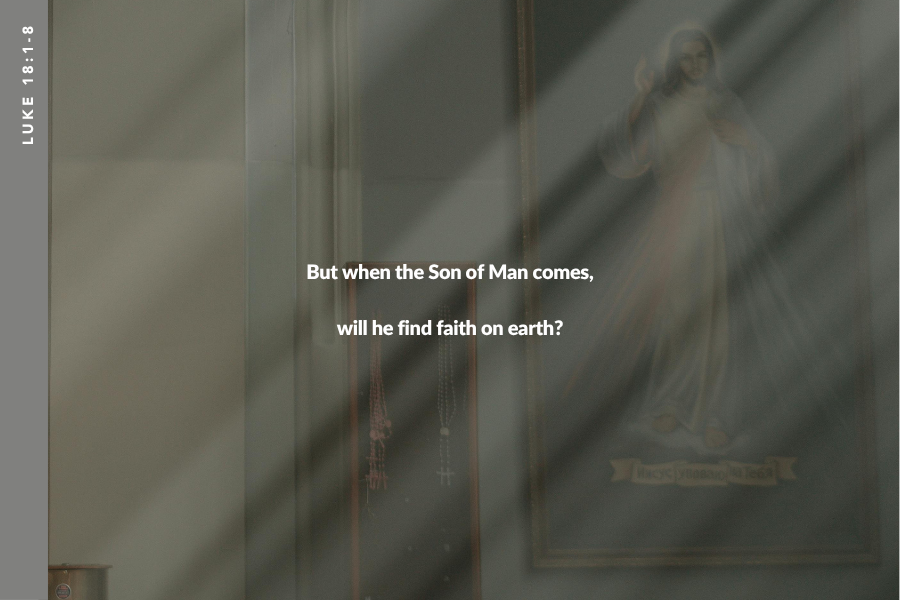
Jesus told his disciples a parable about the necessity for them to pray always without becoming weary. He said, “There was a judge in a certain town who neither feared God nor respected any human being. And a widow in that town used to come to him and say, ‘Render a just decision for me against my adversary.’ For a long time, the judge was unwilling, but eventually he thought, ‘While it is true that I neither fear God nor respect any human being, because this widow keeps bothering me, I shall deliver a just decision for her lest she finally come and strike me.’” The Lord said, “Pay attention to what the dishonest judge says. Will not God then secure the rights of his chosen ones who call out to him day and night? Will he be slow to answer them? I tell you, he will see to it that justice is done for them speedily. But when the Son of Man comes, will he find faith on earth?”

Opening Prayer: Father, you want me to come to you with all that I am: my hopes and desires, my fears and sorrows, my faults and failures. You never tire of listening to me, so why do I spend so little time speaking with you? Lord, I believe that you are my Creator who loves me. I hope in your goodness and providential care for me. I love you and desire to love you more. Grant me the grace to deepen my relationship with you through my prayer.

Encountering Christ:

  1. Prayer Is Necessary: While God can do anything, he chooses most often to work through our prayers and our actions. He gives us the privilege of cooperating with him in his ongoing action in the world in both these ways. Prayer is also a necessary pathway to deeper faith. In prayer, we open our hearts to his heart, sharing our hopes and needs, our fears and joys. We tell him all those things we would tell our closest friend—and more. He knows it all already, but as we share it, our faith is deepened. We come to an experience of his tender love for us, individually and personally. When it seems that the Lord is slow to answer (or answers “no”), he gives us the chance to trust him and to more deeply desire and treasure the things he does. The Catechism asks us to consider that “the wonder of prayer is revealed beside the well where we come seeking water: there, Christ comes to meet every human being. It is he who first seeks us and asks for a drink. Jesus thirsts; his asking arises from the depths of God’s desire for us. Whether we realize it or not, prayer is the encounter of God’s thirst with ours. God thirsts that we may thirst for him” (CCC 2560).


  2. Pray Always: In this parable, the Lord teaches us to pray without ceasing. We may echo the reaction the authors of the Catechism anticipated, “Many Christians unconsciously regard prayer as an occupation that is incompatible with all other things they have to do: they ‘don’t have the time’” (CCC 2726). In contrast, the Catechism insists, “Prayer in the events of each day and each moment is one of the secrets of the Kingdom revealed to ‘little children,’ to the servants of Christ… It is right and good to pray so that the coming of the Kingdom… may influence the march of history, but is just as important to bring the help of prayer into humble, everyday situations (CCC 2660). In the Decree on the Apostolate of the Laity, St. Paul VI recommends that the laity use the “spiritual aids” the Church offers “in such a way that while correctly fulfilling their secular duties in the ordinary conditions of life, they do not separate union with Christ from their life but rather performing their work according to God’s will they grow in that union” (n. 4). Nevertheless, St. Gregory Nazianzen insists that while we “must remember God more often than we draw breath” it is also true that “we cannot pray ‘at all times’ if we do not pray at specific times…” (CCC 2697). Just as in our human relationships, Christ wants to be invited into our daily realities, and our times of focused, attentive daily prayer.


  3. The Family and Prayer: Jesus learned to pray from Joseph and Mary, and our children and grandchildren, nieces and nephews, and others need to learn to pray from us. “The Christian family is the first place of education in prayer. Based on the sacrament of marriage, the family is the ‘domestic church’ where God’s children learn to pray ‘as the Church’ and to persevere in prayer. For young children in particular, daily family prayer is the first witness of the Church’s living memory as awakened patiently by the Holy Spirit” (CCC2685). When we pray regularly with our family, we are calling on the power of Almighty God into our midst and we are teaching the younger ones how important it is to make God the central person in our lives.

Conversing with Christ: Lord, I want to know you more deeply—not just knowing about you through my intellect, but knowing you heart-to-heart. Help me see your presence and action in the events of my day and the people whom I encounter. Help me listen with my mind and heart that I may know and desire to live your will in my life. I want to remember that prayer is about a real relationship with you. And, Lord, help me share the gift of prayer with others, especially the children in my family.

Resolution: Lord, today by your grace I will review my prayer life to see how I can better enter into true conversation with you, and I will invite someone to pray with me.

For Further Reflection: Watch Fr. John Bartunek in the Four “C’s” of Meditation or read the section in the Catechism on meditation (2705-2708).

Janet McLaughlin and her husband Chris live on a mountain in rural northeastern Oregon. She puts her Master of Arts in Pastoral Studies to work as she shares the beauty and importance of the lay vocation in her writing, speaking, and teaching on spiritual topics.
October 20, 2025 – Guard Against Greed

10-20

Monday of the Twenty-Ninth Week in Ordinary Time

Luke 12:13-21

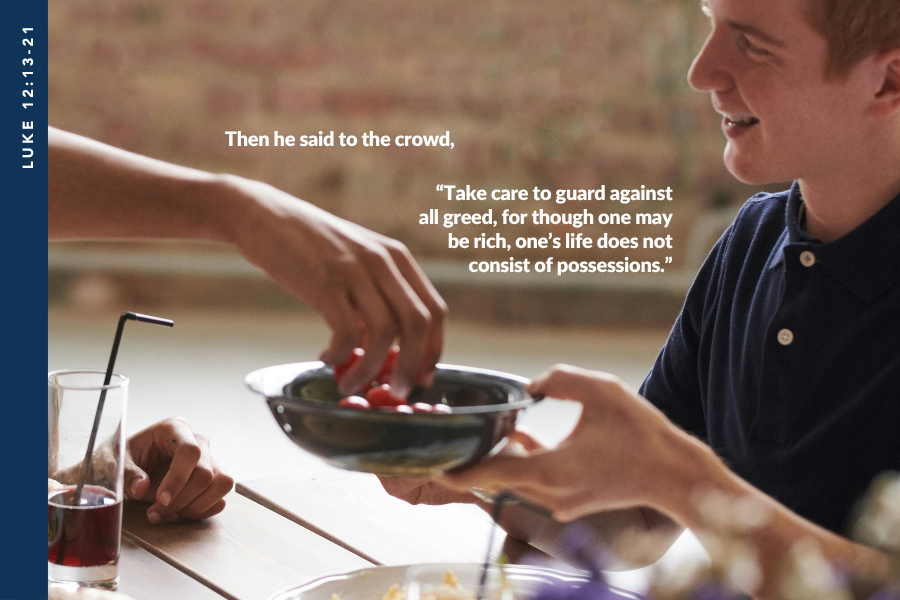
Someone in the crowd said to Jesus, “Teacher, tell my brother to share the inheritance with me.” He replied to him, “Friend, who appointed me as your judge and arbitrator?” Then he said to the crowd, “Take care to guard against all greed, for though one may be rich, one’s life does not consist of possessions.” Then he told them a parable. “There was a rich man whose land produced a bountiful harvest. He asked himself, ‘What shall I do, for I do not have space to store my harvest?’ And he said, ‘This is what I shall do: I shall tear down my barns and build larger ones. There I shall store all my grain and other goods and I shall say to myself, “Now as for you, you have so many good things stored up for many years, rest, eat, drink, be merry!”’ But God said to him, ‘You fool, this night your life will be demanded of you; and the things you have prepared, to whom will they belong?’ Thus will it be for the one who stores up treasure for himself but is not rich in what matters to God.”

Opening Prayer: Lord, nothing the world offers can compare with the gift of your love and the promise of eternal life with you. Nevertheless, it is so easy to get caught up with thoughts of material security. Turning to you in this time of prayer, Lord, I set my heart on you. I remember the saying, “You are what you love.” Lord, I want to love you above all else. I believe that you are the source of real and lasting happiness. I trust in your goodness and mercy.

Encountering Christ:

  1. Guard Against All Greed: Imagine having the opportunity to stand before Jesus and choosing to say, “Teacher, tell my brother to share the inheritance with me.” This man’s question showed what he valued most in life. Like the man who went away sad because he could not let go of his possessions to follow Jesus, this man was focused on material well-being. In the parable, Jesus clearly demonstrates how limited this focus is. Jesus encourages us to look beyond what we see and do here and now and set our sights on the world to come. St. Matthew quotes Jesus, “Where your treasure is, there also will your heart be” (Mt 6:21). Does the way we manage our financial resources reflect our Christian values?


  2. Disordered Attachment: In his First Letter to Timothy, St. Paul warned, “For the love of money is the root of all evils” (1 Tim 6:10), and in the book of Hebrews, he wrote, “Let your life be free from love of money but be content with what you have, for he has said, ‘I will never forsake you or abandon you’” (Heb 13:5). It takes money to live, and money can be used for great good; however, those who consider money to be the source of their identity and happiness need to hear Christ’s statement: “One’s life does not consist in possessions” (Lk12:13). St. Paul VI wrote, “The exclusive pursuit of possessions thus becomes an obstacle to individual fulfillment and to man’s true greatness. Both for nations and for individual men, avarice is the most evident form of moral underdevelopment” (St. Paul VI, Populorum Progressio, 19). Our choices make evident how we prioritize God and the material world.


  3. Practical Atheism?: When we profess to love the Lord and try to follow him, we encounter challenges. Sometimes we are challenged to overcome a bad, even sinful, habit. Sometimes we are challenged to embrace a moral or theological teaching of the Church. However, sometimes it happens that an individual decides to live according to his own lights, effectively putting God in second place. In this passage, the man anticipated storing up everything he needed for many years, implying that he did not need God in his future. Jesus directs our attention to the importance of being rich in the things of God rather than storing up treasure for ourselves. “What profit is there for one to gain the whole world and forfeit his life?” (Mk 8:36).

Conversing with Christ: Jesus, in my mind, I want to believe that there is nothing more important than you. However, as I slow down and look at my life, I see that there are things that I justify clinging to, despite your clear teaching or your whisper asking me to let it go. Lord, expand my heart with love of you, so that I desire you so much that I have the determination to change. Give me the strength to persevere on my path to you.

Resolution: Lord, today by your grace I will make an appointment for a Holy Hour to focus on discovering what is most difficult for me to surrender to you, and I will invite someone to accompany me.

 For Further Reflection: Read this article about the impact of Adoration in Baltimore.

Janet McLaughlin and her husband Chris live on a mountain in rural northeastern Oregon. She puts her Master of Arts in Pastoral Studies to work as she shares the beauty and importance of the lay vocation in her writing, speaking, and teaching on spiritual topics.
October 21, 2025 – The Best Is Yet to Come

10-21

Tuesday of the Twenty-Ninth Week in Ordinary Time

Luke 12:35-38

Jesus said to his disciples: “Gird your loins and light your lamps and be like servants who await their master’s return from a wedding, ready to open immediately when he comes and knocks. Blessed are those servants whom the master finds vigilant on his arrival. Amen, I say to you, he will gird himself, have them recline at table, and proceed to wait on them. And should he come in the second or third watch and find them prepared in this way, blessed are those servants.”

 Opening Prayer: Come, Holy Spirit, come! Be with me as I ponder these words of Scripture seeking wisdom for my day.

Encountering Christ:

  1. The Last Things: Maybe you are wondering about—or even growing tired of—the recurring theme of these days’ Gospels: the end of life, the end of time, the end of the world. The reason for this emphasis is that the yearly liturgical cycle is approaching its end, and this final stretch is dedicated precisely to the “last things.” In a few weeks, the liturgical year will culminate in the feast of Christ the King before commencing the new year with Advent. Let’s take these last days of the church year to dive deeply into the themes of death, judgment, heaven, and hell with the assurance that our contemplation of these realities will help us to grow in holiness.


  2. Ready and Waiting: How ready are we to meet the Master? As the days grow shorter and the light becomes dimmer, we observe that nature has reached the wise and fragile age of an old man. Is one not reminded that all the intense vigor of existence, all the fresh beauty of youth, all the accomplishments of life are fleeting? We can appreciate that this time of year helps to put us in the proper frame of mind to anticipate eternity. We are asked in this Gospel to be ready to meet Jesus face-to-face at any moment. If we’re vigilant, we can expect the Master’s blessing! What will that look like?


  3. The Master Waits on Us: Our Lord became man—Jesus lived among us, suffered, died and was buried, and rose from the dead, all for our benefit. That’s how much he loves us. But it seems more than incredible to imagine that Jesus would want to wait on us one day at the heavenly banquet. Yet he tells us so in this parable. What love! What humility! Truly, “What eye has not seen, and ear has not heard, and what has not entered the human heart, what God has prepared for those who love him” (1 Cor 2:9). Contemplating a love so incomprehensible should inspire us to drop the shiny toys we sometimes cling to in this life and run into his waiting arms.

Conversing with Christ: Jesus, my heart is yours, and I will prepare for your visit: be it during my next holy Communion, be it at the end of my days, be it by means of your continuous visits throughout each day when you simply look out for my well-being. You are always welcome and expected here!

Resolution: Lord, today by your grace I will take a moment to meditate on the fact that earthly life is but the prelude before the reality of eternal life.

For Further Reflection: “Man needs eternity for every other hope is too brief, too limited for him. Man can be explained only if there is a Love which overcomes every isolation, even that of death, in a totality which also transcends time and space. Man can be explained, he finds his deepest meaning, only if there is God. And we know that God left his distance for us and made himself close. He entered into our life and tells us: ‘I am the resurrection and the life; he who believes in me, though he die, yet shall he live, and whoever lives and believes in me shall never die’” (Jn 11:25-26) (Pope Benedict XVI during General Audience on November 2, 2011: Complete address).

Father Gabriel von Wendt, LC, works as an assistant professor at the Pontifical Athenaeum Regina Apostolorum. He has a passion for philosophy and the role of Catholic faith in contemporary culture.

October 22, 2025 – When Will He Come?

10-22

Wednesday of the Twenty-Ninth Week in Ordinary Time

Luke 12:39-48

Jesus said to his disciples: “Be sure of this: if the master of the house had known the hour when the thief was coming, he would not have let his house be broken into. You also must be prepared, for at an hour you do not expect, the Son of Man will come.” Then Peter said, “Lord, is this parable meant for us or for everyone?” And the Lord replied, “Who, then, is the faithful and prudent steward whom the master will put in charge of his servants to distribute the food allowance at the proper time? Blessed is that servant whom his master on arrival finds doing so. Truly, I say to you, he will put him in charge of all his property. But if that servant says to himself, ‘My master is delayed in coming,’ and begins to beat the menservants and the maidservants, to eat and drink and get drunk, then that servant’s master will come on an unexpected day and at an unknown hour and will punish the servant severely and assign him a place with the unfaithful. That servant who knew his master’s will but did not make preparations nor act in accord with his will shall be beaten severely; and the servant who was ignorant of his master’s will but acted in a way deserving of a severe beating shall be beaten only lightly. Much will be required of the person entrusted with much, and still more will be demanded of the person entrusted with more.”

Opening Prayer: My God, I come before you seeking to know and love you more deeply. I trust you; help me deepen my trust. I want to live my life attentive to your call and presence. Lord, I ask that you help me grow in my surrender and fidelity.

Encountering Christ:

  1. Be Prepared: Jesus is coming again, and “When he comes at the end of time to judge the living and the dead, the glorious Christ will reveal the secret disposition of hearts and will render to each man according to his works, and according to his acceptance or refusal of grace” (CCC 682). No one knows this time, not even Jesus himself: “But of that day and hour no one knows, neither the angels of heaven, nor the Son, but the Father alone” (Mt 24:36). Perhaps we look at the world and think, as James and John did, “Lord, do you want us to call down fire from heaven to consume them?” (Lk 9:54). In other words, we are tired of the destructive behaviors we see, the social unrest, and the lack of concern for the Lord’s love and mercy. It is in the face of this that we should remember the book of Esther when Mordecai said to Esther, “Perhaps it was for a time like this that you became queen?” (Esth 4:14). God chose us by name and called us to live in this time and these circumstances. By our personal holiness—our faith, hope, and charity—we can change the world for Christ.


  2. Faithful and Prudent: In addition to Christ’s coming in glory, we anticipate our own individual encounter with the Lord when we die: “Each will be rewarded immediately after death in accordance with his works and faith… in a particular judgment that refers his life to Christ…” (CCC 1021-1022). Being ready to “meet our Maker” requires faithfulness and prudence. It requires that we avoid complacency. When we live in expectancy and preparedness, we will be blessed.


  3. Entrusted with More: The saints have taught that there are varying “degrees of blessedness” in Heaven that result from how we live our earthly lives. A letter from the Congregation for the Doctrine of the Faith states that “our charity on earth will be the measure of our sharing in God’s glory in Heaven” (Letter on Eschatology, 1979). Archbishop Fulton Sheen is often quoted as saying, “There are no planes (or plateaus) in the spiritual life; we are either going uphill or coming down.” As we grow in holiness here on earth, we are expanding our capacity for union with God now and for all eternity in Heaven.

Conversing with Christ: Lord, life is so busy that it is easy to be complacent about my growth in holiness. I see others around me living so far from you that it is hard not to pat myself on the back for the little I am doing. Help me realize that there is no such thing as “settling” in the spiritual life. Give me the grace to love you and others more perfectly, all for your glory.

Resolution: Lord, today by your grace I will identify one way in which I tend to be complacent and will find a means to combat that tendency in my life.

For Further Reflection: Watch Venerable Fulton Sheen in Wasting Your Life.

Janet McLaughlin and her husband Chris live on a mountain in rural northeastern Oregon. She puts her Master of Arts in Pastoral Studies to work as she shares the beauty and importance of the lay vocation in her writing, speaking, and teaching on spiritual topics.

October 23, 2025 – Set My Heart Ablaze

10-23

Thursday of the Twenty-Ninth Week in Ordinary Time

Luke 12:49-53

Jesus said to his disciples: “I have come to set the earth on fire, and how I wish it were already blazing! There is a baptism with which I must be baptized, and how great is my anguish until it is accomplished! Do you think that I have come to establish peace on the earth? No, I tell you, but rather division. From now on a household of five will be divided, three against two and two against three; a father will be divided against his son and a son against his father, a mother against her daughter and a daughter against her mother, a mother-in-law against her daughter-in-law and a daughter-in-law against her mother-in-law.”

Opening Prayer: Jesus, thank you for meeting me here in this time of prayer. I give you thanks for your love for me, for your mercy, and for your forgiveness. I believe that you are with me in every moment of my day. I hope in your goodness and your provision of all that I need. I love you, Lord, and desire to love you above all else. Help me embrace all that you ask of me with great confidence in you.

Encountering Christ:

  1. A Heart on Fire: What is the fire Christ brought to earth and desires to see blazing? It is the fire of charity. The image of the Sacred Heart shows this flame coming from Christ’s heart. In the Catechism, the Sacred Heart is described as “the chief sign and symbol of that […] love with which the divine Redeemer continually loves the eternal Father and all human beings without exception” (CCC 478). Some holy cards have the inscription, “Here is the heart that loved men so much,” and a traditional ejaculatory prayer is: “Sacred Heart of Jesus, burning with love of us, inflame our hearts with love of you.” Knowing that Christ’s heart burns with a passionate love for each and every person, we desire to burn with that same love.


  2. The Earth: By his purifying fire, Christ redeemed not only mankind but all of creation: “For creation awaits with eager expectation the revelation of the children of God… in hope that creation itself would be set free from slavery to corruption and share in the glorious freedom of the children of God. We know that all creation is groaning in labor pains even until now…” (Rom 8:19-22). And as creation awaits the fullness of redemption, it witnesses to God. “Even before revealing himself to man in words of truth, God reveals himself to him through the universal language of creation, the work of his Word, of his wisdom: the order and harmony of the cosmos—which both the child and the scientist discover—‘from the greatness and beauty of created things comes a corresponding perception of their Creator,’ ‘for the author of beauty created them’” [Wis. 13:3, 5] (CCC 2500). We are invited to encounter God and celebrate his glory in the beauty of his creation.


  3. A Contradiction: Jesus is the Prince of Peace, and yet in this passage we are told that he came not to establish peace but division. The peace Christ brings is the fruit of knowing the truth, living in that truth, and accepting his love. When people reject truth, conflicts and divisions occur. Some of the divisiveness is relational, as described in this passage, but we can also experience restlessness and anxiety interiorly. As St. Paul wrote, “For I do not do what I want, but I do what I hate… For I do not do the good I want, but I do the evil I do not want” (Rom 7:15, 19). Whether we battle interior or exterior division, our challenge is to embrace all that Christ calls us to through Scripture and the teachings of his Church, and to strengthen ourselves through the sacraments so that we can be his peacemakers in the world.

Conversing with Christ: Lord, your burning love is the source of peace. I want to open my heart to your love so that I can be inflamed with love for you. The more I love you, the more I will follow your commandments and do your will peacefully and joyfully. Sacred Heart of Jesus, I place all my trust in you. Transform my heart and make it like yours.

Resolution: Lord, today by your grace I will spend five minutes reflecting on some aspect of nature that draws me closer to you, and I will share this with a family member, a friend, or someone I meet today.

For Further Reflection: Pray through this traditional prayer to the Sacred Heart and the following indulgenced ejaculations (exclamatory prayers) to the Sacred Heart.

O most holy Heart of Jesus, fountain of every blessing, I adore Thee, I love Thee, and with a lively sorrow for my sins, I offer Thee this poor heart of mine. Make me humble, patient, pure, and wholly obedient to Thy will. Grant, good Jesus, that I may live in Thee and for Thee.  Protect me in the midst of danger; comfort me in my afflictions; give me health of body, assistance in my temporal needs, Thy blessing on all that I do, and the grace of a holy death.  Within Thy Heart I place my every care. In every need let me come to Thee with humble trust saying Heart of Jesus help me. 

Merciful Jesus, I consecrate myself today and always to Thy Most Sacred Heart. 

Most Sacred Heart of Jesus I implore that I may ever love Thee more and more. 

Most Sacred Heart of Jesus, I trust in Thee. 

Most Sacred Heart of Jesus, have mercy on us! 

Sacred Heart of Jesus, I believe in Thy love for me. 

Jesus, meek and humble of heart, make my heart like unto Thine. 

Sacred Heart of Jesus, Thy Kingdom Come. 

Most Sacred Heart of Jesus, convert sinners, save the dying, deliver the Holy Souls in Purgatory. 

Janet McLaughlin and her husband Chris live on a mountain in rural northeastern Oregon. She puts her Master of Arts in Pastoral Studies to work as she shares the beauty and importance of the lay vocation in her writing, speaking, and teaching on spiritual topics.

October 24, 2025 – Christ in the Nitty-Gritty

10-24
Friday of the Twenty-Ninth Week in Ordinary Time

Luke 12:54-59

Jesus said to the crowds, “When you see a cloud rising in the west you say immediately that it is going to rain—and so it does; and when you notice that the wind is blowing from the south you say that it is going to be hot—and so it is. You hypocrites! You know how to interpret the appearance of the earth and the sky; why do you not know how to interpret the present time? Why do you not judge for yourselves what is right? If you are to go with your opponent before a magistrate, make an effort to settle the matter on the way; otherwise, your opponent will turn you over to the judge, and the judge hand you over to the constable, and the constable throw you into prison. I say to you, you will not be released until you have paid the last penny.”

Opening Prayer: My God, I come before you seeking to know and love you more deeply. I trust you; help me deepen my trust. I want to live my life attentive to your call and presence. Lord, I ask that you help me grow in my surrender and fidelity.

Encountering Christ:

    1. Awareness: Jesus is with us in all the realities of our daily life, but we aren’t always aware of his presence. It’s a bit like the old joke in which someone prayed for a parking place and when one opened up, she said, “Never mind; I’ve found one.” Learning to see God’s presence in the people around us and the circumstances of our daily life is key to knowing God’s will for our lives. In his Introduction to the Devout Life, St. Francis de Sales wrote:

      I say that devotion must be practiced in different ways by the nobleman and by the working man, by the servant and by the prince, by the widow, by the unmarried girl, and by the married woman. But even this distinction is not sufficient; for the practice of devotion must be adapted to the strength, to the occupation, and to the duties of each one in particular. Tell me, please, my Philothea, whether it is proper for a bishop to want to lead a solitary life like a Carthusian; or for married people to be no more concerned than a Capuchin about increasing their income; or for a working man to spend his whole day in church like a religious; or on the other hand for a religious to be constantly exposed like a bishop to all the events and circumstances that bear on the needs of our neighbor. 

      How can we better see Jesus in the realities of our daily life and embrace all that he allows as a foundational means of growth in holiness?

    2. Signs of the Times: Our world is fraught with conflict and division—school shootings, political upheaval, etc. We can be tempted to consider the world’s problems overwhelming and do nothing. Yet, as Christians we are called to interpret the times and prayerfully discern how we can help. We know that prayer is a powerful weapon against evil, as is our personal holiness. We can carry our own personal crosses and embrace them as Jesus embraced the Father’s will. God speaks to us through these circumstances. He asks us to trust that our crosses are a means for good in our lives and the lives of others, even though they are painful and involve sacrifice. And sometimes we are called to address societal issues head-on. “People say, ‘What is the sense of our small effort?’ They cannot see that we must lay one brick at a time, take one step at a time. A pebble cast into a pond causes ripples that spread in all directions. Each one of our thoughts, words, and deeds is like that. No one has a right to sit down and feel hopeless. There’s too much work to do” (Dorothy Day).


    3. Working for Justice: Christ tells us to use our judgment to apply his teachings to our reality. Seeing Christ in our neighbor and serving him requires “respecting the transcendent dignity of man. The person represents the ultimate end of society, which is ordered to him” (CCC 1929). Social justice requires that society “provides the conditions that allow […] individuals to obtain what is their due, according to their nature and their vocation” (CCC 1928). The Catechism stresses that “everyone should look upon his neighbor (without exception) as ‘another self’ (CCC 1932), and “This same duty extends to those who think or act differently from us…” (CCC 1933). In justice we look upon others, even those very different from us, as other Christs and seek peace and reconciliation where possible.

Conversing with Christ: Jesus, you never tired of calling those who were separated from you by their lifestyle or their misunderstanding of the faith to friendship with you. You saw them and their differences in thoughts and behavior, and you loved them. Lord, sometimes I shy away from those who believe or act differently from what I think is right. It’s so much easier to be with those who are like me. Help me, Lord, to be another Christ to everyone I encounter in my life.

Resolution: Lord, today by your grace I will read the USCCB’s overview of the Seven Themes of Catholic Social Teachingv and discern how to apply them to my life.

For Further Reflection: Pray through this Examination of Conscience in Light of Catholic Social Teaching | USCCB.

Janet McLaughlin and her husband Chris live on a mountain in rural northeastern Oregon. She puts her Master of Arts in Pastoral Studies to work as she shares the beauty and importance of the lay vocation in her writing, speaking, and teaching on spiritual topics.
October 25, 2025 – Bearing Fruit—Building the Kingdom

10-25
Saturday of the Twenty-Ninth Week in Ordinary Time

Luke 13:1-9

Some people told Jesus about the Galileans whose blood Pilate had mingled with the blood of their sacrifices. He said to them in reply, “Do you think that because these Galileans suffered in this way they were greater sinners than all other Galileans? By no means! But I tell you, if you do not repent, you will all perish as they did! Or those eighteen people who were killed when the tower at Siloam fell on them—do you think they were more guilty than everyone else who lived in Jerusalem? By no means! But I tell you, if you do not repent, you will all perish as they did!” And he told them this parable: “There once was a person who had a fig tree planted in his orchard, and when he came in search of fruit on it but found none, he said to the gardener, ‘For three years now I have come in search of fruit on this fig tree but have found none. So cut it down. Why should it exhaust the soil?’ He said to him in reply, ‘Sir, leave it for this year also, and I shall cultivate the ground around it and fertilize it; it may bear fruit in the future. If not, you can cut it down.’”

Opening Prayer: Father, you call me not only to believe but to act. You call me not only to keep the Ten Commandments but to serve. As I enter into this prayer, I offer you my whole self. I believe that you are showing me what it means to live for you day by day. I trust that you will give me the grace I need to live faithfully what you ask of me. I offer you my love and ask that you help me deepen that love. God, help me keep my focus on loving you and living your holy will out of that love.

Encountering Christ:

  1. Whose Fault Is It?:Jesus was firm in his teaching regarding suffering: Those who suffered were no different than those speaking with him. He said something similar when he and the disciples passed a man blind from birth, and the disciples asked, “Rabbi, who sinned, this man or his parents, that he was born blind?” (Jn 9:2). Jesus answered, “Neither he nor his parents sinned; it is so that the works of God might be made visible through him” (Jn 9:3). Jesus was rejecting the people’s notion that sin causes suffering. We misunderstand if we think that our crosses are a punishment from God. On the contrary, there is great spiritual power in suffering for God’s glory, even when we don’t suffer “perfectly.” “Suffering is the very best gift he has to give us. He gives it only to his chosen friends” (St. Thérèse of Lisieux).


  2. Bear Fruit: Each of us has a personal vocation that only we can fulfill. By using our gifts and talents, we give glory to God. St. John Paul II wrote, “God with his call reaches the call of each individual, and the Spirit, who abides deep within each disciple, gives himself to each Christian with different charisms and special signs. Each one, therefore, must be helped to embrace the gift entrusted to him as a completely unique person, and to hear the words which the Spirit of God personally addresses to him” (Pastores Dabo Vobis, 40). A good way to discern if we are fulfilling God’s will and bearing fruit is to practice a daily Examen.


  3. God’s Patience: God provides grace to help us to bear fruit through the sacraments, Scripture, the teachings of the Church, and the examples of the saints. He is patient, “not wishing that any should perish but that all should come to repentance” (2 Pet 3:9), but there will come a reckoning. We will be held accountable for that which we have done or failed to do in our lives. Jesus says, “Not everyone who says to me, ‘Lord, Lord,’ will enter the Kingdom of Heaven, but only the one who does the will of my Father in Heaven” (Mt 7:21). Now is our opportunity to put our faith into action so that our lives bear the fruit God asks of us. 

Conversing with Christ: My Father, you are the source of my life. You created me, and each and every minute I want to live a life that radiates your love and goodness. I want to bear fruit that draws others to you. I want to find joy in the gift of being able to participate in your ongoing action in the world. Father, help me grow in my commitment to building your Kingdom both within myself and in the world around me.

Resolution: Lord, today by your grace I will recall at least one instance in which I have felt your call and have responded faithfully, and will consider with gratitude the fruit that resulted.

For Further Reflection: Reflect on God calling you by considering the painting The Calling of St. Peter and St. Andrew by Domenico Ghirlandaio (1481).

Janet McLaughlin and her husband Chris live on a mountain in rural northeastern Oregon. She puts her Master of Arts in Pastoral Studies to work as she shares the beauty and importance of the lay vocation in her writing, speaking, and teaching on spiritual topics.

October 26, 2025 – Pride Goes Before a Fall

25-10-26 DM

Thirtieth Sunday in Ordinary Time

Luke 18:9-14

Jesus addressed this parable to those who were convinced of their own righteousness and despised everyone else. “Two people went up to the temple area to pray; one was a Pharisee and the other was a tax collector. The Pharisee took up his position and spoke this prayer to himself, ‘O God, I thank you that I am not like the rest of humanity—greedy, dishonest, adulterous—or even like this tax collector. I fast twice a week, and I pay tithes on my whole income.’ But the tax collector stood off at a distance and would not even raise his eyes to Heaven but beat his breast and prayed, ‘O God, be merciful to me a sinner.’ I tell you, the latter went home justified, not the former; for whoever exalts himself will be humbled, and the one who humbles himself will be exalted.”

Opening Prayer: Lord, open my mind as I settle down to pray. Help me to enter your holy presence and remain with you throughout my time of prayer so that my soul may be nourished.

Encountering Christ:

  1. Despising Others?: There were people in the crowd that day to whom Jesus was speaking directly. They believed in their own superiority over others. Despite our best intentions, all of us, at times, are guilty of this sin of pride. Manifestations of pride might include stubbornness, impatience, self-reliance, fear of failure, distrust of others, critical speech or thoughts, or self-pity. In every instance, we place our will above the Lord’s, taking credit for our good deeds instead of offering them to God for his glory, as did the Pharisee who said, “I fast twice a week, and I pay tithes on my whole income.” Thomas à Kempis advised, “Do not think yourself better than others lest, perhaps, you be accounted worse before God who knows what is in man. Do not take pride in your good deeds, for God’s judgments differ from those of men and what pleases them often displeases him.” The Catechism teaches, “Man’s merit…itself is due to God, for his good actions proceed in Christ, from the predispositions and assistance given by the Holy Spirit” (CCC 2008).


  2. Both Needed Justification: Pharisees were leaders with political and religious clout among the Jews. Tax collectors were hated by the Jews because they extorted their own people on behalf of the Romans. Observers at the time might have expected the Pharisees to pray humbly and the tax collector to beg for mercy. The tax collector was the greater sinner in the eyes of the Jews. In fact, however, both needed justification. We all need justification! How blessed we are that “Justification has been merited for us by the Passion of Christ who offered himself on the cross as a living victim, holy and pleasing to God, and whose blood has become the instrument of atonement for the sins of all men” (CCC 1992). Our justification is an ongoing process that requires obedience to the Commandments and church teachings as we “work out [our] salvation with fear and trembling” (Phil 2:12). Church Father St. Ignatius of Antioch advises, “Let your baptism be your armament, your faith your helmet, your love your spear, your endurance your full suit of armor. Let your works be as your deposited withholdings, so that you may receive the back pay which has accrued to you.”


  3. The Power of Humility: Humility has been called the mother of all virtues and the gateway to Christ. St. Augustine said, “The way to Christ is first through humility, second through humility, third through humility” (Letters 118:22). But how does one grow in humility? We strive to understand the virtue and to pray for the grace to live it well. According to St. Thomas Aquinas, “Humility means seeing ourselves as God sees us: knowing every good we have comes from him as pure gift” (Summa Q161). This “divine insight” can be acquired by praying fervently for the grace to see as God sees us. As a self-examination and a powerful prayer resource, the Litany of Humilitycan be recited as a novena, or as part of a regular daily prayer routine. Humble hearts are drawn ever closer to Jesus as we cooperate with his grace, and he promised that the humble will be exalted, “lifted up,” taken one day to Heaven to be united forever with the Holy Trinity.

Conversing with Christ: Lord, these lines of Scripture challenge me to recognize my need for repentance and ongoing conversion. I know that by growing in humility I grow closer to you. Please infuse me with grace as I strive to see myself the way you see me and remember that every good thing comes from you as a freely given gift.

Resolution: Lord, today by your grace I will say the Litany of Humility as an examination of conscience and pray for the grace to overcome my faults.

For Further Reflection: Reflect on two verses of Open the Eyes of My Heart, by Michael W. Smith

Open the eyes of my heart, Lord

Open the eyes of my heart

I want to see you

I want to see you

To see you high and lifted up

Shinin’ in the light of your glory

Pour out your power and love

As we sing holy, holy, holy

Maribeth Harper celebrated paying the last tuition bill for her kids’ college by writing a book for moms who have college-aged young adults, And So We Pray, Guidance for Moms with College-Aged Young Adults. She is a wife of thirty-five years, mother of four, and grandmother of twelve and counting.

Scroll to Top

Events

Looking for another country?

Contact Regnum Christi near you

News & Resources

News & Resources

The Regnum Christi Mission

The Regnum Christi Identity

Alex Kucera

Atlanta

Alex Kucera has lived in Atlanta, GA, for the last 46 years. He is one of 9 children, married to his wife Karmen, and has 3 girls, one grandson, and a granddaughter on the way. Alex joined Regnum Christi in 2007. Out of the gate, he joined the Helping Hands Medical Missions apostolate and is still participating today with the Ghana Friendship Mission.

In 2009, Alex was asked to be the Atlanta RC Renewal Coordinator for the Atlanta Locality to help the RC members with the RC renewal process. Alex became a Group Leader in 2012 for four of the Atlanta Men’s Section Teams and continues today. Running in parallel, in 2013, Alex became a Team Leader and shepherded a large team of good men.

Alex was honored to be the Atlanta Mission Coordinator between 2010 to 2022 (12 years), coordinating 5-8 Holy Week Mission teams across Georgia. He also created and coordinated missions at a parish in Athens, GA, for 9 years. Alex continues to coordinate Holy Week Missions, Advent Missions, and Monthly missions at Good Shepherd Catholic Church in Cumming, GA.

From 2016 to 2022, Alex also served as the Men’s Section Assistant in Atlanta. He loved working with the Men’s Section Director, the Legionaries, Consecrated, and Women’s Section leadership teams.

Alex is exceptionally grateful to the Legionaries, Consecrated, and many RC members who he’s journeyed shoulder to shoulder, growing his relationship with Christ and others along the way. He knows that there is only one way, that’s Christ’s Way, with others!