THE WEEKLY DIGEST
OF REGNUM CHRISTI
DAILY MEDITATIONS

November 2, 2025 - The Father’s Vision for Our Future

25-11-02 DM

The Commemoration of All the Faithful Departed (All Souls)

John 6:37-40

Jesus said to the crowds: “Everything that the Father gives me will come to me, and I will not reject anyone who comes to me, because I came down from heaven not to do my own will but the will of the one who sent me. And this is the will of the one who sent me, that I should not lose anything of what he gave me, but that I should raise it on the last day. For this is the will of my Father, that everyone who sees the Son and believes in him may have eternal life, and I shall raise him on the last day.”

Opening Prayer: Lord Jesus, you invite me to discover my identity as beloved, protected, and called to eternal life by the Father. Help me to live according to that call.

Encountering Christ:

  1. Given by the Father: Today we pray for those who still await eternal glory in perfect unity with the Holy Trinity. In this Gospel, Jesus shares with his listeners the Father’s ultimate desire for each and every one of us. Jesus speaks these words in the synagogue at Capernaum to a multitude of people. He had performed a great miracle of the multiplication of the loaves the day before, attracting more attention. He set off for Capernaum by boat and the people followed in search of him. There Jesus offered the famous Bread of Life discourse, challenging his listeners to believe that he is the Bread of Life given by the Father. But Jesus also told them that they too were given to him by the Father. Thus, those whom the Father has given to Jesus also receive Jesus so that he may give them life through the Eucharist.


  2. The Will of the Father: Jesus revealed the heart of the Father. He desires that not one of those given by the Father be lost. The heart of the Father is magnanimous. His love is bountiful. He not only sends his Son to gather together a people to call his own, but also provides them with manna from Heaven. Thirteen hundred years before Jesus was incarnate, the Father called and sent Moses to his people caught in literal slavery and in danger of eternal slavery because of idol worship in their culture. He led them out of slavery into the desert, providing them with their daily bread, the manna that came down from Heaven. Today, Jesus, who is one with the Father, offers his own Body and Blood to become the manna from Heaven for those the Father wills to gather together in Christ’s mystical body, the Church. He gave his life so that not one of us would be lost. And he continues to give us his life through his Body and Blood so that we might not be lost as sojourners towards our heavenly home.


  3. Look to the Son: During the long trek through the desert, the chosen people were faced with many trials. The greatest trial was trust in God’s providence. Numbers 21 recounts the story of their complaint. They had no bread or water and they complained that they would die. According to the account, the Lord sent venomous snakes, and many were bitten and died. The people cried out to God in repentance and Moses interceded for them. The Lord commanded a bronze snake to be placed on a pole for the people to look at and be cured. They looked to the very thing that bit them to find their cure. So it is with Jesus, raised upon the cross. The Father will raise up to eternal life all those who look upon the Son, the Son who took upon himself the sins of the world. He “becomes sin” so we may receive the everlasting cure in salvation. Let us not take our eyes off of Jesus, for this is the gift and the will of the Father.

Conversing with Christ: Lord Jesus, grant me trust and faith in the goodness of the Father. I praise and thank you for taking on the sins of the world so that we might have eternal life. Grant that I may be a messenger of this Good News so that others will fix their gaze on you.

Resolution: Lord, today I will examine the underlying motives of my actions to see if I am motivated by fear of eternal damnation or gratitude for the gift of salvation, and to see if I operate from a paradigm of secular values or from a Christian worldview. By your grace I will trust in providence to provide for the one most important goal in life—union with you in eternity.

For Further Reflection: Audio Interview with Fr. McTeigue.

Jennifer Ristine is a consecrated woman of Regnum Christi dedicated to spiritual and faith formation through teaching, conferences, writing, and spiritual direction. While serving in Ancient Magdala she wrote Mary Magdalene: Insights from Ancient Magdala and “Nine Days with Mary Magdalene.”

November 3, 2025 – Divine Hospitality

25-11-03 DM
Monday of the Thirty-First Week in Ordinary Time

Luke 14:12-14

On a sabbath Jesus went to dine at the home of one of the leading Pharisees. He said to the host who invited him, “When you hold a lunch or a dinner, do not invite your friends or your brothers or sisters or your relatives or your wealthy neighbors, in case they may invite you back and you have repayment. Rather, when you hold a banquet, invite the poor, the crippled, the lame, the blind; blessed indeed will you be because of their inability to repay you. For you will be repaid at the resurrection of the righteous.”

Opening Prayer: Come, Lord Jesus, come! I invite you into my life. I ask you to draw me into yours. Thank you for coming to save me! Jesus, I love you.

Encountering Christ:

  1. Encounter: Encounters with God are the greatest moments in a person’s life. We rejoice over the unexpected spark of recognition in which our soul meets its Creator and realizes it is seen, known, and loved. If nourished, this spark becomes a flaming fire of love which lights, warms, and purifies the soul. In this Gospel passage, Jesus was teaching the Pharisee by speaking many words that encourage this encounter with the living God—Sabbath, dine, home, host, invite, hold, banquet—words that call to mind the Holy Sacrifice of the Mass.


  2. Invite: From the moment that Abraham unknowingly extended hospitality to God who appeared to him as “three men” at the entrance of his tent (cf. Gen 1-5), hospitality has been important to the culture of the people of God. In addition to inviting guests to a Sabbath meal, a wedding banquet, or any lunch or dinner, a number of places were also set for strangers who may appear as the Lord did to Abraham. By saying, “When you hold a lunch or a dinner, do not invite your friends or your brothers or sisters or your relatives or your wealthy neighbors, in case they may invite you back and you have repayment,” Jesus was reminding the Pharisee that an important part of their Jewish heritage was the friendly welcome of strangers. This is also true for Christians today. Let all guests who arrive be received like Christ, for he is going to say: “I was a stranger and you welcomed me” (Mt 25:35).


  3. Blessed: “Rather, when you hold a banquet, invite the poor, the crippled, the lame, the blind; blessed indeed will you be because of their inability to repay you.” We know from Jesus that “the poor will always be with us” (Mt 26:11), and our obligation as Catholics is to serve them. However, this command of Jesus’ may not necessarily require volunteering at a soup kitchen (although that’s very admirable). As Mother Teresa said, “There are two kinds of poverty. We have the poverty of material; for example, in some places like in India, Ethiopia, and other places, where the people are hungry for a loaf of bread—real hunger. But there is a much deeper, much greater hunger; and that is the hunger for love, and that terrible loneliness and being unwanted, unloved—being abandoned by everybody.” To serve these individuals requires prayerful discernment and an open and willing heart. We are to extend ourselves in hospitality not for earthly reward but for treasures in Heaven (cf. Mt 6:20). Jesus tells us, “For you will be repaid at the resurrection of the righteous.”

Conversing with Christ: Lord, you did not come to condemn me. You came to give me life in abundance, and I am to share your life with others, especially with the poor. Help me to heed your call and direct my energies toward the apostolic work you have laid out for me so that I may fulfill your will and bring glory to your name.

Resolution: Lord, today by your grace I will invite a person you place in my path to an event, or to a work, school, or social function, and accompany them during it.

For Further Reflection: The Catholic Hospitality Training Institute.

Nan Balfour is a wife, mother, and grandmother. She volunteers as a writer and speaker for Pilgrim Center of Hope, a Catholic evangelization ministry that answers Christ’s call by guiding people to encounter him so as to live in hope as pilgrims in daily life.

November 4, 2025 – We Are Invited

25-11-04 DM
Memorial of Saint Charles Borromeo, Bishop

Luke 14:15-24

One of those at table with Jesus said to him, “Blessed is the one who will dine in the kingdom of God.” He replied to him, “A man gave a great dinner to which he invited many. When the time for the dinner came, he dispatched his servant to say to those invited, ‘Come, everything is now ready.’ But one by one, they all began to excuse themselves. The first said to him, ‘I have purchased a field and must go to examine it; I ask you, consider me excused.’ And another said, ‘I have purchased five yoke of oxen and am on my way to evaluate them; I ask you, consider me excused.’ And another said, ‘I have just married a woman, and therefore I cannot come.’ The servant went and reported this to his master. Then the master of the house in a rage commanded his servant, ‘Go out quickly into the streets and alleys of the town and bring in here the poor and the crippled, the blind and the lame.’ The servant reported, ‘Sir, your orders have been carried out and still there is room.’ The master then ordered the servant, ‘Go out to the highways and hedgerows and make people come in that my home may be filled. For, I tell you, none of those men who were invited will taste my dinner.’”

Opening Prayer: Dear Lord, I thank you for the gift of faith. Please help me to deepen my faith so that I may discover you in all things. Let this time of prayer make me ever more attentive to your voice and to your will in my life. May I grow in awareness of your goodness towards me so that my confidence in you may also grow.

Encountering Christ:

  1. A Man Gave a Great Dinner: “What eye has not seen, and ear has not heard, and what has not entered the human heart, what God has prepared for those who love him” (1 Cor 2:9). We cannot begin to appreciate truly the incredible gift God is offering us with heaven. It is an invitation to communion with the Blessed Trinity. We will contemplate the face of God in union with all the angels and saints. This will be the ultimate fulfillment of all our “deepest human longings” (cf. CCC 1023-1024). Scripture struggles to find words to describe sufficiently the joy associated with heaven: “a great dinner,” “a wedding feast,” “a feast.” Such worldly joys, good though they are, are but a shadow of the joy awaiting us in heaven. As Catholics, we should cultivate our longing for heaven by frequently meditating on our vocation to be with God eternally.


  2. He Invited Many: The man giving the banquet does the inviting. You may not simply “crash” such a party; you must be invited. Alone and through our own effort, we may neither enter into nor merit heaven. It is a gratuitous gift (cf. CCC 1727). God sought us out before we were aware of heaven, or even when we resisted: “But God proves his love for us in that while we were still sinners Christ died for us” (Rom 5:8). God’s invitation may take various forms, such as the sacraments, Scripture, the example of holy people, a conversation, an answered prayer, and even a crisis. God is constantly renewing his invitation to each person in the very depths of our heart. Even when rebuffed, God continues to search for souls who will accept his gift.


  3. They Began to Excuse Themselves: Sadly, we often find ourselves too busy to bother with God’s invitation to communion with him: “But one by one, they all began to excuse themselves.” They had good things to do, but good things can often get in the way of the best options. We might be too busy with work, projects, or even family to find time for God. Our Lord calls these “excuses,” because there should be no real conflict between our duties and God. Lived well, all our responsibilities should lead us to God, not away from him. The key is to put God above all things. We are called to put him first in setting aside some time daily for prayer, to put God first in living out our responsibilities to work, family, and community. We put God first when we remember to rely upon his grace in our lives. By doing so, we live in communion with God in this life and, with his grace, we will live with him for all eternity.

Conversing with Christ: Dear Lord Jesus, I thank you for the countless times you have invited me to an ever-growing communion with you: when you created me, called me into your Church, and invited me to live my particular vocation in life. You continue to ask me to walk with you in the smallest of details in my life—in work, in chores, in prayer, in encountering others, and in rest. Help me to live all my experiences as an offering with Christ for the salvation of souls and the glory of God the Father in the Holy Spirit.

Resolution: Lord, today by your grace I plan to pause briefly once or twice to make a small prayer of self-offering to you.

For Further Reflection: We can contemplate how we give to and receive from God in the offertory during Mass: https://aleteia.org/2018/02/28/why-the-offertory-is-not-mass-intermission-pope-francis-explains/.

Father John Bullock, LC, was ordained in 2002 and works with Regnum Christi in Houston, Texas, his hometown. He has worked in youthwork, college campus ministry, and as a chaplain to the Regnum Christi movement. He loves his faith, enjoys working with people, and loves riding his bike.

November 5, 2025 – Men of the Old Testament

25-11-05 DM

Wednesday of the Thirty-First Week in Ordinary Time

Luke 14:25-33

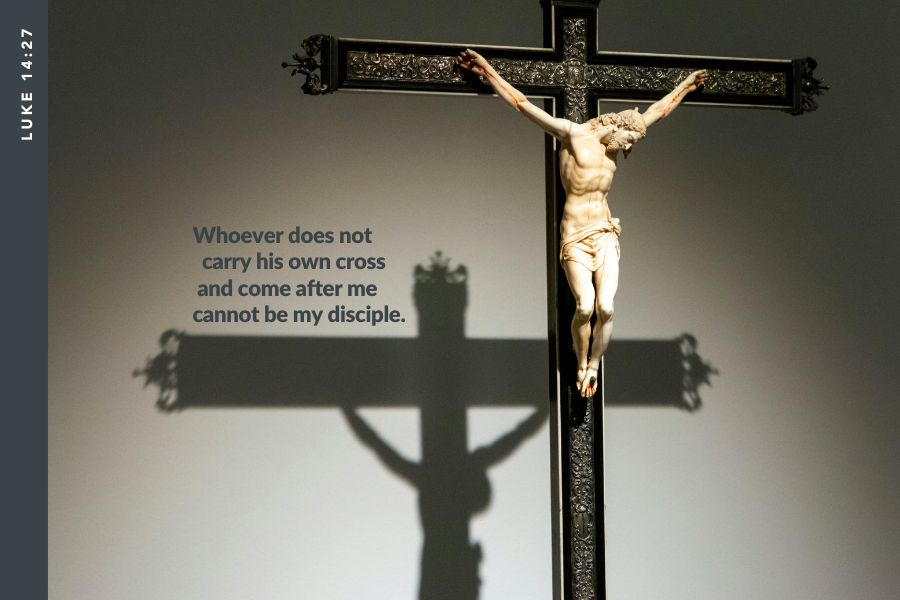
Great crowds were traveling with Jesus, and he turned and addressed them, “If anyone comes to me without hating his father and mother, wife and children, brothers and sisters, and even his own life, he cannot be my disciple. Whoever does not carry his own cross and come after me cannot be my disciple. Which of you wishing to construct a tower does not first sit down and calculate the cost to see if there is enough for its completion? Otherwise, after laying the foundation and finding himself unable to finish the work the onlookers should laugh at him and say, ‘This one began to build but did not have the resources to finish.’ Or what king marching into battle would not first sit down and decide whether with ten thousand troops he can successfully oppose another king advancing upon him with twenty thousand troops? But if not, while he is still far away, he will send a delegation to ask for peace terms. In the same way, everyone of you who does not renounce all his possessions cannot be my disciple.”

Opening Prayer: O God, you are God and Father of us all. You welcome my poor attempt to pray. Strengthen my weak heart and fill me with your grace.

Encountering Christ:

  1. Thin the Ranks: Jesus’ bold challenge to his disciples is shocking. It is as if he wished to thin the ranks of his followers! In Judges 7, we read of Israel’s leader Gideon, who, with a host of some thirty-two thousand soldiers, opposed Midian and Amalek. Surprisingly, “The Lord said to Gideon: ‘You have too many soldiers with you for me to deliver Midian into their power, lest Israel vaunt itself against me and say, “My own power saved me.”’” God permitted nearly the entire army to disband, and with only three hundred men won a great victory. This is a mysterious lesson about the power of God. The only Son of God died for all men; the one Catholic Church is the sacrament of salvation among all mankind; and one disciple who carries his cross sanctifies the whole mystical body of Christ.


  2. Make a Choice: Jesus exhorts us to realism. Don’t start a tower you can’t finish. Don’t fight a battle you can’t win. Be strategic; make the tough choices. In other words, let’s make the love of Christ our number one priority. We look into the eyes of Jesus and know he means it: “If you want to follow me, then follow me with everything, wholeheartedly, or not at all.” In Joshua 24, we read how Joshua exhorted the Israelites: “Now, therefore, fear the Lord and serve him completely and sincerely. Cast out the gods your ancestors served… if it is displeasing to you to serve the Lord, choose today whom you will serve… As for me and my household, we will serve the Lord.”


  3. True Renunciation: What does renunciation really mean? It cannot mean to throw away all we own, or simply do without it. Renunciation means recognizing that everything we have—including relationships with loved ones—comes from the Lord and therefore should be entrusted to him. In 2 Samuel 7, the Lord recalled his countless gifts to the king. “I took you from the pasture, from following the flock, to become ruler over my people Israel. I was with you wherever you went, and I cut down all your enemies before you. And I will make your name like that of the greatest on earth…” David possessed very much—health, riches, wisdom, strength. But what did David do? He “renounced” these possessions by accepting them humbly and praising God’s name. He did not try to stop God’s largesse. “Do, then, bless the house of your servant, that it may be in your presence forever—since you, Lord God, have promised.” May we joyfully welcome and embrace the gifts of God in our lives, never forgetting from where they come.

Conversing with Christ: Lord Jesus, your words are difficult. Sometimes I must literally renounce possessions or relationships because I follow you, while at other times I must simply entrust them to you, again and again. Help me to discern the difference, and never allow anything to be an obstacle to my discipleship.

Resolution: Lord, today by your grace I will make an examination of conscience, asking for the light to discover anything which distracts me from following you.

For Further Reflection: Read and reflect on the short book of Ecclesiastes.

Fr Erik Burckel, LC, was ordained to the priesthood in 2022. He writes articles and short stories for diverse purposes and publications, and can be reached at eburckel@legionaries.org.

November 6, 2025 – O Happy Fault

25-11-06 DM

Thursday of the Thirty-First Week in Ordinary Time

Luke 15:1-10

The tax collectors and sinners were all drawing near to listen to Jesus, but the Pharisees and scribes began to complain, saying, “This man welcomes sinners and eats with them.” So Jesus addressed this parable to them. “What man among you having a hundred sheep and losing one of them would not leave the ninety-nine in the desert and go after the lost one until he finds it? And when he does find it, he sets it on his shoulders with great joy and, upon his arrival home, he calls together his friends and neighbors and says to them, ‘Rejoice with me because I have found my lost sheep.’ I tell you, in just the same way there will be more joy in heaven over one sinner who repents than over ninety-nine righteous people who have no need of repentance. Or what woman having ten coins and losing one would not light a lamp and sweep the house, searching carefully until she finds it? And when she does find it, she calls together her friends and neighbors and says to them, ‘Rejoice with me because I have found the coin that I lost.’ In just the same way, I tell you, there will be rejoicing among the angels of God over one sinner who repents.”

Opening Prayer: Lord Jesus, have mercy on me, a sinner. Grant that I may come to your table with open ears to listen to how you speak to my heart. Grant that I may also rejoice with you for those who turn from sin in order to follow you.

Encountering Christ: 

  1. Dispositions: How impressive that those seeking to win the seat closest to Jesus were the sinners and the tax collectors, those rejected by the religious culture at the time. And instead of listening to Jesus, it seemed that the religious leaders were simply complaining about his welcoming the sinners to his table, a place of intimacy. The eagerness of those sinners to draw near to the Lord tells us something about him. Jesus can find the slightest openness in the human heart in order to enter in. He sets aside the external appearance and social reputations, as well as the repercussions of judgments, in order to make space for further conversion. “It is not easy to entrust oneself to God’s mercy, because it is an abyss beyond our comprehension. But we must! […] ‘Oh, I am a great sinner!’ All the better! Go to Jesus: he likes you to tell him these things! He forgets, he has a very special capacity for forgetting. He forgets, he kisses you, he embraces you and he simply says to you: ‘Neither do I condemn you. Go, [and] from now on do not sin any more” (Jn 8:11)’” (Pope Francis, Homily on March 17, 2013).


  2. Exam of Conscience: Jesus knew the judgments that were being thrown at him. And yet he neither backed away for fear of being rejected, nor pointed a finger. Instead, he was focused on the ones he loved and desired to turn to God. He also invited the Pharisees and scribes to turn their hearts from jealousy and lack of understanding to participation in his joy. His tactic was not to tell them to change their hearts, but rather to tell a story. The story could be applied as each one saw fit. If they were sincere, they would examine their consciences and recognize the invitation that Jesus was offering them to join him at his table as well.


  3. Sinner or Upright: The passage seems to suggest that it would be better to be a repentant sinner. We would offer greater cause for a celestial party! What a cause for joy, since each of us can discover the sinner within. Even the upright of heart may discover deeper motives in need of purifying and converting: vain desires to be seen as a morally upright person, tendencies to be judgmental, etc. Like St. Augustine and St. Ambrose, let us not fear to discover the deeper-rooted egotism that sometimes reigns and taints the purity of our love. And let us rejoice with their same message, “Oh happy fault that won for us so great a Redeemer!”

Conversing with Christ: Lord Jesus, have mercy on me, a sinner. You know the depth of my heart more than I know myself. Reveal to me where I most need conversion, which is a turning of my heart from self-seeking to self-giving.

Resolution: Lord, today by your grace I will ask the Holy Spirit to reveal what aspects of my heart need conversion.

For Further Reflection: Fr. Roger Landry’s homily (audio and written text).

Jennifer Ristine is a consecrated woman of Regnum Christi dedicated to spiritual and faith formation through teaching, conferences, writing, and spiritual direction. While serving in Ancient Magdala she wrote Mary Magdalene: Insights from Ancient Magdala and “Nine Days with Mary Magdalene.”

November 7, 2025 – Stewardship

25-11-07 DM
Friday of the Thirty-First Week in Ordinary Time

Luke 16:1-8

Jesus said to his disciples, “A rich man had a steward who was reported to him for squandering his property. He summoned him and said, ‘What is this I hear about you? Prepare a full account of your stewardship, because you can no longer be my steward.’ The steward said to himself, ‘What shall I do, now that my master is taking the position of steward away from me? I am not strong enough to dig and I am ashamed to beg. I know what I shall do so that, when I am removed from the stewardship, they may welcome me into their homes.’ He called in his master’s debtors one by one. To the first he said, ‘How much do you owe my master?’ He replied, ‘One hundred measures of olive oil.’ He said to him, ‘Here is your promissory note. Sit down and quickly write one for fifty.’ Then to another he said, ‘And you, how much do you owe?’ He replied, ‘One hundred measures of wheat.’ He said to him, ‘Here is your promissory note; write one for eighty.’ And the master commended that dishonest steward for acting prudently. For the children of this world are more prudent in dealing with their own generation than the children of light.”

Opening Prayer: Lord Jesus, grant that I may be a good steward of all you offer me.

Encountering Christ:

  1. Giving an Account: This parable challenges us in many ways. First of all, it reminds us that we are to give an account of what we have been given. If we were to make a list of all that we received from the Lord, what would it contain? In what ways do we feel that we have made the most of what we have received for the building of the Kingdom of God and for his glory?


  2. Astuteness: By the end of the parable, it appears as though the Lord is praising the children of the world. The steward was at least sagacious in preparing for his temporal future, looking out for future provisions. He was making use of a God-given gift, his intelligence. Despite the somewhat self-centered intention, he was astute. How often do we practice this virtue in light of our own stewardship?


  3. Children of the Light: Luke’s Gospel, accompanied by his Acts of the Apostles, portrays the Church as God’s saving instrument, particularly instrumental between the death of Christ and his second coming. The Church is a gift that her children are called to make the most of as its stewards. Are we astute in our use of this gift? Do we neglect the salvific means the Church offers us in its sacraments? Do we hijack it for our own moral purposes? Or do we strive to understand this gift and astutely strive to be children of light?

Conversing with Christ: Lord Jesus, how do you call me to be a steward of all your gifts, particularly that of the Church? Help me to see where my motives lie in my use of the gifts you offer me, and help me to be astute.

Resolution: Lord, today by your grace I will listen to how you call me to be a steward in this world and in the Church.

For Further Reflection: Seven Themes of Catholic Social Teaching.

Jennifer Ristine is a consecrated woman of Regnum Christi dedicated to spiritual and faith formation through teaching, conferences, writing, and spiritual direction. While serving in Ancient Magdala she wrote Mary Magdalene: Insights from Ancient Magdala and “Nine Days with Mary Magdalene.”

November 8, 2025 – Two Standards

25-11-08 DM
Saturday of the Thirty-First Week in Ordinary Time

Luke 16:9-15

Jesus said to his disciples: “I tell you, make friends for yourselves with dishonest wealth, so that when it fails, you will be welcomed into eternal dwellings. The person who is trustworthy in very small matters is also trustworthy in great ones; and the person who is dishonest in very small matters is also dishonest in great ones. If, therefore, you are not trustworthy with dishonest wealth, who will trust you with true wealth? If you are not trustworthy with what belongs to another, who will give you what is yours? No servant can serve two masters. He will either hate one and love the other, or be devoted to one and despise the other. You cannot serve God and mammon.” The Pharisees, who loved money, heard all these things and sneered at him. And he said to them, “You justify yourselves in the sight of others, but God knows your hearts; for what is of human esteem is an abomination in the sight of God.”

Opening Prayer: Lord Jesus, make my heart more like yours. Grant me the grace to turn away from the mentality of the world and love all things according to your heart.

Encountering Christ:

  1. Dichotomy of the Heart: Today’s Gospel continues from the passage of the previous day’s Gospel reading, but goes deeper into the heart of the steward. Jesus speaks about the person’s focus. It cannot be divided. It is either set on God or set on money. It cannot be set on both. In St. Ignatius’ spiritual exercises, he sets up this dichotomy of the heart as well, inviting the retreatant to recognize the quality and consequence of each one’s invitation and consider under whose banner they wish to stand, under that of Christ or that of the enemy, Lucifer. One leads to true life, and the other, while apparently attractive, leads to death. Jesus places this dichotomy before the Pharisees as an exam of conscience for them, as a glimpse into the deeper motives of the heart.


  2. Conscientious Choices: Jesus calls us to make a choice. It is not a matter of rejecting money, but of a deeper conscious choice of our use of goods. St. Ignatius called that “indifference.” Far from not caring, it is caring precisely about what matters. How we make use of the goods that we have at our disposal makes a difference. And even more importantly, the relationship we have with created goods matters. Is our heart seeking them for personal gain? For selfish motives? Or are we capable of making use of them in light of an eternal vision, for the glory of God and for the immediate building of God’s Kingdom here on earth? Our conscientious choice is a matter of the heart. It essentially determines what we are truly seeking.


  3. Esteem: “What is of human esteem is an abomination in the sight of God.” This paradigm is foreign to us. Psychological and emotional esteem, at the expense of maintaining authenticity, is promoted around every corner. It is one’s daily bread and butter to hear that we should do what makes us feel right, that we should not be shamed for our choices, that we must feel ourselves worthy no matter what we do. While these can be misguided statements filled with relativistic untruths, there is an underlying truth at the center: We are fundamentally good and worthy of being loved. Nonetheless, our choices do matter because, made in God’s image, we are called to choose that which leads us to what we have been created for: eternal life, union with God. How different would our motives be if the eyes we felt upon us were our loving God’s instead of the world’s? How different would our choices be if the voices we heard were those of Christ inviting us to an intimate friendship, despite having to reject the ego-affirming voice of the world?

Conversing with Christ: Lord Jesus, I choose you! Help me to be aware of the underlying motives of my heart. Grant that I may perceive the interior movements that give away the ego’s personal pursuit and reject the enemy’s suggestions. Grant that I may hear your voice and follow, despite the sacrifice.

Resolution: Lord, today by your grace I will examine my deeper motives and recognize what is moving me: human esteem or a choice to glorify you.

For Further Reflection: https://www.ignatianspirituality.com/kevin-obrien-sj-on-the-two-standards.

Jennifer Ristine is a consecrated woman of Regnum Christi dedicated to spiritual and faith formation through teaching, conferences, writing, and spiritual direction. While serving in Ancient Magdala she wrote Mary Magdalene: Insights from Ancient Magdala and “Nine Days with Mary Magdalene.”

November 9, 2025 – The Temple

25-11-09 DM
Feast of the Dedication of the Lateran Basilica in Rome

John 2:13-22

Since the Passover of the Jews was near, Jesus went up to Jerusalem. He found in the temple area those who sold oxen, sheep, and doves, as well as the money-changers seated there. He made a whip out of cords and drove them all out of the temple area, with the sheep and oxen, and spilled the coins of the money-changers and overturned their tables, and to those who sold doves he said, “Take these out of here, and stop making my Father’s house a marketplace.” His disciples recalled the words of Scripture, Zeal for your house will consume me. At this the Jews answered and said to him, “What sign can you show us for doing this?” Jesus answered and said to them, “Destroy this temple and in three days I will raise it up.” The Jews said, “This temple has been under construction for forty-six years, and you will raise it up in three days?” But he was speaking about the temple of his Body. Therefore, when he was raised from the dead, his disciples remembered that he had said this, and they came to believe the Scripture and the word Jesus had spoken.

Opening Prayer: Lord Jesus, increase my faith. Make my heart a temple for your dwelling place.

Encountering Christ:

  1. The Passover: The Passover is one of the most important festivities celebrated in the Jewish tradition. Before the existence of the Temple in Jerusalem, it was primarily celebrated in homes by the sacrifice and smearing of the blood of a lamb on the doorposts and lintels. Following the reign of the wicked King Ahaz, his son (and descendant of David) Hezekiah, at the age of twenty-five, sought a reform. He ordered the cleansing of the Temple and restoration of worship after a period of falling away from God (cf. 2 Chr 29-35). With this act, the Passover sacrifice became a central act in the Temple (around 715 BC). About one hundred years later, due to the Babylonian exile, the Passover returned to being celebrated in the home, together with the Feast of Unleavened Bread. By Jesus’ time, the two were celebrated together, with the sacrifice of the lamb taking place primarily in the Temple, but also in homes due to the exorbitant number of lambs being slaughtered. Jesus “went up to Jerusalem” precisely for this feast, in anticipation of the true sacrifice of the Lamb of God and the institution of the Eucharist—the offering of his own Body and Blood on the Feast of Unleavened Bread.


  2. My Father’s House: Jesus arrived at the Temple only to discover that his Father’s house had been turned into a marketplace. The secular had encroached upon the sacred. It is a perennial problem. Rather than sacralizing the secular, the secular dominates the primary role of the sacred due to our human tendencies toward personal gain and greed. The Temple’s central purpose, worship of God, was cast aside for social and economic gains. See Jesus’ response—righteous anger fueled by zeal for reestablishing the Father’s rightful place. He would soon be consummated in the sacrifice of himself as the Lamb of God who takes away the sins of the world. The Temple represents the human heart. Jesus desires to cleanse the idols in our heart that stand at the center in place of the Father.


  3. Destroy This Temple and in Three Days I Will Build It Up: The Jews were confused by Jesus’ words, “Destroy this Temple and in three days I will raise it up.” Herod the Great had just spent forty-six years enlarging and embellishing the Temple, creating a retaining wall over Mount Moriah, the very place of the binding of Isaac by Abraham, when God provided the sacrifice instead of allowing Abraham to sacrifice his only son. The physical building of the Temple had a tumultuous history. Upon Mount Moriah, King Solomon built the first Temple (circa 990–931 BC), but it was destroyed in the Babylonian exile around 587 BC. King Cyrus, king of Persia, permitted the rebuilding in 538 BC. Yet, it was plundered, desecrated, and finally rededicated during the Hasmonean revolt of the 2nd century BC. Not long after Jesus’ prophecy, it would again be torn down by the Romans in the year 70 AD. Only Jesus could restore the temple so that it could not be torn down by human hands. In his very person, the worship of God would be restored and centralized.

Conversing with Christ: Jesus, increase my faith in your presence. Grant me the grace to worship in spirit and truth and to recognize that your grace makes me a temple of the Holy Spirit. Help me also to recognize the gift of the sacrifice of the Holy Eucharist, where I can gather in community for true worship.

Resolution: Lord, today by your grace I will reflect on how I contribute to making my heart, home, and Church community places of true worship.

For Further Reflection: Does God Need Us to Worship Him? by Fr. Mike Schmitz.

Jennifer Ristine is a consecrated woman of Regnum Christi dedicated to spiritual and faith formation through teaching, conferences, writing, and spiritual direction. While serving in Ancient Magdala she wrote Mary Magdalene: Insights from Ancient Magdala and “Nine Days with Mary Magdalene.”

Scroll to Top

Events

Looking for another country?

Contact Regnum Christi near you

News & Resources

News & Resources

The Regnum Christi Mission

The Regnum Christi Identity

Alex Kucera

Atlanta

Alex Kucera has lived in Atlanta, GA, for the last 46 years. He is one of 9 children, married to his wife Karmen, and has 3 girls, one grandson, and a granddaughter on the way. Alex joined Regnum Christi in 2007. Out of the gate, he joined the Helping Hands Medical Missions apostolate and is still participating today with the Ghana Friendship Mission.

In 2009, Alex was asked to be the Atlanta RC Renewal Coordinator for the Atlanta Locality to help the RC members with the RC renewal process. Alex became a Group Leader in 2012 for four of the Atlanta Men’s Section Teams and continues today. Running in parallel, in 2013, Alex became a Team Leader and shepherded a large team of good men.

Alex was honored to be the Atlanta Mission Coordinator between 2010 to 2022 (12 years), coordinating 5-8 Holy Week Mission teams across Georgia. He also created and coordinated missions at a parish in Athens, GA, for 9 years. Alex continues to coordinate Holy Week Missions, Advent Missions, and Monthly missions at Good Shepherd Catholic Church in Cumming, GA.

From 2016 to 2022, Alex also served as the Men’s Section Assistant in Atlanta. He loved working with the Men’s Section Director, the Legionaries, Consecrated, and Women’s Section leadership teams.

Alex is exceptionally grateful to the Legionaries, Consecrated, and many RC members who he’s journeyed shoulder to shoulder, growing his relationship with Christ and others along the way. He knows that there is only one way, that’s Christ’s Way, with others!