


THE WEEKLY DIGEST
OF REGNUM CHRISTI
DAILY MEDITATIONS
Week of May 18-25, 2025
Sunday, May 18, 2025 – Commanded to Love
Monday, May 19, 2025 – Actions Speak Louder than Words
Tuesday, May 20, 2025 – The Peace of Christ
Wednesday, May 21, 2025 – Life and Fruit
Thursday, May 22, 2025 – The Source of Joy
Friday, May 23, 2025 – Marriage: A Gospel for the World
May 18, 2025 - Commanded to Love

Fifth Sunday of Easter
John 13:31-33a, 34-35
When Judas had left them, Jesus said, “Now is the Son of Man glorified, and God is glorified in him. If God is glorified in him, God will also glorify him in himself, and God will glorify him at once. My children, I will be with you only a little while longer. I give you a new commandment: love one another. As I have loved you, so you also should love one another. This is how all will know that you are my disciples, if you have love for one another.”
Opening Prayer: Lord, I come before you knowing my own littleness and offering myself to you, just as I am. You created me and redeemed me and call me to yourself. You desire that I live as your image of love in the world. In faith and hope, I believe that you give me the grace I need to do so. I know that it is only through opening myself to your love that I can truly love. Thank you that you are always with me, Father, Son, and Holy Spirit dwelling within me and giving me life and love.
Encountering Christ:
- Foretelling Betrayals and Loving Anyway: This Gospel passage, the beginning of Jesus’ “Farewell Discourse,” is sandwiched between his foretelling Judas’ betrayal and Peter’s betrayal. In it, Jesus taught the disciples how they were to live: They were to love one another. Knowing that he would be betrayed by those whom he loved, he continued to speak about love as the defining characteristic of his followers. He didn’t qualify his directive to love. Reflecting that it was given in the context of his foretelling of the betrayals to come, we can see that his is a call to love no matter what. As St. Paul teaches in 1 Corinthians 13:7, “[Love] bears all things, believes all things, hopes all things, endures all things.” When we consider this kind of love, we can think of times we have heard (or perhaps thought) that a particular person “didn’t deserve” another’s love. In Jesus’ example, we see that love isn’t based on the other person’s behavior but on our relationship with the Lord. May we never rationalize or justify ourselves when we fail to love as Jesus does.
- As I Have Loved You: In these precious moments, as Jesus prepared his disciples for his Passion, he didn’t give them tasks to do, moral laws to follow, or acts of piety to perform. Of course, this doesn’t preclude the importance of our actions, but his words show us what he most desires of us: “As I have loved you, so you also should love one another.” While each of these elements has a place (and a very important place!) in our lives as we follow Our Lord, our actions, behaviors, and practices will naturally flow out of us when we allow Christ to love us and form us. On the other hand, focusing on the externals without striving to love God and neighbor is hollow. As St. Augustine said: “Anyone can bless himself with the sign of the cross of Christ; anyone can answer ‘Amen’; anyone can sing Alleluia; anyone can be baptized, enter churches, build the walls of basilicas. But the only thing that distinguishes the children of God is charity. Those who practice charity are born of God; those who do not practice charity are not born of God. It is indeed an important sign, an essential difference. No matter what you have, if you do not have this one thing, everything else is of no avail; and if you lack everything, and have nothing else but charity, then you have kept the law.” What kind of disciples are we? Do we consider ourselves faithful followers because of what we do—whether in apostolate, prayer, or the moral life—or are we faithful because of how much we love God and neighbor?
- What Does Love Look Like? Of course, love is manifest in behavior. Jesus tells us, “No one has greater love than this, to lay down one’s life for one’s friends” (Jn 15:13), and he modeled this self-giving love on the cross. As we consider his example of love, we can feel overwhelmed and defeated, as if our ability to love like Jesus depends upon our strength and our will. However, in a very real way, it depends upon us letting ourselves be loved by God, allowing him to dwell within us and act through us. The Catechism tells us that “It is impossible to keep the Lord’s commandment by imitating the divine model from outside; there has to be a vital participation, coming from the depths of the heart, in the holiness and mercy and love of our God” (CCC 2842). This participation comes from the life of the Trinity within us, and the indwelling of the Holy Trinity capacitates us to pour ourselves out in love as Jesus did.
Conversing with Christ: Jesus, I love you, but I want to love you more deeply. I want to give myself to you, to open my heart so that I can experience your love more fully. I want to be a visible instrument of your love in the world, of your mercy and holiness. I need you. It is your love that makes it possible for me to love. Thank you, Lord, for your deep abiding love.
Resolution: Lord, today by your grace I will take time to consider whether there are any parts of myself (my past, personality, habits, etc.) that I feel are unlovable, and I will then bring these to you in prayer, asking to know your love, just as I am.
For Further Reflection: Listen to No Other Heart by the RC Music Collective.
Janet McLaughlin and her husband Chris live on a mountain in rural northeastern Oregon. She puts her Master of Arts in Pastoral Studies to work as she shares the beauty and importance of the lay vocation in her writing, speaking, and teaching on spiritual topics.
May 19, 2025 - Actions Speak Louder than Words

Monday of the Fifth Week of Easter
John 14:21-26
Jesus said to his disciples: “Whoever has my commandments and observes them is the one who loves me. Whoever loves me will be loved by my Father, and I will love him and reveal myself to him.” Judas, not the Iscariot, said to him, “Master, then what happened that you will reveal yourself to us and not to the world?” Jesus answered and said to him, “Whoever loves me will keep my word, and my Father will love him, and we will come to him and make our dwelling with him. Whoever does not love me does not keep my words; yet the word you hear is not mine but that of the Father who sent me. I have told you this while I am with you. The Advocate, the Holy Spirit whom the Father will send in my name, he will teach you everything and remind you of all that I told you.”
Opening Prayer: My Jesus, I come before you in this time of prayer as an act of love, and I believe you are here with me. In faith, I know that I love you, and I want to know your will for me in all things. I pray for the trust that will enable me to say yes to whatever you ask and to delight in doing your will. Your goodness is the source of my hope. Thank you, Lord, for your love for me and your patience with me as I strive to become ever more the person you created me to be.
Encountering Christ:
- Love Desires to Obey: In Psalm 40, we read, “I delight to do your will, my God; your law is in my inner being!” (Ps 40:9). In the book of Hebrews, we read that Jesus said, “Behold, I come to do you will, O God” (Heb 10:7, 9); in fact, Jesus said that doing the will of the one who sent him (God the Father) is his food (cf. Jn 4:34). Finding our nourishment and delight in doing the will of God makes visible the love we are to have for God and neighbor, and this is the love that we see exemplified by Jesus. His self-giving love on the cross was the fruit of his love for the Father, love that was lived out in obedience. Through this kind of love, we grow in knowledge of and intimacy with God. Do we delight in doing God’s will as an act of love? Do we have the courage to say “not my will but yours be done” (Lk 22:42) when we face difficulties?
- Whoever Does Not Love…: There is an old saying, “Actions speak louder than words.” Here Jesus pointed to something similar in a stark statement: “Whoever does not love me does not keep my words.” In another place, he said, “Not everyone who says to me, ‘Lord, Lord,’ will enter the Kingdom of Heaven, but only the one who does the will of my Father in Heaven” (Mt 7:21). Jesus held up obedience—keeping his words and obeying the Father—as the standard for what it means to love him. What gets in the way of obedience? The Catechism identifies failure to trust God as the root of the disobedience in original sin and states, “All subsequent sin would be disobedience toward God and lack of trust in his goodness” (CCC 297). Trust is foundational to love. We can consider our trust in the Lord, our willingness to say “yes” to whatever he asks (through Scripture, the teachings of the Church, or personal inspiration) in light of St. John’s teaching: “There is no fear in love, but perfect love drives out fear because fear has to do with punishment, and so one who fears is not yet perfect in love” (1 Jn 4:18).
- Never Alone: Jesus assures us that we are not left alone. First, he tells us that he and the Father will come and dwell within us, and where the Father and Son are, there the Spirit is too (the Trinity cannot be separated). We are also told that the Holy Spirit will be sent to us, and he will teach us everything and remind us of all that Jesus has told us. We know that this means more than an individual relationship with the Lord and fidelity in following the teachings of the Church. We are called to communion, both in the sacrament of the Holy Eucharist and as part of the Body of Christ. The Catechism calls the Church “the great sacrament of divine communion which gathers God’s scattered children together. Communion with the Holy Trinity and fraternal communion are inseparably the fruit of the Spirit in the liturgy” (CCC 1108). When we receive Jesus in Holy Communion, we acknowledge that he is the source of fraternal communion. We treasure the members of the body of Christ and pray for unity.
Conversing with Christ: Lord, in this prayer, I have been struck by your great love for the Father—your Father and mine. I am struck by your hunger to know and do his will in all things. There was nothing you wanted or valued more than your unity with him, and that unity was made real through obedience. Lord, help me see those areas in my life where I have been saying no and need to say yes. Open my heart to your presence in my life. The opportunities for obedience are like knocks on the door of my heart; let me open that door so that you can come in and dine with me (cf. Rev 3:20).
Resolution: Lord, today by your grace I will increase my trust in you by spending ten minutes looking over my life and identifying several examples of your loving care, and I will share at least one of these with someone.
Janet McLaughlin and her husband Chris live on a mountain in rural northeastern Oregon. She puts her Master of Arts in Pastoral Studies to work as she shares the beauty and importance of the lay vocation in her writing, speaking, and teaching on spiritual topics.
May 20, 2025 - The Peace of Christ

Tuesday of the Fifth Week of Easter
John 14:27-31a
Jesus said to his disciples: “Peace I leave with you; my peace I give to you. Not as the world gives do I give it to you. Do not let your hearts be troubled or afraid. You heard me tell you,
‘I am going away and I will come back to you.’ If you loved me, you would rejoice that I am going to the Father; for the Father is greater than I. And now I have told you this before it happens, so that when it happens you may believe. I will no longer speak much with you, for the ruler of the world is coming. He has no power over me, but the world must know that I love the Father and that I do just as the Father has commanded me.”
Opening Prayer: My God and Father, I live in a world that is busy and filled with division and conflict. When I hear your promise of peace, I feel a great longing to experience it in my life. I believe that you are faithful and that if you promise something, you will give it. Help me remember, though, that it is your peace, not my idea of peace, that you give. Keep my eyes set on you, my ears open to your words, my heart open to your life within me. I hope in your providence that brings all things together for my good. I love you for your constant love, for your ongoing presence and care in my life.
Encountering Christ:
- Not as the World Gives: Thinking of peace may conjure up the idea of freedom from conflict or worry, but Jesus tells us the peace he gives is something different from worldly peace, and since it is Jesus who gives it, we know that it is something greater. The peace that Jesus is telling his disciples about is peace that comes from trusting the Father. As he faced his Passion, Jesus instructed, “Do not let your hearts be troubled or afraid.” His example shows us that peace does not depend on everything going right in our lives, but rather it is rooted in trust in the Father’s goodness and his desire for our ultimate happiness. He wants us to experience peace in the midst of the trials of our lives by trusting him with ourselves and all that is dear to us.
- A Fruit Through Order: St. Augustine described peace as the “tranquility of order,” and St. Paul teaches, “Let the peace of Christ control your hearts…” (Col 3:15). How do we do this? We allow the peace of Christ to be formed within us as one of the fruits of the Holy Spirit (CCC 1832; cf. Gal 5:22). Again, how? By living the kingly mission to which we are called and through which “lay people have the power to uproot the rule of sin within themselves and in the world, by their self-denial and holiness of life” (CCC 943; cf. Lumen Gentium 36). As we grow in union with Christ and conform ourselves to the will of the Father, we find order in our relationships with God and others and within ourselves. In that order, “the peace of God that surpasses all understanding will guard [our] hearts and minds in Christ Jesus” (Phil 4:7). Where in our life do we need order in order to experience greater peace?
- I Am Going to the Father: What might it have been like to be a disciple and hear Jesus say, “If you loved me you would rejoice that I am going to the Father…”? We might be incredulous and wonder how we could possibly rejoice in his leaving us. We might think about all we had experienced with him and learned from him and wonder, “What will we do without you?” Yet Christ’s leaving them allowed him to be present throughout history, all the way to this very day. His leaving is what allows him to be present to each of us through the gift of the Holy Spirit in our lives. A little later in this Gospel, Jesus said, “But I tell you the truth, it is better for you that I go. For if I do not go, the Advocate will not come to you. But if I go, I will send him to you” (Jn 16:7). Christ ascended into Heaven so that he could send his Holy Spirit, and it is through the Holy Spirit that Christ is alive to us right now.
Conversing with Christ: Jesus, I believe that you want me to live with confidence in you and your plan for my life. I believe that you want me to live in interior peace as well as in peace with those around me. Lord, help me see the things that rob me of my peace. Do I spend too much time on social media or watching the news? Do I take on too much of a sense of responsibility for things that belong to another’s free will? Do I really trust your love for my loved ones who have strayed? Lord, help me grow in the virtue of hope, and so trust you for all that I need to reach eternal life with you.
Resolution: Lord, today by your grace I will pray the Litany of Peace below and ask for the grace to see those situations in which I am most likely to lose my peace. As I notice these times occurring throughout the day, I will pray, “Deliver me, Lord Jesus; grant me your peace.”
For Further Reflection: Read the section of the Catechism entitled “The Joint Mission of the Son and the Spirit” (689-690).
“The Litany of Peace” by Fr. Matthew Guckin
Litany of Peace
From the desire to control … Deliver me, Lord Jesus
From the desire to give my opinion … Deliver me, Lord Jesus
From the desire to project myself as the victim …
From the desire to impress others …
From the desire to please everyone …
From the tendency to complain …
From all my irrational fears …
From all violent speech …
From failing to accept uncertainty …
From comparing myself to others …
From not accepting my limitations …
From an unhealthy desire for perfection …
From an unhealthy attachment to others …
From excessive self-blame …
From holding on to grudges …
From holding on to the past …
From wanting more than I need …
From the impulse to justify myself …
From worrying about the future …
From thinking only about myself …
From losing perspective on life …
From not being able to laugh at myself …
From not being able to forgive myself …
From overanalyzing the intentions of others …
From the desire to change others …
From thoughts that this world is all there is …
From failing to trust in God …
From failing to see God in all things …
Peace Prayer by Fr. Matthew Guckin:
God of peace, calm me and heal me.
Let your peace reign in my heart at this very moment and for all eternity.
We make our prayer in the Name of Jesus Christ, the Prince of Peace. Amen.
Janet McLaughlin and her husband, Chris, live on a mountain in rural northeastern Oregon. She puts her Master of Arts in Pastoral Studies to work as she shares the beauty and importance of the lay vocation in her writing, speaking, and teaching on spiritual topics.
May 21, 2025 - Life and Fruit
Wednesday of the Fifth Week of Easter
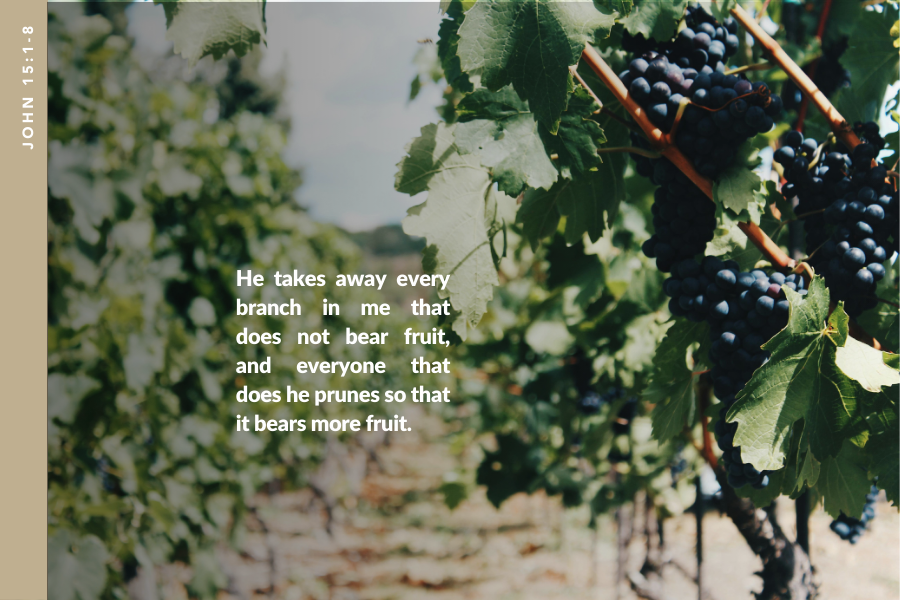
John 15:1-8
Jesus said to his disciples: “I am the true vine, and my Father is the vine grower. He takes away every branch in me that does not bear fruit, and every one that does he prunes so that it bears more fruit. You are already pruned because of the word that I spoke to you. Remain in me, as I remain in you. Just as a branch cannot bear fruit on its own unless it remains on the vine, so neither can you unless you remain in me. I am the vine, you are the branches. Whoever remains in me and I in him will bear much fruit, because without me you can do nothing. Anyone who does not remain in me will be thrown out like a branch and wither; people will gather them and throw them into a fire and they will be burned. If you remain in me and my words remain in you, ask for whatever you want and it will be done for you. By this is my Father glorified, that you bear much fruit and become my disciples.”
Opening Prayer: Holy Spirit, as I settle myself into this time of prayer, I open myself to your action in my life. I believe in your presence within me. I trust that through your guidance and inspirations I may abide ever more deeply in the heart of Jesus. I trust your action in me that increases my fruitfulness in building the Kingdom.
Encountering Christ:
- Sap and Life: The Catechism says, “The Holy Spirit is like the sap of the Father’s vine which bears much fruit on its branches (CCC 1108). What is sap? Simply put, it is the life’s blood of the plant. Sap flows through a plant to nourish it and bring new growth. It also helps protect and heal the plant. Our union with the vine, our life in Christ, requires the life of the Holy Spirit within us. This life is received in Baptism (CCC 1266) and increased and deepened in Confirmation (CCC 1303), as well as in our daily prayer, the sacraments of Holy Communion and Reconciliation, acts of charity and mercy, and all that makes up our Christian walk. Like the sap of a plant, the life of grace nourishes our union with God, helps us grow, and protects and heals us.
- Pruning and Fruitfulness: As we abide in Christ and are nourished by the life of grace, we are meant to bear fruit. We are meant to give of ourselves to build up the Kingdom of Christ on Earth. Jesus said, “The harvest is abundant but the laborers are few; so ask the master of the harvest to send out laborers for his harvest” (Lk 10:2). We often think of this Scripture in terms of praying for priestly vocations, but all the Christian faithful, the baptized of every vocation and state in life, are called to labor for the Lord. Pruning spurs growth and fruitfulness. What is it we need to prune in our life to grow in union with the Lord and become more fruitful disciples?
- Fruitfulness and Glorifying God: It is an essential element of Christian life; all the Christian faithful are called to bear fruit. And Jesus said, “By this is my Father glorified, that you bear much fruit and become my disciples.” Our fruitfulness glorifies God. Speaking specifically about the laity, the Decree on the Apostolate of the Laity states, “The apostolate of the laity derives from their Christian vocation and the Church can never be without it. Sacred Scripture clearly shows how spontaneous and fruitful such activity was at the very beginning of the Church (cf. Acts 11:19-21; 18:26; Rom 16:1-16; Phil 4:3).” In fact, this action of lay men and women in the life of the Church is so important that “for the most part, the apostolate of pastors cannot be fully effective without it” (CCC 900, quoting Lumen Gentium, 33). Our actions are meant to bring the light and life of Christ to the world and are essential to the mission of the Church. How do we choose to use the gifts and talents Jesus has given us to build the Kingdom and glorify the Father?
Conversing with Christ: Lord, I thank you that my life matters in your plan of salvation. It is a gift to know that you trust me to be united with you in building your Kingdom. Lord, there are so many demands on my time. Help me see how to prioritize my life to serve you better. Help me see how I can best use the gifts and talents you have given me in your service. Fill me with zeal to build your Kingdom with your love for each person I meet.
Resolution: Lord, today by your grace I will consider the needs around me and ask you to show me if there is some action I can take to address those needs.
Janet McLaughlin and her husband Chris live on a mountain in rural northeastern Oregon. She puts her Master of Arts in Pastoral Studies to work as she shares the beauty and importance of the lay vocation in her writing, speaking, and teaching on spiritual topics.
May 22, 2025 - The Source of Joy
Thursday of the Fifth Week of Easter
John 15:9-11
Jesus said to his disciples: “As the Father loves me, so I also love you. Remain in my love.
If you keep my commandments, you will remain in my love, just as I have kept my Father’s commandments and remain in his love. I have told you this so that my joy might be in you and your joy might be complete.”
Opening Prayer: Jesus, as I enter into prayer and read your words, I want to thank you for the gift of your word. In the Scriptures, I encounter you and come to know your love for me. Today, I am struck by your assurance that you want me to have your joy. Thank you for the hope this inspires in me. Lord, I believe in you; I hope in you; I love you. Deepen my faith, hope, and love so that I can grow in the joy you promise.
Encountering Christ:
- Remain in My Love: Jesus just told us to abide in him, and he reiterated that message in today’s passage by telling us to remain in him. He told us he remains in the Father’s love by keeping his commandments and teaches us that we remain in his love by keeping his commandments. Unfortunately, we often see Christ’s commandments as burdens or restrictions on our freedom. Jesus himself promised, “Take my yoke upon you and learn from me, for I am meek and humble of heart; and you will find rest for yourselves. For my yoke is easy, and my burden light” (Mt 11:29-30). Not only is his yoke easy and his burden light; it is through his yoke and burden that we find joy.
- Interior Stability: When we trust Jesus and remain in his love through obedience, our life develops an interior stability. We are “like a wise man who built his house on rock. The rain fell, the floods came, and the winds blew and buffeted the house. But it did not collapse; it had been set solidly on rock.” Jesus contrasted this with the “fool who built his house on sand. The rain fell, the floods came, and the winds blew and buffeted the house. And it collapsed and was completely ruined” (Mt 7:24-27). When our lives are built on the solid rock that is Christ, we find true joy and peace.
- Complete Joy: Jesus wants us to experience his joy and tells us that this is found as we live in union with him as we keep his commandments. We don’t find true and complete joy in self-determination and self-reliance, but by recognizing our dependence on God as “the source of wisdom and freedom, of joy and confidence” (CCC 301). But joy doesn’t just happen; it takes work. Spiritual laziness can rob us of joy. The Catechism teaches, “acedia or spiritual sloth goes so far as to refuse the joy that comes from God…” (CCC 2094). To live in joy, we can, “through human effort,” acquire the virtues that “make possible ease, self-mastery, and joy in leading a morally good life” (CCC 1804) as well as overcoming those things that lead to acedia: “lax ascetical practice, decreasing vigilance, carelessness of heart” (CCC 2733). How vigorously do we strive to grow in virtue?
Conversing with Christ: Lord, I sometimes forget that true joy is rooted in you, not in circumstances. I forget that you are the rock upon which my whole life is meant to be built and where I find the security that allows me to experience deep joy. Lord, help me be grateful for all the blessings of my day and the little things that give me the experience of happiness, but also help me desire true joy that goes beyond circumstances. Keep me focused on you and secure in you. Strengthen my trust in you, so that no matter what happens, I find my joy as I remain in you and am faithful to your commandments.
Resolution: The Catechism calls Sunday “the day of joy” (CCC 1193). Lord, today by your grace I will take time to plan my Sunday so that it is an experience of joy for my family and me.
Janet McLaughlin and her husband, Chris, live on a mountain in rural northeastern Oregon. She puts her Master of Arts in Pastoral Studies to work as she shares the beauty and importance of the lay vocation in her writing, speaking, and teaching on spiritual topics.
May 23, 2025 - Marriage: A Gospel for the World
Friday of the Fifth Week of Easter
John 15:12-17
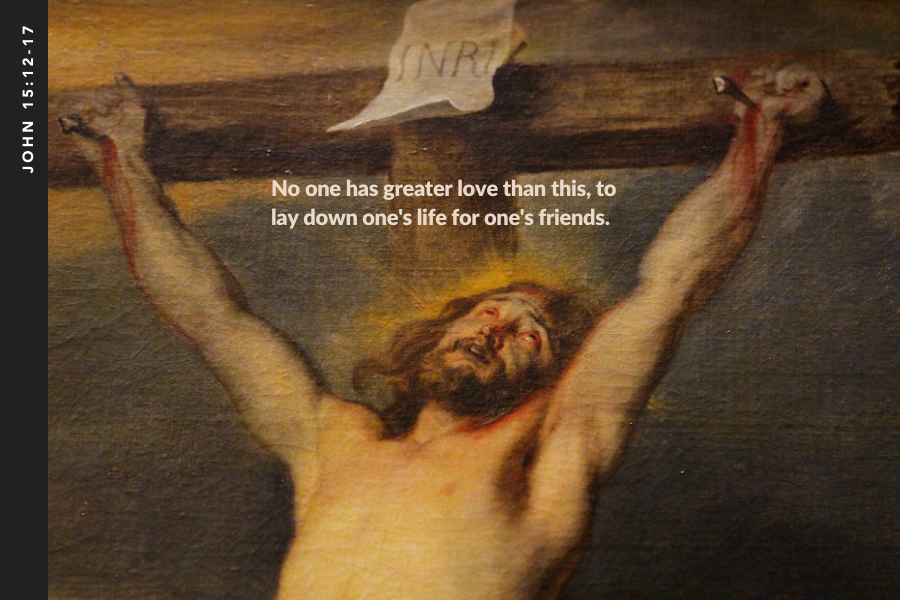
Jesus said to his disciples: “This is my commandment: love one another as I love you. No one has greater love than this, to lay down one’s life for one’s friends. You are my friends if you do what I command you. I no longer call you slaves, because a slave does not know what his master is doing. I have called you friends, because I have told you everything I have heard from my Father. It was not you who chose me, but I who chose you and appointed you to go and bear fruit that will remain, so that whatever you ask the Father in my name he may give you. This I command you: love one another.”
Opening Prayer: Lord Jesus, I love you. Knowing that you created me in your image and likeness and that you call me to share in your life gives my life meaning and purpose. In you, I find my joy and my peace. I believe in you. I believe that you know me and want me to know you in and through the realities of my life. Knowing that you are always with me gives me hope. You are always working for my good. In this prayer time, Lord, I ask that you help me learn from your example of availability and attentiveness, so that I can better love those you have placed in my life.
Encountering Christ:
- I Call You Friends: Friends share their lives with one another. Here Jesus summarized what the disciples had experienced in their travels with him: He called them friends. He shared everything the Father told him and was preparing to lay down his life for them. And this is what he wants from us. He desires our personal friendship, which entails reciprocity. True friendship is mutual. He has revealed and given himself to us totally, and now he wants us to give ourselves to him by following his commandments and loving one another, even if it requires sacrifice. Intimacy with Christ requires committing ourselves to him, not just in words but in actions.
- I Chose You: Sometimes it seems that our relationship with Christ begins in our decision to follow him, but we can only love Christ because he first loved us (cf. 1 Jn 4:19). Just as he chose the disciples, he chooses us to be his friends. He calls us by name. Just as his disciples came to know Jesus as they walked and worked with him, so we can come to know Jesus in the experience of living our daily lives with him. The Second Vatican Council taught, “Laymen should make such a use of these (spiritual) helps that, while meeting their human obligations in the ordinary conditions of life, they do not separate their union with Christ from their ordinary life; but through the very performance of their tasks, which are God’s will for them, actually promote the growth of their union with him” (Apostolicam Actuositatem 4). We encounter the Lord in those things that make up our everyday life. Do we see a separation between daily life and our life of faith?
- To Bear Fruit: Jesus calls us to live a life of holiness not only for our own sake; we are called to bear fruit. He asks us to share in his ongoing mission to spread the Good News throughout the world: “(L)ay people as well are personally called by the Lord, from whom they receive a mission on behalf of the Church and the world” (Christifideles Laici, 2). Indeed, “The fundamental objective of the formation of the lay faithful is an ever-clearer discovery of one’s vocation and the ever-greater willingness to live it so as to fulfill one’s mission” (Christifideles Laici, 58). And because friends share the things they value, as Christians we desire to share the Lord’s goodness with those whom we care for; we want to introduce them to Jesus, our friend.
Conversing with Christ: Jesus, I have often heard people speak of their friendship with you, but just as often I’ve heard people express surprise when invited to think of you that way. Lord, I want to know you as a true friend. I want to share the ins and outs of my life, my joys and sorrows. I want to live my day with you by my side, sharing with you whatever it is that I am doing. Give me the confidence that everything that matters to me matters to you, and form my heart so that everything that matters to you matters to me.
Resolution: Lord, today by your grace I will seek to know what things I can do to enhance my friendship with you, and I will find a way to incorporate that into my daily life.
For Further Reflection: Consider the closeness captured in this image of St. John the Evangelist (“The Beloved Disciple”). Reflect on what it would be like to lean on Christ in this way.
Janet McLaughlin and her husband Chris live on a mountain in rural northeastern Oregon. She puts her Master of Arts in Pastoral Studies to work as she shares the beauty and importance of the lay vocation in her writing, speaking, and teaching on spiritual topics.
May 24, 2025 – Lord, Make Me Like a Little Child

Saturday of the Fifth Week of Easter
John 15:18-21
Jesus said to his disciples: “If the world hates you, realize that it hated me first. If you belonged to the world, the world would love its own; but because you do not belong to the world, and I have chosen you out of the world, the world hates you. Remember the word I spoke to you, ‘No slave is greater than his master.’ If they persecuted me, they will also persecute you. If they kept my word, they will also keep yours. And they will do all these things to you on account of my name, because they do not know the one who sent me.”
Opening Prayer: Jesus, as I come before you today, I give you thanks that you are the light of the world and that you call me to live my life in your light. I thank you that I can come into that light in a special way right now in prayer. I know that you want to speak to me, and I want to hear you so I can know you with an active, living faith. I trust you to show me what it is I need to know and do to walk in your light. I thank you for your love and your grace. I love you and want to love you ever more deeply.
Encountering Christ:
- High Contrast: Jesus has repeatedly said that following him means living in his love and abiding or remaining in him by doing what he commands. Now he shows us a darker truth: As he is persecuted and hated, the disciples should expect the same. He had warned them earlier: “The light came into the world, but people preferred darkness to light, because their works were evil. For everyone who does wicked things hates the light and does not come toward the light, so that his works might not be exposed” (Jn 3:19-20). We may experience this aversion to the light in our interactions with others and so hesitate to express our faith or moral concerns for fear of how others will respond. Nevertheless, it is important that we remember that it is in living our faith authentically that we grow closer to the Lord.
- No Compromise: This passage ends by saying, “They will do all these things… because they do not know who sent me.” They did not know the Father, and so they did not recognize the light and, in fact, preferred the darkness. They didn’t want to change. Light takes away darkness, necessarily involving change. Earlier in John’s Gospel, Jesus told his disciples, “I am the light of the world. Whoever follows me will not walk in darkness…” (Jn 8:12). This darkness represents the things that bind us or hold us back from stepping fully into the light of life in Christ—into intimacy with him. We can be assured that no matter what the darkness is, Jesus can overcome it, for “the light shines in the darkness, and the darkness has not overcome it” (Jn 1:5). How willing are we to be changed by the light of Christ?
- Conversion: Reflecting on Jesus as the light of the world, the light that cannot be overcome by darkness but, indeed, changes the darkness, we can recognize Christ’s invitation to walk in the light. God respects our free will. It is our choice to step out of the darkness or out of the shadows and into the light. This happens first in our heart. As the Catechism reminds us, Christ’s call to conversion “does not aim first at outward works… but at the conversion of the heart, interior conversion… a radical reorientation of our whole life, a return, a conversion to God with all our heart, an end to sin, a turning away from evil, with repugnance toward the evil actions we have committed… it entails the desire and resolution to change one’s life with hope in God’s mercy and trust in the help of his grace” (CCC 1430-1431).
Conversing with Christ: Lord Jesus, you are the light of my life. Living in your light allows me to live with abundance and joy. I ask for the grace to step out of any hint of shadow. I ask for the grace to follow you boldly and courageously by speaking your truth rather than retreating into darkness. Thank you for the sacraments and their work in my life. Help me unite myself ever more closely to you in my prayer each and every day so that I can live as your faithful friend and disciple in all that I do.
Resolution: Lord, today by your grace I will recall an instance when I could have spoken up regarding Jesus, the Catholic faith, or the Church, but didn’t. I will examine myself to identify why I didn’t speak up and ask for forgiveness. I will ask for the courage to speak up in a way that brings light the next time I am in a similar situation.
For Further Reflection: Read a comment by Francis Cardinal George on the secularization of society, from a post by Tim Blake in a National Catholic Register blog: “Speaking a few years ago to a group of priests, entirely outside of the current political debate, I was trying to express in overly dramatic fashion what the complete secularization of our society could bring,” writes the Cardinal. “I was responding to a question and I never wrote down what I said, but the words were captured on somebody’s smartphone and have now gone viral on Wikipedia and elsewhere in the electronic communications world. I am (correctly) quoted as saying that I expected to die in bed, my successor will die in prison, and his successor will die a martyr in the public square. What is omitted from the reports is a final phrase I added about the bishop who follows a possibly martyred bishop: ‘His successor will pick up the shards of a ruined society and slowly help rebuild civilization, as the church has done so often in human history.’ What I said is not ‘prophetic’ but a way to force people to think outside of the usual categories that limit and sometimes poison both private and public discourse.”
Janet McLaughlin and her husband, Chris, live on a mountain in rural northeastern Oregon. She puts her Master of Arts in Pastoral Studies to work as she shares the beauty and importance of the lay vocation in her writing, speaking, and teaching on spiritual topics.
May 25, 2025 – Peace in Our Time
Sixth Sunday of Easter
John 14:23-29
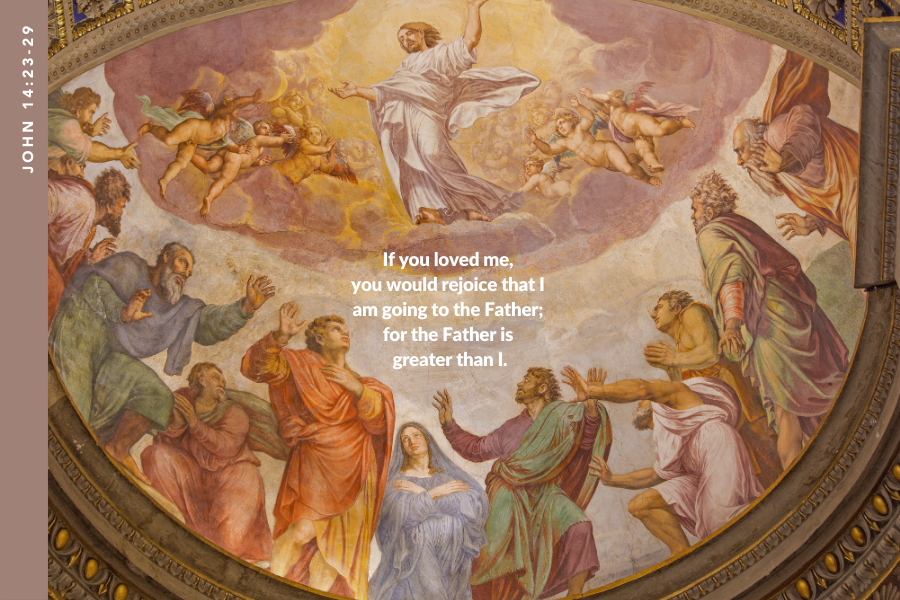
Jesus said to his disciples: “Whoever loves me will keep my word, and my Father will love him, and we will come to him and make our dwelling with him. Whoever does not love me does not keep my words; yet the word you hear is not mine but that of the Father who sent me. I have told you this while I am with you. The Advocate, the Holy Spirit, whom the Father will send in my name, will teach you everything and remind you of all that I told you. Peace I leave with you; my peace I give to you. Not as the world gives do I give it to you. Do not let your hearts be troubled or afraid. You heard me tell you, ‘I am going away and I will come back to you.’ If you loved me, you would rejoice that I am going to the Father; for the Father is greater than I. And now I have told you this before it happens, so that when it happens you may believe.”
Opening Prayer: Lord, thank you for these consoling verses of Scripture. Penetrate my mind and heart as I read and meditate on these words today.
Encountering Christ:
- We Will Dwell with You: The way of a Christian can be difficult—full of doubt, questions, sacrifice, and persecution. But our struggle to keep the word of God is never fought alone. Jesus, the Father, and the Holy Spirit dwell in a soul that keeps the Father’s commandments. This indwelling of the Trinity brings with it unique and beautiful gifts: wisdom, understanding, counsel, fortitude, knowledge, piety, and fear of the Lord. It’s a spiritual reality that is not as perceptible as human accompaniment, but it is infinitely more powerful. St. Teresa of Avila offers this encouragement: “I only beg you to test it (by interior recollection), even at the cost of a little trouble. I assure you…you will find him within you.”
- The Peace of Christ: Peace I leave with you; my peace I give to you. Our Lord promises us peace, but not the world’s version. This heavenly peace can calm a soul in the midst of suffering or grief, not necessarily by taking away the emotional pain but by bringing an awareness to the suffering soul that Christ is present. To feel his closeness, his love and affection for us, his compassion for our sorrow and pain, is a balm no human remedy can match. Our Lord, in his parting words, could have offered any number of blessings, but he showered his disciples with peace and urged them, “Do not let your hearts be troubled or afraid.” When we are worried or anxious, the peace of Christ is available to us for the asking as beloved sons and daughters of the Father.
- Please Believe: These lines of Scripture contain some of the most beautiful promises Our Lord made to his disciples (and to us). He tells us the Trinity dwells in obedient souls. Christ wants to leave his peace with us. The Holy Spirit has come as an advocate, teacher, and reminder of all Christ has taught. Jesus chose this moment to share so much about the coming of the Holy Spirit with the disciples for one reason: so that they would believe. Jesus became incarnate, lived anonymously in Nazareth, preached for three years, suffered, died, and rose from the dead for our redemption—he wants that much for us to believe in him. Lord, increase my faith!
Conversing with Christ: Lord, it is the Easter season and we are a resurrection people! Help me to live very deeply the peace you showered on your disciples. I believe that the Trinity dwells within me and by your power and might, I can live life to the fullest. “Man fully alive is the glory of God” (St. Irenaeus).
Resolution: Lord, today by your grace I will confidently ask for your peace every time my emotions get the best of me.
For Further Reflection: “In the biblical tradition, peace is a very rich concept. It implies much more than simply an absence of war and strife. It implies more than simply a passing feeling of contentment, relaxation, and order. It implies the fullness of joy and life that can only be attained and experienced in a climate of justice, order, truth, respect, and goodwill. Saying ‘peace’ in biblical language is akin to what we moderns might imply by the phrase “peace and prosperity.” By wishing this for those around us [during Mass], and asking Jesus to give it to us, we are invoking our hope and faith in God who is the source and sustainer of all good things, material and spiritual” (from What Does It Mean To Exchange The Peace Of Christ At Mass?).
Maribeth Harper celebrated paying the last tuition bill for her kids’ college by writing a book for parents who have college-aged young adults; A Spiritual Toolbox: Tips for Parenting through the First Year of College. She is a wife of thirty-five years, mother of four, and grandmother of 12 and counting.
- LATEST ARTICLES
View this profile on InstagramRegnum Christi (@regnumchristi_english) • Instagram photos and videos
- RELATED POSTS
