WEEKLY DIGEST OF rc
DAILY MEDITATIONS

March 8, 2026 – The Woman at the Well

26-03-08-DM

Third Sunday of Lent

John 4:5-42

Jesus came to a town of Samaria called Sychar, near the plot of land that Jacob had given to his son Joseph. Jacob’s well was there. Jesus, tired from his journey, sat down there at the well. It was about noon. A woman of Samaria came to draw water. Jesus said to her, “Give me a drink.” His disciples had gone into the town to buy food. The Samaritan woman said to him, “How can you, a Jew, ask me, a Samaritan woman, for a drink?”—For Jews use nothing in common with Samaritans.—Jesus answered and said to her, “If you knew the gift of God and who is saying to you, ‘Give me a drink,’ you would have asked him and he would have given you living water.” The woman said to him, “Sir, you do not even have a bucket and the cistern is deep; where then can you get this living water? Are you greater than our father Jacob, who gave us this cistern and drank from it himself with his children and his flocks?” Jesus answered and said to her, “Everyone who drinks this water will be thirsty again; but whoever drinks the water I shall give will never thirst; the water I shall give will become in him a spring of water welling up to eternal life.” The woman said to him, “Sir, give me this water, so that I may not be thirsty
or have to keep coming here to draw water.” Jesus said to her, “Go call your husband and come back.” The woman answered and said to him, “I do not have a husband.” Jesus answered her, “You are right in saying, ‘I do not have a husband.’ For you have had five husbands, and the one you have now is not your husband. What you have said is true.” The woman said to him, “Sir, I can see that you are a prophet. Our ancestors worshiped on this mountain; but you people say that the place to worship is in Jerusalem.” Jesus said to her, “Believe me, woman, the hour is coming when you will worship the Father neither on this mountain nor in Jerusalem. You people worship what you do not understand; we worship what we understand, because salvation is from the Jews. But the hour is coming, and is now here, when true worshipers will worship the Father in Spirit and truth; and indeed the Father seeks such people to worship him. God is Spirit, and those who worship him must worship in Spirit and truth.” The woman said to him, “I know that the Messiah is coming, the one called the Christ; when he comes, he will tell us everything.” Jesus said to her, “I am he, the one speaking with you.” At that moment his disciples returned, and were amazed that he was talking with a woman, but still no one said, “What are you looking for?” or “Why are you talking with her?” The woman left her water jar and went into the town and said to the people, “Come see a man who told me everything I have done. Could he possibly be the Christ?” They went out of the town and came to him. Meanwhile, the disciples urged him, “Rabbi, eat.” But he said to them, “I have food to eat of which you do not know.” So the disciples said to one another, “Could someone have brought him something to eat?” Jesus said to them, “My food is to do the will of the one who sent me and to finish his work. Do you not say, ‘In four months the harvest will be here’? I tell you, look up and see the fields ripe for the harvest. The reaper is already receiving payment and gathering crops for eternal life, so that the sower and reaper can rejoice together. For here the saying is verified that ‘One sows and another reaps.’ I sent you to reap what you have not worked for; others have done the work, and you are sharing the fruits of their work.” Many of the Samaritans of that town began to believe in him because of the word of the woman who testified, “He told me everything I have done.” When the Samaritans came to him, they invited him to stay with them; and he stayed there two days. Many more began to believe in him because of his word, and they said to the woman, “We no longer believe because of your word; for we have heard for ourselves, and we know that this is truly the savior of the world.”

Opening Prayer: Heavenly Father, I come to the well to drink of your living water, so that I may not thirst for the things of this world but for your will only. Hydrate my soul with your grace, the source of life that fulfills all other desires. 

Encountering Christ:

  1.  Living Water: How is it that when we drink of the Lord’s living water we no longer thirst? To thirst is human nature. To thirst means we have human needs that require quenching. In our spiritual reality, however, the more we drink of the Lord’s living water—in prayer, in the Mass, before the Eucharist in Adoration, marveling at his creation in our loved ones and in nature—the more our desire for the Lord increases while the desire for worldly things decreases. Only the Lord’s living water—pure grace—can make that transformation in our soul.


  2. Leave the Water Jar: A water jar is a heavy vessel and, when filled with water, it is that much more difficult to carry. Reflecting on this can help us to realize that some of the very things we depend on daily, even those that are deemed “good for us” may actually be burdens too heavy to carry. When we feel overwhelmed by our “to dos” or even by the ordinary responsibilities of our vocation in life, we need the grace to see what’s weighing us down and have the courage to leave those water jars behind as we fall into the Lord’s capable arms.


  3. Reaping and Sowing: Like a vain and prideful child we sometimes want to lay claim to our work and shout, “Look at me! Come see what I did!” But the Lord shows us that it is not we who work, but he who works through us. Each one of us is merely a link in a chain of souls who reap and sow for the Kingdom. In the words of St. Frances de Sales, Lord, help us to “be who we are and be that well so that we may give glory to the master craftsman whose handiwork we are.”

Conversing with Christ: Lord Jesus, giver of life-giving water, help me to drink from your well. Each day, I want to attach more to you and heavenly things, and detach from the material world and its short-lived joys. 

Resolution: Lord, today by your grace I will check my attitude about the burdens in my life by taking ten minutes to examine the “burden behind the burden,” as Fr. Mike Schmitz identifies it.

Marjorie Davin is a lay member of Regnum Christi who has served as director of the Women’s Section in the Washington, D.C., area. She and her husband have been married for over 30 years and are the parents of four adult children.
March 9, 2026 – No Prophet Is Accepted in His Own Native Place

26-03-09-DM

Monday of the Third Week of Lent

Luke 4:24-30

Jesus said to the people in the synagogue at Nazareth: “Amen, I say to you, no prophet is accepted in his own native place. Indeed, I tell you, there were many widows in Israel in the days of Elijah when the sky was closed for three and a half years and a severe famine spread over the entire land. It was to none of these that Elijah was sent, but only to a widow in Zarephath in the land of Sidon. Again, there were many lepers in Israel during the time of Elisha the prophet; yet not one of them was cleansed, but only Naaman the Syrian.” When the people in the synagogue heard this, they were all filled with fury. They rose up, drove him out of the town, and led him to the brow of the hill on which their town had been built, to hurl him down headlong. But he passed through the midst of them and went away.

Opening Prayer: Speak, Lord, for your servant is listening. 

Encountering Christ:

  1. Amen, I Say to You: Amen: so be it, verily, truth—when the Lord speaks, he speaks in truth. Sometimes we question in prayer, “Is that my voice and my words? Or is it you, Jesus, and your words?” We can let our thoughts or distractions infiltrate our prayer, turning the conversation into a task list or a hurried, one-sided monologue. If we “rest in him,” allowing the Lord to draw our heart and mind back to him, he reminds us that our prayer time is sacred and intimate—a time we don’t want to rush through, for it’s then that he speaks truth into our lives.


  2. Filled with Fury: Hearing the truth can be difficult. We don’t always like constructive criticism or negative feedback, but it’s a great reminder that we are not perfect, that we need God. Pride and vanity have strong roots, and emotions can be blinding, but we know that when we give our sinful tendencies and emotions over to the Lord in the Sacrament of Reconciliation, we are transformed and our virtue is strengthened. We are more free to be the person Our Lord created and called us to be.


  3. He Passed Through the Midst of Them: Jesus, at the end of this passage, speaks to us of sin. When we allow anger to dictate our actions and reactions we are pushing the Lord out of our heart. He simply passes by. Our Lord never forces us to behave in a certain way. He respects our free will and doesn’t intrude. However, he is never far away—he always awaits our return, for the storm to pass, for our contrition to sink in. His patience, mercy, and compassion are limitless, and for this we are humbled and grateful.

Conversing with Christ: Dearest Jesus, grant me the grace to always recognize and welcome your truth. Grant me the humility to give my sinful tendencies and emotions to you, and strengthen me in virtue so that I may be free. I want to be perfect as my heavenly Father is perfect—perfect in love.

Resolution: Lord, today by your grace I will accept correction, with gratitude for the chance to grow in humility.

For Further Reflection: 2 Peter 1:5-8: “For this very reason, make every effort to supplement your faith with virtue, virtue with knowledge, knowledge with self-control, self-control with endurance, endurance with devotion, devotion with mutual affection, mutual affection with love. If these are yours and increase in abundance, they will keep you from being idle or unfruitful in the knowledge of our Lord Jesus Christ.”

Marjorie Davin is a lay member of Regnum Christi who has served as director of the Women’s Section in the Washington, D.C., area. She and her husband have been married for over 30 years and are the parents of four adult children.
March 10, 2026 – How Often Must I Forgive?

26-03-10-DM

Tuesday of the Third Week of Lent

Matthew 18:21-35

Peter approached Jesus and asked him, “Lord, if my brother sins against me, how often must I forgive him? As many as seven times?” Jesus answered, “I say to you, not seven times but seventy-seven times. That is why the kingdom of heaven may be likened to a king who decided to settle accounts with his servants. When he began the accounting, a debtor was brought before him who owed him a huge amount. Since he had no way of paying it back, his master ordered him to be sold, along with his wife, his children, and all his property, in payment of the debt. At that, the servant fell down, did him homage, and said, ‘Be patient with me, and I will pay you back in full.’ Moved with compassion the master of that servant let him go and forgave him the loan. When that servant had left, he found one of his fellow servants who owed him a much smaller amount. He seized him and started to choke him, demanding, ‘Pay back what you owe.’ Falling to his knees, his fellow servant begged him, ‘Be patient with me, and I will pay you back.’ But he refused. Instead, he had him put in prison until he paid back the debt. Now when his fellow servants saw what had happened, they were deeply disturbed, and went to their master and reported the whole affair. His master summoned him and said to him, ‘You wicked servant! I forgave you your entire debt because you begged me to. Should you not have had pity on your fellow servant, as I had pity on you?’ Then in anger his master handed him over to the torturers until he should pay back the whole debt. So will my heavenly Father do to you, unless each of you forgives your brother from your heart.”

Opening Prayer: Heavenly Father, I give you my distractions, my worries, and my cares and entrust them to you. Grant me the ability to forgive others so that I may live Christ-like patience and compassion in all my relationships.

Encountering Christ:

  1. “Be Patient With Me”: Jesus shows us through this parable that, like the master of this household, he is “moved with compassion” when we ask him to be patient with us. When we give in to our favorite “pet sins”—those things we know we shouldn’t do but can’t seem to stop doing—Jesus is patient. When we refuse to obey an inspiration of the Spirit, Jesus is patient. And, if we fall into grave sin, still, Jesus is patient, knowing that our spirit is willing but the flesh is weak. He is always nearby, ready to forgive our sins.


  2. “You Wicked Servant”: May we never hear these words from the mouth of Our Lord! He gives us all the instruction we need through his word, imbues us with talents unique to our mission, forgives us—every single time we ask—and strengthens our resolve through the sacraments. By his grace and with his strength, each of us is capable of living according to his loving law, so that one day the words we hear will be, “Welcome to my father’s house, good and faithful servant.”


  3. “Forgive Your Brother From Your Heart”: What does Christian forgiveness demand of us? In order to forgive another, we need a heart open and willing to lean on God for grace and strength. As the adage says, “to err is human; to forgive, divine.” We can’t do it on our own, especially if the wound is deep and anger is still present. We are called to will good for the other, to forgive them repeatedly as best we can (sometimes every hour), and to trust that Our Lord’s peace will fill our hearts as we exercise this difficult divine obedience.

Conversing with Christ: Lord Jesus, help me to be more like you. Help me to follow your teachings, your ways, and your example to have patience with others, especially those closest to me, because as you know, those closest can cause the greatest hurt. Help me to forgive not seven times but seventy-seven times. 

Resolution: Lord, today by your grace I will exercise patience with others and reflect on the fruits at the end of the day during my evening examen.

Marjorie Davin is a lay member of Regnum Christi who has served as director of the Women’s Section in the Washington, D.C., area. She and her husband have been married for over 30 years and are the parents of four adult children.
March 11, 2026 – I Come To Fulfill the Law

26-03-11-DM

Wednesday of the Third Week of Lent

Matthew 5:17-19

Jesus said to his disciples: “Do not think that I have come to abolish the law or the prophets. I have come not to abolish but to fulfill. Amen, I say to you, until heaven and earth pass away, not the smallest letter or the smallest part of a letter will pass from the law, until all things have taken place. Therefore, whoever breaks one of the least of these commandments and teaches others to do so will be called least in the kingdom of heaven. But whoever obeys and teaches these commandments will be called greatest in the kingdom of heaven.”

Opening Prayer: Abba in heaven, teach me, your little child, your ways, and give me the grace to live according to your law. I want to experience heaven in its fullest.

Encountering Christ: 

  1. Fulfilling the Law: There can be such fear when we surrender to the Lord’s will—fear that life as we know it will change in some dramatic way. The Lord put the disciples’ hearts and minds at ease when he told them that he had not come to abolish the law that they held so dear, but to fulfill it. Following Our Lord in this life also requires adhering to his law, and undergoing sometimes painful changes to our thoughts and actions as we are slowly transformed into the saints he calls us to be. May we unwaveringly give him our fiat, trusting that the Lord has our best interests in mind.


  2. Break and Teach, Or Obey and Teach?: Each of us has a serious responsibility, as “those entrusted with much” (Lk 12:48), to care for “little ones”—children or those new to the spiritual journey. After all, we have been given faith, many gifts of the Holy Spirit, grace through the sacraments, and a Christian community to support us on our way to heaven. Our responsibility is to share our experience of faith with others, in a genuine spirit of humility, full of the love of Christ.


  3. Least or Greatest?: Who is greatest in the Kingdom of heaven? Those who obey the commandments and teach them. Sharing the love of Christ with others is one of the best ways to make God’s Kingdom come alive in our own hearts. But even when we silently or anonymously obey the commandments out of love for the Lord, God’s Kingdom grows. “I prefer the monotony of obscure sacrifice to all ecstasies. To pick up a pin for love can convert a soul” (St. Thérèse of Lisieux, The Story of a Soul).

Conversing with Christ: Dearest Jesus, may all my choices to teach and obey here on earth be pleasing to you, so that your Kingdom grows as you have promised.

Resolution: Lord, today by your grace I will spend a few minutes reviewing the Ten Commandments and reflect on how well I am living according to your law. 

For Further Reflection: Consult the Catholic Catechism online to review the Ten Commandments.

Marjorie Davin is a lay member of Regnum Christi who has served as director of the Women’s Section in the Washington, D.C., area. She and her husband have been married for over 30 years and are the parents of four adult children.
March 12, 2026 – Christ’s Saving Kingdom

26-03-12-DM

Thursday of the Third Week of Lent

Luke 11:14-23

Jesus was driving out a demon that was mute, and when the demon had gone out, the mute man spoke and the crowds were amazed. Some of them said, “By the power of Beelzebul, the prince of demons, he drives out demons.” Others, to test him, asked him for a sign from heaven. But he knew their thoughts and said to them, “Every kingdom divided against itself will be laid waste and house will fall against house. And if Satan is divided against himself, how will his kingdom stand? For you say that it is by Beelzebul that I drive out demons. If I, then, drive out demons by Beelzebul, by whom do your own people drive them out? Therefore they will be your judges. But if it is by the finger of God that I drive out demons, then the kingdom of God has come upon you. When a strong man fully armed guards his palace, his possessions are safe. But when one stronger than he attacks and overcomes him, he takes away the armor on which he relied and distributes the spoils. Whoever is not with me is against me, and whoever does not gather with me scatters.”

Opening Prayer: Jesus, you are meek and humble of heart, but you are also powerful and mighty (cf. Mt 11:29, Eph 1:21). Come to my heart and reign there always as my King.

Encountering Christ: 

  1. The Kingdom Is Christ: The Kingdom of God has come upon the earth in the person of Jesus Christ. Pope Benedict wrote, “The Kingdom is not a thing, it is not a geographical dominion like worldly kingdoms. It is a person; it is he. In this interpretation, the term ‘Kingdom of God’ is itself a veiled Christology. By the way in which he speaks of the Kingdom of God, Jesus leads men to realize the overwhelming fact that in him God himself is present among them, that he is God’s presence” (Jesus of Nazareth, Part 1). The people in the crowd could not fathom that God was truly among them, so they thought that Jesus was using Satan’s spiritual power to trick them.


  2. The Kingdom Brings Salvation: The Kingdom of God is Christ, and his mission is salvation. St. John Paul II wrote about the saving action that Christ enacts by healing those who have been possessed: “The acts of liberation from demonic possession—the supreme evil and symbol of sin and rebellion against God—are signs that indeed ‘the kingdom of God has come upon you’” (Mt 12:28). He continues, summing up the mission of the Kingdom: “In a word, the kingdom of God is the manifestation and the realization of God’s plan of salvation in all its fullness” (Redemptoris Missio, 14-15).


  3. The Kingdom Is Powerful: In the Kingdom of God, there is no tolerance for evil. Jesus came to destroy sin, evil, and the death that it wrought: “The Son of God was revealed to destroy the works of the devil” (1 Jn 3:8). Satan does have power because he is a pure spirit. But Jesus is much, much stronger. The Catechism states, “The power of Satan is, nonetheless, not infinite. He is only a creature, powerful from the fact that he is pure spirit, but still a creature. He cannot prevent the building up of God’s reign” (CCC 395). The Church, through Peter and his successors, holds the keys to Christ’s Kingdom. The Church, with the authority of Christ’s Kingdom, is stronger than Satan. Jesus tells Peter of this power when he gives him the keys to the Kingdom: “And so I say to you, you are Peter, and upon this rock I will build my church, and the gates of the netherworld shall not prevail against it” (Mt 16:18).

Conversing with Christ: Jesus, I believe that you have the power to save us from sin, evil, and death. Your power is stronger than all things. Sometimes I can be dismayed by the evil in this world and forget that you are the God of all things in heaven and earth. You even hold the keys to death and to hell (cf. Rev 1:18). All things are in your hands. Help me rest in that knowledge, and help me be emboldened to build up your Kingdom here on earth.

Resolution: Lord, today by your grace I will pray a rosary as “a glorious weapon against Satan” (Padre Pio).

Carey Boyzuck is a wife, mother, freelance writer, and a lay member of Regnum Christi. She blogs at www.word-life-light.com.

March 13, 2026 – There Is No Other Commandment Greater Than These

26-03-13-DM

Friday of the Third Week of Lent

Mark 12:28-34

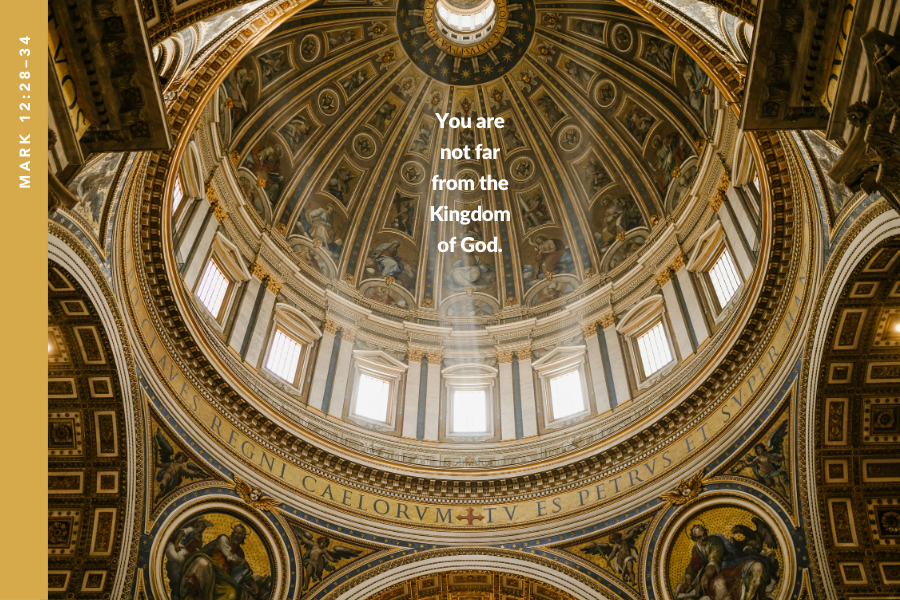
One of the scribes came to Jesus and asked him, “Which is the first of all the commandments?” Jesus replied, “The first is this: Hear, O Israel! The Lord our God is Lord alone! You shall love the Lord your God with all your heart, with all your soul, with all your mind, and with all your strength. The second is this: You shall love your neighbor as yourself. There is no other commandment greater than these.” The scribe said to him, “Well said, teacher. You are right in saying, He is One and there is no other than he. And to love him with all your heart, with all your understanding, with all your strength, and to love your neighbor as yourself is worth more than all burnt offerings and sacrifices.” And when Jesus saw that he answered with understanding, he said to him, “You are not far from the kingdom of God.” And no one dared to ask him any more questions.

Opening Prayer: Heavenly Father, you desire mercy and not sacrifice. Teach me to love you with all my heart, soul, mind, and strength, and to love my neighbor as myself.

Encountering Christ: 

  1. Love God With All Your Heart, Soul, Mind, And Strength: Christianity is not for the weak-willed. Loving the Lord with heart, soul, and mind takes strength, fortitude, and perseverance. To others it may seem that spending time in daily prayer is simply frittering away time that could be used more productively, but Christians know from experience that giving the Lord the first fruits of the day is the very best use of time. It’s calisthenics for the soul and requires a strong-willed, loving heart.


  2. Love Your Neighbor As Yourself: We tend to be very self-aware, knowing what delights us, how we like to spend free time, and what brings us consolation. Do we know these things about our neighbor (understood as family members, friends, and those who live nearby)? Fewer than half of American adults know most or all of their neighbors (Pew Research Center). As Christians, we are called to love our neighbor, and the first step is to get to know their names. May we be builders of strong Christian communities for the glory of God.


  3. You Are Not Far From the Kingdom of God: Imagine hearing these words from the mouth of Jesus. Could there be a greater consolation this side of heaven? The scribe in this Gospel knew the commandments and came to Jesus with a sincere question. He also showed by his spontaneous proclamation that he had been imbued with wisdom from the Holy Spirit, as Jesus acknowledged when he “saw that he answered with understanding.” We follow the scribe’s example when we strive to know our faith and, in prayer, listen attentively to Jesus as he inspires us with word, sacrament, and life circumstances to understand heavenly truths. Then we, too, can be assured of wisdom and understanding as we are drawn more deeply into the Kingdom of God.

Conversing with Christ: Dearest Jesus, grant me the virtues of fortitude and perseverance so that I may strengthen my heart, mind, and soul. With this strength I will be able to concern myself with the needs and interests of my neighbor so that I may sincerely love others.

Resolution: Lord, today by your grace I will reach out and greet one neighbor whom I don’t already know.

Marjorie Davin is a lay member of Regnum Christi who has served as director of the Women’s Section in the Washington, D.C., area. She and her husband have been married for over 30 years and are the parents of four adult children.
March 14, 2026 – The Pharisee and the Tax Collector

26-03-14-DM

Saturday of the Third Week of Lent

Luke 18:9-14

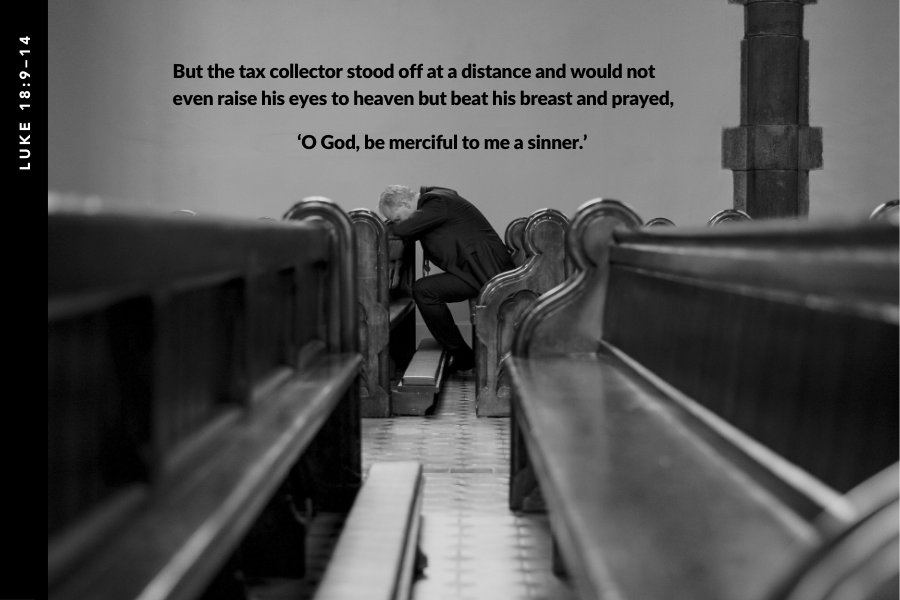
Jesus addressed this parable to those who were convinced of their own righteousness and despised everyone else. “Two people went up to the temple area to pray; one was a Pharisee and the other was a tax collector. The Pharisee took up his position and spoke this prayer to himself, ‘O God, I thank you that I am not like the rest of humanity—greedy, dishonest, adulterous—or even like this tax collector. I fast twice a week, and I pay tithes on my whole income.’ But the tax collector stood off at a distance and would not even raise his eyes to heaven but beat his breast and prayed, ‘O God, be merciful to me a sinner.’ I tell you, the latter went home justified, not the former; for everyone who exalts himself will be humbled, and the one who humbles himself will be exalted.”

Opening Prayer: Good and gracious Father, “be merciful to me a sinner” and help me to approach you with the humility of the tax collector in this time of prayer.

Encountering Christ: 

  1. Pharisee or Tax Collector?: The Pharisee sees only the good he does. Do we see ourselves as “good”? How diligently do we work to rid ourselves of our pet sins? How carefully do we examine our day for evidence of “little” venial sins? How easily do we fall into habits of “seemingly harmless” white lies, exaggerations, idle chatter, or gossip? Every venial sin has consequences: “Venial sin weakens charity; it manifests a disordered affection for created goods; it impedes the soul’s progress in the exercise of the virtues and the practice of the moral good; it merits temporal punishment. Deliberate and unrepented venial sin disposes us little by little to commit mortal sin” (CCC 1863). Many of the saints and popes availed themselves of weekly Confession. Do we feel the weight of sin drawing us to this sacrament? The more sensitive we are to our sinfulness, the more readily we run to the confessional.


  2. “He Spoke This Prayer to Himself”: Humanly speaking, this Pharisee had “his” place in the temple; but spiritually he didn’t realize where he was or who he was. He prayed to himself. He compared himself to others. He thought he knew himself well, but clearly he did not. It can be easy to allow our routine prayer time to turn into a monologue or one long distraction. In those moments we, too, are praying to ourselves. Let’s regroup and approach our time of prayer with a renewed sincerity and an open heart. Jesus will acknowledge our effort and bless us, drawing us ever closer, inviting us to healing and restoration.


  3. “Beat His Breast and Prayed”: The tax collector stood at a distance proclaiming his guilt and beating his breast in contrition. Fortunately, we are not asked to publicly express our guilt and sorrow, except by our presence in the line for Confession. Nor are we expected to keep our distance from Christ. But we are encouraged to be sorry for our sins. “Contrition is sorrow of the soul and detestation for the sin committed, together with the resolution not to sin again. When it arises from a love by which God is loved above all else, contrition is called ‘perfect’ (contrition of charity). […] The contrition called ‘imperfect’ is also a gift of God, a prompting of the Holy Spirit. It is born of the consideration of sin’s ugliness or the fear of eternal damnation and the other penalties threatening the sinner (contrition of fear)” (CCC 1451-1453). Jesus offers us intimate access to his sacred heart through Confession and gives us the grace to be sorry for our sins.

Conversing with Christ: Christ Jesus, I love you and strive to know and carry out your will, but because I am a sinner I fall short each day. By your grace I am able to look with clarity at my life and my choices, and in your mercy I am given another chance to try again. Success is not about my accomplishments but about how well I love.

Resolution: Lord, today by your grace I resolve to practice a balanced look at my day by spending five to ten minutes in the evening reflecting on the ways I cooperated with God’s grace and the ways I failed to cooperate with his grace. From there I will resolve to try again tomorrow.

Marjorie Davin is a lay member of Regnum Christi who has served as director of the Women’s Section in the Washington, D.C., area. She and her husband have been married for over 30 years and are the parents of four adult children.

March 15, 2026 – Christ: The Ultimate Friend

26-03-15-DM

Fourth Sunday of Lent

John 9:1-41

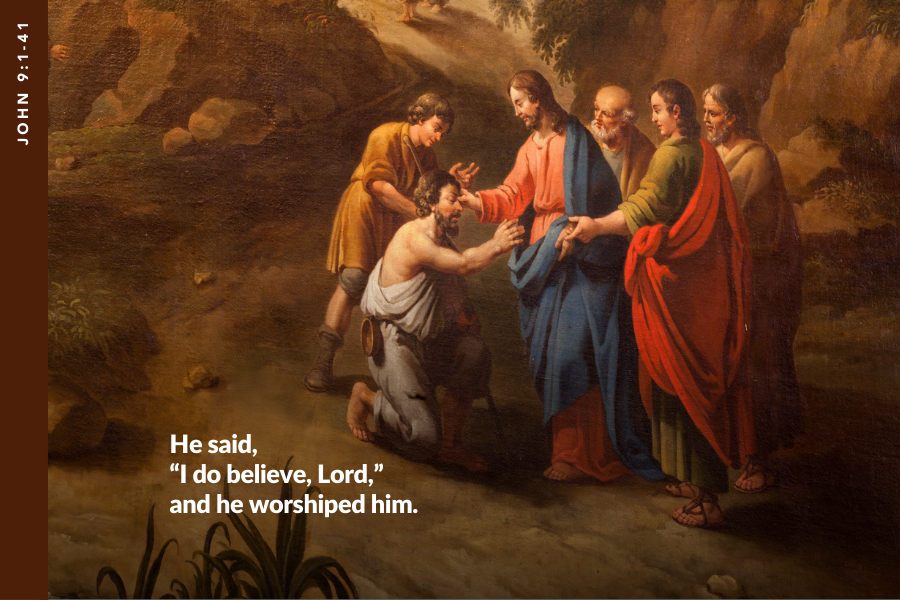
As Jesus passed by he saw a man blind from birth. His disciples asked him, “Rabbi, who sinned, this man or his parents, that he was born blind?” Jesus answered, “Neither he nor his parents sinned; it is so that the works of God might be made visible through him. We have to do the works of the one who sent me while it is day. Night is coming when no one can work. While I am in the world, I am the light of the world.” When he had said this, he spat on the ground and made clay with the saliva, and smeared the clay on his eyes, and said to him, “Go wash in the Pool of Siloam”—which means Sent—. So he went and washed, and came back able to see. His neighbors and those who had seen him earlier as a beggar said, “Isn’t this the one who used to sit and beg?” Some said, “It is, “but others said, “No, he just looks like him.” He said, “I am.” So they said to him, “How were your eyes opened?” He replied, “The man called Jesus made clay and anointed my eyes and told me, ‘Go to Siloam and wash.’ So I went there and washed and was able to see.” And they said to him, “Where is he?” He said, “I don’t know.” They brought the one who was once blind to the Pharisees. Now Jesus had made clay and opened his eyes on a sabbath. So then the Pharisees also asked him how he was able to see. He said to them, “He put clay on my eyes, and I washed, and now I can see.” So some of the Pharisees said, “This man is not from God, because he does not keep the sabbath.” But others said, “How can a sinful man do such signs?” And there was a division among them. So they said to the blind man again, “What do you have to say about him, since he opened your eyes?” He said, “He is a prophet.” Now the Jews did not believe that he had been blind and gained his sight until they summoned the parents of the one who had gained his sight. They asked them, “Is this your son, who you say was born blind? How does he now see?” His parents answered and said, “We know that this is our son and that he was born blind. We do not know how he sees now, nor do we know who opened his eyes. Ask him, he is of age; he can speak for himself.” His parents said this because they were afraid of the Jews, for the Jews had already agreed that if anyone acknowledged him as the Christ, he would be expelled from the synagogue. For this reason his parents said, “He is of age; question him.” So a second time they called the man who had been blind and said to him, “Give God the praise! We know that this man is a sinner.” He replied, “If he is a sinner, I do not know. One thing I do know is that I was blind and now I see.” So they said to him, “What did he do to you? How did he open your eyes?” He answered them, “I told you already and you did not listen. Why do you want to hear it again? Do you want to become his disciples, too?” They ridiculed him and said, “You are that man’s disciple; we are disciples of Moses! We know that God spoke to Moses, but we do not know where this one is from.” The man answered and said to them, “This is what is so amazing, that you do not know where he is from, yet he opened my eyes. We know that God does not listen to sinners, but if one is devout and does his will, he listens to him. It is unheard of that anyone ever opened the eyes of a person born blind. If this man were not from God, he would not be able to do anything.” They answered and said to him, “You were born totally in sin, and are you trying to teach us?” Then they threw him out. When Jesus heard that they had thrown him out, he found him and said, “Do you believe in the Son of Man?” He answered and said, “Who is he, sir, that I may believe in him?” Jesus said to him, “You have seen him, the one speaking with you is he.” He said, “I do believe, Lord,” and he worshiped him. Then Jesus said, “I came into this world for judgment, so that those who do not see might see, and those who do see might become blind.” Some of the Pharisees who were with him heard this and said to him, “Surely we are not also blind, are we?” Jesus said to them, “If you were blind, you would have no sin; but now you are saying, ‘We see,’ so your sin remains.”

Opening Prayer: Lord, you know how blind I am to your presence and your work in my life. In this time of prayer, I renew my faith—I do believe in your enduring presence. I renew my hope in your promise of eternal life. I love you for the work you have already done and are continuing to do.

Encountering Christ:

  1. The Works of God: Jews of the first century commonly regarded blindness (or any physical ailment, for that matter) a manifestation of sin. They asked Jesus, therefore, who it was who sinned. Jesus responded: “Neither he nor his parents sinned; it is so that the works of God might be made visible through him.” St. Paul recounted that the Lord once told him, “My grace is sufficient for you, for power is made perfect in weakness” (2 Cor 12:9). God’s power becomes perfectly manifest in the poverty and blindness of our human condition, especially when we are open to his grace and his work in us.


  2. The Transformation of Healing: After Christ healed the blind man, the Pharisees had trouble recognizing him: “Isn’t this the one who used to sit and beg?” The work of Christ in us, which heals and converts us, is a transformative work that can change the way we are perceived by others. The season of Lent is the perfect time to allow the Lord to perfect this transformation in us, but it can come at a cost. People who think they know us might be tempted to criticize us for our Lenten fasts or mortifications, claiming we’re no longer the same person. Are we willing to endure this criticism, if it means transformation into Christ?


  3. “Even If My Father and Mother Forsake Me…”: The transformation that Christ worked in the blind man had serious repercussions for him: people didn’t recognize him, and his own parents distanced themselves from him. “He is of age; question him,” his parents said. However, he was not totally forsaken. Jesus approached him and revealed himself to be the Son of Man. For the ex-blind man, the words of Psalm 27 came true: “Even if my father and mother forsake me, the Lord will take me in” (Ps 27:10). We need faith to seek out Christ when friends and family seem to misunderstand or reject us.

Conversing with Christ: Lord Jesus, enlighten the eyes of my heart, to see you for who you truly are: the Son of Man, the Savior of the world. Give me the strength to be able to cling to you, even when those I love seem to reject me or distance themselves from me.

Resolution: Lord, today by your grace I will extend my friendship to someone in my workplace or school who seems to be an outcast.

Brian Flanagan is a Regnum Christi member from Atlanta, Georgia.

Scroll to Top

Events

Looking for another country?

Contact Regnum Christi near you

News & Resources

News & Resources

The Regnum Christi Mission

The Regnum Christi Identity

Alex Kucera

Atlanta

Alex Kucera has lived in Atlanta, GA, for the last 46 years. He is one of 9 children, married to his wife Karmen, and has 3 girls, one grandson, and a granddaughter on the way. Alex joined Regnum Christi in 2007. Out of the gate, he joined the Helping Hands Medical Missions apostolate and is still participating today with the Ghana Friendship Mission.

In 2009, Alex was asked to be the Atlanta RC Renewal Coordinator for the Atlanta Locality to help the RC members with the RC renewal process. Alex became a Group Leader in 2012 for four of the Atlanta Men’s Section Teams and continues today. Running in parallel, in 2013, Alex became a Team Leader and shepherded a large team of good men.

Alex was honored to be the Atlanta Mission Coordinator between 2010 to 2022 (12 years), coordinating 5-8 Holy Week Mission teams across Georgia. He also created and coordinated missions at a parish in Athens, GA, for 9 years. Alex continues to coordinate Holy Week Missions, Advent Missions, and Monthly missions at Good Shepherd Catholic Church in Cumming, GA.

From 2016 to 2022, Alex also served as the Men’s Section Assistant in Atlanta. He loved working with the Men’s Section Director, the Legionaries, Consecrated, and Women’s Section leadership teams.

Alex is exceptionally grateful to the Legionaries, Consecrated, and many RC members who he’s journeyed shoulder to shoulder, growing his relationship with Christ and others along the way. He knows that there is only one way, that’s Christ’s Way, with others!