


THE WEEKLY DIGEST
OF REGNUM CHRISTI
DAILY MEDITATIONS
Week of June 29 - July 6, 2025
Sunday, June 29, 2025 – Love for the Church
Monday, June 30, 2025 – Tough Teachings
Tuesday, July 1, 2025 – Jesus Asleep in Your Boat
Wednesday, July 2, 2025 – The Value of the Salvation of One Person
Thursday, July 3, 2025 – Thomas and the Call to Faith
Friday, July 4, 2025 – Desiring Mercy, Not Sacrifice
June 29, 2025 – Love for the Church
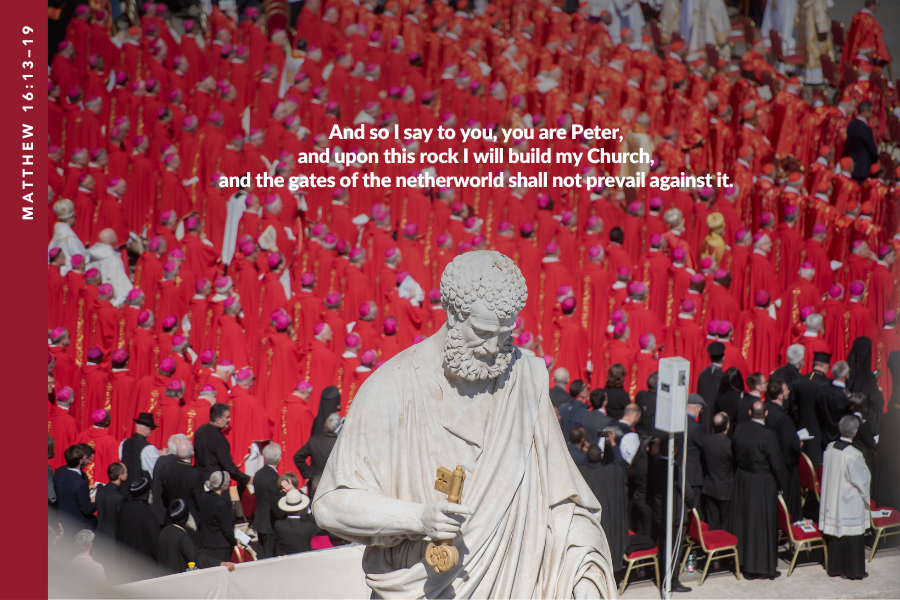
Solemnity of Saints Peter and Paul, Apostles
Matthew 16:13-19
When Jesus went into the region of Caesarea Philippi he asked his disciples, “Who do people say that the Son of Man is?” They replied, “Some say John the Baptist, others Elijah, still others Jeremiah or one of the prophets.” He said to them, “But who do you say that I am?” Simon Peter said in reply, “You are the Christ, the Son of the living God.” Jesus said to him in reply, “Blessed are you, Simon son of Jonah. For flesh and blood has not revealed this to you, but my heavenly Father. And so I say to you, you are Peter, and upon this rock I will build my Church, and the gates of the netherworld shall not prevail against it. I will give you the keys to the Kingdom of Heaven. Whatever you bind on earth shall be bound in Heaven; and whatever you loose on earth shall be loosed in Heaven.”
Opening Prayer: Lord, help me to open my heart to understand more deeply who you are as I spend this time in prayer.
Encountering Christ:
- Spiritual Rock Stars: Sts. Peter and Paul are arguably the most important and influential men in the Church and the world, one our first pope, and the other an apostle to the Gentiles. What made them great was not their talent, personalities, or intelligence. They were leaders and saints because they cooperated with the Holy Spirit to do the will of the Lord. This passage gives us an early example of Peter’s sensitivity to the Spirit. He declared Jesus was the son of God, and Jesus called him “blessed,” adding, “Flesh and blood has not revealed this to you, but my heavenly Father.” We need not have a superior intelligence or a winning personality to become a saint. We will be holy to the degree we cooperate with the Holy Spirit in fulfilling God’s will for our lives.
- Our Story of Conversion: In these verses, we are introduced to Peter, the Rock. No longer Simon, Peter is now the foundation of the new Church and the keeper of the keys to the Kingdom of Heaven. We can imagine Peter’s awe at having had such a powerful experience of the Spirit, his surprise at the words of Jesus’ anointing, and perhaps a bit of trepidation at the responsibility to bind and loose, if he even understood it at that moment. Peter’s whole ministry was ahead of him, and he likely felt zealous and empowered. We can presume so, because a few verses later Peter was rebuked by Jesus when he boldly objected to the prediction of Jesus’ Passion (cf. Mt 16:22-23). In today’s second reading we heard Paul speaking toward the end of his ministry about being “poured out like a libation” (2 Tim 4:6). Paul was looking back over his life’s work, affirming that “the Lord stood by me and gave me strength, so that through me the proclamation might be completed and all the Gentiles might hear it” (2 Tim 4:17). Their story of their journey from obscurity to sainthood is our story too. Like Peter and Paul, we one day awoke to the Spirit-filled realization that we are personally, unconditionally loved by God. Over time, we exchanged our initial zealousness for a faithful determination to accomplish our unique, unrepeatable mission. We are strengthened by prayer, the sacraments, and our community of believers, until one day we say, like St. Paul, “I have competed well; I have finished the race; I have kept the faith” (2 Tim 4:7). As we work day after day in the Church’s field hospital (cf. Pope Francis, February 5, 2015), may we draw consolation from these words of St. Paul: “From now on the crown of righteousness awaits me, which the Lord, the just judge, will award to me on that day, and not only to me, but to all who have longed for his appearance” (2 Tim 4:8).
- The Papacy: Jesus gave Peter the keys to the Kingdom of Heaven and the power to bind and loose. With these few words, Jesus revealed much about the future Roman Catholic Church. According to the Catechism 553, “The ‘power of the keys’ designates authority to govern the house of God, which is the Church. Jesus, the Good Shepherd, confirmed this mandate after his Resurrection: ‘Feed my sheep.’ The power to ‘bind and loose’ connotes the authority to absolve sins, to pronounce doctrinal judgments, and to make disciplinary decisions in the Church. Jesus entrusted this authority to the Church through the ministry of the Apostles and in particular through the ministry of Peter, the only one to whom he specifically entrusted the keys of the Kingdom.” Since these words were spoken by Jesus, there has been an unbroken succession of popes leading our Church. We pray for our Holy Father at every Mass and, out of love for the Church, we also include his intentions in our personal prayer.
Conversing with Christ: Lord, you founded the Church on Peter the Rock and named Paul Apostle to the Gentiles. They had illustrious roles in your divine plan for the Church. Help me to appreciate my role in the Church as well. You have called me to the faith and placed me in my parish, my community, and my family as a member of the Church, for which you are the living Head. By your grace, may I spread the Kingdom and be a fruitful member of the Church.
Resolution: Lord, today by your grace I will offer an Our Father, Hail Mary, and Glory Be for the Holy Father.
For Further Reflection: Catechism Article 9: “I BELIEVE IN THE HOLY CATHOLIC CHURCH.
Maribeth Harper celebrated paying the last tuition bill for her kids’ college by writing a book for parents who have college-aged young adults, A Spiritual Toolbox: Tips for Parenting through the First Year of College. She is a wife of thirty-five years, mother of four, and grandmother of twelve and counting.
June 30, 2025 – Tough Teachings

Monday of the Thirteenth Week in Ordinary Time
Matthew 8:18-22
When Jesus saw a crowd around him, he gave orders to cross to the other shore. A scribe approached and said to him, “Teacher, I will follow you wherever you go.” Jesus answered him, “Foxes have dens and birds of the sky have nests, but the Son of Man has nowhere to rest his head.” Another of his disciples said to him, “Lord, let me go first and bury my father.” But Jesus answered him, “Follow me, and let the dead bury their dead.”
Opening Prayer: Lord Jesus, I know this life is not the end, that I am just passing through on my way to my eternal home with you. Help me to always put you first in my life and never let anything come between us.
Encountering Christ:
- Love Comes First: Matthew’s Gospel is the first book of the New Testament and, therefore, a bridge between the Old and New Testaments. It was written by a Jew, a former tax collector, to his fellow Jews, about the new Kingdom. Many modern readers dislike Matthew’s Gospel because of its hard sayings, like the one found in today’s reading. In this part of the Gospel, Jesus had not yet called apart his Twelve Apostles. Some newcomers had approached Jesus, and Jesus had some harsh sayings for them. Following him wasn’t easy then, and it isn’t easy now. Our relationship with Jesus must be our highest priority in life—higher than even the good priorities that are part of caring for our human family. Of course, we know that the burial of the dead is a corporal work of mercy (cf. Tob 1:16-18); it honors the children of God who are temples of the Holy Spirit (CCC 2300). Yet, the pursuit of divine holiness trumps even the legitimate wishes of our human family. While this scenario may seem a bit extreme, and we are called to carefully discern God’s will, the point is clear: loving God always comes first. “Love… and do what you will,” said St. Augustine. If love is our modus operandi, God takes care of the details.
- Hard Teachings: Christ is Our Lord, and as Lord he demands the very best for his followers. Christ is a passionate lover and only demands what he knows we need. Flannery O’Connor once said: “To the hard of hearing, you must shout,” which is one reason why some of her writings are difficult to digest. Jesus, at times, seemed to shout into our world, but it was necessary because we are all somewhat deaf due to original sin. “Original sin entails captivity under the power of him who thenceforth had the power of death, that is, the devil. Ignorance of the fact that man has a wounded nature inclined to evil gives rise to serious errors of education, politics, social action, and morals” (CCC 407). Yet, Christ’s demands are always signs that he loves us… even more than life itself.
- A Pure Heart: Many people in Jesus’ day misinterpreted obedience to the moral law as a performance, an external behavior, and they obeyed it to the letter. Yet Jesus as God demands more, not less, than the strict observances of the law. God wants our hearts—our pure hearts. God is a lover, not a slave driver. God wants all of us, our whole person, not just certain behaviors; he wants our whole selves. But the spiritual physics of giving him our all is that he gives it back to us and then some. God is always about the more. “I came so that they might have life and have it more abundantly” (Jn 10:10).
Conversing with Christ: Lord, help me today to make sure that what I say and do always increases my love for you and for our Father. Please help me also to assist my neighbor to grow in his love for God.
Resolution: Lord, today by your grace I will look carefully at how I spend my free time and schedule extra time in dialogue to listen to you.
For Further Reflection: Read the Catechism of the Catholic Church 222-227, on the implications of faith in one God.
Janet Scanlan is a lifelong Catholic, wife, mother, and grandmother, who is passionate about helping people know and live the love of Christ through marriage ministry, evangelization, writing, and work as a spiritual director.
July 1, 2025 – Jesus Asleep in Your Boat

Tuesday of the Thirteenth Week in Ordinary Time
Matthew 8:23-27
As Jesus got into a boat, his disciples followed him. Suddenly a violent storm came up on the sea, so that the boat was being swamped by waves; but he was asleep. They came and woke him, saying, “Lord, save us! We are perishing!” He said to them, “Why are you terrified, O you of little faith?” Then he got up, rebuked the winds and the sea, and there was great calm. The men were amazed and said, “What sort of man is this, whom even the winds and the sea obey?”
Opening Prayer: Lord, I come to you today to give you thanks for all the blessings in my life. Please help me to remember that, no matter how dark this life gets for me, you are always in my boat and always ready to restore calm in my heart.
Encountering Christ:
- In the Darkest Times, Pray: “Lord, save us! We are perishing!” comes from Psalm 130 and is a de profundis prayer: “Out of the depths I cry to you, O Lord. Lord, hear my voice! Let your ears be attentive to the voice of my supplications” (v. 1-2). Psalm 130 is the official prayer of the Church for the Holy Souls in Purgatory. It is the prayer offered at the darkest times of our lives, when we feel completely powerless to help ourselves. Jesus sleeping in the midst of a storm is a very powerful image of God’s sovereignty over even the darkest times in our lives. St. Therese of Lisieux used to meditate on this passage in times of inner confusion or darkness. Yet she wouldn’t wake the Lord. For her, it was enough just to sit beside him as he slept.
- Yet You Are There: Notice that Jesus said, “O you of little faith.” These men had faith, but it was just too little. Their faith, like ours, grows only when it is tested. The Father knows what we need even before we ask. Jesus is always with the Father, and that reality is the key to peace in the storms of life. Do we believe that the Father will not try us beyond our strength? Do we believe that faith the size of a mustard seed can move mountains? Lord, please increase our faith.
- The Power of Jesus: Just before this passage, in Matthew 8, Jesus cleansed a leper, healed a centurion’s servant, and healed many at the house of Peter. He was truly a physical healer. Here, we also saw his power over nature; even the winds and the seas obeyed him. Yet, all these healings pale in comparison to his power to heal us from the worst affliction of all and the only one that matters: sin. Jesus came to take away sin by becoming sin and crucifying it on the cross, in his very person. He paid a price we couldn’t pay for our sins that he didn’t commit. There is no greater love—and no greater power—than the power of Jesus Christ, the only son of God. The Gospels of Mark (4) and Luke (8) also tell their version of this calming of the storm at sea. In his famous painting of “The Storm on the Sea of Galilee,” Rembrandt depicted this scene in all its terror. When we imagine ourselves in the scene, how do we react?
Conversing with Christ: Lord, I know you are with me in all the storms of my life. I know that you will never leave me orphaned. Help me to cry out to you in desperate times. Lord, I believe. Increase my faith.
Resolution: Lord, today by your grace I will pray with Psalm 130 and, if possible, commit it to memory.
For Further Reflection: View the famous Rembrandt painting of “The Storm on the Sea of Galilee” online and ponder Jesus always being in the boat of your soul.
Janet Scanlan is a lifelong Catholic, wife, mother, and grandmother, who is passionate about helping people know and live the love of Christ through marriage ministry, evangelization, writing, and work as a spiritual director.
July 2, 2025 – The Value of the Salvation of One Person

Wednesday of the Thirteenth Week in Ordinary Time
Matthew 8:28-34
When he came to the other side, to the territory of the Gadarenes, two demoniacs who were coming from the tombs met him. They were so savage that no one could travel by that road. They cried out, “What have you to do with us, Son of God? Have you come here to torment us before the appointed time?” Some distance away a herd of many swine was feeding. The demons pleaded with him, “If you drive us out, send us into the herd of swine.” And he said to them, “Go then!” They came out and entered the swine, and the whole herd rushed down the steep bank into the sea where they drowned. The swineherds ran away, and when they came to the town they reported everything, including what had happened to the demoniacs. Thereupon the whole town came out to meet Jesus, and when they saw him they begged him to leave their district.
Opening Prayer: My Jesus, I so often find myself divided, giving more importance to things of this world than to the salvation of others or even the good of my own soul. Open my eyes and heart to love holiness and the salvation of souls as much as you do.
Encountering Christ:
- Sin Torments: “Two demoniacs who were coming from the tombs met him.” Here were two people, tormented and in bondage, courtesy of the devil. Their condition was serious, if not fatal, but isn’t this our reality anytime we allow sin into our life? When a soul drifts from God it grows distant, cold to God, and can even become aggressive out of fear or hatred. In their exchange with Jesus, the souls in this passage did all of the talking out of extreme agitation. Jesus simply looked at them unafraid and in control. Jesus is always loving, patient, and attentive to our pleadings, and showers his mercy upon us when we desire to be freed from the bondage of sin.
- Jesus Spoke: “Go then!” Jesus hadn’t spoken a word until now, but the demoniacs knew he would expel them at some point because perfect good always prevails over evil. Jesus didn’t want them to be slaves to sin, nor does he want this for us. Jesus wants us to be free to truly follow him and love what is good, true, and beautiful as he created it. It’s our responsibility to surrender to God, confess, and make reparation whenever we realize we’ve given into sin.
- They Banished Jesus: “They begged him to leave their district.” People sometimes don’t want the good of others, especially if it requires sacrificing their own comfort or security. The people in this district weren’t happy for the demoniacs who had been cured. Rather, they were afraid and concerned with the revenue they lost when Jesus cast the devils into their swine. We should beware of growing tepid in our faith and distant from Jesus lest we lose a sense of the seriousness of sin and its consequences. Conversion of a sinner is the ultimate good and always a cause for celebration.
Conversing with Christ: Lord Jesus, help me to never grow accustomed to sin in my life, but to seek you with a sincere heart so that no taint of sin may mark my soul. Make me a more passionate lover of the salvation of souls so that I may call people to freedom from sin by your grace.
Resolution: Lord, today by your grace I will be open to talking to someone about the gift of salvation in Christ.
For Further Reflection: Interior Freedom,” by Fr Jacques Philippe
Father Todd Arsenault is from Prince Edward Island, Canada, and is a priest with the Legionaries of Christ. He spent fourteen years doing ministry in the greater Toronto area as a chaplain for Regnum Christi and couple’s groups, spiritual director, and retreat master. He is currently on a two-year sabbatical in Rome, studying for a licentiate in Spiritual Theology at the Pontifical Athenaeum Regina Apostolorum.
July 3, 2025 – Thomas and the Call to Faith
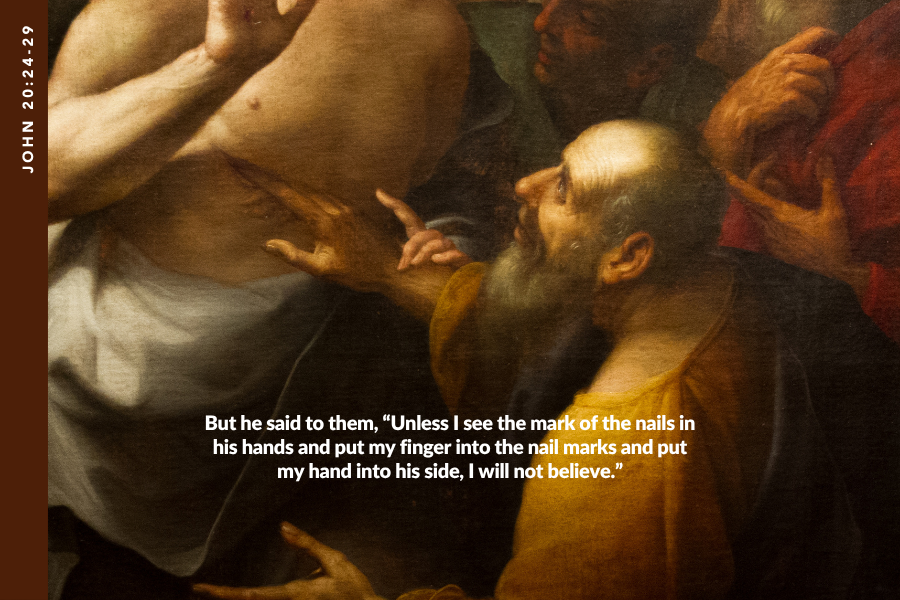
Feast of Saint Thomas, Apostle
John 20:24-29
Thomas, called Didymus, one of the Twelve, was not with them when Jesus came. So the other disciples said to him, “We have seen the Lord.” But he said to them, “Unless I see the mark of the nails in his hands and put my finger into the nail marks and put my hand into his side, I will not believe.” Now a week later his disciples were again inside and Thomas was with them. Jesus came, although the doors were locked, and stood in their midst and said, “Peace be with you.” Then he said to Thomas, “Put your finger here and see my hands, and bring your hand and put it into my side, and do not be unbelieving, but believe.” Thomas answered and said to him, “My Lord and my God!” Jesus said to him, “Have you come to believe because you have seen me? Blessed are those who have not seen and have believed.”
Opening Prayer: Lord Jesus, I believe in you! Strengthen my faith so it may be living and active.
Encountering Christ:
- Doubting Thomas: Thomas rightly attained the appellative “doubting” after this scenario, but what an opportunity this afforded him as well! Thomas was graced with an appearance from Jesus himself, and the invitation to put his finger into Jesus’ wounded side. In this passage, Jesus proved that he will do whatever it takes to help us overcome our doubts. Doubts are a normal part of being human, but also an open door to something more for those who strive to reach out and put their finger into Jesus’ open wounds.
- My Lord and My God!: Thomas went from doubt to a tremendous proclamation of faith! For Thomas, Jesus was no longer simply the rabboni or master. He was the incarnate God! Can we find a greater profession of faith in the Scriptures? Thomas reminds us that faith is not only a gift, but also a human act. Where doubt surfaces, let us wrestle with God, like Jacob in the Old Testament, until we receive the invitation to touch Jesus and discover that he is truly present. When grace begins to bless our wrestling, faith becomes a living testimony of the God who first reached out to us. The words and doctrine that we articulate in the Creed suddenly take on flesh, and our hearts perceive truth differently than before.
- Another Thomas: St. Thomas Aquinas lived in the thirteenth century. He is considered a giant of the faith who attempted a systematic explanation of theology in his Summa Theologica. Take comfort in the testimony of these two Thomases. Thomas the Apostle walked with Jesus in his public ministry and he still doubted. But the Lord came to strengthen his faith. St. Thomas Aquinas labored for years on his work for the Lord and after one mystical experience, one touch of Christ, realized that his great labor paled in comparison with “my Lord and my God!” Let us strive to live faith while also trusting that the Lord will present himself when, where, and as he wants. He knows the best timing for our soul.
Conversing with Christ: My Lord and my God, I praise you for your goodness in my life. You know when to hide yourself and when to reveal yourself. Help me have patience to let you work as you desire.
Resolution: Lord, today by your grace I will make many acts of faith in your presence. And I will decide to study and wrestle with one teaching of the Church that I do not understand.
Jennifer Ristine is a consecrated woman of Regnum Christi dedicated to spiritual and faith formation through teaching, conferences, writing, and spiritual direction. While serving in Ancient Magdala, she wrote Mary Magdalene: Insights from Ancient Magdala and “Nine Days with Mary Magdalene.”
July 4, 2025 – Desiring Mercy, Not Sacrifice

Friday of the Thirteenth Week in Ordinary Time
Matthew 9:9-13
As Jesus passed by, he saw a man named Matthew sitting at the customs post. He said to him, “Follow me.” And he got up and followed him. While he was at table in his house, many tax collectors and sinners came and sat with Jesus and his disciples. The Pharisees saw this and said to his disciples, “Why does your teacher eat with tax collectors and sinners?” He heard this and said, “Those who are well do not need a physician, but the sick do. Go and learn the meaning of the words, I desire mercy, not sacrifice. I did not come to call the righteous but sinners.”
Opening Prayer: Lord, you nourish me with your words in Scripture, and with your body when I answer your invitation to come to your banquet table. Never stop calling me to follow you, and give me the grace to walk in your ways, with the help of your Holy Spirit.
Encountering Christ:
- Seeing a Man: When the penetrating gaze of Jesus fell upon Matthew, the Lord saw a man. Instead of perceiving Matthew as the object of derision for the role he played in society, Jesus saw the man first and foremost as a reflection of himself, created in his image and likeness. Man’s first sin in the garden had surely tarnished this reflection, but neither that original sin, nor any subsequent sin committed by this particular man, diminished the incredible dignity that Matthew enjoyed as a child of God. Matthew had used his free will, granted by our loving God and Father, to side with the Roman authorities against the Jews, the chosen people into which he was born. But Our Lord also gave him, and gives us, a chance to turn his back on his former life and follow Christ, perfecting that will. “By free will one shapes one’s own life. Human freedom is a force for growth and maturity in truth and goodness; it attains its perfection when directed toward God, our beatitude” (CCC 1731).
- Seeing a Problem: Jesus’ invitation to Matthew, a seemingly simple “Follow me,” was anything but simple. Adding the despised tax collector to his band of followers would have immediately sowed discord among the rest of the disciples. Many of them would surely see a problem with this new addition. We can imagine what they might have been thinking, or even declaring aloud: “Lord, not him!” Today, we may be preparing for our weekend and hoping to get together with family or friends. How will we respond if we find a stranger in our company? What if this stranger has a reputation? On one hand, Jesus does tell us to be “shrewd as serpents,” but he also implores us to be “simple as doves” (Mt 10:16). Furthermore, although we must always speak the truth in charity regarding behaviors we witness, Scripture frequently urges us not to judge others, leaving judgment to Our Lord (cf. Mt 7:1, Lk 6:37, and Rom 2:1-2).
- The Master’s Plan: Jesus knew exactly what he was doing when he called Matthew. His reasons soon became quite clear, at the “breaking of bread” that evening. The religious authorities, convinced of their superiority, took the opportunity to test Our Lord. Placing themselves above the sinners present at the dinner, they endeavored to have Jesus admit that the worth of the individual, and thus the degree to which the individual is worthy of attention, is somehow related to their behavior. They failed to acknowledge that they had misunderstood the God of Israel, the object of their intense study. They should, instead, have been studying this man right in front of them to witness how he was fulfilling the law. Jesus, always the teacher, reminded them, and reminds us, how we can draw near to God: “I desire mercy, not sacrifice.”
Conversing with Christ: Jesus, thank you for calling people of all kinds to follow you, especially those to whom I can relate. You show me with your example that you not only desire mercy, but you freely extend mercy to sinners who return to you. Let me never think that any sin is worth distancing myself from you; on the contrary, grant me the grace to seek you often in your sacrament of Reconciliation.
Resolution: Lord, today by your grace I will pray the Divine Mercy chaplet, offering each decade for somebody whom I find myself judging.
Andrew Rawicki and his wife JoAnna live in Irving, Texas, near eight of their ten grandchildren. A convert from Judaism, Andrew entered the Church in 1991, and has been a member of the Regnum Christi spiritual family since 2001. He has served as the Regnum Christi Local Director for Dallas since July 2020.
July 5, 2025 – How Can We Keep From Singing?

Saturday of the Thirteenth Week in Ordinary Time
Matthew 9:14-17
The disciples of John approached Jesus and said, “Why do we and the Pharisees fast much, but your disciples do not fast?” Jesus answered them, “Can the wedding guests mourn as long as the bridegroom is with them? The days will come when the bridegroom is taken away from them, and then they will fast. No one patches an old cloak with a piece of unshrunken cloth, for its fullness pulls away from the cloak and the tear gets worse. People do not put new wine into old wineskins. Otherwise the skins burst, the wine spills out, and the skins are ruined. Rather, they pour new wine into fresh wineskins, and both are preserved.”
Opening Prayer: Lord, let me better understand your word during this time of prayer. I want to be like the wedding guests who are in the presence of the bridegroom, unable to mourn because of intimacy with you. You ask me to detach myself from the things of this world that keep me from you; enlighten me to know what these things are, and strengthen me to give them up, assured of the hope of something infinitely better.
Encountering Christ:
- This One Is Different: Both John the Baptist and Jesus were accompanied by groups of men who were edified by their words and deeds. These people bore the label “disciple,” from the Latin word meaning student, learner, or follower. Those who followed John would have learned from their teacher about certain differences between him and Jesus, particularly in stature: “I am baptizing you with water, but one mightier than I is coming. I am not worthy to loosen the thongs of his sandals. He will baptize you with the holy Spirit and fire” (Lk 3:16). These disciples, some of whom would have seen a dove land on the newly baptized Jesus, and heard a voice from Heaven saying, “This is my beloved son” (Mt 3:16-17), had not yet discovered the most profound difference between these two teachers, one of essence, which John had discerned from his first encounter with the divine Jesus—causing him to leap in St. Elizabeth’s womb (cf. Lk 1:41).
- The Bridegroom Is with Us: Clear differences also existed between the practices of the two bands of disciples. For instance, one group often observed a fast and the other did not. Without a doubt, each teacher preached of the need for repentance, which can be manifested in many ways. “Scripture and the Fathers insist above all on three forms, fasting, prayer, and almsgiving, which express conversion in relation to oneself, to God, and to others” (CCC 1434). Jesus’ disciples did not fast in the presence of “the bridegroom,” the continual source for their joy. Today, while we have access to the bridegroom in the Eucharist, we also long for that continual union with him in joy for all eternity. St. John of the Cross once said that we cannot rise up to God if we are bound to the things of this world, reminding us that fasting from things we enjoy is a preparation for Heaven.
- New Wine, Fresh Skins: Another preparation for Heaven, of course, is to reconcile with God while here on earth, by confessing our sins to “the bridegroom” in humble contrition. With souls absolved of sin, we, like new wineskins, can more effectively receive the “new wine” that Christ has in store for us, an outpouring of his grace. If we wonder what beautiful gifts a pure soul might accept from the Lord, we can look to our Blessed Mother. The Immaculate One, preserved from the stain of sin from the moment of her conception, was the epitome of a “new wineskin.” It was to this beautiful earthen vessel that the Angel Gabriel was able to proclaim “Hail, full of grace,” seeking her fiat to become the bride of the Holy Spirit, and set in motion God’s plan of salvation. May we also cooperate with God’s plan, keeping our souls clean and ready to accept God’s grace with deep gratitude.
Conversing with Christ: I thank you, Lord, for your invitation to me to enter into prayer with you. You are the bridegroom who is always attentive to his bride, the Church, into which you adopted me at my baptism. Let me gratefully appreciate the grace you poured out on that day and each time I return to you in your sacraments. Make me a “fresh wineskin,” always ready to receive from you.
Resolution: Lord, today by your grace I will read (or sing) the lyrics of the hymn “How Can I Keep From Singing?” and consider the joy that flows from the bridegroom’s invitation to be members of his bride, the Church.
For Further Reflection: Reflect on these words of Scripture from the loving bridegroom: “You are beautiful in every way, my friend, there is no flaw in you! With me from Lebanon, my bride!
With me from Lebanon, come! Descend from the peak of Amana, from the peak of Senir and Hermon, From the lairs of lions, from the leopards’ heights. You have ravished my heart, my sister, my bride; you have ravished my heart with one glance of your eyes, with one bead of your necklace” (Song 4:7-9).
Andrew Rawicki and his wife JoAnna live in Irving, Texas, near eight of their ten grandchildren. A convert from Judaism, Andrew entered the Church in 1991, and has been a member of the Regnum Christi spiritual family since 2001. He has served as the Regnum Christi Local Director for Dallas since July 2020.
July 6, 2025 – Laborers for His Harvest

Fourteenth Sunday in Ordinary Time
Luke 10:1-12, 17-20
At that time the Lord appointed seventy-two others whom he sent ahead of him in pairs to every town and place he intended to visit. He said to them, “The harvest is abundant but the laborers are few; so ask the master of the harvest to send out laborers for his harvest. Go on your way; behold, I am sending you like lambs among wolves. Carry no money bag, no sack, no sandals; and greet no one along the way. Into whatever house you enter, first say, ‘Peace to this household.’ If a peaceful person lives there, your peace will rest on him; but if not, it will return to you. Stay in the same house and eat and drink what is offered to you, for the laborer deserves his payment. Do not move about from one house to another. Whatever town you enter and they welcome you, eat what is set before you, cure the sick in it and say to them, ‘The Kingdom of God is at hand for you.’ Whatever town you enter and they do not receive you, go out into the streets and say, ‘The dust of your town that clings to our feet, even that we shake off against you.’ Yet know this: the Kingdom of God is at hand. I tell you, it will be more tolerable for Sodom on that day than for that town.” The seventy-two returned rejoicing, and said, “Lord, even the demons are subject to us because of your name.” Jesus said, “I have observed Satan fall like lightning from the sky. Behold, I have given you the power to ‘tread upon serpents’ and scorpions and upon the full force of the enemy and nothing will harm you. Nevertheless, do not rejoice because the spirits are subject to you, but rejoice because your names are written in Heaven.”
Opening Prayer: Lord, let me ponder deeply these words of Scripture and have them enter both my mind and my heart. Grant me the grace to be courageous in responding to your call, certain that you protect your lambs, especially when we are sent out among wolves.
Encountering Christ:
- Appointed as Emissaries: Thirty-six pairs of the Lord’s followers were sent to multiply the impact of John the Baptist, who had previously been singularly called by God the Father to “Prepare the way of the Lord” (Mk 1:3). Jesus had been cultivating quite a following, and he assessed that many of them were ready to be his hands, feet, and voice in the world. Jesus stated that their destinations were all places he intended to go. We don’t know from the historical record whether Jesus himself ever made the trek to each of these towns. Perhaps this would prove unnecessary, as Christ was spiritually making these visits through his disciples. These emissaries effectively served as “Christ’s body,” of which St. Paul would later speak (cf. 1 Cor 12:27). We rejoice in the hope that these members of Christ’s body are now part of the “cloud of witnesses” that prays for those who continue this evangelizing work.
- The Abundant Harvest: Jesus assured his disciples that the mission fields into which they would travel were ripe for a harvest; many hearts would be thirsting to be exposed to the Gospel message of mercy, and many bodies and souls would be yearning to be healed. If anything, the mission fields have only further ripened over the years. In 1990, St. John Paul II wrote in Redemptoris Missio: “The number of those who do not know Christ and do not belong to the Church is constantly on the increase. Indeed, since the end of the Council it has almost doubled. When we consider this immense portion of humanity which is loved by the Father and for whom he sent his Son, the urgency of the Church’s mission is obvious.” May we have the grace and courage to be an effective Christian witness in our home and in our workplace, overcoming any fear of being a sheep among wolves.
- The Dearth of Laborers: When Jesus told the seventy-two that the “laborers are few,” he instructed them to “ask the master of the harvest to send out laborers” (Mt 9:37-38). Prayers for vocations to the priesthood and consecrated life continue to be sorely needed in all parts of our modern world, and some of the mission fields that need the most urgent attention are areas that saw some of the earliest spread of Christianity. As a response to this urgent need for laborers, and two years before writing Redemptoris Missio, St. John Paul II implored all lay Catholics to play their part in revealing Christ’s love to those who haven’t yet had a meaningful encounter with the Word made flesh. His Apostolic Exhortation entitled Christifideles Laici states: “You go too. The call is a concern not only of pastors, clergy, and men and women religious. The call is addressed to everyone: lay people as well are personally called by the Lord, from whom they receive a mission on behalf of the Church and the world. In preaching to the people, St. Gregory the Great recalled this fact and commented on the parable of the laborers in the vineyard: ‘Keep watch over your manner of life, dear people, and make sure that you are indeed the Lord’s laborers. Each person should take into account what he does and consider if he is laboring in the vineyard of the Lord.’”
Conversing with Christ: Lord, I want to be your voice in this hungry and thirsty world as a lay person, and I pray that more men and women will hear your call to the priesthood and consecrated life. By your grace, may I be an effective witness to my family members, neighbors, and those in my social circle with my words and example.
Resolution: Lord, today by your grace I will pray for vocations with a prayer I know, or with this one: “Lord Jesus, eternal Shepherd, in your kindness look with mercy on your beloved flock. We cry out to you as orphans: Lord, grant us vocations! Call many of our young people to be holy priests and consecrated men and women. We ask you this through the intercession of Mary, your tender, holy Mother.”
For Further Reflection: Read article 2 of Pope Francis’s Gaudete et Exsultate, reflecting on that “cloud of witnesses” that supports us in our evangelizing efforts: “The saints now in God’s presence preserve their bonds of love and communion with us. The Book of Revelation attests to this when it speaks of the intercession of the martyrs: ‘I saw under the altar the souls of those who had been slain for the word of God and for the witness they had borne; they cried out with a loud voice, “O sovereign Lord, holy and true, how long will it be before you judge?”‘ (6:9-10). Each of us can say: ‘Surrounded, led and guided by the friends of God… I do not have to carry alone what, in truth, I could never carry alone. All the saints of God are there to protect me, to sustain me and to carry me.’”
Andrew Rawicki and his wife JoAnna live in Irving, Texas, near eight of their ten grandchildren. A convert from Judaism, Andrew entered the Church in 1991, and has been a member of the Regnum Christi spiritual family since 2001. He has served as the Regnum Christi Local Director for Dallas since July 2020.
- LATEST ARTICLES
View this profile on InstagramRegnum Christi (@regnumchristi_english) • Instagram photos and videos
- RELATED POSTS
