
THE WEEKLY DIGEST
OF REGNUM CHRISTI
DAILY MEDITATIONS

July 20, 2025 – The One Thing

Sixteenth Sunday in Ordinary Time

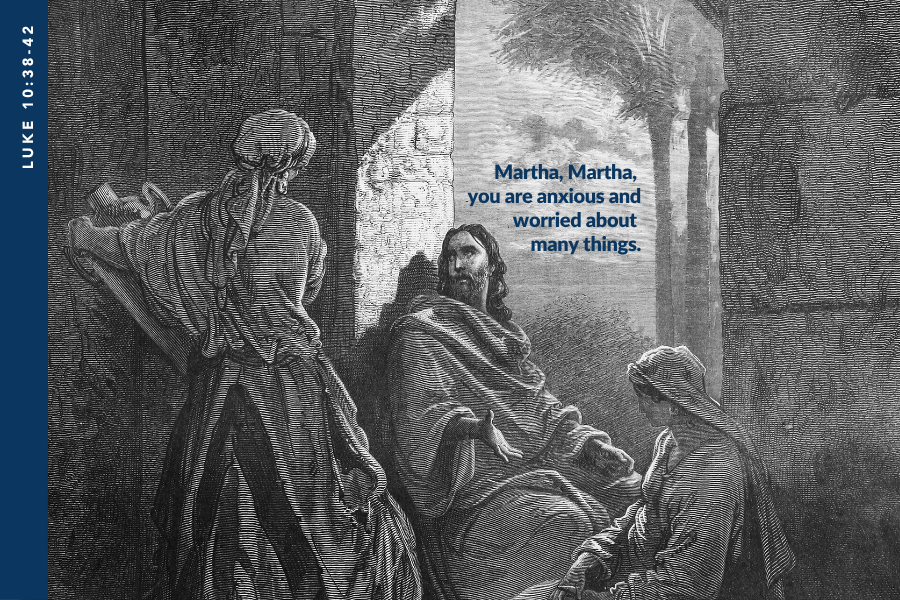
Luke 10:38-42

Jesus entered a village where a woman whose name was Martha welcomed him. She had a sister named Mary who sat beside the Lord at his feet listening to him speak. Martha, burdened with much serving, came to him and said, “Lord, do you not care that my sister has left me by myself to do the serving? Tell her to help me.” The Lord said to her in reply, “Martha, Martha, you are anxious and worried about many things. There is need of only one thing. Mary has chosen the better part and it will not be taken from her.”

Opening Prayer: Jesus, in this time of prayer, I want to sit at your feet, like Mary. I want to listen to you speaking to me. You know that I am so often anxious and worried about many things, and I let those concerns distract me from you, and sometimes, they even keep me from making time for prayer. Lord, give me the grace to desire you above all else. Help me trust that if I make time for you in prayer, the effects will overflow into every aspect of my life. Lord, I believe that you are the source of everything good. I hope in your provision for all my needs. I trust you with those things that are heavy on my heart. Help me know that making this time of prayer is an act of love for you and that it will transform me, if I let it.

Encountering Christ:

  1. One Thing: Martha welcomed Jesus and then busied herself with the details of hospitality. We can imagine how much she desired to show her respect and affection for Jesus through that hospitality. Wanting to provide the best for Jesus became such a focus, however, that it took her attention off of Jesus himself. This same thing can happen to us! We may become so involved in our apostolic work that we skimp on our prayer time, or miss it all together. Jesus wants our hearts. What we do should flow from our love for him and what we hear him ask of us. We are called to honor Jesus through our work, but to do so, we must keep Jesus at the center of everything. We can ask ourselves, “What do I busy myself with to the extent that it takes my attention off of you, Lord? What do I allow to get in the way of listening to you in prayer?”

  2. At His Feet: The most important thing to Mary was to sit at Jesus’ feet so that she could come to know him better and be formed as a disciple by him. Her attention was on what he said. We also have to take time to sit at Jesus’ feet so that we can share what we learn and experience. St. Thomas Aquinas is credited with the Dominican motto: Contemplata aliis tradere—”To contemplate and to share the fruits of our contemplation.” We cannot be satisfied only with efforts for our own sanctification; we are called to work for the sanctification of others. We can consider it a form of charity to form ourselves as we contemplate Our Lord, so that we can help others encounter the Lord and come to know him. In 1 Peter 3:15, we read, “Always be ready to give an explanation to anyone who asks you for a reason for your hope…” How well prepared are we to speak to others about Christ and his Church, both from our personal experience of him and by knowledge of Scripture and tradition?

  3. Both: As Christians, we are called to be both active (evangelizing) and contemplative. Therefore, it is essential that our lives are grounded in Scripture, the teachings of the Church, and prayer. It is also essential that we take seriously the call we received in Baptism to “go and make disciples” (Mt 28:19). We help others not only encounter Christ and come to know his love; we also help them recognize their own call to touch others with the Gospel message as missionary disciples. As Pope Francis wrote in Evangelii Gaudium, “In virtue of their baptism, all the members of the People of God have become missionary disciples (cf. Mt 28:19)… The new evangelization calls for personal involvement on the part of each of the baptized. Every Christian is challenged, here and now, to be actively engaged in evangelization” (n. 120). We can ask ourselves, “Are there obstacles in my life to living this aspect of faith?”
  4.  

Conversing with Christ: Lord, looking at Martha and Mary, I am challenged both to deepen my prayer life and to reach out in active efforts to evangelize. You know my heart. You know I want to love you and those in my life, my family, my friends, my co-workers, but sometimes it is hard to follow through on the inspirations of your Holy Spirit. It is hard to set aside those things that I prioritize over loving and serving you. Lord, help me grow in generosity and charity so that I may live as your image in the world and draw others to you.

Resolution: Lord, today by your grace I will identify one area of Church teaching or Scripture that I would like to know more about and search out a resource to deepen my knowledge and understanding in that area.

Janet McLaughlin and her husband Chris live on a mountain in rural northeastern Oregon. She puts her Master of Arts in Pastoral Studies to work as she shares the beauty and importance of the lay vocation in her writing, speaking, and teaching on spiritual topics.

July 21, 2025 – Demanding Proof or Having Faith

Monday of the Sixteenth Week in Ordinary Time

Matthew 12:38-42

Some of the scribes and Pharisees said to Jesus, “Teacher, we wish to see a sign from you.” He said to them in reply, “An evil and unfaithful generation seeks a sign, but no sign will be given it except the sign of Jonah the prophet. Just as Jonah was in the belly of the whale three days and three nights, so will the Son of Man be in the heart of the earth three days and three nights. At the judgment, the men of Nineveh will arise with this generation and condemn it, because they repented at the preaching of Jonah; and there is something greater than Jonah here. At the judgment the queen of the south will arise with this generation and condemn it, because she came from the ends of the earth to hear the wisdom of Solomon; and there is something greater than Solomon here.”

Opening Prayer: Jesus, as I settle into this time with you, I ask for your help to focus on your presence. Lord, I believe in you. Help me listen with expectancy. Lord, I trust you with all my concerns, knowing that you desire only my good. Lord, I love you. Accept this prayer as an act of love, and through it help me grow closer to you and desire to live for you in every thought, word, and deed.

Encountering Christ:

      1. We Wish to See a Sign from You: Some of the scribes and Pharisees said to Jesus, “Teacher, we wish to see a sign from you.” He said to them in reply, “An evil and unfaithful generation seeks a sign…” By this time, Jesus had already performed many miracles. He had turned water into wine at the wedding in Cana, healed an official’s son, drove an evil spirit from a man in Capernaum, healed Peter’s mother-in-law, and cured many others who were sick and oppressed. The first miraculous catch of fish on the lake of Gennesaret had occurred, and Jesus cleansed a man with leprosy, healed the centurion’s servant, healed a paralyzed man who was lowered through the roof, and healed a man’s withered hand on the Sabbath. In the face of so many miracles—of so many signs—the demand for another sign could be seen as a kind of refusal to see and accept what has already been amply demonstrated. It was a refusal to have faith, and Jesus responded to this doubt and resistance. Are there Church teachings we refuse to accept? Are there circumstances in our life that we refuse to embrace as God’s providence?

      2. Jonah and Solomon: The Gentile Ninevites and the queen of the South responded to Jonah and Solomon. Jesus is greater than Jonah and Solomon, yet the scribes and Pharisees persisted in their unbelief and so would be condemned. By refusing to give proof of his divinity by a sign of such a definitive nature, Jesus respects the freedom of the individual to make a decision in faith; he doesn’t compel belief. The Catechism teaches, “So miracles strengthen faith in the One who does his Father’s works; they bear witness that he is the Son of God. But his miracles can also be occasions for ‘offense’; they are not intended to satisfy people’s curiosity or desire for magic. Despite his miracles some people reject Jesus…” (CCC 548). It also states, “Faith is first of all a personal adherence of man to God” (CCC 150). May our hearts be well disposed to respond to the faith God asks of us.

      3. In the Heart of the Earth: Jesus refused to provide a sign for the scribes and Pharisees, but he alluded to his own death, burial, and Resurrection by describing Jonah’s experience: “Just as Jonah was in the belly of the whale three days and three nights, so will the Son of Man be in the heart of the earth three days and three nights.” He also mentions the “judgment” to come. This was an act of mercy: “The message of the Last Judgment calls men to conversion while God is still giving them ‘the acceptable time…the day of salvation’” (CCC 1041). We will one day be judged as Jesus described: “When the Son of Man comes in his glory…he will separate them one from another, as a shepherd separates the sheep from the goats. He will place the sheep on his right and the goats on his left…To those on the right, he will say, ‘Come, you who are blessed by my Father. Inherit the Kingdom prepared for you from the foundation of the world,’ while he says to those on his left, ‘Depart from me, you accursed, into the eternal fire prepared for the devil and his angels’” (Mt 25:31-46). We live in the time of mercy, so we need not fear judgment. “All grace flows from mercy, and the last hour abounds with mercy for us. Let no one doubt concerning the goodness of God; even if a person’s sins were as dark as night, God’s mercy is stronger than our misery” (St. Faustina).

Conversing with Christ: Lord, the scribes and Pharisees heard of or saw all the good that you did. Why didn’t they let themselves open their hearts and minds? Yet if I am honest with myself, I know that there are times I don’t want to hear what you are saying to me or asking of me. There are times when I demand proof. Lord, please help me to grow in faith, surrender all that I am to you, and live according to your will. Grant me self-knowledge and the grace to overcome any of the obstacles, such as pride, vanity, or laziness, that hinder my response to your call.

Resolution: Lord, today by your grace I will reflect on the Act of Faith prayer and invite a family member or friend to make an Act of Faith with me:

O my God, I firmly believe
that you are one God in three divine Persons,
Father, Son, and Holy Spirit.
I believe that your divine Son became man
and died for our sins and that he will come
to judge the living and the dead.
I believe these and all the truths
which the Holy Catholic Church teaches
because you have revealed them
who are eternal truth and wisdom,
who can neither deceive nor be deceived.
In this faith I intend to live and die.
Amen.

For Further Reflection: Read the Catechism of the Catholic Church 678-679, “To Judge the Living and the Dead.”

Janet McLaughlin and her husband Chris live on a mountain in rural northeastern Oregon. She puts her Master of Arts in Pastoral Studies to work as she shares the beauty and importance of the lay vocation in her writing, speaking, and teaching on spiritual topics.
July 22, 2025 – Seeking Even in the Dark

Feast of Saint Mary Magdalene

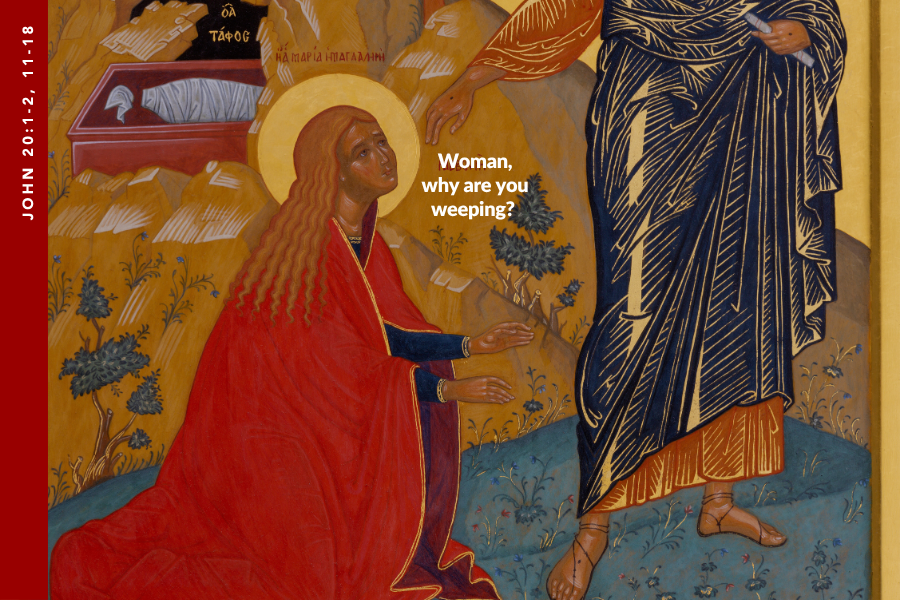
John 20:1-2, 11-18

On the first day of the week, Mary Magdalene came to the tomb early in the morning, while it was still dark, and saw the stone removed from the tomb. So she ran and went to Simon Peter and to the other disciple whom Jesus loved, and told them, “They have taken the Lord from the tomb, and we don’t know where they put him.” Mary stayed outside the tomb weeping. And as she wept, she bent over into the tomb and saw two angels in white sitting there, one at the head and one at the feet where the Body of Jesus had been. And they said to her, “Woman, why are you weeping?” She said to them, “They have taken my Lord, and I don’t know where they laid him.” When she had said this, she turned around and saw Jesus there, but did not know it was Jesus. Jesus said to her, “Woman, why are you weeping? Whom are you looking for?” She thought it was the gardener and said to him, “Sir, if you carried him away, tell me where you laid him, and I will take him.” Jesus said to her, “Mary!” She turned and said to him in Hebrew, “Rabbouni,” which means Teacher. Jesus said to her, “Stop holding on to me, for I have not yet ascended to the Father. But go to my brothers and tell them, ‘I am going to my Father and your Father, to my God and your God.’” Mary Magdalene went and announced to the disciples, “I have seen the Lord,” and then reported what he told her.

Opening Prayer: Jesus, I believe you are with me now as I turn to you in prayer. I want to focus on you with all my heart, mind, soul, and strength. I trust in your love for me and your desire to give me everything I need to follow you. Help me hear you call my name in this time together. I want to know what it is you ask of me so that I can live as your light in the world. Thank you for your love and for the gift of faith. Jesus, I trust in you.

Encountering Christ:

  1. It Was Still Dark: Mary loved Jesus. He had delivered her from seven demons, and she was one of the women who accompanied Jesus and his disciples, providing for Jesus and the Twelve out of their resources (cf. Lk 8:1-3). She was one of the women with St. John and the Blessed Mother at the foot of the cross, accompanying Jesus in his agony (cf. Jn 19:24-25). When Jesus died and was taken down from the cross, “Mary Magdalene and Mary the mother of Joses watched where he was laid” (Mk 15:47). The next morning, when the Sabbath ended (cf. Mk 16:1), Mary went to the tomb so early that it was still dark. She couldn’t wait to care for her Lord’s body, to anoint it with spices (cf. Mk 16:1). She sought him in the darkness, knowing that light was coming. Mary’s life had been transformed by the Lord, and she continued to seek him out and serve him even after his death. Mary’s love for Jesus was steadfast, persevering through the most difficult circumstances because her heart was full of gratitude.

  2. Mary!: Jesus taught that he is the Good Shepherd, that he calls his sheep by name, and that they recognize his voice and follow him (cf. Jn 10:3,14). Here Mary recognized Jesus when he called her by name. In her angst at not finding the Lord’s body in the tomb, she was frantic. She ran to Peter and John and told them that Jesus was missing. She was not consoled by the angels at the tomb. And she didn’t recognize Jesus himself, thinking he was a gardener. She was caught up in her sorrow. But when Jesus called her name, she recognized him instantly. Like Mary, we can easily get caught up in difficult circumstances and fail to recognize the Lord. In these situations, it is important to keep our focus on looking for Jesus. When we persevere, we will have the joy of hearing him call our name.

  3. Apostle to the Apostles: Mary Magdalene was the first person to see the risen Lord, and she “went and announced to the disciples, ‘I have seen the Lord,’ and then reported what he told her.” Describing Mary Magdalene’s role, St. Thomas Aquinas called her the “Apostle to the Apostles,” and in 2016, the Congregation for Divine Worship, “by the express wish of Pope Francis,” elevated her memorial celebration to the level of a feast, of the same significance as the other Apostles. In the General Audience for May 17, 2017, Pope Francis directed our attention to Mary: “Mary would like to embrace her Lord, but he is already oriented towards the heavenly Father, whereas she is sent to carry the news to the brethren. And so that woman, who, before encountering Jesus, had been at the mercy of evil (Lk 8:2) now becomes the Apostle of the new and greatest hope. May her intercession help us in times of woe and abandonment to listen to the Risen Jesus who calls us by name, and, with a heart full of joy, to go forth and proclaim: “I have seen the Lord!” (v. 18).

Conversing with Christ: Lord Jesus, thank you for calling me by name. As I spend this time with you, help me see your presence in those dark and difficult challenges of my life. Open my heart and mind to being sent by you to those who need to encounter you. St. Paul wrote, “The love of Christ impels us…” (2 Cor 5:14), and St. Mary Magdalene models that desire and urgency to share her experience. Help me continue to seek you as Mary Magdalene did so that I too can share your love with enthusiasm and joy.

Resolution: Lord, today by your grace I will look for an opportunity to share a story of God’s action in my life with at least one person.

For Further Reflection: A Retreat Guide: The Apostle of the Apostles is a reflection on St. Mary Magdalene and is available through the RCSpirituality center in audio, video, and written formats. Also published by RCSpirituality and available for purchase is Mary Magdalene: Insights from Ancient Magdala.

Janet McLaughlin and her husband Chris live on a mountain in rural northeastern Oregon. She puts her Master of Arts in Pastoral Studies to work as she shares the beauty and importance of the lay vocation in her writing, speaking, and teaching on spiritual topics.
July 23, 2025 – The Soil of My Life

Wednesday of the Sixteenth Week in Ordinary Time

Matthew 13:1-9

On that day, Jesus went out of the house and sat down by the sea. Such large crowds gathered around him that he got into a boat and sat down, and the whole crowd stood along the shore. And he spoke to them at length in parables, saying: “A sower went out to sow. And as he sowed, some seed fell on the path, and birds came and ate it up. Some fell on rocky ground, where it had little soil. It sprang up at once because the soil was not deep, and when the sun rose it was scorched, and it withered for lack of roots. Some seed fell among thorns, and the thorns grew up and choked it. But some seed fell on rich soil, and produced fruit, a hundred or sixty or thirtyfold. Whoever has ears ought to hear.”

Opening Prayer: Mother Mary, help me see your Son, Our Lord Jesus, with new eyes,and help me hear him speaking these parables. Help me understand how these parables apply to my life. Mother, I want to love Jesus with all my heart. It is so easy to let the busyness of life and the general attitudes of people around me distract me from spending time with him. Please take me by the hand and guide me to him. Intercede for me, please, that I grow in faith, hope, and love to be more and more who your Son calls me to be.

Encountering Christ:

      1. A Large Crowd Gathered: So many people gathered to hear Jesus speak that he had to leave the place where he was seated and teach from a boat. People probably came for many reasons. Some had heard of his teachings and wanted to hear more. Others had seen him heal someone or cast out a demon and wanted to know more about him. It may be that some were there because a family member or a friend brought them. Others may have just seen a crowd gathering and joined the group because they were curious. Perhaps some were skeptical and came in order to find things that they could report to the authorities. There is no simple answer as to why people sought out Jesus. What do we hope for in our daily encounters with Christ? Today, we can reflect on our disposition as we spend this time with Jesus in prayer.

      2. He Spoke in Parables: St. Matthew’s Gospel presents Jesus’ teaching as very straightforward in Chapters 5-7. For example, “… whoever is angry with his brother will be liable to judgment…” (Mt 5:22). In these verses, Jesus spoke in parables, and he spoke at length. Parables are not simple statements of facts, black and white instructions, but are invitations to reflect, to mull things over. This takes time and interior recollection. It takes an interior disposition to want to be touched with a personal application of the truth Jesus is presenting. Presenting his teaching in parables is a way Jesus honors our freedom to assent in faith. He doesn’t “coerce” us by the weight of irrefutable proof. We have to choose him. We are called to allow Jesus to shape us by his word, to let the Word of God change our lives.

      3. What Kind of Soil: We can look at the rocky soil, the shallow soil, and the rich soil as responses to Jesus’ message by different individuals. However, we can also use these references to soil as we consider our own lives. St. Thomas Aquinas is credited with the saying, “Grace builds on nature.” In other words, our spiritual life doesn’t grow in isolation but is built on the foundation of self-knowledge, emotional maturity, psychological health, and virtue, as well as prayer. St. Irenaeus said, “The glory of God is man fully alive.” Our spiritual life is not separate from all the other aspects of our life. We need to seek out an integral formation that is spiritual, apostolic, intellectual, and human. We need to develop our character, our gifts, our mental and emotional health, and, yes, our physical health to be all that God created us to be, and so that we can glorify him in every aspect of our lives. Perhaps we see the rocky soil as those areas where we struggle to accept the cross of Christ. The shallow soil may be an area where we fail to persevere in living the faith deeply. We see evidence of rich soil where we notice growth and fruit, and we thank God for these great blessings.

Conversing with Christ: Jesus, your parables challenge me to see my life in new ways and to make changes so that my life is a more faithful reflection of your life. Lord, help me to “walk my talk.” Let me see those areas where I need to grow, so that I am not only growing in my knowledge of the faith, but that I am more the person you created me to be in all areas of my life.

Resolution: Lord, today by your grace I will pay attention to my behaviors so that at the end of the day, I can determine whether there is a particular area in which I need to develop virtue, emotional maturity, or human skills to support my spiritual life.

Janet McLaughlin and her husband Chris live on a mountain in rural northeastern Oregon. She puts her Master of Arts in Pastoral Studies to work as she shares the beauty and importance of the lay vocation in her writing, speaking, and teaching on spiritual topics.
July 24, 2025 – Bless with Truth

Thursday of the Sixteenth Week in Ordinary Time

Matthew 13:10-17

The disciples approached Jesus and said, “Why do you speak to the crowd in parables?” He said to them in reply, “Because knowledge of the mysteries of the Kingdom of Heaven has been granted to you, but to them it has not been granted. To anyone who has, more will be given and he will grow rich; from anyone who has not, even what he has will be taken away. This is why I speak to them in parables, because they look but do not see and hear but do not listen or understand. Isaiah’s prophecy is fulfilled in them, which says: You shall indeed hear but not understand, you shall indeed look but never see. Gross is the heart of this people, they will hardly hear with their ears, they have closed their eyes, lest they see with their eyes and hear with their ears and understand with their hearts and be converted and I heal them. But blessed are your eyes, because they see, and your ears, because they hear. Amen, I say to you, many prophets and righteous people longed to see what you see but did not see it, and to hear what you hear but did not hear it.”

Opening Prayer: Lord, thank you for the clear teaching of your Church, and thank you for your parables. You give me the parables as a way of reflecting on my life and how I am responding to your truth. In this time of prayer, Lord, please open both my mind and heart to know you more deeply and follow you more closely so that I may obtain the joy of eternal life in Heaven with you.

Encountering Christ:

      1. But Why?: The disciples wanted to know why Jesus had begun speaking to the crowds in parables rather than clearly and specifically. It seemed that the crowds didn’t really want to see or hear or understand Jesus. They were entrenched in their own ways of thinking and not open to Jesus’ teaching. Openness would require willingness to change, and they had closed their eyes and ears “lest they see…and hear…and understand…and be converted and (healed).” According to the Catechism, “Through his parables (Jesus) invites people to the feast of the Kingdom, but he also asks for a radical choice: to gain the Kingdom, one must give everything” (CCC 546). May we never be thwarted from listening and embracing the teachings of Christ because of the cost.

      2. The Back Door: When you go to someone’s back door, it is usually because you know them well and feel comfortable with them. The front door is a little more formal. Offering parables is a little bit like going to the back door. Rather than presenting a clear statement that may immediately elicit resistance (like a door being shut in your face), a parable invites the listener into the mystery of Christ’s Kingdom through very ordinary examples. Then, hopefully, as one works to understand the parable, one is moved by its deep truth. This is a lesson for us as we consider how we evangelize. We are called to remain open to those who do not seem willing to consider the faith we are sharing. We are asked to accompany them in their faith journey over time. We will be most effective if we are able to meet them where they are instead of focusing on what we want to tell them.

      3. Blessed: Jesus told his disciples that they were blessed—that many longed to see and hear what they were privileged to see and hear. They were given knowledge of the mysteries of the Kingdom of Heaven. We are likewise blessed. As Catholics, we have been given the deposit of faith in sacred tradition and sacred Scripture, and we are called to share the truth joyfully. St. John Paul II said, “The Second Vatican Ecumenical Council…had as its intention and purpose to highlight the Church’s apostolic and pastoral mission, and by making the truth of the Gospel shine forth, to lead all people to seek and receive Christ’s love which surpasses all knowledge (cf. Eph 3:19)” (intro to Fidei Depositum, on the publication of the Catechism). He pointed out that the Council “was to guard and present better” the deposit of faith, “to make it more accessible to the Christian faithful and to all people of good will. For this reason, the Council was not first of all to condemn the errors of the time, but above all to strive calmly to show the strength and beauty of the doctrine of the faith.”

Conversing with Christ: O my Jesus, you want all of me, and you are so patient and yet persistent in calling me to that total surrender. While I am a work in progress, you still trust me to share in your mission of reaching the world with the Good News of your salvation and redemption. Lord, grant me the grace of evangelizing as you did. I ask that you give me a loving, patient heart and the desire to help others encounter you.

Resolution: Lord, today by your grace I will have a conversation with someone about Jesus or a teaching of the Church, and in that conversation I will strive to listen deeply and focus on the other person’s thoughts before speaking.

For Further Reflection: Fidei Depositum.

Janet McLaughlin and her husband Chris live on a mountain in rural northeastern Oregon. She puts her Master of Arts in Pastoral Studies to work as she shares the beauty and importance of the lay vocation in her writing, speaking, and teaching on spiritual topics.

July 25, 2025 – Can You Drink?

Feast of Saint James, Apostle

Matthew 20:20-28

The mother of the sons of Zebedee approached Jesus with her sons and did him homage, wishing to ask him for something. He said to her, “What do you wish?” She answered him, “Command that these two sons of mine sit, one at your right and the other at your left, in your Kingdom.” Jesus said in reply, “You do not know what you are asking. Can you drink the chalice that I am going to drink?” They said to him, “We can.” He replied, “My chalice you will indeed drink, but to sit at my right and at my left, this is not mine to give but is for those for whom it has been prepared by my Father.” When the ten heard this, they became indignant at the two brothers. But Jesus summoned them and said, “You know that the rulers of the Gentiles lord it over them, and the great ones make their authority over them felt. But it shall not be so among you. Rather, whoever wishes to be great among you shall be your servant; whoever wishes to be first among you shall be your slave. Just so, the Son of Man did not come to be served but to serve and to give his life as a ransom for many.”

Opening Prayer: Lord, thank you for your presence with me here today. I come to you in faith. I come to you with hope, and I come out of love. Lord help me find that servant’s heart that draws me ever closer to you.

Encountering Christ:

  1. Mothers!: This passage strikes a funny tone on St. James’s feast day, as this might have been an embarrassing moment for the sons of thunder. As their mother asked Jesus for this favor, the other ten overheard this and must have been taken aback. But Jesus took this opportunity to teach, not their mother Salome, but James and John directly. “You do not know what you are asking. Can you drink the chalice that I am going to drink?” Both said yes! They couldn’t have known to what they were assenting. Their ambition overcame them. It’s a perfect description of pride in action. We fall into believing that we can accomplish anything God asks of us. We enthusiastically answer “yes” and set out to do things on our own—and often fail miserably. When do we succeed? When our aim is to become the servant of all, the slave of others, not the “first mate.”
  2. The Others Became Indignant: There is a certain irony in this verse. If the ten apostles only wanted the best for James and John, indignation would probably not have been their response. We can assume that they aspired to the same honor. It is oddly comforting that even those closest to Christ occasionally squabbled amongst themselves over worldly status. But, like the Gospel story of the splinter and the plank (cf. Mt 7:4), we should take a good look first at our own false ambitions, our own self-reliance, our own little vanities, before we criticize anyone for seeking power, honor, or wealth.
  3. We Can: When James and John confirmed that they would, indeed, be willing to drink the chalice, Christ responded, “My chalice you will indeed drink.” They had no idea that the chalice meant their suffering and death, but Christ knew well that they were to live out their mission to serve him by their martyrdom. May we today and always be willing to accept the chalices of suffering we encounter as part of God’s mission for us, knowing that he will use everything as an opportunity to draw us closer to the Father.

Conversation with Christ: Lord I have some disordered passions and misdirected desires, but you still see in me the fulfillment of the mission to which you have called me. Do not let the evil one derail me by my pride, vanity, or sensuality but continue to draw me nearer to you so that I, like the apostles who went before me, can become the servant leader that you need to bring souls to you.

Resolution: Lord, today by your grace I will plan to make a good confession and put the date on the calendar. I will confess my sins out of contrition, not guilt, so I can receive an outpouring of your love and grace to be the servant leader you are calling me to be.

Bob Cohn is an electrical engineer with a manufacturing firm, and he loves to share his faith through speaking and writing.

July 26, 2025 – Mercy Matters

Memorial of Saints Joachim and Anne, Parents of the Blessed Virgin Mary

Matthew 13:24-30

Jesus proposed a parable to the crowds. “The Kingdom of Heaven may be likened to a man who sowed good seed in his field. While everyone was asleep his enemy came and sowed weeds all through the wheat, and then went off. When the crop grew and bore fruit, the weeds appeared as well. The slaves of the householder came to him and said, ‘Master, did you not sow good seed in your field? Where have the weeds come from?’ He answered, ‘An enemy has done this.’ His slaves said to him, ‘Do you want us to go and pull them up?’ He replied, ‘No, if you pull up the weeds you might uproot the wheat along with them. Let them grow together until harvest; then at harvest time I will say to the harvesters, “First collect the weeds and tie them in bundles for burning; but gather the wheat into my barn.”’”

Opening Prayer: Jesus, as I come before you today, I am struck by how easy it is for me to focus on everything wrong with the world and the challenges I face in living my faith. I want to focus on you, on your life in me, on the hope that is mine because you love me and desire my good. I want to love you by uniting my will and my way of seeing things with yours. Lord, help me learn to be merciful as you are merciful.

Encountering Christ:

  1. Seeing Weeds: If we consider the wheat as all that Christ taught and all that we are called to, we don’t have to look far to see that in today’s world there is much that contrasts with the Christian life. In other words, there are weeds. In fact, it may appear that the weeds are even more prolific than the wheat, or at least they’re easier to see. How is it that God allows weeds to seemingly overtake us? Jesus himself said that our “heavenly Father… makes his sun rise on the bad and the good, and causes rain to fall on the just and the unjust” (Mt 5:45). When we see the weeds present in today’s world—the social issues and lifestyles contrary to the Gospel—do we find ourselves becoming discouraged or do we look for ways to make the Kingdom of Christ present in the world around us?

  2. Merciful Love: There have always been weeds, and there will be weeds until the end of time. When we focus on the weeds we can slip into judgmental thinking and retreat from interactions with those who don’t see things the way we do. We may find ourselves becoming negative and losing the hope and joy that we are called to live. Love calls us to see not only what is but what can be. Jesus said, “Love your enemies, and pray for those who persecute you…” (Mt 5:44), and “Those who are well do not need a physician, but the sick do. Go and learn the meaning of the words, ‘I desire mercy, not sacrifice.’ I did not come to call the righteous but sinners” (Mt 9:12-13). As Christians, we are called to look with mercy on those who are living far from our faith. St. Teresa of Calcutta said, “I believe God loves the world through us”; do I allow God to love the world through me?

  3. Judgment Belongs to the Lord: St. Paul tells us that God “is patient… not wishing that any should perish but that all should come to repentance…” (2 Pet 3:9). This parable reminds us that while there will be judgment, only God knows the truth of each person’s heart and the state of their soul. While it isn’t possible for the weeds in a field to become wheat, transformation is possible for human beings. Mercy is the source of this conversion. St. John Paul II said, “What is mercy if not the boundless love of God, who confronted with human sin, restrains the sentiment of severe justice and, allowing himself to be moved by the wretchedness of his creatures, spurs himself to the total gift of self, in the Son’s cross …? Who can say that he is free from sin and does not need God’s mercy? As people of this restless time of ours, wavering between the emptiness of self-exaltation and the humiliation of despair, we have a greater need than ever for a regenerating experience of mercy” (“Regina Caeli” message, April 10, 1994).

Conversing with Christ: Lord, thank you for the generous love you pour out on the world. Whether or not people accept your love, you reach out to them. Lord, I get frustrated seeing people behave in ways that are counter to what I know you desire. I find it hard to reach out to them. Lord, help me see them as you do and give me a generous heart, a heart overflowing with love for all people.

Resolution: Lord, today by your grace I will pray the Divine Mercy Chaplet for those in most need of your mercy and, if possible, I will invite someone to join me in praying it.

For Further Reflection: Pope St. John Paul II’s second encyclical, Dives in Misericordia (Rich in Mercy).

Janet McLaughlin and her husband Chris live on a mountain in rural northeastern Oregon. She puts her Master of Arts in Pastoral Studies to work as she shares the beauty and importance of the lay vocation in her writing, speaking, and teaching on spiritual topics.
July 27, 2025 – Lord, Teach Me to Pray!

Seventeenth Sunday in Ordinary Time

Luke 11:1-13

Jesus was praying in a certain place, and when he had finished, one of his disciples said to him, “Lord, teach us to pray just as John taught his disciples.” He said to them, “When you pray, say: Father, hallowed be your name, your Kingdom come. Give us each day our daily bread and forgive us our sins for we ourselves forgive everyone in debt to us, and do not subject us to the final test.” And he said to them, “Suppose one of you has a friend to whom he goes at midnight and says, ‘Friend, lend me three loaves of bread, for a friend of mine has arrived at my house from a journey and I have nothing to offer him,’ and he says in reply from within, ‘Do not bother me; the door has already been locked and my children and I are already in bed. I cannot get up to give you anything.’ I tell you, if he does not get up to give the visitor the loaves because of their friendship, he will get up to give him whatever he needs because of his persistence. And I tell you, ask and you will receive; seek and you will find; knock and the door will be opened to you. For everyone who asks, receives; and the one who seeks, finds; and to the one who knocks, the door will be opened. What father among you would hand his son a snake when he asks for a fish? Or hand him a scorpion when he asks for an egg? If you then, who are wicked, know how to give good gifts to your children, how much more will the Father in Heaven give the Holy Spirit to those who ask him?”

Opening Prayer: My dear Father in Heaven, you are truly holy. Lord open my heart to your Spirit and guide me in this time of prayer. Thank you for loving me as I am and forgive me for my many failings.

Encountering Christ:

  1. Lord, Teach Me to Pray: Imagine the disciples watching Jesus as his prayer unfolded. How many times had they seen him steeped in prayer? What about this moment made them curious? What was Jesus’ posture? How did his intensity reveal itself? Watching Jesus talk to his Father must have deeply inspired the disciples because they asked to be taught how to pray. We all want an intimacy in our prayer that draws us close to the Father, don’t we? May the Lord teach us to pray.
  2. A Friend at Midnight?: Our Lord was eager to teach his disciples how to pray. In the parable he shared, Jesus urged them (and us) to be persistent in prayer. Persistence in prayer can be difficult while we wait for an answer. Discouragement can sap our hope. But persistence can become much easier if we remember whom we are talking to. We know that Our Lord is pure love. Therefore we can trust him with our deepest longings, knowing that he works everything out for the best (cf. Rom 8:28). “For ‘we have not been commanded to work, to keep watch and to fast constantly, but it has been laid down that we are to pray without ceasing.’ This tireless fervor can come only from love. Against our dullness and laziness, the battle of prayer is that of humble, trusting, and persevering love” (CCC 2743).
  3. Snakes and Scorpions: This may sound strange, but aren’t there times we think we’re getting snakes in answer to our prayers? How often do we look at prayers, perhaps for a dying friend, and wonder if they are being heard? We can be tempted to pull away from God, to cross our arms like a stubborn toddler. If we’re wise, however, we’ll follow St. Paul’s recommendation and praise God! “Rejoice always. Pray without ceasing. In all circumstances give thanks, for this is the will of God for you in Christ Jesus” (1 Thess 5:16-18). As hard as it can be, we praise God for our suffering, and for the good we find in the midst of our deep sorrow. When we praise God, we greatly bless him and our praise draws an abundance of grace upon us and those we love.

Conversation with Christ: Lord, your relationship with the Father is intriguing and captivating. There is an intimacy that I see and that I want. Lord help me, in my prayer, to form that intimacy that only comes with relationship. Help me, through your Holy Spirit, to grow closer to you. Help me to grow in trust as your plan for me unfolds.

Resolution: Lord, today by your grace I will seek out a special time of personal prayer, perhaps to make a visit to Christ in the Tabernacle or a Eucharistic Holy Hour, where I will praise you.

For Further Reflection: Psalm 28 is a beautiful prayer during hardship.

Bob Cohn is an electrical engineer with a manufacturing firm, and he loves to share his faith through speaking and writing.

Scroll to Top

Events

Looking for another country?

Contact Regnum Christi near you

News & Resources

News & Resources

The Regnum Christi Mission

The Regnum Christi Identity

Alex Kucera

Atlanta

Alex Kucera has lived in Atlanta, GA, for the last 46 years. He is one of 9 children, married to his wife Karmen, and has 3 girls, one grandson, and a granddaughter on the way. Alex joined Regnum Christi in 2007. Out of the gate, he joined the Helping Hands Medical Missions apostolate and is still participating today with the Ghana Friendship Mission.

In 2009, Alex was asked to be the Atlanta RC Renewal Coordinator for the Atlanta Locality to help the RC members with the RC renewal process. Alex became a Group Leader in 2012 for four of the Atlanta Men’s Section Teams and continues today. Running in parallel, in 2013, Alex became a Team Leader and shepherded a large team of good men.

Alex was honored to be the Atlanta Mission Coordinator between 2010 to 2022 (12 years), coordinating 5-8 Holy Week Mission teams across Georgia. He also created and coordinated missions at a parish in Athens, GA, for 9 years. Alex continues to coordinate Holy Week Missions, Advent Missions, and Monthly missions at Good Shepherd Catholic Church in Cumming, GA.

From 2016 to 2022, Alex also served as the Men’s Section Assistant in Atlanta. He loved working with the Men’s Section Director, the Legionaries, Consecrated, and Women’s Section leadership teams.

Alex is exceptionally grateful to the Legionaries, Consecrated, and many RC members who he’s journeyed shoulder to shoulder, growing his relationship with Christ and others along the way. He knows that there is only one way, that’s Christ’s Way, with others!