






THE WEEKLY DIGEST
OF REGNUM CHRISTI
DAILY MEDITATIONS

June 15, 2025 – Church as Life in the Holy Trinity

Solemnity of the Most Holy Trinity

John 16:12-15

Jesus said to his disciples: “I have much more to tell you, but you cannot bear it now. But when he comes, the Spirit of truth, he will guide you to all truth. He will not speak on his own, but he will speak what he hears, and will declare to you the things that are coming. He will glorify me, because he will take from what is mine and declare it to you. Everything that the Father has is mine; for this reason I told you that he will take from what is mine and declare it to you.”

Opening Prayer: O my God, Trinity whom I adore, help me forget myself entirely so to establish myself in you, unmovable and peaceful as if my soul were already in eternity. May nothing be able to trouble my peace or make me leave you, O my unchanging God, but may each minute bring me more deeply into your mystery! Grant my soul peace. Make it your Heaven, your beloved dwelling and the place of your rest. May I never abandon you there, but may I be there, whole and entire, completely vigilant in my faith, entirely adoring, and wholly given over to your creative action (Prayer of St. Elizabeth of the Trinity).

Encountering Christ:

  1. Human Understanding: Jesus said to his disciples, “I have much more to tell you, but you cannot bear it now.” Jesus had taught his disciples all they were humanly capable of understanding through their ability to reason. Jesus would need to complete his mission and send the Holy Spirit in order for them to begin to grasp the mystery of the Most Holy Trinity. With the benefit of Church teaching, we can comprehend much more about the Trinity than the disciples could at the time. Yet it remains, and will always remain, a deep mystery to us. “Eternal Trinity… You are a mystery as deep as the sea; the more I search, the more I find, and the more I find the more I search for you. But I can never be satisfied; what I receive will ever leave me desiring more” (St. Catherine of Siena).

  2. Jesus and the Holy Spirit: Jesus told his disciples to expect the Spirit to guide them to the truth. This was not Jesus’ first mention of the Spirit, nor the first experience the disciples had of the Spirit. Yet, they understood very little at that time. From Pope Benedict XVI’s Apostolic Exhortation Sacramentum Caritatis (12): “The Paraclete, Christ’s first gift to those who believe, already at work in Creation is fully present throughout the life of the incarnate Word: Jesus Christ is conceived by the Virgin Mary by the power of the Holy Spirit; at the beginning of his public mission, on the banks of the Jordan, he sees the Spirit descend upon him in the form of a dove; he acts, speaks, and rejoices in the Spirit, and he can offer himself in the Spirit. In the so-called ‘farewell discourse’ reported by John, Jesus clearly relates the gift of his life in the paschal mystery to the gift of the Spirit to his own. Once risen, bearing in his flesh the signs of the Passion, he can pour out the Spirit upon them, making them sharers in his own mission. The Spirit would then teach the disciples all things and bring to their remembrance all that Christ had said, since it falls to him, as the Spirit of truth, to guide the disciples into all truth.”

  3. Mission of the Church: We, the Church, are the Lord’s chosen emissaries to spread the Good News to the people of our time. We undertake this daunting task by availing ourselves of grace so that we can become a living tabernacle for the Father, Son, and Holy Spirit. “The ultimate end of the whole divine economy is the entry of God’s creatures into the perfect unity of the Blessed Trinity. But even now we are called to be a dwelling for the Most Holy Trinity: ‘If a man loves me,’ says the Lord, ‘he will keep my word, and my Father will love him, and we will come to him, and make our home with him’” (CCC 260). By the power of the Holy Spirit dwelling in our souls, we can speak the Father’s truth as given to his Son, and so glorify the Holy Trinity.

Conversing with Christ: Lord, I am amazed at how much you love me and want me to be in communion with you. My only response can be gratitude. Thank you, Father! Thank you, Jesus! Thank you, Holy Spirit!

Resolution: Lord, today by your grace I will make an effort to grow in a personal relationship with each member of the Holy Trinity: Father, Son, and Holy Spirit.

For Further Reflection: Read Catechism of the Catholic Church 238-260 on the revelation of God as Trinity.

Nan Balfour is an events coordinator for Pilgrim Center of Hope, a Catholic Evangelization Ministry that answers Christ’s call by guiding people to encounter him so as to live in hope as pilgrims in daily life. She is also a mother, writer, and speaker on Catholic topics.

June 16, 2025 – Resisting Evil

Monday of the Eleventh Week in Ordinary Time

Matthew 5:38-42

Jesus said to his disciples: “You have heard that it was said, An eye for an eye and a tooth for a tooth. But I say to you, offer no resistance to one who is evil. When someone strikes you on your right cheek, turn the other one to him as well. If anyone wants to go to law with you over your tunic, hand him your cloak as well. Should anyone press you into service for one mile,
go with him for two miles. Give to the one who asks of you, and do not turn your back on one who wants to borrow.”

Opening Prayer: Lord, your words are contrary to how the world operates. I can follow you only if you grant me the grace to do so. Please open my ears to your word. Open my eyes to your Way and open my heart to your Love.

Encountering Christ:

  1. Eye for an Eye: This “eye for an eye and tooth for a tooth” justice was first instituted by Moses to moderate vengeance, “… But if injury ensues, you shall give life for life, eye for eye, tooth for tooth, hand for hand, foot for foot, burn for burn, wound for wound, stripe for stripe” (Ex 21-23-27). The term the ancient Israelites used for this form of justice was called “talion,” which means “the principle that punishment should be equivalent or identical to the offense committed.” It was considered merciful justice by comparison to other forms of justice at the time that involved killing an entire tribe over the offense committed by one of them.

  2. Resist No Evil: “But I say to you, offer no resistance to one who is evil. When someone strikes you on your right cheek, turn the other one to him as well.” Moses served on behalf of God as judge and dispenser of his Law. Jesus is God, the Divine Judge and Giver of the Law. Jesus wants to teach us more than merely how to mitigate evil. He is training his disciples how to defeat it. Venerable Fulton J. Sheen said, “Hate is extremely fertile; it reproduces itself with amazing rapidity. How can all this hatred be stopped when one man is slapping another on the cheek? There is only one way, and that is by turning the other check, which means: ‘I forgive; I refuse to hate you. If I hate you, I will add my quota to the sum total of hate. This I refuse to do. I will kill your hate; I will drive it from the earth. I will love you.’”

  3. One with God: “If anyone wants to go to law with you over your tunic, hand him your cloak as well. Should anyone press you into service for one mile, go with him for two miles. Give to the one who asks of you, and do not turn your back on one who wants to borrow.” Much more painful and difficult than turning the cheek to be slapped again is to give generously to the one who hurts you or asks too much of you. We can comply by considering Jesus’ words less a command and more an invitation. Jesus invites us into his life in the Father and Holy Spirit, the feast we just celebrated yesterday in the Solemnity of the Most Holy Trinity. The Catechism (2842) explains, “It is impossible to keep the Lord’s commandment by imitating the divine model from outside; there has to be a vital participation, coming from the depths of the heart, in the holiness and the mercy and the love of our God. Only the Spirit by whom we live can make ‘ours’ the same mind that was in Christ Jesus. Then the unity of forgiveness becomes possible and we find ourselves ‘forgiving one another, as God in Christ forgave’ us.”

Conversing with Christ: Lord Jesus, you came not only to free us from sin, but also to lift us into the very heart of your communion with the Father and the Holy Spirit. You call me into your Life, and all you ask of me is to follow what you have already accomplished. Come, Holy Spirit, come! Help me follow Jesus, the Way, the Truth, and the Life!

Resolution: Lord, today by your grace I will bring to mind every person by name who has offended me and ask your help to forgive them because you have forgiven my offenses.

For Further Reflection: Read CCC 2838-2849 and meditate on the Lord’s Prayer asking the Father to “forgive us our trespasses, as we forgive those who trespass against us.”

Nan Balfour is an events coordinator for Pilgrim Center of Hope, a Catholic Evangelization Ministry that answers Christ’s call by guiding people to encounter him so as to live in hope as pilgrims in daily life. She is also a mother, writer, and speaker on Catholic topics.
June 17, 2025 – Be Perfect

Tuesday of the Eleventh Week in Ordinary Time

Matthew 5:43-48

Jesus said to his disciples: “You have heard that it was said, ‘You shall love your neighbor and hate your enemy.’ But I say to you, love your enemies and pray for those who persecute you, that you may be children of your heavenly Father, for he makes his sun rise on the bad and the good, and causes rain to fall on the just and the unjust. For if you love those who love you, what recompense will you have? Do not the tax collectors do the same? And if you greet your brothers only, what is unusual about that? Do not the pagans do the same? So be perfect, just as your heavenly Father is perfect.”

Opening Prayer: Good Father, I know you love me. I desire to love you and through you love others, both my neighbors and my enemies. Please help me.

Encountering Christ:

  1. Love Your Enemies: To love our enemies seems impossible, since at times it is difficult enough to love our neighbors as God commands us to do. Consider how Adam blamed his wife, Eve: “The woman whom you put here with me—she gave me fruit from the tree, so I ate it” (Gen 3:12). In turn, Eve blamed the devil: “The snake tricked me, so I ate it” (Gen 3:13). Since the beginning, it has become part of human nature to blame, to assign responsibility for a fault or wrong. How can we be expected to love our enemies? Jesus answered this question: “For human beings this is impossible, but for God all things are possible” (Mt 19:26). To be obedient to God in this teaching of Jesus requires of us what we cannot produce ourselves: grace. “Grace is first and foremost a gift of the Holy Spirit who justifies and sanctifies us” (CCC 2003).

  2. Children of the Heavenly Father: Forgiveness of those who persecute us is a prerequisite to loving our persecutors. Jesus explains through the prayer he taught us that to be a child of God, who is Love, means we are merciful to others as we receive mercy from our heavenly Father: “Forgive us our debts as we forgive our debtors” (Mt 6:12). If we forgive our enemies, we are children of the heavenly Father. If we refuse to forgive, we choose to act as children of the father of the world, who is the devil. Beware! Jesus condemned the unbelieving Pharisees: “You belong to your father the devil and you willingly carry out your father’s desires” (Jn 8:44).

  3. Be Perfect: “So be perfect, just as your heavenly Father is perfect.” These words can discourage us because we think it is impossible. How often we fall! Proverbs 24:16 tells us, “Though the just fall seven times, they rise again, but the wicked stumble from only one mishap.” Our falling is a given; it is the “rising again” that makes one just. Our ideal is Jesus, who fell three times and who rose three times carrying his cross. Our ideal is Jesus who said as he hung on the cross, “Forgive them, Father, for they know not what they do” (Lk 23:34). How can we be perfect? We follow Jesus and do what he does.

Conversing with Christ: Lord Jesus, I have fallen so many times. I hurt from all the wounds I have caused through my refusal to forgive my enemies. I am sorry. Please help me to see my enemies as you see them. Help me to be merciful as you are merciful. Jesus, I trust in you.

Resolution: Lord, today by your grace I will pray a Divine Mercy Chaplet for a person I consider my enemy.

Nan Balfour is an events coordinator for Pilgrim Center of Hope, a Catholic Evangelization Ministry that answers Christ’s call by guiding people to encounter him so as to live in hope as pilgrims in daily life. She is also a mother, writer, and speaker on Catholic topics.

June 18, 2025 – The Rewarding Life

Wednesday of the Eleventh Week in Ordinary Time

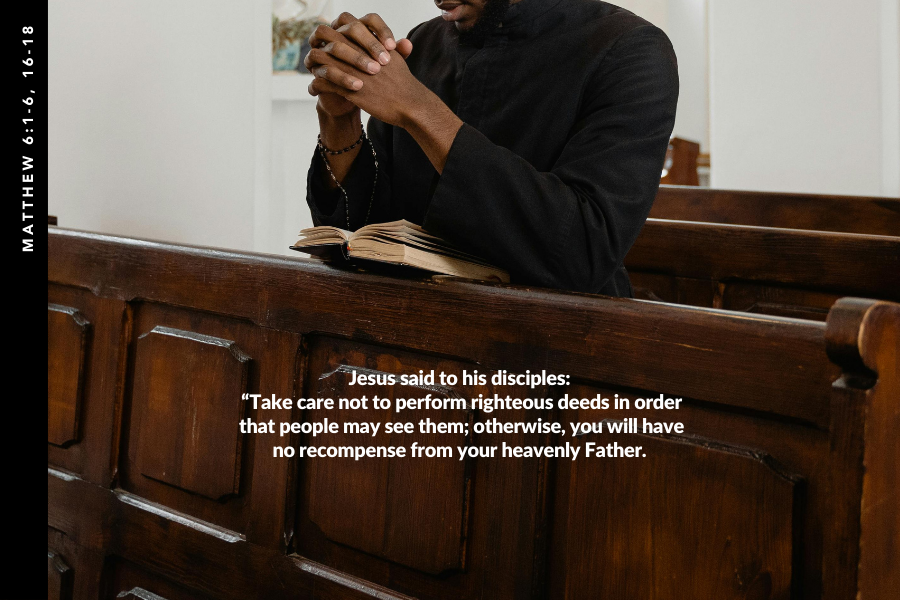
Matthew 6:1-6, 16-18

Jesus said to his disciples: “Take care not to perform righteous deeds in order that people may see them; otherwise, you will have no recompense from your heavenly Father. When you give alms, do not blow a trumpet before you, as the hypocrites do in the synagogues and in the streets to win the praise of others. Amen, I say to you, they have received their reward. But when you give alms, do not let your left hand know what your right is doing, so that your almsgiving may be secret. And your Father who sees in secret will repay you. When you pray, do not be like the hypocrites, who love to stand and pray in the synagogues and on street corners so that others may see them. Amen, I say to you, they have received their reward. But when you pray, go to your inner room, close the door, and pray to your Father in secret. And your Father who sees in secret will repay you. When you fast, do not look gloomy like the hypocrites. They neglect their appearance, so that they may appear to others to be fasting. Amen, I say to you, they have received their reward. But when you fast, anoint your head and wash your face, so that you may not appear to others to be fasting, except to your Father who is hidden. And your Father who sees what is hidden will repay you.”

Opening Prayer: “How great is the goodness, O Lord, which you have in store for those who fear you, And which, toward those who take refuge in you, you show in the sight of the children of men” (Ps 31:20). Lord, teach me your Way. Bring me your Truth. Give me your Life so I may praise you, and only you, here on earth and with you for all eternity. I love you, my God!

Encountering Christ:

  1. A Rewarding Life: “Take care not to perform righteous deeds in order that people may see them; otherwise, you will have no recompense from your heavenly Father.” Jesus was teaching his disciples to consider their actions and notice subtle temptations to pride. In between our good intentions and acting on them, we can get tripped up by the snares of the devil. “Take care,” Jesus said, which means “be cautious; keep oneself safe.” To live a life devoted to God, we need to discern if we are trying to impress others, bring acclaim to ourselves, or glorify God in what we say and do. To receive recompense from God is to receive atonement for our sins. When our righteous deeds are done for love of God, he gladly responds: “But if the wicked turn from the wickedness they did and do what is right and just, they save their lives; since they turned away from all the sins they committed, they shall live; they shall not die” (Ezek 18:27-28).

  2. Almsgiving: “But when you give alms, do not let your left hand know what your right is doing, so that your almsgiving may be secret. And your Father who sees in secret will repay you.” Giving alms is not to be a matter of “checking off spiritual boxes” or lavishly giving so that we will be noticed by others. In this passage, Jesus was both revealing and calling his disciples more deeply into his hidden life with the Father. Almsgiving, Jesus tells us, is yet another invitation to “remain in me” (Jn 15:4).

  3. Useless Fasting: “When you fast, do not look gloomy like the hypocrites. They neglect their appearance, so that they may appear to others to be fasting. Amen, I say to you, they have received their reward.” Jesus was offering practical advice, for it only makes sense that we defeat the purpose of self-denial through fasting if we use the practice to call attention to ourselves. Works of charity, spiritual practices, and praying, if not centered on and offered to God, become nothing more than self-gratification. The Church offers a helpful way for us to discern who we are glorifying by doing a daily examination of conscience. We are invited to spend a couple of minutes at the end of each day to ask the Holy Spirit to shine light on our actions in the past twenty-four hours. Where we have succeeded in giving glory to God, we praise and thank him. Where we have failed to receive his grace, we ask forgiveness. We end by asking for all the graces we will need the next day to try again.

Conversing with Christ: Lord, I believe my righteous deeds are done for you, but you know me better than I know myself. Please reveal to me where I need to improve in my efforts to allow you to transform me. Thank you, Jesus. Mary, Mother of God, intercede for me.

Resolution: Lord, today by your grace I will begin a daily examination of conscience.

For Further Reflection: USCCB – Examinations of Conscience.

Nan Balfour is an events coordinator for Pilgrim Center of Hope, a Catholic Evangelization Ministry that answers Christ’s call by guiding people to encounter him so as to live in hope as pilgrims in daily life. She is also a mother, writer, and speaker on Catholic topics.

June 19, 2025 – Children of the Father

Thursday of the Eleventh Week in Ordinary Time

Matthew 6:7-15

Jesus said to his disciples: “In praying, do not babble like the pagans, who think that they will be heard because of their many words. Do not be like them. Your Father knows what you need before you ask him. This is how you are to pray: ‘Our Father who art in Heaven, hallowed be thy name, thy Kingdom come, thy will be done, on earth as it is in Heaven. Give us this day our daily bread; and forgive us our trespasses, as we forgive those who trespass against us; and lead us not into temptation, but deliver us from evil.’ If you forgive others their transgressions, your heavenly Father will forgive you. But if you do not forgive others, neither will your Father forgive your transgressions.”

Opening Prayer: Lord, teach me how to pray in these moments of quiet I have set aside.

Encountering Christ:

  1. How to Pray: Our Father knows what we need before you ask him. An example of this wonderful reality is the story of Martha in the Gospel of Luke (10:38-42). Martha asked Jesus to make her sister help her. Jesus responded, “Martha, Martha, you are anxious and worried about many things…” Martha shared only one concern, but Jesus acknowledged there were more worries on her heart. We might ask ourselves, “God knows everything; if God is all good, why does he not just solve our problems before we ask him?” The answer can be found in the example of Peter walking on the water toward Jesus (cf. Mt 14:22-33). When Peter took his eyes off Jesus, he sank. We are to pray asking for what we need, because it is too easy to forget that all we need is found in and given to us by God. To believe we are in control can lead to pride. To believe there is no one in control leads to despair. To believe God is in control of all our needs leads to hope and life eternal.

  2. Thy Kingdom Come: “Thy Kingdom come, thy will be done, on earth as it is in Heaven.” The line from the Coldplay song “Viva la Vida,” “I sweep the streets I used to own,” gives a poetic explanation of the consequence of original sin. Adam and Eve were given dominion over creation. They were sharers with the Divine Creator, made in his image and likeness. They lost the privilege to “own the streets they swept.” When we pray the Our Father, we dare to ask God to restore his Kingdom on earth, which we lost by disobeying his will. Jesus told us how to begin to rebuild it: “Repent, for the Kingdom of God is at hand” (Mt 4:17). He told us we would be rewarded for doing so: “If God so clothes the grass of the field, which grows today and is thrown into the oven tomorrow, will he not much more provide for you, O you of little faith? So do not worry and say, ‘What are we to eat?’ or ‘What are we to drink?’ or ‘What are we to wear?’ All these things the pagans seek. Your heavenly Father knows that you need them all. But seek first the Kingdom [of God] and his righteousness, and all these things will be given you besides” (Mt 6:30-33).

  3. Food for the Journey: “Give us this day our daily bread”—why not “Give us this day our bread” or “Give us our daily bread”? Jesus doubly emphasizes our daily need for nourishment, both physical and spiritual. Though humans can go many days without eating food and many years without faith in God, it results in malnutrition of body and soul, depleting a person of the life God desires for us. The Church provides times of fasting from food, such as Advent, Lent, and Fridays, so we have temporary opportunities to feel the ache from lack of nourishment. Hunger pangs hit our stomach and serve as an uncomfortable reminder that life without God’s daily providence is impossible.

Conversing with Christ: Lord Jesus, you teach us how to pray to our Father so we may join in your communion with him as God. You go to such lengths to remind us we have a Father and we are always provided for. Thank you, Jesus!

Resolution: Lord, by your grace tomorrow (Friday), I will fast from at least one meal as a reminder of your providence in my life.

For Further Reflection: Read and meditate on Psalm 23 as another reminder of God’s providence.

Nan Balfour is an events coordinator for Pilgrim Center of Hope, a Catholic Evangelization Ministry that answers Christ’s call by guiding people to encounter him so as to live in hope as pilgrims in daily life. She is also a mother, writer, and speaker on Catholic topics.

June 20, 2025 – Earthly and Heavenly Treasure

Friday of the Eleventh Week in Ordinary Time

Matthew 6:19-23

Jesus said to his disciples: “Do not store up for yourselves treasures on earth, where moth and decay destroy, and thieves break in and steal. But store up treasures in Heaven, where neither moth nor decay destroys, nor thieves break in and steal. For where your treasure is, there also will your heart be. The lamp of the body is the eye. If your eye is sound, your whole body will be filled with light; but if your eye is bad, your whole body will be in darkness. And if the light in you is darkness, how great will the darkness be.”

Opening Prayer: To you, O Lord, I lift up my soul. In you I trust. No one is disgraced who waits for you. Make known to me your ways, Lord; teach me your paths. Guide me by your fidelity and teach me, for you are God my savior (excerpts from Psalm 25).

Encountering Christ:

  1. Earthly Treasure: “Do not store up for yourselves treasures on earth, where moth and decay destroy, and thieves break in and steal.” God created man for greatness, so it is true to our nature to seek greatness. In the world, greatness often means financial prosperity and its usual accompaniment of earthly possessions. It is not immoral to be wealthy, as long as it is accrued ethically and its use includes the good of others. But if earthly possessions become the ultimate goal of our happiness, then we miss out on the treasure God desires for us. This treasure is God himself. We are called to trust, not in our wealth or comforts, but in God’s providence. St. Paul explains, “I know indeed how to live in humble circumstances; I know also how to live with abundance. In every circumstance and in all things I have learned the secret of being well fed and of going hungry, of living in abundance and of being in need. I have the strength for everything through him who empowers me” (Phil 4:12-13).

  2. Heavenly Treasure: “But store up treasures in Heaven, where neither moth nor decay destroys, nor thieves break in and steal.” The heavenly treasure Jesus spoke of is a reward for those who have lived their lives virtuously as a preparation for eternity. And we can experience a taste of these treasures here and now, as we grow in our relationship with God. The Catechism explains, “The human virtues (Prudence, Justice, Fortitude, Temperance) are rooted in the theological virtues (Faith, Hope, Charity), which adapt man’s faculties for participation in the divine nature: for the theological virtues relate directly to God. They dispose Christians to live in a relationship with the Holy Trinity. They have the One and Triune God for their origin, motive, and object (CCC 1812).” Simply put, “The goal of the virtuous life is to become like God” (St. Gregory of Nyssa).

  3. Where Is Your Heart?: “For where your treasure is, there also will your heart be.” Consider that our hearts are like bank vaults where we keep our treasure. To adequately discern how much value we put on our treasure, both earthly and heavenly, we ponder what it is we love and what we would do if we lost it. If wealth was taken away, would we keep our faith in God’s providence? If we lost our health or the health of a loved one, would we continue to hope in God’s goodness? If any of our less tangible earthly treasures (reputation, relationships, social standing) were compromised, would we walk in justice, prudence, fortitude, and temperance as God’s trusting child, forgiving and giving to those who oppose us? Our Lord is presenting a very sobering teaching to help us discern if we are on the narrow road that leads to life (cf. Mt 7:13-14). Jesus, the light of the world, leads the way to all treasure, both earthly and heavenly. Are we following him?

Conversing with Christ: Lord, I love many things, but I want to love you above them all. I know I am to love the Giver more than the many temporal and spiritual gifts you have given me. Come, Holy Spirit, and show me what I am to do to remain in your light.

Resolution: Lord, today by your grace I will spend at least fifteen minutes pondering what I love most in light of this Gospel message. If I find that I am too attached to something, I will ask you through the Holy Spirit to place me back on the right path toward the Father, my heavenly treasure. Blessed Mother, take my hand.

For Further Reflection: Consider reading the Catechism Article 7: The Virtues.

Nan Balfour is an events coordinator for Pilgrim Center of Hope, a Catholic Evangelization Ministry that answers Christ’s call by guiding people to encounter him so as to live in hope as pilgrims in daily life. She is also a mother, writer, and speaker on Catholic topics.

June 21, 2025 – Whom Do You Serve?

Memorial of Saint Aloysius Gonzaga, Religious

Matthew 6:24-34

Jesus said to his disciples: “No one can serve two masters. He will either hate one and love the other, or be devoted to one and despise the other. You cannot serve God and mammon. Therefore I tell you, do not worry about your life, what you will eat or drink, or about your body, what you will wear. Is not life more than food and the body more than clothing? Look at the birds in the sky; they do not sow or reap, they gather nothing into barns, yet your heavenly Father feeds them. Are not you more important than they? Can any of you by worrying add a single moment to your life-span? Why are you anxious about clothes? Learn from the way the wildflowers grow. They do not work or spin. But I tell you that not even Solomon in all his splendor was clothed like one of them. If God so clothes the grass of the field, which grows today and is thrown into the oven tomorrow, will he not much more provide for you, O you of little faith? So do not worry and say, ‘What are we to eat?’ or ‘What are we to drink?’ or ‘What are we to wear?’ All these things the pagans seek. Your heavenly Father knows that you need them all. But seek first the Kingdom of God and his righteousness, and all these things will be given you besides. Do not worry about tomorrow; tomorrow will take care of itself. Sufficient for a day is its own evil.”

Opening Prayer: Lord Jesus, I praise you and I adore you. Forgive me for being so concerned about worldly things. Thank you for the greatest gift of your Holy Spirit. Help me to place all my needs and worries into the loving hands of our heavenly Father. Glory be to the Father, to the Son, and to the Holy Spirit as it was in the beginning is now and will be forever. Amen.

Encountering Christ:

  1. God and Mammon: “No one can serve two masters.” To those whom Jesus preached, being a slave, the property of another, was easily understood. For centuries the Jewish people had been enslaved by many powerful nations. For most of us today, being a slave is not a possibility—or is it? Jesus states that it is not a matter of if we serve but who we serve, either God or mammon (Aramaic word meaning wealth or property). Where we put our hearts, minds, and efforts—that’s who we serve. Slaves to mammon serve wealth, social status, and power. This service may bring worldly privileges and prestige; our cages may be velvet and our shackles made of silk, but we are trapped nonetheless, by the burdens of “keeping it up” or fears that we will lose everything.

  2. Worry: “Do not worry about your life.” Worry can come from within: “to torment oneself with disturbing thoughts.” Worry can come from without: “to harass by repeated biting, snapping, etc.,” which is how the evil one places troubling thoughts into our minds. Whether we bring worry upon ourselves, or we suffer temptations, worrying brings us no good. As Jesus said, “Can any of you by worrying add a single moment to your life-span?” Instead, chronic worry reduces the length of our life. At every Mass, we are blessed so as to reduce our worry: “Grace to you and peace from God our Father and the Lord Jesus Christ.” These are not just words; they contain the power of what they say. It is up to us to receive the peace that God offers us.

  3. The Importance of Man: “Look at the birds in the sky; they do not sow or reap, they gather nothing into barns, yet your heavenly Father feeds them. Are not you more important than they?” The Catechism states, “We believe that God needs no preexistent thing or any help in order to create, nor is creation any sort of necessary emanation from divine substance. God creates freely ‘out of nothing’” (CCC 296). It continues, “The universe, created in and by the eternal Word, the ‘image of the invisible God,’ is destined for and addressed to man, himself created in the ‘image of God,’ and called to a personal relationship with God… for God willed creation as a gift addressed to man, an inheritance destined for and entrusted to him” (CCC 299). With this understanding, we are called to praise God for the great gift of creation, trust him to provide for all we need, and serve him confidently and unafraid as stewards of creation.

Conversing with Christ: Lord, you entrusted Adam and Eve to serve you in the Garden of Eden by tending it and having dominion over it. They forfeited this privilege. But through you, our care of the Father’s creation is restored. Help me, Jesus, to be a good steward of your creation, over which you gave me dominion. May I confidently serve you.

Resolution: Lord, today by your grace I will pay attention to how I treat your physical creation and do my part to be a good steward.

Nan Balfour is an events coordinator for Pilgrim Center of Hope, a Catholic Evangelization Ministry that answers Christ’s call by guiding people to encounter him so as to live in hope as pilgrims in daily life. She is also a mother, writer, and speaker on Catholic topics.

June 22, 2025 – Bring What You Have

The Solemnity of the Most Holy Body and Blood of Christ (Corpus Christi)

Luke 9:11b-17

Jesus spoke to the crowds about the kingdom of God, and he healed those who needed to be cured. As the day was drawing to a close, the Twelve approached him and said, “Dismiss the crowd so that they can go to the surrounding villages and farms and find lodging and provisions; for we are in a deserted place here.” He said to them, “Give them some food yourselves.” They replied, “Five loaves and two fish are all we have, unless we ourselves go and buy food for all these people.” Now the men there numbered about five thousand. Then he said to his disciples, “Have them sit down in groups of about fifty.” They did so and made them all sit down. Then taking the five loaves and the two fish, and looking up to heaven, he said the blessing over them, broke them, and gave them to the disciples to set before the crowd. They all ate and were satisfied. And when the leftover fragments were picked up, they filled twelve wicker baskets.

Opening Prayer: Lord Jesus, I come before you in praise and adoration as I think of your total gift of yourself in your Body and Blood. I thank you that through the Eucharist you unite your people in your visible body on earth, the Church. In faith, I know you are really and truly present in the Eucharist and I thank you that I can encounter you tangibly in Holy Communion and in Eucharistic Adoration. In hope, I know the Eucharist is a hint of the heavenly banquet that you are guiding me to, and I know that your life in me through Communion increases my love for you and others. Lord, in this time of prayer, I ask you to strengthen my faith and hope in and my love for your Real Presence in the Eucharist.

Encountering Christ:

  1. Corpus Christi: At the Last Supper, Jesus said, “This is my Body.” He didn’t say “This represents my body.” In fact, in the Bread of Life discourse in John 6:55, Jesus said, “For my flesh is true food, and my blood is true drink.” Many of his disciples responded, “This saying is hard; who can accept it?” (Jn 6:60) and then “As a result of this, many [of] his disciples returned to their former way of life and no longer accompanied him” (Jn 6:66). Jesus did not call them back and try to mitigate the impact of his words. Instead, he asked those still with him, “Do you also want to leave?” (Jn 6:67). He couldn’t have spoken more clearly about the true nature of the Eucharist. But Catholics today still struggle with this truth. A widely reported Pew Research Center study showed that sixty-nine percent of all self-identified U.S. Catholics believe that the bread and wine remain as “symbols of the body and blood of Jesus Christ,” with only thirty-one percent saying they believe in the Real Presence of Jesus in the Eucharist. The U.S. Bishops, like Jesus, are continuing to insist on the truth about the Eucharist. You may have heard of their efforts in the “My Flesh for the Life of the World” campaign for a national Eucharistic revival, which is meant to renew the Church by enkindling a living relationship with the Lord Jesus Christ in the Holy Eucharist. How deep is my belief in and my devotion to Christ’s Real Presence in the Eucharist?

  2. Bringing Together Past, Present, and Future: This miracle gave witness to the reality of who Jesus was. He provided for the people abundantly out of almost nothing. In doing so, he brought to mind God providing manna for his people when they hungered in the desert. The miracle also foreshadowed the Eucharist and the heavenly banquet we hope to share in eternity. In all of these, we see that for which Jesus taught us to pray: “Give us this day our daily bread…” Christ himself is the Bread of Life and receiving this Bread “increases the communicant’s union with the Lord, forgives his venial sins, and preserves him from grave sins. Since receiving this sacrament strengthens the bonds of charity between the communicant and Christ, it also reinforces the unity of the Church as the Mystical Body” (CCC 1416). Do we see the Eucharist as our daily bread? Do we try to attend daily Mass?

  3. Bring What You Have: Dallas Jenkins, founder of the popular television series The Chosen recounted that this Gospel marked a turning point in his life. His Hollywood movie failed at the box office and effectively ended his career. As he and his wife prayed (and cried), this Scripture came to his wife, and they talked about what it could mean. Later that night, he was on the computer, and he received a message from a friend, “Remember, your job is not to feed the five thousand; it’s only to provide the loaves and fish.” When Dallas asked why he sent that message, the friend said that God told him to. The Chosen grew out of that experience of failure and that message. God wants us to bring the gifts and talents we have, no matter how little and inadequate they seem to us, for him to multiply and distribute as he desires. As St. Teresa of Calcutta said, “God has called us not to be successful, but to be faithful.” Our fear of failure or overemphasis on success can limit our willingness to give ourselves to God and thus limit his ability to work in us, multiplying our gifts, and through us, to touch and enrich the lives of others. Do we have talents or gifts that we have been unwilling to offer to the Lord? Do we have gifts or abilities that we consider insignificant and so we fail to offer them to the Lord?

Conversing with Christ: Lord, how blessed I am that you make yourself available to me in the gift of the Eucharist. It is the source and summit of Christian life, yet sometimes I can take it—you, your great gift—for granted. As the Eucharist Revival kicks off, stir in my heart a revival of love for you in the Eucharist. Open my mind and heart with awe and gratitude. Strengthen me by this gift to be able to give myself more fully to you, offering the loaves and fish of my life for you to use to build your Kingdom.

Resolution: Lord, today by your grace I will make an effort to go to an additional daily Mass or an additional hour of Adoration this week and offer it for all those who doubt the Real Presence.

For Further Reflection: See “Welcome to the National Eucharistic Revival”  and consider how you can participate in this revival. 

Janet McLaughlin and her husband, Chris, live on a mountain in rural northeastern Oregon. She puts her Master of Arts in Pastoral Studies to work as she shares the beauty and importance of the lay vocation in her writing, speaking, and teaching on spiritual topics.

Scroll to Top

Events

Looking for another country?

Contact Regnum Christi near you

News & Resources

News & Resources

The Regnum Christi Mission

The Regnum Christi Identity

Alex Kucera

Atlanta

Alex Kucera has lived in Atlanta, GA, for the last 46 years. He is one of 9 children, married to his wife Karmen, and has 3 girls, one grandson, and a granddaughter on the way. Alex joined Regnum Christi in 2007. Out of the gate, he joined the Helping Hands Medical Missions apostolate and is still participating today with the Ghana Friendship Mission.

In 2009, Alex was asked to be the Atlanta RC Renewal Coordinator for the Atlanta Locality to help the RC members with the RC renewal process. Alex became a Group Leader in 2012 for four of the Atlanta Men’s Section Teams and continues today. Running in parallel, in 2013, Alex became a Team Leader and shepherded a large team of good men.

Alex was honored to be the Atlanta Mission Coordinator between 2010 to 2022 (12 years), coordinating 5-8 Holy Week Mission teams across Georgia. He also created and coordinated missions at a parish in Athens, GA, for 9 years. Alex continues to coordinate Holy Week Missions, Advent Missions, and Monthly missions at Good Shepherd Catholic Church in Cumming, GA.

From 2016 to 2022, Alex also served as the Men’s Section Assistant in Atlanta. He loved working with the Men’s Section Director, the Legionaries, Consecrated, and Women’s Section leadership teams.

Alex is exceptionally grateful to the Legionaries, Consecrated, and many RC members who he’s journeyed shoulder to shoulder, growing his relationship with Christ and others along the way. He knows that there is only one way, that’s Christ’s Way, with others!