
THE WEEKLY DIGEST
OF REGNUM CHRISTI
DAILY MEDITATIONS

July 13, 2025 – The Good Samaritan Revealed

Fifteenth Sunday in Ordinary Time

Luke 10:25-37

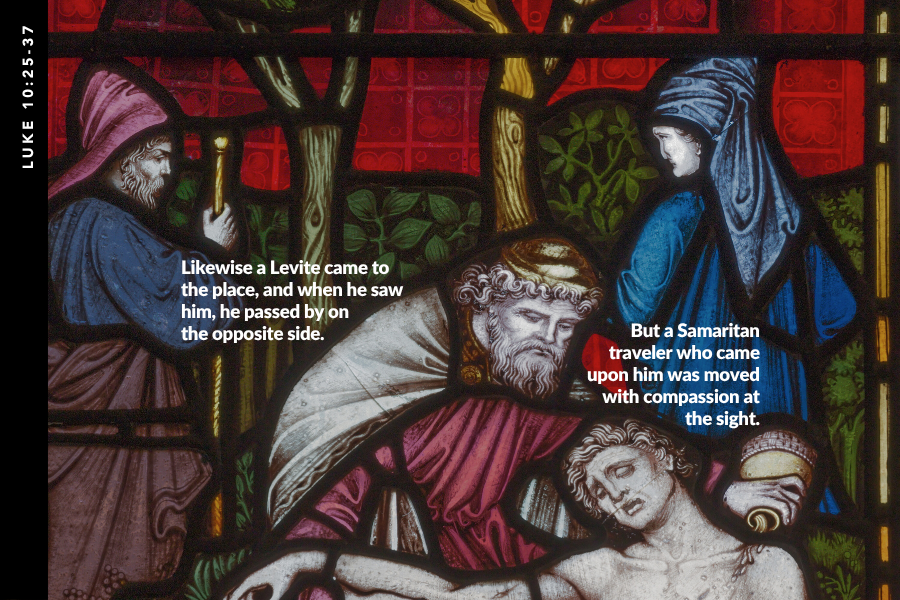
There was a scholar of the law who stood up to test Jesus and said, “Teacher, what must I do to inherit eternal life?” Jesus said to him, “What is written in the law? How do you read it?” He said in reply, “You shall love the Lord, your God, with all your heart, with all your being, with all your strength, and with all your mind, and your neighbor as yourself.” He replied to him, “You have answered correctly; do this and you will live.” But because he wished to justify himself, he said to Jesus, “And who is my neighbor?” Jesus replied, “A man fell victim to robbers as he went down from Jerusalem to Jericho. They stripped and beat him and went off leaving him half-dead. A priest happened to be going down that road, but when he saw him, he passed by on the opposite side. Likewise a Levite came to the place, and when he saw him, he passed by on the opposite side. But a Samaritan traveler who came upon him was moved with compassion at the sight. He approached the victim, poured oil and wine over his wounds and bandaged them. Then he lifted him up on his own animal, took him to an inn, and cared for him. The next day he took out two silver coins and gave them to the innkeeper with the instruction, ‘Take care of him. If you spend more than what I have given you, I shall repay you on my way back.’ Which of these three, in your opinion, was neighbor to the robbers’ victim?” He answered, “The one who treated him with mercy.” Jesus said to him, “Go and do likewise.”

Opening Prayer: Lord, I often wonder if I will inherit eternal life. I try hard to please you but so often believe I fail to live up to your expectations of me. Help me, Lord, to remember your will is your Divine Mercy.

Encountering Christ:

  1. Testing Jesus: There was a scholar of the law who stood up to test Jesus and said, “Teacher, what must I do to inherit eternal life?” Even though this scholar asked in order to test Jesus and justify himself, Our Lord used this opportunity to affirm him and to teach him how to move beyond the law. We should never hesitate to ask the Holy Spirit in prayer for confirmation or clarification about what we believe. God will work through our efforts to know the faith by studying Scripture and teachings of the Church. He will affirm what we understand and explain what we do not. He may speak in the moment with sudden enlightenment, or through others we meet during our day. He may draw our attention to certain writings, or lead us into discussion with knowledgeable friends and colleagues. We need only be open to the workings of the Holy Spirit.

  2. Law of Eternal Life: When Jesus answered the Jewish scholar’s question on eternal life with another question, “What is written in the law?” the scholar responded, “You shall love the Lord, your God, with all your heart, with all your being, with all your strength, and with all your mind, and your neighbor as yourself.” As disciples of Jesus Christ, we are also bound by this law to love God and neighbor, for our Lord tells us, “Do not think that I have come to abolish the law or the prophets. I have not come to abolish but to fulfill” (Mt 5:17). We have a clear advantage over the scholar for as difficult as it is to love God and neighbor as we are called to do, we are able to do so through Jesus. The Jewish people were given the law by God through Moses but Moses had no more power than they did to accomplish it. Jesus both commands this law and accomplishes it in us for he is truly God and truly man.

  3. Good Samaritan Revealed: In his book, Secrets from Heaven, Father Sebastian Walshe offers a wonderful contemplation on Jesus’ parable of the Good Samaritan. The man who fell upon robbers is Adam, who is stripped by the devil of charity and justice and left wounded by original sin and its consequences. He is half-dead because the soul remains immortal but now the body is subject to death. The priest and Levite who walk by him are the sacrifices of the old covenant and the law of Moses which cannot heal man’s fallen state. Christ is the Samaritan, a foreigner whose “Kingdom does not belong to this world” (Jn 18:36) and who out of pity for the plight of man came into human nature when “the Word became flesh and made his dwelling among us” (Jn 1:14). The oil and wine he pours on the man is mercy and justice. The beast the Samaritan mounts the man on is Jesus’ human nature. The inn to which the man is brought is the Church, a “place of safety and healing in this life while we await the Lord’s return,” and the innkeeper’s care into which he places the man is St. Peter and the Apostles. According to Pope Francis, “… The Lord comes to meet each one of us: he does not ignore us, he knows our sorrows; he knows how much we need help and consolation. He comes close to us and never abandons us. Each one of us should ask himself the question and answer in his heart: ‘Do I believe this? Do I believe that the Lord has compassion for me, just as I am, a sinner, with so many problems and so many things?’ Think of this and the answer is: ‘Yes!’ But each one must look into his heart to see if he has faith in this compassion of God, of the good God who comes close, who heals us, who caresses us. And if we refuse him, he waits: he is patient and is always at our side.”

Conversing with Christ: Lord Jesus, you came to heal me. You died for me. You gave me the gift of your Church so I can continue to be healed and so I can live with you forever in eternity. You did not just do this for me. You did this for every person. I will receive your mercy and I will give your mercy to others. Thank you, Jesus.

Resolution: Lord, today by your grace I will spend my time in prayer contemplating your abundant mercy through the gift of your Son, Jesus, who gave us the Church.

Nan Balfour is an events coordinator for Pilgrim Center of Hope, a Catholic Evangelization Ministry that answers Christ’s call by guiding people to encounter him so as to live in hope as pilgrims in daily life. She is also a mother, writer, and speaker on Catholic topics.
July 14, 2025 – God’s Battle for Souls

Memorial of Saint Kateri Tekakwitha, Virgin

Matthew 10:34-11:1

Jesus said to his Apostles: “Do not think that I have come to bring peace upon the earth. I have come to bring not peace but the sword. For I have come to set a man against his father, a daughter against her mother, and a daughter-in-law against her mother-in-law; and one’s enemies will be those of his household. Whoever loves father or mother more than me is not worthy of me, and whoever loves son or daughter more than me is not worthy of me; and whoever does not take up his cross and follow after me is not worthy of me. Whoever finds his life will lose it, and whoever loses his life for my sake will find it. Whoever receives you receives me, and whoever receives me receives the one who sent me. Whoever receives a prophet because he is a prophet will receive a prophet’s reward, and whoever receives a righteous man because he is righteous will receive a righteous man’s reward. And whoever gives only a cup of cold water to one of these little ones to drink because he is a disciple—amen, I say to you, he will surely not lose his reward.” When Jesus finished giving these commands to his Twelve disciples, he went away from that place to teach and to preach in their towns.

Opening Prayer: Lord Jesus, I praise you for continuing to proclaim your Good News to me. Thank you for calling me closer to the heart of the Father. I am sorry for all the times I fail to come because of my sinfulness. Holy Spirit, grant me the grace to be made worthy to receive and give Jesus to my family and to all my brothers and sisters in the world.

Encountering Christ:

  1. Not Peace but the Sword: Doesn’t it seem odd that Jesus, our source of all peace and unity, preached, “Do not think that I have come to bring peace upon the earth. I have come to bring not peace but the sword […]?” Centuries of persecutions by foreign nations caused the Jewish people to consider anyone outside their covenantal faith as enemies. Jesus was cutting through this limited understanding to remind them of the promise God made to Abraham, “For my part, here is my covenant with you [Abraham]: you are to become the father of a multitude of nations” (Gen 17:4). The “sword” Jesus wields is his word, “[…] living and effective, sharper than any two-edged sword, penetrating even between soul and spirit, joints and marrow, and able to discern reflections and thoughts of the heart” (Heb 4:12), slicing through their cultural self-protection to reveal the promise of Scripture now fulfilled in him: God, through his chosen people, is the Father of all people.

  2. Becoming Worthy: “Whoever loves father or mother more than me is not worthy of me, and whoever loves son or daughter more than me is not worthy of me; and whoever does not take up his cross and follow after me is not worthy of me.” Jesus spoke to his disciples about taking up their cross and suffering well before he took up his own cross, so that when it was their turn, they would remember that he had gone first. Suffering is a consequence of mankind’s sinfulness and was not the original plan of God for his children. Jesus entered into our suffering to divinize it, giving it merit and redeeming each of us. Jesus made what was not good, very good, and as Christians we gratefully follow him by enduring any suffering we encounter for his glory. “Whoever finds his life will lose it, and whoever loses his life for my sake will find it.”

  3. A Prophet’s Reward: “Whoever receives a prophet because he is a prophet will receive a prophet’s reward, and whoever receives a righteous man because he is righteous will receive a righteous man’s reward.” Jesus is calling everyone into his Church and explaining there is a role for each of us. This calling is a gift, a privilege, and a great responsibility. The reward for receiving the gifts of righteousness (to be holy) and the prophets (special gifts called charisms), and in turn giving these gifts to others like “a cup of cold water,” is nothing less than his Kingdom, “as he chose us in him, before the foundation of the world” (Eph 1:4). “It is not only through the sacramentals and the ministries that the Holy Spirit makes the people holy, leads them, and enriches them with his virtues. Allotting his gifts ‘at will to each individual,’ [the Spirit] also distributes special graces among the faithful of every rank” (Lumen Gentium 12).

Conversing with Christ: Lord, you call me to life in you, and you give me all I need through your grace to live out this call. You still desire to go out and preach the Good News. Let me go with you.

Resolution: Lord, today by your grace I will “wield the sword of Christ” by sharing Scripture with one or more members of my family as prompted by the Holy Spirit.

For Further Reflection: Tools for Building a Domestic Church, USCCB.org.

Nan Balfour is an events coordinator for Pilgrim Center of Hope, a Catholic Evangelization Ministry that answers Christ’s call by guiding people to encounter him so as to live in hope as pilgrims in daily life. She is also a mother, writer, and speaker on Catholic topics.

July 15, 2025 – Mighty Deeds

Memorial of Saint Bonaventure, Bishop and Doctor of the Church

Matthew 11:20-24

Jesus began to reproach the towns where most of his mighty deeds had been done, since they had not repented. “Woe to you, Chorazin! Woe to you, Bethsaida! For if the mighty deeds done in your midst had been done in Tyre and Sidon, they would long ago have repented in sackcloth and ashes. But I tell you, it will be more tolerable for Tyre and Sidon on the day of judgment than for you. And as for you, Capernaum: Will you be exalted to Heaven? You will go down to the nether world. For if the mighty deeds done in your midst had been done in Sodom, it would have remained until this day. But I tell you, it will be more tolerable for the land of Sodom on the day of judgment than for you.”

Opening Prayer: Lord, I praise you as our ancestors praised you: “Great is the Lord and wholly to be praised in the city of our God. His holy mountain, fairest of heights, is the joy of all the earth.”

Encountering Christ:

  1. Woe to You: “Jesus began to reproach the towns where most of his mighty deeds had been done, since they had not repented.” In Bethsaida, Jesus healed the blind man, taking him outside the village and restoring his sight by putting his spittle on his eyes and touching him. After the healing he told the man, “Do not even go into the village” (Mk 8:26). Why did Jesus warn him not to return to the village? What could have happened to the newly restored sight of the man if he had? What happens after a retreat or conference when we return to family and work? Are we able to keep the fire of faith alive? We carry our faith in earthen vessels (cf. 2 Cor 4:7) and must, therefore, guard our minds, hearts, and souls from the near occasion of sin to the best of our ability while relying on the grace of God to continually purify us.

  2. Tyre and Sidon: “But I tell you, it will be more tolerable for Tyre and Sidon on the day of judgment than for you.” Tyre and Sidon were mentioned in the book of Joel as nations who corrupted God’s people. It is written about them, “There I will enter judgment with them on behalf of my people, my heritage, Israel; because they scattered them among the nations, they divided up my land. For my people they cast lots, trading a young boy for the price of a prostitute, exchanging a young girl for the wine they drank” (Joel 4:2-3). Yet Jesus said judgment on them would not be nearly as harsh as it would be on those in Israel who failed to repent after witnessing the miracles he worked among them. Of all the nations, God chose Israel through which to reveal himself: “And the Word became flesh, and made his dwelling among us” (Jn 1:14). What a privilege it is to be chosen by God! Do we see our Christian faith as a blessing and gift from God, or do we feel entitled to it, or burdened by what we are asked to believe and how we are to act as disciples of Jesus?

  3. Day of Judgment: “And as for you, Capernaum: Will you be exalted to Heaven? You will go down to the nether world. For if the mighty deeds done in your midst had been done in Sodom, it would have remained until this day.” It was in Capernaum that Jesus healed Peter’s mother-in-law and gave his Bread of Life discourse (cf. John 6:35). Capernaum became Jesus’ hometown during his public ministry in Galilee. Jesus did not just visit Capernaum—he lived there, and perhaps despite his miracles, people took him for granted. We can do the same with the Holy Mass. We can become so accustomed to the ritual that we forget a miracle is happening in front of our eyes; bread and wine are being transformed into the Body, Blood, Soul, and Divinity of Jesus Christ. St. Francis de Sales advises, “When you have received him, stir up your heart to do him homage; speak to him about your spiritual life, gazing upon him in your soul where he is present for your happiness; welcome him as warmly as possible, and behave outwardly in such a way that your actions may give proof to all of his Presence.”

Conversing with Christ: Lord Jesus, I do not want to become complacent in my worship of you and in spreading your Good News of salvation. I ask for the grace to pay attention during Mass, participate devoutly in the liturgy, and believe what you proclaim through your Church. I believe in you, Jesus. Help my unbelief!

Resolution: Lord, today by your grace I will actively participate at Mass, thanking you for the gift of your Son in the Eucharist.

Nan Balfour is an events coordinator for Pilgrim Center of Hope, a Catholic Evangelization Ministry that answers Christ’s call by guiding people to encounter him so as to live in hope as pilgrims in daily life. She is also a mother, writer, and speaker on Catholic topics.
July 16, 2025 – Knowing Our Father

Wednesday of the Fifteenth Week in Ordinary Time

Matthew 11:25-27

At that time Jesus exclaimed: “I give praise to you, Father, Lord of Heaven and earth, for although you have hidden these things from the wise and the learned you have revealed them to the childlike. Yes, Father, such has been your gracious will. All things have been handed over to me by my Father. No one knows the Son except the Father, and no one knows the Father except the Son and anyone to whom the Son wishes to reveal him.”

Opening Prayer: Lord, much is hidden from me that I do not understand about how you want me to live. You say your Father is my Father and I want to believe this is true, but so often I feel like an orphan. Lord Jesus, I need your help. Come and rescue me from my confusion.

Encountering Christ:

  1. Children of the Father: Jesus came to bring salvation to all people through his life, death, and Resurrection, but a very significant part of his mission was to reveal that we are children of God the Father. The Jews believed that there had been no prophecy in Israel since the last of the Old Testament prophets, Malachi, and so the coming of a new prophet was eagerly anticipated. Jesus revealed here that he is more than a prophet—he comes as our brother. He comes not just to save our soul from damnation but to make his Father’s home in each of us here and now. Let us make this prayer of our Savior and Brother Jesus our own: “I give praise to you, Father, Lord of Heaven and earth, for although you have hidden things from the wise and learned you have revealed them to me, your child.”


  2. The Childlike: Being childlike is not the same as being childish. To be childish means to be immature, irresponsible, foolish, frivolous, and silly. Whether young or old, to be childlike is a desirable quality. The childlike are trusting, dependent, and loving. With regard to our earthly parents, the Catechism of the Catholic Church states, “Respect for parents (filial piety) derives from gratitude toward those who, by the gift of life, their love and their work, have brought their children into the world and enabled them to grow in stature, wisdom, and grace. ‘With all your heart honor your father, and do not forget the birth pangs of your mother. Remember that through your parents you were born; what can you give back to them that equals their gift to you?’” (CCC 2215). If we owe our parents this love and respect, how much more is due to our eternal Father, source of all life?

  3. Jesus, Our Brother: “No one knows the Son except the Father, and no one knows the Father except the Son and anyone to whom the Son wishes to reveal him.” Jesus reveals the Father to us through the life of the Church. We become son or daughter of the Father by full participation in the sacraments of the Church, “[…] by which divine life is dispensed to us” (CCC 1131). The sacraments and the teachings of Mother Church, like every good parent, raise us to be children who, in imitation of our brother Jesus, “grow in stature, wisdom, and grace.”

Conversing with Christ: Lord Jesus, you amaze me with your abundant love for the Father which you have shared with me. I want to be a childlike daughter of the Father with, in, and through you.

Resolution: Lord, today by your grace I will seek fuller participation in the life of the Church by actively studying the Catechism of the Catholic Church.

For Further Reflection: The Mystery of the Eucharist in the Life of the Church, USCCB.org.

Nan Balfour is an events coordinator for Pilgrim Center of Hope, a Catholic Evangelization Ministry that answers Christ’s call by guiding people to encounter him so as to live in hope as pilgrims in daily life. She is also a mother, writer, and speaker on Catholic topics.


July 17, 2025 – Come to Me

Thursday of the Fifteenth Week in Ordinary Time

Matthew 11:28-30

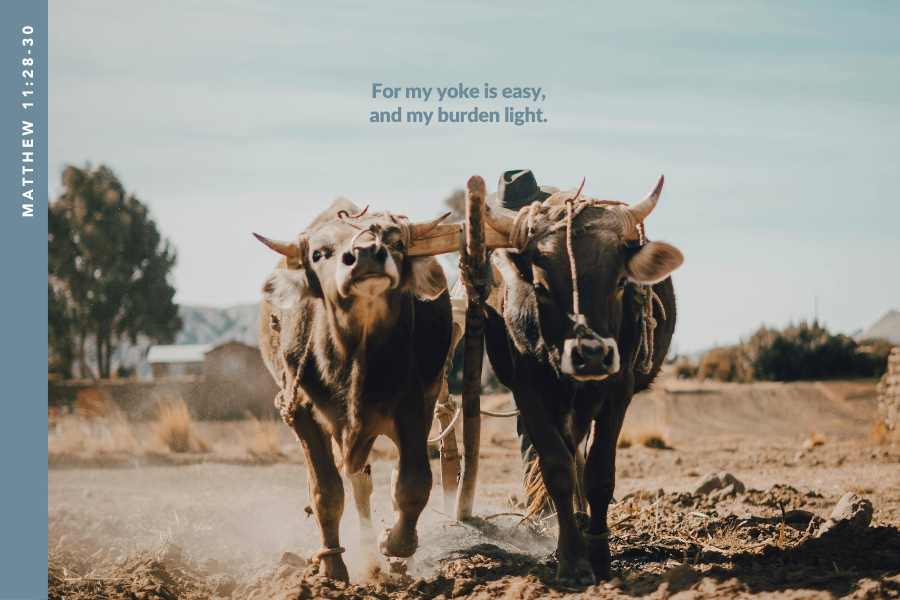
Jesus said: “Come to me, all you who labor and are burdened, and I will give you rest. Take my yoke upon you and learn from me, for I am meek and humble of heart; and you will find rest for yourselves. For my yoke is easy, and my burden light.”

Opening Prayer: “The course of your judgments, Lord, we await; your name and your memory are the desire of our souls. My soul yearns for you at night, yes, my spirit within me seeks you at dawn; when your judgment comes upon the earth, the world’s inhabitants learn justice… O Lord, you will decree peace for us, for you have accomplished all we have done” (Isa 26:8-12).

Encountering Christ:

  1. Labors and Burdens: It is understood in this context that Jesus is speaking to those who labor and are burdened by the law as expounded by the scribes and Pharisees. Further in the Gospel of Matthew we find Jesus rebuking the Pharisees, for “They tie up heavy burdens [hard to carry] and lay them on people’s shoulders, but they will not lift a finger to move them” (Matthew 23:4). What we can learn from this exchange is that the burden of faith we bear, often a weight we carry not only for ourselves but also for loved ones who are outside the faith, is lifted when we ask Our Lord to enter into our burdens. Jesus, through his cross, lifts our burdens onto his own shoulders and carries them with us.

  2. Rest: The rest Jesus invites us into is the Father’s will. Sown into our human nature through original sin is the lie that the Father’s will is a burden, a set of rules limiting our freedom. Jesus leads us on the path to truth, and we find our way by being meek and humble of heart. To be meek like Jesus means to willingly place our power at the service of God, much like a bridled horse who allows itself to be tamed to serve his master. Humble of heart means to freely submit our will to God. To be meek and humble of heart is difficult on our own due to our fallen nature; our concupiscence. Through Jesus, “It (concupiscence) cannot harm those who do not consent but manfully resist it by the grace of Jesus Christ” (CCC 1264).

  3. Jesus’ Yoke: Kateri Tekakwitha, the saint whose feast day we celebrated Monday, took the yoke of Jesus upon herself when she, at eleven years old, accepted the gift of the Catholic faith through Jesuit missionaries who visited her Mohawk tribe in 1667. She practiced her religion unflinchingly in the face of almost unbearable opposition. She lived a life of remarkable virtue despite the many in her tribe who engaged in carnage, debauchery, and idolatrous frenzy. Every morning, even in bitterest winter, she stood before the chapel door until it opened at 4 and remained there until after the last Mass. She was devoted to the Eucharist and to Jesus crucified. Upon her death, devotion to her began immediately to be manifested by her people and many were converted to Catholicism. Kateri’s steadfast devotion to Jesus teaches us how to resist concupiscence by living a life of virtue. We lean upon the grace of Jesus Christ, so that he lifts the burdens we carry for ourselves and for our people.

Conversing with Christ: Lord Jesus, to rest in you is to do the Father’s will and I confess, I often find it a burden difficult to carry, especially when I feel I am also carrying it for others. I want to learn from you that faith is not a burden; it is a gift to appreciate and treasure. Fill me with your grace, Jesus.

Resolution: Lord, today by your grace I will begin a practice of thanking you first thing every morning and last thing every night.

Nan Balfour is an events coordinator for Pilgrim Center of Hope, a Catholic Evangelization Ministry that answers Christ’s call by guiding people to encounter him so as to live in hope as pilgrims in daily life. She is also a mother, writer, and speaker on Catholic topics.
July 18, 2025 – Something Greater

Friday of the Fifteenth Week in Ordinary Time

Matthew 12:1-8

Jesus was going through a field of grain on the Sabbath. His disciples were hungry and began to pick the heads of grain and eat them. When the Pharisees saw this, they said to him, “See, your disciples are doing what is unlawful to do on the Sabbath.” He said to them, “Have you not read what David did when he and his companions were hungry, how he went into the house of God and ate the bread of offering, which neither he nor his companions but only the priests could lawfully eat? Or have you not read in the law that on the Sabbath the priests serving in the temple violate the Sabbath and are innocent? I say to you, something greater than the temple is here. If you knew what this meant, I desire mercy, not sacrifice, you would not have condemned these innocent men. For the Son of Man is Lord of the Sabbath.”

Opening Prayer: This is the day the Lord has made; let us be glad and rejoice in it. Give thanks to the Lord for he is good, his love is everlasting. Let the house of Israel say, “His mercy endures forever.” Let the house of Aaron say, “His mercy endures forever.” Let those who fear the LORD say, “His mercy endures forever” (from Psalm 118).

Encountering Christ:

  1. The Sabbath: “Jesus was going through a field of grain on the Sabbath.” Nothing God does is by chance. Everything that happens God either wills or allows in order that good can be done for his glory. Jesus led the disciples through the grainfield knowing his disciples were very hungry and that the Pharisees were among them. He was provoking both to act so he could reveal more fully who God is. God’s will is revealed in every circumstance if we have eyes to see. He calls on us through prayer and discernment to seek God’s will in the daily happenings of our lives.

  2. God Questions: Jewish rabbis typically taught by asking questions and Jesus continued this tradition. Biblical scholars attribute more than one-hundred questions in the New Testament to Jesus. This is often an effective method for teaching because questions can draw our thoughts beyond the limits of what we know into a deeper understanding of Scripture through discussion and debate. In this case, Jesus was asking the Pharisees to reconsider their understanding with regard to keeping the Sabbath. When we question a church teaching, Our Lord never minds our sincere inquiries. He welcomes our study and encourages us as we wrestle with difficult teachings. He has provided us with great resources: knowledgeable priests, spiritual directors, excellent online resources like The Bible in a Year podcast by Fr. Mike Schmitz, and the Catechism of the Catholic Church. Reading from the Catechism for just fifteen minutes a day will take us far in our understanding of our faith.

  3. Something Greater: If the Pharisees accepted what Jesus said was true, it meant that they would acknowledge his divinity, for Jesus plainly called himself divine by stating, “I say to you, something greater than the temple is here. If you knew what this meant, I desire mercy, not sacrifice, you would not have condemned these innocent men. For the Son of Man is Lord of the Sabbath.” How well do we internalize that Jesus is “something greater”—that he is the Lord, our King, our Master, our Brother? That Jesus is almighty, never changing, perfect in love? Philosopher A. W. Tozer said, “What comes into our minds when we think about God is the most important thing about us.” Our understanding of God informs our every thought and action. We do well to ponder daily, “Who do you say that I am?” (Mt 16:15). When we truly believe that Jesus is “something greater,” every aspect of our lives is changed for the better.

Conversing with Christ: Lord, you refuse to let me stay in my own understanding. You constantly call me to a deeper understanding of you. St. Bonaventure, whose feast we celebrate today, says, “No one can become blessed, unless he ascends above his very self, not by an ascent with the body, but with the heart.” Jesus, I trust in you.  

Resolution: Lord, today by your grace I will open the Catechism of the Catholic Church, heeding these words of St. John Paul II: “In reading the Catechism of the Catholic Church we can perceive the wonderful unity of the mystery of God.”

For Further Reflection: The Catechism of the Catholic Church.

Nan Balfour is an events coordinator for Pilgrim Center of Hope, a Catholic Evangelization Ministry that answers Christ’s call by guiding people to encounter him so as to live in hope as pilgrims in daily life. She is also a mother, writer, and speaker on Catholic topics.
July 19, 2025 – Like Jesus

Saturday of the Fifteenth Week in Ordinary Time

Matthew 12:14-21

The Pharisees went out and took counsel against Jesus to put him to death. When Jesus realized this, he withdrew from that place. Many people followed him, and he cured them all, but he warned them not to make him known. This was to fulfill what had been spoken through Isaiah the prophet: Behold, my servant whom I have chosen, my beloved in whom I delight; I shall place my Spirit upon him, and he will proclaim justice to the Gentiles. He will not contend or cry out,
nor will anyone hear his voice in the streets. A bruised reed he will not break, a smoldering wick he will not quench, until he brings justice to victory. And in his name the Gentiles will hope.

Opening Prayer: Jesus, I want to love others as you do. I can do only this if you love through me. Lord, teach me your ways!

Encountering Christ:

  1. Divine Meekness: In the verses directly before today’s Gospel passage, Our Lord plainly told the Pharisees he was God. Their response was to take counsel against him to put him to death. It can be so disheartening when we share our faith in Jesus by either word or deed and are met with the kind of animosity that Jesus experienced here. We are tempted to retaliate in kind, but instead we should do as Jesus does. Jesus let the Pharisees be and turned to those who were receptive to him. To do as Jesus does here requires meekness. Meekness is the virtue which gives us the power to suppress our instinct to hate or harm another through control of our will. “We ought to be like lilies in the midst of thorns, which, however they be pricked and pierced, never lose their sweet and gentle fragrance” (St. Bernard of Clairvaux, Father and Doctor of the Church).

  2. Divine Mercy: No matter how we are treated, meekness is the appropriate response. But Our Lord also calls us to be merciful in the face of opposition. As Our Lord told St. Faustina, “I demand from you deeds of mercy, which are to arise out of love for me. You are to show mercy to your neighbors always and everywhere. You must not shrink from this or try to excuse or absolve yourself from it. I am giving you three ways of exercising mercy toward your neighbor: the first by deed, the second by word, the third by prayer. In these three degrees is contained the fullness of mercy, and it is an unquestionable proof of love for me. By this means a soul glorifies and pays reverence to my mercy” (Diary 742). When we are able to be meek and merciful, by God’s grace, we will hear him proclaim, “Behold, my servant whom I have chosen, my beloved in whom I delight.”

  3. Divine Humility: “He will not contend or cry out, nor will anyone hear his voice in the streets. A bruised reed he will not break, a smoldering wick he will not quench, until he brings justice to victory.” To share our faith in Jesus with others often means we have to learn to play the long game, to delay gratification now so as to win souls later. If our efforts fall on deaf ears and disbelieving hearts, it benefits us to trust that God is at work and persevere in humility. We want to be the one who brings a soul to full bloom, but we may be called to only plant the seed. With the Pharisees, Jesus had to “withdraw from that place,” even though, as the Son of God, he never ceased interceding for them. We do likewise, standing firm, “until he brings justice to victory. And in his name the Gentiles will hope.”

Conversing with Christ: Lord, I sometimes get discouraged when those I love, and whom I want to love you, refuse to believe in you. I see that you experienced the same. I realize, Lord, that it is not me they are rejecting; it is you. Jesus, I am sorry so many do not know you, love you, and serve you. And I am sorry for the times that person is me. Please forgive me. Help me to love others as you do.

Resolution: Lord, today by your grace I will work on putting into practice the three ways you told St. Faustina to show mercy: 1. By deed, 2. By word, 3. By prayer.

Nan Balfour is an events coordinator for Pilgrim Center of Hope, a Catholic Evangelization Ministry that answers Christ’s call by guiding people to encounter him so as to live in hope as pilgrims in daily life. She is also a mother, writer, and speaker on Catholic topics.

July 20, 2025 – The One Thing

Sixteenth Sunday in Ordinary Time

Luke 10:38-42

Jesus entered a village where a woman whose name was Martha welcomed him. She had a sister named Mary who sat beside the Lord at his feet listening to him speak. Martha, burdened with much serving, came to him and said, “Lord, do you not care that my sister has left me by myself to do the serving? Tell her to help me.” The Lord said to her in reply, “Martha, Martha, you are anxious and worried about many things. There is need of only one thing. Mary has chosen the better part and it will not be taken from her.”

Opening Prayer: Jesus, in this time of prayer, I want to sit at your feet, like Mary. I want to listen to you speaking to me. You know that I am so often anxious and worried about many things, and I let those concerns distract me from you, and sometimes, they even keep me from making time for prayer. Lord, give me the grace to desire you above all else. Help me trust that if I make time for you in prayer, the effects will overflow into every aspect of my life. Lord, I believe that you are the source of everything good. I hope in your provision for all my needs. I trust you with those things that are heavy on my heart. Help me know that making this time of prayer is an act of love for you and that it will transform me, if I let it.

Encountering Christ:

  1. One Thing: Martha welcomed Jesus and then busied herself with the details of hospitality. We can imagine how much she desired to show her respect and affection for Jesus through that hospitality. Wanting to provide the best for Jesus became such a focus, however, that it took her attention off of Jesus himself. This same thing can happen to us! We may become so involved in our apostolic work that we skimp on our prayer time, or miss it all together. Jesus wants our hearts. What we do should flow from our love for him and what we hear him ask of us. We are called to honor Jesus through our work, but to do so, we must keep Jesus at the center of everything. We can ask ourselves, “What do I busy myself with to the extent that it takes my attention off of you, Lord? What do I allow to get in the way of listening to you in prayer?”

  2. At His Feet: The most important thing to Mary was to sit at Jesus’ feet so that she could come to know him better and be formed as a disciple by him. Her attention was on what he said. We also have to take time to sit at Jesus’ feet so that we can share what we learn and experience. St. Thomas Aquinas is credited with the Dominican motto: Contemplata aliis tradere—”To contemplate and to share the fruits of our contemplation.” We cannot be satisfied only with efforts for our own sanctification; we are called to work for the sanctification of others. We can consider it a form of charity to form ourselves as we contemplate Our Lord, so that we can help others encounter the Lord and come to know him. In 1 Peter 3:15, we read, “Always be ready to give an explanation to anyone who asks you for a reason for your hope…” How well prepared are we to speak to others about Christ and his Church, both from our personal experience of him and by knowledge of Scripture and tradition?

  3. Both: As Christians, we are called to be both active (evangelizing) and contemplative. Therefore, it is essential that our lives are grounded in Scripture, the teachings of the Church, and prayer. It is also essential that we take seriously the call we received in Baptism to “go and make disciples” (Mt 28:19). We help others not only encounter Christ and come to know his love; we also help them recognize their own call to touch others with the Gospel message as missionary disciples. As Pope Francis wrote in Evangelii Gaudium, “In virtue of their baptism, all the members of the People of God have become missionary disciples (cf. Mt 28:19)… The new evangelization calls for personal involvement on the part of each of the baptized. Every Christian is challenged, here and now, to be actively engaged in evangelization” (n. 120). We can ask ourselves, “Are there obstacles in my life to living this aspect of faith?”
  4.  

Conversing with Christ: Lord, looking at Martha and Mary, I am challenged both to deepen my prayer life and to reach out in active efforts to evangelize. You know my heart. You know I want to love you and those in my life, my family, my friends, my co-workers, but sometimes it is hard to follow through on the inspirations of your Holy Spirit. It is hard to set aside those things that I prioritize over loving and serving you. Lord, help me grow in generosity and charity so that I may live as your image in the world and draw others to you.

Resolution: Lord, today by your grace I will identify one area of Church teaching or Scripture that I would like to know more about and search out a resource to deepen my knowledge and understanding in that area.

Janet McLaughlin and her husband Chris live on a mountain in rural northeastern Oregon. She puts her Master of Arts in Pastoral Studies to work as she shares the beauty and importance of the lay vocation in her writing, speaking, and teaching on spiritual topics.

 
Scroll to Top

Events

Looking for another country?

Contact Regnum Christi near you

News & Resources

News & Resources

The Regnum Christi Mission

The Regnum Christi Identity

Alex Kucera

Atlanta

Alex Kucera has lived in Atlanta, GA, for the last 46 years. He is one of 9 children, married to his wife Karmen, and has 3 girls, one grandson, and a granddaughter on the way. Alex joined Regnum Christi in 2007. Out of the gate, he joined the Helping Hands Medical Missions apostolate and is still participating today with the Ghana Friendship Mission.

In 2009, Alex was asked to be the Atlanta RC Renewal Coordinator for the Atlanta Locality to help the RC members with the RC renewal process. Alex became a Group Leader in 2012 for four of the Atlanta Men’s Section Teams and continues today. Running in parallel, in 2013, Alex became a Team Leader and shepherded a large team of good men.

Alex was honored to be the Atlanta Mission Coordinator between 2010 to 2022 (12 years), coordinating 5-8 Holy Week Mission teams across Georgia. He also created and coordinated missions at a parish in Athens, GA, for 9 years. Alex continues to coordinate Holy Week Missions, Advent Missions, and Monthly missions at Good Shepherd Catholic Church in Cumming, GA.

From 2016 to 2022, Alex also served as the Men’s Section Assistant in Atlanta. He loved working with the Men’s Section Director, the Legionaries, Consecrated, and Women’s Section leadership teams.

Alex is exceptionally grateful to the Legionaries, Consecrated, and many RC members who he’s journeyed shoulder to shoulder, growing his relationship with Christ and others along the way. He knows that there is only one way, that’s Christ’s Way, with others!