THE WEEKLY DIGEST
OF REGNUM CHRISTI
DAILY MEDITATIONS

August 31, 2025 – Jesus’ Criteria

Twenty-Second Sunday in Ordinary Time

Luke 14:1, 7-14

On a sabbath Jesus went to dine at the home of one of the leading Pharisees, and the people there were observing him carefully. He told a parable to those who had been invited, noticing how they were choosing the places of honor at the table. “When you are invited by someone to a wedding banquet, do not recline at table in the place of honor. A more distinguished guest than you may have been invited by him, and the host who invited both of you may approach you and say, ‘Give your place to this man,’ and then you would proceed with embarrassment to take the lowest place. Rather, when you are invited, go and take the lowest place so that when the host comes to you he may say, ‘My friend, move up to a higher position.’ Then you will enjoy the esteem of your companions at the table. For every one who exalts himself will be humbled, but the one who humbles himself will be exalted.” Then he said to the host who invited him, “When you hold a lunch or a dinner, do not invite your friends or your brothers or your relatives or your wealthy neighbors, in case they may invite you back and you have repayment. Rather, when you hold a banquet, invite the poor, the crippled, the lame, the blind; blessed indeed will you be because of their inability to repay you. For you will be repaid at the resurrection of the righteous.”

Opening Prayer: Lord Jesus, let me know your heart, which is meek, humble, and generous; knowing it, grant me the grace to love and imitate you.

Encountering Christ:

  1. Being a Guest: Jesus offered what appears to be very sagacious human advice. It is as though he was suggesting a strategy for making sure we get places of honor. But underlying his words is an important instruction for us. Every time we attend Mass, we are guests at the wedding banquet. The Eucharist is the foretaste of the eternal wedding feast to come in Heaven. Do we come forward for Communion as though it is our right? Or do we approach with gratitude, reverence, and humility, aware that we are special guests invited to partake of this great gift, Our Lord, Body, Blood, Soul, and Divinity?

  2. Being a Host: Jesus addressed the host of his dinner party with a challenge to invite, not the rich, but those who could not repay him. His words are an invitation to us to consider how often we extend ourselves in hospitality or friendship to others. Does complacency keep us within a circle of friends who are comfortable? Or do we reach out to people on the margins of our life, in the parish, at work, at school? How may the Lord be inviting us to give of ourselves in unexpected ways?

  3. Repayment: To serve those who cannot repay us is what Ignatius of Loyola would call a spirit of indifference. Far from not caring, it places the heart in a position of vigilance, seeing everything as God’s gift to receive and share with others. It frees the heart of egotistic possessing and clamoring after what promotes our own well-being and self-satisfaction. Once again Jesus promised a reward to those who were good stewards and hosts. He said that payment would come at the resurrection of the righteous. The righteous person is one who has a vision of things as they are and has established an honest relationship with God, others, and all of creation. The righteous see everything at their service, while nothing belongs directly to them. For this reason, they are capable of being generous, because they are guided by the beneficent heart of the Lord.

Conversing with Christ: Lord Jesus, you are the giver of all good things. Help me to see anew, with your eyes, so that I may establish a right relationship towards you, others, and all created things. Grant that I may have a heart like yours, humble and capable of living in the truth about who I am in relation to all things.

Resolution: Lord, today by your grace I will reflect on my attitudes about entering into relationships with you, others, and created things.  

Jennifer Ristine is a consecrated woman of Regnum Christi dedicated to spiritual and faith formation through teaching, conferences, writing, and spiritual direction. While serving in Ancient Magdala she wrote Mary Magdalene: Insights from Ancient Magdala and “Nine Days with Mary Magdalene.”

September 1, 2025 – Poor in Spirit

Monday of the Twenty-Second Week in Ordinary Time

Luke 4:16-30

He came to Nazareth, where he had grown up, and went according to his custom into the synagogue on the sabbath day. He stood up to read and was handed a scroll of the prophet Isaiah. He unrolled the scroll and found the passage where it was written: The Spirit of the Lord is upon me, because he has anointed me to bring glad tidings to the poor. He has sent me to proclaim liberty to captives and recovery of sight to the blind, to let the oppressed go free, and to proclaim a year acceptable to the Lord. Rolling up the scroll, he handed it back to the attendant and sat down, and the eyes of all in the synagogue looked intently at him. He said to them, “Today this Scripture passage is fulfilled in your hearing.” And all spoke highly of him and were amazed at the gracious words that came from his mouth. They also asked, “Isn’t this the son of Joseph?” He said to them, “Surely you will quote me this proverb, ‘Physician, cure yourself,’ and say, ‘Do here in your native place the things that we heard were done in Capernaum.’” And he said, “Amen, I say to you, no prophet is accepted in his own native place. Indeed, I tell you, there were many widows in Israel in the days of Elijah when the sky was closed for three and a half years and a severe famine spread over the entire land. It was to none of these that Elijah was sent, but only to a widow in Zarephath in the land of Sidon. Again, there were many lepers in Israel during the time of Elisha the prophet; yet not one of them was cleansed, but only Naaman the Syrian.” When the people in the synagogue heard this, they were all filled with fury. They rose up, drove him out of the town, and led him to the brow of the hill on which their town had been built, to hurl him down headlong. But he passed through the midst of them and went away.

Opening Prayer: Dear Lord Jesus, I come before you in prayer. I need your grace. Please help me to be open and docile to your message to me today. Increase my faith, that I may discover you in all things. Increase my hope, that I may believe in your fidelity even when you seem silent. Increase my love, that I may embrace you in all circumstances.

Encountering Christ:

  1. Bringing Glad Tidings to the Poor: “The Spirit of the Lord is upon me, because he has anointed me to bring glad tidings to the poor… to proclaim liberty to captives and recovery of sight to the blind, to let the oppressed go free, and to proclaim a year acceptable to the Lord.” Jesus read from the prophet Isaiah, which pointed to a messianic promise. This promise was not one of kingly power and might where the enemies of Israel were conquered, but rather a reference to the jubilee year that brought about the remission of debt, itself an image for Jesus’s coming for the remission of sin (Ignatius Catholic Study Bible: New Testament). This promise taps into man’s keen awareness that something is wrong; he knows himself to be poor, captive, blind, and oppressed. Man senses that humanity suffered from a kind of primordial shipwreck (Chesterton, Orthodoxy, loc. 875-880). Man knows he needs a savior.

  2. What Good Did Jesus Bring?: As we look around at this broken world, a world that still contains the poor, the captive, and the blind, we can wonder what good Our Lord’s sacrifice has brought. Pope Benedict XVI asked precisely this question in his book, Jesus of Nazareth. The answer he gave was that thanks to Jesus we now know God’s face and can call upon him (p. 33). By calling upon Jesus and opening ourselves to his grace, we may enter into a friendship with him meant to be everlasting. Jesus’s work has not eradicated evil and death in this world, but they no longer have the last word—his Resurrection and life do.

  3. Who Does Jesus Think He Is?: Our Lord’s listeners marveled at the wisdom coming from his mouth, and yet they rejected him: “Isn’t this the son of Joseph?” Jesus always gives us enough information to follow him if we choose, and just enough space to avoid or deny him, again, if we choose. Pope Benedict XVI said, “Since faith demands our whole existence, our will, our love, since it requires letting go of ourselves, it necessarily always goes beyond a mere knowledge… And because that is so, then I can always turn my life away from faith and find arguments that seem to refute it” (God and the World: A Conversation with Peter Seewald, p. 33). To meet Jesus is to face a choice. Our response to Jesus tells us more about our disposition than about him. Thankfully, Our Lord is both patient and persistent.

Conversing with Christ: Dear Lord Jesus, I want to thank you for bringing me—a poor and needy sinner—your mercy, grace, and love. May I be always receptive to your message. I realize that you will always challenge me to learn and live according to your criteria, not mine. Help me to be your instrument of grace to those around me, so they too may discover your mercy and your grace.

Resolution: Lord, today by your grace I will share a simple word of encouragement with someone, gently reminding them of your grace and fidelity.

Father John Bullock, LC, works with Regnum Christi in Cincinnati, Ohio. You can read his blog at https://www.headandheartcatholic.com/.

September 2, 2025 – Jesus Drives Out an Unclean Spirit

Tuesday of the Twenty-Second Week in Ordinary Time

Luke 4:31-37

Jesus went down to Capernaum, a town of Galilee. He taught them on the sabbath, and they were astonished at his teaching because he spoke with authority. In the synagogue there was a man with the spirit of an unclean demon, and he cried out in a loud voice, “What have you to do with us, Jesus of Nazareth? Have you come to destroy us? I know who you are—the Holy One of God!” Jesus rebuked him and said, “Be quiet! Come out of him!” Then the demon threw the man down in front of them and came out of him without doing him any harm. They were all amazed and said to one another, “What is there about his word? For with authority and power he commands the unclean spirits, and they come out.” And news of him spread everywhere in the surrounding region.

Opening Prayer: Lord Jesus, you are more powerful than any evil. Protect me from distraction while I meditate on your word.

Encountering Christ:

  1. They Were All Amazed: Jesus taught the people on the Sabbath, a day reserved for rest and for hearing the rabbi’s preaching in the synagogue. Jesus, a woodworker from Nazareth, had bystanders enthralled and curious to hear what he would say next. Something stirred their hearts when he spoke. What made the general crowd listen with open hearts while the Pharisees and scribes wanted to silence him? Perhaps it was an awareness of their neediness that sensitized them to Jesus’ life-giving message. As friends of Jesus, we listen with open hearts to his preaching, and recognize our need for greater dependence on him. In this way, we are sensitized to listen to and develop a holy taste for God’s word.


  2. I Know Who You Are: How often we brush aside Jesus’ Real Presence, unaware of the impact he wants to make upon us. The demons recognize him, but do we? A simple acknowledgement suffices for Jesus to enter into relationship with us. From the enemy came a profession of faith, the very profession that Jesus longs for us to proclaim.


  3. Be Quiet! Come Out of Him!: Jesus manifested his power as an act of charity directed at a possessed man. The Scriptures testify that Jesus’ power was never displayed for the sake of lording himself over others. Beginning with the miracle of Cana, he was moved by pure charity to remedy situations and to bring about righteousness. With a sternness he ordered the devil to be silent, but he is gentle with those who are in need of mercy and open to receive. We need never fear drawing close to Jesus.

Conversing with Christ: Lord Jesus, I praise you for the wonders you work in my life and in the lives of others. Grant that I may turn over those areas of my life that are in need of healing. Silence and banish those spirits that seek to obstruct my true surrender to you.

Resolution: Lord, today by your grace I will be attentive to thoughts that obstruct my faith and ask you to silence and send them out.

Jennifer Ristine is a consecrated woman of Regnum Christi dedicated to spiritual and faith formation through teaching, conferences, writing, and spiritual direction. While serving in Ancient Magdala she wrote Mary Magdalene: Insights from Ancient Magdala and “Nine Days with Mary Magdalene.”

September 3, 2025 – Jesus Heals Many

Memorial of Saint Gregory the Great, Pope and Doctor of the Church

Luke 4:38-44

After Jesus left the synagogue, he entered the house of Simon. Simon’s mother-in-law was afflicted with a severe fever, and they interceded with him about her. He stood over her, rebuked the fever, and it left her. She got up immediately and waited on them. At sunset, all who had people sick with various diseases brought them to him. He laid his hands on each of them and cured them. And demons also came out from many, shouting, “You are the Son of God.” But he rebuked them and did not allow them to speak because they knew that he was the Christ. At daybreak, Jesus left and went to a deserted place. The crowds went looking for him, and when they came to him, they tried to prevent him from leaving them. But he said to them, “To the other towns also I must proclaim the good news of the Kingdom of God, because for this purpose I have been sent.” And he was preaching in the synagogues of Judea.

Opening Prayer: Lord Jesus, be with me as I contemplate your word in Scripture. I trust that you will speak with me and increase my faith, hope, and charity.

Encountering Christ:

  1. The Rebuke: The human person was made for wholeness, which ultimately is salvation of our souls and the resurrection of our bodies. Physical illness is a reminder of the imperfection that we continue to face until all is restored and reconciled to God. Only Jesus has the power to restore that which strays from its ultimate purpose. He reveals this by his miracles of nature. Jesus sternly rebuked the fever that plagued Simon’s mother-in-law. The power of his word was revealed. What he speaks is as good as done. Jesus, the Logos and Word of God, is the one who created all the laws of nature. Far from contradicting them, he is capable of setting nature upon its right course. The disciples, from his historical time to the present, continue to act in his name, trusting in his power to restore and heal.


  2. Humble Service: What Jesus had to offer, he did. The crowds continued to come, desiring to be healed. At times, the physical illness that paralyzed the person was accompanied by demons, revealing the intricate connection between body and spirit. When the demons came out, Jesus silenced them, for they were professing that he was the Son of God. He wished to do good, not to attract attention to himself. He did not wish anything to impede him in these moments from healing the “sheep without a shepherd.”


  3. Jesus’ Mission: The next morning, Jesus went out to a solitary place. He had engaged with the people and yet sought solitude to gather strength for fulfilling the Father’s will. While the people wanted him to stay, Jesus seemed to have an internal clock that told him when it was time to move on. His actions were guided by the Father, in step with the Father’s salvific and redemptive mission. Jesus knew that more needed to hear the message of the Kingdom. He had many seeds to plant before the consummation of his sacrifice out of love for all of humanity. And so, he moved on. To this day, Jesus has left his disciples to continue his work. Those who are called must listen and take up the work of healing in his name.

Conversing with Christ: Lord Jesus, I come before you like one among the crowd, in need of healing, physically and inwardly. Do with me as you please. Help me also to listen to your call to follow you as a disciple, doing all in your name.

Resolution: Lord, today by your grace I will give thanks for the healers who work in your name and support them with my prayers.

Jennifer Ristine is a consecrated woman of Regnum Christi dedicated to spiritual and faith formation through teaching, conferences, writing, and spiritual direction. While serving in Ancient Magdala she wrote Mary Magdalene: Insights from Ancient Magdala and “Nine Days with Mary Magdalene.”

September 4, 2025 – The Call

Thursday of the Twenty-Second Week in Ordinary Time

Luke 5:1-11

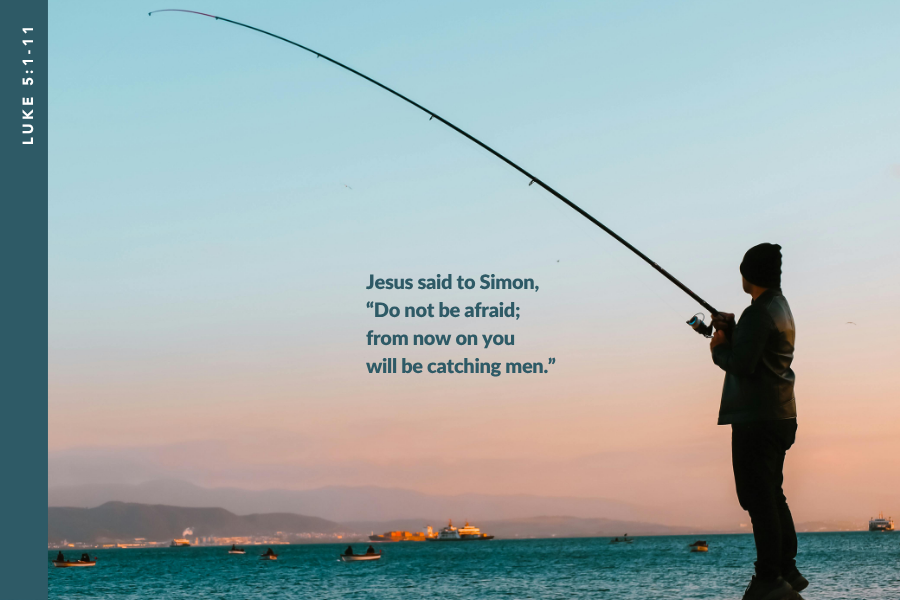
While the crowd was pressing in on Jesus and listening to the word of God, he was standing by the Lake of Gennesaret. He saw two boats there alongside the lake; the fishermen had disembarked and were washing their nets. Getting into one of the boats, the one belonging to Simon, he asked him to put out a short distance from the shore. Then he sat down and taught the crowds from the boat. After he had finished speaking, he said to Simon, “Put out into deep water and lower your nets for a catch.” Simon said in reply, “Master, we have worked hard all night and have caught nothing, but at your command I will lower the nets.” When they had done this, they caught a great number of fish and their nets were tearing. They signaled to their partners in the other boat to come to help them. They came and filled both boats so that the boats were in danger of sinking. When Simon Peter saw this, he fell at the knees of Jesus and said, “Depart from me, Lord, for I am a sinful man.” For astonishment at the catch of fish they had made seized him and all those with him, and likewise James and John, the sons of Zebedee, who were partners of Simon. Jesus said to Simon, “Do not be afraid; from now on you will be catching men.” When they brought their boats to the shore, they left everything and followed him.

Opening Prayer: Lord, I ask you during this time of prayer to help me to better hear you when you call, and to respond with humility and docility. I know that you are the source of the abundant blessings of my life. Give me the grace to be grateful for your presence, and help me to leave behind anything that separates me from you.

Encountering Christ:

  1. Posturing: At the beginning of this famous passage, Jesus was standing. Crowds were filing into position, wanting to find a spot where they could hear the words of the teacher. Jesus saw an opportunity to get out on the water, which would allow him a little space to breathe, and enable his voice to carry without shouting. He even sat down, signaling to the crowd that he was comfortable with this arrangement, and perhaps inviting the people, voicelessly, to do the same. One need not be a behavioral scientist to infer much from observing our body language. What kind of message do we send when we are listening to a spouse, children, parishioners, or coworkers? Are we attentive to each person, or do we seem preoccupied? Does our body language at Mass reflect our enthusiasm for giving God his due praise and worship? What does Our Lord see when we approach him for communion? A soul hungry for the bread which comes down from Heaven?

  2. Know Thyself: A most important posture was demonstrated in today’s Gospel by Simon Peter, who knelt in front of his Lord and Savior. Each of the actions Peter took that night is instructive to us, but he was most definitely not the protagonist. Peter was responding to Christ’s actions in his life. Christ encouraged him to go into the deep, caused a miraculous catch of fish, invited him to swallow his fears, and extended an important life-changing invitation to follow him. Christ always makes the first move in our lives and our response should be one of receptivity, assuming what some call a “Marian posture.” Indeed, as members of the Church which is the bride of Christ, it is always helpful for us to contemplate (and try to replicate) the receptivity shown by the Blessed Mother when she gave her simple fiat to the Angel Gabriel at the Annunciation: “Behold, I am the handmaid of the Lord. May it be done to me according to your word” (Lk 1:38).

  3. The Three “R”s: Simon Peter, in his actions in those few moments with Jesus—embracing his command, falling to his knees, acknowledging his sinfulness, and choosing to follow—demonstrated a great awakening in spiritual maturity. When we attended grade school, each of us attempted to master “reading, writing, and ’rithmetic”; once we did, these skills allowed us to grow in understanding of our material world. Peter’s receptivity, repentance, and reverence reflect three key dispositions that allowed him to grow in understanding of the spiritual realm. These three dispositions will serve us well also. Our own efforts, though, will never be enough. Even Peter, under the duress of Jesus being captured, failed in his pledge to “never deny” his Lord. Thankfully, our resurrected Lord would repeat the miracle of the great catch of fish (cf. Jn 21:1-19), and give Peter the opportunity to repent and recommit to following him. Not only does Christ always make the first move, he always delights in receiving us back after we fall.

Conversing with Christ: Jesus, I thank you today for reminding me that you called simple and sinful men to follow you as your first disciples. You do not wish for me to be weighed down by my own failings; instead, you desire me to follow you, and to receive the abundant graces that you wish to shower upon me, and anyone else who chooses to follow you.

Resolution: Lord, today by your grace I will read John 21:1-19 in light of today’s Gospel, and reflect on how you have worked in my life.

For Further Reflection: For more on the idea of the Blessed Mother’s receptivity, you may wish to reflect on this passage from the 2004 document from the Congregation for the Doctrine of the Faith: Collaboration of Men and Women in the Church and in the World:

“It is from Mary that the Church always learns the intimacy of Christ. Mary, who carried the small child of Bethlehem in her arms, teaches us to recognize the infinite humility of God. She who received the broken body of Jesus from the Cross shows the Church how to receive all those in this world whose lives have been wounded by violence and sin. From Mary, the Church learns the meaning of the power of love, as revealed by God in the life of his beloved Son: ‘He has scattered the proud in the thoughts of their heart… he has lifted up the lowly’ (Luke 1:51-52). From Mary, the disciples of Christ continually receive the sense and the delight of praise for the work of God’s hands: ‘The Almighty has done great things for me’ (Luke 1:49). They learn that they are in the world to preserve the memory of those ‘great things,’ and to keep vigil in expectation of the day of the Lord.”

Andrew Rawicki and his wife, JoAnna, live in Irving, Texas, near eight of their ten grandchildren. A convert from Judaism, Andrew entered the Church in 1991, and has been a member of the Regnum Christi spiritual family since 2001. He has served as the Regnum Christi Local Director for Dallas since July 2020.

September 5, 2025 – Our Time with the Bridegroom

Friday of the Twenty-Second Week in Ordinary Time

Luke 5:33-39

The scribes and Pharisees said to Jesus, “The disciples of John the Baptist fast often and offer prayers, and the disciples of the Pharisees do the same; but yours eat and drink.” Jesus answered them, “Can you make the wedding guests fast while the bridegroom is with them? But the days will come, and when the bridegroom is taken away from them, then they will fast in those days.”

And he also told them a parable. “No one tears a piece from a new cloak to patch an old one.

Otherwise, he will tear the new and the piece from it will not match the old cloak. Likewise, no one pours new wine into old wineskins. Otherwise, the new wine will burst the skins, and it will be spilled, and the skins will be ruined. Rather, new wine must be poured into fresh wineskins.

And no one who has been drinking old wine desires new, for he says, ‘The old is good.’”

Opening Prayer: Lord, today I want to spend this time with you and only you, free of distractions. As a member of the Church that you established as your bride, I want to love you as my bridegroom. Thank you for looking after me, teaching me your ways, and being the source of my joy.

Encountering Christ:

Encountering Christ:

  1. Misjudged: The scribes and Pharisees had obviously been attentive to this new authority figure, Jesus. It was likely that very little of what he said and did escaped them, extending even to the behaviors of Jesus’ followers. These not-so-casual observers had their data, and they arrived at their conclusions. Drawing logical conclusions from a set of data is a good, and one that sets us apart as humans. Sadly, another unique aspect of our nature, our fallen human nature, is to judge others. The scribes and Pharisees went beyond mere logic to implicit accusation. Jesus’ followers were being judged to be less holy than other disciples with whom they were acquainted. St. Paul reminds us in today’s first reading to “not make any judgment before the appointed time, until the Lord comes, for he will bring to light what is hidden in darkness” (1 Cor 4:5). When others judge us for following Our Lord, let us be unperturbed and say as St. Paul said, “It does not concern me in the least that I be judged by you or any human tribunal.”

  2. The Wrong Standards: Perhaps it was rare for these observers to witness Jesus’ followers participating in what they considered to be “prayer.” Little did they realize that conversing with Jesus was, in fact, the very definition of prayer! We can deduce from eyewitness testimonies that the Pharisees and the followers of John the Baptist had a number of admirable qualities, such as obedience, zeal, and perseverance. However, Jesus calls us to a higher standard; he exhorts us to “be perfect, just as your heavenly Father is perfect” (Mt 5:48). And the most reliable way to “achieve” this perfection is through prayer and the sacraments. By conversing with Christ regularly, we can joyfully bear the weight of the crosses that must appear on this path to perfection: “The way of perfection passes by way of the cross. There is no holiness without renunciation and spiritual battle. Spiritual progress entails the ascesis and mortification that gradually lead to living in the peace and joy of the beatitudes (CCC 2015).

  3. From the Beginning: Over and over in Scripture, the relationship between Christ and the Church is compared to the bond between a husband and wife. Today’s Gospel explicitly ties the absence of fasting to the fact that Christ, as bridegroom, is with his followers (soon to be his Church) as the bride. In today’s world, in which the dissolution of marriages is sadly commonplace, the analogy seems to break down. But, as Jesus told the Pharisees when he was asked about Moses sanctioning the practice of divorce, “from the beginning it was not so” (Mt 19:8). A return to the creation narrative of Genesis is instructive when we struggle to discern God’s plan for our lives. What was life like before the fall—a period of time which St. John Paul II labels “Original Man”? We were made male and female, and for one to be a gift to the other. We were made to see each other as subjects worthy of respect rather than objects to be used. We were made also to praise and glorify the God who created us this way.

Conversing with Christ: Jesus, thank you for inviting me to converse with you today. Thank you also for your teachings on holiness, prayer, and marriage—spanning from the creation account of Genesis to the Gospels and the letters of St. Paul. Grant me the grace, Lord, to recognize your original plan for the human race, and to understand that this is still your plan for me.

Resolution: Lord, today by your grace I will review a standard of right human behavior, such as the Ten Commandments or the Eight Beatitudes, and perform an examination of conscience to see where I may need to ask for your help to better conform to this standard,

For Further Reflection: Reflect on this quote from Thomas Merton about contemplative prayer: “For contemplation is… to find the place in you where you are here and now being created by God,” or discover what a number of saints have said about prayer.

Andrew Rawicki and his wife, JoAnna, live in Irving, Texas, near eight of their ten grandchildren. A convert from Judaism, Andrew entered the Church in 1991, and has been a member of the Regnum Christi spiritual family since 2001. He has served as the Regnum Christi Local Director for Dallas since July 2020.

September 6, 2025 – Son of David, Son of Man

Saturday of the Twenty-Second Week in Ordinary Time

Luke 6:1-5

While Jesus was going through a field of grain on a Sabbath, his disciples were picking the heads of grain, rubbing them in their hands, and eating them. Some Pharisees said, “Why are you doing what is unlawful on the Sabbath?” Jesus said to them in reply, “Have you not read what David did when he and those who were with him were hungry? How he went into the house of God, took the bread of offering which only the priests could lawfully eat, ate of it, and shared it with his companions?” Then he said to them, “The Son of Man is Lord of the Sabbath.”

Opening Prayer: Son of David, Son of Man, today I want to be with you; not only in this time of prayer, but in every action that I undertake. I am hungry for your word, and have faith that you will fulfill my deepest desires if I follow in your footsteps.

Encountering Christ:

  1. Field of Dreams: Wouldn’t it have been amazing to be one of Jesus’ disciples during the time of his public ministry? On this occasion, they wandered across somebody’s field, picked the ripe heads off of stalks of grain, and mindlessly fed on the dust ground up between their fingers. We can imagine such a simple, carefree day in the field with Jesus, being blessed to hear his teachings about King David. But why pine for a past to which we can’t return? Jesus clearly told us that he would be with us always (Matthew 28:20). In every Catholic church, the tabernacle light is on. Jesus is truly present, inviting us to draw near. We know from Jesus’ actions in the upper room after his Resurrection that even locked doors are no barrier to him. Nothing keeps us from an intimacy that the disciples themselves could have only dreamed of on that day. May we accept the Lord’s gracious invitation and open ourselves to this intimacy.

  2. Fresh Food: These hungry wanderers must have found the fresh heads of grain irresistible. Do we experience a freshness each time we come to the Lord’s table? Jesus himself is present in the Eucharist, and he is immutable—never changing. When we approach, bringing our ever-changing selves, something powerful happens. “In the Eucharist the sacrifice of Christ becomes also the sacrifice of the members of his Body. The lives of the faithful, their praise, sufferings, prayer, and work, are united with those of Christ and with his total offering, and so acquire a new value” (CCC 1368). Our Lord’s invitation to participate in this “cup of blessing” should fill us each time with wonder and awe, as we anticipate the ways he will renew and transform us so that we can bring about his Kingdom. As related in Revelation 21:5, “Behold, I make all things new.”

  3. Lord of the Sabbath: In the days of those first disciples, and in each day since, fallen man has struggled to find his place in the world that God the Father created and Christ redeemed. We tend to misunderstand true freedom, and pursue actions at odds with God’s plan, due to a disordered desire for some fleeting power or pleasure. In the beginning, though, there was just love—and the pleasure our first parents derived simply from being in communion with each other and with God. When God made man, he proclaimed us to be “very good.” He had crowned his creation, and would next pronounce a day of rest for himself. Later, God clarified that humanity was invited into this day of rest: “Remember the Sabbath day—keep it holy. Six days you may labor and do all your work, but the seventh day is a sabbath of the Lord your God” (Exod 20:8-10). Let us recall the words of St. Gregory the Great, whom the church memorializes today, as we draw closer to the Lord’s day tomorrow: “We therefore accept spiritually, and hold spiritually, this which is written about the Sabbath. For the Sabbath means rest. But we have the true Sabbath in our redeemer himself, the Lord Jesus Christ.” May we have the grace to rest in the Lord.

Conversing with Christ: Jesus, I thank you today for always being available to me in the tabernacle and through the Eucharist. Please increase my desire for this bread of life. Thank you also for reminding me that your will is that I do my work for your glory, and that I rest in you.

Resolution: Lord, today by your grace I will make a conscious effort to make the Sabbath day special tomorrow, freeing myself and my family from activities that don’t bring us closer to you.

For Further Reflection: Read the sections of the Catechism (1362-1372) that describe the Eucharist as the sacrificial memorial of Christ and of his Body, the Church.

Andrew Rawicki and his wife, JoAnna, live in Irving, Texas, near eight of their ten grandchildren. A convert from Judaism, Andrew entered the Church in 1991, and has been a member of the Regnum Christi spiritual family since 2001. He has served as the Regnum Christi Local Director for Dallas since July 2020.

September 7, 2025 – Conditions of Discipleship

Twenty-Third Sunday in Ordinary Time

Luke 14:25-33

Great crowds were traveling with Jesus, and he turned and addressed them, “If anyone comes to me without hating his father and mother, wife and children, brothers and sisters, and even his own life, he cannot be my disciple. Whoever does not carry his own cross and come after me cannot be my disciple. Which of you wishing to construct a tower does not first sit down and calculate the cost to see if there is enough for its completion? Otherwise, after laying the foundation and finding himself unable to finish the work the onlookers should laugh at him and say, ‘This one began to build but did not have the resources to finish.’ Or what king marching into battle would not first sit down and decide whether with ten thousand troops he can successfully oppose another king advancing upon him with twenty thousand troops? But if not, while he is still far away, he will send a delegation to ask for peace terms. In the same way, anyone of you who does not renounce all his possessions cannot be my disciple.”

Opening Prayer: Jesus, I trust in you! I believe your words and I desire to carry them out as your disciple. Come, Holy Spirit, grant me the gifts I need to live out this Gospel truth.

Encountering Christ:

  1. Detachment from the World: Earlier in Luke’s Gospel, Jesus called the first disciples at the Sea of Galilee. After they had a miraculous catch of fish, when “they brought their boats to the shore, they left everything and followed him” (Lk 5:11). In this passage, Jesus called the people gathered in the crowd to discipleship, inviting them to renounce all of their possessions. Jesus wants us to follow him with our whole hearts. It is part of the greatest commandment: “You shall love the Lord, your God, with all your heart, with all your being, with all your strength, and with all your mind, and your neighbor as yourself” (Lk 10:27). When worldly possessions take up space in our hearts that should belong to God, he cannot fully reside there. Becoming detached from worldly things is a process that God wants to guide us through. Do we allow him to work this way in our hearts?

  2. Self-Abnegation: Read these crucial words again: “Whoever does not carry his own cross and come after me cannot be my disciple” (Lk 14:27). When we practice self-abnegation, we deny ourselves the things of this world and turn away from things that can fill our egos with pride. We imitate Christ by emptying ourselves out for love of him and our neighbors (cf. Phil 2:6-8). We do not have to lift our crosses alone because Christ himself lifts them with us. We begin to see ourselves as children of God and his beloved disciples. St. Therese of Lisieux wrote, “He whose Kingdom is not of this world taught me that the only royalty to be coveted lies in being unknown and esteemed as not, and in the joy of self-abasement” (Story of a Soul). May we strive, like St. Therese, to be hidden and small and let go of our own glory so as to share in Christ’s true glory.

  3. Remain in the Lord: Detachment and self-abnegation are possible only when we trust in the Lord and allow him to strengthen us. We must be firmly attached to Christ to have the fortitude and temperance to live as his disciples. Jesus taught the disciples: “Remain in me, as I remain in you. Just as a branch cannot bear fruit on its own unless it remains on the vine, so neither can you unless you remain in me. I am the vine, you are the branches. Whoever remains in me and I in him will bear much fruit, because without me you can do nothing” (Jn 15:4-5). When we are attached to Christ, the true vine, we remain in his love and have everything we need. We learn to need the things of the world less and less. We learn to rely on him for all we need. When we are attached to Jesus, we have true humility and can deny ourselves and bear our crosses through his strength.

Conversing with Christ: Jesus, my King, I want to follow you with my whole heart. I am sorry for the times that I have fallen short of your call to full discipleship. Help me to let go of the things of this world that keep you from dwelling in my heart. Give me the strength to take up my own cross daily and bear it boldly out of love for you. Send your Holy Spirit to dwell in me and give me everything I need to be your disciple.

Resolution: Lord, today by your grace I will deny myself by making a small sacrifice out of love for you.

For Further Reflection: Read this chapter of The Imitation of Christ by Thomas à Kempis: “We Ought to Deny Ourselves and Imitate Christ through Bearing the Cross.”

Carey Boyzuck, MTS, is a wife, mother, freelance writer, pastoral assistant, and lay member of Regnum Christi. She blogs at www.word-life-light.com.

Scroll to Top

Events

Looking for another country?

Contact Regnum Christi near you

News & Resources

News & Resources

The Regnum Christi Mission

The Regnum Christi Identity

Alex Kucera

Atlanta

Alex Kucera has lived in Atlanta, GA, for the last 46 years. He is one of 9 children, married to his wife Karmen, and has 3 girls, one grandson, and a granddaughter on the way. Alex joined Regnum Christi in 2007. Out of the gate, he joined the Helping Hands Medical Missions apostolate and is still participating today with the Ghana Friendship Mission.

In 2009, Alex was asked to be the Atlanta RC Renewal Coordinator for the Atlanta Locality to help the RC members with the RC renewal process. Alex became a Group Leader in 2012 for four of the Atlanta Men’s Section Teams and continues today. Running in parallel, in 2013, Alex became a Team Leader and shepherded a large team of good men.

Alex was honored to be the Atlanta Mission Coordinator between 2010 to 2022 (12 years), coordinating 5-8 Holy Week Mission teams across Georgia. He also created and coordinated missions at a parish in Athens, GA, for 9 years. Alex continues to coordinate Holy Week Missions, Advent Missions, and Monthly missions at Good Shepherd Catholic Church in Cumming, GA.

From 2016 to 2022, Alex also served as the Men’s Section Assistant in Atlanta. He loved working with the Men’s Section Director, the Legionaries, Consecrated, and Women’s Section leadership teams.

Alex is exceptionally grateful to the Legionaries, Consecrated, and many RC members who he’s journeyed shoulder to shoulder, growing his relationship with Christ and others along the way. He knows that there is only one way, that’s Christ’s Way, with others!