THE WEEKLY DIGEST
OF REGNUM CHRISTI
DAILY MEDITATIONS

August 24, 2025 – The Narrow Door

Twenty-First Sunday In Ordinary Time

Luke 13:22-30

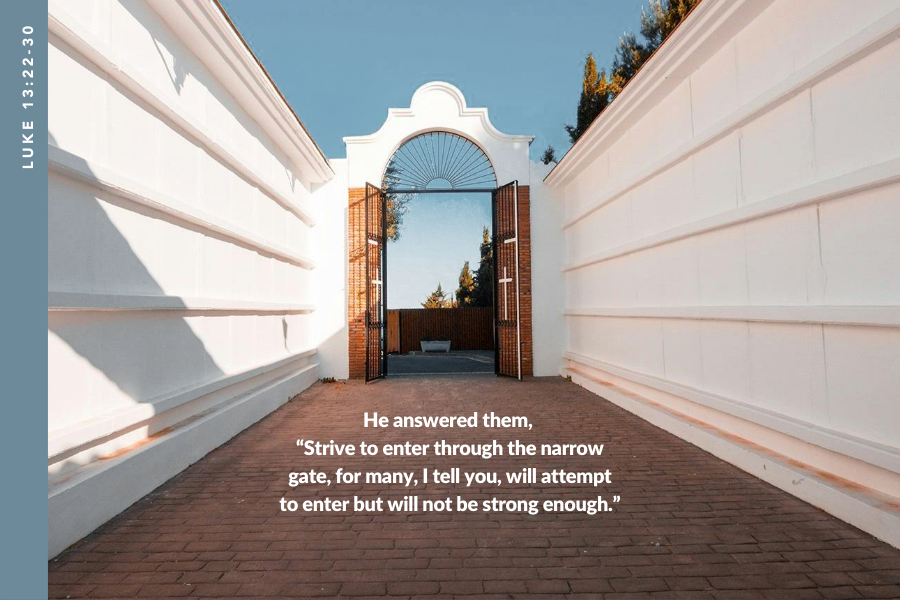
Jesus passed through towns and villages, teaching as he went and making his way to Jerusalem. Someone asked him, “Lord, will only a few people be saved?” He answered them, “Strive to enter through the narrow gate, for many, I tell you, will attempt to enter but will not be strong enough. After the master of the house has arisen and locked the door, then will you stand outside knocking and saying, ‘Lord, open the door for us.’ He will say to you in reply, ‘I do not know where you are from.’ And you will say, ‘We ate and drank in your company and you taught in our streets.’ Then he will say to you, ‘I do not know where you are from. Depart from me, all you evildoers!’ And there will be wailing and grinding of teeth when you see Abraham, Isaac, and Jacob and all the prophets in the kingdom of God and you yourselves cast out. And people will come from the east and the west and from the north and the south and will recline at table in the kingdom of God. For behold, some are last who will be first, and some are first who will be last.”

Opening Prayer: Lord Jesus, grant me true humility to know myself through your eyes and heart. Grant me your salvation.

Encountering Christ:

  1. A Time for Salvation: Images of saints from the middle ages were often painted with a skull in the background, which was a common practice to help the monks to remember the fleetingness of life. They lived with a consciousness that can be easily overrun today by constant attention to the activity at hand through cell phones, alternate realities in gaming, movies, and TV series. The unavoidable reality of death is so swept aside from our consciousness that we have a false understanding of our finality, if we think about it at all. Today’s Gospel brings it to light. There will be a time when we face the truth: are we bound for Heaven or not? This moment comes to everyone. How rooted in our consciousness is the temporality of this life and the horizon of an eternity to come?

  2. Who Will Be Recognized?: In this curious parable, Jesus offers some thought-provoking considerations. The owner of the house did not directly condemn the one who was knocking. He just didn’t recognize him, and thus would not open the door. The one standing outside requested to enter, but to no avail. He was not recognized as one who belonged inside. The request was repeated with insistence, stating that he ate and drank with the owner, but the door remained closed. Both times the owner of the house said he didn’t know who the outsider was or where he came from. This could be a case of a forgotten identity, not on the owner’s part, but on the part of the one knocking. It is a call for us to profoundly remember our origins as sons and daughters of God, and to know that we belong to him and await Heaven one day. Living in this reality—aware of where we came from and where we are going—allows us to be recognized when we are knocking at the door with the hope of entering the Kingdom of Heaven.

  3. Last and First: Jesus stated, once again, that the first will be last and the last will be first. He breaks our schemes, inviting us to an even deeper awareness of our interior motives and intentions as we live our faith. Do we walk with a false security in our own salvation, putting ourselves in first place in God’s eyes? Or are we aware that salvation is an undeserved gift? We are in dire need of God’s mercy and we wait at the end of the line, aware that entry is for those who have humbled themselves.

Conversing with Christ: Lord Jesus, grant me true humility and courage to enter the narrow door, leaving behind or making changes that are not in accord with my origin and destiny.

Resolution: Lord, today by your grace I will reflect on my life in the light of eternity, with a grateful and humble heart.

Jennifer Ristine is a consecrated woman of Regnum Christi dedicated to spiritual and faith formation through teaching, conferences, writing, and spiritual direction. While serving in Ancient Magdala she wrote Mary Magdalene: Insights from Ancient Magdala and “Nine Days with Mary Magdalene.”

August 25, 2025 – Seven Woes on the Teachers of the Law and the Pharisees

Monday of the Twenty-First Week in Ordinary Time

Matthew 23:13-22

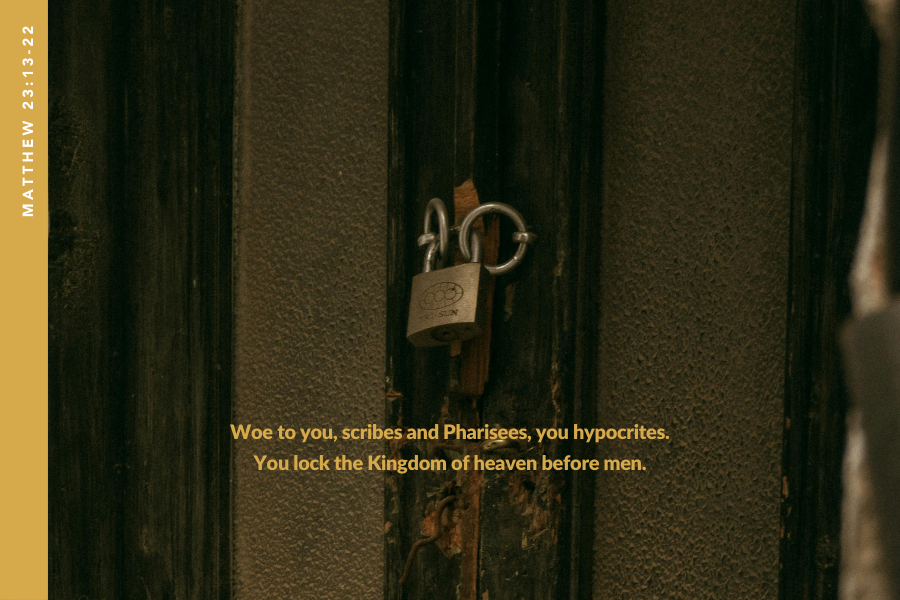
Jesus said to the crowds and to his disciples: “Woe to you, scribes and Pharisees, you hypocrites. You lock the Kingdom of heaven before men. You do not enter yourselves, nor do you allow entrance to those trying to enter. Woe to you, scribes and Pharisees, you hypocrites. You traverse sea and land to make one convert, and when that happens you make him a child of Gehenna twice as much as yourselves. Woe to you, blind guides, who say, ‘If one swears by the temple, it means nothing, but if one swears by the gold of the temple, one is obligated.’ Blind fools, which is greater, the gold, or the temple that made the gold sacred? And you say, ‘If one swears by the altar, it means nothing, but if one swears by the gift on the altar, one is obligated.’ You blind ones, which is greater, the gift, or the altar that makes the gift sacred? One who swears by the altar swears by it and all that is upon it; one who swears by the temple swears by it and by him who dwells in it; one who swears by heaven swears by the throne of God and by him who is seated on it.”

Opening Prayer: Lord Jesus, open my heart to take to heart your words and keep you at the center of my heart.

Encountering Christ:

  1. Woes: Jesus was not afraid of offering warnings. His seven woes were directed at the scribes and Pharisees of his time, but can easily serve as an examination of conscience for our days. His statements seemed very harsh as he called them out, illuminating their interior motives and misguided zeal. But for those who stand in the place of God, acting as gatekeepers to God’s holy presence, a harsh wake-up call is pedagogical. How many times in our lives do we feel that God gives us wake-up calls? Is there anything in our life that his warnings speak to?

  2. Stark Imagery: Jesus is clear about the consequences of the Pharisees’ misguided zeal. “You lock the Kingdom of heaven before men… you make him a child of Gehenna twice as much as yourselves.” What does it say about the Pharisees’ hearts? It seems that their primary goal was condemnation—far from the goal of God the Father who sent his only Son for the salvation of the world. These are very stark images that can help us revisit our interior intentions and our deepest motives for teaching, guiding, and enforcing laws.

  3. A Disciple’s Heart: The mission of the Pharisees is a noble one. Their task is to assure that the people of God follow a righteous path. To be righteous requires having the Lord at the center of our heart, free of the idols of pride, vanity, greed, etc. The first task of those responsible for guiding others is striving to live with their heart centered on the Lord. From there, they are empowered to reach out to others to show them the path to life.

Conversing with Christ: Lord Jesus, grant me a heart like yours, one that is centered on glorifying the Father and seeking you above all else. Grant that I may lead others closer to you by my example, prayer, and action.

Resolution: Lord, today by your grace I will reflect on the deepest interior motives for any zealousness I discover in myself.

Jennifer Ristine is a consecrated woman of Regnum Christi dedicated to spiritual and faith formation through teaching, conferences, writing, and spiritual direction. While serving in Ancient Magdala she wrote Mary Magdalene: Insights from Ancient Magdala and “Nine Days with Mary Magdalene.”
August 26, 2025 – More Woes

Tuesday of the Twenty-First Week in Ordinary Time

Matthew 23:23-26

Jesus said: “Woe to you, scribes and Pharisees, you hypocrites. You pay tithes of mint and dill and cummin, and have neglected the weightier things of the law: judgment and mercy and fidelity. But these you should have done, without neglecting the others. Blind guides, who strain out the gnat and swallow the camel! Woe to you, scribes and Pharisees, you hypocrites. You cleanse the outside of cup and dish, but inside they are full of plunder and self-indulgence. Blind Pharisee, cleanse first the inside of the cup, so that the outside also may be clean.”

Opening Prayer: Lord Jesus, grant me a heart like your meek and humble heart.

Encountering Christ:

  1. Know Thyself: Today’s Gospel continues with Jesus’ warnings to the scribes and Pharisees. He is offering them a most basic and essential exercise for deepening one’s life with God: an examination for self-knowledge. St. Teresa of Avila offered advice on its importance in her work The Interior Castle: “This knowledge of ourselves is so very important, that I wish you never to admit any relaxation therein, however highly elevated you may be, because while we live on this earth, nothing is more necessary for us than humility… for, in my opinion, we shall never be able to know ourselves, except we endeavor to know God. By considering his greatness, we discover our own baseness; by contemplating his purity, we discover our own filthiness, and beholding his humility, we shall discover how far we are from being truly humble… our imperfections better discovered by being contrasted with the divine perfections” (11–12).

  2. What Is Lacking?: These woes were warnings against empty actions, void of interior depth or reverence. Again and again he called them blind. What were they blind to? The depth of love and reverence to which they were called. They remained exacting and harsh in their demands, without any true spirit of honor for the Lord. What actions in our life are routine, lacking any heartfelt or intentional offering in a spirit of praise, honor, or adoration to the Lord? Let us ask the Lord to help us renew our spirit so that we may do everything out of love for him.

  3. Reverence: Reverence is a disposition of the heart that enables us to perceive the sacredness in others and in the world. It is a virtue we cultivate by having an awareness of the purpose of our actions and our relationship with God, others, and all created things. Reverence returns our motives from self-seeking to seeking God’s glory. It reorients our way of thinking, feeling, and acting. It is an awareness that we are completely dependent on God for our salvation. Reverence fills our actions with a sense of true, noble, and exalted purpose.

Conversing with Christ: Lord Jesus, open my eyes to see the interior motives of my heart. Inflame my heart with sincere love for you and a desire to please and glorify you in all I do.

Resolution: Lord, today by your grace I will reflect on the interior intentions of my heart and ask for the gift of reverence.

Jennifer Ristine is a consecrated woman of Regnum Christi dedicated to spiritual and faith formation through teaching, conferences, writing, and spiritual direction. While serving in Ancient Magdala she wrote Mary Magdalene: Insights from Ancient Magdala and “Nine Days with Mary Magdalene.”
August 27, 2025 – How Can I Become an Authentic Friend?

Memorial of Saint Monica

Matthew 23:27-32

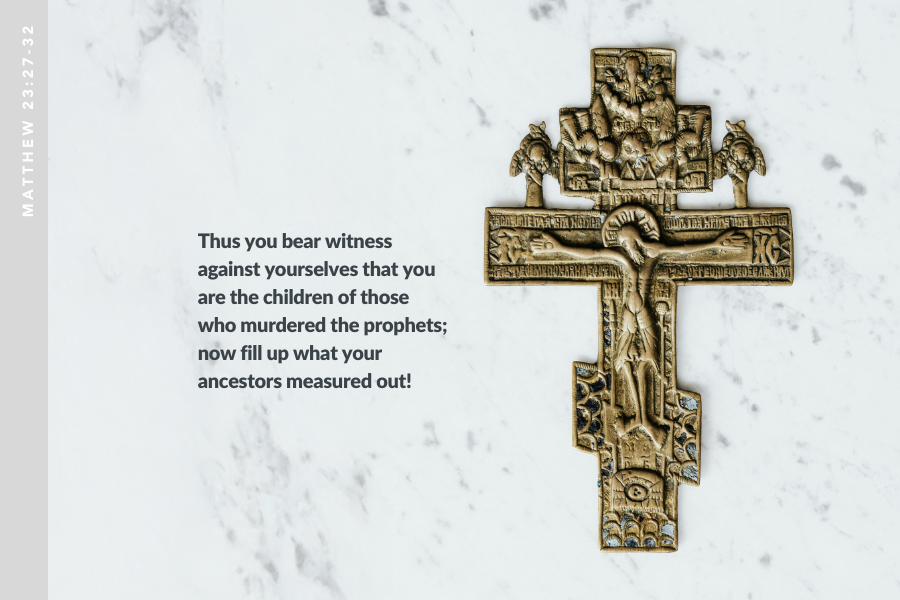
Jesus said, “Woe to you, scribes and Pharisees, you hypocrites. You are like whitewashed tombs, which appear beautiful on the outside, but inside are full of dead men’s bones and every kind of filth. Even so, on the outside you appear righteous, but inside you are filled with hypocrisy and evildoing. Woe to you, scribes and Pharisees, you hypocrites. You build the tombs of the prophets and adorn the memorials of the righteous, and you say, ‘If we had lived in the days of our ancestors, we would not have joined them in shedding the prophets’ blood.’ Thus you bear witness against yourselves that you are the children of those who murdered the prophets; now fill up what your ancestors measured out!”

Opening Prayer: Psalm 139

Lord, you have probed me, you know me…
Where can I go from your spirit?
    From your presence, where can I flee?
If I ascend to the heavens, you are there;
    if I lie down in Sheol, there you are.
If I take the wings of dawn,
    and dwell beyond the sea,
Even there your hand guides me,
    your right hand holds me fast.
If I say, “Surely darkness shall hide me,
    and night shall be my light”–
Darkness is not dark for you,
    and night shines as the day…

Lord, you have probed me, you know me.

Encountering Christ:

  1. “You Hypocrites”: Jesus mentions the word “hypocrite” seven times in this chapter of St. Matthew’s Gospel. He is deeply concerned that we will not find ourselves living a life of hypocrisy. Jesus is not scandalized by sin and imperfection, but he does speak clearly about the scourge of hypocrisy. Why? He knows how much a divided life can hurt and destroy us, and he doesn’t want to see us hurting ourselves and others in this way. He created us to be beautiful, not only on the outside but on the inside too. He wants to restore our inner unity.

  2. Living an Authentic Life: The opposite of hypocrisy is authenticity, sincerity, honesty, and integrity—living a life that flows from inner truths and convictions. Jesus longs for us to be authentic and true to ourselves. He wants leaders in our families, in our communities, and in the church to be men and women of integrity who are deeply rooted in their relationship with him and make wise choices based on their faith. This doesn’t mean he asks us to be perfect and sinless. But it does demand making time with him a priority, so we can receive the grace to live as he did. He wants us to “walk in a manner worthy of the God who calls you into his kingdom and glory,” as St. Paul preaches to the Thessalonians.

  3. Are We Allowing Grace to Transform Us?: Jesus wants authentic friends. To be a Christian means to seek a relationship with God. We are invited to allow God’s grace to penetrate our hearts and minds so that we are transformed into him. To be Christian means to be his. We will always feel the tug of our fallen nature to give in to hypocrisy and insincerity, but it is in those times that Jesus wants us to call out to him and rely on his grace through the power of prayer and the sacraments.

Conversing with Christ: Lord, I want to be a true friend, but you know how hard it is for me to make wise choices and decisions. Please make your presence felt throughout my day, in the times I set aside for prayer, and in the encounters I have with others in my family, school, or work. How much I need your grace! Yet, I need your friendship even more. Come with me now as I leave this time of prayer to begin my day.

Resolution: Lord, today by your grace I will think of your eyes upon me.

For Further Reflection: Reflect on the first reading for the day: an image of who an authentic friend of Christ is, one who leads others into the Kingdom: 1 Thessalonians 2:9-13.

Lisa Small was consecrated to God within Regnum Christi in 2001, is the Communications Director for the Consecrated Women of Regnum Christi in North America, and is the National Formation Director for the Regnum Christi Mission Corps

August 28, 2025 -The Wisdom of Vigilance

Memorial of Saint Augustine, Bishop and Doctor of the Church

Matthew 24:42-51

Jesus said to his disciples: “Stay awake! For you do not know on which day your Lord will come. Be sure of this: if the master of the house had known the hour of night when the thief was coming, he would have stayed awake and not let his house be broken into. So too, you also must be prepared, for at an hour you do not expect, the Son of Man will come. Who, then, is the faithful and prudent servant, whom the master has put in charge of his household to distribute to them their food at the proper time? Blessed is that servant whom his master on his arrival finds doing so. Amen, I say to you, he will put him in charge of all his property. But if that wicked servant says to himself, ‘My master is long delayed,’ and begins to beat his fellow servants, and eat and drink with drunkards, the servant’s master will come on an unexpected day and at an unknown hour and will punish him severely and assign him a place with the hypocrites, where there will be wailing and grinding of teeth.”

Opening Prayer: Lord Jesus, grant me true vigilance of heart, not out of fear, but out of love.

Encountering Christ:

  1. The Power of Contemplation: In these verses, Jesus was calling his listeners to consider life from an eternal vantage point. For those who refused to keep the vision of eternity in mind and prepare their hearts accordingly, Jesus offered powerful imagery of the consequences: “The master of that servant will come on a day when he does not expect him and at an hour he is not aware. He will cut him to pieces and assign him a place with the hypocrites, where there will be wailing and gnashing of teeth.” Like Jesus, St. Ignatius also thought it important that we face the harsh reality of death. In his spiritual exercises he suggested a contemplation of Hell where the retreatant asks for an “interior sense of the pain which the damned suffer, in order that, if, through my faults, I should forget the love of the Eternal Lord, at least the fear of the pains may help me not to come into sin” (Spiritual Exercises, #65). We conquer our fear with a confident awareness that God’s mercy is much greater when we open ourselves in preparedness for it.

  2. Hopeful Anticipation: Jesus spoke of the coming of the Son of Man. The early Christians anticipated an imminent return of the Lord, when he would bring all to fulfillment and all would be under his reign. Rather than a fear of condemnation, it fostered a vigilant hope of the promise to come. They anticipated his coming like waiting for a friend to return after a very long absence. Two thousand years later, we need to tap into this same expectation, living with greater faith and hope in the mystery that Jesus promised to fulfill. St. Paul exhorted, “… that you are not lacking in any spiritual gift as you wait for the revelation of our Lord Jesus Christ. He will keep you firm to the end, irreproachable on the day of our Lord Jesus Christ. God is faithful, and by him you were called to fellowship with his Son, Jesus Christ our Lord” (1 Cor 1:7-9).

  3. Recapitulation, Now and to Come: The promise that we await is one in which Christ will unify everything and everyone by reigning supreme. In this life, we strive to participate in the realization of this plan by being vigilant in our own hearts. Does he reign there? Is charity the guiding principle of our life? Does our friendship with Christ inform all that we think, say, and do? St. Paul reminds us of the graces we possess now and the gift which is to come. Until then, we live the tension of allowing God to work out his redemption in us. “In him we have redemption by his blood, the forgiveness of transgressions, in accord with the riches of his grace that he lavished upon us. In all wisdom and insight, he has made known to us the mystery of his will in accord with his favor that he set forth in him as a plan for the fullness of times, to sum up all things in Christ, in heaven and on earth” (Eph 1:7-10).

Conversing with Christ: Lord Jesus, grant that you may reign in my heart and, reigning there, that you may sustain me in hopeful anticipation of your coming.

Resolution: Lord, today by your grace I will consider whether charity is the guiding principle of my life.

For Further Reflection: “Spread love everywhere you go: first of all in your own house. Give love to your children, to your wife or husband, to a next door neighbor… Let no one ever come to you without leaving better and happier. Be the living expression of God’s kindness; kindness in your face, kindness in your eyes, kindness in your smile, kindness in your warm greeting” (Mother Teresa).

Jennifer Ristine is a consecrated woman of Regnum Christi dedicated to spiritual and faith formation through teaching, conferences, writing, and spiritual direction. While serving in Ancient Magdala she wrote Mary Magdalene: Insights from Ancient Magdala and “Nine Days with Mary Magdalene.”
 

August 29, 2025 – The Need for Discernment

Memorial of the Passion of Saint John the Baptist

Mark 6:17-29

Herod was the one who had John the Baptist arrested and bound in prison on account of Herodias, the wife of his brother Philip, whom he had married. John had said to Herod, “It is not lawful for you to have your brother’s wife.” Herodias harbored a grudge against him and wanted to kill him but was unable to do so. Herod feared John, knowing him to be a righteous and holy man, and kept him in custody. When he heard him speak he was very much perplexed, yet he liked to listen to him. She had an opportunity one day when Herod, on his birthday, gave a banquet for his courtiers, his military officers, and the leading men of Galilee. Herodias’ own daughter came in and performed a dance that delighted Herod and his guests. The king said to the girl, “Ask of me whatever you wish and I will grant it to you.” He even swore many things to her, “I will grant you whatever you ask of me, even to half of my kingdom.” She went out and said to her mother, “What shall I ask for?” She replied, “The head of John the Baptist.” The girl hurried back to the king’s presence and made her request, “I want you to give me at once on a platter the head of John the Baptist.” The king was deeply distressed, but because of his oaths and the guests he did not wish to break his word to her. So he promptly dispatched an executioner with orders to bring back his head. He went off and beheaded him in the prison. He brought in the head on a platter and gave it to the girl. The girl in turn gave it to her mother. When his disciples heard about it, they came and took his body and laid it in a tomb.

Opening Prayer: Lord Jesus, as I reflect on your words today, penetrate my heart with your love so that I can put aside all loves that don’t lead to you.

Encountering Christ:

  1. Herod Was Greatly Perplexed: These simple words of Scripture are indicative of the need for discernment. What flustered Herod? Something resonated within him that did not sit well. John’s words provoked those sentiments or affective movements. Inwardly Herod found himself at a crossroad between attraction and resistance. John, the prophet of God, spoke to the core existential inclination of Herod’s heart. He, too, was called by God to a life of holiness and goodness, a participation in life itself. And yet, the consequences of his chosen path grated upon his moral nerve. Herod was troubled because he did not think it possible or desirable to make the break from sin and follow that barely kindled joy that resonated when truth and life are revealed.

  2. Herodias: Herodias saw John as an obstacle to her anticipated achievements. Like the enemy of our soul, she stopped at nothing to thwart the movement of Herod’s heart towards God’s truth and life. She was vigilant, always looking for opportunities to present themselves to further her ambition. Even her own daughter played into Herodias’s hands. By her daughter’s dance, Herodias exploited what was natural to Herod, his desire to please and his pride, to remove John’s influence from their lives.

  3. John the Baptist: John was an anomaly among the people of his time. While seen as crazy by some, and a thorn in the side to others, he attracted those who were sincerely seeking a path of truth and righteousness. Imprisonment did not stop him from speaking truth to the situations at hand. And in the end, it cost him his head, literally. He was beheaded and his head was brought in on a platter. It is a gross display of irreverence for a man who spoke of the things of God. Despite this end, his message still resonates today to those who will open their ears to listen without resistance. John continues reminding us to prepare a way for the Lord. Our task is to recognize any interior resistance and reject it so as to grow in the grace of God.

Conversing with Christ: Lord Jesus, grant me true discernment to detect the interior movements that come from my original call to holiness and love. Grant that I may be vigilant and name and resist anything that stands in the way of a true surrender to you.

Resolution: Lord, today by your grace I will listen interiorly for any resistance I feel toward living greater faith, hope, and charity.

Jennifer Ristine is a consecrated woman of Regnum Christi dedicated to spiritual and faith formation through teaching, conferences, writing, and spiritual direction. While serving in Ancient Magdala she wrote Mary Magdalene: Insights from Ancient Magdala and “Nine Days with Mary Magdalene.”
August 30, 2025 – Good and Faithful Servant

Saturday of the Twenty-First Week in Ordinary Time

Matthew 25:14-30

Jesus told his disciples this parable: “A man going on a journey called in his servants and entrusted his possessions to them. To one he gave five talents; to another, two; to a third, one—to each according to his ability. Then he went away. Immediately the one who received five talents went and traded with them, and made another five. Likewise, the one who received two made another two. But the man who received one went off and dug a hole in the ground and buried his master’s money. After a long time the master of those servants came back and settled accounts with them. The one who had received five talents came forward bringing the additional five. He said, ‘Master, you gave me five talents. See, I have made five more.’ His master said to him, ‘Well done, my good and faithful servant. Since you were faithful in small matters, I will give you great responsibilities. Come, share your master’s joy.’ Then the one who had received two talents also came forward and said, ‘Master, you gave me two talents. See, I have made two more.’ His master said to him, ‘Well done, my good and faithful servant. Since you were faithful in small matters, I will give you great responsibilities. Come, share your master’s joy.’ Then the one who had received the one talent came forward and said, ‘Master, I knew you were a demanding person, harvesting where you did not plant and gathering where you did not scatter; so out of fear I went off and buried your talent in the ground. Here it is back.’ His master said to him in reply, ‘You wicked, lazy servant! So you knew that I harvest where I did not plant and gather where I did not scatter? Should you not then have put my money in the bank so that I could have got it back with interest on my return? Now then! Take the talent from him and give it to the one with ten. For to everyone who has, more will be given and he will grow rich; but from the one who has not, even what he has will be taken away. And throw this useless servant into the darkness outside, where there will be wailing and grinding of teeth.’”

Opening Prayer: Lord Jesus, grant that I may come to a true knowledge of you and recognize the gifts that you give me to develop and put at the service of others.

Encountering Christ:

  1. Concept of God: Jesus’ parable of the gold talents offers us perspectives on different attitudes towards God and his gifts. Three men were offered gold, each one doing with it what he thought best. The one who had much invested it and brought back a return. The one who had just two did the same. But the man with one mere gold talent hid it out of fear in order to return it exactly as given. Perhaps, in the depths of each man’s heart lay a particular concept of God. The man with one gold talent saw the Lord as exacting, someone to be feared. He treated what had been received by God not as a gift, but as a burden to not be lost in case he be punished. By contrast, the others saw what was given as a gift. They willingly shared in the generosity of their master and invested it with trust in the giver. How do we perceive God and the gifts that he gives us?

  2. My Gold Talents: Like the men in today’s parable, we have been made stewards of many gifts by God’s graciousness. Here is a list of some talents of which we are stewards: creation, parents, spouse, children, friends, parish members, coworkers, material items acquired over time, work, time, money, space, health, physical and mental energy, education, knowledge, skills, human qualities, spiritual gifts, and even suffering. May we praise the Lord for each one and ask how he would like us to use them for his greater honor and glory.

  3. The Promise: Jesus stated, “For to everyone who has, more will be given and he will grow rich.” This mystery is understood only in the context of our relationship with God. He is magnanimous and desirous of our participation in his very life. He wants to shower upon us every good gift. But he cannot give where the door is closed to his giving. Fear limits his action and closes the door to participating in his bounty. When we put aside our fear–fear of change, fear of performing well, fear of what others will think–we open ourselves to collaborate with God and we receive all the gifts we need to be his disciples and friends.

Conversing with Christ: Lord Jesus, thank you for the tremendous gift of your friendship. All that you have is mine and all that I have is yours. Let me return it to you, having invested well the gifts you have given me.

Resolution: Lord, today by your grace I will reflect on the gifts I have and how well I am a loving and grateful steward.

Jennifer Ristine is a consecrated woman of Regnum Christi dedicated to spiritual and faith formation through teaching, conferences, writing, and spiritual direction. While serving in Ancient Magdala she wrote Mary Magdalene: Insights from Ancient Magdala and “Nine Days with Mary Magdalene.”

August 31, 2025 – Jesus’ Criteria

Twenty-Second Sunday in Ordinary Time

Luke 14:1, 7-14

On a sabbath Jesus went to dine at the home of one of the leading Pharisees, and the people there were observing him carefully. He told a parable to those who had been invited, noticing how they were choosing the places of honor at the table. “When you are invited by someone to a wedding banquet, do not recline at table in the place of honor. A more distinguished guest than you may have been invited by him, and the host who invited both of you may approach you and say, ‘Give your place to this man,’ and then you would proceed with embarrassment to take the lowest place. Rather, when you are invited, go and take the lowest place so that when the host comes to you he may say, ‘My friend, move up to a higher position.’ Then you will enjoy the esteem of your companions at the table. For every one who exalts himself will be humbled, but the one who humbles himself will be exalted.” Then he said to the host who invited him, “When you hold a lunch or a dinner, do not invite your friends or your brothers or your relatives or your wealthy neighbors, in case they may invite you back and you have repayment. Rather, when you hold a banquet, invite the poor, the crippled, the lame, the blind; blessed indeed will you be because of their inability to repay you. For you will be repaid at the resurrection of the righteous.”

Opening Prayer: Lord Jesus, let me know your heart, which is meek, humble, and generous; knowing it, grant me the grace to love and imitate you.

Encountering Christ:

  1. Being a Guest: Jesus offered what appears to be very sagacious human advice. It is as though he was suggesting a strategy for making sure we get places of honor. But underlying his words is an important instruction for us. Every time we attend Mass, we are guests at the wedding banquet. The Eucharist is the foretaste of the eternal wedding feast to come in Heaven. Do we come forward for Communion as though it is our right? Or do we approach with gratitude, reverence, and humility, aware that we are special guests invited to partake of this great gift, Our Lord, Body, Blood, Soul, and Divinity?

  2. Being a Host: Jesus addressed the host of his dinner party with a challenge to invite, not the rich, but those who could not repay him. His words are an invitation to us to consider how often we extend ourselves in hospitality or friendship to others. Does complacency keep us within a circle of friends who are comfortable? Or do we reach out to people on the margins of our life, in the parish, at work, at school? How may the Lord be inviting us to give of ourselves in unexpected ways?

  3. Repayment: To serve those who cannot repay us is what Ignatius of Loyola would call a spirit of indifference. Far from not caring, it places the heart in a position of vigilance, seeing everything as God’s gift to receive and share with others. It frees the heart of egotistic possessing and clamoring after what promotes our own well-being and self-satisfaction. Once again Jesus promised a reward to those who were good stewards and hosts. He said that payment would come at the resurrection of the righteous. The righteous person is one who has a vision of things as they are and has established an honest relationship with God, others, and all of creation. The righteous see everything at their service, while nothing belongs directly to them. For this reason, they are capable of being generous, because they are guided by the beneficent heart of the Lord.

Conversing with Christ: Lord Jesus, you are the giver of all good things. Help me to see anew, with your eyes, so that I may establish a right relationship towards you, others, and all created things. Grant that I may have a heart like yours, humble and capable of living in the truth about who I am in relation to all things.

Resolution: Lord, today by your grace I will reflect on my attitudes about entering into relationships with you, others, and created things.  

Jennifer Ristine is a consecrated woman of Regnum Christi dedicated to spiritual and faith formation through teaching, conferences, writing, and spiritual direction. While serving in Ancient Magdala she wrote Mary Magdalene: Insights from Ancient Magdala and “Nine Days with Mary Magdalene.”

Scroll to Top

Events

Looking for another country?

Contact Regnum Christi near you

News & Resources

News & Resources

The Regnum Christi Mission

The Regnum Christi Identity

Alex Kucera

Atlanta

Alex Kucera has lived in Atlanta, GA, for the last 46 years. He is one of 9 children, married to his wife Karmen, and has 3 girls, one grandson, and a granddaughter on the way. Alex joined Regnum Christi in 2007. Out of the gate, he joined the Helping Hands Medical Missions apostolate and is still participating today with the Ghana Friendship Mission.

In 2009, Alex was asked to be the Atlanta RC Renewal Coordinator for the Atlanta Locality to help the RC members with the RC renewal process. Alex became a Group Leader in 2012 for four of the Atlanta Men’s Section Teams and continues today. Running in parallel, in 2013, Alex became a Team Leader and shepherded a large team of good men.

Alex was honored to be the Atlanta Mission Coordinator between 2010 to 2022 (12 years), coordinating 5-8 Holy Week Mission teams across Georgia. He also created and coordinated missions at a parish in Athens, GA, for 9 years. Alex continues to coordinate Holy Week Missions, Advent Missions, and Monthly missions at Good Shepherd Catholic Church in Cumming, GA.

From 2016 to 2022, Alex also served as the Men’s Section Assistant in Atlanta. He loved working with the Men’s Section Director, the Legionaries, Consecrated, and Women’s Section leadership teams.

Alex is exceptionally grateful to the Legionaries, Consecrated, and many RC members who he’s journeyed shoulder to shoulder, growing his relationship with Christ and others along the way. He knows that there is only one way, that’s Christ’s Way, with others!