Regnum Christi Spirituality Center Uncle Eddy

First Martyrs of the Church of Rome

Dear Romeo, Funny that your folks named you after the Shakespearean tragic hero, whose name just happens to coincide with today’s saints (you should have heard what they were going to name you – thanks to good old Uncle Eddy you don’t have to carry an extra ink cartridge around so you can sign your name “Durostrumorrus”… it’s a long story).  The only difference is that Shakespeare’s impetuous and passionate youth is famous, while many of the first martyrs of Rome (those who were martyred under Emperor Nero, after he attributed the terrible fire that devastated the city to Christian malice) are anonymous – at least on this side of eternity. Oh, wait a minute, I guess there is another difference as well.  Romeo privately took his own life, because he was unable to suffer the tortures that his family’s sinful quarrels inflicted upon his impassioned heart. Whereas the martyrs of Rome died publicly, covered with tar and burned as living torches, or wrapped in animal skins and thrown to the lions or hunted for sport, simply because they refused to pay allegiance to any god except the One God, Jesus Christ.   I guess you can say that love was at the root of both deaths: Romeo loved Juliet too much to endure life without her, and the martyrs loved Jesus too much to abandon him to save their lives.  And whose footsteps will you follow in, my dear nephew? What love will you live and die for? What will you be willing to suffer in order to be faithful to your Lord? Will his love keep you strong in the face of life’s challenges (which, if I‘m not mistaken, you have already begun to face)?  Or will you tie the meaning of your life to something perishable, something that someday you will lose: money, fame, pleasure, a relationship? You are not much older than Shakespeare’s Romeo, and you are the same age as many of the Roman martyrs; it could be that your time will soon come to make a choice.  As you ready yourself, count on my prayers. God bless, Uncle Eddy

First Martyrs of the Church of Rome Read More »

WM_Martyrs

Over the horizon

Dear Friends,


June 30th on the liturgical calendar celebrates a memorial for the first martyrs of the Holy Roman Church.

The witnesses died for the faith under the emperor Nero, who blamed them for starting a fire that ravaged half of Rome.

Never mind that Nero was suspected of being the one who started the blaze. The Christians were an easy target and quickly became scapegoats.

It wouldn’t be the last time that Christians were persecuted in Rome—or elsewhere in the world, for that matter.

Persecution is part of the DNA of Christianity. A genuinely Christian life goes against the grain of the world.

It leaves the world feeling uncomfortable because it challenges its values—and pricks more than a few consciences. “The light came into the world, but people preferred darkness to light, because their works were evil” (Jn 3:19).

Persecution and even martyrdom can be signs of a healthy Christian community, in contrast to the not-so-healthy wider culture.

If ever we feel ostracized because of our Catholic faith, that can be a reason, paradoxically, for joy. For Jesus told us, “If the world hates you, realize that it hated me first” (Jn 15:18).

Our Lord’s words are sobering: To imitate him invites opposition from the world.

If that seems intimidating, it might be a theme worth pondering in prayer. Our retreat guide on Heroic Youth might be a good place to start.

It could help people of all ages to recall that we are travelers in a fallen world and shouldn’t expect perfect comfort here.

True happiness, with our Creator and all the saints, lies on the other side of a higher horizon.

In Christ,

Father Edward McIlmail, LC

Ask a Priest contributor

Over the horizon Read More »

Must We Be Perfect to Offer Fraternal Correction?

Q: I was reading the Summa Theologica entry on fraternal correction and I’m a bit confused. If we struggle with any sin whatsoever, does that make us ineligible to fraternally correct someone? I always thought that if we actively struggled with a certain sin, we were in no position to correct someone for that same sin, but the entry makes it seem like anyone who’s a sinner whatsoever is in no place to correct. But who can then? Does it have to do with whether you’re in a state of grace? For example, I found out that my younger brother has cheated on his fiancée, and he and his mistress wanted to stay at my house. I sat him down and told him that that was unacceptable for him to bring her into my home, and that he needed to come clean to his fiancée. But I will readily admit that I have my own sins I’m guilty of, such as struggling with alcohol overuse and being lazy at work. Does this mean that I sinned in having tried to correct my brother? — Michael

Answered by Fr. Edward McIlmail, LC:

Fraternal correction can be an important part of Christian life.

The Catechism in No. 1435 says:

“Conversion is accomplished in daily life by gestures of reconciliation, concern for the poor, the exercise and defense of justice and right, by the admission of faults to one’s brethren, fraternal correction, revision of life, examination of conscience, spiritual direction, acceptance of suffering, endurance of persecution for the sake of righteousness. Taking up one’s cross each day and following Jesus is the surest way of penance.”

Notice that “admission of faults to one’s brethren” comes right before mention of fraternal correction.

The key here is balance. We need to be willing to admit our mistakes. And we don’t need to be perfect in order to correct one another.

If perfection were required, parents could never discipline their children, nor could spouses ever correct each other. Nor for that matter could any priest or bishop correct his flock.

We are all a work in progress, and some of that progress will depend on others’ calling us out at times.

We need to discern when and how to offer fraternal correction. We need to be humble and recognize our own faults; this can help us bring up an issue with someone charitably and prudently.

In the case of your brother, it was good that you challenged him for his infidelity. If he is cheating now, that might be a warning sign that he is not ready for marriage. That is a bigger issue that needs attention.

Must We Be Perfect to Offer Fraternal Correction? Read More »

26-06-30-DM

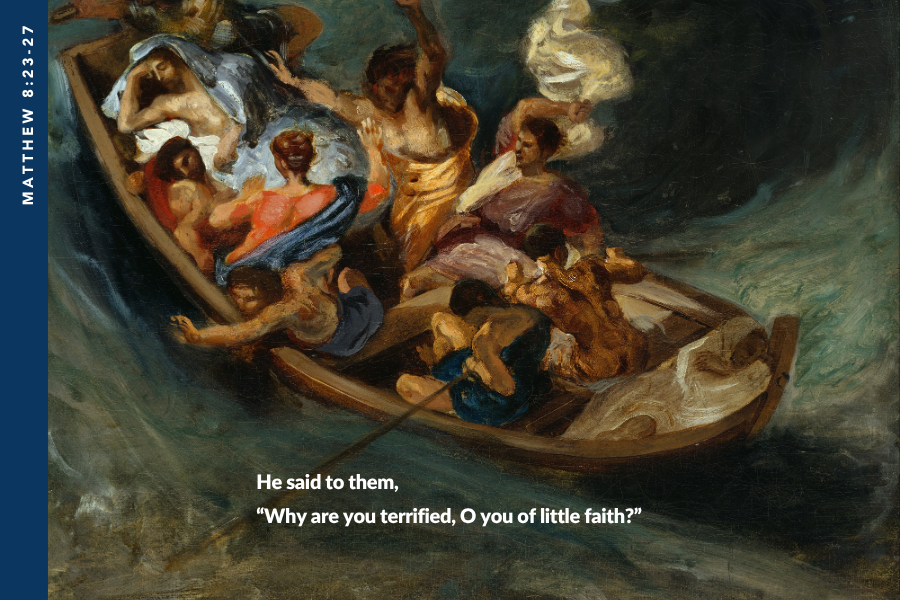
June 30, 2026 – Lessons in a Storm

Tuesday of the Thirteenth Week in Ordinary Time


Matthew 8:23-27

As Jesus got into a boat, his disciples followed him. Suddenly a violent storm came up on the sea, so that the boat was being swamped by waves; but he was asleep. They came and woke him, saying, “Lord, save us! We are perishing!” He said to them, “Why are you terrified, O you of little faith?” Then he got up, rebuked the winds and the sea, and there was great calm. The men were amazed and said, “What sort of man is this, whom even the winds and the sea obey?”

Opening Prayer: I know you are here with me right now, Lord. I know you are thinking of me and eager to give me the graces I need to live this day to the full. I know you are looking at me with a gaze of personal and determined love. You created me, Lord, and you redeemed me, and you accompany me each moment through your Holy Spirit. Please open my mind and my heart so that I can receive the light and strength of your grace through this time I spend with you in prayer.

Encountering Christ:

  1. The Opportunities Storms Give Us: Why does Jesus permit storms in our lives? He didn’t have to let that storm come up as he and his Apostles were making their way across the sea. He shows clearly later on that he has power over the forces of nature at work in the storm. Why didn’t he exercise that power ahead of time, so that the storm wouldn’t even come up in the first place? At least one reason for permitting storms is that they give us opportunities to get to know Jesus better. At the end of this passage, after the crisis is over, St. Matthew tells us: “The men were amazed and said, ‘What sort of man is this, whom even the winds and the sea obey?’” Up to this point, Christ’s followers had witnessed amazing things: marvelous healings, dramatic exorcisms, and powerful preaching. This experience, however, shows them another side of Christ’s lordship: his power over the forces of nature. Their understanding, their knowledge of Jesus, still had room to grow. Maybe Jesus permitted this storm precisely so that through the experience, and through what he would show them in that experience, they would come to know him better. Maybe that’s why Jesus permits storms in our lives too. Somehow, being in a boat with Jesus as the storm rages on gives us a chance to know him more fully, and thus to love him more deeply.


  2. The Mystery of Faith: When his disciples wake him to share their panic with him, Jesus responds with a strange question: “Why are you terrified, O you of little faith?” The disciples must have looked at him as if he were crazy. Or maybe they looked at each other questioningly, wondering if their Lord had lost his marbles. A good number of Christ’s followers were fishermen, familiar with boats and storms. And those expert navigators were fearing for their very lives in the midst of this storm: “Lord, save us!” they cried out, “We are perishing!” From a normal, human standpoint their situation was clearly and obviously dire. But Jesus doesn’t chastise them for failing to make an accurate human evaluation of the situation. He challenges them on a different level, the level of All his teaching, all his miracles—they have had the single purpose of stirring up in his followers faith. We must encounter Jesus and believe in him, trust in him. Only then can his grace penetrate and transform us. This is because God is a real person, and so our relationship with him must be based on something besides mathematical computations. We must throw in our lot with him, believing and trusting, as we must do with any friend if we want the friendship to grow and flourish. Jesus has given us all many direct and indirect experiences of his goodness and his trustworthiness. How deeply have they nourished our faith? Our reaction during life’s storms can tell us.


  3. In the Same Boat: Jesus and his disciples were in the same boat. Jesus isn’t a Savior who redeems us from a distance. Jesus wants to be close to us. The whole Christian mystery broadcasts that amazing truth. In the Incarnation God himself becomes a human being and walks with us here in this fallen world. On the Cross, God himself absorbs into his own body and soul all the many types of suffering that we can’t seem to avoid in our journey through life. He travels the dusty roads of Galilee with his disciples. He speaks with Nicodemus around the fire at night. He touches lepers and weeps with those who mourn. In Jesus God shows us that he truly is with us. He is in our boat. Jesus is “Emmanuel”—God with us. The problem, from our perspective, is that we so easily forget this. The storms of life throw us into a panic. The noise of life drowns out the voice of truth. The distractions of life obstruct our view of the bigger picture as God has revealed it. When will I decide to live according to the truths that I believe? When will I decide to accept the truth of God’s unlimited, unconditional, unmitigated love for me and interest in my life? Will it be today?

Conversing with Christ: Thank you for coming into my boat, Lord. Thank you for caring enough about me to walk with me and protect and enlighten me. Today I just want to savor this gift of your presence. I am never alone. Even the storms that batter me are part of your plan for my life. Nothing can separate you from me, because you are all in for me. Please teach me, Lord, to live with a greater and greater awareness of your presence. Grant me the grace never to forget that even when the storms rage, you are with me in my boat, and with a mere word you can rebuke the winds and calm the sea. You are my Lord and my brother, and I never want to leave your side.

Resolution: Lord, today by your grace I will put some kind of faith-reminder (crucifix, image, rosary, post-it with a verse) in a place where I tend to feel more acutely the stresses and anxieties of life (desk, car, kitchen). Whenever I see it, I will make a little act of faith, telling Jesus that I do believe in him and asking him to increase my faith.

For Further Reflection: Navigating Stormy Seas: A Do-It-Yourself Retreat on Jesus Calming the Storm

Fr. John Bartunek, LC, is an author, speaker, and Creative Director at RCSpirituality, an online spirituality center providing a variety of resources for spiritual growth.

June 30, 2026 – Lessons in a Storm Read More »

Regnum Christi Spirituality Center Uncle Eddy

The Solemnity of St Peter and St Paul

Dear Pippin, Can I bare my heart to you?  I think it’s safe, since you probably won’t read this till after midnight, as your downing a couple Twinkies and gulping another can of Jolt (you see, I know why you find it so hard to get up in the mornings and spend a little time in prayer; a few simple adjustments to your schedule and diet would do wonders for your prayer life).  It’s just that today is June 29th.  June 29th.  For almost 2000 years June 29th has been the day that Christians commemorate the final sacrifice of the two pillars of the early Church, Peter and Paul.  And I can remember as if it were yesterday the glorious celebrations that they are having today in the Vatican. The Papal Mass, the crowing of the statue of St Peter in the Basilica, the teeming flocks of pilgrims giving praise to God for the great gift of the Church, and the crisp and delicious Roman breeze of early summer making every pilgrim’s face smile.  How I wish I could be there. How I wish I could join my voice to theirs, extending the unbroken testimony of God’s faithfulness into another year. That’s what it’s all about, really, God’s faithfulness.  He promised that the gates of Hell would not prevail against the Church built on the rock foundation of Peter, Prince (from the Latin for “first”) of the Apostles.  (Funny how last century’s excavations showed incontrovertibly that Peter’s tomb is indeed right under his Basilica’s dome – an architectural symbol of the truth of Christ’s promise.)  And though Peter had to follow the Lord’s footsteps and die the death of crucifixion (although he was crucified upside down, upon his own request – he felt unworthy to be crucified as Jesus had been), his faith did not fail.   And though Paul, a latecomer to the Apostolic ranks (remember how he was the Jews’ top anti-Christian persecutor until our Lord appeared to him on the road to Damascus?), had to suffer, as he explained, “still more, with far greater labors, far more imprisonments, far worse beatings, and numerous brushes with death. Five times at the hands of the Jews I received forty lashes minus one. Three times I was beaten with rods, once I was stoned, three times I was shipwrecked, I passed a night and a day on the deep; on frequent journeys, in dangers from rivers, dangers from robbers, dangers from my own race, dangers from Gentiles, dangers in the city, dangers in the wilderness, dangers at sea, dangers among false brothers; in toil and hardship, through many sleepless nights, through hunger and thirst, through frequent fastings, through cold and exposure. And apart from these things, there is the daily pressure upon me of my anxiety for all the churches,” (2 Corinthians 11:25) even so, at the end of his life, just before he was beheaded, he could say what I so dearly hope to be able to say when my own last day comes: “I have fought the good fight; I have finished the race; I have redeemed my pledge; I look forward to the prize that is waiting for me, the prize I have earned.  The Lord, the judge whose award never goes amiss, will grant it to me when that day comes; to me, yes, and all those who have learned to welcome his appearing.” (2 Timothy 4:6-8)… Through the faithful love of these two saints, and the many other saints (canonized and not canonized) who have kept the faith in an unbroken chain of fidelity to God’s will since the very beginning, God has made known his undying and untiring love.  Yes, it would be nice to be there today, to celebrate it at the geographical heart of things. But I do not mourn, for I am here at my own post, watching and praying in defense of the eternal Kingdom. And I hope you are doing the same. Love, Uncle Eddy

The Solemnity of St Peter and St Paul Read More »

26-06-29-DM

June 29, 2026 – Faithful Forever

Solemnity of Saints Peter and Paul, Apostles


Matthew 16:13-19

When Jesus went into the region of Caesarea Philippi he asked his disciples, “Who do people say that the Son of Man is?” They replied, “Some say John the Baptist, others Elijah, still others Jeremiah or one of the prophets.” He said to them, “But who do you say that I am?” Simon Peter said in reply, “You are the Christ, the Son of the living God.” Jesus said to him in reply, “Blessed are you, Simon son of Jonah. For flesh and blood has not revealed this to you, but my heavenly Father. And so I say to you, you are Peter, and upon this rock I will build my Church, and the gates of the netherworld shall not prevail against it. I will give you the keys to the Kingdom of heaven. Whatever you bind on earth shall be bound in heaven; and whatever you loose on earth shall be loosed in heaven.”

Opening Prayer: As I come before you today, Lord, I thank you for all the gifts you have given me. I thank you especially for the gift of my faith, for bringing me into your very family, the Church, and strengthening me day after day, year after year with all the graces of the sacraments. Thank you for being with me right now. I turn to you to give you praise and to receive whatever grace you see fit to give me today.

Encountering Christ:

  1. Peter the Rock: This isn’t the only time Jesus changes Simon’s name to Peter. In the Gospel of John, the very first time Jesus meets Simon he says to him, “‘You are Simon the son of John; you will be called Cephas’ (which is translated Peter)” (Jn 1:42). Such a solemn changing of someone’s name is always deeply significant whenever it happens in the Bible. It happened with Abraham and Sarah; it happened with Jacob; it happens here with Peter. Jesus changes his name to reflect his mission in salvation history. Jesus gave Peter a special role of leadership in his band of Apostles. His presence and his ministry would be the guarantee of the Church’s authenticity after Jesus ascended back to heaven. And that guarantee would continue throughout the centuries through what has come to be known as “the Petrine ministry,” that is, the papacy. Peter concluded his life serving as the bishop of Rome, the city where he was martyred around the year 64 A.D. Since then, the bishop of Rome (the pope) has been the figure through which the Holy Spirit has continued exercising Peter’s own ministry of unity and universality in Christ’s Catholic Church. The papacy is the continuation throughout history of Peter’s special leadership role in the Church. And the promise Jesus makes that the gates of hell will not prevail against the Church, that the Church will faithfully guard and spread the Gospel until Jesus comes again, is linked to this Petrine ministry: “You are Peter, and upon this rock I will build my Church.” This is Our Lord’s plan for his followers. Because he has been faithful to it, Christians like you and me have always had trustworthy access to Christ’s truth and grace through the Gospel and the sacraments—and we always will. Thanks be to God!


  2. The Church: Throughout history, many worldly forces have tried to destroy Christ’s Church. In fact, efforts to destroy the Catholic Church are a constant factor in human history since the time of Christ. First there was the Roman Empire. Then there were a series of Muslim empires. Then in more modern times Napoleon himself had the pope kidnapped in order to try to absorb the Catholic Church into his empire. The Nazis and Communists both targeted the Catholic Church in the twentieth century. And in addition to these attacks from the outside, the forces of evil have ceaselessly sought to undermine the Church from within—through heresies, divisions, and corruption. And yet, more than twenty centuries after Jesus made this promise that his Church would stand strong forever and never fail in its mission to roll back the forces of darkness, that much maligned and suffering Church is still the primary moral and spiritual compass of the world. God is faithful. We can count on him. Truly.


  3. Apostles of Rome: Today the Church not only contemplates the figure of St. Peter and God’s truly amazing fidelity as shown through his promise to protect the Church through the Petrine ministry. We also contemplate the figure of St. Paul, who was also martyred in Rome around the year 64 A.D. Together, Peter and Paul are considered the Apostles of Rome. St. Paul’s ministry complemented St. Peter’s. Peter’s ministry was the solid rock which gave unity and universality to the Gospel wherever it was preached. Paul’s ministry set out to preach that Gospel to the far corners of the world. As he describes it in today’s second reading: “The Lord stood by me and gave me strength, so that through me the proclamation might be completed and all the Gentiles might hear it.” St. Paul himself showed reverence for the Petrine ministry when he went to consult with St. Peter and the other Apostles in Jerusalem about his own mission in the Church. He describes how, “I presented to them the Gospel that I preach to the Gentiles—but privately to those of repute—so that I might not be running, or have run, in vain… and when they recognized the grace bestowed upon me, James and Cephas [Peter] and John, who were reputed to be pillars, gave me and Barnabas their right hands in partnership, that we should go to the Gentiles and they to the circumcised” (Gal 2:2, 9). St. Paul shows here his respect for the hierarchical structure of the Church as it was established by Jesus. But he also shows us the human side of the Church. He never rebelled against the divine authority present in the Petrine ministry, but he did courageously challenge Peter the man to live more coherently with the doctrine that he was teaching: “And when Cephas came to Antioch, I opposed him to his face because he clearly was wrong… And the rest of the Jews [also] acted hypocritically along with him, with the result that even Barnabas was carried away by their hypocrisy” (Gal 2:11, 13). Jesus guarantees that he will always give life and safety to his Church through the Petrine ministry, in spite of the fact that those who exercise that ministry (the popes) will always be imperfect human beings.

Conversing with Christ: I praise you, Lord, for your infinite power, which somehow finds a way to preserve your Church and even keep it growing in spite of the flaws of your followers and the wrathful attacks of your enemies. I praise you for giving me older brothers and sisters in the faith like Saints Peter and Paul and all the saints. If your grace transformed their lives, I know that same grace can keep transforming my life. Dear Jesus, I never want to abandon you or abandon your Church. Keep me faithful, Lord, through darkness and through light, just as you did for Peter and Paul.

Resolution: Lord, today by your grace I will pray in a special way for the Holy Father and the Church, maybe by lighting a candle near one of the sacred images in my parish church.

For Further Reflection: Built to Last: A Do-It-Yourself Retreat on St. Peter and the Papacy

Fr. John Bartunek, LC, is an author, speaker, and Creative Director at RCSpirituality, an online spirituality center providing a variety of resources for spiritual growth.

June 29, 2026 – Faithful Forever Read More »

Regnum Christi Spirituality Center Uncle Eddy

St Irenaeus of Lyons

Dear Irene, I can tell from your notes (which are very welcome, by the way; it is nice to know that someone besides God hasn’t forgotten about me) that you have a lot of free time on your hands this summer.  Probably because you got one of those cushy, air-conditioned office jobs due to your technical skills, and they don’t need you to do a lot of work, but the work that they need you to do they really need you to do.  Blessed be God for small favors.  Nevertheless, I can also tell from your notes (which are also very well written, by the way – quite similar in style to your mother’s writing) that you are spending WAY TOO MUCH TIME ON THE INTERNET!  Of course, it may sound hypocritical for me to say that, since I make generous use of email et alia in order to keep in the loop, but don’t be deceived by appearances. In any case, I remind you that time is one of the most precious resources we have been given; every moment can be spent either in doing something productive for the Kingdom (and thereby making an eternal investment), or not.  Those are the only options. And surfing as much as you have been doing, I dare to say, is not. Why don’t you take a lesson from today’s saint?  Besides being a disciple of St Polycarp, who was a disciple of St John the Evangelist, intimate companion of Christ, and becoming the much-loved bishop of Lyons, Irenaeus single-handedly dealt a deathblow to Western Europe’s greatest heretical threat to early Christianity: Gnosticism.  I won’t go into details on the heresy (plenty of pamphlets that you can find in health food stores and yoga centers can do that), but I will mention how he defeated it. First of all he learned all about it. Now that was no easy task, considering that every Gnostic master propagated his own customized version of the heresy.  It took time, careful research, and intense mental acumen. Then he proceeded to write five full volumes outlining Gnosticism’s fundamental principles and cataloguing its variations. After describing each principle and each variation, he would point out its philosophical strengths and weaknesses (mostly the latter) and then present the true teaching of Christ and the Apostles on the same issue.  And every sentence was written in simple, clear, and pleasant prose so that the humblest reader or listener could easily understand it. In addition to protecting Christians from the heresy’s tantalizing errors, as soon as it was published, it put the poor Gnostics out of business, and, thanks be to God, brought a lot of them into the baptistery. So, my creative niece, I advise you to find a productive way to utilize your free time (indeed, all of your time).  The Kingdom of Christ needs zealous and committed apostles, not freeloaders. With love, Uncle Eddy

St Irenaeus of Lyons Read More »

26-06-28-DM

June 28, 2026 – The Right Reward

Thirteenth Sunday in Ordinary Time


Matthew 10:37-42

Jesus said to his Apostles: “Whoever loves father or mother more than me is not worthy of me, and whoever loves son or daughter more than me is not worthy of me; and whoever does not take up his cross and follow after me is not worthy of me. Whoever finds his life will lose it, and whoever loses his life for my sake will find it. Whoever receives you receives me, and whoever receives me receives the one who sent me. Whoever receives a prophet because he is a prophet will receive a prophet’s reward, and whoever receives a righteous man because he is a righteous man will receive a righteous man’s reward. And whoever gives only a cup of cold water to one of these little ones to drink because the little one is a disciple—amen, I say to you, he will surely not lose his reward.”

Opening Prayer: Today is your day, Lord, the Lord’s Day. I want to give you the gift of my smile today. I want to spend time with you today. I want to glorify you by the way I live this day. Help me to put aside my worries and busyness. Help me to enjoy your goodness and to help others enjoy it. Enlighten me with your wisdom and strengthen me with your grace. Blessed by your name, O Lord!

Encountering Christ:

  1. Priorities: A commitment to Jesus changes everything. A commitment to Jesus rearranges priorities and relationships. When we decide to follow Jesus, and each time we renew that decision, we are laying everything on the line. Only his Kingdom will last forever. And there is no guarantee that the other people in our lives will agree with our decision to live for that Kingdom. If they don’t, we will inevitably have conflicts with them. Those can be painful trials. But in the end, Jesus is faithful and our relationship with him—our obedience to his teachings and faithfulness to his call—is what will give lasting meaning to our lives. Even if those close to us—father, mother, son, daughter—do share our faith in Jesus and approve of our commitment to make his Kingdom the true goal of our living, the world around us will surely not. This is a fallen world inundated with evil. Our own human nature is also fallen and at times experiences a twisted attraction to evil. Whenever what is fallen within us and around us clashes with the newness of life in Christ, we have a cross: “Whoever does not take up his cross and follow after me is not worthy of me.” Jesus was clear about the cost and difficulties of being his disciple. But he was also clear about where following him leads—with Christ, every crucifixion comes to and opens the door to a resurrection that will never end. When we commit to Christ, that is what we are looking forward to: the painful loss of all that is fallen and the joyful gain of all that is redeemed. That deal is well worth it.


  2. Jesus Is Closer Than We Think: Jesus is so faithful to his followers that he actually identifies himself with them. This is why he promises that the way we treat his followers—whether a prophet, a righteous man, a disciple, or even a “little one”—is the way we treat him. When we treat them lovingly and respectfully, we show our reverence for Christ himself, and so we “will surely not lose” our reward. This is a promise from the Lord himself. When was the last time I thought about this promise? How does this promise affect the way I treat Christ’s messengers? Spiritual writers tell us that one of the signs of the Holy Spirit’s gift of piety is a genuine respect and appreciation for Christ’s messengers—especially consecrated souls, priests, and others who give their lives to Christ and his Kingdom with particular intensity. God calls some people to serve him and his Church in these special ways, and our faith-filled respect for them is a manifestation of our respect and admiration for Christ himself. In today’s world, it is easy to lose sight of this. Respect and reverence are not favorite categories in the digital world. And yet, they are clearly categories Jesus values deeply. How does my heart reflect his heart in this regard? How would I like it to? How would he like it to?


  3. Are Rewards Selfish?: Jesus spoke often about rewards. In today’s Gospel passage he mentions the word three times. Is he appealing to our selfishness? After all, if we do what is right just to get a reward, isn’t that being kind of self-centered? Sometimes we can think so. But Jesus doesn’t seem to think so. If he did, he wouldn’t have talked about rewards so often. The truth is that we were created to experience the fulfillment and joy that come from living in communion with God. We are built with a strong desire for happiness, for true, lasting happiness. This desire is actually an essential part of the engine of our lives. It keeps us going. It motivates us and gives us energy. Whenever Jesus speaks about rewards he is appealing to a natural, healthy desire for fulfillment that he built into our human nature. It is not selfish to want to experience fulfillment. It is not selfish to do what is right because we know that it will lead us further along the path of a meaningful and fruitful life, and moving forward on that path will feel good. That is not selfishness; rather, it is hope. We are called by God to hope for all good things in him. Hope for fulfillment and joy in Christ is part of our Christian DNA—just as much a part of it as the cross. Jesus wants us to cultivate it and nourish it. He delights when we enjoy the good gifts of God and make choices that create more space for us and others to continue enjoying those gifts. Let us hope in Christ. Let us relish the thought of the rewards he has in store for those who trust and obey him.

Conversing with Christ: Your every word, Lord, seems to challenge and inspire me. I want to follow you, and I am willing to take up my cross. I want to follow you, and so I am willing to leave behind anyone who would obstruct me from doing so, as painful as it may be. I want to follow you, and so I want to treat all your messengers generously and respectfully. I want to give you the joy of giving me the reward you have in store for me, the reward you purchased with your own blood on the Cross. May your will, O Lord, be my food and my joy!

Resolution: Lord, today by your grace I will make an act of generosity—even if it is as small as giving someone a cup of cold water—toward one of your messengers out of love for you and your Kingdom. And I will try to do it with a smile.

For Further Reflection: Retreat Guide: Why Do Sundays Matter?

Fr John Bartunek, LC, is an author, speaker, and Creative Director at RCSpirituality, an online spirituality center providing a variety of resources for spiritual growth.

June 28, 2026 – The Right Reward Read More »

Weekly Digest of the Regnum Christi Daily Meditations: June 28th – July 5th, 2026

WEEKLY DIGEST OF rc
DAILY MEDITATIONS

June 28, 2026 – The Right Reward

26-06-28-DM

Thirteenth Sunday in Ordinary Time

Matthew 10:37-42

Jesus said to his Apostles: “Whoever loves father or mother more than me is not worthy of me, and whoever loves son or daughter more than me is not worthy of me; and whoever does not take up his cross and follow after me is not worthy of me. Whoever finds his life will lose it, and whoever loses his life for my sake will find it. Whoever receives you receives me, and whoever receives me receives the one who sent me. Whoever receives a prophet because he is a prophet will receive a prophet’s reward, and whoever receives a righteous man because he is a righteous man will receive a righteous man’s reward. And whoever gives only a cup of cold water to one of these little ones to drink because the little one is a disciple—amen, I say to you, he will surely not lose his reward.”

Opening Prayer: Today is your day, Lord, the Lord’s Day. I want to give you the gift of my smile today. I want to spend time with you today. I want to glorify you by the way I live this day. Help me to put aside my worries and busyness. Help me to enjoy your goodness and to help others enjoy it. Enlighten me with your wisdom and strengthen me with your grace. Blessed by your name, O Lord!

Encountering Christ:

  1. Priorities: A commitment to Jesus changes everything. A commitment to Jesus rearranges priorities and relationships. When we decide to follow Jesus, and each time we renew that decision, we are laying everything on the line. Only his Kingdom will last forever. And there is no guarantee that the other people in our lives will agree with our decision to live for that Kingdom. If they don’t, we will inevitably have conflicts with them. Those can be painful trials. But in the end, Jesus is faithful and our relationship with him—our obedience to his teachings and faithfulness to his call—is what will give lasting meaning to our lives. Even if those close to us—father, mother, son, daughter—do share our faith in Jesus and approve of our commitment to make his Kingdom the true goal of our living, the world around us will surely not. This is a fallen world inundated with evil. Our own human nature is also fallen and at times experiences a twisted attraction to evil. Whenever what is fallen within us and around us clashes with the newness of life in Christ, we have a cross: “Whoever does not take up his cross and follow after me is not worthy of me.” Jesus was clear about the cost and difficulties of being his disciple. But he was also clear about where following him leads—with Christ, every crucifixion comes to and opens the door to a resurrection that will never end. When we commit to Christ, that is what we are looking forward to: the painful loss of all that is fallen and the joyful gain of all that is redeemed. That deal is well worth it.


  2. Jesus Is Closer Than We Think: Jesus is so faithful to his followers that he actually identifies himself with them. This is why he promises that the way we treat his followers—whether a prophet, a righteous man, a disciple, or even a “little one”—is the way we treat him. When we treat them lovingly and respectfully, we show our reverence for Christ himself, and so we “will surely not lose” our reward. This is a promise from the Lord himself. When was the last time I thought about this promise? How does this promise affect the way I treat Christ’s messengers? Spiritual writers tell us that one of the signs of the Holy Spirit’s gift of piety is a genuine respect and appreciation for Christ’s messengers—especially consecrated souls, priests, and others who give their lives to Christ and his Kingdom with particular intensity. God calls some people to serve him and his Church in these special ways, and our faith-filled respect for them is a manifestation of our respect and admiration for Christ himself. In today’s world, it is easy to lose sight of this. Respect and reverence are not favorite categories in the digital world. And yet, they are clearly categories Jesus values deeply. How does my heart reflect his heart in this regard? How would I like it to? How would he like it to?


  3. Are Rewards Selfish?: Jesus spoke often about rewards. In today’s Gospel passage he mentions the word three times. Is he appealing to our selfishness? After all, if we do what is right just to get a reward, isn’t that being kind of self-centered? Sometimes we can think so. But Jesus doesn’t seem to think so. If he did, he wouldn’t have talked about rewards so often. The truth is that we were created to experience the fulfillment and joy that come from living in communion with God. We are built with a strong desire for happiness, for true, lasting happiness. This desire is actually an essential part of the engine of our lives. It keeps us going. It motivates us and gives us energy. Whenever Jesus speaks about rewards he is appealing to a natural, healthy desire for fulfillment that he built into our human nature. It is not selfish to want to experience fulfillment. It is not selfish to do what is right because we know that it will lead us further along the path of a meaningful and fruitful life, and moving forward on that path will feel good. That is not selfishness; rather, it is hope. We are called by God to hope for all good things in him. Hope for fulfillment and joy in Christ is part of our Christian DNA—just as much a part of it as the cross. Jesus wants us to cultivate it and nourish it. He delights when we enjoy the good gifts of God and make choices that create more space for us and others to continue enjoying those gifts. Let us hope in Christ. Let us relish the thought of the rewards he has in store for those who trust and obey him.

Conversing with Christ: Your every word, Lord, seems to challenge and inspire me. I want to follow you, and I am willing to take up my cross. I want to follow you, and so I am willing to leave behind anyone who would obstruct me from doing so, as painful as it may be. I want to follow you, and so I want to treat all your messengers generously and respectfully. I want to give you the joy of giving me the reward you have in store for me, the reward you purchased with your own blood on the Cross. May your will, O Lord, be my food and my joy!

Resolution: Lord, today by your grace I will make an act of generosity—even if it is as small as giving someone a cup of cold water—toward one of your messengers out of love for you and your Kingdom. And I will try to do it with a smile.

For Further Reflection: Retreat Guide: Why Do Sundays Matter?

Fr John Bartunek, LC, is an author, speaker, and Creative Director at RCSpirituality, an online spirituality center providing a variety of resources for spiritual growth.

June 29, 2026 – Faithful Forever

26-06-29-DM

Solemnity of Saints Peter and Paul, Apostles

Matthew 16:13-19

When Jesus went into the region of Caesarea Philippi he asked his disciples, “Who do people say that the Son of Man is?” They replied, “Some say John the Baptist, others Elijah, still others Jeremiah or one of the prophets.” He said to them, “But who do you say that I am?” Simon Peter said in reply, “You are the Christ, the Son of the living God.” Jesus said to him in reply, “Blessed are you, Simon son of Jonah. For flesh and blood has not revealed this to you, but my heavenly Father. And so I say to you, you are Peter, and upon this rock I will build my Church, and the gates of the netherworld shall not prevail against it. I will give you the keys to the Kingdom of heaven. Whatever you bind on earth shall be bound in heaven; and whatever you loose on earth shall be loosed in heaven.”

Opening Prayer: As I come before you today, Lord, I thank you for all the gifts you have given me. I thank you especially for the gift of my faith, for bringing me into your very family, the Church, and strengthening me day after day, year after year with all the graces of the sacraments. Thank you for being with me right now. I turn to you to give you praise and to receive whatever grace you see fit to give me today.

Encountering Christ:

  1. Peter the Rock: This isn’t the only time Jesus changes Simon’s name to Peter. In the Gospel of John, the very first time Jesus meets Simon he says to him, “‘You are Simon the son of John; you will be called Cephas’ (which is translated Peter)” (Jn 1:42). Such a solemn changing of someone’s name is always deeply significant whenever it happens in the Bible. It happened with Abraham and Sarah; it happened with Jacob; it happens here with Peter. Jesus changes his name to reflect his mission in salvation history. Jesus gave Peter a special role of leadership in his band of Apostles. His presence and his ministry would be the guarantee of the Church’s authenticity after Jesus ascended back to heaven. And that guarantee would continue throughout the centuries through what has come to be known as “the Petrine ministry,” that is, the papacy. Peter concluded his life serving as the bishop of Rome, the city where he was martyred around the year 64 A.D. Since then, the bishop of Rome (the pope) has been the figure through which the Holy Spirit has continued exercising Peter’s own ministry of unity and universality in Christ’s Catholic Church. The papacy is the continuation throughout history of Peter’s special leadership role in the Church. And the promise Jesus makes that the gates of hell will not prevail against the Church, that the Church will faithfully guard and spread the Gospel until Jesus comes again, is linked to this Petrine ministry: “You are Peter, and upon this rock I will build my Church.” This is Our Lord’s plan for his followers. Because he has been faithful to it, Christians like you and me have always had trustworthy access to Christ’s truth and grace through the Gospel and the sacraments—and we always will. Thanks be to God!


  2. The Church: Throughout history, many worldly forces have tried to destroy Christ’s Church. In fact, efforts to destroy the Catholic Church are a constant factor in human history since the time of Christ. First there was the Roman Empire. Then there were a series of Muslim empires. Then in more modern times Napoleon himself had the pope kidnapped in order to try to absorb the Catholic Church into his empire. The Nazis and Communists both targeted the Catholic Church in the twentieth century. And in addition to these attacks from the outside, the forces of evil have ceaselessly sought to undermine the Church from within—through heresies, divisions, and corruption. And yet, more than twenty centuries after Jesus made this promise that his Church would stand strong forever and never fail in its mission to roll back the forces of darkness, that much maligned and suffering Church is still the primary moral and spiritual compass of the world. God is faithful. We can count on him. Truly.


  3. Apostles of Rome: Today the Church not only contemplates the figure of St. Peter and God’s truly amazing fidelity as shown through his promise to protect the Church through the Petrine ministry. We also contemplate the figure of St. Paul, who was also martyred in Rome around the year 64 A.D. Together, Peter and Paul are considered the Apostles of Rome. St. Paul’s ministry complemented St. Peter’s. Peter’s ministry was the solid rock which gave unity and universality to the Gospel wherever it was preached. Paul’s ministry set out to preach that Gospel to the far corners of the world. As he describes it in today’s second reading: “The Lord stood by me and gave me strength, so that through me the proclamation might be completed and all the Gentiles might hear it.” St. Paul himself showed reverence for the Petrine ministry when he went to consult with St. Peter and the other Apostles in Jerusalem about his own mission in the Church. He describes how, “I presented to them the Gospel that I preach to the Gentiles—but privately to those of repute—so that I might not be running, or have run, in vain… and when they recognized the grace bestowed upon me, James and Cephas [Peter] and John, who were reputed to be pillars, gave me and Barnabas their right hands in partnership, that we should go to the Gentiles and they to the circumcised” (Gal 2:2, 9). St. Paul shows here his respect for the hierarchical structure of the Church as it was established by Jesus. But he also shows us the human side of the Church. He never rebelled against the divine authority present in the Petrine ministry, but he did courageously challenge Peter the man to live more coherently with the doctrine that he was teaching: “And when Cephas came to Antioch, I opposed him to his face because he clearly was wrong… And the rest of the Jews [also] acted hypocritically along with him, with the result that even Barnabas was carried away by their hypocrisy” (Gal 2:11, 13). Jesus guarantees that he will always give life and safety to his Church through the Petrine ministry, in spite of the fact that those who exercise that ministry (the popes) will always be imperfect human beings.

Conversing with Christ: I praise you, Lord, for your infinite power, which somehow finds a way to preserve your Church and even keep it growing in spite of the flaws of your followers and the wrathful attacks of your enemies. I praise you for giving me older brothers and sisters in the faith like Saints Peter and Paul and all the saints. If your grace transformed their lives, I know that same grace can keep transforming my life. Dear Jesus, I never want to abandon you or abandon your Church. Keep me faithful, Lord, through darkness and through light, just as you did for Peter and Paul.

Resolution: Lord, today by your grace I will pray in a special way for the Holy Father and the Church, maybe by lighting a candle near one of the sacred images in my parish church.

For Further Reflection: Built to Last: A Do-It-Yourself Retreat on St. Peter and the Papacy

Fr. John Bartunek, LC, is an author, speaker, and Creative Director at RCSpirituality, an online spirituality center providing a variety of resources for spiritual growth.

June 30, 2026 – Lessons in a Storm

26-06-30-DM

Tuesday of the Thirteenth Week in Ordinary Time

Matthew 8:23-27

As Jesus got into a boat, his disciples followed him. Suddenly a violent storm came up on the sea, so that the boat was being swamped by waves; but he was asleep. They came and woke him, saying, “Lord, save us! We are perishing!” He said to them, “Why are you terrified, O you of little faith?” Then he got up, rebuked the winds and the sea, and there was great calm. The men were amazed and said, “What sort of man is this, whom even the winds and the sea obey?”

Opening Prayer: I know you are here with me right now, Lord. I know you are thinking of me and eager to give me the graces I need to live this day to the full. I know you are looking at me with a gaze of personal and determined love. You created me, Lord, and you redeemed me, and you accompany me each moment through your Holy Spirit. Please open my mind and my heart so that I can receive the light and strength of your grace through this time I spend with you in prayer.

Encountering Christ:

  1. The Opportunities Storms Give Us: Why does Jesus permit storms in our lives? He didn’t have to let that storm come up as he and his Apostles were making their way across the sea. He shows clearly later on that he has power over the forces of nature at work in the storm. Why didn’t he exercise that power ahead of time, so that the storm wouldn’t even come up in the first place? At least one reason for permitting storms is that they give us opportunities to get to know Jesus better. At the end of this passage, after the crisis is over, St. Matthew tells us: “The men were amazed and said, ‘What sort of man is this, whom even the winds and the sea obey?’” Up to this point, Christ’s followers had witnessed amazing things: marvelous healings, dramatic exorcisms, and powerful preaching. This experience, however, shows them another side of Christ’s lordship: his power over the forces of nature. Their understanding, their knowledge of Jesus, still had room to grow. Maybe Jesus permitted this storm precisely so that through the experience, and through what he would show them in that experience, they would come to know him better. Maybe that’s why Jesus permits storms in our lives too. Somehow, being in a boat with Jesus as the storm rages on gives us a chance to know him more fully, and thus to love him more deeply.


  2. The Mystery of Faith: When his disciples wake him to share their panic with him, Jesus responds with a strange question: “Why are you terrified, O you of little faith?” The disciples must have looked at him as if he were crazy. Or maybe they looked at each other questioningly, wondering if their Lord had lost his marbles. A good number of Christ’s followers were fishermen, familiar with boats and storms. And those expert navigators were fearing for their very lives in the midst of this storm: “Lord, save us!” they cried out, “We are perishing!” From a normal, human standpoint their situation was clearly and obviously dire. But Jesus doesn’t chastise them for failing to make an accurate human evaluation of the situation. He challenges them on a different level, the level of All his teaching, all his miracles—they have had the single purpose of stirring up in his followers faith. We must encounter Jesus and believe in him, trust in him. Only then can his grace penetrate and transform us. This is because God is a real person, and so our relationship with him must be based on something besides mathematical computations. We must throw in our lot with him, believing and trusting, as we must do with any friend if we want the friendship to grow and flourish. Jesus has given us all many direct and indirect experiences of his goodness and his trustworthiness. How deeply have they nourished our faith? Our reaction during life’s storms can tell us.


  3. In the Same Boat: Jesus and his disciples were in the same boat. Jesus isn’t a Savior who redeems us from a distance. Jesus wants to be close to us. The whole Christian mystery broadcasts that amazing truth. In the Incarnation God himself becomes a human being and walks with us here in this fallen world. On the Cross, God himself absorbs into his own body and soul all the many types of suffering that we can’t seem to avoid in our journey through life. He travels the dusty roads of Galilee with his disciples. He speaks with Nicodemus around the fire at night. He touches lepers and weeps with those who mourn. In Jesus God shows us that he truly is with us. He is in our boat. Jesus is “Emmanuel”—God with us. The problem, from our perspective, is that we so easily forget this. The storms of life throw us into a panic. The noise of life drowns out the voice of truth. The distractions of life obstruct our view of the bigger picture as God has revealed it. When will I decide to live according to the truths that I believe? When will I decide to accept the truth of God’s unlimited, unconditional, unmitigated love for me and interest in my life? Will it be today?

Conversing with Christ: Thank you for coming into my boat, Lord. Thank you for caring enough about me to walk with me and protect and enlighten me. Today I just want to savor this gift of your presence. I am never alone. Even the storms that batter me are part of your plan for my life. Nothing can separate you from me, because you are all in for me. Please teach me, Lord, to live with a greater and greater awareness of your presence. Grant me the grace never to forget that even when the storms rage, you are with me in my boat, and with a mere word you can rebuke the winds and calm the sea. You are my Lord and my brother, and I never want to leave your side.

Resolution: Lord, today by your grace I will put some kind of faith-reminder (crucifix, image, rosary, post-it with a verse) in a place where I tend to feel more acutely the stresses and anxieties of life (desk, car, kitchen). Whenever I see it, I will make a little act of faith, telling Jesus that I do believe in him and asking him to increase my faith.

For Further Reflection: Navigating Stormy Seas: A Do-It-Yourself Retreat on Jesus Calming the Storm

Fr. John Bartunek, LC, is an author, speaker, and Creative Director at RCSpirituality, an online spirituality center providing a variety of resources for spiritual growth.

July 1, 2026 – Almighty God!

26-07-01-DM

Wednesday of the Thirteenth Week in Ordinary Time

Matthew 8:28-34

When Jesus came to the territory of the Gadarenes, two demoniacs who were coming from the tombs met him. They were so savage that no one could travel by that road. They cried out, “What have you to do with us, Son of God? Have you come here to torment us before the appointed time?” Some distance away a herd of many swine was feeding. The demons pleaded with him, “If you drive us out, send us into the herd of swine.” And he said to them, “Go then!” They came out and entered the swine, and the whole herd rushed down the steep bank into the sea where they drowned. The swineherds ran away, and when they came to the town they reported everything, including what had happened to the demoniacs. Thereupon the whole town came out to meet Jesus, and when they saw him they begged him to leave their district.

Opening Prayer: Lord, help me to put away my distractions and focus on this encounter with you today, trusting that you will give me all of the light and inspiration I need to hear and absorb your message for me.

Encountering Christ:

  1. Subject to God: The devils who possessed two men hiding out in the tombs dared to approach Jesus with an unusual request. Wanting to avoid their inevitable torment they asked Jesus if they could be sent into the swine instead of being sent straight to Hell. Even though they were “savage” and probably terrifying to behold, Jesus, seemingly unperturbed, granted their request, “Go then!” With two simple words, Jesus showed us his power over the devil, saying “Go then!” as he showed his power over nature when he calmed the storm, saying “Be still!” and his power to restore Lazarus to life, saying, “Lazarus, come out!” The Son of God is almighty! Truly, “The Father loves the Son and has given everything over to him” (Jn 3:35).


  2. Everyone Came Out: On the testimony of the swineherds, the whole town came out to meet Jesus, but instead of welcoming him they asked him to leave their district. In another Gospel scene, the whole town of Samaria came to believe in Jesus because of the testimony of the women at the well. Personal testimony can be very persuasive. While the woman at the well evangelized her town, the swineherds apparently dissuaded their townsfolk from believing in Jesus. When we encounter Jesus in our prayer, the sacraments, or life circumstances, what kind of testimony do we give?


  3. Seeing Versus Believing: When the Gerasenes saw Jesus, they asked him to leave. It seemed as if they were more afraid of Jesus than of the demoniacs. We know that not everyone who met Jesus during his life followed him. Nor does everyone who encounters Christ today follow him. Let us never take for granted our desire to follow Jesus! The desire we have in our hearts is itself a gift of God. “For God is the one who, for his good purpose, works in you both to desire and to work” (Phil 2:13).

Conversing with Christ: Lord, this Gospel passage reminds me that the battle between good and evil rages even today. Although I don’t encounter people who are possessed, I know that I am strongly tempted sometimes to reject you. Please send your Holy Spirit to rekindle my fervor for you so that I can resist the pull of evil and bring glory to your name.

Resolution: Lord, today by your grace I will spend a couple of minutes reflecting with gratitude on my spiritual blessings, including the desire I have to follow you.

For Further Reflection: Read Psalm 16, especially these verses:

I bless the Lord who counsels me;

    even at night my heart exhorts me.

I keep the Lord always before me;

    with him at my right hand, I shall never be shaken.

Therefore my heart is glad, my soul rejoices;

    my body also dwells secure,

For you will not abandon my soul to Sheol,

    nor let your devout one see the pit.

You will show me the path to life,

    abounding joy in your presence,

    the delights at your right hand forever.

Maribeth Harper celebrated paying the last tuition bill for her kids’ college by writing a book for parents who have college-aged young adults: A Spiritual Toolbox: Tips for Parenting through the First Year of College. She is a wife of over thirty-five years, mother of four, and grandmother of twelve and counting.

July 2, 2026 – Healing Touch

26-07-02-DM

Thursday of the Thirteenth Week in Ordinary Time

Matthew 9:1-8

After entering a boat, Jesus made the crossing, and came into his own town. And there people brought to him a paralytic lying on a stretcher. When Jesus saw their faith, he said to the paralytic, “Courage, child, your sins are forgiven.” At that, some of the scribes said to themselves, “This man is blaspheming.” Jesus knew what they were thinking, and said, “Why do you harbor evil thoughts? Which is easier, to say, ‘Your sins are forgiven,’ or to say, ‘Rise and walk’? But that you may know that the Son of Man has authority on earth to forgive sins”—he then said to the paralytic, “Rise, pick up your stretcher, and go home.” He rose and went home. When the crowds saw this they were struck with awe and glorified God who had given such authority to men.

Opening Prayer: Lord, today I feel like the paralytic, in need of your tender touch. Help me to open my heart and mind to your healing as I reflect on these lines of Scripture.

Encountering Christ: 

  1. His Heart’s Desire: When friends brought the paralytic to Jesus, he cured the paralytic spiritually. That was apparently Jesus’ first priority, his heart’s desire. But Jesus also longs to be known by us, and he cured the paralytic physically to demonstrate his authority over sin, so that we may know what he values above all—a pure, unsoiled soul. Jesus wants us to trust in his power to forgive sin so that we will come to him in the Sacrament of Reconciliation. He is ready to restore our souls and heal our hearts no matter how badly we’ve misbehaved.


  2. Mind Reading: Jesus knew that his critics were thinking “evil thoughts.” And he knows our thoughts, too. As Psalm 139 reminds us, “Lord, you have probed me, you know me: you know when I sit and stand; you understand my thoughts from afar. You sift through my travels and my rest; with all my ways you are familiar. Even before a word is on my tongue, Lord, you know it all.” Even though Jesus knew their “evil thoughts,” he didn’t condemn them. Instead, he offered them proof of his authority in an effort to win them over. Nor does Jesus condemn us. He perpetually knocks at the door of our hearts, inviting us to welcome him in.


  3. The Paralytic: The paralytic received from Jesus a complete cure—body and soul. He owed his new beginning to a few good friends who literally carried him to Jesus. Sometimes we’re the one needing a cure, but sometimes God is calling us to be that good friend to a soul in need. Prayer and the sacraments can help to put us into good spiritual shape so that we’re able to do the “heavy lifting” to bring souls placed in our path to Jesus.

Conversing with Christ: Lord, this story is hopeful and full of love—the love of friends for the paralytic; the love of Jesus for the paralytic; and Jesus’ love for the skeptical Pharisees, which he showed by demonstrating his authority over sin. You are pure love! Help me to remember that you love me infinitely as well.

Resolution: Lord, today by your grace I will offer tangible help to someone, as prompted by the Holy Spirit.

For Further Reflection: Slowly read and meditate on all of Psalm 139.

Maribeth Harper celebrated paying the last tuition bill for her kids’ college by writing a book for parents who have college-aged young adults: A Spiritual Toolbox: Tips for Parenting through the First Year of College. She is a wife of over thirty-five years, mother of four, and grandmother of twelve and counting.

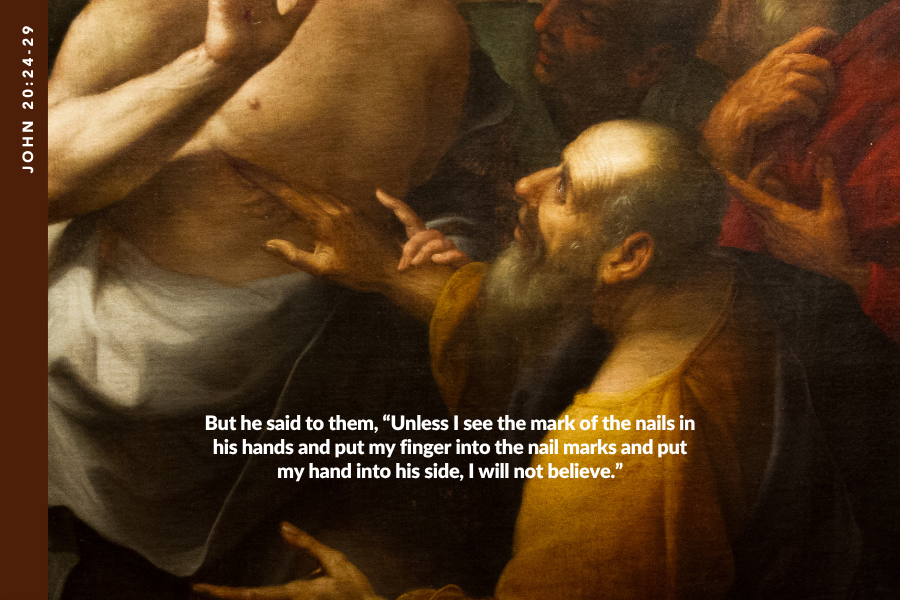
July 3, 2026 – Peace, Not Doubt

26-07-03-DM

Feast of Saint Thomas, Apostle

John 20:24-29

Thomas, called Didymus, one of the Twelve, was not with them when Jesus came. So the other disciples said to him, “We have seen the Lord.” But Thomas said to them, “Unless I see the mark of the nails in his hands and put my finger into the nailmarks and put my hand into his side, I will not believe.” Now a week later his disciples were again inside and Thomas was with them. Jesus came, although the doors were locked, and stood in their midst and said, “Peace be with you.” Then he said to Thomas, “Put your finger here and see my hands, and bring your hand and put it into my side, and do not be unbelieving, but believe.” Thomas answered and said to him, “My Lord and my God!” Jesus said to him, “Have you come to believe because you have seen me? Blessed are those who have not seen and have believed.”

Opening Prayer: Lord, help me to place myself into this Gospel scene and learn from Thomas on his feast day.

Encountering Christ:

  1. One of the Twelve: Doubting Thomas was “one of the Twelve,” as was Judas the betrayer, Peter who denied Christ, and the two brothers who coveted seats at the right and left of Jesus in his Kingdom. Jesus’ closest companions were very flawed humans. Praise God, because we, too, doubt, betray, deny, and covet at times. When we fall, if we turn to Jesus, we will realize that we can experience the same patient, gentle, reassuring Jesus that Thomas did.


  2. Unbelief: Sons and daughters of God who encounter him regularly in their prayer, through the sacraments, and experientially in life can’t help but proclaim, “We have seen the Lord.” Hearts overflow with love expressed as evangelical enthusiasm. Yet, many people resist. Like Thomas, they say, “I will not believe.” There’s nothing sadder. True love requires, however, that we don’t ostracize unbelievers. On the contrary, we continue to love them and pray for them until Jesus himself draws from them their own proclamation, “My Lord and my God.”


  3. Blind Faith: This story of Thomas’ doubt ended with some truly consoling words from Jesus, “Blessed are those who have not seen and have believed.” Since none of us have seen what the Apostles saw, yet we believe, we are “blessed.” The blessing Jesus alludes to is faith. “Faith is a gift of God, a supernatural virtue infused by him. Before this faith can be exercised, man must have the grace of God to move and assist him; he must have the interior aid of the Holy Spirit, who moves the heart and converts it to God, who opens the eyes of the mind and makes it easy for all to accept and believe the truth” (CCC 153).

Conversing with Christ: Lord, thank you for the great gift of faith. I know that the theological virtue of faith is infused by you into my soul every time I ask for it. When I doubt you, as did Thomas, I know that I can expect to hear you encouraging me: “Peace be with you.”

Resolution: Lord, today by your grace I will make a sincere act of faith, hope, and charity.

For Further Reflection: There are many versions of Acts of Faith, Hope, and Charity. Here is one:

Act of Faith

O my God, I firmly believe that you are one God in three divine Persons, Father, Son, and Holy Spirit. I believe that your divine Son became Man, died for our sins, and that he will come to judge the living and the dead. I believe these and all the truths which the Holy Catholic Church teaches, because you have revealed them, who can neither deceive nor be deceived.

Act of Hope

O my God, relying on your almighty power and infinite mercy and promises, I hope to obtain pardon of my sins, the help of your grace, and life everlasting through the merits of Jesus Christ, my Lord and Redeemer.

Act of Charity

O my God, I love you above all things, with my whole heart and soul, because you are all-good and worthy of all love. I love my neighbor as myself for the love of you. I forgive all who have injured me, and ask pardon of all whom I have injured. Amen.

Maribeth Harper celebrated paying the last tuition bill for her kids’ college by writing a book for parents who have college-aged young adults: A Spiritual Toolbox: Tips for Parenting through the First Year of College. She is a wife of over thirty-five years, mother of four, and grandmother of twelve and counting.

July 4, 2026 – Bless Our Future

26-07-04-DM

Saturday of the Thirteenth Week in Ordinary Time

Matthew 9:14-17

The disciples of John approached Jesus and said, “Why do we and the Pharisees fast much, but your disciples do not fast?” Jesus answered them, “Can the wedding guests mourn as long as the bridegroom is with them? The days will come when the bridegroom is taken away from them, and then they will fast. No one patches an old cloak with a piece of unshrunken cloth, for its fullness pulls away from the cloak and the tear gets worse. People do not put new wine into old wineskins. Otherwise the skins burst, the wine spills out, and the skins are ruined. Rather, they pour new wine into fresh wineskins, and both are preserved.”

Opening Prayer: Lord Jesus, I want to approach you today, as did your disciples, with my questions, my doubts, and my concerns. I am confident that you hear me and that you have a message especially for me as I reflect on your words.

Encountering Christ:

  1. Our Future: The Lord recommended to his listeners that they put new wine into fresh wineskins, “so that both are preserved.” He was recommending that they accommodate the new ways Jesus wanted to be worshiped, the new Church he was forming, the new graces he would leave for all of us in the Sacraments, etc. Many of his teachings seemed radical to Pharisees and followers alike, so that even Peter said, “Master, to whom shall we go? You have the words of eternal life” (Jn 6:68). In our own lives, following Jesus can require abandonment of the future we planned for ourselves. Only when we place our future in his hands can we be assured that we will age well, like wine in new wineskins.


  2. Fasting and Feasting: When Jesus walked the earth, fasting was unnecessary because, as Jesus told his disciples, the bridegroom was present! Modern-day disciples of Jesus follow the Church’s liturgical year, which is cyclical, and includes seasons for fasting (Advent and Lent) and even longer seasons for feasting (Easter and Christmas). We exert self-control during fasts to unite ourselves with Christ and open our hearts to become more receptive to grace. Feasting is especially sweet, temporally and spiritually, when we’ve fasted well. Wanting only the best for us, our Church never demands that we fast without feasting, nor vice versa.


  3. Living with the Bridegroom: Our bridegroom lives! Does this fact fill us with joy? Are we fervent and faithful to him? Do we act like a bride, striving to keep ourselves pure and undefiled? Attentive and obedient to the groom? Willing to bear fruit? We are invited to a nuptial union with Christ. As the saints describe it, this union is infinitely more intimate than conjugal love. What a reason to rejoice that the bridegroom lives!

Conversing with Christ: Lord, everywhere I look today in the Scriptures I see your protective care: in the institution of the Church; in its cyclical nature, which encourages us to fast and feast; and in the spousal intimacy you want to share with me. You are a mighty and powerful God, but you remind me in these lines of Scripture that you care for me tenderly. 

Resolution: Lord, today by your grace I will open my heart to greater intimacy with you, and with those souls you place in my life.

For Further Reflection: Jesus to St. Catherine of Siena about union with him: “And if anyone should ask me what this soul is, I would say: she is another me, made so by the union of love. What tongue could describe the marvel of this final unitive state and the many different fruits the soul receives when its powers are so filled? Not even the soul’s own will stands between us, because she has become one thing with me” (The Dialogue, Chapter 96, p. 181).

Maribeth Harper celebrated paying the last tuition bill for her kids’ college by writing a book for parents who have college-aged young adults: A Spiritual Toolbox: Tips for Parenting through the First Year of College. She is a wife of over thirty-five years, mother of four, and grandmother of twelve and counting.

July 5, 2026 – A Gracious Father and a Loving Heart

26-07-05-DM

Fourteenth Sunday in Ordinary Time

Matthew 11:25-30

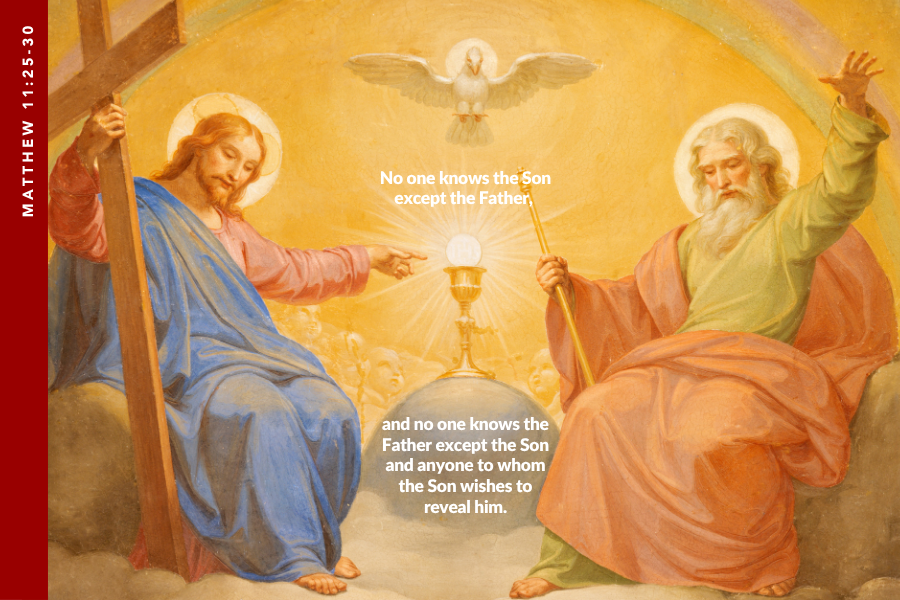
At that time Jesus exclaimed: “I give praise to you, Father, Lord of heaven and earth, for although you have hidden these things from the wise and the learned you have revealed them to little ones. Yes, Father, such has been your gracious will. All things have been handed over to me by my Father. No one knows the Son except the Father, and no one knows the Father except the Son and anyone to whom the Son wishes to reveal him. Come to me, all you who labor and are burdened and I will give you rest. Take my yoke upon you and learn from me, for I am meek and humble of heart; and you will find rest for yourselves. For my yoke is easy, and my burden light.”

Opening Prayer: Lord, each day I experience my own smallness, my insufficiencies, and my shortcomings. Still, I know that you are the One who accomplish every good thing in my life, and that on my own I can do nothing. Therefore, Lord, I cast my worries to you, and I renew my faith, hope, and love in your infinite goodness. Lord, grant me the humble knowledge that you are working in me, and that I am in your hands.

Encountering Christ:

  1. Faith to the Little Ones: Every day we experience, in some form or another, our own smallness. Whether it is our lack of attention at work, laughing at something that makes us look insensitive, or simply not meeting up to our own exaggerated expectations of ourselves, we fall far short of seeming “wise and learned” by the world’s standards. However, Christ says that the Father has hidden “these things”—spiritual truths—from the wise and the learned, and revealed them to the childlike. Why is that? Precisely because God and a proud soul—a soul who touts their own wisdom and learning—are like oil and water. They cannot mix. A small soul is able to allow God’s greatness to overshadow it, and thus able to receive spiritual wisdom.


  2. The Father’s Gracious Will: One of the most intriguing lines of Jesus in the entire Gospel occurs here, in Matthew, with a parallel in the Gospel of Luke: “Yes, Father, such has been your gracious will.” The prophet Isaiah spoke of God’s ways being so high above our own (cf. Isa 55:8-9), but Jesus shows us that this is not because God is some sort of dilettante whose whims are inscrutable, but rather that God is a gracious Father. God is always looking for our good, and even if we cannot understand his plans in the present moment, God the Son in Jesus shows us that childlike trust always turns us toward praise and appreciation of a Father who truly loves us.


  3. The Yoke of Christ: Outside the steps leading to the seminary in Cheshire, Connecticut, there is a large granite crucifix. It is unique: Instead of the typical crucified Lord hanging in agony, Christ stands as though already risen, arms extended and his Sacred Heart burning with love. Engraved below Our Lord are the very same words from the end of this Gospel passage: “Come to me, all you who labor and are burdened, and I will give you rest.” These words are an indescribable source of comfort for every Christian: Christ bore the Cross first for us, and he rose again that we too may rise. His heart bears all our woes and sorrows, and is a sure resting place for us all.

Conversing with Christ: Lord Jesus, teach me how to walk in faith and in childlike simplicity. At times, this life can be difficult and complicated. I place all of my troubles and cares on your heart; grant me that special knowledge of the Father’s gracious will, and help me to remember that I am loved and all is working toward my final good.

Resolution: Lord, today by your grace I will spend a few minutes before a holy image (maybe of the Sacred Heart or Our Lady), asking for faith and trust.

For Further Reflection: Go deeper into Regnum Christi’s understanding of devotion to the Sacred Heart in the retreat guide “Fire and Thorns” by Fr. John Bartunek, LC.

Brian Flanagan is a Regnum Christi member from Atlanta, Georgia.

Weekly Digest of the Regnum Christi Daily Meditations: June 28th – July 5th, 2026 Read More »

Scroll to Top

Events

Looking for another country?

Contact Regnum Christi near you

News & Resources

News & Resources

The Regnum Christi Mission

The Regnum Christi Identity

Alex Kucera

Atlanta

Alex Kucera has lived in Atlanta, GA, for the last 46 years. He is one of 9 children, married to his wife Karmen, and has 3 girls, one grandson, and a granddaughter on the way. Alex joined Regnum Christi in 2007. Out of the gate, he joined the Helping Hands Medical Missions apostolate and is still participating today with the Ghana Friendship Mission.

In 2009, Alex was asked to be the Atlanta RC Renewal Coordinator for the Atlanta Locality to help the RC members with the RC renewal process. Alex became a Group Leader in 2012 for four of the Atlanta Men’s Section Teams and continues today. Running in parallel, in 2013, Alex became a Team Leader and shepherded a large team of good men.

Alex was honored to be the Atlanta Mission Coordinator between 2010 to 2022 (12 years), coordinating 5-8 Holy Week Mission teams across Georgia. He also created and coordinated missions at a parish in Athens, GA, for 9 years. Alex continues to coordinate Holy Week Missions, Advent Missions, and Monthly missions at Good Shepherd Catholic Church in Cumming, GA.

From 2016 to 2022, Alex also served as the Men’s Section Assistant in Atlanta. He loved working with the Men’s Section Director, the Legionaries, Consecrated, and Women’s Section leadership teams.

Alex is exceptionally grateful to the Legionaries, Consecrated, and many RC members who he’s journeyed shoulder to shoulder, growing his relationship with Christ and others along the way. He knows that there is only one way, that’s Christ’s Way, with others!