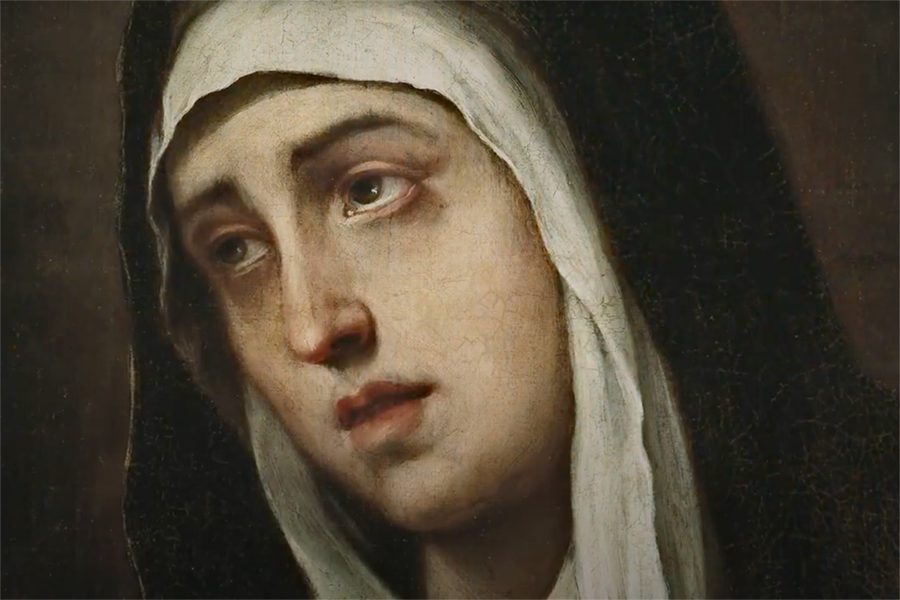
A Mother’s Tears: A Retreat Guide on Our Lady of Sorrows
A Mother’s Tears: A Retreat Guide on Our Lady of Sorrows Read More »




Q: I’m having a slight problem understanding why the Church can excommunicate sinners when the sin is grave enough, yet the Church does not condemn Judas who betrayed Jesus. I understand that no one can know the heart of another, except God. I truly believe the same way, and I’m having trouble understanding why we need canon lawyers when only God knows our hearts? -M.O.
Answered by Fr. Edward McIlmail, LC
A: It’s good to remember that excommunication is meant to be corrective rather than punitive. That is, it is a penalty that is meant to send a strong signal to someone that he needs to change his ways and repent.
The glossary of the Catechism defines excommunication as: “A severe ecclesiastical penalty, resulting from grave crimes against the Catholic religion, imposed by ecclesiastical authority or incurred as a direct result of the commission of an offense. Excommunication excludes the offender from taking part in the Eucharist or other sacraments and from the exercise of any ecclesiastical office, ministry, or function.”
By the penalty of excommunication, the Church does not condemn anyone. As you mention, God alone knows the heart of each person. What the Church does do, and can do by the authority given it by God, is teach that certain types of objective offenses are so serious that they effectively cut off a person from the sacraments and from the exercise of Church office or ministries, etc. Put another way, excommunication is a kind of teaching tool. The lesson it teaches in this case is a severe one.
Excommunication, then, is not a case of canon lawyers “reading a person’s heart.” That is not the point of the penalty. Moreover, it is not up to canon lawyers to decide what constitutes an excommunicable offense. That is decided by the magisterium, the teaching authority of the Church that comprises the Pope and the bishops. Canon lawyers might help shed light on certain points, but they are ultimately at the service of the Church. And again, the Church gets its authority from God. So it’s a false dilemma to say that somehow canon lawyers have as much say as the Almighty.
In the case of Judas, true, the Church hasn’t ruled on his destiny. God alone knows that. At any rate, excommunication is designed to help the living, who have the chance to repent. It doesn’t apply to the dead, whose days of decision are over. I hope this helps. God bless.
“Ask a Priest: Can you explain excommunication?” Read More »
Q: I know people say sins are by choice, which I agree to to an extent. Sometimes I honestly believe people cannot help who they are. For example, I am more predisposed to anxiety, vanity, etc. I understand how to stop doing sins in action, but feelings are difficult to control. Does the Bible ever explain this? I honestly feel I cannot help being envious of others at times. Someone in the same position might feel differently, but still that is how I feel. I know it is sinful to get very angry, envious. Why do humans feel the way they do even when it is sinful? -Y.
Answered by Fr. Edward McIlmail, LC
A: Your question touches on the reality of fallen human nature. This is the result of original sin, which we inherit from our first parents who sinned in the Garden of Eden. The Catechism in No. 390 says, “The account of the fall in Genesis 3 uses figurative language, but affirms a primeval event, a deed that took place at the beginning of the history of man. Revelation gives us the certainty of faith that the whole of human history is marked by the original fault freely committed by our first parents.”
St. Paul in Romans 7:15 spoke honestly about sin’s grip on him: “What I do, I do not understand. For I do not do what I want, but I do what I hate.” What St. Paul is describing is concupiscence, that is, our tendency toward sin.
Having a tendency toward sin doesn’t mean we can’t resist sin. But our fallen human nature makes it difficult. Life is a constant battle against sin. On the positive side we can pray for God’s grace for help. “God is faithful and will not let you be tried beyond your strength” (1 Corinthians 10:13). For more reading on the difference between the feeling and the sin of anger see this blog.
A few suggestions if I may. First, have faith that with God’s grace you can grow in the spiritual life and avoid many sins. Second, dedicate time each day to prayer (for more reading, see this article). You might want to include the Rosary in your schedule, a beautiful prayer in honor of the Blessed Mother.
Third, try to frequent the sacrament of confession, and receive Communion with great reverence and only in a state of grace. Also, you might try to draw up a “program of life” which could help you identify your main area of sin. With the program you would systemically try to work at eliminating certain sins from your life. Don’t worry if you don’t arrive to perfection — we are all human and will struggle all our lives. You might want to approach a priest or confessor for advice on putting together a program of life.
The important thing is, count on God’s grace — and my prayers. God bless.
“Ask a Priest: I am predisposed to certain types of sin… How can I resist them?” Read More »
Q: I am a married Catholic. My faith is so very important to me and a very important part of my life. I am having a struggle. I have felt since high school that I did not want children. I love kids, but this world makes me very fearful to have children. I also have many concerns with the way they will “turn out.” I was put on birth control when I first married due to a medical reason. I have continued to take them ever since in fear of getting pregnant. My husband shares my same views. We are both very active in our church. I am a Eucharistic minister and we both receive Communion regularly. I feel like the biggest hypocrite/sinner. I struggle because I feel that God understands the way I feel, but I know accordingly to my Catholic religion this is wrong. I do attend confession, but I have never confessed this sin because I know I will continue to use birth control. I am looking for guidance/help/advice of how to address this issue. -S.
Answered by Fr. Edward McIlmail, LC
A: I can understand your fears about raising a family in the world. The culture doesn’t support marriage and family the way it used to. Every generation has its share of darkness to deal with. The proper response as a Christian is to look to the Resurrection and realize that, if Christ could overcome death, he can overcome anything. “Put on the armor of God,” exhorts St. Paul in Ephesians 6:11, “so that you may be able to stand firm against the tactics of the devil.”
Put another way, the world has had its nasty sides ever since the fall of Adam. The way to battle the evil in the world is by living our faith to the full as best we can. Your e-mail would indicate that you are not doing that. In fact, at least in this area of your life you are doing very much the opposite and, perhaps unwittingly, adding to the darkness. Let me explain.
First, marriage is meant to be a sign of Christ’s love for his Bride the Church. Marriage involves a self-giving of a man and a woman totally to each other. That involves openness to each other and openness to the gift of new life that God might want to bless you with. The use of contraception to avoid pregnancy undercuts the gift of a husband and wife to each other. Fertility, even potential fertility, is part of who they are as human persons, and for them to “hold back” this part of themselves would be to deny the total gift of themselves to each other. It thus hurts the unitive dimension of marital intimacy. Contraception also slams the door on the potentially procreative dimension of this intimacy — and further thwarts God’s plan for marriage.
No. 2370 of the Catechism notes that a contraceptive action “is intrinsically evil: Thus the innate language that expresses the total reciprocal self-giving of husband and wife is overlaid, through contraception, by an objectively contradictory language, namely, that of not giving oneself totally to the other. This leads not only to a positive refusal to be open to life but also to a falsification of the inner truth of conjugal love, which is called upon to give itself in personal totality.”
What makes the situation more problematic is the sin of sacrilege that is being added, each and every time Communion is received in a state of grave sin. Deliberately withholding mention of grave sins in confession renders the sacrament invalid and is in itself a sacrilegious act. Someone in this position should refrain immediately from receiving Communion. Perhaps some confusion and poor catechetical instruction has lessened the culpability in your case, but now that the Holy Spirit has moved you to seek guidance, this is clearly a danger for you.
If you intend to continue to contracept, then you need to do some serious praying and thinking about the faith. A practicing Catholic by definition is someone who is trying to live the Commandments and the precepts of the Church. To say that “God understands the way I feel” overlooks some obvious facets of our faith: namely, he was the one who instituted marriage as a sacrament, he was the one who created sex and ordained its proper use, he was the one who established the Church, and he guides the Church in its teaching. If something is wrong according to the Catholic faith, it’s because it is wrong according to God. Jesus told his disciples, “Whoever listens to you listens to me. Whoever rejects you rejects me. And whoever rejects me rejects the one who sent me” (Luke 10:16).
You might consider looking for guidance from a good confessor or spiritual director who is faithful to Church teaching. Your husband might want to consider the same. In fact, I would recommend that you go together to speak with someone about your situation and receive the support you need to take the beautiful step that God is clearly inviting you to take — the step of trusting in his infinite wisdom and goodness by obeying more fully his plan for marriage.
In a global sense you need to cultivate a spirit of joy and hope. This is not naïveté but rather Christian faith in action. If the world seems like a mess, well, it’s always been a mess. And it will remain a mess until the end times. That is part of the human condition.
The way to counter this is not by contracepting. Rather, we are to live the faith robustly. What the Church teaches us is that, with the grace of God, we can bring the light of the Gospel into the world — and even become saints. It is not impossible. “For God all things are possible” (Matthew 19:26).
Often, a source of hope and joy for married couples is the arrival of children. Little ones have a way of changing a parent’s view of the world. Instead of being focused on the misery of the world, a parent becomes attentive to the child who needs her, a child who embodies a reason for hope. By catechizing their children, parents will see their own faith strengthened. Parents need to trust in God, too, who also loves their children. Even in this crazy world, you and any children that God may give you can experience joy and meaning, and with the help of God’s grace even become true saints.
Maybe you fear that somehow the world is so bad that you can’t do anything to improve it. Set aside that fear! You can do something, or rather God can do something through you, by your sincere living of your faith.
Pope John Paul II once exhorted a gathering of young people not to be discouraged by the difficulties of the world but rather to focus on what they could do positively. “Part of Christian realism is to understand that great social changes are the fruit of small courageous daily choices. You often ask yourselves: when will this world of ours be fully conformed to the Gospel message? The answer is simple: when you first think and always act according to Christ, at least a part of that world will, in you, be entrusted to him” (click here for the speech). In other words, Jesus doesn’t ask you to change the world. But he does ask you to cooperate with him to change your little piece of it.
I pray that you will put on the armor of Christ and be courageous enough to live your faith in an integral way. Only then can you experience what real Christian hope means. Only then can you realize that it’s better to light a candle than to curse the darkness. God bless.
Q: Okay, so I’m a Catholic but my parents are devout Baptists, and I recently discovered the “extra ecclesiam nulla salus” doctrine. Does this say that they will not be saved since they aren’t Catholics? I’m really worried about them. -B.M.
Answered by Fr. Edward McIlmail, LC
A: Thanks for your show of love for your parents. “Extra ecclesiam nulla salus” (Outside the Church there is no salvation) is a commonly misunderstood teaching. It assuredly does not mean that non-Catholics are doomed.
What it does do is point to Christ as the one mediator and path of salvation. And since he continues to be present on earth in his body the Church, the Church by its nature is an instrument for salvation.
The Catechism in No. 846 recognizes the need for this doctrine to be understood properly: “Re-formulated positively, it means that all salvation comes from Christ the Head through the Church which is his Body: Basing itself on Scripture and Tradition, the [Second Vatican] Council teaches that the Church, a pilgrim now on earth, is necessary for salvation: the one Christ is the mediator and the way of salvation; he is present to us in his body which is the Church. He himself explicitly asserted the necessity of faith and Baptism, and thereby affirmed at the same time the necessity of the Church which men enter through Baptism as through a door. Hence they could not be saved who, knowing that the Catholic Church was founded as necessary by God through Christ, would refuse either to enter it or to remain in it.”
No. 847 adds, “This affirmation is not aimed at those who, through no fault of their own, do not know Christ and his Church: Those who, through no fault of their own, do not know the Gospel of Christ or his Church, but who nevertheless seek God with a sincere heart, and, moved by grace, try in their actions to do his will as they know it through the dictates of their conscience — those too may achieve eternal salvation.”
These points could be restated like this: Whether a person realizes or not, his salvation would come through the Church as the body of Christ. This is part of Christ’s plan. Even a non-Christian could be saved, since through no fault of his own he might never have heard of the Gospel or made the connection between the Gospel message and the Church. No. 1257 of the Catechism notes, “God has bound salvation to the sacrament of Baptism, but he himself is not bound by his sacraments.” This doesn’t mean that we Catholics should neglect our duty to spread the truth of the Gospel; it just means that God will never be unfair.
This principle applies to non-Catholic Christians as well; many have a deep love for Christ and live exemplary lives yet for various reasons they never entered into full communion with the Church.
All this assumes good will on the part of the person, of course. The good news is that there is hope for everyone to obtain salvation. Your own example as a loving son and a fervent Catholic might go a long way to bring your parents closer to the Church. I pray that that happens. God bless.
“Ask a Priest: Can Non-Catholic Christians Be Saved?” Read More »
Q: Is it a sin, or simply morally unacceptable, for a Catholic couple who desire to have children to undergo assisted reproductive procedures like IVF? Should such a couple stay away from the Holy Eucharist? Are there options for Catholic spouses grappling with infertility? -J.
Answered by Fr. Edward McIlmail, LC
A: The pain of infertility can be a very heavy cross for a couple desiring to have children. That such a couple wants to share their love and life with children is a beautiful sign of their generosity.
But this desire, however sincere it may be, does not mean that couples can do whatever is medically possible in order to have children. In fact, procedures such as in vitro fertilization (IVF) are gravely morally evil, for several reasons.
One, it detracts from the dignity of the marital act. In 1987 the Congregation for the Doctrine of the Faith published Donum Vitae, an instruction “On Respect for Human Life in Its Origin and on the Dignity of Procreation: Replies to Certain Questions of the Day”.
The document says, “Homologous artificial fertilization, in seeking a procreation which is not the fruit of a specific act of conjugal union, objectively effects an analogous separation between the goods and the meanings of marriage.” In simpler terms what this implies is that IVF separates the goods (here, we mean children) of marriage from the conjugal act, which is the natural means of bringing new life into the world. The idea here is that a child has the right to be the fruit of a loving, conjugal act between spouses — and not the product of some medical lab procedure.
Children have a right to be conceived in a womb, not “produced” in a petri dish. It is a basic justice owed to children, who are human beings (every child is gift from God) and not things or products. Of course, this doesn’t mean that children born through IVF are any less human than other children. They should be treated with equal dignity. But parents committed to living out a true and Christian meaning in their marriage will want to avoid treating children like products in the way they seek to be open to the gift of new life.
The document continues, “Fertilization achieved outside the bodies of the couple remains by this very fact deprived of the meanings and the values which are expressed in the language of the body and in the union of human persons.”
A second consideration is the way the material is procured for IVF techniques. On the man’s part it usually (though not always) involves masturbation to procure semen — “an intrinsically and gravely disordered action” (Catechism No. 2352).
Another, highly problematic facet of IVF is that it often involves the production of multiple human embryos — many of which are not implanted and thus doomed to destruction. Many people don’t realize this — they have no idea that five or six or even more embryos are “produced” through the IVF procedure, and the ones not “used” are kept in storage indefinitely or simply killed. The 1987 Vatican instruction says: “It is therefore not in conformity with the moral law deliberately to expose to death human embryos obtained ‘in vitro.’ In consequence of the fact that they have been produced in vitro, those embryos which are not transferred into the body of the mother and are called ‘spare’ are exposed to an absurd fate, with no possibility of their being offered safe means of survival which can be licitly pursued.” In blunt terms, IVF leads to the death of human lives.
As to the question of whether couples undergoing IVF should refrain from the Eucharist, I would say this: It goes without saying that such a couple should refrain from receiving the Eucharist. But they need to do much more than that. They need to ask themselves if they understand the gravity of the evil they are doing. Do they understand they are choosing a path of killing innocent human lives? God help such people.
There are, however, morally licit ways of assisted reproduction, such as the Creighton Model and the Billings Ovulation Method. These respect both the dignity of the conjugal act and the human life conceived through it. I pray that any couple who needs assistance to look into these programs. God bless.
“Ask a Priest: May a Catholic Couple Undergo an IVF Procedure?” Read More »
Q: Is it morally permissible for a Catholic to have a health care proxy that directs his next-of-kin and doctors to withhold artificially delivered food/water in the event that he is in a persistent vegetative state? -D.
Answered by Fr. Edward McIlmail, LC
A: Thanks for your question, which is timely and touches on an issue that can be very difficult for families to deal with.
The short answer to your question is: in most cases, no, because it is not morally permissible to withhold what is known as assisted nutrition and hydration. In most cases patients in the so-called persistent vegetative state are normally healthy and not in physical distress, except they do not have awareness or meaningful interaction. In these cases the use of assisted nutrition and hydration is considered basic care and thus cannot be omitted.
Pope John Paul II in a 2004 address said that such food and water “always represents a natural means of preserving life, not a medical act. Its use, furthermore, should be considered, in principle, ordinary and proportionate, and as such morally obligatory, insofar as and until it is seen to have attained its proper finality, which in the present case consists in providing nourishment to the patient and alleviation of his suffering.” Note that phrase, “morally obligatory.”
The National Catholic Bioethics Center, however, notes, “The pope’s address does not teach anything about when nutrition and hydration cease to nourish the patient and for that reason can be withdrawn, which is a judgment rightly left to medical professionals.”
That means that a moment might arrive when assisted nutrition and hydration no longer serves a positive purpose. This can happen in the last stages of a person’s life, when the body starts to shut down, so to speak. At that point it could be morally permissible to halt the nutrition and hydration, since this kind of care then becomes “extraordinary” and disproportionate and even burdensome to the patient. But these cases might be more the exception than the rule.
A word on “persistent vegetative state” is in order too. Patients in PVS have been known to regain consciousness (see this Q&A), so diagnoses need to be prudent. It is not uncommon nowadays to find a “pull the plug” mentality at the first sign of a prolonged illness or “vegetative state.”
What is required, therefore, is proper discernment by medical officials as well as by next of kin. In practice doctors and healthcare workers have a lot of influence at this point. So one might think twice before signing a statement that could clear the way for a premature withdrawal of assisted nutrition and hydration. The Catechism in No. 2280 reminds us: “Everyone is responsible for his life before God who has given it to him. It is God who remains the sovereign Master of life. We are obliged to accept life gratefully and preserve it for his honor and the salvation of our souls. We are stewards, not owners, of the life God has entrusted to us. It is not ours to dispose of.”
Instead, you might think about giving written consent to a trustworthy person who can make the right decisions if you are incapacitated. This person should understand and be willing to follow the principles taught by the Church — or at least be willing to confer with someone who does know these principles well.
I hope this helps. Count on my prayers for you to make a wise decision. God bless.
“Ask a Priest: Are Health-Care Proxy Directives OK?” Read More »
Q: My niece and godchild is going to another state to get “married to her female partner.” Her mother, my sister and best friend, is having a reception in our city. She and my other siblings have said they are against gay marriage, but they are all attending this reception. I feel it is hypocritical to attend. Am I being judgmental? I will be categorized as such. Any ideas? – P.O.
Answered by Fr. Edward McIlmail, LC
A: I’m sorry to hear about your niece. It must be very painful to see someone you love get involved in such a relationship.
I applaud your delicacy of conscience, in that you believe it would be hypocritical to attend the reception. After all, receptions are for celebrating, and morally this isn’t much to celebrate in this case.
In fact, by not attending you would be living in accord with the promises you made when you became godmother to your niece. You are giving witness to your faith. And a tenet of our Catholic faith is that marriage is between a man and a woman. The advent of so-called same-sex marriage contradicts the very nature and purpose of sexuality.
In 2013 in Rhode Island, Bishop Thomas Tobin published a letter to Catholics on the approach of legalized same-sex marriage.
He wrote: “[I]t is important to affirm the teaching of the Church, based on God’s word, that ‘homosexual acts are intrinsically disordered,’ (Catechism of the Catholic Church, #2357) and always sinful. And because ‘same-sex marriages’ are clearly contrary to God’s plan for the human family, and therefore objectively sinful, Catholics should examine their consciences very carefully before deciding whether or not to endorse same-sex relationships or attend same-sex ceremonies, realizing that to do so might harm their relationship with God and cause significant scandal to others.”
Notice his strong warning: Catholics could harm their relationship with God and cause scandal by attending same-sex marriage ceremonies. I think the bishop’s point could be extended to receptions as well.
In short, I don’t think you are being judgmental. You are simply making a decision based on your Catholic beliefs and, I would guess, a desire not to give scandal by appearing to support the same-sex relationship in any way. You have a right and duty to follow your conscience. The Catechism in 1782 says, “Man has the right to act in conscience and in freedom so as personally to make moral decisions. ‘He must not be forced to act contrary to his conscience. Nor must he be prevented from acting according to his conscience, especially in religious matters.’”
That said, you might consider taking your niece out for coffee or lunch sometime before the “wedding,” just to explain, very simply and honestly, why you won’t be attending the wedding and reception. You could remind her of your love for her, but share your conviction that a lesbian relationship will not lead your niece to true happiness, since it is against God’s design for human sexuality and for families.
You might share some of the points mentioned in the Catechism, including No. 2358 that says, “The number of men and women who have deep-seated homosexual tendencies is not negligible. This inclination, which is objectively disordered, constitutes for most of them a trial. They must be accepted with respect, compassion, and sensitivity. […] These persons are called to fulfill God’s will in their lives and, if they are Christians, to unite to the sacrifice of the Lord’s Cross the difficulties they may encounter from their condition.”
No. 2359 adds, “Homosexual persons are called to chastity. By the virtues of self-mastery that teach them inner freedom, at times by the support of disinterested friendship, by prayer and sacramental grace, they can and should gradually and resolutely approach Christian perfection.” Let your niece know that you will be praying precisely for her embrace of virtue.
In the meantime be prepared for opposition within the family. You might want to start preparing some answers in advance for those who challenge you. (For some background information check out this video and FAQs from the USCCB.)
I hope this helps. Count on my prayers for you and your family. God bless.
“Ask a Priest: Should I attend my niece’s same-sex marriage reception?” Read More »
Q: I was recently at a Mass in a parish in Arizona. The priest welcomed everyone before the start of Mass and then quoted from Pope Francis’ apostolic exhortation, Evangelii Gaudium: “The Eucharist, although it is the fullness of sacramental life, is not a prize for the perfect but a powerful medicine and nourishment for the weak. These convictions have pastoral consequences that we are called to consider with prudence and boldness. Frequently, we act as arbiters of grace rather than its facilitators. But the Church is not a tollhouse; it is the house of the Father, where there is a place for everyone, with all their problems” (paragraph 47). The parish priest then proceeded to tell the congregation that regardless of what some theologians may tell us, Communion should not be withheld from those in a state of mortal sin because the Holy Father said it is medicine for the sick. He left it hanging like that. I talked with my family members after and everyone had a different “take” on what they heard the priest say. I thought the opinion he gave, based on the Holy Father’s statement in the letter, opened a “can of worms” that needed more explanation. Thank you for any light you can provide on this dilemma. -J.M.
Answered by Fr. Edward McIlmail, LC
A: I’m afraid that priest in Arizona badly misinterpreted the Holy Father’s words.
True, Pope Francis has put a special emphasis on reaching out to those who feel distant from the Church. But by no means is he endorsing an indiscriminate dispensing of the sacraments.
In that section quoted from Evangelii Gaudium the Pope also writes, “Everyone can share in some way in the life of the Church; everyone can be part of the community, nor should the doors of the sacraments be closed for simply any reason” (No. 47, [italics mine]).
Mortal sin is a serious reason for not receiving Communion. In fact, the Church has taught as much since its earliest days.
The Catechism in No. 1385 says, “To respond to this invitation we must prepare ourselves for so great and so holy a moment. St. Paul urges us to examine our conscience: ‘Whoever, therefore, eats the bread or drinks the cup of the Lord in an unworthy manner will be guilty of profaning the body and blood of the Lord. Let a man examine himself, and so eat of the bread and drink of the cup. For any one who eats and drinks without discerning the body eats and drinks judgment upon himself.’ Anyone conscious of a grave sin must receive the sacrament of Reconciliation before coming to communion.”
So if Pope Francis is not overturning ancient Church teaching, what is he saying? Essentially, nothing new!
When Francis writes that “The Eucharist … is not a prize for the perfect” he is correct. None of us is perfect. If receiving Communion depended on our perfection, no one would be receiving at Mass. In fact, the priest — any priest — probably wouldn’t be able to receive either. In which case there wouldn’t be a real Mass, since Mass requires that the celebrant or celebrants receive Communion.
The Holy Father also notes that the Eucharist is “a powerful medicine and nourishment for the weak.” Again, this is nothing new. It is restating what the Church has always taught.
One of the ways that the Eucharist helps the weak is by motivating them to get to confession first, if need be. A fruitful receiving of Communion requires that a person be in a state of grace — if not, he commits the sin of sacrilege by an unworthy reception.
Hence the need for confession. Pope Francis emphasized this need in a general audience address of Feb. 19, 2014. His address is worth quoting at length:
“The forgiveness of our sins is not something we can give ourselves. … the Christian community is the place where the Spirit is made present, who renews hearts in the love of God and makes all of the brethren one thing in Christ Jesus. That is why it is not enough to ask the Lord for forgiveness in one’s own mind and heart, but why instead it is necessary humbly and trustingly to confess one’s sins to a minister of the Church. In the celebration of this Sacrament, the priest represents not only God but also the whole community, who sees itself in the weakness of each of its members, who listens and is moved by his repentance, and who is reconciled with him, which cheers him up and accompanies him on the path of conversion and human and Christian growth. One might say: I confess only to God. Yes, you can say to God “forgive me” and say your sins, but our sins are also committed against the brethren, and against the Church. That is why it is necessary to ask pardon of the Church, and of the brethren in the person of the priest.”
I would clarify two other statements that you quote. One is: “regardless of what some theologians may tell us.” The Catechism number mentioned above indicates that the requirement about being in a state of grace goes beyond “what some theologians” think; it is official Church teaching.
The other statement is: “Communion should not be withheld from those in a state of mortal sin.” In practice it is not so much that the Church that withholds the Eucharist as much as it is the duty of each Catholic to examine his conscience before receiving Communion. This is why the onus is very much on the individual. I hope this helps. God bless you.
“Ask a Priest: What Is Pope Francis Saying in ‘Evangelii Gaudium’?” Read More »
