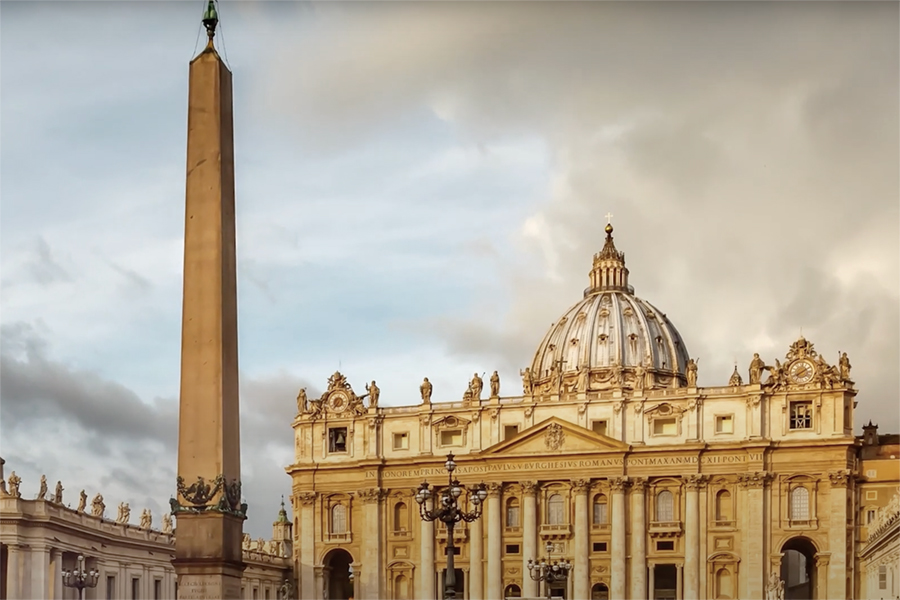
Built to Last | A Regnum Christi Retreat Guide of St. Peter and the Papacy with Fr. John Bartunek,LC

Built to Last: A Retreat Guide on St. Peter and the Papacy

The various Christian denominations have a lot in common, but unfortunately, we also have our differences. One major difference between Catholic and non-Catholic Christians has to do with our understanding of how Jesus wants his Church to be structured. Is the Church just a spiritual association of people who believe in Jesus? Or is it an actual, visible society, meant from the very beginning to have a hierarchical structure, with legitimate authority and common forms of worship? As Catholics, we believe that Jesus actually gave the Church just such a visible nature. We believe that he desires to continue working in the world through this visible society, which has been referred to throughout its history as the People of God, the Mystical Body of Christ, and the universal sacrament of salvation. And if that’s how God has chosen to interact with the world, he must have his reasons. A visible Church, with common forms of worship and a human structure through which the Holy Spirit continues Christ’s work on earth must have some benefits for us who are members of that Church. Otherwise, why would God have chosen to do things this way? One key ingredient in God’s design for the Church is the papacy. By reflecting on the role of the papacy as God envisions it, we will discover some of those great benefits, and that’s what this Retreat Guide, Built to Last: A Retreat Guide on St. Peter and the Papacy, will try to do.

  • In the first meditation, we will reflect on the biblical and historical roots of the papacy.
  • In the second meditation, we will look at the spiritual experience of St. Peter himself, to help us understand how Jesus views the papacy.
  • And in the conference, we will look at papal infallibility, the Catholic magisterium, and the freedom they give us.
Let’s begin by turning our attention to God, who is always paying loving attention to us. Let’s ask him to bless this time we will spend with him, and to grant us the grace to be faithful sons and daughters of his Catholic Church.

Video

Audio

Built to Last: A Retreat Guide on St. Peter and the Papacy Read More »

Regnum Christi Spirituality Center Ask a Priest

“Ask a Priest: Is Mentioning One Sin Enough for a Valid Confession?”

Q: My 21-year-old daughter and friend recently went to confession. The priest told them they only needed to confess one sin that was really troubling them. They both left wondering if this was a valid confession. One of the girls hadn’t gone to confession in a couple of years and knew she needed to go. Thank you. -K.

Answered by Fr. Edward McIlmail, LC

A: Valid confessions require that penitents tell all the mortal sins they can remember from their previous confession, plus any from the past that they might have forgotten to mention.

Moreover, the Catechism in No. 1458 says, “Without being strictly necessary, confession of everyday faults (venial sins) is nevertheless strongly recommended by the Church. Indeed the regular confession of our venial sins helps us form our conscience, fight against evil tendencies, let ourselves be healed by Christ and progress in the life of the Spirit.”

If what you described is accurate, then the directive given in the confessional seems, at best, extremely ill-advised.

If a penitent didn’t have the chance to confess mortal sins, then the person should go to another confessor and explain what happened and proceed to confess anything serious that wasn’t mentioned the first time. A penitent who only had venial sins to confess wouldn’t need to worry, since the absolution would have removed all venial sins, including those not mentioned.

But permit me a word of caution: Since we never know firsthand what transpires in the confessional, it is good to be prudent about what we pass on, so as not to put anyone in a bad light. It is possible that things can be misunderstood. Some priests might counsel frequent penitents to just focus on one or two venial sins that they commit repeatedly. (This assumes that there are no mortal sins to be confessed.) The idea is that the focus on one or two categories of sin might help a penitent zero in on an aspect of his life that needs special effort.

At any rate, it is good to hear that your daughter and her friend are trying to take advantage of the sacrament. It is a treasure that can help them become saints.

“Ask a Priest: Is Mentioning One Sin Enough for a Valid Confession?” Read More »

Regnum Christi Spirituality Center Ask a Priest

“Ask a Priest: Is It Wrong for a Non-Catholic to Wear a Rosary?”

Q: I grew up in the Lutheran faith but no longer identify myself as such. Over time I’ve struggled with my faith, but as of the last few years I finally feel comfortable with where I’m at in my relationship with God. As part of that I’ve been wearing a rosary for quite some time because for some reason it brings me comfort, and I feel a sense of protection by wearing it. Is it wrong or hypocritical of me to be wearing it even if I’m not Catholic? I don’t mean any disrespect by wearing it, but I’ve had several people get upset with me for “false advertisement.” Even some say that I don’t deserve to wear it. Am I really disrespecting anyone by doing this, and is it wrong in the eyes of God? -J.M.

Answered by Fr. Edward McIlmail, LC

A: Trying to decide the appropriateness of wearing a rosary might depend on a number of factors, for instance, your intention and the impression the rosary makes on others.

Your intention leans in the right direction. Your interest in the rosary might be a sign that the Holy Spirit is leading you closer toward the Catholic Church and possibly a devotion to the Blessed Virgin Mary.

The second point deals with whether you are giving scandal to others. Now, we can’t always be responsible for how people react to us. Yet it might be worth asking whether your use of a rosary might be offending Catholics who know you aren’t Catholic. I don’t have an answer here; it is something you might want to take to prayer and see where the Spirit is leading you.

As for Our Lord, it is good to remember that you are a beloved son of his. He only wants the best for you. Given your journey of the past few years, it might be a good time to consider doing a retreat (non-Catholics are usually welcome at Catholic retreat centers).

For further reading about wearing rosaries, see my colleague Fr. Edward McNamara’s column.

Oh, and yes, feel free to pray the rosary too. Online guides will help you. I hope this helps. God bless.

“Ask a Priest: Is It Wrong for a Non-Catholic to Wear a Rosary?” Read More »

Regnum Christi Spirituality Center Ask a Priest

“Ask a Priest: Is God the Father Supreme in the Trinity?”

Q: I was praying from my Liturgy of the Hours, and in Philippians 2:6-12 it is written that “though he was in the form of God,” Jesus “did deem equality with God something to be grasped.” We are taught, regarding the Trinity, that all three divine Persons are equal — the Father, the Son and the Holy Spirit. So there seems to be a contradiction. Rationally, one would assume that the Father is supreme. In addition, Jesus in his obedience to the Father is an example for all of us Catholics. However, aren’t we obedient to our “superior,” our God? And if Jesus is the way to God the Father, it seems that there is an apparent hierarchical relationship. I believe that all Three Persons are equal, or more specifically, one, so how do I connect the “circle”? Thank you and God bless your work. -J.D.

Answered by Fr. Edward McIlmail, LC

A: Questions about the Trinity are often among the trickiest in theology. Let me attempt a brief answer to your questions.

First, it would be good to see the footnote to Philippians 2:6 in the New American Bible. It says, “[2.6] Either a reference to Christ’s preexistence and those aspects of divinity that he was willing to give up in order to serve in human form, or to what the man Jesus refused to grasp at to attain divinity. Many see an allusion to the Genesis story: unlike Adam, Jesus, though … in the form of God (Gn 1:26–27), did not reach out for equality with God, in contrast with the first Adam in Gn 3:5-6.”

In other words, Jesus by taking on human form was willing to lower himself, to become one of us. That he was and remains God at every moment is part of the mystery of the Incarnation. Yet his very willingness to take on human nature was an act of loving abasement.

Now, it might be good to clarify that notion of equality of the Three Persons of the Trinity. Yes, each is equal in the sense that each is God. Equal doesn’t mean identical, however.

Father, Son and Holy Spirit are, in theological terms, subsistent relations. There is an opposition, so to speak, among them. The Father is Father to the Son, the Son is Son to the Father, and the Holy Spirit proceeds from the Father and the Son. There is a real distinction between the Three Persons, though they are all the same substance.

Is the Father supreme among them? We might say that he is a kind of “first among equals.” The Father is unbegotten, “the principle not from a principle” (see St. Thomas Aquinas’ Summa Theologiae, I, q.33, a.4). To the Father alone is attributed the property of innascibility.

Now, Jesus’ obedience to his Father isn’t a sign of inferiority but rather a sign of the fullness of his Sonship. As the perfect Son he shows perfect love to his Father – and what better way than through perfect obedience?

Obedience, moreover, doesn’t necessarily connote a superior-subordinate relationship. Think of a husband who is quick to fulfill his wife’s wishes, or vice versa. Both are equal in dignity, and we wouldn’t think of an obedient spouse necessarily being “under the other’s thumb.” Rather, obedience can be one of the highest expressions of love between spouses. Or think of a parent who is up late at night with a sick baby. The parent, in a sense, is obedient to the needs of the little one. Yet we would likely see this as an act of love, not subordination.

As for the hierarchical relationships: Hierarchy can be understood to mean a sacred rule or sacred order. Hierarchy can be thought of as a way of understanding (in some small way) how the Trinity “is put together.”

All Three Persons are coeternal; there was no temporal beginning for them, no time when the Father was alone. Yet we can speak of an ontological beginning or source of the Trinity – and this is where the notion of the Father being “a principle not from a principle” can help. The Father generates the Son (not the other way around); nor is it the Father who proceeds from the Holy Spirit.

I will admit that such a brief answer really can’t do justice to your questions. For in-depth reading you might look at Bertrand de Margerie, SJ, The Christian Trinity in History. The International Catholic University course on the Trinity has a lecture dedicated to the divine Persons as subsistent relations.

I hope some of this helps. God bless.

“Ask a Priest: Is God the Father Supreme in the Trinity?” Read More »

Regnum Christi Spirituality Center Ask a Priest

“Ask a Priest: Why 7 Pairs of Clean Animals on Noah’s Ark?”

Q: I am in a very wonderful class this year — a class that studies early world history by comparing and researching different religious texts. I was looking through my Bible, and in Genesis, Chapter 7, I found that there were actually seven pairs of “clean” animals [on Noah’s ark], which was a shock to me, as I was raised on cartoon Bible stories thinking that there were only two. My questions: Why are there seven clean pairs of animals, but only one unclean pair? Why are some animals considered unclean? On that note, are birds considered clean, or are they just special? Finally, with all of the number 7’s, is there significance that this is in the seventh chapter, or is it just a coincidence? Thank you very much for your answer! -C.S.

Answered by Fr. Edward McIlmail, LC

A: It is good that you have such interest in the Bible, which is the inspired word of God.

The cartoons you remember might have been inspired by Genesis 6:20, where God initially gives a general order to bring two animals of each kind — “Of every kind of bird, of every kind of animal, and of every kind of thing that crawls on the ground, two of each will come to you, that you may keep them alive.”

In Genesis 7:2, God gives an additional order — to bring seven pairs of clean animals and birds. The reason becomes clear after the flood subsides. The initial pair of each animal from 6:20 will assure that the world is repopulated after the flood with all the different species of animals and birds.

As regards the seven pairs, in Genesis 8:20, after the flood subsides Noah offers to God a sacrifice of some of the clean animals: “Then Noah built an altar to the LORD, and choosing from every clean animal and every clean bird, he offered burnt offerings on the altar.”

By having taken seven pairs of the clean animals and clean birds on the ark, Noah is able to offer a sacrifice to God of those clean animals while still allowing those species to repopulate the earth.

So, in this context, clean animals were animals that were considered apt to sacrifice to God. Beyond that, why are some animals considered clean and others not? That is a difficult question. There are many theories, including hygiene. Some birds were considered clean, but others (such as birds of prey) were considered unclean. For more reading see the Jewish Encyclopedia entry.

Is there something significant about the reference to “seven” appearing in Genesis 7? Probably not, since chapter numbers weren’t affixed to Scripture until the Middle Ages (see here).

I hope some of this helps. God bless.

“Ask a Priest: Why 7 Pairs of Clean Animals on Noah’s Ark?” Read More »

Regnum Christi Spirituality Center Ask a Priest

“Ask a Priest: Aren’t Some Catholic Doctrines Outdated?”

Q: How do you reconcile today’s world with the current Catholic doctrine? The Catholic Church is quite conservative; not only this, but some of its doctrines seem irrelevant and outdated. It would be wrong to expect the Church to change its stance on particular issues because it is offensive to some or because most do not follow. The Catholic Church claims to have the fullness of the Gospel. How would I know if this is true? I have talked to a few Christian denominations, and plenty do not have a good view of the Catholic Church. Jehovah Witnesses claim to have the truth, as do other denominations. There are many interpretations about who Jesus was, is, and how he would respond today’s issues. Why is the Catholic Church concerned with how people use their sexuality, which is a very private affair? -L.

Answered by Fr. Edward McIlmail, LC

A: You mention that the Catholic Church claims to have the fullness of the Gospel. That is a good place to begin. That would mean that the Gospel — coming from Christ, who is God — doesn’t change. Jesus is the fullness of God’s revelation to the world, and what he taught is meant for all peoples in all times.

So it would make sense that any church that claims to have the fullness of the Gospel wouldn’t change that Gospel, correct? And what did Jesus say about matters of, say, sexuality? He told the woman caught in adultery, “Go, [and] from now on do not sin any more” (John 8:11). He also warned that “everyone who looks at a woman with lust has already committed adultery with her in his heart” (Matthew 5:28).

So if Jesus is concerned about how people use their sexuality, there must be a serious reason. It isn’t just a “very private affair.”

Sins against the flesh are offenses against God because they are misuses of the gift of sex that the Almighty gives us. Sex is sacred because it enables spouses to express intimate union as well as partake in procreation, where couples join God in raising up new human life. That is why sex is such a sacred power.

As to belief in the Church as such, well, no one can prove the veracity of Catholicism. That is why faith is needed. But let’s say this: God made faith as well as reason. I invite you to go deep into any religion you want. You will likely find that no other religion is as deep and broad as Catholicism. Moreover, there is nothing unreasonable about it; it might go beyond reason occasionally, but it doesn’t go against reason.

Whatever the Church teaches can be linked to Scripture or Tradition, which is the oral transmission of everything that wasn’t written explicitly in the Bible. (An example of Tradition is the list, or canon, of books in the Bible; where did that list come from? It came from Tradition.)

True, there are many interpretations of who Jesus is and what he would say today. That is why he sent the Holy Spirit to guide his Church, the Catholic Church. “I have much more to tell you, but you cannot bear it now. But when he comes, the Spirit of truth, he will guide you to all truth” (John 16:12-13). We believe the Holy Spirit guides the magisterium, the teaching authority, of the Church in order to keep us from false doctrines. That is why you can find continuity in what the Church teaches from the very beginning.

Many other religions or denominations have changed their teachings over the centuries — for instance, allowing contraception and women priests. If they can change their teachings on such fundamental issues, isn’t that a sign that they might be trying to win favor with the world rather than proclaim what Christianity held from the very start?

Perhaps it might help you to go deeper into some of the Church’s teachings. A few sites that might help are the Chastity Project and the Theology of the Body. I hope this helps. God bless.

“Ask a Priest: Aren’t Some Catholic Doctrines Outdated?” Read More »

Scroll to Top

Events

Looking for another country?

Contact Regnum Christi near you

News & Resources

News & Resources

The Regnum Christi Mission

The Regnum Christi Identity

Alex Kucera

Atlanta

Alex Kucera has lived in Atlanta, GA, for the last 46 years. He is one of 9 children, married to his wife Karmen, and has 3 girls, one grandson, and a granddaughter on the way. Alex joined Regnum Christi in 2007. Out of the gate, he joined the Helping Hands Medical Missions apostolate and is still participating today with the Ghana Friendship Mission.

In 2009, Alex was asked to be the Atlanta RC Renewal Coordinator for the Atlanta Locality to help the RC members with the RC renewal process. Alex became a Group Leader in 2012 for four of the Atlanta Men’s Section Teams and continues today. Running in parallel, in 2013, Alex became a Team Leader and shepherded a large team of good men.

Alex was honored to be the Atlanta Mission Coordinator between 2010 to 2022 (12 years), coordinating 5-8 Holy Week Mission teams across Georgia. He also created and coordinated missions at a parish in Athens, GA, for 9 years. Alex continues to coordinate Holy Week Missions, Advent Missions, and Monthly missions at Good Shepherd Catholic Church in Cumming, GA.

From 2016 to 2022, Alex also served as the Men’s Section Assistant in Atlanta. He loved working with the Men’s Section Director, the Legionaries, Consecrated, and Women’s Section leadership teams.

Alex is exceptionally grateful to the Legionaries, Consecrated, and many RC members who he’s journeyed shoulder to shoulder, growing his relationship with Christ and others along the way. He knows that there is only one way, that’s Christ’s Way, with others!