

Regnum Christi Spirituality Center Ask a Priest

“Ask a Priest: I Don’t Feel God in My Life. What Can I Do?”

Q: I’m a teenager who has grown up in, and been educated in, the Catholic Church since birth; and my school is a very lively faith community. My problem is thus: While I hold the teachings of the Church to be absolute truth, and know my faith very well intellectually and do all that I can to live by it, I’m completely unable to feel God in my life. Intellectually I know that he is there, but spiritually and emotionally (even during the Eucharistic consecration) I can’t feel anything, and it worries me very much. I see the wonder and joy that other members of my community, family, and friends feel, but it just seems like every Mass and Eucharistic adoration I am going through the motions, despite focusing intently what is happening on the altar (I’m actually an altar server as well) / monstrance. What can / do I do? –A.

Answered by Fr. Edward McIlmail, LC

A: It’s possible that you aren’t really having any big problems. Let me explain.

Faith and devotion to Our Lord are not a matter of feelings. Feelings are not the measure of the health of a spiritual life. Feelings come and go like the wind. The better gauge is whether a person is growing in virtue.

If we sense that our patience and generosity are growing, and that we are holding on to high standards despite the temptations around us, then we could be sure that we are on the right path.

Perhaps God has taken away feelings of consolation right now in order to help you grow deeper in your faith. That is, since you don’t get the same consoling feelings as you possibly did before (or as others seem to get), your presence at Mass might require a greater act of the will, and greater faith. And that is what real love for God is about: an act of the will is based on the truth we know by faith. You are in Mass because deep down you might realize that you owe due worship to God. You aren’t there because it leaves you feeling warm and fuzzy; you are there because you want to give glory to God.

It might seem odd, but even many priests and consecrated people don’t have lots of feelings of consolation day by day. Many of them don’t need those feelings; they are faithful to prayer because they want to be faithful to Jesus.

That said, perhaps it might be good to see if you can get involved in volunteer work or some Church-related projects. It is great that you assist at Mass and Eucharistic adoration. The fruit of those acts of worship permeates the whole of your life, motivating your charity and service to others, prompting you to build community wherever you are. Being able to see God in the poor, the sick, the lonely and anyone who needs assistance, will help you be more aware of the Almighty’s continuous presence in your life. Besides, while the faith is intellectual, it is also meant to move the heart.

Beyond that, stick to the basics. Make time for prayer each day, no matter how dry it might be. Frequent the sacraments. And cultivate your devotion to the Blessed Virgin Mary.

For further reading see my colleague Father John Bartunek’s three-part article starting here. You also might benefit from his book “Seeking First the Kingdom,” which helps you take an X-ray of your entire spiritual life, to see what might need work.

“Ask a Priest: I Don’t Feel God in My Life. What Can I Do?” Read More »
Regnum Christi Spirituality Center Ask a Priest

“Ask a Priest: Is Someone Still Bound If I Don’t Forgive Him?”

Q: It is my understanding that Scripture states we must forgive in order to be forgiven, and more or less limitlessly. Is that correct? Also, I think that I’ve read something along the lines of, if we do not forgive someone of something, then they are still bound to it (not forgiven by God the Father?). Surely it’s not implying that the fate of another soul could be, in part, determined by me somehow? One thing I am having the most trouble with is knowing for sure if I actually have forgiven someone. If I say that I have forgiven something but am still angered/hurt by it, then have I truly forgiven it? And how can I truly forgive if I know for sure the person isn’t sorry? –D.

Answered by Fr. Edward McIlmail, LC

A: Ultimately, sin offends God, and his forgiveness is what counts. So even if you don’t forgive someone, God can still forgive that person.

God wants us to forgive, in part, because he has forgiven us so much. We would be ungrateful not to extend his mercy to others through our own acts of forgiveness. A spirit of forgiveness also liberates us. Otherwise we could spend a lot of time stewing over past wounds and doing even more damage to ourselves.

And yes, ideally there should be no limit to our forgiveness, even when offenders fail to express remorse. Here, forgiveness means that we resolve not to hold a grudge against someone in our heart.

It is worth noting that our forgiveness differs from God’s forgiveness. An unrepentant soul, for instance, might end up lost for eternity. God didn’t forgive that person, but not because God held a grudge. Rather, it was because the sinner simply wasn’t repentant, and God doesn’t force his forgiveness on anyone.

In our case, as mentioned at the start, our forgiveness doesn’t release souls from sin; only God can do that. Our forgiveness, in contrast, is a kind of letting go of hurt, of just wishing the best for a soul, of commending them to God’s mercy. We can show this kind of forgiveness no matter how the person reacts. This means we aren’t leaving our peace of mind in the hands of another person. Rather, we are choosing to make an act of forgiveness, as God asks, and that can bring us peace.

Forgiveness is an act of the will. Don’t worry if you still have hurt feelings toward someone. Hurt feelings take time to heal. But good feelings are not essential for an act of forgiveness – it is the act of the will.

Forgiveness isn’t the same as condoning, by the way. It doesn’t go against justice; rather, it is a participation in the kind of mercy God shows. We who are sinners and who have been forgiven by God so much, need to be similarly merciful to others. This is a kind of justice.

You might find this video helpful.

For more reading, you might consider two of my colleague Father John Bartunek’s articles beginning with this one. For extensive reading see Forgiveness Is a Choice, by Robert Enright.

If ever you find it hard to forgive, just remember that your sins help put Jesus on a cross. And he is the one who asks us to forgive others.

“Ask a Priest: Is Someone Still Bound If I Don’t Forgive Him?” Read More »

Regnum Christi Spirituality Center Ask a Priest

“Ask a Priest: Is Communion in the Hand OK?”

Q: Our youth minister is truly trying to follow the teachings of the Catholic Church. She comes to me with questions, and I need to give her the correct answers so I am coming to you. 1) Her mother has told her that it is wrong to receive Communion in the hand and that the Church has not approved this practice. 2) The girls in their family wear veils out of reverence for the presence of Jesus. 3) Almost the entire congregation extends and holds hands for the Our Father and raises each other’s hands when the priest does. Her mother does not allow her family to do this as it is “disruptive” in Mass. 4) Her mom also says the Latin Mass is the true way to offer Mass. Please assist me in finding the right resources. –S.

Answered by Fr. Edward McIlmail, LC

A: Briefly, Communion in the hand is fine. A post on the U.S. bishops’ conference website says, “Those who receive Communion may receive either in the hand or on the tongue, and the decision should be that of the individual receiving, not of the person distributing Communion.” Here is the post.

Veils are fine (though you wouldn’t have to go far to find other points of view). They are certainly not required. My colleague Father Edward McNamara, L.C., once wrote:

“During St. Paul’s time it was considered modest for a woman to cover her head, and he was underscoring this point for their presence in the liturgical assembly.

“This custom was considered normative and was enshrined in Canon 1262.2 of the 1917 Code of Canon Law alongside the recommendation that men and women be separated in Church and that men go bareheaded. This canon was dropped from the new Code of Canon Law promulgated in 1983, but the practice had already begun to fall into disuse from about the beginning of the 1970s. Even though no longer legally binding, the custom is still widely practiced in some countries, especially in Asia. It has been generally abandoned in most Western countries even though women, unlike men, may still wear hats and veils to Mass if they choose.”

(The full column can be found here.)

The raising of hands by laypeople at the Our Father is not in the rubrics. If families or individuals want to do it, there is no big difficulty. But the whole congregation should not be obliged to do it; that would be demanding something that isn’t prescribed in the missal. (For further reading Father McNamara has a column on this subject too.)

As for the Latin Mass being the “true way” to offer Mass, Latin is still the official language of the Church, so there is certainly no problem in offering the Eucharistic celebration in that ancient tongue. But the very fact that the Holy See has approved Masses in the vernacular (English, Spanish, French, etc.) is a sign that Masses can be validly celebrated in a variety of tongues. The Church has the authority to adapt the liturgy. Besides, Latin itself is something of an adaptation, since Jesus would have spoken Aramaic, not Latin, when he instituted the Eucharist at the Last Supper.

I hope some of this helps. And please don’t hesitate to send more questions if they come up. God bless.

“Ask a Priest: Is Communion in the Hand OK?” Read More »

Regnum Christi Spirituality Center Ask a Priest

“Ask a Priest: What Does “Giving It to God” Mean?”

 
Q: I was born/raised Catholic. I left the Church for a long time and went to other churches for a while. I came back to the Catholic Church because I signed my daughters up with the Catholic school in the area, and it was required to go to church or pay extra money. That being said, I have learned more about the religion and have questions. What exactly is “giving it to God”? And how do I do this? Is it basically like jumping off a cliff without checking to see if there is water below or just a pile of rocks? -K.

Answered by Fr. Edward McIlmail, LC

A: It is good to hear that you have resumed your practice of the faith. It is good, too, to hear that you have questions. The Catholic faith is deep, and God gives us an intellect in order to understand it more profoundly.

“Giving it to God,” if I understand the context correctly, means leaving in his hands those problems that seem insurmountable in the moment. These could be big things, such as the illness of a loved one, as well as little things, such as a rude cashier who annoys us.

Part of the thinking behind this idea is this: God in his wisdom allows certain crosses in our life, not to irritate us, but to help us grow in humility and patience. If life were easy, we wouldn’t progress and our virtues probably wouldn’t grow.

There might be times when we pray to have a difficulty taken away, but God in his wisdom might decide the better thing is for us to struggle with a challenge.

St. Paul had such an experience. “A thorn in the flesh was given to me, an angel of Satan, to beat me, to keep me from being too elated. Three times I begged the Lord about this, that it might leave me, but he said to me, ‘My grace is sufficient for you, for power is made perfect in weakness'” (2 Corinthians 12:7-9).

“Giving it to God” doesn’t mean, however, being presumptuous and thinking that he is going to swoop down and save us from our bad decisions. If we jump off a cliff without first seeing what is below, we are recklessly endangering our lives — a grave sin that we will answer for.

Another way of interpreting the phrase is the notion of “offering it up,” of tendering our suffering back to God in reparation for our sins and the sins of others. For more material on this point, see the third part (the Conference) of the online Retreat Guide “A Mother’s Tears”.

On the theme of trusting in divine providence, two Retreat Guides might be helpful for you. One is called “Trouble with Trust” and one is called “Trouble Hearts”.

For weighty reading see “Providence: God’s Loving Care for Man and the Need for Confidence in Almighty God,” by Father Reginald Garrigou-Lagrange, O.P.

“Ask a Priest: What Does “Giving It to God” Mean?” Read More »

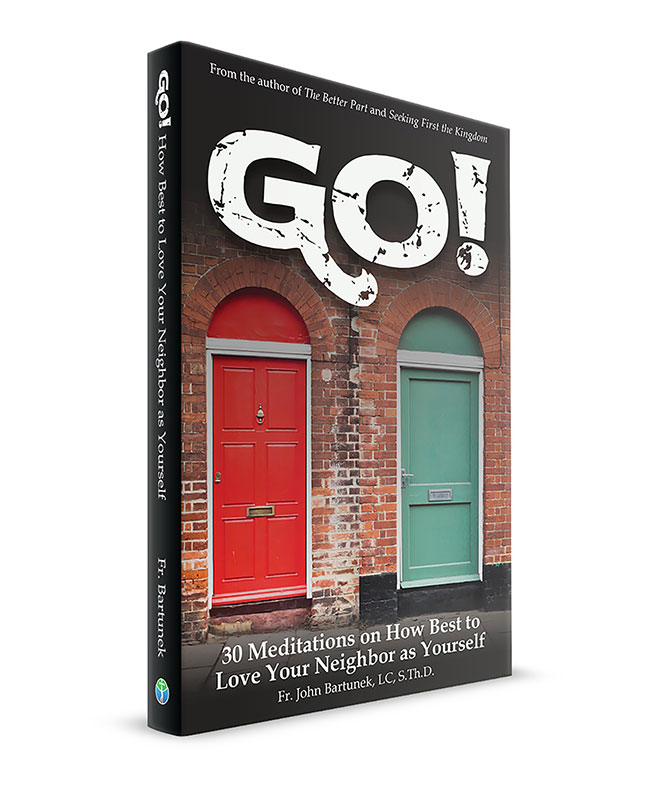
30 Meditations on How Best to Love Your Neighbor as Yourself Fr. John Bartunek, LC

Go! 30 Meditations on How Best to Love Your Neighbor as Yourself

We are not all called to travel far from home to serve others. You can live out the missionary dimension of your Christian vocation right now in your current state of life! In Go! 30 Meditations on How to Best Love Your Neighbor as Yourself, Father John Bartunek insightfully combines Bible passages and Church teaching with practical and actionable advice that you can apply to your daily life. Throughout the book, he clarifies commonly misunderstood terms like mission, apostolate, evangelization, and new evangelization. As Christians, we are called to encounter Christ, to be His disciples, and to bring Him into the world. Go! explores this missionary dimension as the third book in Fr. Bartunek’s Complete Christian Collection, which includes The Better Part: A Christ-Centered Resource for Personal Prayer and Seeking First the Kingdom: 30 Meditations on How to Love God with All Your Heart, Soul, Mind, and Strength. As with all of his books, Go! can be used for individual spiritual reading, personal meditation, or in a small group.

Go! 30 Meditations on How Best to Love Your Neighbor as Yourself Read More »

Scroll to Top

Events

Looking for another country?

Contact Regnum Christi near you

News & Resources

News & Resources

The Regnum Christi Mission

The Regnum Christi Identity

Alex Kucera

Atlanta

Alex Kucera has lived in Atlanta, GA, for the last 46 years. He is one of 9 children, married to his wife Karmen, and has 3 girls, one grandson, and a granddaughter on the way. Alex joined Regnum Christi in 2007. Out of the gate, he joined the Helping Hands Medical Missions apostolate and is still participating today with the Ghana Friendship Mission.

In 2009, Alex was asked to be the Atlanta RC Renewal Coordinator for the Atlanta Locality to help the RC members with the RC renewal process. Alex became a Group Leader in 2012 for four of the Atlanta Men’s Section Teams and continues today. Running in parallel, in 2013, Alex became a Team Leader and shepherded a large team of good men.

Alex was honored to be the Atlanta Mission Coordinator between 2010 to 2022 (12 years), coordinating 5-8 Holy Week Mission teams across Georgia. He also created and coordinated missions at a parish in Athens, GA, for 9 years. Alex continues to coordinate Holy Week Missions, Advent Missions, and Monthly missions at Good Shepherd Catholic Church in Cumming, GA.

From 2016 to 2022, Alex also served as the Men’s Section Assistant in Atlanta. He loved working with the Men’s Section Director, the Legionaries, Consecrated, and Women’s Section leadership teams.

Alex is exceptionally grateful to the Legionaries, Consecrated, and many RC members who he’s journeyed shoulder to shoulder, growing his relationship with Christ and others along the way. He knows that there is only one way, that’s Christ’s Way, with others!