Rome, April 9-18, 2018 – The first part of the Extraordinary General Assembly of Regnum Christi has come to an end. In this first part, of a two part process, the assembly (91 delegates from all four vocations within the Movement and from around the world) provided their opinion on the Draft General Statutes and on the proposed canonical configuration for Regnum Christi. From now until November 2018, when the second part of the assembly will take place, the Regnum Christi General Committee will prepare a new version of those chapters of the Draft General Statutes that have to be modified, based on the recommendations and reflections that came out of the first part of the assembly. No final decisions have been made, only proposed. Part 1 of the assembly was designed to be consultative.
Q: I was born and baptized into Catholicism. I attended catechism classes around age 12 or so, but I was never confirmed. I have been away from the Church ever since. I have questions about returning. Can you help? 1) My first marriage was in a Presbyterian church. We divorced years ago. My second marriage was given by a non-denominational pastor. How would this affect my ability to receive sacraments and other parts of the Church? What if my wife chooses not to convert to Catholicism or attend church? 2) Abortion is unfortunate, and I wish there was never the need for another one. More importantly, I wish that the rapes, incest and domestic violence behind many unwanted pregnancies would stop. I have talked with many victims and I understand their pain. I am willing to help someone in crisis, but it is not my place to judge their decision to have an abortion. Therefore, I cannot agree that abortion should be illegal. Can I have that belief and still be a faithful Catholic? 3) It is not for me to judge what consenting adults do in their bedroom. Love is love. I believe homosexuals should be allowed to marry. That does not mean that I believe any church or representative should be forced to perform the marriage. Again, can I have this belief and still be a faithful Catholic? I have more questions, but those are the three big ones for now. Thank you for your help. – Steve
Answered by Fr. Edward McIlmail, LC
A: It sounds as though the Holy Spirit is at work trying to nudge you back to the practice of your Catholic faith. This would be a great grace.
Let’s turn to your questions.
In theory the issue of your marriages could be dealt with, possibly relatively easily.
The first marriage would need a decree of nullity (an “annulment”), which shouldn’t be complicated, since it lacked what is known as canonical form. Then, your second marriage would need to be convalidated (“blessed”). This is assuming that your partner wasn’t married before. She wouldn’t have to convert to Catholicism for the marriage to be convalidated.
The other issues you raise are more problematic, however.
Abortion is the deliberate killing of an innocent human life and therefore is always an evil act to be avoided. Life comes from God, and it needs to be respected.
Women with difficult pregnancies, whatever the circumstances, need to be helped. There are two lives at stake here. And under no circumstance can an unborn child be deliberately put to death. Even a child who is the result of a rape cannot and should not be punished for the sins of its father.
A society whose laws fail to protect innocent lives is headed for ruin. This isn’t just a Catholic issue, this is a basic human issue of justice. Besides, countless women suffer deep psychological and sometimes physical wounds by abortion.
Woefully inadequate is the attitude that says, “I’m personally opposed, but I don’t want to push my beliefs on anyone.” In this case it amounts to saying, “I don’t believe we should protect unborn human life.”
Laws are about protecting rights, the most basic of which is the right to life. Without that one, all the other rights are meaningless. For a person to do nothing about stopping abortion could amount to a tacit defense of it. Is this honoring the Fifth Commandment?
As for same-sex relations: God created sex and he has a purpose for it. It is meant to be unitive and procreative within marriage. It reflects the complementarity of a man and a woman, and its fruitfulness is evident in the children who arise from acts of marital intimacy.
One doesn’t even need to resort to religious beliefs to defend the wisdom and goodness of marriage between a man and a woman. Just about every society throughout the history of the world (until now) has recognized the value of marriage.
Still, the Catholic Church certainly recognizes divine prerogatives behind the commands regarding marriage. That is why it cannot support same-sex unions. If two people of the same sex love each other, that is fine – they are called to do it in a chaste, non-sexual way.
Now, given that Church teachings about abortion and homosexual behavior are so basic to the healthy functioning of families and societies, and given that you don’t seem to be ready to accept these teachings, it might be a sign that you need to pause. You probably need to study these issues in depth to understand why the Church teaches what it does.
I don’t intend for any of this to sound harsh. It just doesn’t seem to make sense for someone to want to embrace Catholicism while rejecting some of its crucial teachings. It seems neither morally consistent or even intellectually coherent. If the Church is wrong on these issues, why should anyone of us believe in it?
What can happen is that a person who drifts from the practice of the faith and starts living a life outside of a state of grace can end up rejecting all kinds of Church teaching. Someone who doesn’t practice what he believes, ends up believing what he practices.
It might be good to ask who has the better chance of having a fuller grasp of the truth – you or I personally, or a 2,000-year-old Church to whom Jesus promised the Holy Spirit, who “will guide you to all truth”?
It might be good to speak with a priest directly about your situation. It might help to join an RCIA program (these are the classes for people who are considering coming back or coming into the Catholic Church) at a parish close to where you live and to see how things go.
The Spirit could be guiding you back to the Church. But you would want to do it correctly.
For more reading about abortion and other life issues, you might want to look at Evangelium Vitae.
For more reading about marriage, you might want to turn to Amoris Laetitia.
Today’s secular world throws curve balls at us all the time. AskACatholicPriest is a Q&A feature that anyone can use. Just type in your question or send an email to AskAPriest@rcspiritual.wpenginepowered.com and you will get a personal response back from one of our priests at RCSpirituality. You can ask about anything – liturgy, prayer, moral questions, current events… Our goal is simply to provide a trustworthy forum for dependable Catholic guidance and information. So go ahead and ask your question…
Q: I have been diagnosed with a virus, and for many years I have had a condition called polyneuropathy. My whole body feels intense burning, stinging, tingling and itching sensations all day long. It is very hard living with this condition. The virus, which I’m told is incurable, is making my neuropathy worse. I believe in the power of prayer, and I went online seeking help with praying for my condition. A pastor answered back, saying he had said the perfect healing prayer for my condition, and if I believe and have faith, I am healed. I told him I have been praying to saints, Jesus and Mother Mary. He told me I am only to pray to Jesus, and he quoted many biblical passages relating to this. I was baptized Roman Catholic as a baby. But my parents only did this because of my grandmother. All my life, until just a few months ago, I have never been in a Catholic church. My mother took us to non-denominational or Presbyterian churches. The pastor who did the healing prayer says I am now reborn again and I need to attend a Pentecostal church. I am confused. Since I was baptized Catholic, can a long-distance prayer make me born again? Is it wrong to pray to saints for my healing? I am desperate and want to do the right thing. According to this pastor I am healed and need to thank Jesus every day and not pray anymore — that if I pray, it is like saying I don’t believe Jesus healed me. I went and had a blood test done and I am still positive for the virus. It is a very low positive, and I believe this will become negative. But I am in so much pain with my neuropathy and I can’t think straight. I have just started attending Mass, but I’m not sure if the Catholic Church is the right church for me. Any guidance and answers would be most appreciated. And if you’d like to pray for my healing, I would be so grateful. – D.
Answered by Fr. Edward McIlmail, LC
A: It sounds as though Our Lord has allowed a heavy cross in your life with the polyneuropathy and now this virus.
Part of our Christian faith tells us, however, that the cross can be an instrument to help us grow in holiness. It helps us focus on the most important things in life, for instance.
Regarding your questions, let me try to answer briefly.
First, baptism can only be received once. It is a onetime sacrament since it marks an indelible mark on the soul. People speak of being reborn, but strictly speaking they are not receiving baptism a second time.
The Church still considers you its daughter because of your being baptized Catholic. The Church is here to embrace you if you decide to practice the Catholic faith.
As for praying to Mary and the saints, that is fine. Salvation history is full of cases of mediation and intercession. Think of Moses, who frequently interceded for the Israelites before God.
Intercessory prayer was also encouraged in the New Testament. St. Paul exhorted, “First of all, then, I ask that supplications, prayers, petitions, and thanksgivings be offered for everyone, for kings and for all in authority, that we may lead a quiet and tranquil life in all devotion and dignity This is good and pleasing to God our savior” (1 Timothy 2:1-3).
None of this is meant to dissuade us from praying directly to Jesus. It’s just that at times, we feel more comfortable going to Mary or the saints to intercede for us with Our Lord. It’s like going to friends to ask them to pray for us, but in this case our friends are already with the Lord in heaven.
As for prayers and healing: It is certainly within God’s power to grant prayers and heal someone. You might, however, want to be wary of someone who promises healing if this or that prayer is said. This can border on presumption.
In fact, God has a way of answering prayers in ways that are unexpected. His might have his own timetable. Sometimes he answers the way we want, but sometimes he answers by giving us what we really need.
And it is certainly not offensive to God to continue to pray for the same intention. Jesus himself taught us to do that with his parable about the widow and the unjust judge in the Gospel of Luke, Chapter 18.
The fact that you are searching and that you have started to attend Mass might be a sign of how God is leading you.
My suggestion would be to continue attending Mass, and to try to learn more about the Catholic faith. One place to start would be the Youth Catechism, or YouCat.
If you are more curious about the faith, you might ask the nearest parish about joining an RCIA program.
And continue to pray to Mary especially. She is a great intercessor with her Son. You might benefit significantly from our Retreat Guide on the value and meaning of suffering, called “A Mother’s Tears.”
I hope some of this helps. Count on being included in my intentions at Mass.
Today’s secular world throws curve balls at us all the time. AskACatholicPriest is a Q&A feature that anyone can use. Just type in your question or send an email to AskAPriest@rcspiritual.wpenginepowered.com and you will get a personal response back from one of our priests at RCSpirituality. You can ask about anything – liturgy, prayer, moral questions, current events… Our goal is simply to provide a trustworthy forum for dependable Catholic guidance and information. So go ahead and ask your question…
Q: I am a car enthusiast. I enjoy cars that are more fun, but harder on fuel, which means more emissions. Is this doing an evil for a good (that is, more emissions for the sake of fun)? Much of the fun we have causes more emissions, such as watching TV or playing video games, or playing hockey in an arena that has to be heated and lighted. These aren’t necessities but are for enjoyment. So where is the line? I own a V8 Mustang. And even if I had to sell this one for a car that was better on fuel, I’d still want to enjoy accelerating hard (when it’s reasonable to do so) and enjoy driving. But if it’s sinful and wrong, I want to know so I can stop. This is especially problematic because I want to become a mechanic, and if my passion for cars is immoral I would obviously no longer want to do that. — Patrick
Answered by Fr. Edward McIlmail, LC
A: Your desire to harmonize your healthy hobbies and the even healthier wisdom of your faith is commendable and inspiring. The Lord is clearly at work in your heart.
There are no hard-and-fast rules about Mustangs or hockey rinks and pollution, etc. It is certainly not a sin to enjoy muscle cars or to own them. In our society the government regulates emissions in order to keep pollution at reasonable levels, and those regulations include muscle cars.
But it is possible, in particular cases, that an obsession with muscle cars — or hockey — could be damaging to a person’s pursuit of holiness. How do we discern this? We need to tap into the Church’s wisdom and learn to apply it to our concrete situation.
What the Church teaches is principles. One principle is that the world was created for our use, but we need to use it wisely and with moderation. We are called to be good stewards.
It might be worth quoting a few numbers from the Catechism:
I. The Universal Destination and the Private Ownership of Goods
2402. In the beginning God entrusted the earth and its resources to the common stewardship of mankind to take care of them, master them by labor, and enjoy their fruits. The goods of creation are destined for the whole human race. However, the earth is divided up among men to assure the security of their lives, endangered by poverty and threatened by violence. The appropriation of property is legitimate for guaranteeing the freedom and dignity of persons and for helping each of them to meet his basic needs and the needs of those in his charge. It should allow for a natural solidarity to develop between men.
2403. The right to private property, acquired or received in a just way, does not do away with the original gift of the earth to the whole of mankind. The universal destination of goods remains primordial, even if the promotion of the common good requires respect for the right to private property and its exercise.
2404. “In his use of things man should regard the external goods he legitimately owns not merely as exclusive to himself but common to others also, in the sense that they can benefit others as well as himself.” The ownership of any property makes its holder a steward of Providence, with the task of making it fruitful and communicating its benefits to others, first of all his family.
2405. Goods of production — material or immaterial — such as land, factories, practical or artistic skills, oblige their possessors to employ them in ways that will benefit the greatest number. Those who hold goods for use and consumption should use them with moderation, reserving the better part for guests, for the sick and the poor. [end quoted material]
So how should we interpret all this?
Here, it might step back and look at the big picture and ask a few questions:
How much am I spending on my pastimes? Is it a big chunk of my resources? It is affecting others in a negative way?
Am I spending an unreasonable amount of time on entertainment? Is there a better way to spend my time?
Do I remember the poor and share my resources with them? Do I support the Church with my resources?
Obviously, there are questions each person must answer himself. He has look at his personal situation and see how he is living in accord with the Gospel.
The fact that you are asking about the cars and pollution might be a sign that the Holy Spirit is inviting you to re-evaluate your priorities. This isn’t to say you must get rid of the Mustang. But you might ask yourself whether Christ is nudging you in a certain direction.
You might want to take all this to prayer and see where the Spirit is leading you.
For more reading, you might consider Pope Francis’ encyclical Laudato Si‘. I hope some of this helps you choose the right road.
Got a question? Need an answer?
Today’s secular world throws curve balls at us all the time. AskACatholicPriest is a Q&A feature that anyone can use. Just type in your question or send an email to AskAPriest@rcspiritual.wpenginepowered.com and you will get a personal response back from one of our priests at RCSpirituality. You can ask about anything – liturgy, prayer, moral questions, current events… Our goal is simply to provide a trustworthy forum for dependable Catholic guidance and information. So go ahead and ask your question…
Q: When I was 12 years old I saw my mother take her last breath and die from cancer. That was 10 years ago. At that time I had been an altar server for three years at my parish and I continued to serve. But as time passed by I started to feel like God betrayed me and didn’t love me. Every time I served I felt anger, because here I am serving someone who took my mother away. So, after serving for six years I left because that sense of betrayal was hard for me to cope with and it still is. I’m afraid to get close to my faith again because I’m afraid to get hurt once more. When I pray, I do it because I’m afraid of God. I’m afraid of what he can do in my life if I don’t pray. I’m sacred of him and his power. I hope you can give me some advice. Thank you and God bless you. – A.
Answered by Fr. Edward McIlmail, LC
A: My heart goes out to you. I am sorry to hear that you lost your mom at such a young age.
Hard as it was to lose her, you mustn’t think that God somehow betrayed you. God loves you and your mom. And while it might be difficult to grasp, God loves your mom even more than you do.
It was not part of his original plan for suffering and death to be present in the world. Those came because of the sin of our first parents.
There are three sure signs of God’s love for you.
First, he created you. Your very existence depends on him. He sustains you out of love.
Second, he created your mom and gave her as a gift to you.
Third, he sent his only Son to suffer and die on a cross for your redemption and your mom’s redemption — and for the redemption of all of us.
Now, there is no doubt that one of the great mysteries is why God allows pain and suffering and evil in the world.
Here we can recall that the suffering of Jesus brought something good — redemption. Likewise, our own suffering can be united with his for the sake of souls.
God can also bring something good out of suffering. Perhaps beneath your sorrow and fear is a desire to want to be close to God. You aren’t indifferent to him, which could be a lot worse. And it is significant that in the closing of your e-mail, you wrote, “… and God bless you.” You might already have a sense that he is really is a good God, a loving God.
Sometimes it is the people we are closer to who can baffle us and seem mysterious at times. It is the same with God. Even the psalmists complained to him – and that was recorded in Sacred Scripture.
Perhaps the passing of your mom has kept you asking the deep questions of life. Perhaps this has helped you avoid a lot of the frivolity that seems to grip many of your contemporaries.
Perhaps the passing of your mom has kept you asking the deep questions of life. Perhaps this has helped you avoid a lot of the frivolity that seems to grip many of your contemporaries.
Regardless of the good that God will bring out of that painful loss, you might want to try thanking him for all the good that you received from your mother and for the years that you did have her, rather than being angry at the Lord for her death.
Death comes for us all. Suffering comes for us all. But those hardships don’t have to negate the many gifts and good things that God sends us in our lives. We have the freedom to think of those and let them shore up hope and gratitude in our souls.
In the recent past there was someone else who lost his mom at a young age — he was only about 8 years old at the time of her death. He later lost his brother during an epidemic and at age 20 he lost his dad. With faith and confidence in God this young man went on to become a priest. Today the world remembers him as Pope St. John Paul II.
Certainly, the ways of God are mysterious. But be sure that he loves you and wants you close to him.
Perhaps this is a moment to draw close to the Blessed Virgin Mary. She is your Mother, too, and she wants nothing more than for you to be close to her Son, Jesus. Perhaps Mary might be a little easier for you to draw close to. John Paul II found great comfort in his devotion to Our Lady.
It might be good for you to cultivate your devotion to her. Ask her to help you trust God and to see his plan for your life. You can be sure that Our Lady would love for you to be reunited with your own mom someday. (You might find helpful our Retreat Guide “God Is Faithful.“)
I hope some of this helps. Count on my prayers.
Got a question? Need an answer?
Today’s secular world throws curve balls at us all the time. AskACatholicPriest is a Q&A feature that anyone can use. Just type in your question or send an email to AskAPriest@rcspiritual.wpenginepowered.com and you will get a personal response back from one of our priests at RCSpirituality. You can ask about anything – liturgy, prayer, moral questions, current events… Our goal is simply to provide a trustworthy forum for dependable Catholic guidance and information. So go ahead and ask your question…
The list of participants in the General Assembly of Regnum Christi is now complete, with the announcement of those elected by the Legionaries of Christ and the Consecrated Women of Regnum Christi.
A total of 91 delegates will participate in the assembly: 29 are ex-officio, and 62 are elected by the members of their own branches.
The following delegates from the Territory of North America are participating: Fr. John Connor, LC (ex-officio as the Territorial Director of Regnum Christi in North America), Fr. John Bartunek, LC (elected in the Extraordinary General Chapter of the Legionaries of Christ), Nancy Nohrden and Betty Rivera (elected in the Extraordinary General Assembly of the Consecrated Women of Regnum Christi), Mike Williams, Kerrie Rivard, Donna Garrett and Rebecca Teti (elected in the Regnum Christi Territorial Assembly of North America).
The complete list of delegates who will participate in the General Assembly of Regnum Christi which runs from April 9 to 18 is:
Lay Consecrated Men of Regnum Christi
6 ex-officio:
Jorge López González
Bernardo Pérez Ruiz Esparza
Alberto García Gómez Alberto
Félix Gómez Rueda
Fernando Rincón Gallardo
Cristian Nazer Astorga
Elena Bustillos Cornejo
Michelle Reiff
Mariana Ibáñez Diez
6 ex-officio:
Gloria Rodríguez Díaz, General Director of the Consecrated Women of Regnum Christi
Paula Errázuriz Sotomayor, General Councillor
Viviana Limón Olavarrieta,General Councillor
Denise Funke, General Councillor
Mari Carmen Ávila Díaz- Rubín, General Councillor
Cristina Danel Cendoya, General Councillor
Legionaries of Christ
21 Elected Delegates:
P. Roberto Aspe
P. Pedro Amador Barrajón Muñoz
P. John Bartunek
P. Eloy Bedia
P. Javier Cereceda Vicente
P. Jesús María Delgado Vizcaíno
P. Emilio Díaz-Torre
P. Rafael Ducci
P. José García Sentandreu
P. Luis Garza Medina
P. Gabriel González Zambrano
P. Paul Habsburg
P. Adolfo Güemez
P. Hemán Jiménez Barrera
P. Rafael Pacanins
P. Alberto Puértolas
P. Evaristo Sada
P. Florencia Sánchez Soler
P. Ignacio Sarre Guerreiro
P. Alberto Simán Dada
P. Gabriel Ramón Sotres Sáinz
5 Substitutes if needed:
P. John Pietropaoli
P. Fernando Morales Lugo
P. Shawn Aaron
P. Anthony Bannon
P. David Daly
Ex-officio:
P. Eduardo Robles Gil, General Director of the Legionaries of Christ and Regnum Christi
P. Juan José Arrieta, Vicar General of the Legionaries of Christ
P. Sylvester Heereman, General Councillor of the Legionaries of Christ
P. Juan Sabadell, General Councillor of the Legionaries of Christ
P. Jesús Villagrasa, General Councillor of the Legionaries of Christ
P. José Cárdenas, General Administrator of Regnum Christi
P. Jaime Rodríguez, General Secretary of Regnum Christi
P. Cleomar Ferronato, Territorial Director of Brasil
P. Xavier Castro, Territorial Director of Chile
P. José Carlos Zancajo,Territorial Director of Spain
P. Andreas Schoggl, Territorial Director of Western and Central Europe
P. Manuel Álvarez, Territorial Director of Italy
P. Ricardo Sada, Territorial Director of México
P. Paul Lara, Territorial Director of Monterrey
P. John Connor, Territorial Director of North America
P. Julio Martí, Territorial Director of Venezuela
Lay Members
Elected Delegates:
José Lasses
Maria Corina Ferreres
Luisa Páez de Visani
Rebecca Teti
Mike Williams
Donna Garrett
Kerrie Rivard
Atala Alba de Barba
Rocío Treviño Garín
David Huerta Lozano
David Zárate Pérez
Mauricio A. Arellano de la Garza
José Antonio Lebrija Ruiloba
Cecilia Badía de Sánchez
José Carredano Pérez
Félix Sánchez Soler
Ana María Bravo de Simán
Anna Maria De Francesco
Stefano De Pasquale Ceratti
Sebastian Hoogewerf
Karl-Olaf Bergmann
Álvaro Abellán-García
Carmen Fernández Rodríguez
Lucía Scassera
Francisco José Boccardo
Andrés Amenábar
Amandda Christina de Souza
Pedro Delduque Kropf
Luiz Flávio Azevedo
Wayne Ringer keeps getting himself into things. He lives in the Diocese of Lincoln, NE, led by Bishop James Conley, who also keeps getting into things.
Wayne and other Regnum Christi members in Lincoln seem to be the “go to” people when the bishop needs something done: “Anything you need, we’re there for you,” Wayne said.
Sometimes the bishop needs something relatively little, like his request during a Newman Center event hosted by Regnum Christi members, when he asked them for19,000 Miraculous Medals for all the Catholic school students and CCD kids in the diocese.
Sometimes the bishop needs help with something bigger. He called on RC members to organize the March 27, 2018, Eucharistic procession around the Planned Parenthood officer in Lincoln. Regnum Christi member Mike Davis spearheaded the effort – in less than three weeks.
Sometimes the bishop needs help for something huge. As a result, Wayne finds himself helping to coordinate the Eucharistic Family Rosary Crusade.
Bishop Conley
Bishop Conley got the idea for the Crusade from the Diocese of Spokane, where it had been highly successful. The Crusades have been held in in numerous cities and foreign countries. The program was developed by the Society of Our Lady of the Most Holy Trinity (SOLT). And it turns out that the priest leading this particular apostolate is Fr. James Kelleher, SOLT, a friend of Bishop Conley’s from their days studying in Rome.
The Society of Our Lady of the Most Holy Trinity (SOLT) was founded in 1958, by Fr. James Flanagan in the Archdiocese of Santa Fe, NM. Currently, SOLT has missions in 12 countries where members “live as disciples of Jesus through Mary in Marian-Trinitarian communion on Ecclesial Family Teams in areas of deepest apostolic need.”
The Crusade has three phases, all designed to bring people into a closer relationship with Mary and Christ. Phase one includes talks in parishes and schools, and gatherings in homes: for men, Saints on Tap; for women, Vino et Veritas. Wayne created a library of study guides and videos for use in these sessions, drawing liberally from Regnum Christi meditations and materials.
The goal of phase one is for people to make a daily rosary commitment. For “experienced” rosary reciters, this would mean a full rosary a day. For those new to this form of prayer, perhaps a decade a day would be enough to start.
“The Crusade is easy to understand and extremely practical,” Wayne said. “And you see in how we have it organized a good deal of Regnum Christi methodology.”
But to organize the program in every parish – 136 in Diocese of Lincoln – requires time and lots of work, all volunteer. Wayne has a volunteer coordinator in each parish; nearly all are men.
“We intentionally recruited men into these positions, and not because women would not have done the job as well – maybe better,” Wayne explained. “But we believe men need the experience of being leaders in the parish, stepping up and being faith leaders in their families.
“Look in the pews and you’ll see more women than men,” Wayne said. “But we know that children are more likely to hold onto their faith if the father is a strong and participating Catholic.
The parish effort seems to be working. Twenty percent of the diocese – about 4,500 families – already have made a daily rosary commitment.
Wayne and the other organizers will need an army of participants, because they have huge plans.
Phase one of the Crusade peaks with the Husker Catholic Candle-Lit Rosary on April 29, 2018. Picture this: More than 3,000 Catholics form a human circle around the entire University of Nebraska-Lincoln campus and pray the rosary together while holding lighted candles.
“Yes, we had to buy a parade permit,” Wayne said. “And I’m sure there will be counter-demonstrators, but you just come to expect that. We hope the event will draw positive attention to the faith, maybe even national media.”
Then it will be on to phase two, which has a goal of people committing to a weekly or bi-weekly hour of adoration. As in the first phase, there will be Sunday talks in parishes. (And more Saints on Tap – and Vino for the ladies.)
Phase two will climax with a Eucharistic Procession around the state capitol building, led by Bishop Conley, on November 4, 2018. The preparation period for consecration to Jesus through Mary starts the following day and culminates on the Feast of the Immaculate Conception, December 8.
Phase three – tentative until phase one is complete – is where things get really huge. It will include efforts to increase the number of parishes that have perpetual adoration – and increase the hours of adoration in smaller parishes. To encourage frequent confession, a Sunday will be picked for all the homilies in the diocese to talk about the benefits of confession.
Fr. Kelleher speaking to students
And then there will be the “stadium event.” That is scheduled for May 5, 2019, with a Global Living Rosary (rosary in many languages) and Eucharistic Adoration let by Bishop Conley and Fr. Kelleher from SOLT. And yes, the stadium event will be held in a really big football stadium, one of which Lincoln most certainly has.
“It’s a big program, but think of the advantage the bishop has by coming to Regnum Christi for help,” Wayne said. “We already have a strong organization and many of the parish coordinators for the Crusade are RC members.”
On the family side, Wayne and Mary Ringer will celebrate their 20th anniversary this year. They have seven children – four daughters and three sons – kindergarten through high school senior. All three boys attend Sacred Heart Apostolic School in Indiana.
The Ringer family
Wayne, who spent some time in seminary discerning a vocation to the priesthood, gives credit to several people for his commitment to the Catholic faith, as well as his apostolic zeal:
Msgr. Leonard Kalin, the late head of the Newman Center in Lincoln, who was critical as a director and role model to Wayne in his youth.
Regnum Christi, especially Fr. Daniel Polzer, LC, who laid the foundation for Regnum Christi in Lincoln.
Msgr. Mark Huber, pastor of St. Mary’s, the Ringer’s parish in Denton, NE.
Herb Reese, RC leader in Lincoln, who heads the Lincoln Leadership Camp for boys.
“Herb has been a real mentor and was apostolically engaged long before I was,” Wayne said. “We have in Herb a real Catholic leader who believes in the mission of the Church. And it rubs off on others.
“I’m convinced the way to a man’s heart is to ask him to do something. It doesn’t have to be big, but it has to be active and help others. The apostolate is important to men; you have to get them involved. That’s one of the benefits of the Rosary Crusade – getting many men involved and living out their faith.”
Fr. Jason Smith, LC, is convinced that an essential part of being a missionary is communicating the joy of the Gospel outside of a church environment. He has an eye for art and a passion for evangelization, which he shares with the world through Instagram, where his almost18,000 followers are nourished by his elegant blending of photography and short written meditations.
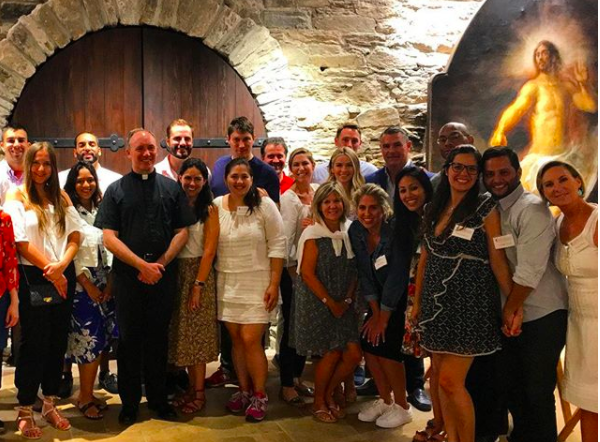
Part of Fr. Jason’s ministry is his involvement with Cana Uncorked, an evangelization project that Regnum Christi operates in collaboration with the Basilica of Saint Patrick’s Old Cathedral in SoHo. The program was started by Regnum Christi members Rob and Kristen Chmiel, and a team of newly-wed graduates of their Three to Get Married marriage prep program, as a way to create a community of newly married couples who could continue to grow in their faith together.
Since he lives in the New York City area, he is always looking for ways to bring Christ and the Catholic faith into the city. He shares that since he has the Metropolitan Museum of Art (MET) in his “backyard” so to speak, it was only natural for him to find a way to introduce people to Christ by bringing them there.
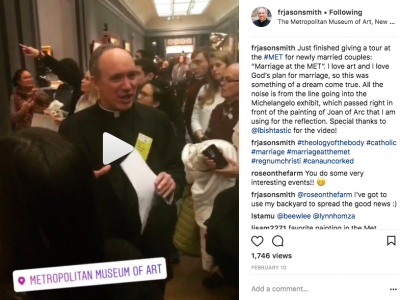
Fr. Jason gives Instagram followers a taste of the “Marriage at the MET” tour
One of the Cana Uncorked events is a couples tour of the MET, led by Fr. Jason, which focuses on the good, true and beautiful aspects of marriage that can be found in the art there. Fr. Jason tells us, “Regarding the tour itself, I used some of my favorite paintings at the MET and make the connection to different aspects of marriage. Parallels are easy to find once I let my imagination run a little.”
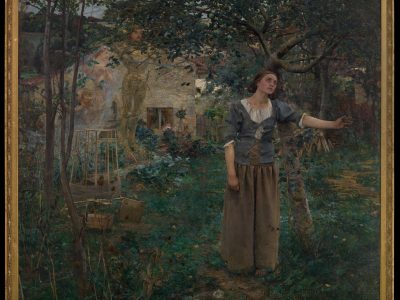
Joan of Arc by Jules Bastien-Lepage (public domain)
Giving a couple of examples of how he does this, Fr. Jason shares, “For example, with this painting of Joan of Arc, one point I emphasized is the contrast between the solidity and inner strength with which St Joan is painted and the impressionistic style with which the three saints behind her are painted, blending into the trees in the background.
The lesson I see here is that many times faith inspires us to move forward in love but we ourselves are the ones who need to take the steps, God is not going to do it for us, and that takes a lot of inner strength, which I see in this depiction of Joan—even more than if she had been painted in a suit of armor.
I closed this little part of my reflection with a story that a young couple had told me. They had just come home with their first newborn, put the baby in the crib, and were standing there together, looked at each other and at the baby and said to each other, now what do we do? They were having their Joan of Arc moment.”
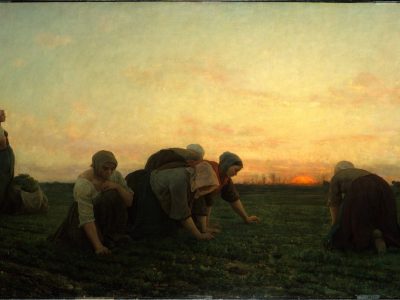
The Weeders by Jules Breton (public domain)
“Another painting we reflected on, the Weeders, speaks to me of the of the importance of stopping to lift our gaze to what is good, noble, just, and beautiful in our life, something that is remarkably hard to do, as only one of the women in the painting is doing it.
To learn to stop in a city that never sleeps and is always working is essential to a good marriage. When we see a painting like this it hits a chord deep within of a desire to be captivated by delight in what is most important in life.”
One marriage at a time, Fr. Jason is encouraging New Yorkers, in the words of St. Paul, to see “whatever is true, whatever is noble, whatever is right, whatever is pure, whatever is lovely, whatever is admirable–if anything is excellent or praiseworthy– [and] think about such things.” (Phil 4:8)
Q: The reason God created material human life in the first place, was for human creatures to know him and choose to love him freely via their free will, that is, not created like the angels who are already in heaven glorifying God and who had no material life and had no free-will test presented to them. So, Adam and Eve were in effect given the choice to choose him freely via the test of the tree of life — which they failed. The result of that sin is the life we humans live today, freely choosing via our free will to accept or reject God via the moral choices we make. If Adam and Eve did not sin, would they and their descendants never have encountered sin for the rest of their life since Adam and Eve passed the first test? — Frank
Answered by Fr. Edward McIlmail, LC
A: Let me try to address some of your points and questions.
First, the angels, too, faced a test. They weren’t already in heaven when they were created. They were tested, and some of them failed; these are the ones who rebelled against God. These we know as Satan and the other demons.
Second, the test in the Book of Genesis revolved around the tree of the knowledge of good and evil. The tree of life was something different. When Adam and Eve partook of the forbidden fruit, they indeed gained knowledge of evil, having by then disobeyed God.
Third, if Adam had not sinned, there wouldn’t be the original sin that he passed on to others. This doesn’t rule out the possibility, however, that his descendants could have chosen to sin, since they too would have free will. But those offenses would be actual sins, not original sin that they would pass on to others.
Recall that one doesn’t have to suffer the effects of original sin in order to commit actual sin (Adam and Eve didn’t have original sin).
As for Adam “passing the first test”: presumably the forbidden fruit would have been there all the days of his life on earth and thus always a temptation.
On the positive side we could say that Adam would have had the chance to decide every day to continue to obey God – and so use his free will well.
Today’s secular world throws curve balls at us all the time. AskACatholicPriest is a Q&A feature that anyone can use. Just type in your question or send an email to AskAPriest@rcspiritual.wpenginepowered.com and you will get a personal response back from one of our priests at RCSpirituality. You can ask about anything – liturgy, prayer, moral questions, current events… Our goal is simply to provide a trustworthy forum for dependable Catholic guidance and information. So go ahead and ask your question…
Alex Kucera has lived in Atlanta, GA, for the last 46 years. He is one of 9 children, married to his wife Karmen, and has 3 girls, one grandson, and a granddaughter on the way. Alex joined Regnum Christi in 2007. Out of the gate, he joined the Helping Hands Medical Missions apostolate and is still participating today with the Ghana Friendship Mission.
In 2009, Alex was asked to be the Atlanta RC Renewal Coordinator for the Atlanta Locality to help the RC members with the RC renewal process. Alex became a Group Leader in 2012 for four of the Atlanta Men’s Section Teams and continues today. Running in parallel, in 2013, Alex became a Team Leader and shepherded a large team of good men.
Alex was honored to be the Atlanta Mission Coordinator between 2010 to 2022 (12 years), coordinating 5-8 Holy Week Mission teams across Georgia. He also created and coordinated missions at a parish in Athens, GA, for 9 years. Alex continues to coordinate Holy Week Missions, Advent Missions, and Monthly missions at Good Shepherd Catholic Church in Cumming, GA.
From 2016 to 2022, Alex also served as the Men’s Section Assistant in Atlanta. He loved working with the Men’s Section Director, the Legionaries, Consecrated, and Women’s Section leadership teams.
Alex is exceptionally grateful to the Legionaries, Consecrated, and many RC members who he’s journeyed shoulder to shoulder, growing his relationship with Christ and others along the way. He knows that there is only one way, that’s Christ’s Way, with others!





 “We intentionally recruited men into these positions, and not because women would not have done the job as well – maybe better,” Wayne explained. “But we believe men need the experience of being leaders in the parish, stepping up and being faith leaders in their families.