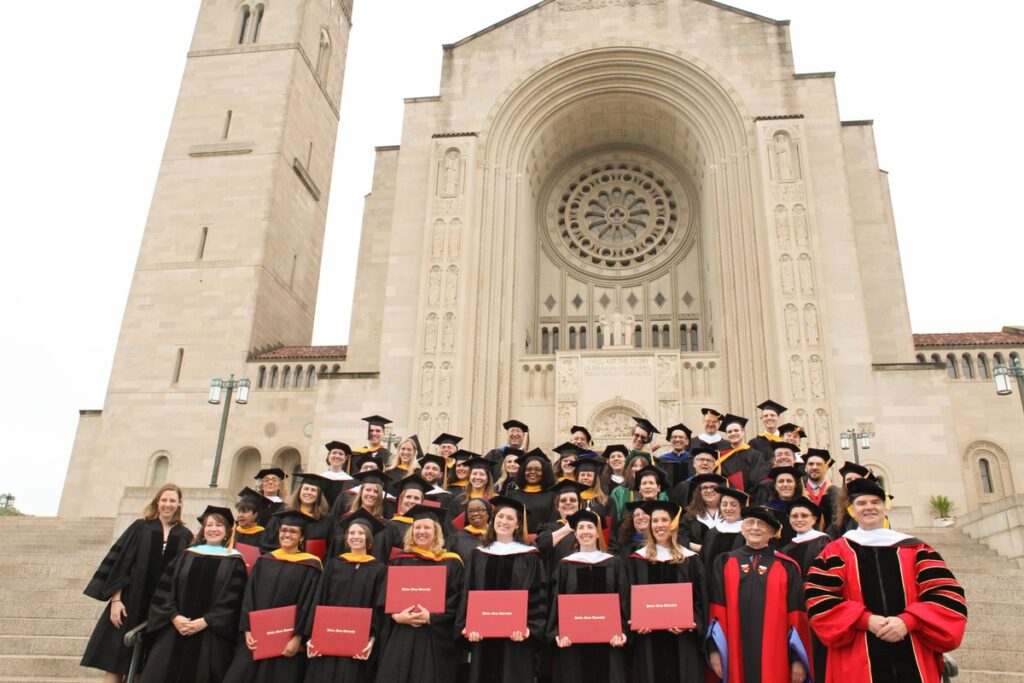
On May 18, 2018, Divine Mercy University celebrated the graduation of 45 students at the National Basilica of the Immaculate Conception. The Keynote Speaker was Dr. Ben Carson, Secretary of Housing and Urban Development.
The ceremony began with a Mass presided over by Bishop Michael Burbidge of the Diocese of Arlington, Virginia.
Fr. Charles Sikorsky, LC, president of Divine Mercy University, preached the homily. He spoke of the parable of the vine and the branches, reminding the graduates to remain attached to Christ. “If we remain attached to the vine,” he said, “we can overcome all human limitations. Today’s Gospel gives us great reasons to trust in the Lord.”
Fr. Charles also told the story of a graduate whose psychological training now helps him serve patients in a hospital where 80-90% of those cared for have suffered some form of abuse. He left the graduates with two exhortations: “Never forget the why” and “Do everything with love.”
Dr. Ben Carson received an honorary doctorate. He began his speech by saying, “I’m greatly humbled by the dedication of this university to its mission, and by the commitment of graduates that embody that mission, seeking to ensure the moral resolve with which we should go forward in our professions to serve others in a Christian way.”
“I think God gives each of special talents,” Dr. Carson said, adding that discernment of his own talents helped him determine which branch of medicine he would go into. Addressing the graduates directly, he continued, “There’s something each one of you is better at than everyone else here. And one of the things that really leads to great success is recognizing what it is.”
The HUD secretary also addressed the needs of our culture, saying, “We have enormous challenges with mental illness in our country, and we need to be healers.”
Dr. Carson concluded, “You’re all going to have tremendous spheres of influence. Can you imagine how many people will be impacted by what you do, what you say, how you act?”
This year, Divine Mercy had 29 Master’s graduates in General Psychology, seven Master’s graduates Clinical Psychology, and nine Doctors of Psychology. These join others to make a total of 255 Master’s graduates and 60 Doctoral Graduates. The university hopes to add Master’s degree in Counseling next year.
Dr. Peter Martin, PsyD (class of 2009), received the distinguished alumnus award. Dr. Martin explained to the graduates, “You will learn more about your calling to heal than your academic training could have possibly equipped you [for] before today. Embrace the sometimes challenging years of transformation to come in your work with your clients, and grow in wisdom and virtue in the Lord as his faithful disciple.”
Afterwards, Fr. Charles described the ceremony as a “great event.” Commenting on a recent letter from the California Bishops seeking to reduce the stigma of mental illness and to take away the fear of coming forward, he noted, “Churches can play a major role in that.” He also explained, “Faith and science need to work together to heal a person; a holistic approach of body, mind and spirit is so important, and that’s what we’re working on at DMU.”
You can watch a video of the graduation on Facebook or YouTube, and you can see a collection of social media about the event on the DMU blog.
Divine Mercy University offers a 25-50% tuition reduction for Regnum Christi. Find details here.
Q: I am 19 and have been in a relationship for over a year with a boy I love and who has supported me through a lot of difficult times. We sinned and had sex before marriage. His parents are very religious (he and I not so much, though we both believe in God). Now, his parents won’t let us talk to each other. All I know is I love him and would want to spend the rest of my life with him. We discussed marriage and family before this all happened. I spoke to one priest and he said that I should marry this guy. I don’t know how my boyfriend feels and know his parents see what we did as a sin against God. I can’t ask him how he feels as he’s scared of getting into trouble. We love each other and know we have done wrong. Would it be a bit extreme to ask him to marry me? Would his parents as Christians agree? It’s a difficult situation, and I want to get another priest/reverend’s opinion. Thank you. – S.
Answered by Fr. Edward McIlmail, LC
A: Your e-mail points to some interesting factors in this situation. Permit me to make a few observations and suggestions.
First, it is good that you at least recognize that you sinned by having sex. Premarital sex is not a good preparation for marriage. It would be good to get to confession as soon as possible if you haven’t done so yet.
This is the moment when a young couple should be learning to relate to each other in a chaste way. For chastity is an extremely helpful ingredient in a solid marriage.
For there will be lots of times when a married couple cannot be intimate. What will they do then? They will have to live as celibates and show their love in other ways. This is a skill that is best learned before marriage, since it won’t get any easier to learn after the wedding day.
Also, chastity can give you and your friend the space you need to get to learn about each other as persons. This includes finding out the things that you disagree on. The problem with premarital sex — aside from the risk of unexpected pregnancy and the emotional wounds that can arise in the event of a breakup — is that it can become the focal point of the relationship. Other things take on secondary importance. This can rob you of the chance to develop a solid friendship and to confront and work out differences.
Second, you mention your friend’s parents and his being “scared of getting into trouble.” This sounds like something that might be expected of a work-in-progress adolescent, not of someone who is truly ready for marriage. If your friend is basing his decisions on fear of his parents, this might reason enough to pause and step back. Perhaps this relationship needs time to mature.
Third, the idea of asking the young man to marry you, rather than the other way around, seems a bit forced. This isn’t said out of any sense of chauvinism. It’s just that your friend needs to show more leadership. If he hasn’t “popped the question,” that could be a sign that he realizes he isn’t ready for marriage. It wouldn’t be surprising if his parents agree.
Fourth, the fact that his parents won’t let you talk to each other isn’t a healthy sign. The parents are certainly right to oppose the premarital sex. Yet it’s not ideal that they see a need to try to micromanage the relationship between you and your friend.
This romance might need time to develop (chastely). It is good to keep in mind, too, that there is only one perfect man you will ever find, and that is Jesus.
Your e-mail implies that you don’t share all the Christian beliefs about marriage and sex. You might want to delve deeper into this topic. The Catholic Church has lots of wisdom in this area.
Today’s secular world throws curve balls at us all the time. AskACatholicPriest is a Q&A feature that anyone can use. Just type in your question or send an email to AskAPriest@rcspiritual.wpenginepowered.com and you will get a personal response back from one of our priests at RCSpirituality. You can ask about anything – liturgy, prayer, moral questions, current events… Our goal is simply to provide a trustworthy forum for dependable Catholic guidance and information. So go ahead and ask your question…
Away Flew Mary is not a typical Regnum Christi (RC) essay addressing a specific virtue or offering instruction to members. Mary’s story is simply a personal testimony of walking through daily life to death with my Regnum Christi sister, Mary Alwan. This is a reflection of a faith-based friendship, started in the RC Movement, that was deepened and strengthened through the carrying of the cross.We each know that God works in our lives daily, but in His way and in His time. It is our responsibility to enter the silence, be in His presence, and listen to Him as he speaks. The Holy Spirit gave me the graces to write this story for my own spiritual and emotional healing. Until now it has been shared only with Mary’s daughters and a few others. It has laid undisturbed, on my bookshelf, for six years now, until now.
Q: I am a young Catholic. In the past couple of years I’ve been learning more about my faith and become more aware of God and his power. I really realized one day that God, the God we pray to daily, the God I put my faith in, is a murderer. In Genesis 6-8 God destroys everyone in the world — all the children, unborn babies, all people except for Noah and his family. In 2 Kings 2:23-25 God orders bears to kill 42 children because they made fun of a bald guy. These are just a few of the killings ordered/approved of by God. How can we as Christians have our commandment “You shall not kill” and say we are pro-life while our God has done this? – M.
Answered by Fr. Edward McIlmail, LC
A: It is good for a person not to presume to stand in judgment of God. He is our Creator. Without him we would never have existed.
If there is something that seems odd to us in Scripture, the least we can do is give God the benefit of the doubt. He deserves at least that much from us.
First, it is good to remember that there would be no murder if there were no life. And all life comes from God. He can certainly take away what he gives. So by definition God cannot be guilty of murder.
As for the Old Testament, it needs to be read within the whole context of Scripture and within our faith. Scripture uses a variety of styles of writing — some symbolic, some allegorical, some a mixture of these and historical events. It’s not always easy to say right away what style is being used.
The part in Genesis you mention can be seen as an act of God’s patience with the world. Given the wickedness of the world, the story underlines not God’s vindictiveness but his sense of justice and his desire to salvage something of mankind and to try to rebuild society.
As for the passage in 2 Kings, it doesn’t explicitly state that God ordered the killings. In any case, it might be that the story was simply symbolic. The footnote in the New American Bible says, “This story probably was told to warn children of the importance of respect for prophets.” In other words, it functioned as kind of a bogeyman tale to instill a healthy fear in children to respect people who were called by God to do special works.
If you want to “judge” God, you would do well to judge him by the fullest expression of what he revealed to us. He did this in the person of Jesus Christ, his Son. So the Gospels are the pivotal texts for us as Christians.
Also, it is worth noting the serpent’s first question to Eve in Genesis 3:1 — “Did God really say, ‘You shall not eat from any of the trees in the garden’?” Implicit in the serpent’s question is that God intended Adam and Eve to starve to death — that God was some kind of sadist. The serpent’s trick worked, unfortunately. Adam and Eve were led to believe God was holding back on them. They fell, and mankind has suffered from their fall ever since.
Unfortunately, the serpent, Satan, still goes around tempting people about God’s goodness.
Today’s secular world throws curve balls at us all the time. AskACatholicPriest is a Q&A feature that anyone can use. Just type in your question or send an email to AskAPriest@rcspiritual.wpenginepowered.com and you will get a personal response back from one of our priests at RCSpirituality. You can ask about anything – liturgy, prayer, moral questions, current events… Our goal is simply to provide a trustworthy forum for dependable Catholic guidance and information. So go ahead and ask your question…
Q: I’m a 22-year-old girl, raised by parents who are atheists, and so I wasn’t exposed to a lot of church-related events growing up. Despite this, I still have always felt drawn to religion, to Christianity and God. For about a year and a half now, I’ve felt this weird sort of longing to become Catholic. It seems such a beautiful way to worship! The Masses, the idea of Communion, confession — it all seems so incredible! I’ve been looking into Catholicism, and I’m fascinated by it! And recently, I shyly stepped into my local Catholic church, and I was enchanted by the stained-glass windows, with images of the saints on them. I was in awe! (Will stained glass always seem so beautiful?) But, now that I’ve been invited to the RCIA process, I’m feeling suddenly afraid, suddenly scared. I suppose I’m feeling a little guilty, because I’ve pulled away suddenly from the RCIA director, even though I told him I would love to go to the classes. Is it normal to have doubts once the process has begun? I also worry that maybe (this is going to sound a bit silly!) I won’t be accepted, that I won’t belong, or that they already have all the parishioners they want. Any advice for a gal longing to be Catholic, but having these sudden doubts and fears? Many thanks, and much appreciation to you all, for the wonderful work you do! – T.
Answered by Fr. Edward McIlmail, LC
A: You’ve made my day! It’s beautiful to learn that you feel so drawn to the Catholic faith, despite (or maybe because of) your family background. Sometimes non-Catholics are the ones who can best appreciate the beauty of Catholicism.
At any rate, it sounds as though God has been giving you great graces to draw you, his beloved daughter, closer to him.
Don’t worry about the fears or concerns that you are feeling. It’s normal when someone draws closer to the Church to be tempted toward discouragement or worse. The devil certainly doesn’t want you to discover the riches of the Church that awaits you.
My suggestion is to stay on the path of the RCIA, the Rite of Christian Initiation of Adults. Feel speak to speak with someone (a priest, an RCIA director, etc.) about your concerns. There is nothing to fear. And there is lots to learn, to help you prepare for your possible entrance into the Church.
In the meantime, you might want to pray for your parents’ conversion.
And I hope the stained-glass windows always inspire you, though keep in mind the words of Jesus in John 1:50, “You will see greater things than this.”
Today’s secular world throws curve balls at us all the time. AskACatholicPriest is a Q&A feature that anyone can use. Just type in your question or send an email to AskAPriest@rcspiritual.wpenginepowered.com and you will get a personal response back from one of our priests at RCSpirituality. You can ask about anything – liturgy, prayer, moral questions, current events… Our goal is simply to provide a trustworthy forum for dependable Catholic guidance and information. So go ahead and ask your question…
These men may live next door or work in the next office. They pass you in their cars, walk by you on a busy sidewalk and might be a close friend or relative.
They are doctors, lawyers, accountants, bus drivers, truckers, teachers, musicians, farmers, construction workers and even the idle rich. They come in every shape, size, and ethnic background.
Many are Catholics or former Catholics. Some may sit in the pews around you at Mass on Sunday. They are likely the guys checking their watches to see how much longer the service will last.
They are the men who are ready to meet “The Regular Catholic Guy.”
Jeff Garrett used to be one of those guys. He was a cradle Catholic who didn’t know much about his faith. But being involved in Regnum Christi for the past 19 years turned him into a Regular Catholic Guy and motivated him to found The Regular Catholic Guy, a website/podcast/blog/resource for guys like he once was.
“This was one of those things that came to me in prayer,” Jeff said. “I think the seed was planted at the Convocation for Catholic Leaders last July. I kept putting it off and putting it off. I’d do a little, then I’d put it off. And I did a little more and finally launched it on June 9, 2018 on the Feast of the Immaculate Heart of Mary.”
Jeff explained that all three aspects of Regnum Christi are vital: spirituality, communion, and mission. “Mission is key because being a Regnum Christi member isn’t just about personal formation – it is putting that formation into a mission, which is what this podcast and its related elements are all about.”
The five dimensions of RC are vital. These are spiritual life, formation, apostolate, personal accompaniment, and team life. Apostolate and mission are the two keys.
“I want to reach out to the guy sitting in the pew who really doesn’t know much about his faith – he may not even understand much about what is going on,” Jeff continued. “He might have grown up in the Catholic faith but didn’t get much real formation. He might be going to Mass for his wife’s sake, to be a good example for the kids or he might be one of those guys who just shows up at Christmas and Easter.
“He might even be someone who left the church. He could be your neighbor, brother, brother-in-law or father-in-law. I hope someone will share the podcast with guys like this and it will start them on the path to learning more about their faith.”
Catholic websites and blogs abound. Does the world really need another? Jeff thinks it does and explains why The Regular Catholic Guy is different:
“There is a lot available on the web, but most is for guys who are already into their faith and want answers about interpretations. There isn’t much for the person just starting out. The guys I have in mind have really basic questions: How do I pray…what do you mean the Eucharist is real…What is the point of confession? What I’m doing isn’t a theological treatise – it is for the entry-level Catholic.”
And as a Regular Catholic Guy, Jeff has the prudence to draw on the expertise of a chaplain, Fr. Mark McKercher, a Catholic priest in the diocese of Omaha, Nebraska. He is a frequent guest on the podcast.
You can ask a question by clicking on Ask Fr. Mark on the website. He will answer them on the show. The button is in the lower right corner of the site. And Jeff means literally ask a question because they record what you want to know and Fr. Mark answers it in an upcoming podcast.
Upcoming podcast topics include:
How to pray
Parenting
How to go to Mass with small children
Pornography and its impact
Protecting kids on social media
Understanding the Mass (a series)
“We’re also going to cover some fun, guy topics like cooking on the grill and sports,” Jeff explained. “We’re blessed to have a Regular Catholic Guy Priest in Fr. Mark who enjoys a Budweiser and baseball.”
As visitors to the Regular Catholic Guy website will quickly learn, Jeff has a full suite of social meeting. And on Facebook you may recognize some familiar contributors: Fr. Michael Sliney, LC, and Fr. Daniel Brandenburg, LC.
Although the podcast is in its infancy, there already are several podcasts for you to catch up on. Jeff plans to have a new show weekly – and a written blog a couple times a month. More than 150 podcasts have been downloaded by listeners and the initial Instagram post has over 1,000 likes.
Jeff says he is encouraged – and hopes the site will bring men to a better understanding of their faith.
Jeff’s Story:
“I grew up as a ‘cradle Catholic.’ I went to public schools and attended CCD like many of you. I did not get much out of CCD and went as I got older only because there were girls there.
In college I left the faith and went on a self-discovery. Most of the professors were atheist or agnostic at best. So I waded through these and thought that agnostic was better than an atheist because I did believe there was a God. I was a “Chreaster” meaning I went to church at Christmas and Easter, when I was at home on break.
I started attending mass again when I met my wife. Funny how this works for men. We floated between parishes trying to find one that had a school because we wanted to send the kids to Catholic schools. She had gone to Catholic schools through high school.
We have four children. We have two boys and two girls. We had girl, boy, girl, boy just as we planned it (just kidding). Well when my oldest daughter got to be about four she started asking inquisitive questions about the faith. They were good questions and I could not answer them. So I decided I better learn about the faith so I could answer a four year old’s questions. I studied books, listened to tapes and CDs. I learned about apologetics and got to the point that I could facilitate classes in it. Now I want to help men like you become men who know their faith. I have learned that the more men know about the Catholic faith, the more they come to appreciate its beauty and how much it makes sense yet at the same time remains a mystery.”
Q: So I have a great family and a pure and wonderful boyfriend and a loyal best friend and a great dog. You might think that I am never lonely. But for some reason, even though I am always finding ways to draw closer to God (for example, the rosary, service projects, praying often) I still manage to have a deep pit of loneliness and unfulfillment. I often try to stuff it with cat videos on YouTube (you have to admit those are funny) and spending as much time with family and friends as I can. The pit is, regardless, never full and I feel it most whenever I am alone and missing my family and friends. I have come to a conclusion that this deep pit is not only loneliness and unfulfillment but also the need to feel unconditional love. I have all these fabulous people who love me, but people die. Or they have their own lives to live. They’re not always there, present in my life. Even though I know God is, I struggle to feel his presence. So maybe where I’m going with this is how can I always manage to find God’s unconditional love and fulfillment even when I feel extremely lonely and disconnected? Thank you. – K.
Answered by Fr. Edward McIlmail, LC
A: You are feeling what everyone feels deep down — a need for unconditional love. I would dare say a perfect love.
The only one who can give us this kind of love is God. Human beings will always come up short. With good reason St. Augustine wrote of God in his Confessions: “You have made us for Yourself, and our hearts are restless until they rest in You.”
The difference between you and most other people is that you at least recognize this phenomenon that you are experiencing, and you know what it is you are seeking.
The good news is that you don’t need to “find” God’s unconditional love — he already gives it to you! More accurate would be to ask how you can become aware of his unconditional love.
The short answer is: lots of prayer, lots of acts of charity. In prayer, you will grow closer to God (or rather, you will be more aware of his presence in your life). In acts of charity, you will give your heart a chance to grow. You will love more as Jesus loved.
It is also good to remember that as we grow spiritually, our awareness and experience of God’s love also grows.
But even the saints never experienced the complete fulfillment that you find yourself yearning for here on earth. That only comes when we get to the Father’s house in heaven. For now, we remain pilgrims. The very longing that you feel can be a powerful prayer, a powerful motivation to keep seeking “first the kingdom [of God]” (Matthew 6:33) instead of getting overly entangled in earthly things.
What is the upshot of all this? Perhaps Our Lord is asking you to dedicate more of yourself to him … maybe through a vocation. A desire for greater union with God can be a sign that he is calling you to dedicate yourself to him through a life of consecration.
It might be worth taking to prayer. Don’t worry if the idea scares you. Just trust in Jesus and where he might be leading you.
To help you go deeper in the spiritual life, consider some of the RC Spirituality resources, such as the Retreat Guides and the RC Daily Meditations.
Today’s secular world throws curve balls at us all the time. AskACatholicPriest is a Q&A feature that anyone can use. Just type in your question or send an email to AskAPriest@rcspiritual.wpenginepowered.com and you will get a personal response back from one of our priests at RCSpirituality. You can ask about anything – liturgy, prayer, moral questions, current events… Our goal is simply to provide a trustworthy forum for dependable Catholic guidance and information. So go ahead and ask your question…
In our busy world, everyone looks forward to getting away for a week, but not often the way Mary Jo Kenny from Chicago is. This summer she is going on her first six-day Spiritual Exercises, a silent retreat run by the Regnum Christi Movement, which will be held July 24-29, 2018 at the Cardinal Strich House in Chicago.
Mary Jo, a Regnum Christi member, wife, and mother who has been attending annual three-day retreats for a long time, shares, “I am really looking forward to more silence, more immersion in God, and hopefully learning better how he speaks in my soul in prayer. I seem to leave three-day retreats wishing they were longer.” Even Mary Jo, who is serious about her spiritual life and developing a deep relationship with God, admits that while she is really looking forward to the six days of silence and prayer, “the prospect is a little scary – you know, the fears ‘will I be able to really open my soul?’ and ‘what will God ask of me?’”
What are the Spiritual Exercises?
The traditional Spiritual Exercises of St. Ignatius are a silent retreat meant to go through four weeks, or more correctly, four stages which may each take about a week to explore. Each stage focusses on different mysteries of Christ. The popular three-day version gives a taste of each of the mysteries, while the six-day retreat offers the chance to go deeper into dialogue with God through each one.
The stages are:
Week One: A time of reflection on one’s life in the light of God’s limitless love for us. The retreatant sees and understands how their response to that love has been wounded by sin, they acknowledge the ways sin has affected their own relationship with God and repent of it and resolve to follow him with a renewed intention.
Week Two: The meditations and prayers of the second week teach participants how to follow Christ as apostles. They reflect on the mysteries of his life, preaching and ministry. Through this reflection, they allow God to lead them in changing their lives so that they love him more intimately and see how they can join him concretely in his evangelizing mission.
Week Three: Retreatants meditate on Christ’s Last Supper, passion, and death. Accompanying the Lord intimately in his suffering and in the gift of the Eucharist, they experience this ultimate expression of God’s love more deeply in their hearts and minds.
Week Four: Meditating on Jesus’ resurrection and his apparitions to his disciples, they experience themselves how Christ walks with them, and they set out to love and serve him in concrete ways in the world around them.
Following the tradition of Ignatian prayer, retreatants do not only meditate on these mysteries, they contemplate and discern. Contemplation, as St. Ignatius encouraged it, is more a movement of the heart than of the intellect. It is using the heart, imagination and emotions that God gives human beings to allow him to touch us deeply. Contemplation allows truths, that our mind believes to become realities, that our hearts and souls live and experience first-hand.
Discernment, or discernment of spirits as St. Ignatius called it, is a prayerful process of noticing the interior movements of our hearts and understanding where they come from and where they are leading us. These include our thoughts, imagination, emotions, desires, feelings, repulsions and attractions. By understanding this better, retreatants learn to listen to the voice of God in their lives and make decisions to act based on his will.
The silent retreat format unites the Church’s spiritual traditions like daily Mass, confession, adoration, the Liturgy of the Hours, the rosary, and the Stations of the Cross, with extended times of personal silent prayer. Each retreatant also meets one-on-one daily with the retreat director, a priest, who will guide them through the Spiritual Exercises, help them in the discernment of spirits, and provide personalized material for meditation.
The spiritual exercises are not simply a relaxed time of passively listening to talks and reading, but they require the active participation of the retreatant who applies their mind, will, memory, imagination, and whole heart to seeking Christ.
The priest’s perspective
Fr. Brett Taira, LC, who will be the retreat master in Chicago this summer, explains that for many people who are very familiar with the mysteries of Christ’s life and have an established life of prayer, only having three days to touch on all of them is not enough. They may feel they need more time and more silence to go deeper and unravel the mysteries of Christ that they only had time to touch on before. He gives an analogy, “If you only had three days to visit Rome, you would still be able to go everywhere and see all of the important places, but you wouldn’t have a lot of time to stay in any one spot for long or understand it very deeply. If you had a week, you would see more and your experience would be different, spending more time in the places that resonated more with you. That is essentially the difference between the three-day and six-day spiritual exercises, too.” However, Fr. Brett cautioned that the retreat is not a vacation. Being able to spend more time going deep into the mysteries of Christ’s love also means spending more time being uncomfortable in the mysteries of sin and the crucifixion.
The experience helps people see the mysteries of Christ in their own life, and understand more clearly how Christ is working in their souls. Daily spiritual direction with a priest is a part of that discernment. The hope is that after leaving the retreat, people have learned to see the mysteries of Christ that God makes present in their lives and how to live them by applying the discernment they used during the spiritual exercises.
Fr. Louis de Vaugelas, LC, who preaches the six-day Spiritual Exercises in the Ohio Valley, explains how the longer retreat is different than the three-day spiritual exercises which Regnum Christi runs over 100 of in various cities around the country every year. “You put yourself in special circumstances that give more space to the Creator to speak to your heart. You allow him to deal with you in a very unique way, investing your time in what he wants to do. After a few days, entering more deeply in the silence, your interior heart becomes more receptive to the voice of the Lord, and his voice becomes what you want to listen to. The silence is no longer uncomfortable, but a way to hear God’s voice.”
Even as a preacher, Fr. Louis finds the experience transformative, “In the two years that I have preached six-day retreats, I felt deeply evangelized by what the Lord is doing in each one of the participants and I felt that that the Lord uses them to teach me ‘the way of the heart’ in dealing with Jesus. He asks them what they are looking for, the way he asks Mary Magdalene at the tomb. He brings them to see the desires that are being shown through their emotions. Through their emotions, he reveals himself to them in a way that, like Mary Magdalene became the apostle to the apostles, those participants become apostles to me, allowing me to see the resurrected Christ in a way that is very transforming for me.”
Q: I keep thinking I am doing good. I keep trying to be positive, do the right thing, work hard. All of this is in an effort to think that I will somehow reap the benefits. No matter how much I do for others or think I am helping, I still feel like I am merely treading water and not getting anywhere. I don’t feel like any favors are returned. Even watering a bamboo plant made it die. Please help me in my faith. – K.
Answered by Fr. Edward McIlmail, LC
A: Ideally we should do the right thing, the charitable thing, for love of Jesus and for no other reason.
This might be a moment when Our Lord is trying to purify your motives. Perhaps you aren’t feeling any feedback precisely because you are doing the “right thing” in order to get rewarded. Self-seeking can rob us of the graces we would otherwise merit from doing acts of charity.
This might be the moment to consciously commit to doing the right thing in reparation for your sins, for the salvation of other souls, and for the glory of God.
If you can do that, without expecting recompense in this world, you can be on your way to real growth in holiness.
This approach might sound a bit simplistic, but it’s powerful. It can allow you to abandon yourself into God’s hands, leaving the matter of rewards in his hands.
So, try to see those instances of an apparent lack of rewards as an opportunity, not as an annoyance. You will understand much better what Our Lord went through in his passion, when he gave everything but didn’t see many signs of gratitude from the crowds in Jerusalem.
Doing it purely for love of his Father and for the salvation of souls was enough to keep Jesus going. There is a profound lesson there for all of us.
Today’s secular world throws curve balls at us all the time. AskACatholicPriest is a Q&A feature that anyone can use. Just type in your question or send an email to AskAPriest@rcspiritual.wpenginepowered.com and you will get a personal response back from one of our priests at RCSpirituality. You can ask about anything – liturgy, prayer, moral questions, current events… Our goal is simply to provide a trustworthy forum for dependable Catholic guidance and information. So go ahead and ask your question…
Alex Kucera has lived in Atlanta, GA, for the last 46 years. He is one of 9 children, married to his wife Karmen, and has 3 girls, one grandson, and a granddaughter on the way. Alex joined Regnum Christi in 2007. Out of the gate, he joined the Helping Hands Medical Missions apostolate and is still participating today with the Ghana Friendship Mission.
In 2009, Alex was asked to be the Atlanta RC Renewal Coordinator for the Atlanta Locality to help the RC members with the RC renewal process. Alex became a Group Leader in 2012 for four of the Atlanta Men’s Section Teams and continues today. Running in parallel, in 2013, Alex became a Team Leader and shepherded a large team of good men.
Alex was honored to be the Atlanta Mission Coordinator between 2010 to 2022 (12 years), coordinating 5-8 Holy Week Mission teams across Georgia. He also created and coordinated missions at a parish in Athens, GA, for 9 years. Alex continues to coordinate Holy Week Missions, Advent Missions, and Monthly missions at Good Shepherd Catholic Church in Cumming, GA.
From 2016 to 2022, Alex also served as the Men’s Section Assistant in Atlanta. He loved working with the Men’s Section Director, the Legionaries, Consecrated, and Women’s Section leadership teams.
Alex is exceptionally grateful to the Legionaries, Consecrated, and many RC members who he’s journeyed shoulder to shoulder, growing his relationship with Christ and others along the way. He knows that there is only one way, that’s Christ’s Way, with others!







 And as a Regular Catholic Guy, Jeff has the prudence to draw on the expertise of a chaplain, Fr. Mark McKercher, a Catholic priest in the diocese of Omaha, Nebraska. He is a frequent guest on the podcast.


 Fr. Brett Taira, LC, who will be the retreat master in Chicago this summer, explains that for many people who are very familiar with the mysteries of Christ’s life and have an established life of prayer, only having three days to touch on all of them is not enough. They may feel they need more time and more silence to go deeper and unravel the mysteries of Christ that they only had time to touch on before. He gives an analogy, “If you only had three days to visit Rome, you would still be able to go everywhere and see all of the important places, but you wouldn’t have a lot of time to stay in any one spot for long or understand it very deeply. If you had a week, you would see more and your experience would be different, spending more time in the places that resonated more with you. That is essentially the difference between the three-day and six-day spiritual exercises, too.” However, Fr. Brett cautioned that the retreat is not a vacation. Being able to spend more time going deep into the mysteries of Christ’s love also means spending more time being uncomfortable in the mysteries of sin and the crucifixion.
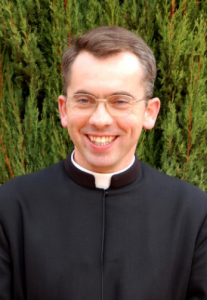 Fr. Louis de Vaugelas, LC, who preaches the six-day Spiritual Exercises in the Ohio Valley, explains how the longer retreat is different than the three-day spiritual exercises which Regnum Christi runs over 100 of in various cities around the country every year. “You put yourself in special circumstances that give more space to the Creator to speak to your heart. You allow him to deal with you in a very unique way, investing your time in what he wants to do. After a few days, entering more deeply in the silence, your interior heart becomes more receptive to the voice of the Lord, and his voice becomes what you want to listen to. The silence is no longer uncomfortable, but a way to hear God’s voice.”
