
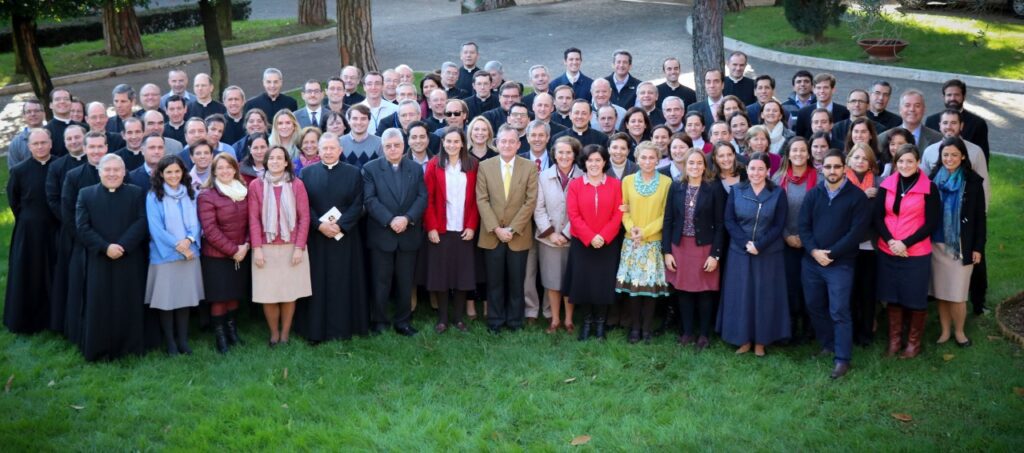
First General Assembly of Regnum Christi Concludes with a Request to be Recognized as a Federation

December 5th, 2018 marked the conclusion of the first General Assembly of Regnum Christi and its approval of a final draft of the statutes that will now be sent to the Holy See requesting the recognition of this spiritual family as a Federation under the governance of the dicastery  led by Cardinal João Bráz de Aviz,  The Congregation for Institutes of Consecrated Life and Societies of Apostolic Life.


The General Assembly included 91 delegates from 14 countries, members of the Legionaries of Christ (37), the Consecrated Women of Regnum Christi (18), the Lay Consecrated Men of Regnum Christi (6) and the Lay Members of Regnum Christi (30). The assembly’s purpose was to complete the writing of statutes that would propose the government of  Regnum Christi as a Federation to the Holy See, and to approve the draft of the Rule of Life of the Lay Faithful Associated with Regnum Christi which the lay members had composed through a five-year international process.


In a communication released December 7th, 2018, Regnum Christi states that, “The General Statutes express the meeting point of the discernment that the four vocations of Regnum Christi have made together during the process of renewal with regard to their charism and common mission, spirituality, members, organization and government. It has been a participatory and global process in which all Regnum Christi members from the four vocations that make up this ecclesial reality have been involved since 2010, some 22,000 from among the Legionaries of Christ, Consecrated Women, Lay Consecrated Men, and Lay Members of Regnum Christi.”


Following almost a decade of reflection, reform, and revision of governing documents, the four vocational realities wrote statutes that formally declared their intent to be one body called Regnum Christi, while maintaining the autonomy proper to the each of the religious congregation and the societies of apostolic life that are part of it.  They have been accompanied in this process first by a pontifical delegate, the late Cardinal Velasio de Paolis, and to this date by Fr. Gianfranco Ghirlanda, SJ, a canon lawyer and pontifical assistant.  The new draft of the statutes of the Regnum Christi Federation were approved by the General Chapter of the Legionaries of Christ, the General Assemblies of the Consecrated Women of Regnum Christi and the Lay Consecrated Men of Regnum Christi, and by the General Assembly of Regnum Christi in a last step before they are sent to the Holy See for final approval.


The process included several challenges, including the question of how to form one institution that could juridically include a religious congregation of pontifical right, associations of lay consecrated members and other laity.  In the December 7th communiqué of the lay delegates to the General Assembly, they note, “Jesuit Father Gianfranco Ghirlanda, the pontifical assistant, explained to us that Regnum Christi was historically “de facto” an entity with four distinct vocations, each of which, in its own way, received and participated in a common charism. However, there is currently no canonical configuration in the Church capable of expressing and recognizing this type of entity. Because of the good it represents for our spiritual family, we accept the form of a federation with enthusiasm and hope. At the same time, we know it is not capable of fully reflecting the way in which we actually form part of and participate in the common charismatic reality, as evidenced by the very path taken from 2013 until today and in the life of many of our sections and apostolates.”


The structure of the Federation is seen by all delegates as a very positive step for Regnum Christi, as it gives a recognized canonical identity to the Movement and unites all the vocations and branches involved.  The members look forward to ongoing development and maturity of the identity of Regnum Christi, both in the living of the charism and in how it is formally recognized by the Holy See.


At the opening Mass of the Assembly, in which the Consecrated Women of Regnum Christi and the Lay Consecrated Men of Regnum Christi were officially approved by the Holy See as societies of apostolic life of pontifical right, Mons. Rodríguez Carballo, OFM, secretary of the Congregation for Institutes of Consecrated Life and Societies of Apostolic Life, addressed the Assembly and guided the work of these weeks: “Congratulations, and may Regnum Christi continue working from this moment, if possible with even greater strength as a family united in Christ and in the same charism. Always count on each other, and on the help of Mother Church who will certainly give you her hand as she has given it you from the beginning always and everywhere …. No one among you can develop his mission in isolation …. I will always repeat: ‘Be United!’ The charism is one, although the ways of developing it and living it are diverse.”


The collegiality of the government of the Federation represents an advance and expression of a renewed form of the exercise of authority in the service of the common mission of Regnum Christi. It shows the spirit of communion and the complementarity of vocations, respecting the autonomy of each vocation. The governing body will be called the General Directive College of the Regnum Christi Federation. It will be formed by the directors of the three consecrated vocations – the Legionaries of Christ, the Consecrated Women of Regnum Christi, and the Lay Consecrated Men of Regnum Christi – and by two lay people with a consultative voice and vote.


The Statutes contain a renewed and shared expression of spirituality and principles of apostolic action, and clearly delineate the spiritual foundations of Regnum Christi. Its members seek to “give glory to God and make present the Kingdom of God in the hearts of men and in society” (EFRC 7) for their own sanctification and apostolic action.


The Statutes were approved in the General Assembly with 58 votes in favor, 2 abstentions, and 1 against. The General Assemblies of the Consecrated Women of Regnum Christi and of the Lay Consecrated Men of Regnum Christi ratified them unanimously. The General Chapter of the Legionaries of Christ, for its part, ratified them with 59 votes in favor and 1 abstention.


At the end of 2017, Regnum Christi had 21,300 lay members, 526 Consecrated Women, 63 Lay Consecrated Men and 1,537 Legionaries of Christ. It also has 11,584 members in ECYD (the Regnum Christi charism lived by adolescents).


All information about the General Assembly, as well as all documents, a photo gallery and day-by-day proceedings can be found here.


First General Assembly of Regnum Christi Concludes with a Request to be Recognized as a Federation Read More »

Regnum Christi Spirituality Center Ask a Priest

“Ask a Priest: Would a Tattoo Bar Me From the Priesthood?”

Q: I am a 22-year-old college student and have been growing deeply in my faith and relationship with God this past year. Right now, I am fasting from dating and focusing on finishing school and finding where the Lord is calling me to. I have no idea what occupation or vocation God calls me to. Am I to be a husband to a woman and a father to our children? Or a husband to the Church, my bride, and a father to our people? I know God has called me to be one of the sheepdogs protecting and leading his flock — hence, my previous belief that I had no calling but the military (I’m in the Marine Reserves). I hear a voice telling me not to turn down a religious vocation for false fear thinking that I “can’t be holy enough,” and I am just trusting God and seeing where he calls me to for the next couple of years. Anyway, these following questions popped into my head: 1) Can someone with tattoos apply for the priesthood? (I have a tattoo on my shoulder); 2) Is there a general GPA requirement you need to apply?; 3) I feel that I have holes in my knowledge of our faith; could you recommend one resource or book to start to learn more of the deep parts of our faith so I can better help lead and protect our people? Thank you. – A.

Answered by Fr. Edward McIlmail, LC

A: It is good to hear that you feel called to protect people and are at least open to the idea of a priestly vocation. That shows a spirit of generosity.

To briefly answer your specific questions:

A tattoo, if it is discreet, wouldn’t necessarily ban you from the priesthood. You would have to check with a vocation director or religious superior.

There is no magic GPA required, though someone usually needs at least average or above-average intelligence. Studies for the priesthood are serious and long, and a priest should keep up his intellectual formation throughout life.

For your knowledge of the faith, the best resources would be the Catechism and its Compendium. Helpful, too, might be the Youth Catechism, or YouCat.

There are lots of authors who make the faith accessible: Fulton Sheen; Frank Sheed; John Hardon, S.J.; Patrick Madrid; Peter Kreeft; and Pope Benedict XVI/Cardinal Ratzinger, to name just a few. You could find out about their works online.

Be sure to read the Gospels. You want to get to learn about the person of Christ. He is the one High Priest. He is the one who calls men to the priesthood. He is the model for every priest.

And it would be good not to just read the Gospels, but to pray them. My colleague Father John Bartunek has an app to help you do that; it’s called “The Better Part” (it also exists as a book). He also made a video about understanding and discovering one’s calling. You can find it here (scroll down to the bottom for the last video – the “conference” video — of Be Not Afraid: A Retreat Guide on St. John Paul II).

And, yes, don’t worry if you “don’t feel holy enough.” All of us are a work in progress. Holiness comes from God. We just need to be open to where he leads us.

In the meantime, you might want to contact a vocation director. Perhaps you could visit your local seminary if you feel called to the diocesan life.

For more material about vocations, you might find check out http://vocation.com/. You also might find it useful to check out some of the testimonies of members of my own religious order, the Legionaries of Christ, at http://legionariesofchrist.org/our-stories/.

I hope some of this helps. Count on being included in one of my Mass intentions.

Keep learning more with Ask a Priest

Got a question? Need an answer?

Today’s secular world throws curve balls at us all the time. AskACatholicPriest is a Q&A feature that anyone can use. Just type in your question or send an email to AskAPriest@rcspiritual.wpenginepowered.com and you will get a personal response back from one of our priests at RCSpirituality. You can ask about anything – liturgy, prayer, moral questions, current events… Our goal is simply to provide a trustworthy forum for dependable Catholic guidance and information. So go ahead and ask your question…

“Ask a Priest: Would a Tattoo Bar Me From the Priesthood?” Read More »

On the Leading Edge with Katie Lundstrom 

Where does a person go to get great leadership and management skills?  The places that come to mind are Harvard, Yale, University of Chicago, Stanford, and maybe a couple Big Ten universities.

Most people would not say “The Catholic Church.” Yet, from the parish level to the Vatican, leadership and management skills are essential for the Church to be successful.  And that also is true for religious congregations like the Legionaries of Christi – and lay movements like Regnum Christi.

Fortunately for our Movement, we have an apostle who knows a bit about leadership and management and is willing to share what she knows.

She is Katie Lundstrom, President and CEO of Firm Foundations – and active member of the DC women’s section.

Katie has worked for more than 25 years to help individuals and organizations transform into high performing industry leaders. She has experience in both public and private sectors, specializing in strategic planning, executive and team coaching, and performance management. Katie Lundstrom has worked closely with senior executives in many industries including the government professional services, non-profits, utilities, telecommunications, transportation, and healthcare.

In 2011, she started Firm Foundations as a way to focus in on her true passion – helping others achieve their full leadership potential. She started the company after seven days of spiritual exercises where she received a clarion call to start it – despite much fear and trepidation to go “out on my own”.

Firm Foundations specializes in multiple areas of expertise: strategic planning, change management, stakeholder engagement, strategic facilitation, executive and leadership coaching, and performance management.

As the leader of FFI, Katie works closely with every client, tailoring her approach to meet their needs and facilitating personal and professional transformation to achieve outstanding results. She has developed a team of partners and experts, who support and contribute to her mission of leadership development, building a firm foundation for success. She is known by FFI’s clients for “bringing out the best in everyone”.

That is something she is trying to do in Regnum Christi. For the Movement, she is something of a triple option.

First, she works close with the Mission Support Team. This is the group of professionals (both lay and religious) who manage the day-to-day operations of the Movement at the Territorial level. Members of the team have varied backgrounds, some with business experience.

But like most people who join Regnum Christi, their reasons for being part of the Movement are more spiritual than practical. As part of the support team, the leadership and management skills Katie is teaching are key to the proper stewardship of the time, talent, and treasure people bring to the Movement.

And she occasionally works with other groups in the Movement. She recently did a three-day leadership seminar in Germany with leaders of the Legionaries, Consecrated Women, and Laity of the European Territory, as well as a workshop with the Young Adults in Vienna, Austria.

Second, Katie is a key member of the teaching team for Catholic Worldview Fellowship. CWF is a unique combination: courses, workshops, personal coaching, leadership training, prayer, and travel. The 30-day program includes time in Germany and Rome. Don’t be surprised if some of the most effective leaders in the future of the Church are past participants.

Third, she has just been appointed the local RC director for the Washington locality. With this on top of everything else, you have to wonder how she got so involved. In light of her personal history, her passion for Catholic apostolate today might be a bit of a surprise.

Katie grew up in Woodstock, Illinois, a small town northwest of Chicago that isn’t quite sure if it is a suburb or “downstate”.

Woodstock is pure Americana: farmer’s market, folk festival, historic town square, antique mall, and one of the oldest operating theaters in the country: Woodstock Opera House.

She graduated from Miami University (Ohio), worked for five years in Chicago, then went back to school and got her MBA from the University of North Carolina. Fifteen years into her consulting career, she received her coaching certification to be a personal coach for leaders, something that had become her professional passion.

As for her faith life, Katie was raised Lutheran and sampled several Protestant flavors during college and after. She admits she tended to follow what was trendy in faith circles. But she learned that God was preparing her for a big change.

By the early 2000s, she was living and working in Washington.  She got involved in the local Episcopal Parish.  In fact, she got so involved that she became a member of the parish council.

It was a controversial time for the Episcopal Church, which elected the first openly gay bishop, Gene Robinson, to a diocese in 2004.  The controversy was so great that it threatened a schism in the Worldwide Anglican Communion, of which the Episcopal Church in the United States is a member.

Katie had been part of several church communities but had never experienced up close and personal the pain of a schism.

And somewhere back in her mind, she realized how awful it was when schism tore the church apart.  And while it had happened long ago, for the first time, she experienced personally how much the Church must have suffered at the break away of Protestants.

Ironically, a friend was in the process of converting to Catholicism. The friend recommended that Katie read Rome Sweet Home by Scott & Kimberly Hahn. Katie got the book, starting reading, and finished it the same day.

It stuck so many cords, as did what she had heard about the church’s teaching on theology of the body. Katie signed up for RCIA and entered the Catholic Church in 2006.

That is supposed to be the part where everything turns out perfectly. But it wasn’t that easy.

Katie had been part of ACTIVE church communities in the past. She was enthralled by the TRUTH of the Catholic faith, but it seem to lack warmth. She says for the first couple years she really didn’t do much but show up for Mass and sit alone in the pew.

But in 2008 she went on spiritual exercises at Our Lady of Bethesda Retreat Center, She was welcomed and felt comfortable with the people she met.  Fr. John Hopkins, LC, got her involved in a Regnum Christi study circle.

In January, 2009, Katie became a member of Regnum Christi. She joined at the moment the Movement would enter its period of initial shock and eventual renewal as the scandal of the founder unfolded.

All that trauma didn’t affect Katie.  She was accompanied in her faith journey by the RC family in the Washington locality:

“The people were amazing…they all have hearts like I want to have.”

On the Leading Edge with Katie Lundstrom  Read More »

Regnum Christi Spirituality Center Ask a Priest

“Ask a Priest: What If I Don’t Buy the Church’s Commitment to Aristotle’s Metaphysics?”

Q: I wanted to ask if endorsing divine simplicity is necessary for the Catholic. I am currently a Protestant of the Baptist flavor and I am intrigued by the Catholic faith. Something that has been keeping me from venturing further into Catholicism is its apparent commitment to Aristotelian metaphysics, which I find very problematic for the Bible-believing Christian. Any help would be much appreciated! – S.

Answered by Fr. Edward McIlmail, LC

A: It is good to hear about your interest in the Catholic faith. It would be a shame if you didn’t pursue that interest because of your difficulties with Aristotelian metaphysics, the branch of philosophy that deals with being as being.

Perhaps a few observations would help you.

First, while it’s true that many Catholic theologians see value in Aristotelian metaphysics, this branch of philosophy isn’t on the same level as the tenets of faith.

And while the Church gives a certain pride of place to the theology of St. Thomas Aquinas, who managed to see a lot of useful material in Aristotle’s thinking, that isn’t to say that the Church has put Aristotle on the same level as, say, St. Paul. (By the way, St. Thomas Aquinas in his lifetime had his share of passionate opponents.)

Second, it’s good to remember that the Catholic Church was around for 12 centuries before the works of Aristotle were practically available in the West. For a number of centuries the bulk of theological thought relied on St. Augustine, who was more of a Platonist, philosophically speaking.

Third, theologians such as Aquinas found some things in Aristotle he didn’t agree with (the Greek thinker didn’t believe in the immortality of the soul, for instance), and other things that needed, let’s say, a fresh interpretation in order to make them compatible with Christian doctrine. One of Aquinas’ biggest contributions was to argue that faith and reason are not opposed; hence, much of Aristotelian philosophy (but not all of it) was compatible with Christianity.

It is good to remember, too, that Aquinas was a great biblical commentator. He had the utmost respect for Scripture.

I’m not sure what your specific difficulties are. Let’s just say the Church leaves open the door for philosophical research.

For more reading/listening you might find the Teaching Company audio course “Faith and Reason: Philosophy in the Middle Ages” to be helpful, especially its lectures on Aristotle and Aquinas. Your local library system might carry it.

Permit me one more observation: I’ve known lots of saintly Catholics and other Christians who have probably never studied Aristotelian metaphysics. Some probably never even heard of it.

This isn’t meant as an anti-intellectual comment. Rather, it is just a reminder that ultimately the most important focus of Catholicism is Christ, not philosophy.

Keep learning more with Ask a Priest

Got a question? Need an answer?

Today’s secular world throws curve balls at us all the time. AskACatholicPriest is a Q&A feature that anyone can use. Just type in your question or send an email to AskAPriest@rcspiritual.wpenginepowered.com and you will get a personal response back from one of our priests at RCSpirituality. You can ask about anything – liturgy, prayer, moral questions, current events… Our goal is simply to provide a trustworthy forum for dependable Catholic guidance and information. So go ahead and ask your question…

“Ask a Priest: What If I Don’t Buy the Church’s Commitment to Aristotle’s Metaphysics?” Read More »

Regnum Christi Spirituality Center Ask a Priest

“Ask a Priest: What If I’m Really a Phony?”

Q: Until last spring I was a practicing Catholic. Then my spiral down began. It started with a phone call from a family member from whom I have been estranged. The conversation was initially friendly, but it soon escalated into name-calling directed at me. I was called a “phony Catholic” who wasn’t fooling anyone. I couldn’t stop thinking about what was said. I wondered why I was so bothered by this — perhaps it might be true. I started feeling self-conscious at Mass. My prayers became few and far between. Then I was injured at work and left with chronic back pain and no job. Thereafter my husband became very ill. He dropped weight dramatically, and I sadly gained the weight he lost. After several months he began to recover but was told the illness is incurable though manageable. During this time, I was put to the test of being a support to my husband — and I was not. I failed my husband by making the situation worse by being frustrated, fearful and thinking of myself. So here I am today, a person who stopped receiving the Eucharist and who chose to let sin and evil in. How do I get back to reconciliation with the Father? – C.

Answered by Fr. Edward McIlmail, LC

A: I am sorry to hear about the trials that have come along. Perhaps Our Lord has allowed them to enter your life in order to give you a chance to go deeper in your faith and your practice of charity.

You suspect that that family member was right about you being a “phony Catholic.” Let’s say for the sake of argument that there is indeed a pointed weakness in the way your practice your faith. That estrangement from the family member could be a sign that there is a need for forgiveness within the family, perhaps on both sides.

Perhaps, too, the trials of recent months have been a blessing in disguise. For they are like the hurricane winds that batter a house built on sand. The house starts to tumble because of its shaky foundation. If you perceive that you haven’t lived the faith sincerely, then that very recognition is a kind of grace. That means you at least are seeing yourself in a true light.

So what to do? The first thing, in a word, is to be humble.

If you have made mistakes, even chronic mistakes, just recognize that. And then consider making a good confession, perhaps a general confession of your life.

The grace of the sacrament will help you put things in perspective. It might help you recall that you are a beloved daughter of God, and there is no reason to think you are lost. You only need to repent, to have confidence in God, and to return to the sacraments. Carve out ample time for prayer each day, too.

On the human side, it sounds as though you have been through a lot physically and emotionally these past months. Chronic pain can wear down a person, and the devil is quick to fan the flames of discouragement.

Without knowing more about your situation, I would suggest the sacramental route as a good start. Having a regular confessor or spiritual director might help. The important thing is to stay close to Jesus in prayer and the Eucharist. With him by your side and in your heart, any cross can be carried.

By the way, you might find our retreat guide “From Sorrow to Joy” helpful in preparing for confession. Another helpful guide might be “A Cure for Discouragement.”

Keep learning more with Ask a Priest

Got a question? Need an answer?

Today’s secular world throws curve balls at us all the time. AskACatholicPriest is a Q&A feature that anyone can use. Just type in your question or send an email to AskAPriest@rcspiritual.wpenginepowered.com and you will get a personal response back from one of our priests at RCSpirituality. You can ask about anything – liturgy, prayer, moral questions, current events… Our goal is simply to provide a trustworthy forum for dependable Catholic guidance and information. So go ahead and ask your question…

“Ask a Priest: What If I’m Really a Phony?” Read More »

Spiritual Exercises in the Holy Land

Spiritual Exercises in the Holy Land 

Next spring, Catholics can take advantage of two unique new Holy Land pilgrimages organized by RC member Cris Tallent, who has directed pilgrimages for Our Lady of Bethesda Retreat Center for years.

The first pilgrimage, March 16–28, 2019, is for women only and focuses on feminine spirituality. Entitled “In the Footsteps of Jesus,” it will be led by Fr. Daniel Pajerski, LC,  and Fr. Stephen Ellis, LC, assisted by Fr. David Steffy, LC, and author Melissa Obermeyer.

The second pilgrimage, “Come, Remain, Go Out, ” is open to both men and women. Running  March 30-April 11, 2019, this tour combines pilgrimage with a preached 8-day Spiritual Exercises. This unique combination provides both the deep spirituality of the Exercises and the experience of being in the Holy Land. This is an opportunity for Regnum Christi members to “go deep.”

Both of these pilgrimages feature stays at the Notre Dame of Jerusalem pilgrimage center and visits to Magdala, rated the top “Thing to Do in Galilee” by Trip Advisor. Both sites are run by Legionary priests and Regnum Christi members.

Participants in either pilgrimage can take advantage of the optional extension, “In the Footsteps of the Early Christians,” a side trip that will take place during the days between the two pilgrimages, March 28–31, 2019. This option takes participants into Jordan to see Petra, which was built by the Nabateans. (King Herod, in Jesus’ day, divorced his first wife, a princess of the Nabateans, to marry Herodias). Participants in this trip will spend a night out in the desert in tents to get a real taste of desert life.

Pilgrimage organizer Cris Tallent points out that one of the unusual features of these Holy Land tours is that they start and end in Jerusalem rather than doing time there and in Galilee separately. “We do things in the order of the life of Christ,” Cris explained. They keep the groups small, around 25-30 pilgrims.

Cris describes how they live each place intensely: “When we go to Capernaum, we don’t just go but we have Mass at the site. When we go to the Mount of the Beatitudes, we don’t just go there but we hike down to a special cave where we have an ancient description of Christ preaching from there. We end up doing things different from other pilgrimages.”

With her long experience leading pilgrimages, Cris can help you with details such as how much money you’ll need for different activities,  whether you need sunscreen, and where to find secret spots at some churches.

We asked Cris about her experience in organizing and leading pilgrimages.

How did you get involved in directing pilgrimages? 

It started years ago.  My husband was career Air Force and we were stationed in Germany.  I got involved in the wives club, and they needed a tour coordinator, so I volunteered. Having majored in History, I love to travel. Most of the husbands worked long hours, so I figured this would be the best way to get all the wives to see the area while we were there.  Well … I guess you could say I was enthusiastic about the job – I organized more than 30 tours the first year.  Some were nearby for the wives with small children, others as far as Russia and Egypt.  Frankly, at that point in life, I wasn’t involved much in my faith, so they were really secular tourist events.

We had a second tour in Europe a few years later and by that time I had begun to discover the beauty of my Catholic faith, so this time I traveled with my husband and it was all about visiting all the pilgrimage sites I had missed before.

When did you get involved with Our Lady of Bethesda pilgrimages? 

After we moved to Washington, I was involved in Regnum Christi and starting serving at the retreat center.  When Fr. Donal O’Keefe, LC, moved here, he shared his experience of Holy Land pilgrimages from his past assignments and expressed his desire for Our Lady of Bethesda to do a pilgrimage. It seemed a “heaven sent” natural for me to tackle.

What makes these tours different than other Holy Land tours? 

I want to stress that what we do is a pilgrimage that is also a retreat.  We want people to walk in the steps of Jesus and have an experience that changes them forever.  What we do is completely Christ-centered – no Old Testament or Israel tourism.

We have a personal one-inch binder for each participant to refer to and record their experiences.  My passion is giving the pilgrims the richest experience possible – not only in terms of places, but so they can write their own narrative. So, when they get home, they can remember and savor in their daily prayer the things they have seen and touched. If you look at the hills surrounding the Sea of Galilee, those really have not changed much since Jesus saw them, neither has the way that the sun reflects on them, or how they look at sunrise and at sunset.  Your “composition of place” will never be the same!

Have you ever had to deal with a serious illness, somebody lost, or any other crisis? 

[Once], when Fr. Donal O’Keefe got sick and had to be hospitalized for a couple days.  Fortunately, he recovered and, in his absence, other Legionaries picked up the baton. The pilgrimage didn’t miss a beat, and the pilgrims were super understanding!

Well … and there was a pilgrim who ignored my admonition not to drink the unprocessed pomegranate and orange juice and spent a day very ill and looking rather green. But she was soon back to normal.

What are the biggest challenges? 

For me, the challenge is making it special for each person. This is my RC apostolate [as] a laborer in the vineyard – a way of expressing my love for God, trying to be his instrument, building the Kingdom! That’s why I always write the trip plan sitting before the Blessed Sacrament. I don’t want to forget who is in charge. As my first LC spiritual director told me, “All apostolate is done with love out of love for Christ.” That’s my impetus.

What are the most rewarding aspects? 

That is simple: seeing lives transformed. People go home filled with passion for Jesus and our faith, many undertaking apostolates in their parishes.

To reserve your place in one of these unique pilgrimages, be sure to sign up by January 16 for the women’s March 16–28, 2019 pilgrimage with Fr. Daniel Pajerski, LC and January 30 for the Spiritual Exercises Pilgrimage with Fr. Stephen Ellis.

To learn more about the Holy Land pilgrimages offered through Our Lady of Bethesda Retreat Center, check out this previous article.

Spiritual Exercises in the Holy Land  Read More »

Regnum Christi Spirituality Center Ask a Priest

“Ask a Priest: What If a Priest Leaves Laypeople to Distribute Communion?”

Q: What do I do when the priest at Mass does not distribute Communion but lets the extraordinary ministers do it? I don’t understand why this happens, but it’s happened three or four times in the last year. I think receiving from EMs in the hand is an abuse of our Blessed Lord, and I always cross the aisle (if need be) to receive from the priest on the tongue (if only there were altar rails so I could kneel). I have done it both ways: not taken Communion and taken in the hand from the EM, but I don’t feel good about doing either one. What does Jesus want me to do? — B.

Answered by Fr. Edward McIlmail, LC

A: It is true that extraordinary ministers are overused in many places. They should be something of a last resort, not a first preference. Still, it is up to the priest to decide, and so it is not illicit to receive from lay ministers even when in our own judgment the priest should not have to use the lay ministers.

In any case, it might not be good to press the issue. Many priests already have a lot of work and responsibilities on their shoulders. No need to add one more weight on them. Sometimes they might go along with the plethora of extraordinary ministers in order to keep peace in a parish.

This isn’t to say that overuse of extraordinary ministers is OK. But given the very shortage of priests nowadays, many Catholics are happy just to have the chance to receive Communion.

So, it is good to stay focused on why you are receiving Communion, and who it is that awaits you. You receive Jesus in the Eucharist whether the host comes from the hand of a priest or deacon or a lay minister. The one giving out Communion doesn’t detract from what is being given.

(For related reading, see my colleague Father Edward McNamara’s posting here.)

The ideal, of course, is that ordained ministers give out Communion. But even in the absence of that ideal, there is no need to deny yourself Communion.

Keep learning more with Ask a Priest

Got a question? Need an answer?

Today’s secular world throws curve balls at us all the time. AskACatholicPriest is a Q&A feature that anyone can use. Just type in your question or send an email to AskAPriest@rcspiritual.wpenginepowered.com and you will get a personal response back from one of our priests at RCSpirituality. You can ask about anything – liturgy, prayer, moral questions, current events… Our goal is simply to provide a trustworthy forum for dependable Catholic guidance and information. So go ahead and ask your question…

“Ask a Priest: What If a Priest Leaves Laypeople to Distribute Communion?” Read More »

Regnum Christi Spirituality Center Ask a Priest

“Ask a Priest: Is a Non-Religious Party Near Christmas OK?”

Q: I am a tutor at an underprivileged middle school for my work/study job at college. All the tutors have to throw a “Holiday Party” in December for the kids and make decorations for it. But since the kids are from public school, we cannot have any Catholic or religious decorations. Is it a sin for me to help throw this party since I am Catholic and believe the true meaning of Christmas is about Christ’s birth? Also, is it a sin for me to help make secular decorations for the party? My second question is: We are also throwing a Halloween party for the kids where they come and trick or treat at the dorms. Some of the decorations are like zombies and other spooky-type things. They aren’t gory or scary to look at, but I am just not a big fan of all the strange things that go along with Halloween. Is it wrong for me to help throw this party and decorate for it as well? The main focus isn’t on the decorations — it’s on them coming to trick or treat and get some goodies. I really am more worried about the party in December. Thanks for your help! – M.

Answered by Fr. Edward McIlmail, LC

A: I think you could participate in both events.

The first event, the Holiday Party, doesn’t sound like anything inherently sinful, notwithstanding its secular nature. If the theme of the party is explicitly to pooh-pooh the religious connection with Christmas, then that would be a different case.

The Holiday Party is probably a lowest-common-denominator event that is designed not to make anyone feel excluded (such as non-believing or non-Christian students). It is not the kind of event, however, that would be appropriate in, say, a parish or Catholic school.

As for the Halloween party, I don’t see an immediate problem, either. Some people might disagree and say that anything that smacks of zombies, etc., is pagan and should be excluded totally. But I’m not sure that that view needs to be embraced.

Nevertheless, this might be a good moment to step back and consider what path you want to take as a career.

These parties are a taste of the secularism that is all around us. If you choose the path of working in public schools, you will likely face much more serious issues in this regard.

Now is the time to ask yourself whether you want to face that prospect. Or whether you would want to dedicate yourself to institutions that are decidedly Catholic.

Both paths can be paths that offer you a chance to fulfill your Christian mission in this world and help many people, but they will have different challenges. You might want to prayerfully discern this question and ask the Lord how he wants you to serve him.

Perhaps you are already thinking about these issues. Ideally, whatever you do, you will do for the glory of God.

Keep learning more with Ask a Priest

Got a question? Need an answer?

Today’s secular world throws curve balls at us all the time. AskACatholicPriest is a Q&A feature that anyone can use. Just type in your question or send an email to AskAPriest@rcspiritual.wpenginepowered.com and you will get a personal response back from one of our priests at RCSpirituality. You can ask about anything – liturgy, prayer, moral questions, current events… Our goal is simply to provide a trustworthy forum for dependable Catholic guidance and information. So go ahead and ask your question…

“Ask a Priest: Is a Non-Religious Party Near Christmas OK?” Read More »

Regnum Christi Spirituality Center Ask a Priest

“Ask a Priest: If Mary Spoke to Me in a Dream, Is That Clairvoyance?”

Q: I’ve always been told that psychics are bad and immoral. But throughout the Bible prophets have seen or spoken to God, and to me that sounds like aspects of clairvoyance. Is clairvoyance OK if it is used to seek a deeper connection with God instead of for personal gain? I’m asking because I’ve experienced premonitions in dreams before, and I believe Mary came and spoke to me in my dream during a time of struggle for me. It led me to see clairvoyance as a gift, but I still am told by my grandmother that it’s against God. I didn’t ask for or actively seek out a special ability like this, so is it really bad? I’d really like to know what the Church says about things like this. Thank you. – H.

Answered by Fr. Edward McIlmail, LC

A: There is a big difference between clairvoyants and fortunetellers, and the prophets and saints who do God’s bidding.

The short answer to your question is: If you want a deeper relationship with God, the way to do it is through prayer and the sacraments and Scripture reading and works of charity.

If God allows, for instance, the Blessed Virgin to appear to you in a dream, that is great. But that is a bit out of the ordinary — and it is far removed from clairvoyance, which tries to tap into occult, demonic powers.

In the case of the prophets, it was God who took the initiative to communicate to them and through them. Throughout Scripture the prophets were chosen unexpectedly – Moses wasn’t seeking the burning bush that he happened to encounter, for instance. With clairvoyance, by contrast, people try to tap into some kind of spiritual force that is not the Almighty.

A few numbers are worth quoting from the Catechism:

Divination and magic

2115 God can reveal the future to his prophets or to other saints. Still, a sound Christian attitude consists in putting oneself confidently into the hands of Providence for whatever concerns the future, and giving up all unhealthy curiosity about it. Improvidence, however, can constitute a lack of responsibility.

2116 All forms of divination are to be rejected: recourse to Satan or demons, conjuring up the dead or other practices falsely supposed to “unveil” the future. Consulting horoscopes, astrology, palm reading, interpretation of omens and lots, the phenomena of clairvoyance, and recourse to mediums all conceal a desire for power over time, history, and, in the last analysis, other human beings, as well as a wish to conciliate hidden powers. They contradict the honor, respect, and loving fear that we owe to God alone.

2117 All practices of magic or sorcery, by which one attempts to tame occult powers, so as to place them at one’s service and have a supernatural power over others — even if this were for the sake of restoring their health — are gravely contrary to the virtue of religion. These practices are even more to be condemned when accompanied by the intention of harming someone, or when they have recourse to the intervention of demons. Wearing charms is also reprehensible. Spiritism often implies divination or magical practices; the Church for her part warns the faithful against it. Recourse to so-called traditional cures does not justify either the invocation of evil powers or the exploitation of another’s credulity. [end quoted material]

If you think Mary appeared to you in a dream, then you might interpret that as a sign of her closeness to you. The dream certainly had nothing to do with clairvoyance. You might want to intensify your devotion to her, through the rosary. In this way you will take advantage, licitly, of what is perhaps a special grace.

You might consider one of our online retreats on Mary and the rosary, entitled “River of Wisdom.”

Keep learning more with Ask a Priest

Got a question? Need an answer?

Today’s secular world throws curve balls at us all the time. AskACatholicPriest is a Q&A feature that anyone can use. Just type in your question or send an email to AskAPriest@rcspiritual.wpenginepowered.com and you will get a personal response back from one of our priests at RCSpirituality. You can ask about anything – liturgy, prayer, moral questions, current events… Our goal is simply to provide a trustworthy forum for dependable Catholic guidance and information. So go ahead and ask your question…

“Ask a Priest: If Mary Spoke to Me in a Dream, Is That Clairvoyance?” Read More »

Scroll to Top

Events

Looking for another country?

Contact Regnum Christi near you

News & Resources

News & Resources

The Regnum Christi Mission

The Regnum Christi Identity

Alex Kucera

Atlanta

Alex Kucera has lived in Atlanta, GA, for the last 46 years. He is one of 9 children, married to his wife Karmen, and has 3 girls, one grandson, and a granddaughter on the way. Alex joined Regnum Christi in 2007. Out of the gate, he joined the Helping Hands Medical Missions apostolate and is still participating today with the Ghana Friendship Mission.

In 2009, Alex was asked to be the Atlanta RC Renewal Coordinator for the Atlanta Locality to help the RC members with the RC renewal process. Alex became a Group Leader in 2012 for four of the Atlanta Men’s Section Teams and continues today. Running in parallel, in 2013, Alex became a Team Leader and shepherded a large team of good men.

Alex was honored to be the Atlanta Mission Coordinator between 2010 to 2022 (12 years), coordinating 5-8 Holy Week Mission teams across Georgia. He also created and coordinated missions at a parish in Athens, GA, for 9 years. Alex continues to coordinate Holy Week Missions, Advent Missions, and Monthly missions at Good Shepherd Catholic Church in Cumming, GA.

From 2016 to 2022, Alex also served as the Men’s Section Assistant in Atlanta. He loved working with the Men’s Section Director, the Legionaries, Consecrated, and Women’s Section leadership teams.

Alex is exceptionally grateful to the Legionaries, Consecrated, and many RC members who he’s journeyed shoulder to shoulder, growing his relationship with Christ and others along the way. He knows that there is only one way, that’s Christ’s Way, with others!
