Regnum Christi Spirituality Center Ask a Priest

“Ask a Priest: Is It OK If I’m Cohabitating and Receiving Communion?”

Q: I am engaged to be married later this year. My fiancé and I have been living together, we are sexually active, and we use contraception. Now it’s my understanding that in order to receive the Eucharist one must not be in the condition of a mortal sin, defined as something of grave matter, done freely, and with full knowledge. I have confessed these sins, but made an imperfect act of contrition, given that I do not intend to change these behaviors since we will be married in a short time. Therefore, even though I have confessed these and done my penance, am I prohibited from receiving the Eucharist, given that each day that I continue in this state? I am still sinning? I do feel genuinely sorry that I did not from the beginning follow God’s commands and abstain from such sins. However, I don’t know how to go about undoing such things and feel it is really too late. Thank you for your valued time. – N.

Answered by Fr. Edward McIlmail, LC

A: Part of the goal of marriage is to help the spouses grow in holiness and to get to heaven. Ideally this is something that engaged couples should be doing long before the wedding day: helping each other grow in holiness.

From what you describe, unfortunately, the opposite is happening in your case. You and your fiancé are engaging in fornication, an objectively grave sin that puts your souls at risk. At the very least it is poor preparation for marriage.

Since you asked about receiving Communion, etc., you deserve a straight answer.

First, if you have been going to confession, confessing the sins of fornication, etc., but have no intention of changing your behavior, your contrition has not been “imperfect.” Imperfect contrition is sorrow for sin based on a fear of punishment. As the name implies, it isn’t perfect sorrow, but it would suffice for the sacrament of confession.

In your case, I’m afraid that you really haven’t had proper contrition at all. If you have the intention to sin again, the confession is invalid. The absolution is invalid. And thus it isn’t good to be receiving Communion.

So the bad news is that all those confessions where you had no intention of quitting sin, are probably invalid.

The good news is that you still have time to change. You say it’s “too late” to quit the sin against purity. Think again. Think again for the sake of your soul and the soul of your fiancé.

What you need to consider is moving into separate residences and practicing chastity. You need to have the intention of not returning to fornication (and any other sin). Then you might consider trying to make a good, valid confession. It would be helpful to explain your situation to the confessor.

It would also help for you and your fiancé to do some soul-searching.

You need to ask yourselves if you two are really prepared to sacrifice in order to help each other stay close to God and remain in a state of grace.

At a practical level, ask yourself this: If you are having sex now, what will happen after the wedding day, and those difficult moments arrive when you need to live like celibates? If you haven’t learned self-discipline now, it won’t get any easier later.

Also, you and he need to examine your attitude about contraception. Is that what you plan to do after marriage? Do you understand why contraception can hurt marriage? If not, it might be good to do some research. For materials you might check out Janet E. Smith’s website at http://www.janetesmith.org/.

Now, I don’t intend for this answer to be a downer for you. It is possible that you simply never learned the faith well.

Perhaps it was the Holy Spirit who prompted you to send your questions in the first place. If that is the case, this is an opportunity you want to seize. You and your fiancé have a right to learn what the Church teaches about chastity and marriage and healthy preparation for marriage.

You might want to begin by reading together Pope St. John Paul II’s Letter to Families, Pope Francis’ “The Joy of Love” (especially chapters 4 and 6), and watching our retreat guide on the sacrament of marriage, called “Three Hearts.”

It might be good to speak to a pastor sooner than later. In the meantime try to make time for prayer each day. And ask the Blessed Virgin Mary for help.

Keep learning more with Ask a Priest

Got a question? Need an answer?

Today’s secular world throws curve balls at us all the time. AskACatholicPriest is a Q&A feature that anyone can use. Just type in your question or send an email to AskAPriest@rcspiritual.wpenginepowered.com and you will get a personal response back from one of our priests at RCSpirituality. You can ask about anything – liturgy, prayer, moral questions, current events… Our goal is simply to provide a trustworthy forum for dependable Catholic guidance and information. So go ahead and ask your question…

“Ask a Priest: Is It OK If I’m Cohabitating and Receiving Communion?” Read More »

Training Regnum Christi Members in Public Speaking

Fr. John Bullock, LC, has trained 15 women in the Cincinnati area to offer retreats and evangelize. This intensive two-year training is now bearing fruit.

The Initial Idea

Jenni von Lehman, a Regnum Christi member from Covington, KY, was one of the first to go through this training. “Fr. John was just coming up with ways that we could evangelize more effectively and [to] more people,” she said.

When asked how the idea germinated, Fr. John described a long thought process. “A lot of times my best ideas come from seeing someone else do something and thinking we could adapt that for Regnum Christi,” he said. “Back when Pope Benedict visited England, around 2012, Austen Ivereigh prepared a group of laypeople [to be] spokespersons for the Church. It was unofficial, of course. He trained them over three weekends in doing media interviews, as he knew the demand would be there once the Pope arrived.”

Fr. John saw several articles about how successful this initiative was, so he thought about how to train Regnum Christi members in similar things. Originally, he thought of just training them to offer retreats but then expanded to evangelization. He called it the Regnum Christi Evangelization Teams,so it wasn’t conceptually limited to giving retreats. Fr. Bullock even avoided taking a cookie cutter approach to what kinds of retreats, although most of the retreats that teams have given so far have been all-day Saturday retreats.

Training Teams of Speakers

Fr. John decided on a lengthy formation of 18 monthly sessions of three hours each, over two years. He focused on three areas of content. First, he offered catechetical instruction, in which he would quickly quote numbers from the Compendium of the Catechism, then go then go deeper into concepts.

Along with the Compendium, Fr. John used a number of other sources, including Austen Ivereigh’s How to Defend the Faith without Raising Your Voice, and Fr. C. John McCloskey’s Good News, Bad News: Evangelization, Conversion and the Crisis of Faith. As he got deeper into catechesis, he explained how to respond to hot-button issues.

Although catechesis is inherently theoretical, he wanted to be more practical in the other two topics. So, in the second element of his approach, he taught each member of the teams how to speak in public. They would be given assignments for talks of certain lengths or with certain elements. After they spoke, Fr. John and the others would give constructive criticism so they could improve. Jenni noted this included not only ordinary speaking but other ways of sharing the faith, such as blogs and radio spots. One of the women has even kept up the blog she started as homework for these classes.

The third element was practical organization, so that these members could organize retreats or similar events. Many already had experience organizing Regnum Christi monthly retreats, but others had to learn by trial and error — one early retreat had to be canceled due to miscommunication with the parish.

Fr. John had a few requirements for anyone signing up: they had to be Regnum Christi already, they had to come as team, and they had to commit to running events even before they had finished all the classes.

Three teams have gone through the training since the fall of 2014, and two of those teams continue to offer retreats. All 15 who have gone through the training so far are women, but Fr. Bullock said he would be open to men’s teams or mixed teams.

Fruits from These Evangelization Teams

Towards the end of their second year or shortly afterward, participants gave their first retreat. “Out of principle,” Fr. John explained, “I would not go to the retreat because I want them to be fully self-sufficient, not relying on our presence. That’s how we begin to multiply ourselves.”

Jenni and her team decided to start in Lent, as people tend to think more spiritually then. Describing her team’s first retreat in 2016, she said, “I was personally a nervous wreck with all the logistics and speaking; we had no idea how it would go. We weren’t going to talk about Regnum Christi and give a sales pitch, but the women were asking, so at the end we spontaneously decided to tell them about our experience in Regnum Christi.”

In response to this description of how Regnum Christi affects them and their families, three women signed up to receive more information. Those three women ended up joining Regnum Christi and being part of the second group to go through Fr. John’s training. Four or five other women from subsequent retreats are currently discerning Regnum Christi. Jenni’s team has offered four retreats so far and had 35-50 women attending each one.

Fr. Bullock explained how Regnum Christi methodology is reflected in the retreats. “I think the participants are drawn more quickly to Regnum Christ when they see a Regnum Christi member preach than when they see a Legionary or Consecrated because it removes the excuse, ‘They’re a priest or Consecrated so they have to speak like that.’” He said, “Women are moved seeing others who are moms and housewives just like them: ‘How did that woman get on fire for her faith? I can do that, too.’”

Jenni notes that her team is made up of ordinary women who just love Jesus a lot. She remarked that having five different perspectives and personalities involved in giving the retreat helps them keep women engaged throughout the day. They have a basic idea of Ignatian methods from their time in Regnum Christi but feel free to adapt it to their circumstances.

Fr. John said, “I think when we in the movement stick to our basic charism of forming apostles, God will bless it.”

Training Regnum Christi Members in Public Speaking Read More »

For Many Churches in North America, Holy Week is Becoming Mission Week

Holy Week is the most sacred time of year for Catholics.  Yet sometimes the holy days can go by as if nothing different was happening.  This apathy and indifference in parish life is a problem that Pope Francis is facing head-on. In his chief pastoral document, Evangelii Gaudium #49 he said:

“My hope is that we will be moved by the fear of remaining shut up within structures which give us a false sense of security, within rules which make us harsh judges, within habits which make us feel safe, while at our door people are starving and Jesus does not tire of saying to us: “Give them something to eat” (Mk 6:37).”

This message of Pope Francis is being heard loud and clear, especially by millennials.  They are leading the charge into the periphery: the highways and byways of the world.  They have a knack for leaving behind a church focused on, in Pope Francis’ words, mere “maintenance” and self-interest in favor of a church focused on mission!

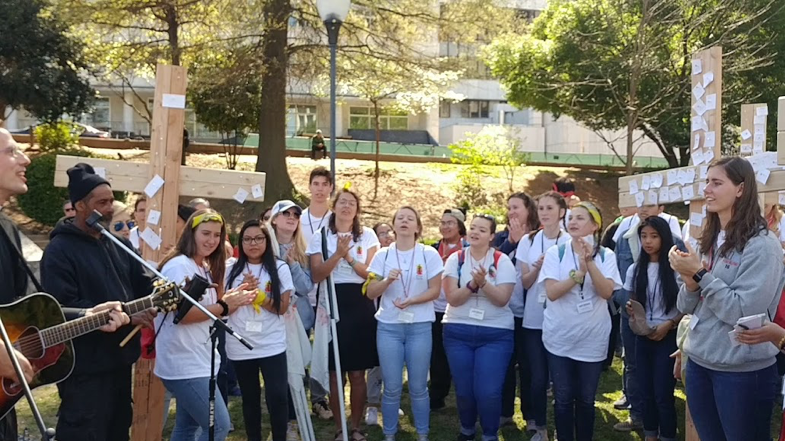
Take the Mission Youth apostolate for example. Last Holy Week they helped Msgr. EdwardThein at the downtown Atlanta basilica of the Sacred Heart.  A hundred of these millennials, decked out in mission t-shirts and singing their very own theme song, spent Holy Week doing an astonishing list of mission work!

Here’s what they did:  they went through the streets and parks in the neighborhood and invited every person to mass, providing detailed lists of mass times and “welcome home” type materials.  They went to the local food pantries, homeless shelters, cancer wards and poor homes to cook meals and embrace all the needy with the warmth of the love of Jesus. They organized living stations of the cross through the nearby parks and downtown Atlanta.  They packed lunches for the poor, helped the Salvation Army, ran an Easter Carnival for underprivileged kids and were present helping at every church service of the holy days.

One of the organizers, a consecrated woman of Regnum Christi named Emily Roman, said “these kids have a mission-focus, their enthusiastic and full of life! Sharing Jesus with others is something they seem to enjoy doing.  What was amazing is that they themselves organized the mission and were running it. This was teen-led and teen-powered.”

“We’re definitely doing this again next year”, said Fr John Klein, one of their chaplains. He added, “Holy Week will now be Mission Week for us.  That’s what the Church is about, right?  Jesus said to go out into the streets to proclaim the good news.  That is literally what these kids are doing!”


For more information:

–How to Set-up a Holy Week Mission

– More info on Mission Youth Missions here.

For Many Churches in North America, Holy Week is Becoming Mission Week Read More »

Regnum Christi Spirituality Center Ask a Priest

“Ask a Priest: Should I Speak Up About a Friend’s Immodest Posts on Facebook?”

Q: I had a question regarding fraternal correction and how it should be done. A friend of mine has immodest pictures on her Facebook. It is not somewhere where most people would see them, but I am wondering if I am obliged to do anything about it and if so, what? Any advice you can give is welcome. I am a guy, by the way. – L.

Answered by Fr. Edward McIlmail, LC

A: It is good that you have concern about your friend, especially in an area where people might have blind spots in their discretion.

The short suggestion is that you could bring this to her attention, but to do it with great charity and prudence.

For starters, it is good to assume that she has a lot of good will. The young woman simply might not understand how the photos could be perceived.

It is understandable that she might be influenced by the images she sees in ads and TV and movies, etc. She might think this is how to look “terrific,” though she might not understand the impression she is making on others, especially men.

Then again, you might ask whether these photos were meant for a very private audience – such as for a few of her women friends who might be less offended by the pictures.

Perhaps you might consider a few steps.

First, take this to prayer. Ask the Holy Spirit for the guidance to say the right thing at the right moment. Ask the Spirit to enlighten your friend, too. You might offer up a Mass or a rosary for this intention.

Second, if and when you decide to say something, mention to her first the things you admire about her: her charity, her joy, her loyalty, etc. If she senses your brotherly love for her, it might make for an ambience in which it is it easier to raise the issue of the photos.

Whatever you do, do it from the perspective of charity. You want to help your friend. And sometimes loves means we are willing to risk saying things that might be hard to hear.

Keep learning more with Ask a Priest

Got a question? Need an answer?

Today’s secular world throws curve balls at us all the time. AskACatholicPriest is a Q&A feature that anyone can use. Just type in your question or send an email to AskAPriest@rcspiritual.wpenginepowered.com and you will get a personal response back from one of our priests at RCSpirituality. You can ask about anything – liturgy, prayer, moral questions, current events… Our goal is simply to provide a trustworthy forum for dependable Catholic guidance and information. So go ahead and ask your question…

“Ask a Priest: Should I Speak Up About a Friend’s Immodest Posts on Facebook?” Read More »

Regnum Christi Spirituality Center Ask a Priest

“Ask a Priest: Why Did God Allow the Fall of Adam?”

Q: Before the fall of Adam, Scripture says there was no death. Did that mean that humans were to remain on Earth and not ascend to heaven? This all goes back to the question some people ask, “Why did God allow all of this?” Yes, we have free will, but why would the “tree of life and the tree of knowledge of good and evil” even be placed in the garden in the first place? According to my research through Catholic sources only, one answer is to test us through our free will, but another answer posed the thought that God already knew what would happen even though it was our free will. This makes sense to me because a logical human being would have a backup plan just in case Adam did eat from the tree. God is infinitely greater than us. So I’m sure God was prepared for either result or even already knew it. Perhaps the temptation was allowed not only to test us, but to allow the human spirit to enter heaven where there is absolutely no evil? I understand that Eden was a paradise and God walked with man, but the fallen angels were still cast out of heaven, and temptation, in this case through the serpent, was clearly in the garden; therefore, man would have never been truly “safe” from the fallen angels or completely one with God in heaven. There might not be definite answers you can offer, but theories and philosophies are more than welcome. – F.M.

Answered by Fr. Edward McIlmail, LC

A: It is good to see that you are thinking and asking these deep questions. That is part of the purpose of Scripture: to draw us deeper into the mystery of God and of salvation history.

Let me say upfront that I won’t have definitive answers for all your questions. Some of these matters are mysterious, which is why we never quite figure out everything. Nevertheless, there are some observations that might help you.

First, let’s say that the temptation – the serpent, and the tree of the knowledge of good and evil – was a test that allowed man to affirm his love and obedience to God. Man failed the test, but that doesn’t mean he lost forever the chance to be united with God in heaven.

As to your questions: First, people would not have remained on earth for all eternity. Our real home is in heaven, so before original sin came along the plan was probably that we would go from this world to the next world fairly smoothly.

As for free will and why God allowed the fall to happen, this is certainly one of the most perplexing questions. God knows all things from eternity. So, yes, he knew man would misuse his free will and sin.

But God’s foreknowledge of man’s fall doesn’t mean God caused the sin. Moreover, God can bring good out of bad, and in this case man’s fall meant that a redeemer would be needed.

That redeemer was Jesus, the Second Person of the Trinity who took on human nature and suffered and died for us. God became one of us, in other words.

That is why in the Easter Vigil Mass, at the Exsultet, we hear that line about “O felix culpa” (O happy fault). The fault of man (sin) brought us so great a redeemer (hence the cause for joy). This is a very profound insight, the kind we could meditate on for a lifetime. We could say that the sending of a Redeemer was God’s backup plan.

As for the trees in Eden: the tree of life could be seen as a symbol of immortality (that is, the absence of death). After the fall, man is barred from the tree of life. This reflects the fact that man will now face death.

The tree of the knowledge of good and evil can be seen as a symbol of the test that God put man to. Eating the produce of this tree is in itself an act of disobedience — which is why man has knowledge of good and evil after disobeying God and partaking of the forbidden fruit.

Maybe your deeper question is why God put man to the test in the first place.

Testing is the way we can grow. Every time we resist a temptation, we grow stronger. To leave someone untested is to leave him a baby all his life. God didn’t want man to remain a baby, but to be a responsible adult who would freely choose to love and obey his Creator.

Man was safe from the influence of the fallen angels to the extent that he obeyed God. Being “safe” isn’t the point of life, by the way.

Imagine a child whose parents never let him out of the house, never let him play with neighborhood kids, so that he would be “safe.” Would that be a happy child? Would that be a healthy child? Maybe not. It might be a child who never learns, never grows, never knows how to deal with real-world problems.

Perhaps you still have questions. That’s good, because these aren’t meant to be exhaustive answers. These are the kinds of questions you can pray about for years. If such praying and questioning brings you closer to God, then that is good.

For more reading, you might want to take a look at Frank Sheed’s Theology and Sanity as a possible next step.

Keep learning more with Ask a Priest

Got a question? Need an answer?

Today’s secular world throws curve balls at us all the time. AskACatholicPriest is a Q&A feature that anyone can use. Just type in your question or send an email to AskAPriest@rcspiritual.wpenginepowered.com and you will get a personal response back from one of our priests at RCSpirituality. You can ask about anything – liturgy, prayer, moral questions, current events… Our goal is simply to provide a trustworthy forum for dependable Catholic guidance and information. So go ahead and ask your question…

“Ask a Priest: Why Did God Allow the Fall of Adam?” Read More »

ECYD Project “Totus Tuus” Promotes the Rosary in Two Mexican Cities

In Acapulco and Mérida, ECYD members participated in an event called “Totus tuus” where they handed out rosaries and encouraged people to pray them. 

The name of the activity arose in honor of the papal motto of John Paul II, “Totus tuus” which comes from the abbreviation of the consecration of St. Louis Marie Grignion de Montfort, “Totus Tuus ego sum et omnia mea tua sunt,” which means, “I am all yours and all that is mine is yours.” 

Mérida 

On Saturday, October 20, children, adolescents and parents belonging to the ECYD Mérida did “Totus tuus.” The event began with the meeting of the participants in the Summit Institute at 10:00 am to pray the rosary, then divided into teams in different locations to encourage people to pray the rosary by means of banners, and distributing rosaries and holy cards. 

This took place in different parts of Mérida, such as Las Américas Park, Salvador Alvarado, Centenario, Hidalgo, Paseo de Montejo, Centro Histórico and Zócalo. 

The activities ended around noon, when they met at the Church of Our Lady of Fatima to join the celebration of the Mass, offered in honor of the Virgin Mary. 

According to the testimony expressed by Eduardo Peniche, the event was made possible thanks to the good organization of AFIRE and the availability of the children who attended. 

Acapulco 

A week later on October 29, ECYD youth of various ages, with team leaders and parents, met in the courtyard of Colegio Liceo in the city of Acapulco, Guerrero to recite of the rosary. 

They were prayers and songs that cheered the hearts of everyone present. The intentions of this rosary were mainly for all the disappeared victims, for the violence that the whole country suffers, for Acapulco, for the migrants, because abortion is not legalized, for a united country, for peace, for family and friends. 

On this occasion the “Totus tuus” was held inside the school due to the violence suffered by the city and not to expose the young people in the streets as it was done previously. 

Because of the situation of violence that Acapulco is experiencing, the members of the Regnum Christi Movement of that locality faithfully believe that by praying and asking Jesus Christ with all their faith, it will help them to improve this situation that keeps the whole population tense. 

This article is a translation of two articles from SomosRC, the Mexican Regnum Christi site.

ECYD Project “Totus Tuus” Promotes the Rosary in Two Mexican Cities Read More »

Regnum Christi Spirituality Center Ask a Priest

“Ask a Priest: What If a Confessor Seems Distracted With His iPad?”

Q: Several months ago in confession I could see through the screen the backlight of the priest’s iPad, and that he was scrolling on it during my confession. When I finished with the “And for these and all my sins …” there was an awkward pause that reinforced the impression that he was not listening. It really bothered me. I pray for him and give him the benefit of the doubt, but should I say something to him or someone else so that others don’t have the same experience? I have great respect for priests, so I feel uncomfortable complaining to him or someone higher up, but at the same time, the sacrament of reconciliation is very important to me. Thank you. – C.

Answered by Fr. Edward McIlmail, LC

A: Your esteem for the sacrament of reconciliation is admirable. It is good that you are taking advantage of the sacrament. It works ex opere operato, which means the grace of the sacrament is there, no matter the holiness of the minister, since it is really Christ who is working.

It is admirable, too, that your reaction was to pray for the priest.

Perhaps he was listening. Or perhaps he allowed himself to get distracted when he shouldn’t. God alone knows.

If you feel you the need to say something, it would be better to say it to him — but within the sacrament of confession, not outside. A priest can’t say anything about what transpires in the confessional, not even to defend himself.

For the same reason it might not be good to say anything to anyone else; at the very least it wouldn’t be good to name the priest. The person you would tell — a pastor or a bishop, for instance — probably wouldn’t say anything to the priest, because he knows that the priest can’t respond. You get the idea.

Meanwhile, you might consider two simpler options.

First, just move on and try to forget the incident. Perhaps the priest wasn’t really at fault. Or perhaps the iPad incident was a onetime slip.

Second, if the incident bothered you deeply, you could seek out another confessor in the future.

At any rate, keep taking advantage of the sacrament. It is really Jesus who is doing the most important work of grace.

Keep learning more with Ask a Priest

Got a question? Need an answer?

Today’s secular world throws curve balls at us all the time. AskACatholicPriest is a Q&A feature that anyone can use. Just type in your question or send an email to AskAPriest@rcspiritual.wpenginepowered.com and you will get a personal response back from one of our priests at RCSpirituality. You can ask about anything – liturgy, prayer, moral questions, current events… Our goal is simply to provide a trustworthy forum for dependable Catholic guidance and information. So go ahead and ask your question…

“Ask a Priest: What If a Confessor Seems Distracted With His iPad?” Read More »

Regnum Christi Spirituality Center Ask a Priest

“Ask a Priest: Is It OK That an RCIA Instructor Propose God as Female?”

Q: At a retreat for the RCIA program we studied the Our Father phrase by phrase. The presentation went well until the end. The instructor caused great confusion in my heart. She told us if we cannot connect with the Father as a male figure, we should try to think of God being a female. Is this a new teaching of the Church? I know God is a spirit and Jesus Christ came into the world as a man, but why would Jesus teach us to pray to our Father if it does not matter the image we have of him? – D.

Answered by Fr. Edward McIlmail, LC

A: Your instinct is right: Jesus talked about his Father and gave us the Our Father because there is something profound in that notion of the First Person of the Trinity as a male image. And Jesus, being the Word of God, the Second Person of the Trinity, the fullness of Revelation, teaches us something profound by his coming into the world as a man, not a woman.

Perhaps the RCIA instructor was simply trying to anticipate the problems that some people have in relating to God as a Father, because their own experience of a human father has been deeply unhappy. This is a not uncommon occurrence nowadays, given the number of broken marriages and dysfunctional families.

In that sense the instructor was probably trying to be pastoral, to help people who have had bad experiences with their dads and who thus have a hard time relating to God as Father.

Perhaps her intention wasn’t to rewrite Scripture or Church doctrine as much as to help the people in front of her to embrace some kind of image of God as a loving Being with whom they can have a warm relationship.

A relevant number from the Catechism worth citing here is No. 239:

“By calling God ‘Father,’ the language of faith indicates two main things: that God is the first origin of everything and transcendent authority; and that he is at the same time goodness and loving care for all his children. God’s parental tenderness can also be expressed by the image of motherhood, which emphasizes God’s immanence, the intimacy between Creator and creature. The language of faith thus draws on the human experience of parents, who are in a way the first representatives of God for man. But this experience also tells us that human parents are fallible and can disfigure the face of fatherhood and motherhood. We ought therefore to recall that God transcends the human distinction between the sexes. He is neither man nor woman: he is God. He also transcends human fatherhood and motherhood, although he is their origin and standard: no one is father as God is Father.”

An example where Scripture presents God in maternal terms is found in Isaiah 66:13 — “As a mother comforts her child, so I will comfort you; in Jerusalem you shall find your comfort.”

With time and the grace of God, all the people in that RCIA program can come to appreciate the Our Father for the beautiful prayer it is and the profound truths it transmits.

Keep learning more with Ask a Priest

Got a question? Need an answer?

Today’s secular world throws curve balls at us all the time. AskACatholicPriest is a Q&A feature that anyone can use. Just type in your question or send an email to AskAPriest@rcspiritual.wpenginepowered.com and you will get a personal response back from one of our priests at RCSpirituality. You can ask about anything – liturgy, prayer, moral questions, current events… Our goal is simply to provide a trustworthy forum for dependable Catholic guidance and information. So go ahead and ask your question…

“Ask a Priest: Is It OK That an RCIA Instructor Propose God as Female?” Read More »

Legion’s First Filipino Father Leads Mission Youth

“I remember going to school early one morning and seeing a middle-aged man by the roadside naked, covered in dirt, famished, his hair disheveled, and his eyes wandering aimlessly as though he were all alone without any hope or support. This, together with many other encounters with the poor strongly beckoned me to dedicate my life to them.” 

Those are a just few words from the vocation story of Fr. Luis Lorenzo, LC. But they go to the heart of what let him to the path of the priesthood.  

Luis came to the United States to attend university in 2004, carrying with him a determination to serve the poor.  But that year turned out to be a remarkable one for the future priest.  

One Friday after confession, the priest asked Luis if he was thinking about becoming a priest, “Because the way you confessed your sins reveals your great desire for the happiness of others, something that God alone can truly bring.”  

Luis said he was open to the idea. And the priest said, “Luis, just remember, the sooner you respond to God’s call in your heart, the sooner the people who are farthest away from Him, who need Him, will find Him too.” 

Fr. Luis believes that is the moment God called him to the priesthood. And the call would soon become more specific. 

He met Regnum Christi that year. And browsing in the bookstore of the Basilica of the Immaculate Conception in Washington, he discovered a book about the Legionaries of Christ, which then led him to contact the Legionaries of Christ in Cheshire, Connecticut. He was soon on his path to become a Legionary of Christ. Today, his path has taken him to the Philippines, where he works with high school boys and college students. 

Mission Youth – Philippines (MYP) is the overarching apostolate for Regnum Christi youth work (high school and college young men and women) in the Philippines. 

“Mission Youth – Philippines (or MYP) gives young people the opportunity to learn from the faith of the poor, and in turn, share their faith with them. It also gives everyone the opportunity to grow in compassion, charity and service towards one other,” says Fr. Luis Lorenzo, current director of MYP. 

The young missionaries come from different high schools and universities in Metro Manila. They spend quality time with poor communities for “whole day missions”, about three times a year, or “Holy Week Missions”. They bless homes, pray with families, teach catechism to children, and invite people back to the Sacraments and other activities of the parish.  

“MYP first brings focus to any good one desires or tries to bring, that is, to help the other person make an experience of God who is real, God who is near, God who is Love,” Fr. Luis said. “One then also become part of that experience, allowing God to transform his heart into one like His. An apostle is one who brings Christ and not himself.” 

“Second, Regnum Christi becomes a team and family with whom I can grow, learn from, and work with in bringing the Good News. Being in a community gives me much strength, support, and value as a person.” 

Fr. Luis is MYP director, but he hardly works alone. Part of the MYP team are Fr. Mauricio Guajardo, LC, Regnum Christi Consecrated Women Claire Umali, Gudelia Guerra and Amanda Eckert, two RC Mission Corps volunteers, and student volunteers from Everest Academy Manila, De la Salle Zobel School, and several universities in Metro Manila. 

“I think our work in MYP makes evangelization more real, more human,” Fr Luis said. “We all learn to love our Lord in the least of our brothers and sisters, and they love and care for us in return, regardless of background or social status. It is an exchange of the many blessings God has given to all of us, especially our faith.  

“MYP contributes to what Cardinal Tagle consistently encourages Filipinos to create and protect against the dangers of secularism and injustice – a culture of caring.” 

Fr. Luis Lorenzo, LC with Cardinal Tagle

Measuring the success of MYP in objective terms is difficult. But Fr. Luis shared a story of an even greater value: 

“Last Holy Thursday, I celebrated the Mass of the Last Supper for the very first time as a priest. In fact, the poor community we were in had also never had a priest be with them during Holy Week.  

At the moment of the Washing of the Feet, I took off my outer priestly garments and bent over to wash the feet of twelve elderly men. You could tell that this was also a first time for them as they took off their sandals. They had all come in from a hard day’s work in the field or in the marketplace.  

Bending over to wash the first man’s feet, I saw how unattractive they were, how tried, and dry, and dirty they were. Then it hit me strongly. This man’s feet were also my feet, my life; and I was washing his feet because our Lord had first washed mine.  

It wasn’t just water pouring down upon this man’s feet from the small plastic pitcher I held. So were my tears. And it became so hard to move and wash the next man. But when I finally stood up from having washed these twelve humble men, I saw that I wasn’t the only one crying. That mass was touching them profoundly.  

Somehow, in some way, we all believed that Jesus had come among us. In the words of one of them, “Father, binisita kami ni Hesus,” that is, “Father, Jesus came to visit us.” It’s hard to express how I felt after that. But how strong the faith of the poor is! I know I can say that their faith strengthens my own.” 

Father Luis Lorenzo LC was born in Manila, Philippines on April 3, 1986. He is the second of four children. He attended Xavier Elementary School and the Ateneo de Manila High School, both Jesuit institutions, before moving to the United States to earn a college degree. In the summer of 2004, he entered the Legionary Novitiate in Cheshire, Connecticut and made his first profession of vows on September 2, 2006. He earned a Bachelor’s degree of Philosophy at the Legionary Center for Higher Studies in Thornwood, New York in 2009. He then spent three years of apostolic ministry in Monterrey, Mexico and New England, as part of the youth ministry and vocational promotion team for the Novitiate. On August 15, 2012, he made his perpetual profession of vows and arrived to Rome to earn a Licentiate in Philosophy and Bachelor’s Degree in Theology. On May 31, 2017, he was ordained to the diaconate in Manila by His Eminence, Cardinal Luis Antonio Tagle. He was ordained to the priesthood with 32 other Legionaries on December 16, 2017, by Cardinal Giuseppe Bertello, President of the Pontifical Commission for the Vatican City State.

Legion’s First Filipino Father Leads Mission Youth Read More »

Scroll to Top

Events

Looking for another country?

Contact Regnum Christi near you

News & Resources

News & Resources

The Regnum Christi Mission

The Regnum Christi Identity

Alex Kucera

Atlanta

Alex Kucera has lived in Atlanta, GA, for the last 46 years. He is one of 9 children, married to his wife Karmen, and has 3 girls, one grandson, and a granddaughter on the way. Alex joined Regnum Christi in 2007. Out of the gate, he joined the Helping Hands Medical Missions apostolate and is still participating today with the Ghana Friendship Mission.

In 2009, Alex was asked to be the Atlanta RC Renewal Coordinator for the Atlanta Locality to help the RC members with the RC renewal process. Alex became a Group Leader in 2012 for four of the Atlanta Men’s Section Teams and continues today. Running in parallel, in 2013, Alex became a Team Leader and shepherded a large team of good men.

Alex was honored to be the Atlanta Mission Coordinator between 2010 to 2022 (12 years), coordinating 5-8 Holy Week Mission teams across Georgia. He also created and coordinated missions at a parish in Athens, GA, for 9 years. Alex continues to coordinate Holy Week Missions, Advent Missions, and Monthly missions at Good Shepherd Catholic Church in Cumming, GA.

From 2016 to 2022, Alex also served as the Men’s Section Assistant in Atlanta. He loved working with the Men’s Section Director, the Legionaries, Consecrated, and Women’s Section leadership teams.

Alex is exceptionally grateful to the Legionaries, Consecrated, and many RC members who he’s journeyed shoulder to shoulder, growing his relationship with Christ and others along the way. He knows that there is only one way, that’s Christ’s Way, with others!