
Living Water: A Lenten Retreat Guide on Christ’s Encounter with the Samaritan Woman
Living Water: A Lenten Retreat Guide on Christ’s Encounter with the Samaritan Woman Read More »



Q: My husband and I are Catholic and converted from Protestantism. We have been Catholic for years but still struggle with all the attention Mary receives. To us she receives more prayers, attention, devotion, processions and obedience than Jesus, which to us still after all these years is worship and not mere veneration. We were going to go to the Orthodox but don’t want to start the church-bouncing thing again, and believe in the basics of the Catholic Church which no other but the Orthodox teach; however, we decided to stay at the Catholic Church. We went to confession (I didn’t mention that I had had problems with Mary and the constant attention to her over God). For penance the priest told me to ask Mary to pardon my sins and then say five Hail Mary’s. I tried to do this penance and felt so spiritually dirty. Why is Mary able to forgive sins? Why was I ask to do this? Is there another explanation I have missed? As is, I had been struggling to go to church because of Mary, and now I never want to go back, not to any church. – M.
Answered by Fr. Edward McIlmail, LC A: I understand the difficulty you are describing. I have a priest friend who is also a convert from Protestantism, and he tells me that people’s exaggerations of Marian devotion were a stumbling block for him even after years of being a Catholic. I hope that a few distinctions and observations can help you in this area. First of all, it’s important to remember that from the perspective of Catholic doctrine (not the practice of individual Catholics), true devotion to Mary always leads us closer to her Son. It is also true that some people can exaggerate Marian devotion if it diverts their attention from Christ as the center of our Catholic faith. But these cases of exaggeration are anomalies — they aren’t the intention of the Church. The Church gives a revered but balanced place to Our Lady in the history of salvation and the work of redemption. Here is an official expression of how the Church sees Marian devotion: “There is but one Mediator as we know from the words of the apostle, ‘for there is one God and one mediator of God and men, the man Christ Jesus, who gave himself a redemption for all.’ The maternal duty of Mary toward men in no wise obscures or diminishes this unique mediation of Christ, but rather shows His power. For all the salvific influence of the Blessed Virgin on men originates, not from some inner necessity, but from the divine pleasure. It flows forth from the superabundance of the merits of Christ, rests on His mediation, depends entirely on it and draws all its power from it. In no way does it impede, but rather does it foster the immediate union of the faithful with Christ” (Lumen Gentium, No. 60). Notice how this teaching recognizes that God chose to involve Mary in the history of salvation in a special way, but her special role flows from (and leads back to) Jesus. Any Catholic who begins to worship Mary as if she were a goddess, or who seeks to obtain grace from her as if she were the origin of that grace, is making a mistake. Mary is important only because Jesus is much, much more important. Think, for example, about the highest form of worship in the Church, the Mass. It is extremely Christ-centered, as it is his sacrifice of himself to God the Father for the redemption of the world. As for the penance you received: Perhaps the priest in his zeal misspoke when he implied that Mary would be the one to forgive you. It is always God who forgives us in the sacrament. Mary cannot forgive sins; only God can do that. I doubt that the priest meant to say anything that could be heretical — after all, he absolves “in the name of the Father and of the Son and of the Holy Spirit.” He was probably just trying to encourage you in your relationship with Mary. Perhaps the solution is all this is to familiarize yourself more with what the Church actually teaches about Mary and Marian devotion. She has an important place in God’s plan; through her the Second Person of the Trinity took on human nature and was born a man. It is significant, too, that from the cross Jesus entrusted her to John and the Church, “Behold, your mother” (John 19:27). The key thing is not to dismiss entirely the role of Mary simply because some folks might seem to take things to an unhealthy extreme. You could read up on Mary in the Catechism, starting at No. 963. Also helpful is a wonderful book by a convert to Catholicism, called Hail, Holy Queen, which explores the scriptural roots of true Marian devotion. Here at RC Spirituality we have also put together some retreat guides on Mary, showing that she can be for us an inspiration and an example in our following of Christ. See, for instance, “Welcoming the Word: A Retreat Guide on the Annunciation.” Having a healthy view of Our Lady will help you in your Catholic faith and in your efforts to come closer to our Lord, as it has helped so many saints through the centuries, such as Pope St. John Paul II. And could help you from the temptation to start “church-bouncing” again. That is the last thing you want to do. You want to be careful, too, because the devil would like to sow seeds of doubt about the Church in you, especially after your journey over the years. In the meantime stay focused on Jesus in the Eucharist and in Scripture. Mary would certainly approve of that. After all, her last words in Scripture are, “Do whatever He [Jesus] tells you” (John 2:5).
Today’s secular world throws curve balls at us all the time. AskACatholicPriest is a Q&A feature that anyone can use. Just type in your question or send an email to AskAPriest@rcspiritual.wpenginepowered.com and you will get a personal response back from one of our priests at RCSpirituality. You can ask about anything – liturgy, prayer, moral questions, current events… Our goal is simply to provide a trustworthy forum for dependable Catholic guidance and information. So go ahead and ask your question…
“Ask a Priest: What If Marian Devotion Seems Too Much?” Read More »

Divine Mercy University and Regnum Christi are teaming up to respond to the need for spiritual directors in the Church. Fr. Robert Presutti, LC, PhD, is heading the initiative.
Fr. Presutti teaches at Divine Mercy University and has been involved in higher education for a number of years. He leads a team of 12 experts in psychology, Catholic spirituality, and spiritual direction, who will be offering the course. He responded to questions via email.

What is the history of training spiritual directors in Regnum Christi? How did you get involved?
Fr, Robert: The great importance of spiritual direction in our lives and for our apostolates is no secret. With the growth of Regnum Christi in North America, it became clear that we needed to expand the opportunities for spiritual direction for our own and for those who benefit from our work. This meant training more spiritual directors or guides. Over the years, various localities made an effort to do so and, most notably, spiritual director courses were organized for the territory at Our Lady of Bethesda Retreat Center in the Washington, DC, metro area. These courses were spearheaded by Fr. John Hopkins and involved the active collaboration of lay and consecrated members and other Legionaries. For years, this program at Bethesda — subsequently replicated in various locations and furthered by the involvement of the RC Spirituality — yielded many good and holy fruits, but it became clear that the opportunity for training needed to extend further. This is where DMU came in.
You mentioned this was a partnership between Divine Mercy and Regnum Christi. How does that partnership work? What does each side provide?
DMU has a tradition of developing rigorous academic programs, both onsite and online. Students literally from around the world participate in DMU’s online programs, and DMU has become known in both Catholic and non-Catholic communities. Naturally, the question arose: is there an opportunity to use DMU’s experience to create a globally-accessible spiritual directors program in conjunction with Regnum Christi in North America? The result would meet the need for training spiritual directors not only for Regnum Christi, but for anyone who wanted to explore this ministry. In this partnership, DMU provides the pedagogical and academic expertise and infrastructure, while Regnum Christi provides a charism that deeply informs the program.
 How do you think this program can help Regnum Christi members? Why might they get this certificate?
This program can help Regnum Christi members in various ways. For those with the call to become spiritual directors, this program will provide the requisite theological background, human skills training, and supervision to begin a fruitful exercise of this ministry or apostolate. For others, some of the courses might become an opportunity for either spiritual deepening or learning human interpersonal skills for apostolates besides spiritual direction.
How might this program compare to other programs out there teaching spiritual direction?
This program is fully online, with two four-day residencies. This makes it widely accessible. Additionally, some distinguishing features include the theological content: this program is set very strongly in the wonderful tradition of Catholic Christian spiritual theology from the time of the Fathers of the Church to present day authors, highlighted by those who are recognized as “doctors” of the spiritual life by the Church. A second distinguishing feature is the interpersonal skills training: this program will draw from the DMU experience of teaching solid interpersonal skills for online students, which has yielded good fruit in the clinical programs offered by DMU (such as the online MS in Counseling degree). Thirdly, this program will provide supervision to students as they begin exercising as spiritual directors, toward the middle and end of the program. As one learns supervision, we can say that “quality” of spiritual direction can increase.
The website says the program includes six online courses offered in eight-week modules, two onsite residences, and a practicum. What kind of time and monetary commitment might a person be putting in to fulfill those requirements?
The courses are $750 each, and residencies are $1000 each.
For the courses, students should expect to work on average five to eight hours weekly when the courses are offered.
For the residencies, students can expect an intensive all-day schedule during their time.
How can people get more information or register?
Please go to www.sdc-divinemercy.org or divinemercy.edu/divine-mercy-university-launches-spiritual-direction-certificate-program.
Fr. Robert Presutti, LC: Helping Others Learn Spiritual Direction Read More »

If there is one place in life where ideals and dreams must come to terms with reality it is in marriage.
Anyone who is married likely has experienced the jolting “what now” moment that comes after dating, the wedding, and the honeymoon. It happens when the young couple is at home together, perhaps sitting over cups of coffee at the breakfast table and the reality of real life hits them directly in their until-now blissful faces.
The questions/complaints may start tumbling forth:
The United State Conference of Catholic Bishops (USCCB) offers materials to address a variety of problems that can beset marriage: addiction, careers, conflict, death of a loved one, disillusionment, domestic violence, finances, household duties, illness, infertility, infidelity, in-laws, miscarriage, personality differences, pornography.
 Young Catholic couples typically have received some level of marriage preparation and may have in mind the ideal of a loving, congenial marriage. But until you are actually there you really don’t know what to expect – and the toolbox to maintain and repair the marriage may be sparse.
Catholics have exceptionally high standards for marriage – perhaps the highest of any religion. Unfortunately, accompaniment of the couple after marriage is pretty much nonexistent. Pre-Cana courses are inconsistent in quality, depth, and fidelity to the teachings of the Church.
In his January 29, 2019, talk to the Tribunal of the Roman Rota, Pope Francis began his remarks by acknowledging the challenges marriages face:
“The society in which we live is increasingly secularized and does not favor the growth of faith, with the consequence that Catholic faithful struggle to bear witness to a style of life in accordance with the Gospel, also with regard to the sacrament of marriage.
“In such a context, it is necessary for the Church, in all her articulations, to act in harmony to offer adequate spiritual and pastoral support.”
 Chelsea and Ryan Harkins, a young married couple and Regnum Christi members in Dallas, believe couples need “post-Cana” accompaniment. And they are doing something that grew from an idea they picked up in Fiji.
The mention of Fiji requires a little historical context.
In August of 2015, Mission Youth brought a team of Missionaries to Fiji to bring the message of St. John Paul II’s Theology of the Body (TOB) to the Archdiocese. Each of the missionaries was specially selected and had a background in TOB. The core of the program was forming trainers in two key areas: Theology of the Body; the other in natural family planning.
Chelsea and Ryan were two of those special trainers. No, they were not married, although they had recently started dating. Each was selected for the Fiji mission because of their background.
Chelsea, who grew up in Houston, was a graduate of Texas Woman’s University, where she met Tammy Grady, a Consecrated Woman of Regnum Christi. Chelsea was a faithful Catholic who wanted to do more for the Church, so she devoted two years of her life as a Regnum Christi Mission Corps volunteer in the Philippines. After her service, she moved to Dallas to finish training as a physical therapist.
Ryan grew up in Mississippi and met Regnum Christi at an early age. He served as a Mission Corps volunteer, then spent seven years as a Legion seminarian, eventually discerning he was not called to the priesthood. He moved to Dallas, taught high school theology for a bit, then became the executive director of Birth Choice Dallas, a pro-life pregnancy center.
Given their RC connections, it wasn’t surprising that Chelsea and Ryan connected in Dallas, dated, fell in love, married, and started a family; John Paul Harkins is a year old.
 As they prepared for marriage, something they had observed in Fiji kept coming to mind. Doing marriage preparation with Fr. Peter Hopkins, LC, only made the importance of proper formation for marriage loom even more vital. When Fr. Peter held a marriage retreat for Chelsea, Ryan, and other engaged couples, the idea for Three to Thrive became real.
Chelsea and Ryan had been impressed during the TOB mission that in Fiji, the bishop requires each Catholic couple who marry not only to attend a Pre-Cana program but to come back for a refresher course after five years of marriage.
There wasn’t such a thing in Dallas, so they invented it – with the help of Fr. Peter, the afore-mentioned Tammy Grady, and a few marriage expert friends.
“We started Three to Thrive because we needed it,” Chelsea says. “And we have to check with each other regularly to make sure we’re practicing what we’re sharing with others.
“Couples have to learn that marriage isn’t just about personal fulfillment for them – it is for the kingdom of God. Jesus starting His public ministry at the wedding in Cana tells us the importance of marriage. God wants us to create and redeem through marriage. We have to ask God what he wants to create through our marriage, through the love He has given us to share.”
 Ryan explains that Three to Thrive meets monthly with a combination of practical and spiritual topics, as well as couple testimonies. The program started small but now has reached more than 200 couples. Initial meetings were in the offices of Birth Choice but now they meet in parishes – and are an approved marriage enrichment program of the Archdiocese of Dallas.
Each monthly session is “stand-alone” so couples won’t miss out if they can come only occasionally. And they can choose topics that interest the most. Couples of any faith are welcome, but Chelsea and Ryan point out that Three to Thrive is “Unapologetically Catholic and orthodox in everything it presents.”
Perhaps the hottest topics are on issues related to family of origin. (That gets into some of the questions mentioned at the top of this article). Even two devout Catholics can feel a strain in marriage because their families imparted different values, styles, and habits on each of them.
Three to Thrive is more “preventative” than “corrective” for marriages. Still, some couples attend because they are struggling. In other cases, couples have seen family members and friends suffer failed marriages and want to make sure they avoid the problems that lead to divorce.
Chelsea and Ryan are blessed to have a team of people who help make the apostolate work. Tammy Grady and a Legionary priest are regular session leaders and consultants. The program also has a Legionary as the chaplain for the apostolate. And there are others:

Still, it takes a lot of time and hard work on the part of Chelsea and Ryan to make the apostolate thrive. They lean heavily on the inspiration of the program’s patron Saint, John Paul II.
And as the name Three to Thrive implies, the Harkins always have a third partner in every part of their marriage: God.
Three to Thrive: The Post-Cana Booster Shot for Young Catholic Couples Read More »

St. Simon and Jude parish in the Woodlands TX (North Houston) takes foot washing very seriously. That’s right. Holy Thursday 2017 the pastor, Fr Pat Garrett, decided he wanted the Holy Thursday foot washing to be more than just symbolic. He invited the people in the pews to spontaneously wash one another’s feet and to also leave their shoes at the altar as an offering to the poor. The result? An extra half-hour of liturgical foot washing and almost 700 pairs of shoes left behind for the poor!
“It was amazing!” said Charlene Alexander, a consecrated woman of Regnum Christi on the pastoral staff. “So many people left their shoes behind and went home barefoot or in the 300 pairs of disposable flip flops that had been donated for this moment. Tears of joy and forgiveness abounded as the foot washing was taking place! Sincere embraces were exchanged after each foot washing…this is what moved me as I observed this most extraordinary moment on that Holy Thursday. I had never seen anything like it.”
It was clearly a Holy Spirit moment. The movement of generosity and desire to live this act was contagious. People of all ages were bringing each other forward and washing one another’s feet and leaving their shoes behind…Did Fr Pat realize beforehand what was going to happen?
He said afterwards: “I wanted the people to have the liturgy tied to a spiritual experience and tied to a missionary outreach. It was prayer, service and mission all in one! I was surprised at just how needed and heartfelt the moment became.”
One could say that Fr Pat has encouraged a way of Christian life in his parish that is discipleship rather than mere catechesis. Sharing the truths of the faith is one way to evangelize, but it’s incomplete by itself. Discipleship is more than just transmitting ideas, it’s sharing a relationship. And this is exactly what happened when liturgy became life. “Attempting to catechize families who have not been evangelized is like planting seeds in concrete. It doesn’t work” added Charlene.
Are they doing it again? This year they are planning a coat drive with similar dynamics. Hopefully it won’t be too cold out as many people are sure to leave their coats at the foot of the altar!
For more information:
– How to Set-up a Holy Week Mission
– More info on Mission Youth Missions here.
Linking Liturgy to Life – How a Parish in Houston is going from Maintenance to Mission Read More »
Q: I was raised Catholic but must admit that in my 20s I completely fell away from the Church. I met, fell in love with and married a Lutheran girl whose family was very involved with their church. I became a Lutheran who since then attends church regularly and has become passionate about my faith in Christ. I know there are some differences in the churches but from a lay perspective they seem so similar. My question is how would the Catholic Church view my road to salvation — given my circumstances, will I be saved? – R.
Answered by Fr. Edward McIlmail, LC
A: The Catholic Church isn’t here to make judgments about the fate of people who leave for another faith. God alone knows the heart and mind of each person.
In any case, a prudent person of any creed shouldn’t presume he will be saved automatically. “Work out your salvation with fear and trembling” (Philippians 2:12).
What the Church does do is propose the fullness of the teachings of Christ and the apostles. Among those teachings are the ones in regards to the sacraments.
While the Lutherans might share a number of things in common with the Catholic Church, they don’t have some key ingredients that Jesus gave us, such as the sacraments of the Eucharist or confession. They don’t recognize the priesthood or the papacy. And they don’t have the seven deuterocanonical books in their Old Testament.
In other words, the Christianity that Lutherans embrace is shorn of crucial elements. This isn’t to question the sincerity of Lutherans — I’m sure that many of them are trying to lead Christian lives — but it is unfortunate that those who broke with the Church in the 16th century left aside various gifts that Christ gave in order to help us reach heaven.
As for your personal journey, you are certainly entitled to follow your conscience. Following one’s conscience can help bring a person to heaven someday.
You might want to reflect sometime on why you fell away from the Catholic Church. It is here waiting, should you decide to return. To help your own reflection, I’d recommend a book of personal stories from people who journeyed into the Catholic faith from other communities: Surprised by Truth, edited by Patrick Madrid.
If you have a deep relationship with Christ, that is wonderful. Perhaps someday you will rediscover the beauty of his real presence in the Eucharist, and in his workings through the other sacraments.
Today’s secular world throws curve balls at us all the time. AskACatholicPriest is a Q&A feature that anyone can use. Just type in your question or send an email to AskAPriest@rcspiritual.wpenginepowered.com and you will get a personal response back from one of our priests at RCSpirituality. You can ask about anything – liturgy, prayer, moral questions, current events… Our goal is simply to provide a trustworthy forum for dependable Catholic guidance and information. So go ahead and ask your question…
“Ask a Priest: Raised Catholic, Now a Lutheran – Can I Be Saved?” Read More »

Fisherman’s Wharf in San Francisco is a tourist hot-spot famous for clam chowder in a bread bowl and street performers. Usually the street artists dwell more on the mundane and superficial, but on Good Friday, nobody would have imagined just how spiritual and deep a “performance” could become!
 What happened was a flash mob. It involves a large group of people planning a spontaneous event such as a song and dance in a public area. They set themselves up secretly within the group as if they just happened to be there. However, one by one they shed their alter-egos and join into a performance that grows into a crescendo.
A group of Catholic millennials from Mission Youth, an apostolate of Regnum Christi, decided to take the flash mob idea and use it as a vehicle for a Good Friday Way of the Cross. The venue would be Fisherman’s Wharf, a place brimming with tourists during Holy Week. In the weeks leading up to Good Friday, they planned and organized themselves. Each one of them had a role to play: Jesus, Mary, soldiers, Simon, Mary, Veronica to name a few. They memorized the script, donned their costumes and then secretly took up their positions among the tourists. Lights, camera, Jesus!
“It was an unforgettable experience,” said one of the kids named Juliana. “I grew up hearing the story of Christ’s Passion, but last Holy Week, it came to life.”
 A young Catholic priest was one of the inspirations behind the event. His name is Fr. Justin Kielhorn. “I work with Millennials a lot. They don’t want to simply be passive in Church. They want a Mission-Church. They like to take their faith into the streets. Kind of like Pentecost!”
The group also helped feed the homeless, gave out free coffees and hugs on Easter morning to cheer up those passing by, and even took the cross across the Golden Gate bridge.
For more information:
–How to Set-up a Holy Week Mission
– More info on Mission Youth Missions here.
Ever Seen a Flash-Mob Way of the Cross? Yes, it’s a Thing. Read More »
Q: I have a question about making a good confession without always going and rolling out my usual “laundry list” of venial sins. Is it expected in confession to list these common sins, i.e., gossiping, pride, anger, not trusting God, etc., especially since they are forgiven at Mass? Or can you confess the one or two that keep popping up in life and/or just go to reconciliation to receive the sacrament for the purpose of receiving God’s healing and guidance in your life? Do you have suggestions for making a good confession? – R.J.
Answered by Fr. Edward McIlmail, LC
A: It is good that you want to take advantage of the great sacrament of reconciliation. It is one of the most underused treasures in the Church.
The key sins that have to be confessed are any mortal sins we might commit since our last confession, and any mortal sins we forgot to confess in the past.
As for venial sins, the Catechism in No. 1458 says:
“Without being strictly necessary, confession of everyday faults (venial sins) is nevertheless strongly recommended by the Church. Indeed the regular confession of our venial sins helps us form our conscience, fight against evil tendencies, let ourselves be healed by Christ and progress in the life of the Spirit.”
So in one sense there is no need to bring a laundry list of all the venial sins we commit, though it is helpful to mention them. And you will note that the use of the sacrament helps us “progress in the life of the Spirit.” This is vital since we are called to holiness.
Now, your suggestion of focusing on one or two recurring venial sins is OK. Perhaps a way to go deeper in your confession is to try to articulate what might be motivating you to commit these sins again and again.
For example, instead of just saying, “I was angry with my sister three times,” it might be good to add, “I give in to anger with my sister because I think I harbor a bit of jealousy toward her, or because I fail to see Jesus in her,” or “I am angry a lot because I think I have been neglecting my prayers lately.”
That kind of introspection might help us go to the roots of problems and dig them out.
Helpful, too, might be Benedict Baur’s classic “Frequent Confession: Its Place in the Spiritual Life.”
Be sure to ask the guidance of the Holy Spirit before confession, too.
Today’s secular world throws curve balls at us all the time. AskACatholicPriest is a Q&A feature that anyone can use. Just type in your question or send an email to AskAPriest@rcspiritual.wpenginepowered.com and you will get a personal response back from one of our priests at RCSpirituality. You can ask about anything – liturgy, prayer, moral questions, current events… Our goal is simply to provide a trustworthy forum for dependable Catholic guidance and information. So go ahead and ask your question…
“Ask a Priest: Do I Need to Confess a Laundry List of Venial Sins?” Read More »
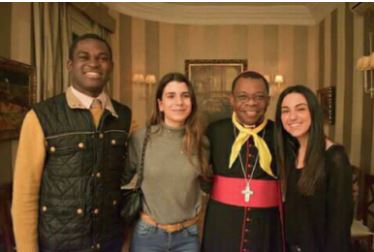
Bishop Miguel Ángel Nguema from Equatorial Guinea spoke with Regnum Christi young adults in Madrid after the youth synod. Mission Youth has been doing missions to his diocese in recent years.
On his way back to his diocese of Ebibeyin, in Equatorial Guinea, Bishop Nguema stopped to speak with Regnum Christi youth in Madrid. The mission Youth trips to his diocese have been from Spain over recent summers.
He was invited to speak at a colloquium organized in the Almagro section and later at the Francisco de Vitoria High School. The bishop shared the key points of the Synod and a message for those present: “Young people should feel protagonists of their history, they should be exemplary professionals. The Church not only needs sacristy Christians, but also young people who take their Christian and social commitment seriously.” The bishop explained several possible concrete means to achieve this: promote education from primary school to university, and their personal commitment in the parishes.
“Young people are a place where I see God,” he continued. When the young person is aware of this, it is because he has begun a journey of education and evangelization. It is important that a young person not only knows that they are love loved, but also that they feel loved.
The Mission Youth apostolate responds directly to what the Synod says. The bishop says that it was the young people of this apostolate who helped him prepare the forums of his diocese for the Synod.
“The youth of today have a more critical spirit, this translates into ability to discern. It is no longer believed ‘because my parents believe,’ this is good because doing good or evil is a free and thoughtful decision,” concluded the bishop from Equatorial Guinea.
This is the second time he has spoken to Regnum Christi young people.
You can read the original on the Regnum Christi Spain website.
Bishop from Equatorial Guinea Visits RC Young Adults after Youth Synod Read More »
