Helping Regnum Christi Get Down to Business

In all labor there is profit, but mere talk leads only to poverty.– Proverbs 14:23

An old newspaper editor once claimed that a charitable organization should call itself a not-for-profit, the point being that it doesn’t exist to make a profit. He said the term “non-profit” could apply to both charities and businesses. After all, there are businesses that despite their best-laid plans, turn out to be non-profits.

In the editor’s somewhat cantankerous insistence on precise language, there was a lesson for charities: just like a business, if you want to succeed you have to have more at least as much money coming in or going out.

There is a good deal of talk these days about the importance of charitable organizations operating on business principles. That means paying attention to the budgets, effectively managing people, and understanding terms like ROI.

According to a recent article in Inc.,the successful nonprofits of the future must operate like innovative business. And the magazine recommends five steps in the process:

  1. Think like a business.  How would you function if all your funding sources suddenly disappeared?
  2. Redefine “customer.”  In addition to those you serve, consider who could become a paying
  3. Package up offerings.  Think creatively about what you “sell,” whether a product, service, event, or experience.
  4. Don’t go it alone. Innovation is about partnerships.
  5. Create a sustainable business model.  Measure your organization like a business.

Forbes has a nonprofit council for senior executives of nonprofits (membership by invitation only). The council has offered 12 ways for a nonprofit to operate more like a for-profit:

  1. Raise Funds And Save Money
  2. Speak The Same Language
  3. Focus On ROI
  4. Build Models Of Earned Income
  5. Run Your NonprofitLike A Startup
  6. Generate Revenue Through Corporations
  7. Don’t Ignore Expenses
  8. Match Costs And Benefits
  9. Make The Mission Itself Profitable
  10. Make Investments In Member Needs
  11. Use Data To Make Decisions
  12. Be An Ecosystem Warrior

In typically direct fashion, Fast Company offers a three-point plan for improving the performance of a nonprofit:

  1. Impact through purpose
  2. Impact through talent
  3. Impact through innovation

Yes, there are many wonderful recommendations and lots of talk about applying business principles to nonprofits. But at Regnum Christ, two men are doing more than talking. They have made it part of their mission to coach localities and apostolates on how to be more effective, be better stewards of the resources they use – and thereby better fulfill the Regnum Christi mission to bring more souls to Christ.

Jeff Garrett of Omaha, is a cradle Catholic and member of Regnum Christi since 1999. He has been involved in adult education and formation, pastoral counsel, communion to the homebound, a member of the Archbishop’s Campaign for Development, and an ambassador for Cloisters on the Platte. In other words, this is an involved Catholic man. And you may have met him on the Regnum Christi website; he is the force behind The Regular Catholic Guy Show.

Jeff also is married; wife Donna is on the Regnum Christi Territorial Council. They have four grown children.

He also has been in the corporate world for more than 30 years, leading large and small sales teams, working in start-ups and in large corporations. These day, he does executive coaching helping men in the areas of work/life balance, leadership, CliftonStrengths, business vision, business planning and life planning.

“There are lots of different challenges in localities that I have seen in RC or experienced in the business world,” Jeff said. “The job of Section Director and Locality Director can be overwhelming and requires a lot of different skills. I was inspired to offer my experience to other localities – in addition to be involved locally

“One of the key things we do in RC is to help form leaders,” Jeff explained. “I feel this apostolate assists in helping the locality leadership develop and learn.”

So…if you a leader in a locality and would like a bit of business counseling, Jeff is your man. Or perhaps it is more accurate to say that he is one of your men. That’s because he has a partner in this apostolate, Atlanta’s Tom Clements.

Tom Clements was raised Catholica and has been involved with nonprofits for more than 20 years. He worked fulltime for Regnum Christi for three years, then spent nine years on the Movement’s Financial Advisory Council. These days, Tom offers his wisdom as a consultant to various apostolates and localities that are looking to improve their business acumen.

Among the apostolates that have benefitted from Tom’s coaching are Catholic Worldview Fellowship and Our Lady of Bethesda Retreat Center.

“Under the locality model we implemented a few years ago, we handed many assets and responsibility over to the localities,” Tom recalled. “But we didn’t have the resources to train people locally and realized we had a huge need for strategic and management consulting with apostolate sand locality leaders. That’s what I’m available to do.”

Tom, who admits he can be a bit of a contrarian, said the success of Regnum Christi in North America lies squarely with the willingness and ability of lay people to assume the leadership of localities and apostolates. That means lay people filling the management roles and minimizing the amount of time priests and consecrated women have to spend in jobs that take them away from their roles as spiritual advisers and evangelizers.

“As lay members of Regnum Christi, we have to relieve our religious and consecrated members of worrying about the business of running operations,” Tom said. “We have to keep in mind that the highest and best use of a priest’s time is providing spiritual direction, preaching retreats, and offering the sacraments. It isn’t going over balance sheets and other business work that a competent lay person can so.”

Tom spoke here from personal experience; he treasures his Legionary spiritual director.

Tom also suggested that apostolate and localities be prudent about putting new assets on the books, noting that Regnum Christi has experience the discomfort of high debt and worked hard to achieve a solid financial structure.

“We’ve made incredible progress over the past few years,” Tom said. “I believe with the strong efforts of lay, consecrated, and religious taking their proper roles as a team, the future is really bright.”

And if you want to get a feel for what Tom the consultant might tell you, check out what Tom the author said in his book: HOW TO RUN A NONPROFIT, The Go-to Guide for all Nonprofit Managers.

Tom and Jeff both believe they – and others like them – can help Regnum Christi achieve what business guru Peter Drucker said of a nonprofit three decades ago: “It’s product is a changed human being.”

Helping Regnum Christi Get Down to Business Read More »

Regnum Christi Spirituality Center Ask a Priest

“Ask a Priest: Since When Is Inappropriate Dress OK at Mass?”

Q: I have recently come back to the Catholic Church after about 15 years. Some of the changes in the new Mass are troubling for me. People in the pews don’t seem to have the reverence that I remember, especially in their attire, especially teenage girls and women. I notice this is very common throughout our diocese. I’ve looked on our diocesan website, and individual parish websites, and I see no mention made of this. Is it no longer considered disrespectful to present oneself in God’s house dressed inappropriately? – C.

Answered by Fr. Edward McIlmail, LC

A: It is good to hear that you have returned to the practice of the Catholic faith. It brings joy to the heart of Jesus to have you home. In turn, it helps to keep your eyes on him. He is the reason why we are here.

You touch on a very real problem: the lack of decorum and immodesty in dress at Mass. It is a reflection of the times and the wider culture, unfortunately. It also reflects deep-seated attitudes toward the Mass itself. The faithful are there to worship Christ. Dressing in something that seems provocative or suited only for a secular venue is not so appropriate at Mass.

In some ways this problem is like the proverbial elephant in the corner. It’s big, it’s there, but few people seem to raise the issue in a high-profile way. So what to do?

Perhaps you could look for ways to promote more-distinguished dress in the parish. This might not be easy, but it is worth a shot. Better to light a candle than to curse the darkness.

Bear in mind that many people have been deeply influenced by the media over the years. It simply wouldn’t occur to some people that their attire isn’t appropriate for a Eucharistic celebration. So there would be a need for a bit of education in this area.

You might broach the subject with other women at the parish and see if there is any support for an effort to promote better dress at Mass. Perhaps you can brainstorm and come up with a proposal, and then, with a companion or two, approach your pastor.

Just beware that this won’t likely be an easy subject to deal with, and the pastor is probably already loaded with work. So try to be realistic and positive. You might look for gradual and subtle ways to promote the idea of dignity and modesty.

In a roundabout way, you might think of promoting an activity such as Pure Fashion at the parish. You might want to build on the ideas presented in the Pure Fashion website.

The key thing is to be loving and patient at every step. While a lot of people don’t have a deep understanding of, or appreciation for, modesty today, it could be assumed that anyone attending Mass has good intentions.

It would be good to take all this to prayer and see where the Holy Spirit is leading you.

Keep learning more with Ask a Priest

Got a question? Need an answer?

Today’s secular world throws curve balls at us all the time. AskACatholicPriest is a Q&A feature that anyone can use. Just type in your question or send an email to AskAPriest@rcspiritual.wpenginepowered.com and you will get a personal response back from one of our priests at RCSpirituality. You can ask about anything – liturgy, prayer, moral questions, current events… Our goal is simply to provide a trustworthy forum for dependable Catholic guidance and information. So go ahead and ask your question…

“Ask a Priest: Since When Is Inappropriate Dress OK at Mass?” Read More »

New Book Shares the Adventures of the Missionary of Wall Street

Sometimes you come across people with stories so compelling you wish you could sit down with them for an afternoon and just listen to them relate their adventures. Steve and Evelyn Auth are good examples.  He is an energetic Wall Street investor with a wry smile, and she is a warm and engaging prayer warrior who speaks softly and in a way that makes people pause to listen. You know there is something unique about this couple just by meeting them.

What am I, a chief investment officer of one of the country’s largest investment managers, doing hailing down strangers at night on the streets of New York City? “Are you Catholic?” my friends and I ask… -from The Missionary of Wall Street

Steve is indeed the Executive Vice President and a chief investment officer with Federated Global Equities. He earned his undergraduate degree at Princeton University, where he graduated summa cum laude, and his graduate degree at Harvard Business School, where he was a Baker Scholar. As a leading investor and financial analyst,  Steve is a frequent guest on CNBC, Fox Business News, and Bloomberg TV, but in his new book, The Missionary of Wall Street, published by Sophia Institute Press, Steve ventures out of his investment wheelhouse and shares an entirely different side of himself.

You can almost hear Steve’s New York accent and the hint of humor in his voice as he relates not only his story, but stories of some of the estimated 2.5 million New Yorkers that he, Evelyn, and a band of street missionaries have encountered over the last 10 years around Prince & Mott in SoHo.  Of those 2.5 million, over 10,000 people have come to confession during the missions, many for the first time since their first communion.  Many thousands more have been accompanied by street missionaries into a church to pray or light a candle.

The book shares the true and remarkable stories of the miracles that happen on the street when Catholics become missionaries in the city that is the epicenter of secular culture. They base their evangelization outreach at Old St. Patrick’s in SoHo, led by the inspiration of Monsignor Donald Sakano, the pastor.  Their primary goal is to engage fallen away Catholics and accompany them in taking their first steps back into the Church. Stationed on neighborhood street corners, they greet passers-by with a warm smile and the question, “Are you Catholic?”  The answer to that question (or more often the lack of an answer) determines what happens next. Steve estimates that for every person who says yes and stops to speak with a missionary there are about 40 who just ignore them or respond with a quick negative.

The harsh reality is that, for every successful encounter on the streets of SoHo, our missionaries are rejected or ignored or yelled at by a minimum of twenty passers-by, an average of forty, and on some nights eighty or a hundred.

On top of our own natural human reactions to that abuse in the streets, add the role of the devil. Rest assured, the devil is not happy about our new evangelization. Most of the souls we encounter are on some level of his slippery slope—some are near the bottom, convinced they’re lost, or even no longer aware of eternity and their impending lost future….Most are practicing a reasonably sophisticated form of rationalization, convincing themselves that, for some reason or another, their behavior is morally acceptable….

Before we head to the streets, I stop in the church to pray, maybe even do a daily confession. I put myself in the hands of the Holy Spirit and ask Him to carry me through. When I do this sincerely and with deep faith, I always find I have joyful, confident perseverance through the long night of darkness.

Once you have the habit of joyful perseverance, you’ll keep going even when everything seems to be working against you. Even the weather.

Then success will sneak up on you and surprise you.

In today’s world of me first, love—true love—is in short supply. Lost souls hunger for love. And when they sense true love in a missionary’s spirit on the street, inevitably they’re drawn in. -from The Missionary of Wall Street

Sometimes God uses the missionaries to reach people outside of the Catholic faith as well, like Khalid, whose story Steve relates in the book:

Prince and Mott, SoHo.
Tuesday of Holy Week, 2017

It’s a beautiful, joyful evening in SoHo. It appears summer has come two months early. The afternoon sun is shining warmly in our faces, and joy is in the air.

Then Khalid, a Muslim from Morocco, walks by.

“You Christians all want to kill us!” he tells one of our missionaries.

A heated discussion follows. We have lots in common. Abraham, the father of both faiths. God, who inspired Mohammed, is the same God we worship. Jesus is at least a great prophet in a Muslim context.

“But the world is going to hell! Too many of you are trying to get us!” Actually, he uses some much more colorful language, but I’m not going to repeat it.

“Khalid, can you stop using those kinds of words out here on the street? You’re bigger than this. You’re a child of God. Come on!”

Khalid is still hostile; and the language is no less colorful. “Khalid, you’re trying to rile me up, but it’s not going to work. I love you too much. You’re my brother. Love will always conquer hate.”

“No way!”

“Khalid, I want you to go into the church to light a candle before God, and to pray for me. Can you do this for me?”

It takes some talking and a lot of Christian love, but somehow, someway (the Holy Spirit, perhaps?), Khalid finds the strength to head into a church for the first time in his life.”


Steve has a compelling story of his own as a cradle Catholic who had a dramatic “re-version” almost 20 years ago. He is a Regnum Christi member, and a national board member of the Lumen Institute. He makes it clear that the cause of the missions’ success, and of each individual conversion he has witnessed, is not him, but Jesus Christ who calls the missionaries out into the streets and lets them actively witness what he is doing in the lives of the passers-by that they engage. The Missionary of Wall Street invites the reader out of the holy huddle and on to the cold and tough street corners of New York.  You get the sense that as he tells these stories, each more improbable and transformative than the last, Steve is just as amazed as the reader is.


These inspiring tales of Steve Auth’s faithful band of Catholic missionaries working the street corners of New York City reads like a 21st-century version of the Acts of the Apostles.”

Jim Towey
President – Ave Maria University


Woven among the stories is another key component of the book. Pausing from his narrative every now and then, Steve speaks directly to the reader as a would-be missionary, giving tips on how to engage in street evangelization effectively.  In an experienced but accessible way, he shares the key elements of running a street mission, essential strategies, and some do’s and don’ts that he has learned over the years. Having touched millions of passers-by in New York over the last decade as the missionary of Wall Street, Steve may very well touch millions more through those who read this book and are inspired to step out and become missionaries themselves.

The Missionary of Wall Street is available in paperback and e-book from Sophia Institute Press.

For a taste of what you’ll find in the book, watch a recent talk Steve gave at an Atlanta Regnum Christi Convention below.

New Book Shares the Adventures of the Missionary of Wall Street Read More »

Regnum Christi Spirituality Center Ask a Priest

“Ask a Priest: Is Baptism Required for Salvation or Not?”

Q: The Catechism in No. 1257 says, “God has bound salvation to the sacrament of Baptism, but he himself is not bound by his sacraments.” What does this mean? Does someone need to be baptized or not? – B.

Answered by Fr. Edward McIlmail, LC

A: Basically it means that baptism is the ordinary means that God uses to bring people into the Church, to take away their original sin, and to make them his adoptive children – in short, to open the path of salvation to them.

People who understand the necessity of baptism are required to undergo baptism.

For people who might not hear the Gospel or have a chance at baptism, though they believe in Jesus and seek to become Christian, God steps in and fills in the gap, so to speak. This is what is known as baptism of desire.

The Catechism in No. 1260 says, “‘Since Christ died for all, and since all men are in fact called to one and the same destiny, which is divine, we must hold that the Holy Spirit offers to all the possibility of being made partakers, in a way known to God, of the Paschal mystery.’ Every man who is ignorant of the Gospel of Christ and of his Church, but seeks the truth and does the will of God in accordance with his understanding of it, can be saved. It may be supposed that such persons would have desired Baptism explicitly if they had known its necessity.”

While baptism is an ordinary means for salvation (the person also has to do other things as he goes through life, but that’s another issue), God can bring about salvation for a person by other means.

In other words, God established the ordinary means, but he still reserves the right, so to speak, to use extraordinary means in accordance with his wisdom and goodness. Note that in Matthew 8:11 Jesus mentions Abraham, Isaac and Jacob being in the kingdom of heaven. Obviously they didn’t receive water baptism as Christians do. But they made it to heaven.

An analogy might help: Imagine you lose your wallet in the middle of a bad storm, and you need to get home. A bus driver, who normally requires passengers to pay the full fare, might take pity on you and let you ride for the 25 cents you have in your pocket. The rules about bus fares remain, but you were granted an exception.

It’s a bit like with baptism. God can let people on the bus who otherwise can’t pay the full fare. But if they can pay, they need to pay. I hope some of this helps.

Keep learning more with Ask a Priest

Got a question? Need an answer?

Today’s secular world throws curve balls at us all the time. AskACatholicPriest is a Q&A feature that anyone can use. Just type in your question or send an email to AskAPriest@rcspiritual.wpenginepowered.com and you will get a personal response back from one of our priests at RCSpirituality. You can ask about anything – liturgy, prayer, moral questions, current events… Our goal is simply to provide a trustworthy forum for dependable Catholic guidance and information. So go ahead and ask your question…

“Ask a Priest: Is Baptism Required for Salvation or Not?” Read More »

Guadalupe Radio: A Spiritual Safe Harbor in a Challenging World

Most Americans have warm and sunny thoughts of Southern California. It is a place for family vacations: Disney World, Venice Beach, Hollywood, Universal Studios.

Southern California is the home of surfers and stars, a laid-back culture of beautiful people who set the style trends for the rest of America. It is permissive and passionate in its pursuit of pleasure.

But for many in Southern California, dreams of stardom and the good life are lost to the daily struggle to make ends meet. A large segment of the population has different dreams than a visit to the Magic Kingdom. They are looking for a way to support their children, give them an education, and provide them the opportunity for a better life.

The lion’s share of this “other” population is Hispanic, with a heritage mostly from Mexico and various Central American countries. This Hispanic population makes up roughly half of the nearly 10 million people in Los Angeles County. This makes the county the largest Hispanic population among all American counties – and there isn’t a close second.

As a recent report by the Los Angeles County Economic Development Corporation shows,the gap between Hispanics and the rest of the population – from an economic perspective – is substantial. A few key statistics:

  • 4 percent of Hispanics age 25 and older have a high school diploma; for the rest of the population it is 77.3 percent.
  • Hispanic median household income is $46,850; for the rest of the population it is $59,135.
  • 5 percent of Hispanic families in Los Angeles are living in poverty.
  • Unemployment is 7.4 percent for Hispanics and 6.9 percent for others.

However, the wealth of a community is not only in the material. Its greatest treasure lies in the spiritual, which in Southern California’s Hispanic community is grounded in the Catholic Faith. That faith is supported by the Archdiocese of Los Angeles and its and many parishes and programs.
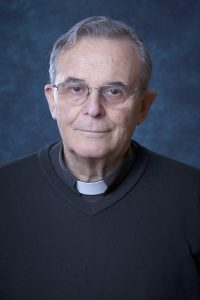
In fact, the largest segment of the Catholic population in the archdiocese is Hispanic.  There are 228 parishes with an organized Hispanic ministry, and nearly 370,000 attend the 638 weekly Masses in Spanish.

The faith also is strengthened by Guadalupe Radio,a far-reaching apostolate of the Legionaries of Christ. And despite the name, it includes outreach programs, videos, publications, events that inspire people to return to parishes and the archdiocese – in addition to 24-hour-a-day radio programming.

“What we have is a church on wheels,” said Fr. Lorenzo Gomez, LC, who heads institution advancement for Guadalupe Radio.  He explained that the station reaches five-six million listeners (Spanish speaking) a month from Los Angeles to Tijuana, Mexico.

If you visit the Hispanic communities in Southern California, you will hear Guadalupe Radio blaring from car radios. A high percentage of women listen at home or at work where permitted. And don’t be surprised if you hear the rosary coming from the speakers of a delivery truck. For many people who work long hours – and may not read English or Spanish well – it is a true spiritual lifeline.

Fr. Gomez said that everything the apostolate does is designed to evangelize, either bringing people to the faith or helping them return to the faith if they have wandered away. Because some of those reached are new immigrants or in extreme poverty, they are facing issues with drugs, abuse, gangs, and marital infidelity. Although generalizations can be dangerous, he says sees many families where the men are rather savage – and the women brave, depending on their faith to hold the household together.
“We attract them through the radio, then through various programs, then encourage them back into the parishes,” Father explained. “God uses the radio to give people a chance to come to the faith. Some families have faced tragedy, but every family that comes to us becomes a miracle, a miracle of conversion…you see God’s work all the time.”

He explained that Guadalupe Radio provides formation in the faith to people who have had little formal education. Couples that have live together but never married come back to the Church and experience the blessing of a sacramental union.

A remarkable aspect of the apostolate is how it raises money. While there are some significant benefactors, the bulk of the budget comes from the people who are helped.

“It is beautiful to see how generous people are – people who have so little,” Fr. Gomez said. “We just had a fundraising campaign that raised $1.2 million and nearly all of it came in small amounts: $10, $20, maybe $50. People see the change Christ has made in their lives and they want to help.”

Those small donations – coming in the thousands – allow Guadalupe Radio to conduct its wide variety of programs and events. And some of them are nothing short of monumental.

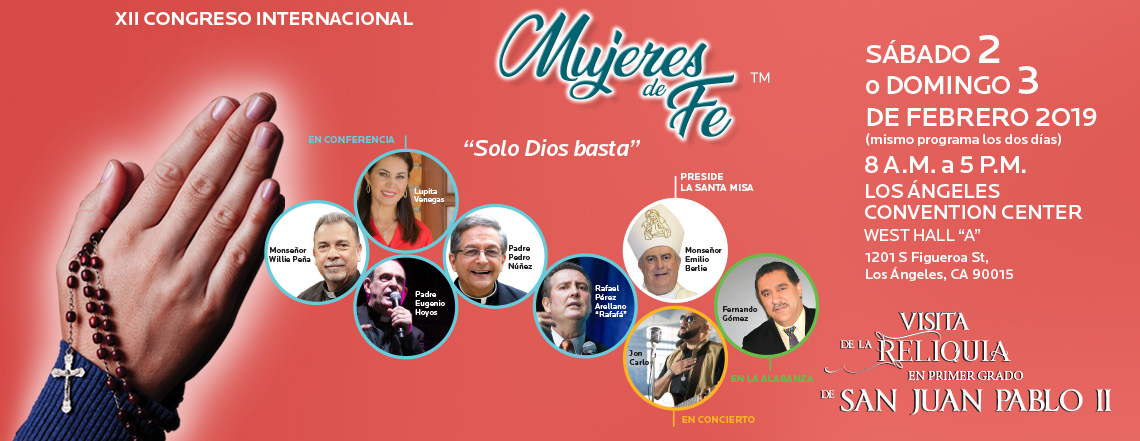
The Women of Faith International Congress– sponsored by Radio Guadalupe – drew 15,000 attendees to the Los Angeles Convention Center the first weekend of February, 2019. It is the largest event in the country to address the needs of Spanish-speaking women and featured a combination of inspirational speakers, faith leaders, and entertainers.

Guadalupe Radio sponsors half a dozen events on this scale each year. Fr. Gomez points out, however, that events for men draw a smaller crowd (only about 5,000). That seems to go with the reality that in the Hispanic community in Los Angeles, the women tend to take the lead to responding to evangelization.

Another major event upcoming April 13-14, 2019, is Cristo Vive,a remarkable presentation of Christ’s Passion, presented at the 1600-seat United Artist Theater in Los Angeles.It will be a live stage production with more than 100 actors. There will be six performances, almost certainly to have every seat filled. Last year’s event, at the 2000-seat Orpheum Theatre in Los Angeles was a sellout (five performances).

Fr. Gomez insisted that none of these huge events – or the regular programs of the radio station – would happen without the participation of the laity. In fact, lay Catholics are the staff, the management, the technical expertise and the force that gets everything practical done. And by having lay leadership, he and the other Legionaries in Los Angeles are able to concentrate on priestly things.

“Our priests concentrate on preaching, sacraments, and spiritual direction,” Father said. “Having lay people doing the management and production is a real blessing.

“It is mission work, but in a city. Like missions during holy week to remote villages, but instead of going out and knocking on doors we are using the radio.

“To me, the greatest accomplishment is to bring the Catholic Church to so many people – it is evangelization, 24 hours a day. To bring God to this society is so beautiful – and last year we had five young men decide to test a vocation with the Legionaries of Christ.”

Guadalupe Radio: A Spiritual Safe Harbor in a Challenging World Read More »

Regnum Christi Spirituality Center Ask a Priest

“Ask a Priest: Is It Sufficient to Receive Communion Under One Species?”

Q: My Lutheran friends, a minister and his wife, are debating with me and insist that the reception of Holy Communion must be under both species. They assert that when Jesus said, “Eat my flesh and drink my blood,” he meant not only the priest should receive the Eucharist, but the faithful also. The reason this debate began is because in my parish, where a new pastor arrived, the wine is no longer served. Upon research, I found that within the 2,000 years of the Church’s history, the distribution of the Eucharist has been modified as time when by, for various reasons. Lutherans contend that receiving the Holy Eucharist under only one species is not following Our Lord’s command, hence, Catholics are not adhering to Christ’s teaching. Is there a valid clarification I can give them? Thank you. – D.

Answered by Fr. Edward McIlmail, LC

A: In the early 15th century Jacob of Mies, a professor in Prague, promulgated the idea that the partaking of both the host and the chalice at Communion was of absolute necessity for salvation. He cited Christ’s words: “Amen, amen, I say to you, unless you eat the flesh of the Son of Man and drink his blood, you do not have life within you” (John 6:53).

The belief came to be known as Utraquism (from the Latin sub utraque specie, “in both kinds”).

In response, the Council of Constance (1414-1418) raised to the level of dogma the point that Christ is fully present under each species. The Council of Trent reaffirmed this teaching in the 16th century.

The basic reason for this teaching is the hypostatic union (a theological term used to express the revealed truth that in Christ one person subsists in two natures, the divine and the human) and the indivisibility of Jesus’ glorified humanity.

In simpler terms, Christ himself is not divided. So, those who receive the consecrated host receive the full Christ. Likewise those who receive only from the chalice receive the full Christ.

One reason the Eucharist is sometimes distributed at Mass under both species is to make the sign of the sacrament more readily discernible. But it isn’t essential for the laity receiving Communion.

There is, of course, a more important difference between Catholics and Lutherans over the Eucharist. Catholics believe that the bread and wine change completely into the body and blood of Christ, a process known as transubstantiation.

Lutheranism believes that the body and blood of Christ are truly and substantially present with the bread and wine, a process that has been called consubstantiation. Lutherans themselves tend to call it sacramental union.

Now, it’s unlikely that your friends will be won over by the content of this answer. But I offer it here to help you realize that the issue of Communion under both species was decided on by the Church a long time ago.

Keep learning more with Ask a Priest

Got a question? Need an answer?

Today’s secular world throws curve balls at us all the time. AskACatholicPriest is a Q&A feature that anyone can use. Just type in your question or send an email to AskAPriest@rcspiritual.wpenginepowered.com and you will get a personal response back from one of our priests at RCSpirituality. You can ask about anything – liturgy, prayer, moral questions, current events… Our goal is simply to provide a trustworthy forum for dependable Catholic guidance and information. So go ahead and ask your question…

“Ask a Priest: Is It Sufficient to Receive Communion Under One Species?” Read More »

Regnum Christi Spirituality Center Ask a Priest

“Ask a Priest: Is Acting Sinful?”

Q: I’m enrolled in an acting class at my college and we’re doing a play by Molière. I was cast as someone who doesn’t have any lines. I’m wondering if it would be wrong to be in this play and if acting in general is sinful. – S.K.

Answered by Fr. Edward McIlmail, LC

A: Perhaps there isn’t much in a Molière play that would scandalize many people in the 21st century. But the wider question you raise is an important one: Is acting in general sinful?

Acting is not intrinsically sinful. It involves talents that can enlighten and entertain others. Pope St. John Paul II was an actor in his youth.

The key point is what you act in. If you are acting in things that are edifying or artful in a positive sense, then that’s OK. If you are talking about acting in things that are obscene or salacious, then you might be putting yourself in mortal sin and being a source of scandal for others.

John Paul II in his 1987 address to leaders of the communications industry, in Hollywood, said, “Your work can be a force for great good or great evil.” That caveat could apply to acting. (See the Pope’s full address.)

This is the moment when you might want to take things to prayer and make some fundamental decisions. The temptation for actors, especially since many of them struggle to start a career, is to accept any kind of role — and all too often the roles offered aren’t morally uplifting.

Of course, most good dramas also have characters who make mistakes or commit sins. In that sense, an actor may play an evil or an antagonistic character, since the play as a whole is worthy. Pope Pius XII explains this in greater detail in his discourse “The Ideal Film.”

You might need to consider whether you can act within moral boundaries, or whether the field in general will compromise you. This is not a danger to be underestimated.

Perhaps you might want to try to network with like-minded actors and artists who want to use their talents for the glory of God. You might check out the Act One site, for ideas.

Although it is a daunting task to use acting to promote a Christian outlook, it is not impossible.

Keep learning more with Ask a Priest

Got a question? Need an answer?

Today’s secular world throws curve balls at us all the time. AskACatholicPriest is a Q&A feature that anyone can use. Just type in your question or send an email to AskAPriest@rcspiritual.wpenginepowered.com and you will get a personal response back from one of our priests at RCSpirituality. You can ask about anything – liturgy, prayer, moral questions, current events… Our goal is simply to provide a trustworthy forum for dependable Catholic guidance and information. So go ahead and ask your question…

“Ask a Priest: Is Acting Sinful?” Read More »

Regnum Christi Spirituality Center Ask a Priest

“Ask a Priest: Can a Soldier Kill and Still Make It to Heaven?”

Q: It came up in a debate earlier whether or not soldiers go to heaven. The main point of contention was that soldiers (for the most part) kill, and the Commandments state, “Thou shall not kill.” If a soldier (or police officer, for that matter) who has killed in the line of duty dies before they have the opportunity to confess the sin of killing and to perform penance, where would their soul go after death? – K.G.

Answered by Fr. Edward McIlmail, LC

A: The commandment “Thou shall not kill” involves primarily the killing of innocent people. The Church has long accepted that killing can be permitted in the case of self-defense or the protection of innocent lives, which would include police and soldiers using deadly force.

A few numbers are worth quoting from the Catechism:

Legitimate defense

2263 The legitimate defense of persons and societies is not an exception to the prohibition against the murder of the innocent that constitutes intentional killing. “The act of self-defense can have a double effect: the preservation of one’s own life; and the killing of the aggressor. … The one is intended, the other is not.”

2265 Legitimate defense can be not only a right but a grave duty for one who is responsible for the lives of others. The defense of the common good requires that an unjust aggressor be rendered unable to cause harm. For this reason, those who legitimately hold authority also have the right to use arms to repel aggressors against the civil community entrusted to their responsibility.

Later, No. 2310 says:

“Public authorities, in this case, have the right and duty to impose on citizens the obligations necessary for national defense.

“Those who are sworn to serve their country in the armed forces are servants of the security and freedom of nations. If they carry out their duty honorably, they truly contribute to the common good of the nation and the maintenance of peace.”

So, people who have the responsibility to protect the common good can rightly use deadly force if that is the only way to stop unjust aggressors.

Thus, police and soldiers who killed in the line of duty and who otherwise are in a state of grace can certainly attain to heaven.

Keep learning more with Ask a Priest

Got a question? Need an answer?

Today’s secular world throws curve balls at us all the time. AskACatholicPriest is a Q&A feature that anyone can use. Just type in your question or send an email to AskAPriest@rcspiritual.wpenginepowered.com and you will get a personal response back from one of our priests at RCSpirituality. You can ask about anything – liturgy, prayer, moral questions, current events… Our goal is simply to provide a trustworthy forum for dependable Catholic guidance and information. So go ahead and ask your question…

“Ask a Priest: Can a Soldier Kill and Still Make It to Heaven?” Read More »

Our Formation Pathway: A Regnum Christi Essay on Integral Formation and the Journey to Christian Maturity

Regnum Christi has always been passionate about integral formation—the ongoing pilgrimage of faith that gradually leads us to greater and greater intimacy with God, apostolic fruitfulness, and personal fulfillment.  Integral formation is not only an instrument that enables us to evangelize better, the way training enhances an athlete’s performance during the actual competition, but rather, our own formation actually comprises, at least in part, the building up of Christ’s kingdom. Formation certainly prepares us for our Christian mission, but at the same time it is our mission; integral formation builds up Christ’s kingdom within us.   

Our Formation Pathway: A Regnum Christi Essay on Integral Formation and the Journey to Christian Maturity Read More »

Scroll to Top

Events

Looking for another country?

Contact Regnum Christi near you

News & Resources

News & Resources

The Regnum Christi Mission

The Regnum Christi Identity

Alex Kucera

Atlanta

Alex Kucera has lived in Atlanta, GA, for the last 46 years. He is one of 9 children, married to his wife Karmen, and has 3 girls, one grandson, and a granddaughter on the way. Alex joined Regnum Christi in 2007. Out of the gate, he joined the Helping Hands Medical Missions apostolate and is still participating today with the Ghana Friendship Mission.

In 2009, Alex was asked to be the Atlanta RC Renewal Coordinator for the Atlanta Locality to help the RC members with the RC renewal process. Alex became a Group Leader in 2012 for four of the Atlanta Men’s Section Teams and continues today. Running in parallel, in 2013, Alex became a Team Leader and shepherded a large team of good men.

Alex was honored to be the Atlanta Mission Coordinator between 2010 to 2022 (12 years), coordinating 5-8 Holy Week Mission teams across Georgia. He also created and coordinated missions at a parish in Athens, GA, for 9 years. Alex continues to coordinate Holy Week Missions, Advent Missions, and Monthly missions at Good Shepherd Catholic Church in Cumming, GA.

From 2016 to 2022, Alex also served as the Men’s Section Assistant in Atlanta. He loved working with the Men’s Section Director, the Legionaries, Consecrated, and Women’s Section leadership teams.

Alex is exceptionally grateful to the Legionaries, Consecrated, and many RC members who he’s journeyed shoulder to shoulder, growing his relationship with Christ and others along the way. He knows that there is only one way, that’s Christ’s Way, with others!