Regnum Christi Spirituality Center Ask a Priest

“Ask a Priest: How Could My Love for a Married Man Be Wrong?”

Q: My ex-husband and I were married in the Church for 24 years and have been divorced for two years. I have a court-awarded permanent restraining order against him and cannot contact him regarding the annulment process. I am not even sure if I qualify for an annulment. We had a good marriage for many years — three children, we were both Eucharistic ministers. I am struggling now because I feel lost in regards to receiving the sacraments. I am in love. And I’ve never been in a situation where love was considered “wrong.” The man I love is my best friend, and he is married. He is not Catholic. I cannot stop myself from loving him. It is not lust, it is not merely sexual (though we have had relations), he has been my friend for over a decade, and we have grown very close. Shortly after divorcing, I went through an immoral phase — drinking, partying, sleeping around. I regret that phase and am deeply sorry for those sins, but I have not been to confession for those things — because I can’t go to confession and leave things out, yet I can’t confess being in love with a married man because I don’t feel sorry for it. And I have no intention of terminating my relationship with him. I have a hard time believing God would turn his back on me for loving someone I’m not supposed to love. I yearn for holy Communion. I ache to confess my past sins. But I don’t feel that my love is wrong, and therefore can’t confess and ask forgiveness. I know the easy answer is to simply terminate my relationship. I can’t. Even before we were intimate, we loved each other. It is not a relationship I can just drop and walk away from. I consider myself a good Catholic. I have never strayed from the Church. Never questioned my faith. But I struggle with my emotions. I love God. Deeply. And I love this man. Deeply. I cannot lose one for the other. Any advice or thoughts would be greatly appreciated. Thank you. – C.

Answered by Fr. Edward McIlmail, LC

A: Thank you very much for this question. It is clear that you are suffering greatly in your current situation. I promise to pray for you, in addition to sharing some thoughts here, which I hope will be helpful for your reflection.

There seems to be a basic misunderstanding at the root of your difficulty. It is never a sin to love someone. Loving someone means actively willing what is best for that person. You can certainly love, in this authentic way, anyone, including someone else’s husband.

But there are different ways of expressing our love for people: appropriate ways, and inappropriate ways; helpful ways, and harmful ways.

Clearly, committing adultery with someone is neither an appropriate nor a helpful way to express love for that person.

Authentic love expresses itself in ways that respect each person’s state in life. Without that respect, we end up damaging ourselves, others, and the Church.

If you truly love this man, you will seek God’s help and grace to continue loving him, and that will include ending once and for all the adulterous affair. You don’t have to ask God’s forgiveness for loving this man, only for committing adultery with him, and for all the lies and deceptions that always accompany adulterous relationships. Let me explain a little bit more.

We have inherited original sin from our first parents. And the effects of original sin are these: It darkens the intellect, weakens the will, and disorders the passions.

The devil tries to play on the damage done by original sin, which is why we can often be mistaken about things.

Jesus knew this, which is why he didn’t pull punches on certain topics. “Everyone who divorces his wife and marries another commits adultery, and the one who marries a woman divorced from her husband commits adultery” (Luke 16:18).

You might feel in your heart as though this adulterous relation is good. But feeling so doesn’t make it right.

Our feelings can often mislead us. Think of your own wedding day and the love you felt for your husband and he for you. Those feelings have evaporated. (Feelings aren’t the same as love, but that is another topic.)

The point here is that feelings are not the firmest ground to stand on. We need something more durable. This is where faith comes in. And this is why we have the Church to guide us.

Now, the Holy Spirit wouldn’t guide the Church for 2,000 years to teach one thing about marriage, and then whisper something different in your heart. That just isn’t the way God works.

For the sake of your soul, and your friend’s, and for the sake of his marriage, you need to step back and rethink things. Is it God who has turned his back on you? Hardly. He only wants the best for you and for all of us. Which is why he commands that we respect marriage and practice chastity in our respective walks of life. And doesn’t your friend’s wife have a right to his fidelity?

It would help to speak to a priest directly. There might be a chance for annulment, too, though you would need to research that a bit.

It might also help to do a retreat. Our affiliated movement Regnum Christi offers retreats around the country, http://www.regnumchristi.org/en/retreats/.

At least you are honest enough to recognize that you are not ready for confession yet. The Holy Spirit can work with honest souls.

I hope you let the Spirit speak to you clearly.

Keep learning more with Ask a Priest

Got a question? Need an answer?

Today’s secular world throws curve balls at us all the time. AskACatholicPriest is a Q&A feature that anyone can use. Just type in your question or send an email to AskAPriest@rcspiritual.wpenginepowered.com and you will get a personal response back from one of our priests at RCSpirituality. You can ask about anything – liturgy, prayer, moral questions, current events… Our goal is simply to provide a trustworthy forum for dependable Catholic guidance and information. So go ahead and ask your question…

“Ask a Priest: How Could My Love for a Married Man Be Wrong?” Read More »

Regnum Christi Spirituality Center Ask a Priest

“Ask a Priest: How Can I Banish Fears and Negative Thoughts?”

Q: I need spiritual guidance on how to stay strong and banish negative thoughts. I am in a relationship with someone whom I love dearly, and we recently started dating, and I am fearful somewhere in the back of my mind that one day everything good I have could come falling apart. This is by far the most love I have ever felt for someone, and I have my full trust invested in this young man, and I believe we can get through any tough times we face. I also feel as if my low self-esteem and fears are an issue. How can I reach out to God for guidance in a time like this? I want us to be the strongest we can be as a pair and have a lasting and loving bond, possibly leading to marriage one day. I need guidance on how to let go of the negative thoughts and release my sins so I can have a clear mind. – R.

Answered by Fr. Edward McIlmail, LC

A: The fact that your instinct is to reach out to God for guidance is a good sign. God is and will be the best foundation on which you can build your life and relationships. There is no substitute.

Now, low self-esteem and fears can have various roots. Perhaps you as a child were exposed to a lot of criticism and heavy-handedness. I won’t try to guess further about your situation.

Let’s turn to your current relationship. What people find enticing about romance is the same thing that can leave them feeling vulnerable: the thrill of opening one’s heart to another person.

There are no guarantees about what lies ahead. The best thing you can do is to try to build any romantic relationship on solid ground.

The first relationship you want to take care of is your relationship with Christ. He truly loves you and will always be by your side.

To build your relationship with him you need to dedicate time to prayer each day, perhaps a bit of Bible reading or spiritual reading. Frequent the sacraments if you are Catholic. And cultivate a devotion to the Blessed Virgin Mary through the rosary.

All this will help to counter some of the negativity you feel. Frequent meditation on Christ’s love for you, the hope of salvation he holds out to you, and the gifts he has already bestowed – these are all causes for a genuine sense of joy and peace.

And if you are not used to engaging in daily personal prayer, you might find this video on Christian meditation useful, as well as the book A Quiet Place, to help get yourself started.

Nevertheless, we are complicated beings. We need accompaniment. To this end, you might look for a regular confessor or spiritual director who could help you.

As for this young man: Again, since I don’t know your situation well, the advice will be general.

First, focus on things that will help you build a solid friendship. Do things that will help the two of you learn about each other’s ways of thinking, your values, your common interests, your differences and – this is important – your ways of dealing with problems.

Your activities could include a range of things: trips to museums or shrines, events with each other’s family. Doing volunteer work together can be helpful, too. In your case, reaching out and helping others is a great way to put your life and challenges in perspective. We appreciate more what we have, when we see others who carry much heavier crosses.

Another thing that will help is to envelop your relationship in purity. Chastity practiced now is a beautiful preparation for marriage. Chastity will also carve out the space that the two of you need to grow in your friendship. The best marriages often start with great friendships.

All of this could help stave off the negative thinking. Even if the negative streak never totally disappears, it need not ruin your life. It can be kept in check.

For now, take things one day at a time. Keep Christ at the center of your life, and you will be on the right path.

Keep learning more with Ask a Priest

Got a question? Need an answer?

Today’s secular world throws curve balls at us all the time. AskACatholicPriest is a Q&A feature that anyone can use. Just type in your question or send an email to AskAPriest@rcspiritual.wpenginepowered.com and you will get a personal response back from one of our priests at RCSpirituality. You can ask about anything – liturgy, prayer, moral questions, current events… Our goal is simply to provide a trustworthy forum for dependable Catholic guidance and information. So go ahead and ask your question…

“Ask a Priest: How Can I Banish Fears and Negative Thoughts?” Read More »

Consecrated Woman joins Editorial Board of Vatican Women’s Magazine

This May the Vatican announced it is resuming publication of Women Church World (Donne Chiesa Mondo), a monthly magazine insert in  L’Osservatore Romano,with new leadership and the goal of highlighting the views and voices of Catholic women around the world. Marta Rodriguez, a Consecrated Woman of Regnum Christi and sister of the general director of the consecrated women, Gloria Rodriguez, was named to the editorial board. The board is made up of 10 women from diverse backgrounds and nationalities led by Rita Pinci, an Italian journalist.

Marta has long had a passion for working on women’s issues, including the founding of the Institute for Higher Studies on Women in 2003 in response to the call from Pope John Paul II to promote the feminine genius.  In 2017 she was appointed as director of the Office of Women’s Issues in the Vatican Dicastery for Laity, Family and Life. In an interview with Regnum Christi News at that time she stated, “I believe that one of the great challenges for modern women is to discover what it means to be a woman. Once a woman discovers who she is, she ends up discovering the feminine richness; she can contribute to the cultural world and the ecclesial world with much more dedication, much more bravery, much more freedom.” This new role will give her a way to impact global culture through the dicovery of the feminine richness she is passionate about.

L’Osservatore Romanopublished the biographies of the board members through the Vatican News Office:

Marta Rodríguez Díaz – Since 2010 she heads the Institute of Higher Studies on Women at the Pontifical Regina Apostolorum, which she helped found in 2003. She studied Education and has completed degrees in Bioethics and Philosophy (with a specialization in Anthropology). From May 2017 to May 2019, she was head of the Women’s Office of the Dicastery for Laity, Family and Life. She specializes in gender themes, sexual identity, women and the Church, violence against women and full integration in the sexual and affective dimension of consecration. She is consecrated to God in the Regnum Christi Movement. She was born in Madrid and has lived in Rome since 2000.

Francesca Bugliani Knox – Honorary Senior Research Associate, University College London and Honorary Research Fellow, University of Roehampton. Her academic work focuses on European literature and culture, and particularly on the relationship between literature, theology, spirituality and philosophy. For some time, she has been active in spiritual accompaniment and is an advocate for marital cases at the Diocesan Ecclesiastical Tribunal. She lives in London, is married, and has two children.

Elena Buia Rutt – holds a degree in Literature and Philosophy. She is a poet and translator and has worked on cultural programmes for Radio 3 and Rai Educational for some 20 years. She writes for the cultural section of “L’Osservatore Romano” and in the section dedicated to reviews in “Civiltà Cattolica”. She currently teaches American Literature at John Cabot University in Rome. She lives in Assisi with her husband and their four children.

Yvonne Dohna Schlobitten – Associate Professor at the Pontifical Gregorian University where she teaches Aesthetics, Philosophy and History of Christian Art in the Faculty of History and Cultural Heritage of the Church of the Institute of Spirituality.

Coming from a multidisciplinary formation (law, philosophy, art history, aesthetics and theology), she has developed a transdisciplinary approach to her formational methodology through “artistic creation”. Her specialization in Aesthetics as the origin of Romano Guardini’s theology led her to investigate the analogy between the methods of fundamental theology, aesthetics and spiritual exercises. She is German, married, has two children and lives in Rome.

Giulia Galeotti – has been the editor of the cultural pages of “L’Osservatore Romano” since 2014. She has written a number of books, amongst which Il Velo (EDB 2016, translated into Spanish); Storia dei trapianti da vivente (Vita&Pensiero, 2012); In cerca del Padre (Laterza 2009, Minturnae Prize), Storia del voto alle donne in Italia (Biblink 2006; Capalbio Prize and Amelia Rosselli Award), Storia dell’aborto (Il Mulino 2003, translated into Spanish and Portuguese).

Chiara Giaccardi – holds a degree in Philosophy from the Catholic University of the Sacred Heart, Milan, and a PhD in Social Sciences from the University of Kent (UK). She is a Professor of Sociology of Culture and Communications Processes at the Catholic University of Milan where she is responsible for the Social Communications periodical, Journal of Media, Performing Arts and Cultural Studies. Her work focuses on cultural transformations linked to globalization and the worldwide web. She is the author of La comunicazione interculturale nell’era digitale (Il Mulino 2012), and of various essays in books and periodicals. She is a member of the Pontifical Academy for Life. Together with Mauro Magatti, she co-authored Generativi di tutto il mondo unitevi! (Feltrinelli 2014) and Social generativity: an introduction, in M. Magatti (ed.) Social Generativity. A relational paradigm for Social Change (Routledge, 2018). She has seven children.

Silvia Guidi – is a professional journalist and has worked for the cultural section of “L’Osservatore Romano” since 2008.

She was a recipient of the Formenton scholarship in the Finegil Group newspapers (Trento, Pescara and Milan newsrooms). She has cooperated in digital cataloguing projects with the SismelEzio Franceschini Foundation for the study of medieval Latin. Beginning in 2003, she is the editor of the art and literary magazine “Il Fuoco” and collaborates with the Sycamore T Company theatre group. She is a member of Memores Domini, a lay group whose vocation is based on complete devotion to God, while living in the world.

Shahrzad Houshmand Zadeh – holds a Master’s Degree in Islamic Theology from the Free Islamic University in Iran and Fundamental Christian Theology from the Pontifical Lateran University of Rome. She is a former lecturer of Islamic studies at the Pontifical Gregorian University in Rome and at Roma Tre University. She is honorary co-president of the “Karol Woijyla” Association and the international association, “Religions for Peace”; Vice President of the Women’s Consultation Group of the Pontifical Council for Culture; Reader in Persian Languages and Literature at La Sapienza University of Rome; Member of the jury of the “Mediterranean Culture” Award. She has three children and lives in Rome.

Amy-Jill Levine – is a writer, scholar and historian from the United States, Professor of New Testament Studies at Vanderbilt University, Department of Religious Studies, and Graduate Department of Religion. She describes herself as a “Yankee Jewish feminist who teaches in a predominantly Protestant divinity school in the buckle of the Bible belt”.

Valeria Pendenza – holds a degree in Letters from Sapienza University in Rome, a diploma in Library Studies from La Sapienza’s special school for archivists and librarians, with a thesis on Page 3 (cultural page) of newspapers, and an Archivist diploma from the Vatican Secret Archives. She has worked for “L’Osservatore Romano” for 20 years, 11 of these years as an archivist. She lives in Rome with her husband and her son.

Silvina Pérez – is a journalist and television writer. She currently heads the Spanish edition of “L’Osservatore Romano”. She has written various news content for La7 tv channel where she worked for 11 years. She has produced television reports for RAI and has written mostly for national politics programmes. After completing her studies at the University of Buenos Aires and the Iser in Argentina, she worked for Italian and foreign weeklies, radio and television. From 1999- 2001 she was press officer at the Ministry of Foreign Affairs. She has published books and her work has long been focused on Latin America’s economic, social, political and ecclesiastic situation. Despite her Spanish name, her origins are from Piedmont, Italy.

Giorgia Salatiello – She is a full professor in the Faculty of Philosophy of the Pontifical Gregorian University and a visiting professor at the Pontifical Regina Apostolorum. She works in the field of philosophy of religion, the relationship between philosophy and theology, sexual differences, philosophical consultation and neurobioethics. She lives in Rome with her husband and son.

Carola Susani – was born in Italy’s Veneto region and has lived in Sicily for a long time. She writes novels for adults and adolescents. She teaches narrative writing and is a member of Piccoli Maestri – a reading project for young people. Amongst her books are L’infanzia e’ un terremoto (Laterza 2008); Mamma o non Mamma, written with Elena Stancanelli (Feltrinelli 2009); Eravamo bambini abbastanz” (Minimum fax 2012, Lo straniero award); La prima vita di Italo Orlando (Minimum fax 2018). She has edited “Nuovi Argomenti” and has collaborated with amongst others the magazines: “Gli Asini” and “Gli Altri” and with the daily “Il Dubbio”.

Rita Pinci – is a journalist and holds a degree in Sociology. She began working as a correspondent for “Il Messaggero” where she worked for 20 years and was subsequently its editor-in-chief and vice director, the first Italian woman to hold these roles in a major national daily newspaper. She was vice director of the web portal Rcs-Hdp and was director of the “Specchio” magazine of “La Stampa”. She was vice director of the weeklies “Panorama” and “Chi”. She has worked for the “Huffington Post Italia” and collaborated as author for the television program “In Mezz’ora” which airs on Sundays on Rai 3. She currently works for Tv2000.

Consecrated Woman joins Editorial Board of Vatican Women’s Magazine Read More »

Regnum Christi Spirituality Center Ask a Priest

“Ask a Priest: After Death, Is There One Last Chance to Avoid Hell?”

Q: I am trying to understand eternal damnation and why it is just. My understanding is that God longs for every soul to go to heaven, so it must be at great pain that his justice has to send some to hell. Can you help me understand that and why it would happen? Also, after physical death, do souls get a final chance to repent (in purgatory) before they go to hell? Why is hell eternal? It seems that some would learn their lesson and repent. Some things like murder do seem to warrant eternal separation though, because murder destroys God’s plans, including future children that will never be born. – S.

Answered by Fr. Edward McIlmail, LC

A: What heavy questions! Let me try to address them briefly.

True, God longs for every soul to reach heaven. But he doesn’t force heaven on anyone. He doesn’t force his love and grace on people. He gives them free will, and he respects that free will.

So if people sin grievously, they put their souls at risk. It isn’t God who sends souls to hell as much as it is they choose it for themselves.

Why would people reject a loving God? The short answer is: pride. But that doesn’t quite capture the senselessness and foolishness behind the decision to reject the Almighty.

You ask about justice. In justice God didn’t have to go as far as he did (and has) to save sinners.

Do souls get a final chance to repent in purgatory before they go to hell? No. The only souls that go to purgatory are those that need purification from venial sin and from the temporal punishment still owed for sins. They go on to heaven afterward. Souls that are damned go to hell immediately.

The Catechism in No. 1035 says:

The teaching of the Church affirms the existence of hell and its eternity. Immediately after death the souls of those who die in a state of mortal sin descend into hell, where they suffer the punishments of hell, “eternal fire.” The chief punishment of hell is eternal separation from God, in whom alone man can possess the life and happiness for which he was created and for which he longs. [end quoted material]

“Why is hell eternal? It seems that some would learn their lesson and repent.” When we die, we step out of time. The time to make decisions is up. We enter a kind of eternal “now.” The good thing is that heaven will never end; that is part of what makes it heaven.

The time for repentance is in this life. Jesus makes that clear in the parable of the rich man and Lazarus (Luke 16:19-31). When we die, the time for repentance has passed.

Notice, too, that the sin of the rich man wasn’t murder; rather, it was the sin of omission. He ignored the poor man outside his gate. There are all kinds of mortal sins: adultery, fornication, lust, serious theft, calumny, abortion, etc. There are varying degrees of punishment associated with each sin. But all of them can doom a soul nonetheless.

For more reading, you might check out Cardinal Avery Dulles’ sobering article “The Population of Hell.”

And you might benefit from our Retreat Guide on these topics: “Fire of Mercy.”

Keep learning more with Ask a Priest

Got a question? Need an answer?

Today’s secular world throws curve balls at us all the time. AskACatholicPriest is a Q&A feature that anyone can use. Just type in your question or send an email to AskAPriest@rcspiritual.wpenginepowered.com and you will get a personal response back from one of our priests at RCSpirituality. You can ask about anything – liturgy, prayer, moral questions, current events… Our goal is simply to provide a trustworthy forum for dependable Catholic guidance and information. So go ahead and ask your question…

“Ask a Priest: After Death, Is There One Last Chance to Avoid Hell?” Read More »

Regnum Christi Spirituality Center Ask a Priest

“Ask a Priest: Could My Gay Sister Be a Godmother?”

Q: We are in the process of discerning a godmother for my daughter. I would love to have my sister be godmother, but she is living in a same-sex relationship with her girlfriend who is divorced. I would love any advice you might have regarding the Catholic Church’s views. – S.

Answered by Fr. Edward McIlmail, LC

A: A godparent is someone who helps a child grow in the faith, especially by example.

If your sister is in a same-sex relationship, she is living in a situation that is objectively and blatantly against Church teaching. As such, she would not be allowed to be a godparent (or sponsor).

Canon law (that is, Church law) in No. 874 §1 says: “To be permitted to take on the function of sponsor a person must: […]  3. be a Catholic who has been confirmed and has already received the most holy sacrament of the Eucharist and who leads a life of faith in keeping with the function to be taken on …”

Notice that phrase “leads a life of faith.” This doesn’t imply that a person has to be a saint. But it does mean that a person should be making an honest effort to live the demands of the Gospel and the precepts of the Church.

Being a godparent might not have the same urgency that it had in the past, when lifespans were shorter and families tended to live closer together. But nor is it a mere social custom. It implies a serious responsibility to step in and help a child grow in the faith, especially if something happens to the parents.

A person who is openly living a life in contradiction to Church teaching on sexuality and marriage would do well to excuse herself from consideration to be a sponsor at a baptism.

In the meantime, it might be good to pray for your sister’s conversion. And look for another godparent.

This might be a good moment to go deeper in the faith yourself. The Church’s teaching on sexuality is based on God’s plan for marriage. That is among the teachings you will need to impart to your daughter as she grows in the faith. You might want to start looking into the theology of the body.

With God’s grace, your sister will have changed her ways before your daughter is old enough to sense her aunt’s unusual relationship.

Keep learning more with Ask a Priest

Got a question? Need an answer?

Today’s secular world throws curve balls at us all the time. AskACatholicPriest is a Q&A feature that anyone can use. Just type in your question or send an email to AskAPriest@rcspiritual.wpenginepowered.com and you will get a personal response back from one of our priests at RCSpirituality. You can ask about anything – liturgy, prayer, moral questions, current events… Our goal is simply to provide a trustworthy forum for dependable Catholic guidance and information. So go ahead and ask your question…

“Ask a Priest: Could My Gay Sister Be a Godmother?” Read More »

Milestones Mount for Divine Mercy University

These are times of many milestones for Divine Mercy University (DMU) as it continues its mission to serve the world through the union of the Catholic Faith and psychology.

DMU began as The Institute for the Psychological Sciences, founded in 1997 by a group of mental health professionals, academicians, and clinicians, who perceived a need for a proper understanding of the interrelationship between psychology and its philosophical foundations.

It was a big dream and small reality at the start, with a handful of instructors, students, and staff in a small rental space in Arlington, Virginia. Two decades later, the reality has blossomed into something truly special. And while the list of milestones is long, two recent ones make a strong case.

First, DMU celebrated its 18th Graduation Mass and Commencement Exercises on May 11th, 2019, with 87 new masters and doctoral graduates from the Institute for the Psychological Sciences (IPS) and the School of Counseling.This year marked the first graduating cohort from the M.S. in Clinical Mental Health Counseling program, which began in 2016.

It marked the first time graduation ceremonies were held on the main floor of the Basilica of the National Shrine of the Immaculate Conception.

Second, in the fall of 2019, DMU will leave its leased space for its own facility in Sterling, Virginia.

The building is located on 5.1 acres.   It would increase the square footage of the campus from 16,000 square feet to 46,000 square feet. The expansion will give DMU space to house its academic programs and operations and expand the training clinic. The building allows for more and varied classroom and library space, offices, community space, and a larger Chapel all for advancing the important mission of DMU.  The new location allows for greater flexibility including having regular M.S. in Counseling residencies on-campus and opportunities for additional national and international training programs and conventions.

DMU has a list of its impressive milestones here. As for the 2019 graduation milestone, it has a story all its own…

DMU President, Fr. Charles Sikorsky, L.C., J.D., J.C.L. welcomed the graduates and families present and shared his enthusiasm in their great accomplishments and hope for the future:

“We celebrate your commencement knowing that as your journey begins, whether as a licensed psychologist or counselor, as an business leader, helping professional, clergy or pastoral worker – you will continue to serve and empower others in your own distinctive way, and to live in the spirit of this university and of our God, as healers and bearers of hope in the face of suffering.”

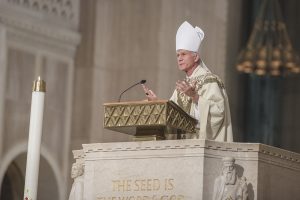
Bishop Joseph E. Strickland, of the Diocese of Tyler, Texas, was the principal celebrant and homilist of the Graduation Mass and honored guest. He offered his words of encouragement to the graduating students:

“I commend you and all of this community of DMU, for entering into an important work that is very much linked with the Lord sending out those apostles to bring His light to the world. So when you become burdened, when the brokenness tends to overwhelm you, when you get bogged down in the darkness in the world, remember to look up and allow the Word of God to nurture you. Look up to the heights of grace, and hope, and mercy, and goodness – that is Jesus Christ.”

Referring to it being DMU’s first graduation on the main level of the basilica, Bishop Strickland already had “come up higher” and urged the graduates to continue to do so. “The Lord has called you to a higher place of greater responsibility, joy, and hope.”

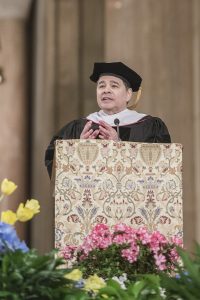
Daniel D’Aniello, Co-Founder and Chairman Emeritus of The Carlyle Group, was the Honorary Degree Recipient and 2019 Commencement. D’Aniello, shared with graduates his personal experience in encountering and working against the stigma of mental illness in his own family.

“We are stronger when we know we are not alone and when there are people to support us,” he said. He continued to address the graduates about the uniqueness of the integration of faith and the practice of psychology.

“You [graduates] are here to aid, to heal, to help in the ways that no others could otherwise do. Faith in God is not a neurosis, as Freud would have us believe. It is a critical component of understanding the person completely and treating the patient holistically. That wisdom will serve you well as you accept the invitation to the most private of all places – the mind of your patients. And of course, that privilege comes with the great responsibility of helping your patients comprehend the reality and shape their future.”

D’Aniello grew up in a small town in western Pennsylvania, raised by a single mother and grandmother.  From a very early age, he was exposed to the hard work and dedication needed to move through difficult circumstances.  He received a scholarship to attend Syracuse University and upon graduation, spent three years as a supply officer in the Navy before heading to Harvard University for an MBA.

Prior to forming Carlyle in 1987, Mr. D’Aniello was a Vice President for Finance and Development at Marriott Corporation where he was responsible for the valuation of all major mergers, acquisition, divestitures, debt and equity offerings, and project financings. Before joining Marriott, Mr. D’Aniello was a financial officer at PepsiCo, Inc. and Trans World Airlines. In 2016, D’Aniello received the Lone Sailor Award from the U.S. Navy Memorial Foundation.

Mr. D’Aniello’s philanthropic work follows what he calls his “five pillars” of philanthropy: faith-based giving, educational programs, free enterprise, the performing arts, and mental health research.  He and his wife Gayle have been married for 42 years and have two adult children.

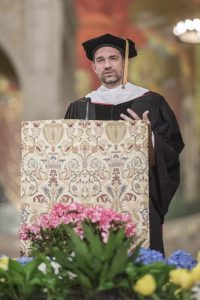
Dr. Gregory Bottaro, Class of 2012, was honored with the 2019 Distinguished Alumni Award, bestowed upon an alumnus who has shown great dedication and leadership in his field.  He shared with the graduates the critical mission of being “practitioners and protectors of integration,” and how this is essential in the future professions of the graduates.

Dr. Bottaro is a clinical psychologist practicing in Connecticut, serving the greater New York Metropolitan area and many others through online therapy.  Before finishing his Doctorate in Clinical Psychology, he discerned a religious vocation with the Community of the Franciscan Friars of the Renewal (CFRs).  He lived four years in the Bronx, serving the poor in the tradition of St. Francis. These years were emotionally, spiritually, and professionally formative as Dr. Bottaro tested his vocation and ultimately felt the prompting of God’s will to pursue family life. Six years after leaving NYC as a friar he returned as a psychologist.  His aim is fundamentally the same – to serve. Instead of serving those suffering material poverty, he now seeks to serve those with psychological needs.

Dr. Bottaro cited the “beautiful harmony between psychology and out faith” as presented at DMU. But he warned that this approach would generate persecution.

“You will find enemies where you expected to be friends and friends where you expected to be enemies,” he said. “That’s because you are the stewards of the incarnation, which is denied in our world today.

“This is the greatest crisis in our Church,” he concluded. “It isn’t homosexuality…it isn’t clericalism…those are symptoms. No, the crisis today is because of the denial of the incarnation, denial that we are both material and spiritual.”

For highlight photos of the 2019 Graduation Mass & Commencement Exercises, view here.

For the full Livestream of the ceremony, view here.

Milestones Mount for Divine Mercy University Read More »

Regnum Christi Spirituality Center Ask a Priest

“Ask a Priest: Should I Cut My Tithes to Save Up for a House?”

Q: I recently got married and my husband and I feel a little differently regarding charitable giving. I now give 10% of each paycheck to charity. He has asked that I start saving 10% of every other paycheck so we can save for a house and make up for the difference by donating my time. I feel as though I have some blessings and privileges, and this proposal doesn’t seem fair or right. But I also want to be fair to my husband, who is able to save a lot more than I can. Any direction you can provide would be greatly appreciated. – C.

Answered by Fr. Edward McIlmail, LC

A: It is good to learn that you are so diligent about almsgiving. That shows a generous heart.

The Church doesn’t mandate an exact percentage of one’s income for tithing. A person has leeway to decide here.

This is the kind of decision that you and your husband need to work out. He has a point in saying the donations of time can be a form of charitable giving.

On the other hand, there is the broader issue of priorities in your household. Support for the poor and needy is a longstanding demand throughout Scripture.

To cut back on donations for the sake of buying a house shifts the weight of attention. I’m not here to make a moral judgment about the wisdom of such a shift. There are likely lots of factors involved which can legitimately be considered.

Perhaps this might be a good opportunity to go deeper into your thinking and your husband’s thinking in this area.

It might be good for the both of you to articulate how you see yourselves before God, knowing how much he has blessed you, and what he might be asking of you now. “For God loves a cheerful giver” (2 Corinthians 9:7).

It might be good to ask what would happen down the line. Would you as a couple cut back on donations when other items appear on the horizon: a new car, a fancier vacation, an updated wardrobe?

This isn’t meant to lay a guilt trip on anyone; it’s just to caution that the lure of consumerism can have an impact on the spirit of generosity. In that light, you might enjoy our Retreat Guide called The Widow’s Might. In general, people who keep almsgiving as a top priority have found that their own needs end up being met in surprising and wonderful ways.

At a deeper level, too, this might be a good moment to speak frankly about what the both of you value most in life and how you see your mission together in the world.

Keep learning more with Ask a Priest

Got a question? Need an answer?

Today’s secular world throws curve balls at us all the time. AskACatholicPriest is a Q&A feature that anyone can use. Just type in your question or send an email to AskAPriest@rcspiritual.wpenginepowered.com and you will get a personal response back from one of our priests at RCSpirituality. You can ask about anything – liturgy, prayer, moral questions, current events… Our goal is simply to provide a trustworthy forum for dependable Catholic guidance and information. So go ahead and ask your question…

“Ask a Priest: Should I Cut My Tithes to Save Up for a House?” Read More »

Regnum Christi Spirituality Center Ask a Priest

“Ask a Priest: Why Have Other Religions Been Around So Long?”

Q: I am a young man who is interested in developing my faith. I wish nothing more than to be a devout Catholic. However, recently I have been questioning many aspects of Catholic theology and Christology. If the true Christian God has been ever-present in the world, why do other religions such as Hinduism predate Judaism and Christianity? If God is of an all-knowing nature, did he know that man would sin when he initiated creation? If so, why would God create a being that he knew would ultimately fail him? Why did Jesus have to die on the cross? Why was there a requirement for sacrifice? In other words, if Jesus died to pay for our sins, who is getting paid? Do people who are exposed to Christianity and still reject it, go to hell? Do people who don’t encounter the word of God go to hell? Why do these people exist in the first place? – P.V.

Answered by Fr. Edward McIlmail, LC

A: It is good that you are serious about your faith. The faith is a great gift of God that we are called to nourish and deepen constantly. This includes the use of our reason. Let me try to address your questions briefly.

Leaving aside the question of whether Hinduism can be said to predate the religion of the Israelites, we could say that God, in his wisdom, revealed himself progressively.

First, he did it through the world around us. We can see the beauty of his handiwork everywhere. He started to reveal himself as a personal God, at a particular time, somewhere in the Middle East. This is when he chose to “enter history” more obviously, so to speak. It is part of his style.

At any rate, the fact that other religions might have predated Judaism simply shows that man has always had a religious impulse. He has always confronted big questions about the universe and himself and the purpose of it all. The early peoples in South Asia were searching for answers to such questions, and Hinduism, a complex phenomenon, emerged as something of an answer.

Did God know that man would sin? Yes. So why would God create a being that would ultimately reject him?

Here we could say that God gave man free will so that man could love God freely. If a person misuses his free will, that’s his fault, not God’s. Just the fact that God created this person is an objective good; indeed, everything the Almighty creates is good. If God only created people who would love him in return, that would imply that God wouldn’t have respected the free will he wanted to give people. Many people use their free will to accept God.

As to why Jesus had to die on the cross, and if he paid for our sins, “who is getting paid?” – let’s say this:

Sin is an offense against an infinitely good God. We, being finite creatures, couldn’t make up on our own for our sins.

It took God himself to make up for that. Hence, Jesus came and suffered. In one sense, it is fitting that the debt of sin was paid somehow, since God’s glory deserves as much. The alternative — to brush off sin as no big deal — wouldn’t have been just. It certainly wouldn’t have edified us, for we might have gone on sinning and not given it a second thought.

That God himself was willing to pay the price for sin is an extraordinary sign of his love for us. Jesus was willing to pay that price, in order that his heavenly Father would get the honor he deserves. There was a balance to be restored in the universe. It’s a bit mysterious, no doubt.

Will people who are exposed to Christianity and reject it, go to hell? They might, depending on their motives and a lot of other factors, some of which are known to God alone. Let’s not forget Jesus’ warning: “Whoever believes and is baptized will be saved; whoever does not believe will be condemned” (Mark 16:16).

Then there are your last questions: Will people who do not encounter the word of God go to hell? And why do these people exist in the first place?

People who do not encounter the word of God are not damned automatically. The Church teaches that people who have never heard of Christ or the Gospel can reach heaven if they follow their conscience and try to live a good life. You could find this in part No. 16 of the Vatican II document Lumen Gentium.

Whole books could be written to respond to your questions. For your own studies you might find it helpful to go through the Youth Catechism, or YouCat; the Catechism of the Catholic Church; or Frank Sheed’s “Theology for Beginners.”

In the meantime, I hope these short answers help point you in the right direction.

Keep learning more with Ask a Priest

Got a question? Need an answer?

Today’s secular world throws curve balls at us all the time. AskACatholicPriest is a Q&A feature that anyone can use. Just type in your question or send an email to AskAPriest@rcspiritual.wpenginepowered.com and you will get a personal response back from one of our priests at RCSpirituality. You can ask about anything – liturgy, prayer, moral questions, current events… Our goal is simply to provide a trustworthy forum for dependable Catholic guidance and information. So go ahead and ask your question…

“Ask a Priest: Why Have Other Religions Been Around So Long?” Read More »

Lisa’s Feast: Dinner and a Rosary

Good food plays a role in many of life’s most important events. It helps bring people together, facilitates conversation, and makes it easier to build community. Lisa Satory used this premise to invite some Catholic friends to join her for dinner and a rosary one Sunday night eight years ago and started a tradition – one that other families can reproduce in their own communities.

“I grew up in Cleveland, Ohio, and was a cradle Catholic,” Lisa recalls. “The faith was important to our family. I went to Catholic school through college. In fact, my husband, David, and I met in the seventh grade at St. Michael Middle School in Cleveland,” she adds.

For Lisa, Sunday was family day. Her mom was one of six kids and everyone went to grandma’s house on Sunday for a big dinner and to spend time together. It was a weekly extended-family combination of food, fun, prayer, and being together. For Lisa, that family dinner was a typical life event. And in Cleveland, it continues to this day.

In 2002, when the Satory family moved away from their hometown to Cumming, an Atlanta suburb, they realized they wanted to recreate this same close-knit, Catholic family experience. She birthed the idea of hosting dinner and a rosary to meet the need she and her husband David had to create an extended Catholic family support system within their greater church home of St. Brendan. She understood a good meal can build friendship, deepen connections, perhaps whet the appetite for great knowledge of the faith, and create a true sense of family.

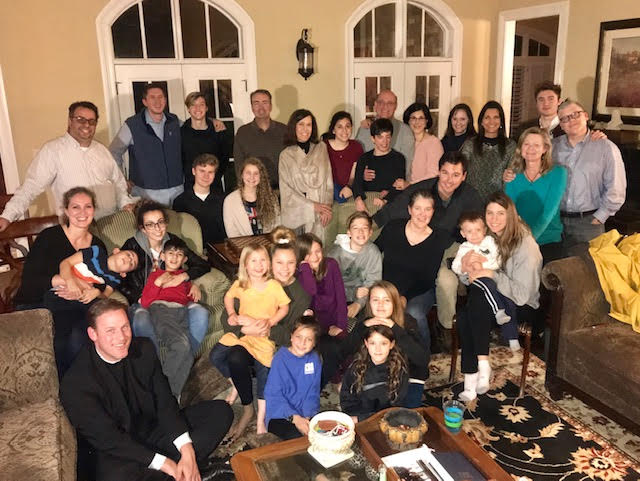
“I love to pray the Rosary and I love to entertain,” Lisa says. “Community is important, so given what I love to do, David and I decided to open our home once a month for dinner and the praying of the Rosary,” she says. Before the rosary begins, Lisa opens the floor to any special prayer requests whether personal or global. Extra rosaries are always on hand and one finds it’s the kids who often jump in to lead the prayers.

The format is simple, but certainly involves a good deal of work. Lisa prepares the main dinner dishes, which often include southern favorites such as barbequed pulled pork, corn, and mac-and-cheese. Guests bring side dishes and desserts to share.
Things get underway around 6:30 pm. The group starts with dinner, followed by the Rosary, and tops off the evening with dessert. The “formal” festivities usually conclude by 8:30 pm although some guests occasionally linger over a glass of wine. The monthly gathering includes entire families, both young and old, and typically draws 40-50 people.

Lisa and David have four children, two sons in college and two daughters in their teens still at home. But the dinner and Rosary events usually draw the boys home for the weekend. And all the kids say they want to continue the tradition when they have their own families.

Never one to shy away from a commitment, Lisa is an active Regnum Christi member who organizes and leads Holy Week Missions to serve the marginalized every year. “I was drawn to Regnum Christi because I’m a doer; I like to organize and coordinate,” Lisa says. Her four children and husband join her on these missions as do a host of other Catholic families. She discovered Regnum Christi when the family moved to Atlanta and found the Movement to be a great way to deepen her faith and be a more effective missionary. “Regnum Christi has helped me to be better at whatever I do for the Church,” Lisa says. And for Lisa, who has the energy and passion of someone fresh out of college, there is always room for more evangelization.

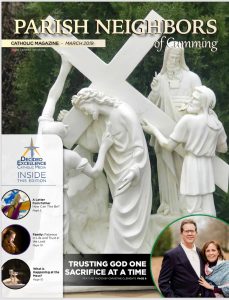
For instance, she publishes “Parish Neighbors of Cumming,” through Decided Excellence Media.The monthly print magazine is distributed throughout the Cumming area and includes Catholic articles, readings, information about the local parishes, and a lead article featuring a local Catholic family. “Like the Holy Week Missions, the magazine is an effort to reach out to people in the community and either bring them back to Church or, in some cases, introduce them to the Catholic faith,” Lisa explains.

If you are starting to think Lisa has superpowers, you may be right. But she will be the first to tell you it’s not her, it’s the Holy Spirit alive in her heart that fuels all her apostolic endeavors. She recently took on a full-time sales job with Sadlier selling Catholic educational books to schools in the Southeast region. She accomplishes all this on top of being a wife and mother. At a recent rosary dinner, she was asked how she manages to keep all these balls in the air. Without hesitation, she said, “Passion.” She hopes to create that same passion in others who will carry the torch and build a kingdom of disciplines on earth.

Lisa’s Feast: Dinner and a Rosary Read More »

Scroll to Top

Events

Looking for another country?

Contact Regnum Christi near you

News & Resources

News & Resources

The Regnum Christi Mission

The Regnum Christi Identity

Alex Kucera

Atlanta

Alex Kucera has lived in Atlanta, GA, for the last 46 years. He is one of 9 children, married to his wife Karmen, and has 3 girls, one grandson, and a granddaughter on the way. Alex joined Regnum Christi in 2007. Out of the gate, he joined the Helping Hands Medical Missions apostolate and is still participating today with the Ghana Friendship Mission.

In 2009, Alex was asked to be the Atlanta RC Renewal Coordinator for the Atlanta Locality to help the RC members with the RC renewal process. Alex became a Group Leader in 2012 for four of the Atlanta Men’s Section Teams and continues today. Running in parallel, in 2013, Alex became a Team Leader and shepherded a large team of good men.

Alex was honored to be the Atlanta Mission Coordinator between 2010 to 2022 (12 years), coordinating 5-8 Holy Week Mission teams across Georgia. He also created and coordinated missions at a parish in Athens, GA, for 9 years. Alex continues to coordinate Holy Week Missions, Advent Missions, and Monthly missions at Good Shepherd Catholic Church in Cumming, GA.

From 2016 to 2022, Alex also served as the Men’s Section Assistant in Atlanta. He loved working with the Men’s Section Director, the Legionaries, Consecrated, and Women’s Section leadership teams.

Alex is exceptionally grateful to the Legionaries, Consecrated, and many RC members who he’s journeyed shoulder to shoulder, growing his relationship with Christ and others along the way. He knows that there is only one way, that’s Christ’s Way, with others!