Regnum Christi Spirituality Center Ask a Priest

“Ask a Priest: What Is Humility Like?”

Q: I’m finding it hard to know what humility is exactly. I know Jesus has humility. It’s not being a doormat. In a way, the devil tries to tell me everyone else knows what they are doing and I don’t. Are you able to help me distinguish between pride and humility? Is humility being God-confident rather than self-confident? I usually confess the sin of pride, but I’m vague about when I was proud, though I know I can be. – P.B.

Answered by Fr. Edward McIlmail, LC

A: Pride is the mother of all vices. We put ourselves first. We might think our opinions are better than others’. We get mad when people overlook us or slight us. We push for our “rights.”

In a word, we tend to follow what we want rather than what God wants.

And what does God want? Our Lord Jesus showed us. He wants us to help others, think of others’ needs. He wants us to bear our sufferings with patience and to unite them with his suffering on the cross.

In a word, humility is an antidote to pride. Humility means living in the truth.

And the truth is this: God created us. Everything good we have is a gift from God: our family, our faith, our health, our talents. None of this came from us. So we shouldn’t be boastful about what we have.

Moreover, everyone one else around us was created out of love by God, too. They are his sons and daughters. Christ died for all of them, too, out of love. We should aim to show that same love for everyone.

The more these truths sink in, the more we realize how much we owe to God.

Now, we want to be careful to avoid a false humility. For a person to say, “I’m no good, I’m worthless” is not humility, since it isn’t true. All of us have the image of God in us. All of us are redeemed by Jesus. All of us have value.

In light of our faults and weaknesses, true humility sounds like this: “I’m weak, I’m a sinner. But I have been redeemed by Christ, and with God’s grace I can improve.” This is real humility because it reflects the truth about who we are and what we can achieve with divine help.

As you mention, humility doesn’t mean we have to become doormats.

There are times when it’s admirable to suffer in silence. But it’s not healthy to let people walk over us habitually. It isn’t good for them, and it doesn’t help our state of mind. Fraternal charity can require that we speak up and call people to a greater show of respect.

Some ways to cultivate humility have been linked to a certain modern saint:

— Speak as little as possible about yourself.

— Keep busy with your own affairs and not those of others.

— Avoid curiosity about things that shouldn’t concern you.

— Do not interfere in the affairs of others.

— Accept annoyances with good humor.

— Don’t dwell on the faults of others.

— Accept censures even if unmerited.

— Accept contempt, being forgotten and disregarded.

— Be courteous and delicate even when provoked by someone.

— Don’t seek to be admired and loved.

— Always pick the harder task.

For more reading, see Humility of Heart.

I hope some of these humble suggestions help.

Keep learning more with Ask a Priest

Got a question? Need an answer?

Today’s secular world throws curve balls at us all the time. AskACatholicPriest is a Q&A feature that anyone can use. Just type in your question or send an email to AskAPriest@rcspiritual.wpenginepowered.com and you will get a personal response back from one of our priests at RCSpirituality. You can ask about anything – liturgy, prayer, moral questions, current events… Our goal is simply to provide a trustworthy forum for dependable Catholic guidance and information. So go ahead and ask your question…

“Ask a Priest: What Is Humility Like?” Read More »

Give the Gift of the Mass on the New Legionaries of Christ Mass Program Website

The tradition of having a Mass celebrated for yourself or for someone else is centuries old. In fact, the Catechism of the Catholic Church states that “From the beginning the Church has honored the memory of the dead and offered prayers in suffrage for them, above all the Eucharistic sacrifice, so that, thus purified, they may attain the beatific vision of God.” (CCC 1032)

Over 900 priests of the Legionaries of Christ celebrate the holy sacrifice of the Mass daily, and each Mass is offered for an intention.  That’s almost 330,000 Masses every year. Now it’s easier than ever to request that one of these Masses, or a series of them, be celebrated for your intentions, with their new Mass Program website.

There is no price tag on the celebration of a Mass, however it is customary to give an offering when requesting that a priest celebrate a Mass for an intention.  The suggested donations that are typically given for Masses offered in many parishes and religious orders vary according to the many types of Mass enrollments, and are listed on the website along with the option to request a Mass intention without making a monetary offering if one’s circumstances do not permit it. The donations that the Legionaries of Christ receive from the Mass program fund the needs of the priests and seminarians of the congregation.

When requesting a Mass intention, you can select a greeting card from one of many designs with religious art on the cover and information about the Mass intention and the priest who is saying the Mass inside.

You can request a Mass enrollment for yourself or for another person–living or deceased, for a special occasion, for healing, or for other special intentions. Information on each of these options is available on the website to help you find the right one for your intention.

Enrollment options include:

Individual Holy Mass

A single Mass will be offered for your intentions or the intentions of your loved ones, living or deceased.

Triduum of Masses

A series of three Masses on consecutive days exclusively for your intentions or the intentions of your loved ones, living or deceased.

Novena of Masses (Group Enrollment)

Your intentions will be remembered in our monthly Novena offered at the Legionaries of Christ’s seminary in Cheshire, Connecticut.

Novena of Masses (Individual Enrollment)

A series of nine Masses on consecutive days exclusively for your intentions or the intentions of your loved ones, living or deceased.

Perpetual Mass Enrollment

A remembrance in a Mass offered every Friday at our seminary in Cheshire, and in the seminarians’ daily Adoration. This special gift may be requested for individuals, couples, or families, living or deceased. Presented in a standing folder suitable for display.

Gregorian Series of Masses

Thirty Masses offered on consecutive days for the repose of the soul of a departed person.  Presented in a standing folder suitable for display.

Life in Christ Series of Masses

Thirty Masses offered on consecutive days for your intentions or the intentions of your living loved ones. Presented in a standing folder suitable for display.

The Legionaries of Christ also offer Mass enrollments based on the liturgical calendar. The next one is an All Souls’ Day novena, which is a series of nine Masses offered in a special Group Novena for the Souls of our Dearly Departed beginning on November 2nd.

To request a Mass, or for more information about any of the Mass enrollment options, go to www.lcmassrequest.org.


Give the Gift of the Mass on the New Legionaries of Christ Mass Program Website Read More »

Regnum Christi Spirituality Center Ask a Priest

“Ask a Priest: Should Gossip Keep Me From Receiving Communion?”

Q: I frequently go to confession, confessing the same sin (gossip) with the intention of not falling again. I am never quite sure if it is mortal or venial, as I am just mostly complaining about my kids. My question is since I still receive Communion at Mass in between my failings, am I committing a greater sin? I received Communion yesterday and didn’t think of it then. – M.K.

Answered by Fr. Edward McIlmail, LC

A: Unless you are complaining in some fire-breathing, hate-filled way, or unless you are posting on Facebook about your 20-something “kids” and their immoral lifestyles, it’s likely that your offense is venial.

This would include things such as complaining to a sister about the way your 10-year-old leaves the kitchen a mess.

Messy kitchens are not end-of-the-world stuff. It’s part of the normal tensions within families. And your complaining about it wouldn’t be a reason for staying away from Communion.

Nevertheless, it’s good that you are confessing what you perceive to be sins against charity. If you are confessing the sin of gossip frequently, that is a sign that it is a dominant bad habit in your life.

One way to effectively combat a bad habit is to work on the opposite virtue.

In practice that means trying to speaking well of others. It also means not complaining to someone who isn’t in a position to do something about a problem. Otherwise you would be venting pointlessly.

How would this habit of speaking well of others look in your life?

Perhaps you could reserve your negative comments about the kids to your spouse, who might be in a position to help you form the children in better habits. There is no need to tell the relatives and neighbors about your kids’ shortcomings.

It could mean internally counting to 10 before speaking, whenever you feel tempted to unleash a barrage of criticism. That pause might give you a chance to catch yourself and refrain from saying something you will later regret.

Primarily, you want to learn to focus on the positive.

Instead of stewing about the 10-year-old who left the kitchen a mess for the umpteenth time, just wait for a moment for calm to return and say, “Joey, could you help clean up the kitchen? I need to do the laundry since dad is all out of shirts.” Or, “Joey, I’m glad you put your cereal bowl in the dishwasher. Could you do the same with the other things in the sink?”

And then speak positively to your husband later within earshot of your son. “Joey was a big help in the kitchen this morning …” You get the idea.

To dig a little more into the virtues and vices linked to our words, you might find it helpful to read my colleague Father Bartunek’s booklet, Sharpening Your Tongue: A Regnum Christi Essay on Charity in Our Words.

Cultivating the habit of speaking well of others will be a great way to form your children, and it will go a long way to producing an atmosphere of love and respect in the home. Which will be one more thing to be grateful for when you receive Communion.

Keep learning more with Ask a Priest

Got a question? Need an answer?

Today’s secular world throws curve balls at us all the time. AskACatholicPriest is a Q&A feature that anyone can use. Just type in your question or send an email to AskAPriest@rcspiritual.wpenginepowered.com and you will get a personal response back from one of our priests at RCSpirituality. You can ask about anything – liturgy, prayer, moral questions, current events… Our goal is simply to provide a trustworthy forum for dependable Catholic guidance and information. So go ahead and ask your question…

“Ask a Priest: Should Gossip Keep Me From Receiving Communion?” Read More »

New Ways to Share the Mission of Regnum Christi

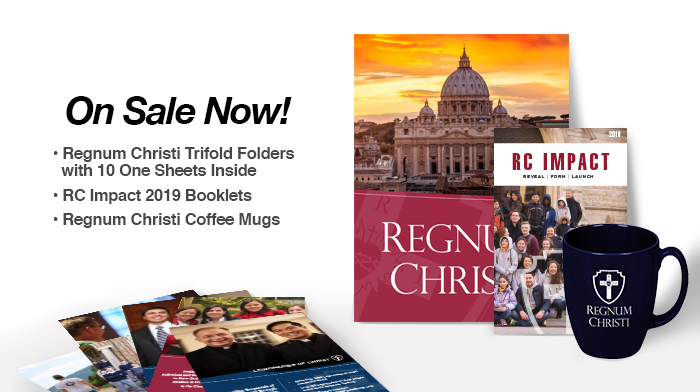
RC IMPACT 2019 is a brand new 36-page booklet highlighting the evangelizing missions of Regnum Christi Members from around the North American territory and sharing the dynamic impact that lay members have on the world through their vocation.  

The booklet is 8 1/2″ x 5 1/2″ and can be used by itself or in the pocket of the Regnum Christi Trifold Folder.  It is high-quality, full-color, includes letters from the territorial directors, and a directory of Regnum Christi locations, vocations, and ways to get involved in our mission.   

RC IMPACT 2019 is sold in sets of 25 for $50 per set, including shipping and handling, while quantities last.  


The Regnum Christi Coffee Mug Start your day with your favorite beverage in a new Regnum Christi coffee mug! These high-quality 14-ounce navy blue ceramic mugs have a white Regnum Christi logo on the side. They make great gifts! $12 each, including shipping and handling, while quantities last. 


The Regnum Christi Folder is a high-quality, 8 ½” x 11” folder that holds one-sheets introducing 10 aspects of Regnum Christi, including the RC identity and each vocation, our formation centers, and some of our institutions and programs.  

These products are all available for order here. For more tools to help you connect with the Regnum Christi mission, check out www.regnumchristiconnect.org . 

New Ways to Share the Mission of Regnum Christi Read More »

Regnum Christi Spirituality Center Ask a Priest

“Ask a Priest: Must We Avoid All Media That Have Themes Contrary to the Faith?”

Q: Are we as Catholics obliged to avoid reading or watching books, movies, and TV shows that include gay characters? I know the secular world today is wanting to promote diversity and ideals that are contrary to Catholic belief (such as the normalization of homosexual relationships and radical feminism). There are rarely any books I’ve seen that shows characters accepting the true Christian approach to homosexuality. As an avid reader and book blogger, I know that if a book revolves around a gay character or couple, and the main theme is accepting and acting upon this sexuality, I know I should avoid it. But the line gets blurry for me when it comes to books that includes an LGBT character on the side (where he/she is not the main focus). Even some really good stories I’ve read and reviewed fall under these categories. Is it ever permissible to read such books or watch such movies/shows and even promote them, or is there a moral obligation to avoid them whenever possible? Some people might say, “They’re just movies or books,” but I know that they do hold immense power in impacting viewers and readers. – K.N.

Answered by Fr. Edward McIlmail, LC

A: It’s good that you are so mindful of the agenda at work in a lot of the secular media.

As Catholics we have the obligation to avoid material that would be a blatant near-occasion of sin, such as explicit sexual content in a movie or book. Beyond that, though, there is no simple answer in every instance.

Lots of serious literature and movies over the years have had less-than-saintly characters. Even the Bible has its share of edgy tales.

Secular media, of course, are a far cry from inspired Scripture. The latter points us to Christ. The former can lead us to the father of lies.

Perhaps an analogy is worth keeping in mind.

Try putting a frog in a pot of hot water, and it jumps out immediately. Put a frog in a pot of cool water and turn up the heat little by little. The frog won’t notice, even as it reaches death’s door.

The same can happen in the moral realm. We expose ourselves to certain seedy plots and racy characters, and eventually we can become numb to them. Along the way our worldview warps. What used to offend us, we now barely notice. Our conscience grows dull.

Meanwhile, the people around us might be going through the same process. The result: year by year the culture grows more accepting of what used to be unacceptable.

If we aren’t careful, we can feed that culture, in that we no longer challenge things the way we used to. Moreover, by consuming bad media, we nurture the demand for them. Hollywood obliges by producing more of the stuff. And so the downward spiral continues.

Suggestion: You might want to make a concerted effort in the other direction. Make Christian-friendly media your staple for consumption. Don’t go with the flow. And don’t be afraid to do some radical surgery, even up to cutting the TV cable and banning certain books from your reading list. When you do decide to read and review stories that promote a non-Christian worldview, be sure to clearly explain the downside even as you fairly explicate the good points.

Above all, whatever you do, remember 1 Corinthians 10:31 and “do everything for the glory of God.”

Keep learning more with Ask a Priest

Got a question? Need an answer?

Today’s secular world throws curve balls at us all the time. AskACatholicPriest is a Q&A feature that anyone can use. Just type in your question or send an email to AskAPriest@rcspiritual.wpenginepowered.com and you will get a personal response back from one of our priests at RCSpirituality. You can ask about anything – liturgy, prayer, moral questions, current events… Our goal is simply to provide a trustworthy forum for dependable Catholic guidance and information. So go ahead and ask your question…

“Ask a Priest: Must We Avoid All Media That Have Themes Contrary to the Faith?” Read More »

Regnum Christi Spirituality Center Ask a Priest

“Ask a Priest: Can I Be Bisexual and Christian?”

Q: Someone told me I can’t be Christian and bisexual. They said I wasn’t a real Christian. Is this true? – J.R.

Answered by Fr. Edward McIlmail, LC

A: It is good to remember that your core identity is that you are a son of God. You are not your “sexual identity.”

As a loving Father, God only wants the best for you. As a baptized Christian, you are incorporated into the mystical body of Christ and are called to follow the ways of Jesus.

Among the things Jesus asks of us is to live chastely. This means we are called to use our God-given gift of sexuality according to his plan. This means that intimate physical relations are proper only to a husband and a wife who are open to life.

As to your specific question …

Are you a Christian? If you baptized validly, yes, you are technically a Christian. If you believe in the divinity of Christ and the other tenets of the Gospels, yes, you could say that you are a believing Christian.

But if you are living a life that isn’t in accord with Christian teachings about sexuality, then you are a Christian who, well, isn’t living in accord with the Gospel.

In one sense you aren’t alone. We are all sinners. We are all a work in progress.

And while it’s one thing to struggle with failings and weaknesses, it’s quite another to embrace a lifestyle that is openly contrary to Christian principles.

You might ask yourself a few questions.

First, do you see a bisexual lifestyle as being in accord with Jesus’ teachings? If not, are you willing to cut with this lifestyle?

That someone has raised the issue with you, and the fact that you sent in this question, might be a sign that the Holy Spirit is trying to nudge you in the right direction.

If you have a problem with same-sex attraction — which is probably closer to the problem you are facing — then it’s good to remember that God is calling you to live chastely and to refrain from any kind of homosexual behavior.

Experiencing same-sex attraction isn’t a sin in itself. It’s when we choose to act on it that it becomes sinful. This is a distinction to keep in mind.

We all experience feelings or tendencies that we need to resist and govern so that they don’t lead us off the path of true happiness. Those feelings and tendencies come from our fallen human nature and the fallen world we live in. Same-sex attraction is one of those.

Jesus’ teaching lead us to true, lasting happiness in this life and the next. For God knows better than anyone what is best for us, since he created us.

Two numbers might be worth quoting from the Catechism of the Catholic Church:

2358. The number of men and women who have deep-seated homosexual tendencies is not negligible. This inclination, which is objectively disordered, constitutes for most of them a trial. They must be accepted with respect, compassion, and sensitivity. Every sign of unjust discrimination in their regard should be avoided. These persons are called to fulfill God’s will in their lives and, if they are Christians, to unite to the sacrifice of the Lord’s Cross the difficulties they may encounter from their condition.

2359. Homosexual persons are called to chastity. By the virtues of self-mastery that teach them inner freedom, at times by the support of disinterested friendship, by prayer and sacramental grace, they can and should gradually and resolutely approach Christian perfection. [end quoted material]

Note those last words, “Christian perfection.” That means you are called to be a saint. If Christ is asking that of you, he would certainly give you the grace to achieve holiness — if you do your part.

For more reading, you might look at:

— Why I Don’t Call Myself Gay

— Homosexuality and the Catholic Church

In the meantime try to maintain a solid prayer life. And read a bit of the Gospels daily. Count on my prayers.

Keep learning more with Ask a Priest

Got a question? Need an answer?

Today’s secular world throws curve balls at us all the time. AskACatholicPriest is a Q&A feature that anyone can use. Just type in your question or send an email to AskAPriest@rcspiritual.wpenginepowered.com and you will get a personal response back from one of our priests at RCSpirituality. You can ask about anything – liturgy, prayer, moral questions, current events… Our goal is simply to provide a trustworthy forum for dependable Catholic guidance and information. So go ahead and ask your question…

“Ask a Priest: Can I Be Bisexual and Christian?” Read More »

Regnum Christi Spirituality Center Ask a Priest

“Ask a Priest: What If I Find Part of the Creed Hard to Accept?”

Q: I was wondering about the last two lines of the Nicene Creed where it says, “I look forward to the resurrection of the body and the life of the world to come.” I have been omitting saying these two lines during the Mass for many months now, partly because I don’t understand it theologically and I don’t want to be guilty of lying if I say it without believing it. I have the idea (partly from my studying) that we don’t know with certainty that we’ll make it to heaven when we die, so how can we look forward to it so much? But then again, I don’t want to intentionally not participate in the whole Mass by not saying these lines. I’d appreciate your feedback on this situation. – M.O.

Answered by Fr. Edward McIlmail, LC

A: It is good to see that you are so conscientious about trying to practice your faith sincerely.

First off, it’s not essential that we “understand” every tenet of the faith “theologically,” for the simple fact that some points will always be a bit mysterious and beyond the full grasp of our intellects.

This doesn’t mean that our act of faith is naïve or mindless or insincere. After all, we often make “acts of faith” in people without totally understanding them or what they do. As kids we trusted our moms when they told us to eat our spinach, for instance. Or we casually board an airliner, trusting that the pilot knows his job. These acts of faith don’t require that we understand everything about nutrition or about the person in the cockpit.

Now, to the specific point you mention: It is a matter of our faith that we will all be reunited with our bodies at the end of time.

Here, it is worth quoting from the Catechism:

  1. We firmly believe, and hence we hope that, just as Christ is truly risen from the dead and lives forever, so after death the righteous will live forever with the risen Christ and he will raise them up on the last day. Our resurrection, like his own, will be the work of the Most Holy Trinity.
  2. The term “flesh” refers to man in his state of weakness and mortality. The “resurrection of the flesh” (the literal formulation of the Apostles’ Creed) means not only that the immortal soul will live on after death, but that even our “mortal body” will come to life again.
  3. Belief in the resurrection of the dead has been an essential element of the Christian faith from its beginnings. “The confidence of Christians is the resurrection of the dead; believing this we live .…”

In fact, even lost souls will be reunited with their bodies. Back to the Catechism:

  1. Who will rise? All the dead will rise, “those who have done good, to the resurrection of life, and those who have done evil, to the resurrection of judgment.”
  2. How? Christ is raised with his own body: “See my hands and my feet, that it is I myself”; but he did not return to an earthly life. So, in him, “all of them will rise again with their own bodies which they now bear,” but Christ “will change our lowly body to be like his glorious body,” into a “spiritual body.”
  3. This “how” exceeds our imagination and understanding; it is accessible only to faith. [end quoted material]


So that is our faith: whether we are going to heaven or to hell, we will be reunited with our bodies someday. This is one reason we treat dead bodies reverently.

That we say in the creed that we “look forward to the resurrection of the body” expresses our Christian hope that salvation is attainable. You could see your own recitation of this line as an expression of hope, not as a statement of absolute foreknowledge of the future.

In fact, your attitude is healthy, for we shouldn’t think our salvation is automatic. Even St. Paul warned his audience to “work out your salvation with fear and trembling” (Philippians 2:12).

So the upshot: Don’t worry if you fully understand everything in the creed. The creed is only the tip of an iceberg; beneath the waves lie the fathomless depths of the truths of the faith. These truths take a lifetime to plumb.

For now, ask the Holy Spirit for the gift of deeper understanding. So long as you aren’t rejecting parts of the creed outright, you can be sure that your participation in the Mass is sincere.

Keep learning more with Ask a Priest

Got a question? Need an answer?

Today’s secular world throws curve balls at us all the time. AskACatholicPriest is a Q&A feature that anyone can use. Just type in your question or send an email to AskAPriest@rcspiritual.wpenginepowered.com and you will get a personal response back from one of our priests at RCSpirituality. You can ask about anything – liturgy, prayer, moral questions, current events… Our goal is simply to provide a trustworthy forum for dependable Catholic guidance and information. So go ahead and ask your question…

“Ask a Priest: What If I Find Part of the Creed Hard to Accept?” Read More »

Regnum Christi Spirituality Center Ask a Priest

“Ask a Priest: Should We Shame a Woman Who’s Had Abortions?”

Q: Should Catholics shame a women for having abortions early in her life and is now scared and ashamed and remorseful? I have had a friend who confided in me about two abortions she had years ago. She only told me and explained to me why she is always so down and distant from people but felt she could trust me. Because of my upbringing in very strict, judgmental Catholic family I feel I should distance myself from her. But my own version of God is to not abandon people in need. I care deeply for this person. She even hopes one day we can be in a relationship, but my mind will never let me go there, and I think it’s more because of worry about how my family will feel. I feel it’s not a Christian way to treat people by not forgiving and showing compassion. But maybe I’m wrong as a devout Catholic myself — maybe I need to cut this person from my life? Looking for some guidance. – T.G.

Answered by Fr. Edward McIlmail, LC

A: It’s not the role of Catholics to shame a woman in this situation but rather to encourage her on a path of healing.

Many women suffer deep psychological wounds because of their abortions. Those who think they cannot obtain God’s mercy can end up in a psychological and emotional tailspin.

This woman needs healing both at the spiritual and the psychological levels.

That she has been so secretive about her past indicates that she has a lot of regret for what happened. She recognizes that the abortions were wrong. If she has confided her past to you, that means she trusts you and might be open to any advice you could offer.

This would be the moment to encourage her to go to confession and to seek out counseling, such as what could be offered at a Rachel’s Vineyard retreat.

Pope St. John Paul II’s encyclical Evangelium Vitae articulates a pastoral approach toward post-abortive women:

“I would now like to say a special word to women who have had an abortion. The Church is aware of the many factors which may have influenced your decision, and she does not doubt that in many cases it was a painful and even shattering decision. The wound in your heart may not yet have healed. Certainly what happened was and remains terribly wrong. But do not give in to discouragement and do not lose hope. Try rather to understand what happened and face it honestly. If you have not already done so, give yourselves over with humility and trust to repentance. The Father of mercies is ready to give you his forgiveness and his peace in the Sacrament of Reconciliation. To the same Father and his mercy you can with sure hope entrust your child. With the friendly and expert help and advice of other people, and as a result of your own painful experience, you can be among the most eloquent defenders of everyone’s right to life. Through your commitment to life, whether by accepting the birth of other children or by welcoming and caring for those most in need of someone to be close to them, you will become promoters of a new way of looking at human life” (No. 99).

You might be the instrument through which your friend will learn of God’s mercy and find a source of hope.

Catholics more than anyone are called to be witnesses of God’s mercy. We ourselves encounter that mercy every time we take advantage of the sacrament of confession. It is an imminently Christian thing to reach out to a fallen soul and help her to reconcile with God.

It’s one thing to hate sin; it’s quite another to be judgmental and to write off sinners. “Stop judging, that you may not be judged” (Matthew 7:1).

Jesus died for all of us. We all need his redemption. It would give him great joy if your friend could turn to him for mercy. He wants to bring healing to her heart.

And with God’s grace she might someday be reunited with her babies.

Keep learning more with Ask a Priest

Got a question? Need an answer?

Today’s secular world throws curve balls at us all the time. AskACatholicPriest is a Q&A feature that anyone can use. Just type in your question or send an email to AskAPriest@rcspiritual.wpenginepowered.com and you will get a personal response back from one of our priests at RCSpirituality. You can ask about anything – liturgy, prayer, moral questions, current events… Our goal is simply to provide a trustworthy forum for dependable Catholic guidance and information. So go ahead and ask your question…

“Ask a Priest: Should We Shame a Woman Who’s Had Abortions?” Read More »

Regnum Christi Spirituality Center Ask a Priest

“Ask a Priest: What If a Priest Flaunts a Rolex?”

Q: Recent snowbirds, we found a parish in our small town, but the priest is causing me concern. Different culture, so that may be why. He celebrates with a large platinum chalice, just bought a new luxury vehicle, shows off his Rolex watch and lives in an upscale gated community. He proudly shows his stipend check to members, and recently he based his homily on the “camel through the eye of a needle” Gospel passage in a way that seemed to skirt the Scripture. Our parish back home was pastored by a great down-to-earth man. He saved for many years to buy an older Dodge Charger, a car he had always wanted. I guess the difference bothers me, and I recall the bishop in Germany that the Pope had move from his “palace” and into the rectory. Bottom line: Am I being overly critical? I certainly have my share of sins but find it hard to get past the observed excess. – C.Y.

Answered by Fr. Edward McIlmail, LC

A: What you describe is not the ideal situation by any means.

A diocesan priest, even if he doesn’t strictly take a vow of poverty, is expected to live modestly. This helps keep him from being too attached to material goods. It also helps him to be mindful of the poor and to share his resources with them. It also, of course, helps to avoid scandal.

Maybe the best thing is to simply pray for this priest. With all the other problems the Church faces, it might not help the parish or the diocese to make this high-living lifestyle a public issue right now.

Perhaps as you get to know the priest and win over his confidence, you might drop a suggestion at an opportune time. But this takes patience. In the meantime your prayers would help.

It might also help you to focus on the good: He is still a priest, still celebrating the sacraments, and he might have some real virtues in other areas of his life.

Keep learning more with Ask a Priest

Got a question? Need an answer?

Today’s secular world throws curve balls at us all the time. AskACatholicPriest is a Q&A feature that anyone can use. Just type in your question or send an email to AskAPriest@rcspiritual.wpenginepowered.com and you will get a personal response back from one of our priests at RCSpirituality. You can ask about anything – liturgy, prayer, moral questions, current events… Our goal is simply to provide a trustworthy forum for dependable Catholic guidance and information. So go ahead and ask your question…

“Ask a Priest: What If a Priest Flaunts a Rolex?” Read More »

Scroll to Top

Events

Looking for another country?

Contact Regnum Christi near you

News & Resources

News & Resources

The Regnum Christi Mission

The Regnum Christi Identity

Alex Kucera

Atlanta

Alex Kucera has lived in Atlanta, GA, for the last 46 years. He is one of 9 children, married to his wife Karmen, and has 3 girls, one grandson, and a granddaughter on the way. Alex joined Regnum Christi in 2007. Out of the gate, he joined the Helping Hands Medical Missions apostolate and is still participating today with the Ghana Friendship Mission.

In 2009, Alex was asked to be the Atlanta RC Renewal Coordinator for the Atlanta Locality to help the RC members with the RC renewal process. Alex became a Group Leader in 2012 for four of the Atlanta Men’s Section Teams and continues today. Running in parallel, in 2013, Alex became a Team Leader and shepherded a large team of good men.

Alex was honored to be the Atlanta Mission Coordinator between 2010 to 2022 (12 years), coordinating 5-8 Holy Week Mission teams across Georgia. He also created and coordinated missions at a parish in Athens, GA, for 9 years. Alex continues to coordinate Holy Week Missions, Advent Missions, and Monthly missions at Good Shepherd Catholic Church in Cumming, GA.

From 2016 to 2022, Alex also served as the Men’s Section Assistant in Atlanta. He loved working with the Men’s Section Director, the Legionaries, Consecrated, and Women’s Section leadership teams.

Alex is exceptionally grateful to the Legionaries, Consecrated, and many RC members who he’s journeyed shoulder to shoulder, growing his relationship with Christ and others along the way. He knows that there is only one way, that’s Christ’s Way, with others!