Dear Bertha, If your first two years of college have been a kind of “training” in how to live out your faith without sinking into the typical collegiate pitfalls (and I must say you have been an inspiringly docile trainee), now begins (if I may be so bold as to say it) your years of “apostolate.” Now is your chance to “give freely what you have freely received,” as our Lord would put it (Mathew 10:8). And if you have any memory at all, you will recall how much the underclassmen could use your kind and wise guidance – before they get sucked into what they will later regret. Why not take today’s saint as your personal patron for your upperclassman years? He was such an active apostle that historians lost track of him as soon as he set out to spread the good news. In the Gospels he is referred to both as Nathaniel and as Bartholomew, though he is not referred to often. After our Lord’s Ascension, he trekked east and preached in northern India and Armenia, where he met his death by being skinned alive and then beheaded (King Astyages wasn’t impressed with his eloquence, I guess). Thus he died fulfilling Christ’s final command: “Go and make disciples of all nations” (Matthew 28:19), a command that the Church ceaselessly repeats. As you defend the Kingdom among the “nations” there on campus, ask St Bartholomew to give you a hand – maybe that way you’ll at least be able to keep your skin. Love, Uncle Eddy
Philip found Nathanael and told him, “We have found the one about whom Moses wrote in the law, and also the prophets, Jesus son of Joseph, from Nazareth.” But Nathanael said to him, “Can anything good come from Nazareth?” Philip said to him, “Come and see.” Jesus saw Nathanael coming toward him and said of him, “Here is a true child of Israel. There is no duplicity in him.” Nathanael said to him, “How do you know me?” Jesus answered and said to him, “Before Philip called you, I saw you under the fig tree.” Nathanael answered him, “Rabbi, you are the Son of God; you are the King of Israel.” Jesus answered and said to him, “Do you believe because I told you that I saw you under the fig tree? You will see greater things than this.” And he said to him, “Amen, amen, I say to you, you will see heaven opened and the angels of God ascending and descending on the Son of Man.”
Opening Prayer: My Lord, here I am. I invite you to come and lay your eyes on my soul. I want to put aside all distractions and return that look.
Encountering Christ:
There Is No Duplicity in Him: The way in which Jesus described Nathanael speaks of integrity, honesty, and justice. The Gospel passage seems to suggest further that the encounter between such a person and Christ is characterized by profound and almost immediate mutual recognition—almost as if the absence of duplicity clears the way for man to come to faith.
How Do You Know Me?: At first glance, the sudden realization that we are known by another may frighten us. At the same time, to be known is one of our deepest desires and needs. To stand fast while someone’s gaze embraces our soul: We know that nothing makes us feel more vulnerable, but we also know that nothing can bring greater joy than this type of communion. That is what awaits us in heaven: perfectly joyful communion among each other, while basking in the loving and eternal gaze of God.
You Are the Son of God: Jesus and Nathanael locked eyes in this passage. Something extraordinary happened here, and Nathanael realized this in an instant. To pray means to lock eyes with Jesus. What sensation does that provoke? Fear? When we put all duplicity aside and allow the Holy Spirit to replace that fear with the genuine desire to be known by Our Lord, joyful communion will take possession of us, and Nathanael’s profession of faith can become our own.
Conversing with Christ: My Lord, no one sees into the depths of my heart like you do. Sometimes, I want to hide from your gaze because it makes me feel vulnerable. I now renew my trust in you: I have nothing to fear from you, and there is nothing in me that I cannot show to you. Your gaze does not sting but soothes and heals.
Resolution: Lord, today by your grace I will bask in your gaze by spending a few moments in prayer and simply allow you to see me.
For Further Reflection:Catechism of the Catholic Church, 1024:
This perfect life with the Most Holy Trinity—this communion of life and love with the Trinity, with the Virgin Mary, the angels, and all the blessed—is called “heaven.” Heaven is the ultimate end and fulfillment of the deepest human longings, the state of supreme, definitive happiness.
Father Gabriel von Wendt, LC, works as an assistant professor at the Pontifical Athenaeum Regina Apostolorum. He has a passion for philosophy and the role of Catholic faith in contemporary culture.
Dear Lise, I’m not one to deprecate beauty pageants, so I gladly congratulate you on winning the Miss Atlanta contest. (I guess your piano lessons paid off.) Nevertheless, now that you are heading off to college, it is my responsibility to remind you that many dangers await you there, so you need to be prepared. I speak not only of the obvious temptations (drinking, drugs, sex, etc.), but also of another sort. God has gifted you with an attractive appearance, a magnetic personality, and numerous other talents. How will you deploy these gifts during your college years? Of course, only you can decide, but you will at times (maybe often) be tempted to use them for selfish and vain pursuits. You should always reflect on why God gave you these many gifts, and what purpose they are meant to serve in his Kingdom. Up until now, Father Paul and Sister Rita have been there to remind you of this perspective, and you have responded admirably. It may not be so easy at the university. You may want to stay spiritually close to today’s saint as a way to keep on track. Rose of Lima (born of middle-class parents in Peru) is the first American (in the broad sense) to be canonized, and she has a lot to teach us. Admittedly, hers was an extraordinary calling, but sound principles of holiness undergirded her abnormal austerities. She was strikingly beautiful in all her features, and of a charming personality. Frequent compliments alerted her to this and fearing that her beauty might be an occasion of sin for someone, she used to rub her face with pepper to make blotches appear on her skin. Once she rubbed her hands with lime for the same reason and was so burned by the acid that she couldn’t dress herself for a month. She eventually made a vow of virginity to dissuade her parents from marrying her off and spent not a few of her 31 years living in seclusion in a little hut she erected in the family garden. There she was granted many spiritual consolations but was also beset by temptations and mockery. She longed to share the sufferings of Christ, and whenever she spoke of him to others, or whenever she received him in Holy Communion, her face visibly glowed. When her family fell on hard times, she gardened all day and sewed all night to keep them from destitution, but in the end, her sacrifices weakened her, and she spent the last three years of her life enduring a long, drawn-out illness, which answered her prayer for suffering. We live in different times and a different place, but Christ remains the same, and his love for you is no less than his love for St Rose. May you put all your gifts and talents at his service with the same love and purity that she did – and may you be fast friends forever in heaven. Much love, Uncle Eddy
Jesus went into the region of Caesarea Philippi and he asked his disciples, “Who do people say that the Son of Man is?” They replied, “Some say John the Baptist, others Elijah, still others Jeremiah or one of the prophets.” He said to them, “But who do you say that I am?” Simon Peter said in reply, “You are the Christ, the Son of the living God.” Jesus said to him in reply, “Blessed are you, Simon son of Jonah. For flesh and blood has not revealed this to you, but my heavenly Father. And so I say to you, you are Peter, and upon this rock I will build my church, and the gates of the netherworld shall not prevail against it. I will give you the keys to the Kingdom of heaven. Whatever you bind on earth shall be bound in heaven; and whatever you loose on earth shall be loosed in heaven.” Then he strictly ordered his disciples to tell no one that he was the Christ.
Opening Prayer: Holy Spirit, descend upon me as I gather myself in order to spend a moment in personal prayer. Fill my heart with your grace so that I can recognize the presence of Jesus Christ in my life, his presence here and now.
Encountering Christ:
When You Spend Time with Jesus: The disciples had spent months with Jesus by now. Having grown into a group of close friends, they were probably getting used to their new lifestyle as “knights errant,” ever on the road, looking for the next town in which to preach. Sure, Jesus would surprise them every now and then with lofty speeches or mighty deeds, but even that might have been starting to feel quite normal. Then, suddenly, heinterrupted their smoothly-running normality and asked, “Who do you say that I am?” For a moment, the world held its breath, as did each one of the disciples. The semblance of normality disappeared into thin air, and their commitment to the mission was tested as they prepared to answer: Who is Jesus of Nazareth?
When Christ Taps on Your Shoulder: Our Lord has made himself human, “normal,” so that we can approach him and walk beside him in our daily life. Like the disciples during their journey through the mountains of Palestine, our Christian life can fall into a certain routine. However, every now and then, Our Lord can make us pause. He puts his hand on our shoulder signaling us to stop, then steps in front of us, faces us, and, while locking eyes, asks us that very question. He, God himself, is interested in hearing our personal answer time and again.
When You Stand before God: Just like the disciples, who paused in momentary silence, our knees might well get wobbly for a second when we face the Almighty. Peter finally broke the spell when he professed Christ’s divinity, causing everyone who was feeling so comfortable a minute ago to pause and reflect. They were in God’s very presence and probably felt prompted to take off their shoes and kneel, for they stood on holy ground (cf. Ex 3:5). Yet, where God’s greatness shines, man is not crushed, but elevated; Peter was not ordered to prostrate himself, but was raised to become Jesus’ prime witness and minister of his mercy.
Conversing with Christ: My Lord, as you stand before me and look at me expectantly, I consider both your greatness and your humble presence in my life. You are the Eternal Son of the Father, true God and King of the universe. And yet you are interested in me and care for the tiny reality of my life. I renew my faith in you and profess it, knowing that your reign will not crush my development, but empower it.
Resolution: Lord, today by your grace I will consciously praise your greatness and power in my life, allowing you to lead me to whatever responsibilities you have in mind for me.
For Further Reflection:Catechism of the Catholic Church, 441-442:
In the Old Testament, “son of God” is a title given to the angels, the Chosen People, the children of Israel, and their kings. It signifies an adoptive sonship that establishes a relationship of particular intimacy between God and his creature. When the promised Messiah-King is called “son of God,” it does not necessarily imply that he was more than human, according to the literal meaning of these texts. Those who called Jesus “son of God,” as the Messiah of Israel, perhaps meant nothing more than this. Such is not the case for Simon Peter when he confesses Jesus as “the Christ, the Son of the living God,” for Jesus responds solemnly: “Flesh and blood has not revealed this to you, but my Father who is in heaven.” Similarly Paul will write, regarding his conversion on the road to Damascus, “When he who had set me apart before I was born, and had called me through his grace, was pleased to reveal his Son to me, in order that I might preach him among the Gentiles…” (Galatians 1:15-16). “And in the synagogues immediately [Paul] proclaimed Jesus, saying, ‘He is the Son of God’” (Acts 9:20). From the beginning this acknowledgment of Christ’s divine Sonship will be the center of the apostolic faith, first professed by Peter as the Church’s foundation.
Father Gabriel von Wendt, LC, works as an assistant professor at the Pontifical Athenaeum Regina Apostolorum. He has a passion for philosophy and the role of Catholic faith in contemporary culture.
Philip found Nathanael and told him, “We have found the one about whom Moses wrote in the law, and also the prophets, Jesus son of Joseph, from Nazareth.” But Nathanael said to him, “Can anything good come from Nazareth?” Philip said to him, “Come and see.” Jesus saw Nathanael coming toward him and said of him, “Here is a true child of Israel. There is no duplicity in him.” Nathanael said to him, “How do you know me?” Jesus answered and said to him, “Before Philip called you, I saw you under the fig tree.” Nathanael answered him, “Rabbi, you are the Son of God; you are the King of Israel.” Jesus answered and said to him, “Do you believe because I told you that I saw you under the fig tree? You will see greater things than this.” And he said to him, “Amen, amen, I say to you, you will see heaven opened and the angels of God ascending and descending on the Son of Man.”
Opening Prayer: My Lord, here I am. I invite you to come and lay your eyes on my soul. I want to put aside all distractions and return that look.
Encountering Christ:
There Is No Duplicity in Him: The way in which Jesus described Nathanael speaks of integrity, honesty, and justice. The Gospel passage seems to suggest further that the encounter between such a person and Christ is characterized by profound and almost immediate mutual recognition—almost as if the absence of duplicity clears the way for man to come to faith.
How Do You Know Me?: At first glance, the sudden realization that we are known by another may frighten us. At the same time, to be known is one of our deepest desires and needs. To stand fast while someone’s gaze embraces our soul: We know that nothing makes us feel more vulnerable, but we also know that nothing can bring greater joy than this type of communion. That is what awaits us in heaven: perfectly joyful communion among each other, while basking in the loving and eternal gaze of God.
You Are the Son of God: Jesus and Nathanael locked eyes in this passage. Something extraordinary happened here, and Nathanael realized this in an instant. To pray means to lock eyes with Jesus. What sensation does that provoke? Fear? When we put all duplicity aside and allow the Holy Spirit to replace that fear with the genuine desire to be known by Our Lord, joyful communion will take possession of us, and Nathanael’s profession of faith can become our own.
Conversing with Christ: My Lord, no one sees into the depths of my heart like you do. Sometimes, I want to hide from your gaze because it makes me feel vulnerable. I now renew my trust in you: I have nothing to fear from you, and there is nothing in me that I cannot show to you. Your gaze does not sting but soothes and heals.
Resolution: Lord, today by your grace I will bask in your gaze by spending a few moments in prayer and simply allow you to see me.
For Further Reflection:Catechism of the Catholic Church, 1024:
This perfect life with the Most Holy Trinity—this communion of life and love with the Trinity, with the Virgin Mary, the angels, and all the blessed—is called “heaven.” Heaven is the ultimate end and fulfillment of the deepest human longings, the state of supreme, definitive happiness.
Father Gabriel von Wendt, LC, works as an assistant professor at the Pontifical Athenaeum Regina Apostolorum. He has a passion for philosophy and the role of Catholic faith in contemporary culture.
Jesus said: “Woe to you, scribes and Pharisees, you hypocrites. You pay tithes of mint and dill and cummin, and have neglected the weightier things of the law: judgment and mercy and fidelity. But these you should have done, without neglecting the others. Blind guides, who strain out the gnat and swallow the camel! Woe to you, scribes and Pharisees, you hypocrites. You cleanse the outside of the cup and dish, but inside they are full of plunder and self-indulgence. Blind Pharisee, cleanse first the inside of the cup, so that the outside also may be clean.”
Opening Prayer: My Lord, teach me how to pray. I want to recollect myself and become aware of your presence here, and of your words for me now. Amen.
Encountering Christ:
Is Jesus Angry?: Few times do we hear such harsh words from Our Lord. Jesus does not like hypocrisy, not at all. While he surprised everyone around him, time and again, with his clemency regarding all types of sinners, he had little patience for the Pharisees’ hypocrisy.
Jesus Wants the Real You: In general, sin does not stop Jesus from fulfilling his mission. On the contrary, sinfulness is precisely what he has come to address, to heal, and to redeem. So there is really nothing we can do that would cause Jesus to abandon us; no sin is too grave, no crime too gruesome, to prevent the Savior of the world from coming closer. But Jesus is not simply interested in defeating sin. He wants to reestablish our integrity. He wants to make us whole and holy. When we mask our real self and hide, we undermine Jesus’ mission. Jesus looks for us in our true reality, within our actual condition. For he has come to redeem us, the real us.
We Are Good Actors: A hypocrite projects an image of himself that does not match his true being; he espouses ideals yet falls short in actions. Our Lord wants us to be vulnerable enough to shed any false mask we wear and let him touch our heart with his healing grace. Sometimes, however, we don’t realize we’re acting or hiding behind a facade. In this case, the saints urge us to pray for greater self-knowledge. Self-knowledge, coupled with knowledge of God, produces humility, a virtue without which we cannot make progress in the spiritual life.
Conversing with Christ: My Lord, you have no problem with me having problems, but only with my failing to admit them. You have died for my sins. Before such love, I let all my masks fall and meet your gaze without filters. Look at me, O Lord.
Resolution: Lord, today by your grace I will examine my conscience in the “freedom of the children of God” (cf. Rom 8:21), thus not with fear, but in the awareness that Christ wants to meet me where I am and heal me.
Father Gabriel von Wendt, LC, works as an assistant professor at the Pontifical Athenaeum Regina Apostolorum. He has a passion for philosophy and the role of Catholic faith in contemporary culture.
August 26, 2026 – There’s No Time Like the Present
Wednesday of the Twenty-First Week in Ordinary Time
Jesus said, “Woe to you, scribes and Pharisees, you hypocrites. You are like whitewashed tombs, which appear beautiful on the outside, but inside are full of dead men’s bones and every kind of filth. Even so, on the outside you appear righteous, but inside you are filled with hypocrisy and evildoing. Woe to you, scribes and Pharisees, you hypocrites. You build the tombs of the prophets and adorn the memorials of the righteous, and you say, ‘If we had lived in the days of our ancestors, we would not have joined them in shedding the prophets’ blood.’ Thus you bear witness against yourselves that you are the children of those who murdered the prophets; now fill up what your ancestors measured out!”
Opening Prayer: My Lord, help me to listen with an open heart and root out any pharisaical tendencies I see there.
Encountering Christ:
Woe to You: Jesus told the Pharisees that, while they appeared beautiful on the outside, they were full of filth inside. He looked directly into their souls, as he does into ours. Power, beauty, and honor can corrupt. If we’re beautiful on the outside, praise him. If we’re in leadership positions, like the Pharisees were, depend on him. If we’re being honored, it’s because Jesus allowed it. Only by relying solely on Jesus, and not on our own gifts and strengths, will we avoid condemnation like the Pharisees. May Jesus never say to us, “Woe to you.”
The Moment Is Now: Jesus pointed out how absurd it was for those who wanted to kill him to claim that they wouldn’t have killed the prophets. “Thus you bear witness against yourselves,” he remarked. Such hypocrisy must be absent from my life. If I want to be a hero, a Christian leader, a saint tomorrow, this desire is authentic in as much as I act accordingly today. If I want to live a lifetime with Jesus, my desire shows in how dedicated I am to him today. If I want to become the best version of myself, now is a good time to start.
Good Deeds, Wrong Reasons: Jesus acknowledged in his condemnation of the Pharisees that they had done good deeds. They built and adorned tombs for the prophets. Yet, they did these things to appear righteous. Do I look for approval, affirmation, and admiration from other people, especially those who are closest to me? Am I tempted to talk about myself and my accomplishments? Have I compromised my principles in order to fit in and be accepted? Our Lord knows our weaknesses and extends his loving arms in forgiveness. The Pharisees rejected Jesus’ invitations. Let’s repent of our vanities and fall into his embrace.
Conversing with Christ: My Lord Jesus Christ, often I yearn for clarity. My heart longs for a safe harbor, a home. I beg you, put into my heart the confidence that you will guide me. I hope in you, for you are my eternal home, my safe harbor, my guarantee for future happiness. Teach me to live from this trust today, so that I can embrace fully one day what I hope for now.
Resolution: Lord, today by your grace I will put into action a good intention, something which I have been wanting to do for a long time but haven’t done yet.
For Further Reflection: Catechism of the Catholic Church, 2014-2016
Spiritual progress tends toward ever more intimate union with Christ. This union is called “mystical” because it participates in the mystery of Christ through the sacraments—”the holy mysteries”—and, in him, in the mystery of the Holy Trinity. God calls us all to this intimate union with him, even if the special graces or extraordinary signs of this mystical life are granted only to some for the sake of manifesting the gratuitous gift given to all. The way of perfection passes by way of the Cross. There is no holiness without renunciation and spiritual battle. Spiritual progress entails the ascesis and mortification that gradually lead to living in the peace and joy of the Beatitudes: “He who climbs never stops going from beginning to beginning, through beginnings that have no end. He never stops desiring what he already knows” (St. Gregory of Nyssa, Hom. in Cant. 8: PG 44, 941C). The children of our holy mother the Church rightly hope for the grace of final perseverance and the recompense of God their Father for the good works accomplished with his grace in communion with Jesus. Keeping the same rule of life, believers share the “blessed hope” of those whom the divine mercy gathers into the “holy city, the new Jerusalem, coming down out of heaven from God, prepared as a bride adorned for her husband.”
Father Gabriel von Wendt, LC, works as an assistant professor at the Pontifical Athenaeum Regina Apostolorum. He has a passion for philosophy and the role of Catholic faith in contemporary culture.
August 27, 2026 – Christian, Recognize Your Dignity!
Jesus said to his disciples: “Stay awake! For you do not know on which day your Lord will come. Be sure of this: if the master of the house had known the hour of night when the thief was coming, he would have stayed awake and not let his house be broken into. So too, you also must be prepared, for at an hour you do not expect, the Son of Man will come. Who, then, is the faithful and prudent servant, whom the master has put in charge of his household to distribute to them their food at the proper time? Blessed is that servant whom his master on his arrival finds doing so. Amen, I say to you, he will put him in charge of all his property. But if that wicked servant says to himself, ‘My master is long delayed,’ and begins to beat his fellow servants, and eat and drink with drunkards, the servant’s master will come on an unexpected day and at an unknown hour and will punish him severely and assign him a place with the hypocrites, where there will be wailing and grinding of teeth.”
Opening Prayer: My Lord, I stand before you as someone who has many needs. You remind me today that you are more than happy to help me out with all my struggles. Strengthen my trust, so that I can allow you to lighten my burden.
Encountering Christ:
The Big Picture: This is certainly one of those Gospels that keeps me on my toes. Even though I wish I wouldn’t need constant reminders, real experience shows that spiritual and moral life needs renewal daily, even sometimes hourly. Today, Jesus urges us to consider the big picture as a way of motivation and renewal: “Remember where all this is going, live with one eye focused on the eternal things, stay attuned to the Holy Spirit who will grant you a supernatural lookout on things.”
The Orientation of the Heart: When Jesus steps into our lives and shakes us, gently but decisively, it’s as if to say, “Remember your dreams, remember your heart’s deepest desires, remember what I have done for you.” He never grows tired of reorienting us, as we frequently get sidetracked. Simple distractions can hinder our spiritual journey more subtly than can the “direct” sins, which is why the orientation of our heart can be a good point to examine in our conscience frequently.
Jesus Will Come: Jesus will come, and before long we will stand in front of him. May it be a moment of passionate joy! He will speak, and all our doubts will be whisked away. The one encounter that surpasses all the others, that encounter for which we prepare during this life will come!
Conversing with Christ: My Lord, thy Kingdom come! I really can’t wait to be with you. You have given us so many ways in the Church to encounter you while awaiting the ultimate encounter. Renew my faith in the Sacraments, and renew my faith that you are present in Scripture and in my neighbors. Above all, Lord, grant me the grace of being a “faithful and prudent servant.”
Resolution: Lord, today by your grace I will remember and renew my desire to live in you, with you, and for you.
For Further Reflection:Catechism of the Catholic Church, 1691, 1693, and 1696
“Christian, recognize your dignity and, now that you share in God’s own nature, do not return to your former base condition by sinning. Remember who is your head and of whose body you are a member. Never forget that you have been rescued from the power of darkness and brought into the light of the Kingdom of God.” Christ Jesus always did what was pleasing to the Father, and always lived in perfect communion with him. Likewise Christ’s disciples are invited to live in the sight of the Father “who sees in secret,” in order to become “perfect as your heavenly Father is perfect.” The way of Christ “leads to life”; a contrary way “leads to destruction.” The Gospel parable of the two ways remains ever present in the catechesis of the Church; it shows the importance of moral decisions for our salvation: “There are two ways, the one of life, the other of death; but between the two, there is a great difference.”
Father Gabriel von Wendt, LC, works as an assistant professor at the Pontifical Athenaeum Regina Apostolorum. He has a passion for philosophy and the role of Catholic faith in contemporary culture.
August 28, 2026 – Shining Glory
Memorial of St. Augustine, Bishop and Doctor of the Church
Jesus told his disciples this parable: “The Kingdom of heaven will be like ten virgins who took their lamps and went out to meet the bridegroom. Five of them were foolish and five were wise. The foolish ones, when taking their lamps, brought no oil with them, but the wise brought flasks of oil with their lamps. Since the bridegroom was long delayed, they all became drowsy and fell asleep. At midnight, there was a cry, ‘Behold, the bridegroom! Come out to meet him!’ Then all those virgins got up and trimmed their lamps. The foolish ones said to the wise, ‘Give us some of your oil, for our lamps are going out.’ But the wise ones replied, ‘No, for there may not be enough for us and you. Go instead to the merchants and buy some for yourselves.’ While they went off to buy it, the bridegroom came and those who were ready went into the wedding feast with him. Then the door was locked. Afterwards the other virgins came and said, ‘Lord, Lord, open the door for us!’ But he said in reply, ‘Amen, I say to you, I do not know you.’ Therefore, stay awake, for you know neither the day nor the hour.”
Opening Prayer: My Lord, you reveal to us the fullness of what it means to become truly human. I renew my faith in the promise that you will lead me to this fulfillment.
Encountering Christ:
Right Place at the Right Time: In this parable, Jesus told us that ten virgins “went out to meet the bridegroom.” All ten of them were in the right place when the bridegroom arrived. Yet, some were unprepared to actually go into the feast. Even good people can be in the “right place” for the wrong reasons. Let’s look with fresh insight into the purity of intention with which we strive to live out our relationship with Christ and with others.
What’s the Lesson?: Jesus always teaches a spiritual lesson in his parables. In today’s Gospel, Jesus’ message focuses on lamps. Like yesterday, his point is to encourage us to prepare for his coming. The shining lamps stand for the virtues with which we want to present ourselves; the oil is the persevering dedication we need in order to grow in these virtues by living accordingly.
Too Sleepy?: Our Lord is the bridegroom, and he invites each of us into the wedding feast. He is asking each of us to consider whether we are foolish virgins or wise ones. Do we eagerly anticipate an encounter with Jesus in our daily prayer, in the sacraments, in our neighbor? Or are we “unprepared,” distracted, or too sleepy?
Conversing with Christ: Lord, grant me the grace to see you in all things, in my everyday tasks. I invite you, Lord, to make yourself present in today’s tasks, to accompany me, nudge me, smile at me in every possible moment. Teach me to recognize you, so that I can smile back!
Resolution: Lord, today by your grace I will evaluate my preparedness for entering the wedding feast, and make a date to go to confession, as necessary.
Father Gabriel von Wendt, LC, works as an assistant professor at the Pontifical Athenaeum Regina Apostolorum. He has a passion for philosophy and the role of Catholic faith in contemporary culture.
Herod was the one who had John the Baptist arrested and bound in prison on account of Herodias, the wife of his brother Philip, whom he had married. John had said to Herod, “It is not lawful for you to have your brother’s wife.” Herodias harbored a grudge against him and wanted to kill him but was unable to do so. Herod feared John, knowing him to be a righteous and holy man, and kept him in custody. When he heard him speak he was very much perplexed, yet he liked to listen to him. She had an opportunity one day when Herod, on his birthday, gave a banquet for his courtiers, his military officers, and the leading men of Galilee. Herodias’s own daughter came in and performed a dance that delighted Herod and his guests. The king said to the girl, “Ask of me whatever you wish and I will grant it to you.” He even swore many things to her, “I will grant you whatever you ask of me, even to half of my kingdom.” She went out and said to her mother, “What shall I ask for?” She replied, “The head of John the Baptist.” The girl hurried back to the king’s presence and made her request, “I want you to give me at once on a platter the head of John the Baptist.” The king was deeply distressed, but because of his oaths and the guests he did not wish to break his word to her. So he promptly dispatched an executioner with orders to bring back his head. He went off and beheaded him in the prison. He brought in the head on a platter and gave it to the girl. The girl in turn gave it to her mother. When his disciples heard about it, they came and took his body and laid it in a tomb.
Opening Prayer: My Lord, let your Spirit widen my heart through your words and with your wisdom. Help me to become more like you and teach me to love my neighbor as you love me. Amen.
Encountering Christ:
Silencing the Truth: John the Baptist gives us a clear example of leadership. Facing the moral and legal misconduct of King Herod, he could not remain silent. This of course triggered hostile reactions by those who stood accused. On the one hand, there was Herodias. Filled with hatred, she wanted to silence the bothering voice of the prophet. The starkness of that anger suggests that she sensed danger in the Baptist’s righteous words. Whether she worried that public opinion would turn against her, or that she might lose Herod’s favor, Herodias feared the truth and sought to silence it. She wanted to defeat the truth, kill it, thinking that it was a threat to her happiness.
Imprisoning the Truth: On the other hand, there was Herod. He feared the truth too. But instead of triggering violence in him, the Baptist’s words intrigued him. He could see the beauty of virtue, could admire the heroism of the prophet, could probably even have harbored the desire to be different himself. But, ultimately, he could not change. He heard the accusation, he sensed the compelling power of truth, and yet he could not invite that truth in. Herod tried to incarcerate the truth, store it away, possess it without having to obey it. If we feel attracted to the truth but don’t have the courage to succumb to it, we also sometimes try to tame it and bend it so that we can control it.
The Truth Is No Threat to Our Happiness: These two reactions are patterns for both the cultural battle in our world and the spiritual battle in our personal lives. When taking on the role of the prophet in our world, denouncing what is wrong and giving a voice to the truth, we may encounter both types of reactions. And when the truth knocks on the door of our own heart suggesting that we change our conduct, we also may be tempted with both kinds of reactions. The truth can be neither defeated nor incarcerated. Most importantly, the truth is no threat to our happiness.
Conversing with Christ: My Lord Jesus Christ, I trust in you. Daily life tempts me to think that I am the only one responsible for my happiness. Instead, I know that you are continuously guiding me toward greater joy and fulfilment. Nobody—not even I myself—can make me as happy as you can. Increase therefore my readiness to embrace your truth always and everywhere. Take away my fear of change, let me overcome the constant temptation of thinking I know better than you do, and send prophets of truth into my life who can redirect me when I’m mistaken. Lastly, Lord, send me to be a voice of truth myself. Not a grating voice with a lack of charity that can extinguish a smoldering wick, but the voice of a collaborator of the truth who seeks the true happiness of his brothers and sisters.
Resolution: Lord, today by your grace I will examine my attitude toward the truths the Church teaches. Am I trying to defeat or incarcerate a truth in my life?
For Further Reflection: Catechism of the Catholic Church, 2465-2470
The Old Testament attests that God is the source of all truth. His Word is truth. His Law is truth. His “faithfulness endures to all generations.” Since God is “true,” the members of his people are called to live in the truth. In Jesus Christ, the whole of God’s truth has been made manifest. “Full of grace and truth,” he came as the “light of the world,” he is the Truth. “Whoever believes in me may not remain in darkness.” The disciple of Jesus continues in his word so as to know “the truth [that] will make you free” and that sanctifies. To follow Jesus is to live in “the Spirit of truth,” whom the Father sends in his name and who leads “into all the truth.” To his disciples Jesus teaches the unconditional love of truth: “Let what you say be simply ‘Yes or No.’” Man tends by nature toward the truth. He is obliged to honor and bear witness to it: “It is in accordance with their dignity that all men, because they are persons . . . are both impelled by their nature and bound by a moral obligation to seek the truth, especially religious truth. They are also bound to adhere to the truth once they come to know it and direct their whole lives in accordance with the demands of truth.” Truth as uprightness in human action and speech is called truthfulness, sincerity, or candor. Truth or truthfulness is the virtue which consists in showing oneself true in deeds and truthful in words, and in guarding against duplicity, dissimulation, and hypocrisy. “Men could not live with one another if there were not mutual confidence that they were being truthful to one another.” The virtue of truth gives another his just due. Truthfulness keeps to the just mean between what ought to be expressed and what ought to be kept secret: it entails honesty and discretion. In justice, “as a matter of honor, one man owes it to another to manifest the truth.” The disciple of Christ consents to “live in the truth,” that is, in the simplicity of a life in conformity with the Lord’s example, abiding in his truth. “If we say we have fellowship with him while we walk in darkness, we lie and do not live according to the truth.”
Father Gabriel von Wendt, LC, works as an assistant professor at the Pontifical Athenaeum Regina Apostolorum. He has a passion for philosophy and the role of Catholic faith in contemporary culture.
Jesus began to show his disciples that he must go to Jerusalem and suffer greatly from the elders, the chief priests, and the scribes, and be killed and on the third day be raised. Then Peter took Jesus aside and began to rebuke him, “God forbid, Lord! No such thing shall ever happen to you.” He turned and said to Peter, “Get behind me, Satan! You are an obstacle to me. You are thinking not as God does, but as human beings do.” Then Jesus said to his disciples, “Whoever wishes to come after me must deny himself, take up his cross, and follow me. For whoever wishes to save his life will lose it, but whoever loses his life for my sake will find it. What profit would there be for one to gain the whole world and forfeit his life? Or what can one give in exchange for his life? For the Son of Man will come with his angels in his Father’s glory, and then he will repay all according to his conduct.”
Opening Prayer: Lord, I come before you today seeking your will, difficult though it may be. Grant me the wisdom to know what you want from me, the generosity to accept it, and the strength to carry it out. May everything I do today reflect your holy will.
Encountering Christ:
Tough Words: As Jesus began to reveal the suffering that awaited him, Peter reacted strongly. “God forbid, Lord!” he told God himself. Peter seemed to be saying to the Son of God, “Peter knows best.” Every time we step outside of God’s will, we behave like Peter, saying, “I know best, Lord.” Jesus claimed Peter was an obstacle to him. The totality of our sin also threatened to become an obstacle to Jesus during his passion. Jesus begged his Father in the Garden of Gethsemane, “Take this cup from me.” May we be enlightened by the Holy Spirit to know the evil of sin, aiming to be a messenger of God’s goodness, not an obstacle.
“Get Behind Me”: In his humanity, Jesus was apparently upset by Peter’s words and thus ordered Peter to “Get behind me, Satan!” As difficult as that must have been for Peter to hear, Jesus teaches us a lesson about how to pray when we’re upset. We are to acknowledge our feelings to Jesus and then beg him for help in our circumstance, praying in his words, “Get behind me, Satan!” to the temptation we face.
For My Sake: Jesus said, “For whoever wishes to save his life will lose it, but whoever loses his life for my sake will find it.” Among the young adults in our culture, acts of service are admired, and having a sense of mission in one’s work boosts employee engagement. These are good things! However, among the “nones” (those who subscribe to no faith tradition), humanitarian deeds and having a sense of mission are essential for self-fulfillment, and not always “for his sake.” All works, even the smallest and invisible, are pleasing to God when they’re done “for his sake.” Let’s pray for purity of intention in all our thoughts and deeds.
Conversing with Christ: Lord, many times, I fear, my actions don’t serve you as they ought. Remind me, Lord, that I am your servant, and in your name I serve the people you place in my path.
Resolution: Lord, today by your grace I will do a hidden kindness for someone I encounter for “your sake.”
Maribeth Harper celebrated paying the last tuition bill for her kids’ college by writing a book for parents who have college-aged young adults: A Spiritual Toolbox: Tips for Parenting through the First Year of College. She is a wife of over thirty-five years, mother of four, and grandmother of twelve and counting.
Dear Martial, I detect in your last note telltale signs that you have once again begun to read Westerns in your free time. You gave yourself away by using phrases like “yellow-bellied coward” and “lower than a snake’s belly”; whenever you resort to such vivid language I know that you have renewed your old pastime. Not that I deplore Westerns; both novels and movies of that sort can be entertaining, and the better ones can even be instructive. They often glorify great American values like ingenuity, dedication and hard work, responsibility, and justice. Nevertheless, even the best of them tend to suffer from a strain of exaggerated individualism, a very un-Catholic anti-value that sometimes emerges in American culture. The invincible gunfighter who always makes the right decision and can single-handedly save civilization from the onslaught of hoards of evil outlaws… Philosophically speaking, this is simply unchristian. Christ was a team player; God is a family – and he created us to need one another, to achieve our full potential only through mutual interdependence. Today’s feast is a potent reminder of this. A week ago we celebrated Mary’s Assumption into heaven. (At least, I hope you celebrated it; it is a holy day of obligation, you know.) Today we commemorate her ongoing role in the Kingdom of Christ. Just as King Solomon gave his mother Bathsheba special honor in the court of the earthly Jerusalem, so Jesus has made his mother queen over the heavenly Jerusalem. There at his side she watches over all of us younger brothers and sisters of her beloved Son, anticipating our needs and interceding for us just as she did when the hapless newlyweds at Cana (cf. John 2) ran out of wine. We who struggle to advance the Kingdom on earth need the supernatural encouragement and inspiration that comes from knowing that we have a home in heaven to look forward to. And what would a home be without a mother? So, my six-shooting nephew, don’t forget that you’re part of God’s family, and your heroism (being quick in virtue, not quick on the draw) needs the support of the whole Church, and can in turn be a support for the whole Church. Christians always fight together, never alone – so stay in touch with your Mother. God bless, Uncle Eddy
Memorial of the Queenship of the Blessed Virgin Mary
Matthew 23:1-12
Jesus spoke to the crowds and to his disciples, saying, “The scribes and the Pharisees have taken their seat on the chair of Moses. Therefore, do and observe all things whatsoever they tell you, but do not follow their example. For they preach but they do not practice. They tie up heavy burdens hard to carry and lay them on people’s shoulders, but they will not lift a finger to move them. All their works are performed to be seen. They widen their phylacteries and lengthen their tassels. They love places of honor at banquets, seats of honor in synagogues, greetings in marketplaces, and the salutation ‘Rabbi.’ As for you, do not be called ‘Rabbi.’ You have but one teacher, and you are all brothers. Call no one on earth your father; you have but one Father in heaven. Do not be called ‘Master’; you have but one master, the Christ. The greatest among you must be your servant. Whoever exalts himself will be humbled; but whoever humbles himself will be exalted.”
Opening Prayer: Lord, here I am. Thank you for this moment, for the gifts of life and your love. Help me to be open to hear what you have to say, or to simply enjoy being in your presence. I believe in you, trust you, and love you; increase my faith, hope, and love.
Encountering Christ:
Carrying Burdens: It can be very easy to demand things of others—our children, spouse, coworkers, or acquaintances—while making little excuses for ourselves in the exact same context. We’re being pharisaical when we do so. “They tie up heavy burdens hard to carry and lay them on people’s shoulders, but they will not lift a finger to move them.” In fact, it is so easy that looking at what bothers us in others is a great way to see what virtues we need to grow in.
All in the Family: “You have but one teacher, and you are all brothers.” Christ makes it clear that as soon as we start putting on airs, thinking that we are somehow above others, we’re fooling ourselves. We are allowing our pride or vanity to color our perceptions. Growth in humility doesn’t come through mental acrobatics, by forcing ourselves to think differently, but through real, daily contact with the Lord. When we spend time every day to put ourselves in his presence and let him show us just how much we depend on him, the way we look at the world and others totally changes.
Whoever Humbles Himself Will Be Exalted: Humility is like exercise. No one likes it (at first), but everyone needs more of it. The best way to become humble is to ask God for the grace, and then start trying. How? Padre Pio offers some great advice for practicing humility: “We must humble ourselves on seeing how little self-control we have and how much we love comfort and rest. Always keep Jesus before your gaze; He did not come to rest nor to be comfortable either in spiritual or temporal matters, but to fight, to mortify himself and to die.”
Conversing with Christ: Lord, thank you for this moment of grace. I am sorry for my weak faith, hope, and love; support me by your grace today. I know that you love me more than I can imagine. Thank you for your love, and never let be separated from you.
Resolution: Lord, today by your grace I will, when tempted to judge someone, take a moment to think of something positive about them.
For Further Reflection:
“These are the few ways we can practice humility:
To speak as little as possible of one’s self.
To mind one’s own business.
Not to want to manage other people’s affairs.
To avoid curiosity.
To accept contradictions and correction cheerfully.
To pass over the mistakes of others.
To accept insults and injuries.
To accept being slighted, forgotten, and disliked.
To be kind and gentle even under provocation.
Never to stand on one’s dignity.
To choose always the hardest.”
― Mother Teresa, The Joy in Loving: A Guide to Daily Living
Riley Connors was born in Dayton, Ohio. He studied classical humanities and philosophy with the Legionaries of Christ. He enjoys running, thinking, praying, and, on occasion, all three.
On August 18, six young women from different countries will begin the Candidacy program, one of the stages of vocational discernment within the Society of Consecrated Apostolic Life of Regnum Christi: María Agustina López (Argentina), Clara Ansaldo (Argentina/Chile), Mónica Borja (Colombia), María Enríquez (Mexico), Regina Lizárraga (Mexico), and Marielos Simón Batzibal (Guatemala).
“We thank God for each one of them and for the generosity with which they continue to seek Jesus and his path for their lives,” said Nancy Nohrden, General Director of the Consecrated Women, assuring the new candidates of her support and prayers as they take this new step in their vocation.
The six young women have reached this stage after completing the Summer Discernment Course, a period of formation guided by Mónica Ortiz de Montellano, Megan Houbeck, Melanie Zoll, and Ale Copado. The Summer Discernment Course is a 4- to 6-week program in Monterrey designed to help clarify a possible call from God. This particular group arrived with prior experience related to consecrated life and Regnum Christi, since, over the past year, most of the participants lived in one of the communities of the Consecrated Women, where they received the guidance and companionship of other Consecrated Women; while others participated in formative experiences such as NET, ECYD, Reino, or courses on the Theology of the Body.
For María de los Ángeles, the Preparatory Course has been a path to freedom. “This time has helped me bring order to my life. I see it as a path to freedom, so that you can choose—or not choose—based on the right reasons. Don’t stay just because you’ve already told everyone or because you’ve had a nice experience, and don’t leave just because you’re afraid or feel incapable. This time helps you choose for the right reasons and do so consciously, according to what God is asking of you.”
Regina also acknowledged how liberating the process was, without ignoring the doubts that taking this step may raise. “Fear and uncertainty are part of the journey—and I speak from experience—but it’s worth pausing to ask God what he wants for you, because no one knows your heart better than the One who created it. God is not a God who binds, but one who sets free, and he created us out of love.”
In this new stage of candidacy, the young women will experience what it means to live a life of consecration within the Society: experiencing the style of the evangelical counsels, community life, and mission. During this two-year stage, they are given the space to develop a deep relationship with God, as well as a greater understanding of themselves and their vocation.
For the Consecrated Women of Regnum Christi, every new vocation is a supernatural gift from on high. Vocational ministry, highlighted as an essential dimension of the life and mission of Consecrated Women at the recent Third Ordinary General Assembly, is a responsibility and a hope shared by all. Precisely for this reason, the Society’s Vision for 2026–2032 renews the commitment to cultivate a culture of vocation where each person can discover the beauty of their own calling and find the necessary support to respond with confidence.
Speaking on the meaning of vocation, Pope Leo XIV noted at the 63rd World Day of Prayer for Vocations that “every vocation, in fact, arises from the awareness and experience of a God who is Love”—a God who knows each person deeply and has planned a unique path of holiness and service for them. In the same spirit, the Consecrated Women invite everyone to join in prayer for the fruits of this Candidacy, asking the Lord to grant each of the candidates the grace to listen to His voice with an open heart and to live this time with joy, hope, and generosity.
May Mary, Mother of the Church, accompany each one of them with her tenderness and teach the entire community to renew its “yes” to the Lord each day.
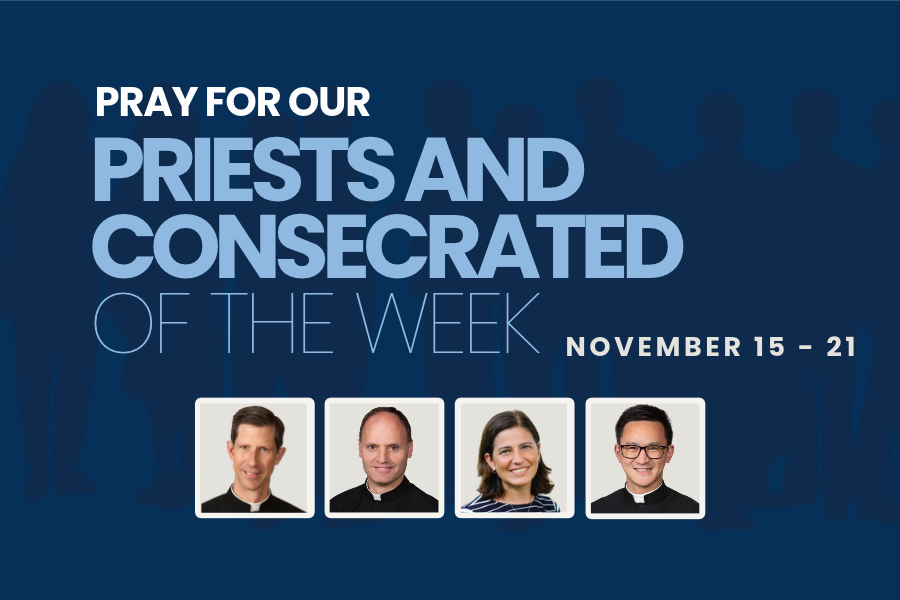
Regnum Christi invites our entire spiritual family and all our friends to join us in praying especially for our brothers and sisters living the consecrated vocations of Legionary priests, Consecrated Women, and Lay Consecrated Men in our territory.
Each week throughout the year, we will pray together for a different group of Legionaries and Consecrated, spanning all the communities across the territory, as our “Priests and Consecrated of the Week.”
Our Consecrated members are men and women who have said yes to Christ’s call to follow him, leaving everything behind to dedicate their entire lives to him and to join him in the mission of building his Kingdom. We come together to support them with our prayer, asking our Lord to strengthen them, hold them close to his Sacred Heart, and give them his deep joy as they live their mission each day.
This Week We Pray for
Beth Van de Voorde grew up in a Navy family, where moving around the world prepared her for a missionary vocation. She made her vows of consecration in 2006, and since then, she has studied and served in Rhode Island, Georgia, and, since 2018, in various cities throughout Spain. Currently, she works with RC young adults and adults in pastoral ministry and formation, offering spiritual direction and forming future spiritual directors in Divine Mercy’s School of Spiritual Direction and Francisco de Vitoria Univeristy’s Master de Acompañamiento Espiritual.
Fr. Jason Brooks, LC, grew up in Milwaukee, Wisconsin and was ordained in 2004. After being ordained, Fr. Jason served the Regnum Christi members in Chicago until 2011. Then, he served in a variety of roles in the Atlanta locality from 2011 to 2016. Since moving to Michigan in 2017, Fr. Jason has been genuinely inspired by his involvement with Encounter Ministries and has developed a passion for helping people to experience the healing power of the Holy Spirit through healing services and personal prayer ministry. Fr. Jason is currently leading the Regnum Christi Healing Ministry in Detroit, where he also serves as Regnum Christi chaplain.
Catherine Macora has been a Consecrated Woman of Regnum Christi for 30 years. Catherine grew up in a military family, graduated from UT Austin, worked in public relations and marketing in Houston and London, before entering consecrated life. She has worked in Regnum Christi schools in Spain and the US and with youth and Youth Missions. Catherine completed a Master’s Certificate in Christian Wisdom and currently resides in the Chicago community, offering spiritual direction, formation retreats and supporting Archdiocesan and local parish ministries.
Fr. Timothy Moran, LC is originally from Milwaukee, Wisconsin. After high school, he joined the United States Marine Corps Reserve and obtained a bachelor of science in chemical engineering at the University of Wisconsin–Madison. He entered the Legionaries of Christ in 1996 and was ordained to the priesthood in 2006. After ordination, Fr. Timothy served as chaplain at Royal Palm Academy and vocation director in Florida. He next served in Atlanta, Georgia as vocation director for the Southeast and also directed youth work and retreats, and acted as a spiritual director. From 2015 to 2025, Fr. Timothy was part of the chaplaincy of a family centre in Dublin, Ireland, providing spiritual direction, retreats, and healing prayer ministry. Since August of 2025, he has been working in Cupertino, California, where he serves as a retreat director at Our Lady of Clara Retreat Center.
Fr. Kevin Gillis, LC, was born in Halifax, Nova Scotia, Canada, and was ordained in 2020. Following his ordination, he served in San Jose, California, offering Catholic formation at Canyon Heights Academy. In 2024, he received his current assignment, which returned him to Canada, where he is serving as the associate pastor of Ascension Catholic Parish in Calgary, Alberta.
Prayer for Priests and Consecrated Members in Regnum Christi
God our Father, We thank you for our spiritual family of Regnum Christi, and for those within it that you have called to total consecration as Legionaries of Christ, Consecrated Women, and Lay Consecrated Men.
We ask you to renew their encounter with your Son Jesus Christ, who goes out to meet them and reveals the love of his heart to them. Deepen their personal love for Christ and their trust in his love for them. Gather them close to him, form them, and send them out accompanied by your Son, in the mission of forming apostles and Christian leaders who make your Kingdom present in hearts, in families, and in society.
Send your Holy Spirit to sanctify and strengthen them, And to help them respond generously and courageously to their mission each day.
Alex Kucera has lived in Atlanta, GA, for the last 46 years. He is one of 9 children, married to his wife Karmen, and has 3 girls, one grandson, and a granddaughter on the way. Alex joined Regnum Christi in 2007. Out of the gate, he joined the Helping Hands Medical Missions apostolate and is still participating today with the Ghana Friendship Mission.
In 2009, Alex was asked to be the Atlanta RC Renewal Coordinator for the Atlanta Locality to help the RC members with the RC renewal process. Alex became a Group Leader in 2012 for four of the Atlanta Men’s Section Teams and continues today. Running in parallel, in 2013, Alex became a Team Leader and shepherded a large team of good men.
Alex was honored to be the Atlanta Mission Coordinator between 2010 to 2022 (12 years), coordinating 5-8 Holy Week Mission teams across Georgia. He also created and coordinated missions at a parish in Athens, GA, for 9 years. Alex continues to coordinate Holy Week Missions, Advent Missions, and Monthly missions at Good Shepherd Catholic Church in Cumming, GA.
From 2016 to 2022, Alex also served as the Men’s Section Assistant in Atlanta. He loved working with the Men’s Section Director, the Legionaries, Consecrated, and Women’s Section leadership teams.
Alex is exceptionally grateful to the Legionaries, Consecrated, and many RC members who he’s journeyed shoulder to shoulder, growing his relationship with Christ and others along the way. He knows that there is only one way, that’s Christ’s Way, with others!





 For the Consecrated Women of Regnum Christi, every new vocation is a supernatural gift from on high. Vocational ministry, highlighted as an essential dimension of the life and mission of Consecrated Women at the recent Third Ordinary General Assembly, is a responsibility and a hope shared by all. Precisely for this reason, the Society’s Vision for 2026–2032 renews the commitment to cultivate a culture of vocation where each person can discover the beauty of their own calling and find the necessary support to respond with confidence.