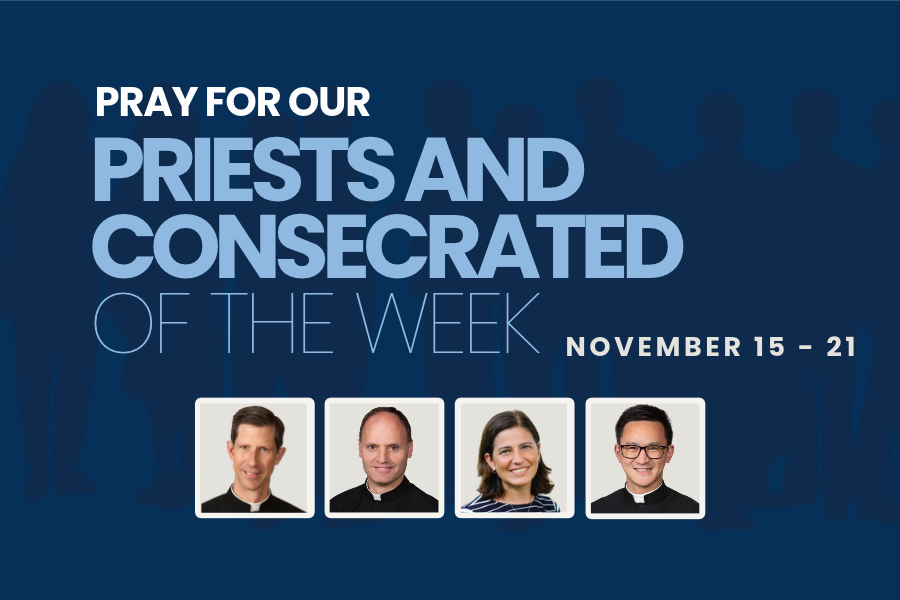
On June 27, the Solemnity of the Sacred Heart of Jesus, the new essay from the Regnum Christi General Directorate, “Here I Am Because You Called Me! Vocational Culture, Vocational Work, and Vocation Promotion in Regnum Christi“ will be published. The date of publication is not a coincidence. The heart, as a symbol of divine love, is also the starting point of every call—every vocation. The essay offers a look at vocation as a personal call that springs from the heart of Jesus Christ.
Through the voices of four of the authors who participated in its development, it explores how to renew the culture of vocations in the Church and to offer concrete paths to accompany each person in the discovery and fulfillment of their vocation. We interviewed them to understand the development of the text.
Taís Gea “Vocation springs from the heart of God”
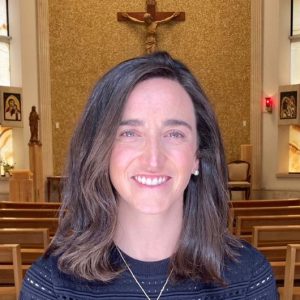 This is the belief of Taís Gea, a Consecrated Woman of Regnum Christi and one of the authors of the essay, who believes that “every vocation springs from the heart of Jesus.” For her, the call is not only an invitation to a specific mission, but a profound affirmation of one’s existence, where God has taken the initiative from the beginning. “One of the most beautiful stories about vocation,” she says, “is that of Jeremiah,
where God knows him from the womb. It shows us that vocation is not a human invention, but something that springs from the heart of God.”
Taís Gea, why is this essay being published on the Feast of the Sacred Heart of Jesus? What does it have to do with vocation?
I think it’s valuable to launch this essay on the feast of the Sacred Heart of Jesus because, in my opinion, every vocation springs from the heart of Jesus. Ultimately, a vocation is a call to existence, a call to a specific mission to serve the Lord. It’s God who takes the initiative, and from his heart springs this desire. I believe one of the most beautiful accounts of vocation is that of Jeremiah , where he speaks of how God knows the prophet from the womb, chosen from his creation . He shows us how a vocation springs from the heart of God, and it’s he who first takes the initiative.
How did the idea to write this essay come about, and what need does it seek to address within Regnum Christi and the Church?
One of the issues I was called to address was the biblical foundation. I believe it is very valuable for all of us, members of Regnum Christi, to constantly root ourselves in the Word of God. The Word of God is living and effective, and it is this deep well of wisdom where each of us finds a constant answer to our questions and inner concerns. Therefore, beginning the essay with a biblical foundation helps Regnum Christi members turn to that source where they themselves can continue to deepen their own calling, their own vocation. I believe it is very valuable to be able to find there, in the outlines of vocation in the Old Testament and in the personal vocation of the disciples in the New Testament, a foundation for the vocation of each of us as members of Regnum Christi.
We love the Church, which is the seed and beginning of the Kingdom on this earth; we feel a living part of it and collaborate in its evangelizing mission; we adhere with love and obedience to the Pope and the other bishops, knowing and spreading their teachings, supporting their initiatives, and supporting the local Church.
Father Juan Antonio Ruíz, LC: Vocation in times of noise
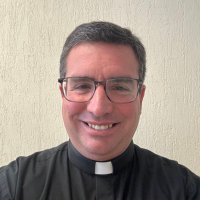 The essay also arises as a response to the challenges of our time. Father Juan Antonio Ruíz, a Legionary priest and another of the essay’s authors, puts it this way: “To listen to God, one must live a life consistent with him.”
Fr. Juan Antonio Ruíz, LC, a vocation is not just a choice, but a personal call from God. How can we help people hear him in such a noisy world?
As in any relationship with anyone, we need to learn to adapt to what the person says and their personality. Indeed, every vocation is a call from God. And, since I am his, I must adapt myself to him. There’s no better way to hear that call than by living the life He gives me.
If I live a coherent life, it’s easier for me to listen to God. If I fill my life with things that aren’t of God, with people who aren’t with God, with circumstances that aren’t aligned with him, it’s very difficult for me to listen to Him. Our heart is like a glass. A glass is known by what it’s filled with: a glass of water, a glass of soda… and that’s how our heart is. If I fill it with God and his things, what will illuminate my life will be God and his things, it’s easier for me to listen to him. But if I’m continually filling it with everything that is contrary to God, then it’s very difficult to listen to him.
This filling of oneself with God involves, above all, moments of prayer. These include not only praying Our Fathers and Hail Marys, which are very good, but also slowing down and asking God directly: What do you want from me? And then letting him answer. This is key, along with reading the Word of God, spiritual direction, Eucharistic moments, etc.
To know what our vocation is, it is necessary to listen to God in prayer.
The essay discusses mindset, sensitivity to God, and vocational pedagogy. Could you explain how these three aspects help create an authentic vocational culture?
A culture is a lifestyle, a way of living. When we speak of a vocational culture, we are speaking of a fullness of life which leads us to seek the fulfillment of each individual. This mindset, sensitivity, and pedagogy encompass three elements that drive a person to seek this fulfillment, the call of God, for their entire existence. It is not just a vocation to what I do, but a vocation to who I am, which is also realized and lived out over time. We develop that God-mindedness, a sensitivity that is sharpened and educated through prayer, through contact with the Eucharist.
And then there’s a pedagogy, the accompaniment that I’m given, which is part of a whole lifestyle of the five elements of Regnum Christi in my life, in the section, that leads me to live my vocation and create a vocational culture. It’s living a lifestyle that lets us see God’s call in every circumstance with the desire to respond to that call of God in every aspect of our life.
So it’s those three elements: the our mindset, the sensitivity of each person and of the people in the institution, and the processes that happen through accompaniment that help the us create that vocational culture.
Many young people today are afraid of commitment. How does this essay encourage them to give a free and trusting “yes” to God?
For me, the key word is “fulfillment.” Every human being seeks to transcend, to be someone, and not merely to survive. Knowing that God created me for something and to be fulfilled in that “something” is precisely what can lead me to give that free, trusting “yes” to God. Only God seeks happiness for each person. And it is precisely by discovering, through the means that Regnum Christi can offer me—which is what this essay is trying to offer and invite us to do—how to seek that fullness of heart, that fullness of soul, that fullness of life in each person.
And yes, taking a step is always scary because it implies something unknown ahead, but if throughout my life I am trying to have a personal relationship with Christ who loves me, who is in love with me, it will be easier to take that step, even if it may cost me at first. It is God who calls me, it is He who has accompanied me, who has formed me, who has come out to meet me, who has sent me to be an apostle.
And so, how can we respond? I believe these are the elements that this essay shares, with practical aspects, inviting young people not to be afraid of God, to feel complete freedom to respond to him because he will lead them to fulfillment. The response should be given with generosity, and complete trust in him because he is always present and helps us. He always wants our happiness.
Why is it so important in life to discern what your vocation is?
It’s very important because we’re all made for something, and we’re all connected. And precisely, discernment, which isn’t simply discovery, discernment is a much deeper verb; it’s a reflection made into prayer, it’s a reflection made with someone who may be a person, but above all, it’s with God. It’s going down into my heart and seeing why I was created.
And that’s why the second part of the essay is so beautiful because it’s about realizing that a vocation has different dimensions: I’m called to life, I’m called to faith, I’m called to a specific vocation within the faith of the Church, which can be lay, consecrated, or priestly. And discerning, walking, making that journey is exciting; it’s beautiful because it’s about discovering how the pieces of the puzzle of my life will gradually fit together.
And that’s why it’s so important, because otherwise, I’ll just survive in a routine not knowing if it’s what I was created for. This discernment that every Catholic should do, and even more so every member of Regnum Christi, is something very important because it leads to that fulfillment, a fulfillment that can be found in any vocation.
Even within each vocation, there are, so to speak, smaller vocations. A priest, for example, is called not only to be a priest, but a priest dedicated to youth, a priest dedicated to being a teacher. These are vocations within the vocation. Being married implies married life, but it doesn’t stop there. It’s a calling, within married life, to be a person who has a concern for the social sphere, something my company is dedicated to, etc.
The essay helps us a lot with guidelines that can guide us in that direction, to not simply stagnate, but see I am called to be much more.
Many people today find no meaning in their lives; they are depressed, without desire… Could this be because they haven’t found their calling?
It may be that not fully finding my vocation leads me to sadness, but not necessarily, because there are also people who find themselves in a vocational fulfillment and are stuck in their own lives.
There are many elements, but one I would emphasize a lot is: if I love what I do, if I love who I am, what is the first thing I do when I wake up? To focus my life, to count my blessings, and not to list my shortcomings. This attitude toward life is not simply cheap optimism but a supernatural attitude of saying: “I am loved by God.” If God has me in this world and I live, it is precisely because God loves me and has this trust, has this mission that he is giving me, or wants to accompany me in every moment of my life, even in my crosses, even in my tears.
This paradigm shift or change of vision, this chip that I have to put in my heart, in my mind, is something that helps a lot to live life better, because it seems to me that in our world we are just surviving, like floating and watching one day go by and another go by and I’m not doing anything, when in reality I should be doing a lot. In that sense, meditation on Nazareth impresses me a lot. To think that a God who doesn’t miss a thing, whose entire plan is meticulously thought out, thought that his incarnate Son would spend 30 years living routinely doing everyday things, in a carpentry service, helping out in his parents’ house, living normal lives, the way you and I live. For me, those 30 years are just as redemptive as the three years spent preaching, performing miracles, healing the sick, as the three hours on the cross, they are just as redemptive because suddenly it doesn’t matter what we do but how we do things.
Christ put the same love into those nails he hammered into his carpentry service as he did into allowing himself to be nailed to the cross, because it’s not what we do, but how we do it. And this paradigm shift is something that happens to many Catholics because we live in a world that absorbs us in a frenzy of a thousand activities, glued to our cell phones everywhere, always at work , and we forget that we can put a lot of love into it.
That’s why I’m impressed and I love that phrase from Saint John of the Cross: “Where there is no love, put love and you will get love.” And that’s also true in our lives, where there is no love, put all the love in the world. Let yourself be embraced by the love of God, go to the people who are around you and who do love you and you will see that you will get love in your life, even if you do things that are, so to speak, meaningless , because it is the love of God and the love that you put into Him that is present in that moment.
Pepe Mateos: One heart, many answers
 Vocational culture is not the exclusive domain of seminaries or religious institutes. For Pepe Mateos, a Lay Consecrated Man of Regnum Christi and also an author of the essay, it is a horizon that everyone—lay people, priests, and consecrated persons—are called to build. “Everything begins with understanding life as a gift with a purpose,” he affirms. And that purpose requires a response.
Pepe Mateos, how can a lay person, a priest, or a consecrated person be a natural promoter of vocational culture in their environment?
It seems to me that what lies at the heart of a vocational culture is understanding life as a gift we have received from God, a gift that has a purpose, a call from God, and that call awaits a response. On the other hand, there are common elements that are necessary for all vocations to flourish, for example, knowing how to make a lifelong commitment, living faithfully, knowing how to postpone gratification for the greater good, knowing how to stoop to wash the feet of our brothers and sisters, learning to spend our lives for something greater than ourselves, etc.
By understanding vocational culture in this way, all people, regardless of their specific vocation, build a vocational culture when they propose, present, and bear witness to all of these themes just mentioned. Every member of Regnum Christi promotes a vocational culture when they transmit these values in everything they do, in the apostolate in its broadest sense, not only in apostolic activities, but also in their own lives.
How can this essay help Regnum Christi teams and communities live their vocation more deeply?
This essay helps identify the concept of vocation and sheds light on the understanding of the different personal vocations, the path of vocational growth, and how to guide people toward vocational fulfillment.
Why is this vocational wealth so important for Regnum Christi?
The happiness and fulfillment of people depend on their discovery of their personal vocation and how they can best live it. In its own mission, Regnum Christi seeks to reach out to people to reveal to them the heart of Christ. Vocation is perhaps the clearest way in which Christ’s personal love for each person is expressed.
Behind the essay
Every essay has a process, and Viviana Limón, a Consecrated Woman of Regnum Christi, has been a fundamental part of it. ” The essay began to take shape in 2021 , ” she says. At that time, there was already a clear awareness within Regnum Christi about the importance of accompanying each person in their vocation. However, there was also a need for a shared understanding of fundamental concepts: What is a vocation? What does vocational fulfillment mean? How do we truly accompany others?
Viviana Limón, an essay like this doesn’t just come out of nowhere. How did the idea come about?
The essay has been in preparation, in some way, since 2021. In the Church and in Regnum Christi, there is a clear awareness of the importance of accompanying each person to discover and fully live the vocation to which God calls them. However, we saw the importance of having a shared understanding of what we mean by vocation, vocational accompaniment, and vocational fulfillment. We also saw the need to start from solid foundations in order to live from a vocational culture and carry out appropriate vocational work and vocation promotion.
How were the participating authors chosen?
We sought to have members of the various Regnum Christi vocations with training and experience in vocational areas participate in the preparation of the essay .
What part of the process was most challenging? Were there any unexpected discoveries or insights you gained as you wrote it?
The most interesting thing was being able to start from what the Church tells us on the subject. What the documents of the Council and the recent Magisterium tell us about vocation, about the Church, about the human person. And seeing how we live this out in Regnum Christi and from the charism of Regnum Christi. And realizing that what the General Convention said on the subject was in complete communion with it. That we resonate with what the Church says and that we want to live life as a vocation, as a call and response. We want to know and promote all vocations and, at the same time, adequately accompany each person in their discernment of their vocation.
The essay “Here I Am Because You Called Me! Vocational Culture, Vocational Work, and Vocation Promotion in Regnum Christi “ is, in the words of those who prepared it, an invitation to live meaningfully. To discover God’s love as the source of every vocation. To listen, with an open heart, to the unique call He makes to each person. Because responding to that call not only transforms the life of those who hear it, but enriches the entire Church.