Twenty-Second Sunday in Ordinary Time
Luke 14:1, 7-14
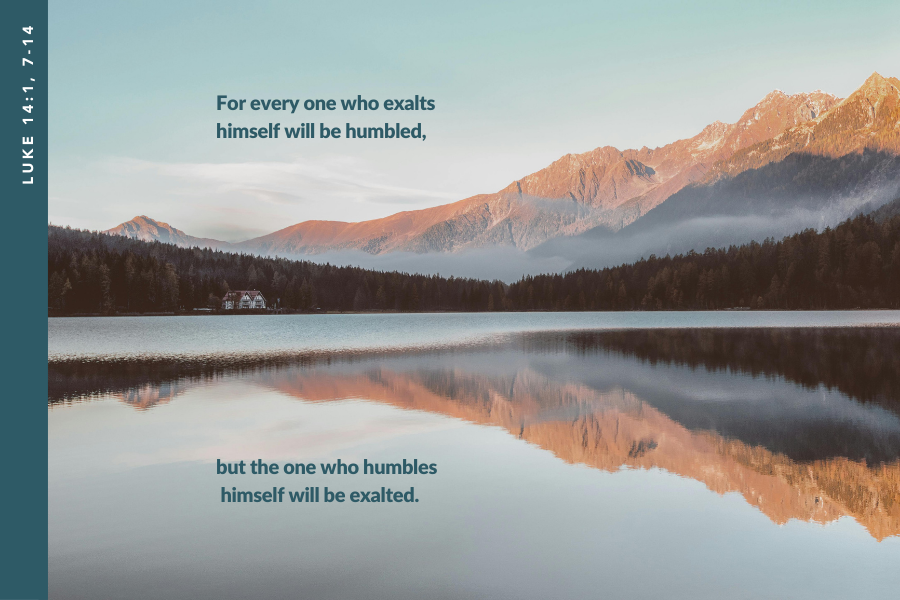
On a sabbath Jesus went to dine at the home of one of the leading Pharisees, and the people there were observing him carefully. He told a parable to those who had been invited, noticing how they were choosing the places of honor at the table. “When you are invited by someone to a wedding banquet, do not recline at table in the place of honor. A more distinguished guest than you may have been invited by him, and the host who invited both of you may approach you and say, ‘Give your place to this man,’ and then you would proceed with embarrassment to take the lowest place. Rather, when you are invited, go and take the lowest place so that when the host comes to you he may say, ‘My friend, move up to a higher position.’ Then you will enjoy the esteem of your companions at the table. For every one who exalts himself will be humbled, but the one who humbles himself will be exalted.” Then he said to the host who invited him, “When you hold a lunch or a dinner, do not invite your friends or your brothers or your relatives or your wealthy neighbors, in case they may invite you back and you have repayment. Rather, when you hold a banquet, invite the poor, the crippled, the lame, the blind; blessed indeed will you be because of their inability to repay you. For you will be repaid at the resurrection of the righteous.”
Opening Prayer: Lord Jesus, let me know your heart, which is meek, humble, and generous; knowing it, grant me the grace to love and imitate you.
Encountering Christ:
- Being a Guest: Jesus offered what appears to be very sagacious human advice. It is as though he was suggesting a strategy for making sure we get places of honor. But underlying his words is an important instruction for us. Every time we attend Mass, we are guests at the wedding banquet. The Eucharist is the foretaste of the eternal wedding feast to come in Heaven. Do we come forward for Communion as though it is our right? Or do we approach with gratitude, reverence, and humility, aware that we are special guests invited to partake of this great gift, Our Lord, Body, Blood, Soul, and Divinity?
- Being a Host: Jesus addressed the host of his dinner party with a challenge to invite, not the rich, but those who could not repay him. His words are an invitation to us to consider how often we extend ourselves in hospitality or friendship to others. Does complacency keep us within a circle of friends who are comfortable? Or do we reach out to people on the margins of our life, in the parish, at work, at school? How may the Lord be inviting us to give of ourselves in unexpected ways?
- Repayment: To serve those who cannot repay us is what Ignatius of Loyola would call a spirit of indifference. Far from not caring, it places the heart in a position of vigilance, seeing everything as God’s gift to receive and share with others. It frees the heart of egotistic possessing and clamoring after what promotes our own well-being and self-satisfaction. Once again Jesus promised a reward to those who were good stewards and hosts. He said that payment would come at the resurrection of the righteous. The righteous person is one who has a vision of things as they are and has established an honest relationship with God, others, and all of creation. The righteous see everything at their service, while nothing belongs directly to them. For this reason, they are capable of being generous, because they are guided by the beneficent heart of the Lord.
Conversing with Christ: Lord Jesus, you are the giver of all good things. Help me to see anew, with your eyes, so that I may establish a right relationship towards you, others, and all created things. Grant that I may have a heart like yours, humble and capable of living in the truth about who I am in relation to all things.
Resolution: Lord, today by your grace I will reflect on my attitudes about entering into relationships with you, others, and created things.
Jennifer Ristine is a consecrated woman of Regnum Christi dedicated to spiritual and faith formation through teaching, conferences, writing, and spiritual direction. While serving in Ancient Magdala she wrote Mary Magdalene: Insights from Ancient Magdala and “Nine Days with Mary Magdalene.”