Twenty-First Sunday In Ordinary Time
Luke 13:22-30
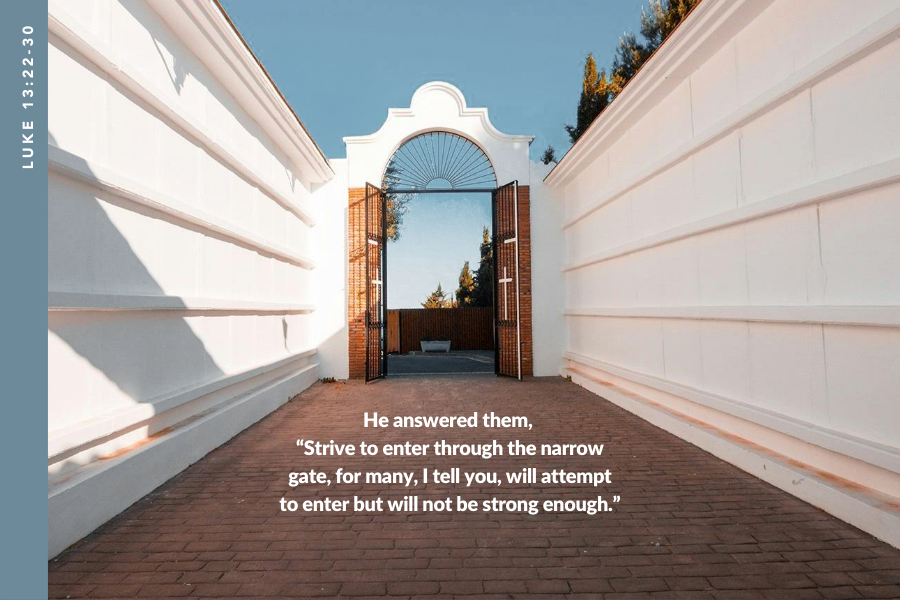
Jesus passed through towns and villages, teaching as he went and making his way to Jerusalem. Someone asked him, “Lord, will only a few people be saved?” He answered them, “Strive to enter through the narrow gate, for many, I tell you, will attempt to enter but will not be strong enough. After the master of the house has arisen and locked the door, then will you stand outside knocking and saying, ‘Lord, open the door for us.’ He will say to you in reply, ‘I do not know where you are from.’ And you will say, ‘We ate and drank in your company and you taught in our streets.’ Then he will say to you, ‘I do not know where you are from. Depart from me, all you evildoers!’ And there will be wailing and grinding of teeth when you see Abraham, Isaac, and Jacob and all the prophets in the kingdom of God and you yourselves cast out. And people will come from the east and the west and from the north and the south and will recline at table in the kingdom of God. For behold, some are last who will be first, and some are first who will be last.”
Opening Prayer: Lord Jesus, grant me true humility to know myself through your eyes and heart. Grant me your salvation.
Encountering Christ:
- A Time for Salvation: Images of saints from the middle ages were often painted with a skull in the background, which was a common practice to help the monks to remember the fleetingness of life. They lived with a consciousness that can be easily overrun today by constant attention to the activity at hand through cell phones, alternate realities in gaming, movies, and TV series. The unavoidable reality of death is so swept aside from our consciousness that we have a false understanding of our finality, if we think about it at all. Today’s Gospel brings it to light. There will be a time when we face the truth: are we bound for Heaven or not? This moment comes to everyone. How rooted in our consciousness is the temporality of this life and the horizon of an eternity to come?
- Who Will Be Recognized?: In this curious parable, Jesus offers some thought-provoking considerations. The owner of the house did not directly condemn the one who was knocking. He just didn’t recognize him, and thus would not open the door. The one standing outside requested to enter, but to no avail. He was not recognized as one who belonged inside. The request was repeated with insistence, stating that he ate and drank with the owner, but the door remained closed. Both times the owner of the house said he didn’t know who the outsider was or where he came from. This could be a case of a forgotten identity, not on the owner’s part, but on the part of the one knocking. It is a call for us to profoundly remember our origins as sons and daughters of God, and to know that we belong to him and await Heaven one day. Living in this reality—aware of where we came from and where we are going—allows us to be recognized when we are knocking at the door with the hope of entering the Kingdom of Heaven.
- Last and First: Jesus stated, once again, that the first will be last and the last will be first. He breaks our schemes, inviting us to an even deeper awareness of our interior motives and intentions as we live our faith. Do we walk with a false security in our own salvation, putting ourselves in first place in God’s eyes? Or are we aware that salvation is an undeserved gift? We are in dire need of God’s mercy and we wait at the end of the line, aware that entry is for those who have humbled themselves.
Conversing with Christ: Lord Jesus, grant me true humility and courage to enter the narrow door, leaving behind or making changes that are not in accord with my origin and destiny.
Resolution: Lord, today by your grace I will reflect on my life in the light of eternity, with a grateful and humble heart.
Jennifer Ristine is a consecrated woman of Regnum Christi dedicated to spiritual and faith formation through teaching, conferences, writing, and spiritual direction. While serving in Ancient Magdala she wrote Mary Magdalene: Insights from Ancient Magdala and “Nine Days with Mary Magdalene.”