Tuesday of the Twentieth Week in Ordinary Time
Matthew 19:23-30
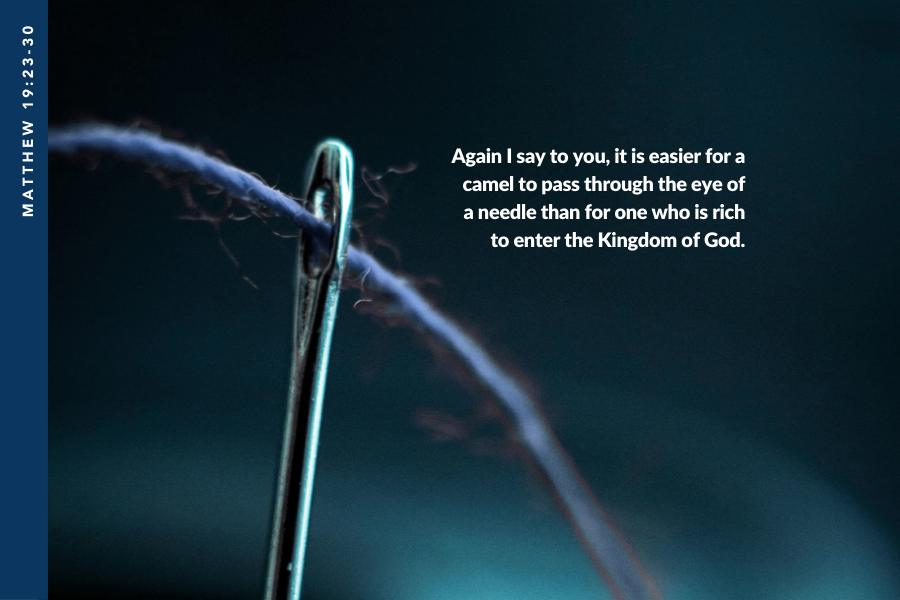
Jesus said to his disciples: “Amen, I say to you, it will be hard for one who is rich to enter the Kingdom of heaven. Again I say to you, it is easier for a camel to pass through the eye of a needle than for one who is rich to enter the Kingdom of God.” When the disciples heard this, they were greatly astonished and said, “Who then can be saved?” Jesus looked at them and said, “For men this is impossible, but for God all things are possible.” Then Peter said to him in reply, “We have given up everything and followed you. What will there be for us?” Jesus said to them, “Amen, I say to you that you who have followed me, in the new age, when the Son of Man is seated on his throne of glory, will yourselves sit on twelve thrones, judging the twelve tribes of Israel. And everyone who has given up houses or brothers or sisters or father or mother or children or lands for the sake of my name will receive a hundred times more, and will inherit eternal life. But many who are first will be last, and the last will be first.”
Opening Prayer: Lord Jesus, I am rich by the world’s standards but want to be rich in your grace. Please be with me as I contemplate your words and look for meaning to inspire change in my life.
Encountering Christ:
- Compatibility: Jesus makes use of imagery from his time to show the incompatibility of entrance to the Kingdom of Heaven with one whose heart is full of earthly treasures. The “eye of a needle” was a large hole within the city wall that permitted people to enter after the gates were shut. They were made so that a person could enter and find protection, but they were not big enough for animals such as horses, mules, or camels. Just as the eye of the needle is made for a person to slip through, the Kingdom of Heaven is for those whose hearts are free from the enslavement of worldly things. That does not mean that one who owns earthly treasures cannot enter Heaven; rather, earthly treasures can be an obstacle for one whose interior motive in the use of them is personal gain, usurping serving others and giving glory to God in the use of created things.
- “With God All Things Are Possible”: The tradition of the Church has long taught us that salvation comes through the grace of faith in God. To believe is to throw oneself upon the mercy and goodness of God. He is the Savior. This truth does not invite laxity, but rather a confident participation in God’s saving work. In this way, we become coworkers with Christ, never losing sight of who has gone before us in the fight for our salvation. Let us ask the Holy Spirit to illuminate our mind to know where we seek to be our own Savior and what areas of our life need to be turned over to the Lord. May we trust in his interest and capacity to work through whatever circumstances we find ourselves in.
- Trust in the Process: The disciples were “greatly astonished”: “We have left everything to follow you! What then will there be for us?” They seemed to feel that God owed them something. We do the same. We can feel that, since we have given a piece of our life to him, he should carry on with his business according to our preconceived plan. But God owes us nothing and has given us everything through the salvation wrought by Jesus Christ. Truly, God sees a bigger picture. May we trust in the process, knowing that Our Lord always works to bring out the best for us.
Conversing with Christ: Lord Jesus, your ways are marvelously mysterious, but at the same time so clear. You are the way—humble, poor, patient, seeking the Father’s will in all things. Help me to give of myself without holding onto my notions of how things should be. I want to trust in you totally.
Resolution: Lord, today by your grace I will be attentive to how the enemy attacks me at my weakest points, especially attacking my trust in you. When doubt enters, I will make an act of trust in you.
Jennifer Ristine is a consecrated woman of Regnum Christi dedicated to spiritual and faith formation through teaching, conferences, writing, and spiritual direction. While serving in Ancient Magdala she wrote Mary Magdalene: Insights from Ancient Magdala and “Nine Days with Mary Magdalene.”