WEEKLY DIGEST OF rc
DAILY MEDITATIONS

October 25, 2026 – The Language of Selfless Love

26-10-25-DM

Thirtieth Sunday in Ordinary Time

Matthew 22:34-40

When the Pharisees heard that he had silenced the Sadducees, they gathered together, and one of them, a scholar of the law, tested him by asking, “Teacher, which commandment in the law is the greatest?” He said to him, “You shall love the Lord, your God, with all your heart, with all your soul, and with all your mind. This is the greatest and the first commandment. The second is like it: You shall love your neighbor as yourself. The whole law and the prophets depend on these two commandments.”

Opening Prayer: Lord Jesus, I love you with all my heart, soul, mind, and strength. I thank you for creating and redeeming me and for inviting me to a deeper relationship with you. I believe in you and hope you will sustain me. I ask for the grace to love others as you do.

Encountering Christ:

  1. The First Commandment: Jesus teaches us to love God above all else. Love means taking the beloved into account before making important decisions. It is natural to avoid behaviors that would hurt, harm, or disrespect a loved one. So, too, we should be attentive that our actions are pleasing to God. If we consult a spouse before making a big decision, why wouldn’t we pray and consult God about what is happening in our lives? God is always ready to listen and to offer counsel. Let us turn to him when faced with important decisions, showing him the greatest love and respect, and full of confidence that he will guide us.


  2. The Second Commandment: “You shall love your neighbor as yourself” is a challenging admonition, yet living that way is completely fulfilling. A middle-aged woman once told me that she struggled to find the time to help a bedridden friend with household tasks. The sacrifices she made to find the time enriched her life. She felt truly blessed. God puts people in our path who long for love and support. He invites us to reach out in the same way that we would want others to reach out to us. Even the smallest acts of kindness can be signs of great love.


  3. The Whole Law: Our human laws work only as well as we are conformed to God’s laws—the laws of love God and love your neighbor. How well our political system would work if everyone was motivated by their love of neighbor! St. Teresa of Calcutta was able to win over adverse political officials by her acts of selfless love for the sick and dying. She entered countries closed to Christianity because those leaders saw her love. True love is a language that rises above politics and self-interest. May our selfless love be a testimony to our love of Christ.

Conversing with Christ: Dear Lord, I long for a peaceful and loving home and homeland. Teach me to be a vehicle of your peace by bringing love wherever I go!

Resolution: Lord, today by your grace I will look for a soul you place in my path and show him or her show true selfless love.

For Further Reflection: Fr. Leo Maasburg’s book Mother Teresa of Calcutta: A Personal Portrait outlines many inspiring acts of selfless love.

Renee Pomarico is Communications Director for the Consecrated Women of Regnum Christi. She is from Philadelphia, has been consecrated to God since 2000, and is currently stationed in Rome.

October 26, 2026 – Bent Over

26-10-26-DM

Monday of the Thirtieth Week in Ordinary Time

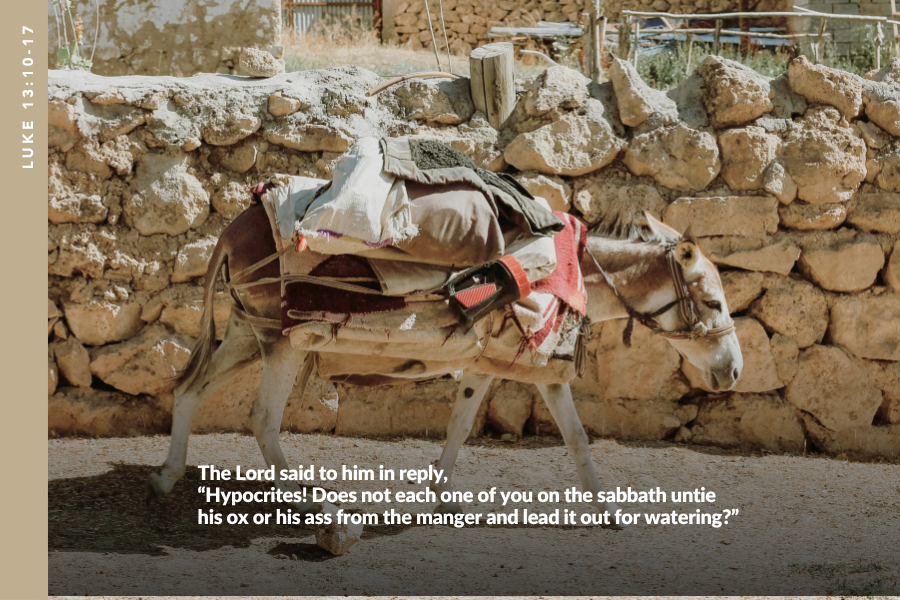
Luke 13:10-17

Jesus was teaching in a synagogue on the sabbath. And a woman was there who for eighteen years had been crippled by a spirit; she was bent over, completely incapable of standing erect. When Jesus saw her, he called to her and said, “Woman, you are set free of your infirmity.” He laid his hands on her, and she at once stood up straight and glorified God. But the leader of the synagogue, indignant that Jesus had cured on the Sabbath, said to the crowd in reply, “There are six days when work should be done. Come on those days to be cured, not on the Sabbath day.” The Lord said to him in reply, “Hypocrites! Does not each one of you on the Sabbath untie his ox or his ass from the manger and lead it out for watering? This daughter of Abraham, whom Satan has bound for eighteen years now, ought she not to have been set free on the Sabbath day from this bondage?” When he said this, all his adversaries were humiliated; and the whole crowd rejoiced at all the splendid deeds done by him.

Opening Prayer: Lord Jesus, I desire freedom, and I know that you alone can make me free. Lord, I humbly ask for freedom of spirit, freedom in love, and freedom from sin and selfishness.

Encountering Christ: 

  1. Bent Over: The woman in today’s Gospel was bent over, presumably forced by her infirmity to stare at the ground ahead rather than to look at a person talking to her. From her position, she couldn’t see the clouds in the sky, watch birds nesting in the trees, or scan a crowd for familiar faces. She was missing out on some of life’s simple pleasures. Standing there in the synagogue that day, she listened to Jesus teaching, but she couldn’t see his face—until he called her over. How often are we like this woman? Bent over, crippled by sadness, grief, or illness? Unable to see any blessings amidst so much sorrow? When we feel like this, we need to place ourselves in proximity to Jesus, as the bent-over woman did. Whether or not we see his face or audibly hear his voice, Jesus will make himself present with healing graces. May we abandon ourselves in these situations and trust God to act in his time.


  2. He Touched Her: Jesus laid his hands on the woman to cure her. What must it have been like to feel the Lord’s hands on her head sending his healing powers through her tortured body? The touch of Christ happens in our lives every time we receive a sacrament. He also touches us through other people or through “coincidental” circumstances he arranges during our day. When have you felt the touch of Christ? What was it like? Whether it was physical, emotional, or spiritual, the consequence of being touched by Christ is a heart overflowing with gratitude. Thank you, Lord Jesus!


  3. Angry Legalism: Jesus unequivocally condemned the legalism of the Pharisees who complained that he healed the woman on the Sabbath. They were so infuriated with Jesus’ rising status among the people that they were unable to feel compassion for the woman, or even awe at the healing power manifested by Christ. Anger is a human emotion, but how we process it divides sinners from saints. Unchecked anger is a dangerous vice—one that can blind us to good in our lives. The Scriptures say, “Tremble and sin no more” (Ps 4:5)

Conversing with Christ: Lord, help me to accept the circumstances in my life. Please give me self-mastery to control any anger I feel, and prudence to take a course of action that is pleasing to you. I never want to be considered a “hypocrite” or a wrathfully angry person, but I need your grace to live peacefully and authentically.

Resolution: Lord, by your grace I will entrust my concerns to you and mentally “let go” of anything that is preventing me from seeing the blessings in my day.

For Further Reflection: The Seven Deadly Sins: Anger, an excellent blog post on dealing with anger.

Maribeth Harper celebrated paying the last tuition bill for her kids’ college by writing a book for parents who have college-aged young adults: A Spiritual Toolbox: Tips for Parenting through the First Year of College. She is a wife of over thirty-five years, mother of four, and grandmother of twelve and counting.
October 27, 2026 – Time, Growth, and Fruitfulness

2026-10-27-DM

Tuesday of the Thirtieth Week in Ordinary Time

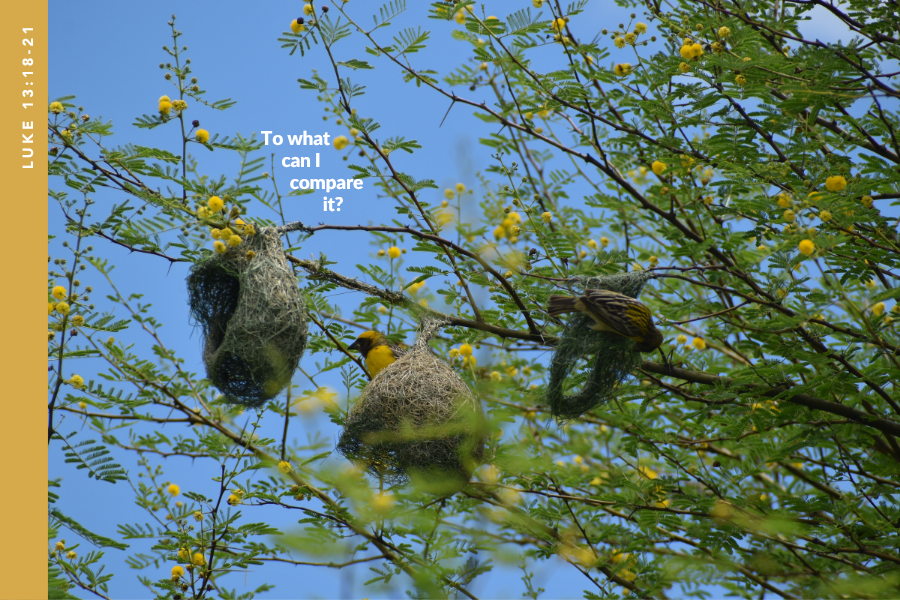
Luke 13:18-21

Jesus said, “What is the kingdom of God like? To what can I compare it? It is like a mustard seed that a person took and planted in the garden. When it was fully grown, it became a large bush and the birds of the sky dwelt in its branches.” Again, he said, “To what shall I compare the kingdom of God? It is like yeast that a woman took and mixed in with three measures of wheat flour until the whole batch of dough was leavened.” 

Opening Prayer: Lord, I believe in your goodness, I hope in your grace, and I love you for having loved me. Thank you for the gift of life. Help me have the humility to recognize that all good things come from you. Help me to be docile to your timing and to the spiritual process that is developing in my soul.

Encountering Christ:

  1. The Kingdom of God: The Church started with a mustard seed—one person, Jesus Christ. He proclaimed the Kingdom of God so that it began to grow, first with the Twelve Apostles, Mary, and the other holy women who followed Christ. Over time, it grew into an institution with a hierarchy, with dioceses and parishes. The Kingdom of God takes time to grow. It is ever developing. The same is true for each person who comes to know Christianity: Once the seed is planted, it needs time to develop in the individual’s heart until the full truth of the Gospel is embraced and the Kingdom of God reigns in them.


  2. Spiritual Growth: Our own maturation in faith and virtue is similar to the process of the mustard seed. We go through stages, forming our minds and hearts and conforming them to the mind and heart of Christ. Gradually habits of virtue develop and the exercise of the theological virtues deepens. We become strong, rooting ourselves in faith even amidst difficult circumstances. Sometimes we’d like to run ahead, but we grow in holiness at the pace of the Holy Spirit. “The wind blows where it wills, and you can hear the sound it makes, but you do not know where it comes from or where it goes; so it is with everyone who is born of the Spirit” (Jn 3:8).


  3. Shade and Nourishment: Today’s Gospel passage points out that when the mustard seed became a large bush, birds came to dwell in its branches, receiving shade and refreshment. The large bush was life-giving. Just as human beings go through a process of maturation before becoming parents, so too our spiritual life develops gradually to the point that it becomes life-giving. All true love brings forth new life. Being in love with God and living a life in communion with him generates spiritual motherhood and fatherhood. Others can find refreshment in “our branches.” “I am the vine, you are the branches. Whoever remains in me and I in him will bear much fruit, because without me you can do nothing” (Jn 15:5).

Conversing with Christ: Dear Lord, grant me the grace to become a refuge for souls who seek your love. I want to remain in you, to live in communion with you, and to bear fruit for the Kingdom of God.

Resolution: Lord, today by your grace I will visit an Adoration chapel to root myself in your presence in my life.

For Further Reflection: The podcast on Discerning Hearts entitled Dr. Mitchell A. Kalpakgian —The Virtues We Need Again on Inside the Pages with Kris McGregoron expounds on the building blocks we need to grow in the spiritual life.

Renee Pomarico is Communications Director for the Consecrated Women of Regnum Christi. She is from Philadelphia, has been consecrated to God since 2000, and is currently stationed in Rome.

October 28, 2026 – Profound Union

26-10-28-DM

Feast of Saints Simon and Jude, Apostles

Luke 6:12-16

Jesus went up to the mountain to pray, and he spent the night in prayer to God. When day came, he called his disciples to himself, and from them he chose Twelve, whom he also named Apostles: Simon, whom he named Peter, and his brother Andrew, James, John, Philip, Bartholomew, Matthew, Thomas, James the son of Alphaeus, Simon who was called a Zealot, and Judas the son of James, and Judas Iscariot, who became a traitor.

Opening Prayer: Lord Jesus, you have called me to collaborate with you in spreading your Kingdom of love. Strengthen my faith, hope, and love so as to respond generously to your call. Lord, I humbly ask the grace to listen to your voice.

Encountering Christ: 

  1. Jesus Spent the Night in Prayer: Jesus’ profound union with the Father is exemplary. We are called to imitate his desire for union with the Father as did all of the great saints. “Love to pray. Prayer enlarges the heart until it is capable of containing God’s gift of himself,” says St. Teresa of Calcutta. When we pray, we turn to the Father, like Jesus did to better know the Father’s will. We ask to grow in the desire to act according to his will. We look to Jesus who shows us how important it is to pray, especially when we have important decisions to make.


  2. Jesus Called Disciples: Jesus knew that his choice of Apostles would affect everything about the new Church. He prayed about who to invite and, when he extended the invitation, he hoped they would follow. Jesus knew that each one was created for a mission and would find fulfillment in carrying out his mission. Yet Jesus did not force this invitation upon them. He allowed them to respond freely. In the same way, God calls each one of us for a specific mission and gives us the freedom to choose the path of God’s will or the path of our own will. Those who fulfill their mission will find fulfillment, and win eternal life as well.


  3. Judas the Traitor: Choosing to respond positively to God’s call does not mean that once we follow Christ, salvation is assured. There are twists and bends along the journey, temptations and falls, growth and success, and the opportunity to lose everything. Judas, who stood so faithfully by Christ’s side up to the end turned away to become a traitor. We must be on guard, renewing our love for God in our hearts every day, participating regularly in the sacraments, and seeking to conform our behavior to the Gospel standard.

Conversing with Christ: Dear Lord, you teach me important truths about my eternal destiny in these lines of Scripture. Prayer is essential to finding and living out the specific mission you have for me. Through prayer I will stay connected to you so that I may be your friend always. Sustain me in the life of grace. I ask when I pray the “Our Father,” “Lead me not into temptation, but deliver me from evil.” Grant that I may be a faithful follower up until the very last moment of my life.

Resolution: Lord, today by your grace I will make a small sacrifice as a renewal of my love for you.

For Further Reflection: Do Something Beautiful for God: The Essential Teachings of Mother Teresa—365 Daily Reflections

Renee Pomarico is Communications Director for the Consecrated Women of Regnum Christi. She is from Philadelphia, has been consecrated to God since 2000, and is currently stationed in Rome.

October 29, 2026 – Docility to God’s Will

26-10-29-DM

Thursday of the Thirtieth Week in Ordinary Time

Luke 13:31-35

Some Pharisees came to Jesus and said, “Go away, leave this area because Herod wants to kill you.” He replied, “Go and tell that fox, ‘Behold, I cast out demons and I perform healings today and tomorrow, and on the third day I accomplish my purpose. Yet I must continue on my way today, tomorrow, and the following day, for it is impossible that a prophet should die outside of Jerusalem.’ Jerusalem, Jerusalem, you who kill the prophets and stone those sent to you, how many times I yearned to gather your children together as a hen gathers her brood under her wings, but you were unwilling! Behold, your house will be abandoned. But I tell you, you will not see me until the time comes when you say, Blessed is he who comes in the name of the Lord.”

Opening Prayer: Lord Jesus, I believe that you are pure goodness and know what is best for me. Help me to surrender to your goodness as I reflect on your words. I humbly ask for the grace of docility in imitation of Mary.

Encountering Christ: 

  1. Time Can Teach Docility: Jesus came in God’s name to gather the people to himself, but many were unwilling to approach him. He prophesied that the day would come when their perspective would change from resistance to proclaiming him blessed “who comes in the name of the Lord.” Time has a way of teaching and maturing us. With time we learn that we cannot achieve everything we thought we could on our own power. If we turn to Christ and persevere with him, we learn to surrender and become docile—willing to let him act for our benefit and through us for the benefit of those we love.


  2. Not Thwarted: Jesus told the Pharisees that he would not be thwarted by Herod the fox from the mission to which the Father called him. He would continue to preach, heal, and suffer “today, tomorrow, and the following day.” What an example of fortitude and perseverance Jesus is to us. We also have the shining example of thousands of missionaries who traveled far from home to preach the Gospel in uncomfortable circumstances. So what stops us? What obstacles do we face completing the tasks Our Lord asks of us every day? By his grace, we want to say with Jesus, “I accomplish my purpose.”


  3. Blessed Is He: We pray, “Blessed is he who comes in the name of the Lord” at every Mass we attend. Jesus could have asked us to pray, “Blessed is he who cures the sick,” or “Blessed is he who died on the cross,” or “Blessed is he who rose from the dead,” but it seems as if Jesus wanted to be identified for all time as the Son who came in his Father’s name. Paramount to Jesus was the completion of his Father’s will, as signified by his last words from the cross, “It is finished.” How strongly do we identify with the will of the Father? Is God’s will our life’s guiding principle? Will we be remembered as someone who lived for God’s glory?

Conversing with Christ: Dear Lord, shine your light into my soul so that I can see nothing but your will there. I want to live for your glory, not for my own, but I need your grace. Bless me, Lord, so that, like you, I may one day say, “It is finished,” and hear you say, “Well done, good and faithful servant.”

Resolution: Lord, today by your grace I will spend ten minutes before bed reflecting on how well I fulfilled your will.

For Further Reflection: Try the Daily Examen

Maribeth Harper celebrated paying the last tuition bill for her kids’ college by writing a book for parents who have college-aged young adults: A Spiritual Toolbox: Tips for Parenting through the First Year of College. She is a wife of over thirty-five years, mother of four, and grandmother of twelve and counting.
October 30, 2026 – Love over Law

26-10-30_DM

Friday of the Thirtieth Week in Ordinary Time

Luke 14:1-6

On a sabbath Jesus went to dine at the home of one of the leading Pharisees, and the people there were observing him carefully. In front of him there was a man suffering from dropsy. Jesus spoke to the scholars of the law and Pharisees in reply, asking, “Is it lawful to cure on the sabbath or not?” But they kept silent; so he took the man and, after he had healed him, dismissed him. Then he said to them, “Who among you, if your son or ox falls into a cistern, would not immediately pull him out on the sabbath day?” But they were unable to answer his question.

Opening Prayer: Dear Lord, I believe in you, I hope in you, and I love you. You are all merciful. As I read and reflect on your words, teach me to forgive and to reach out to others as you do. Lord, I ask for the grace of a merciful heart.

Encountering Christ:

  1. No Judgment Zone: The man suffering from dropsy was likely judged by the Pharisees to be a sinner and therefore they saw his affliction as a punishment by God. We know that not all suffering is a consequence of sin, and Jesus has taught us that judgment is God’s right alone. Jesus shows concern for the suffering man and taught us how to be merciful. May we choose as Christ did to reach out and lift others up with mercy and forgiveness.


  2. Distortion of the Law:The Pharisees followed the letter of the law, interpreting it in minute detail. In their rigorous enforcement, they distracted themselves and veered off from God’s original intention. They missed the message Christ brought—lovesums up the whole law. Jesus gave us the reason behind the law. Not working on the Sabbath is an important way to honor God, but the law does not justify leaving someone to suffer unnecessarily. Loving acts of kindness and healing are always encouraged, Sabbath or not.


  3. Silence: Jesus left the Pharisees speechless when he exposed their hypocrisy and legalism. They knew that no words could defend their judgmental attitude. At times in our lives, Jesus exposes our sins to us as well—either through other people, interiorly during prayer, or by negative consequences we experience. In those instances, silence might be our best recourse, but not the silence that disguises internal rage like that of the Pharisees. Our silence reflects our sorrow for having offended Jesus, humility, and the desire to be strengthened and healed through the sacraments. As we say in the act of contrition, we “firmly resolve, with the help of your grace, to sin no more and to avoid the near occasions of sin.”

Conversing with Christ: Dear Lord, true love engenders a merciful heart. Help me to love like you do, so that when I see someone in need, I reach out to help, whether it’s convenient or not. I want to recognize my own insignificance and see you in every soul I encounter. When I fail, allow me to see my faults and humbly seek you in the sacrament of reconciliation.

Resolution: Lord, today by your grace I will extend an act of kindness to someone who has been wrongly judged.

For Further Reflection: Pope Francis’ reflection on October 31, 2014

Renee Pomarico is Communications Director for the Consecrated Women of Regnum Christi. She is from Philadelphia, has been consecrated to God since 2000, and is currently stationed in Rome.

October 31, 2026 – Humility, Joy, Freedom

26-10-31-DM

Saturday of the Thirtieth Week in Ordinary Time

Luke 14:1, 7-11

On a Sabbath Jesus went to dine at the home of one of the leading Pharisees, and the people there were observing him carefully. He told a parable to those who had been invited, noticing how they were choosing the places of honor at the table. “When you are invited by someone to a wedding banquet, do not recline at table in the place of honor. A more distinguished guest than you may have been invited by him, and the host who invited both of you may approach you and say, ‘Give your place to this man,’ and then you would proceed with embarrassment to take the lowest place. Rather, when you are invited, go and take the lowest place so that when the host comes to you he may say, ‘My friend, move up to a higher position.’ Then you will enjoy the esteem of your companions at the table. For everyone who exalts himself will be humbled, but the one who humbles himself will be exalted.”

Opening Prayer: Lord Jesus, I come to you as my Creator and Redeemer to thank you for the gift of my life, my talents, my family, and my faith. Please give me the graces of humility, joy, and strength of character.

Encountering Christ:

  1. Humility: Jesus was dining with a “leading Pharisee,” and people were jostling for attention and seats of honor. This kind of human behavior is very familiar to us. Our natural inclination is to seek the best for ourselves at the expense of our neighbor. The virtue of humility counteracts this tendency. A humble person recognizes God as the author of all creation and knows that they are dust and to dust they will return. They knows their worth as a child of God and depend entirely on God’s grace to live virtuously. If a humble person is given honor, they attribute it to the gifts and talents they have received from God. They are comfortable with themself as a “work in progress.” Proud and vain people eye each other, while a humble person has eyes only for God.


  2. Joy: Jesus promised in this Scripture passage that the humble would be exalted. Is there any greater joy than being drawn closer to God in exaltation? God also exalts us when he allows our light to shine before others for his glory. When we are humble enough to be “real” with people, and to allow our true selves to love purely and mercifully, pride is tamped down and joy floods into our hearts. “The humble are necessarily joyful, for where there is no pride, there can be no self-centeredness, which makes joy impossible,” said Fulton J. Sheen.


  3. Freedom: Imagine the inner turmoil of the Pharisee’s guests as they sought positions of honor at the table. Their minds were likely busy with comparisons, judgments, and guardedness. A humble person would feel none of these anxieties. Free of negativity and distractions, they would be focused on warmly greeting other guests, and most importantly, on acknowledging and attending to Jesus. May humility be the source of our security rather than wealth, honors, or esteem.

Conversing with Christ: Lord Jesus, when my mind is jumbled and busy, grant me the grace to see if I am exalting myself in any way. Am I selfishly seeking power, honor, or wealth? Help me to reorient myself, acknowledging that you are Creator and I am your beloved creature. May I attribute my success to you and accept my failures as my own.

Resolution: Lord, today by your grace I will recall the gifts you have given me and see how they can be used for your glory.

For Further Reflection: Reflect on this line from Ephesians 4:2: “… with all humility and gentleness, with patience, bearing with one another through love.”

Renee Pomarico is Communications Director for the Consecrated Women of Regnum Christi. She is from Philadelphia, has been consecrated to God since 2000, and is currently stationed in Rome.

November 1, 2026 – Jesus Is Beatitude

26-11-01-DM

Solemnity of All Saints

Matthew 5:1-12a

When Jesus saw the crowds, he went up the mountain, and after he had sat down, his disciples came to him. He began to teach them, saying: “Blessed are the poor in spirit, for theirs is the kingdom of heaven. Blessed are they who mourn, for they will be comforted. Blessed are the meek, for they will inherit the land. Blessed are they who hunger and thirst for righteousness, for they will be satisfied. Blessed are the merciful, for they will be shown mercy. Blessed are the clean of heart, for they will see God. Blessed are the peacemakers, for they will be called children of God. Blessed are they who are persecuted for the sake of righteousness, for theirs is the kingdom of heaven. Blessed are you when they insult you and persecute you and utter every kind of evil against you falsely because of me. Rejoice and be glad, for your reward will be great in heaven.”

Opening Prayer: Dear Lord, I come before you today with the desire to grow in faith, hope, and love, which are at the very heart of my relationship with you. I desire the holiness to which you have called me, and which the saints, whom we celebrate today, have shown me is possible. Open my mind and heart so that I may receive the lights and graces you wish to share with me in this time together.

Encountering Christ:

  1. Jesus Our Model: The Beatitudes speak principally of Jesus himself. He is our model, the norm of the new law (cf. CCC 459). In him we see a “poverty” that, although rich, emptied himself for our sake (cf. Phil 2:7). Who is meek if not Jesus who said, “Learn from me, for I am meek and humble of heart” (Mt 11:29)? He is merciful like no other, seeking out the lost sheep, which is humanity gone astray (cf. Mt 18:12-14). As Christians, we follow the person of Jesus Christ. Dogmas are an effort to understand him; norms are an effort to follow him. As Our Lord’s self-portrait, the Beatitudes become the Christian’s Magna Carta. They do not replace the Ten Commandments; they go beyond them. The former insists that we do not offend love; the latter insists we love as Jesus did.


  2. The Saints Have Followed: Our Lord’s invitation to imitate him is daunting. However, Jesus has made it possible through the gift of the Holy Spirit, which we receive in baptism (cf. CCC 1227). Then, as children of God, we are able to cry out “Abba, Father!” (Gal 4:6). All the saints, whom we celebrate today, have preceded us and shown us that sanctity is within our reach. Sanctity is simply allowing the grace God has planted in us through baptism to grow and develop. No situation or circumstance can prevent God’s grace from working powerfully in a docile soul. The saints, men and women from all ages and all walks of life, have modeled the way. Their example and their intercession are powerful aids on our own journey. We know we can make it to heaven because they have. They fortify in us the theological virtue of hope.


  3. An Invitation to Joy: In the Sermon on the Mount, Jesus’ invitation to blessedness is an invitation to joy. However, Jesus’ joy sets the world’s joy on its head. We want to avoid discomfort and pain at all costs. Jesus says, “Blessed are you when they insult you and persecute you… Rejoice and be glad, for your reward will be great in heaven.” However, the promise of heaven amidst suffering is not merely a promise of future joy, but of a joy already begun even while suffering. This joy amidst suffering was the “insanity” that only the saints understood. St. John Paul II said, “To know that God is not far but close… is reason for profound joy that different daily events cannot affect… An unmistakable characteristic of Christian joy is that it can coexist with suffering, because it is totally based on love.” The saint knows they are secure in God’s love amidst suffering. This experience of God’s love then moves the saint to give everything back to Christ and, in that self-sacrificing gift, to find deep joy.

Conversing with Christ: Dear Lord Jesus, you offer me your joy by concretely showing me how I should imitate your virtues, such as meekness, purity, and mercy. In addition to your grace, you have given me my older brothers and sisters in the faith who are living icons of you. They inspire me with their lives and sustain me with their prayers. May my increased devotion to them augment my devotion to you. Let me embrace the joy of the cross and console your Sacred Heart.

Resolution: Lord, today by your grace I will read at least one brief article about the life of a saint. Then I will say a simple prayer to that saint asking for their intercession for my family and me.

For Further Reflection: To find a brief introduction to one or more saints, go to Catholic Online: https://www.catholic.org/saints/ or My Catholic Life! https://mycatholic.life/saints/#gsc.tab=0.

Fr John Bullock, LC, was ordained in 2002 and works with Regnum Christi in Houston, Texas, his hometown. He has worked in youth work, college campus ministry, and as a chaplain to the Regnum Christi movement. He loves his faith, enjoys working with people, and loves riding his bike.

Scroll to Top

Events

Looking for another country?

Contact Regnum Christi near you

News & Resources

News & Resources

The Regnum Christi Mission

The Regnum Christi Identity

Alex Kucera

Atlanta

Alex Kucera has lived in Atlanta, GA, for the last 46 years. He is one of 9 children, married to his wife Karmen, and has 3 girls, one grandson, and a granddaughter on the way. Alex joined Regnum Christi in 2007. Out of the gate, he joined the Helping Hands Medical Missions apostolate and is still participating today with the Ghana Friendship Mission.

In 2009, Alex was asked to be the Atlanta RC Renewal Coordinator for the Atlanta Locality to help the RC members with the RC renewal process. Alex became a Group Leader in 2012 for four of the Atlanta Men’s Section Teams and continues today. Running in parallel, in 2013, Alex became a Team Leader and shepherded a large team of good men.

Alex was honored to be the Atlanta Mission Coordinator between 2010 to 2022 (12 years), coordinating 5-8 Holy Week Mission teams across Georgia. He also created and coordinated missions at a parish in Athens, GA, for 9 years. Alex continues to coordinate Holy Week Missions, Advent Missions, and Monthly missions at Good Shepherd Catholic Church in Cumming, GA.

From 2016 to 2022, Alex also served as the Men’s Section Assistant in Atlanta. He loved working with the Men’s Section Director, the Legionaries, Consecrated, and Women’s Section leadership teams.

Alex is exceptionally grateful to the Legionaries, Consecrated, and many RC members who he’s journeyed shoulder to shoulder, growing his relationship with Christ and others along the way. He knows that there is only one way, that’s Christ’s Way, with others!