
WEEKLY DIGEST OF rc
DAILY MEDITATIONS

March 1, 2026 – Terms of Endearment

26-03-01-DM

Second Sunday of Lent

Matthew 17:1-9

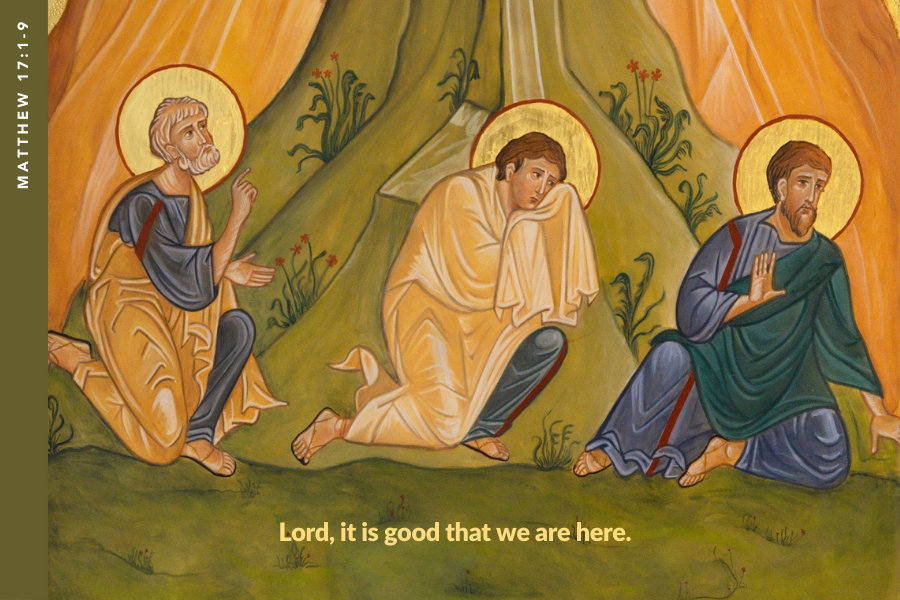
Jesus took Peter, James, and John his brother, and led them up a high mountain by themselves. And he was transfigured before them; his face shone like the sun and his clothes became white as light. And behold, Moses and Elijah appeared to them, conversing with him. Then Peter said to Jesus in reply, “Lord, it is good that we are here. If you wish, I will make three tents here, one for you, one for Moses, and one for Elijah.” While he was still speaking, behold, a bright cloud cast a shadow over them, then from the cloud came a voice that said, “This is my beloved Son, with whom I am well pleased; listen to him.” When the disciples heard this, they fell prostrate and were very much afraid. But Jesus came and touched them, saying, “Rise, and do not be afraid.” And when the disciples raised their eyes, they saw no one else but Jesus alone. As they were coming down from the mountain, Jesus charged them, “Do not tell the vision to anyone until the Son of Man has been raised from the dead.”

Opening Prayer: Holy Trinity, shine down upon me as I begin my prayer. Father, I invoke your aid. Son, I praise your majesty. Holy Spirit, I bless your glorious name. Glory be to the Father, and to the Son, and to the Holy Spirit, now and forever, Amen.

Encountering Christ:

  1. “And He Was Transfigured Before Them”: Why does the Church present this Gospel passage to us at the beginning of Lent? The most direct answer is that it is a preparation for Christ’s suffering and death on Good Friday. In St. Mark’s account, Jesus quizzed his friends just after coming down from the mountain: “How is it written regarding the Son of Man that he must suffer greatly and be treated with contempt?” He tried to get them thinking. “You have just seen me in glory; what would you say if I told you I would soon be in disgrace?” Christ showed himself in his glory on the mountain so that his Apostles would not be scandalized or fall away when they saw him naked and crowned with thorns. In my own life, Christ has often given me periods of clarity and consolation to prepare me for times of darkness and confusion.


  2. Terms of Endearment: The Holy Trinity is present on Mount Tabor. The voice is of the Father. In the cloud we see the Spirit. And the Son is glorified. Truly, the glory of God himself is present on the holy mountain! Along with the Apostles, we overhear the tender words of the Father for his dear Son: “This is my beloved Son, with whom I am well pleased.” Jesus is loved by his Father. Jesus is loved by his friends, the Apostles. He is also adored by his Blessed Mother Mary. Jesus, beloved of all hearts! “Fretted by sallies of his mother’s kisses / With light upon him from his father’s eyes!”—William Wordsworth


  3. Lent: Climbing up “a high mountain” is hard work. When they got there, the Apostles didn’t particularly enjoy hearing the Father’s voice: “They fell prostrate and were very much afraid.” Additionally, in the twelfth verse the disciples received some bad news: “So also will the Son of Man suffer.” Lent can be a toilsome journey up a figurative mountain. We can tend to get wrapped up in ourselves and our own crosses, forgetting that Easter will come. We endure Lenten hardships, but always with Jesus, and he rewards us on Easter Sunday with a taste of celestial glory, a bit of Paschal joy.

Conversing with Christ: Jesus, you are Lord indeed. You are the only Son of the Father, sitting at his right hand, interceding for me as I continue on this journey of Lent. You enjoy transfigured glory, heavenly glory, for all time. Encourage me by your Holy Spirit and strengthen me for this Lenten journey.

Resolution: Lord, today by your grace I will devoutly pray the Glory Be three times.

For Further Reflection: “Ode: Intimations of Immortality from Recollections of Early Childhood,” by William Wordsworth.

Fr Erik Burckel, LC was ordained to the priesthood in 2022. He writes articles and short stories for diverse purposes and publications, and can be reached at eburckel@legionaries.org.

March 2, 2026 – Measure for Measure

26-03-02-DM

Monday of the Second Week of Lent

Luke 6:36-38

Jesus said to his disciples: “Be merciful, just as your Father is merciful. Stop judging and you will not be judged. Stop condemning and you will not be condemned. Forgive and you will be forgiven. Give and gifts will be given to you; a good measure, packed together, shaken down, and overflowing, will be poured into your lap. For the measure with which you measure will in return be measured out to you.”

Opening Prayer: Lord God, your teaching challenges me. I admire the moral standard of righteousness that you demand of me, and at the same time I recognize that it is impossible for me if you don’t help me. With you, all things are possible. Help me, God, to be merciful.

Encountering Christ:

  1. Be Merciful: In the Our Father, we ask God to forgive us our trespasses as we forgive those who trespass against us. That is, we ask God to look at how we treat others and deal with us accordingly. This is reminiscent of numerous Psalms, such as Psalm 139:23-24, “Probe me, God, know my heart… see if there is a wicked path in me.” But in today’s passage, Jesus instructs us in the reverse direction; we are to look on God, and let his actions determine how we deal with others. “Be merciful, just as your Father is merciful.” This is a very high bar to clear. But we can forgive because God has first forgiven us. And we can be merciful because our Father is merciful.


  2. The Two Go Hand in Hand: “Forgive and you will be forgiven.” Forgiving others and being forgiven by them would seem to be two separate affairs. Yet the Gospel assures us they are related. Most of us easily recall the vivid parable about the servant forgiven a huge sum: “When that servant had left, he found one of his fellow servants who owed him a much smaller amount. He seized him and started to choke him, demanding, ‘Pay back what you owe’” (Mt 18:28). We decry his behavior because he tried to separate being forgiven from forgiving others. Pope Benedict XVI in Introduction to Christianity wrote, “Who would dare to assert of himself that he did not need to be tolerated by others, indeed borne up by them? And how can someone who lives on the forbearance of others himself renounce forbearing? Is it not the only gift he can offer in return, the only comfort remaining to him, that he endures just as he, too, is endured? Holiness in the Church begins with forbearance and leads to bearing up” (p. 343).


  3. Overflowing: “Give and gifts will be given to you.” The words of Christ are trustworthy, and they can make us long for heaven. In heaven, Christ will give us the gift of himself. We will see him face to face, as he is. But the “good measure” of the gift of our salvation must be “worked out with fear and trembling.” There are crosses to be endured, penance to be done. These sufferings increase our desire to reach Christ. The good measure must be “packed together” and “shaken down” so that more of it can fit into our hearts. St. Ignatius of Antioch wished to be fed to the lions, if only it would enable him to see God. If we give God our best, he will give us our heart’s desire.

Conversing with Christ: Lord Jesus, your words challenge me to the utmost. I will keep my eyes on you and not fear. Give me a double portion of your amazing grace, so that I can be grace-filled toward those around me.

Resolution: Lord, today by your grace I will thank God for the Sacrament of Confession, and for all the mercy he has shown me through this sacrament.

For Further Reflection: Mt 18:21-35.

Fr Erik Burckel, LC was ordained to the priesthood in 2022. He writes articles and short stories for diverse purposes and publications, and can be reached at eburckel@legionaries.org.

March 3, 2026 – Humble Greatness

26-03-03-DM

Tuesday of the Second Week of Lent

Matthew 23:1-12

Jesus spoke to the crowds and to his disciples, saying, “The scribes and the Pharisees have taken their seat on the chair of Moses. Therefore, do and observe all things whatsoever they tell you, but do not follow their example. For they preach but they do not practice. They tie up heavy burdens hard to carry and lay them on people’s shoulders, but they will not lift a finger to move them. All their works are performed to be seen. They widen their phylacteries and lengthen their tassels. They love places of honor at banquets, seats of honor in synagogues, greetings in marketplaces, and the salutation ‘Rabbi.’ As for you, do not be called ‘Rabbi.’ You have but one teacher, and you are all brothers. Call no one on earth your father; you have but one Father in heaven. Do not be called ‘Master’; you have but one master, the Christ. The greatest among you must be your servant. Whoever exalts himself will be humbled; but whoever humbles himself will be exalted.”

Opening Prayer: Lord God, the teachings you impart are profound. Send forth your Holy Spirit, who can guide me to interior understanding.

Encountering Christ:

  1. Authority Has Its Place: The scribes and Pharisees of Jesus’ time occupied seats of authority and Jesus told the people to obey them: “Observe all things whatsoever they tell you.” Their leadership was not to be questioned, even though they gave scandal by their actions: “They preach but they do not practice.” We can apply this lesson in our day to Church leaders who have sadly caused scandal by their actions. Our Lord promised that the “gates of the netherworld will not prevail against… the Church” (Mt 16:18). We are to obey the tenets of the Church—“doing what they tell us.” But we are not asked to endorse, excuse, or in any way follow their example. Instead, we pray fervently for them, and for the purification of the whole Church.


  2. “All Their Works Are Performed to Be Seen”: In many areas of our culture, people perform works to be seen: in politics, on Parisian runways, in movies and the theater. Some works are meant to be entertaining, but we detect quite easily when someone is “showing off” or seeking attention—and it’s difficult to watch, isn’t it? We naturally avoid people who make themselves the center of attention. The Pharisees’ highfalutin ways were symptomatic of their deep interior emptiness. In the center of their hearts, they sat themselves on the throne intended for Our Lord. When Our Lord is properly seated on the throne of our hearts, our need for affirmation from others is well-ordered, not extreme. We’re not show-offs. Our good deeds are cloaked in humility and oriented toward the good of the other.


  3. The Greatest: “The greatest among you must be your servant.” When we read this line of Scripture, it can lose its potency because we’re so familiar with it. Consider how Jesus’ listeners might have interpreted his directive. Scripture tells us that servants washed feet. Servants made their owners’ lives more comfortable (cf. Lk 17:8). Servants did what they were told (cf. Lk 7:8). Serving others in our lives rarely involves feet washing, but Jesus clearly invites us to surrender our will to God’s—to do as we’re told— so that we can be a blessing for others.

Conversing with Christ: Lord Jesus, teach me to think more like you, to “think of what is above” (cf. Col 3:2). The last shall be first, and blessed are the poor in spirit. Help me, Jesus, to be more humble.

Resolution: Lord, today by your grace I will cede a point to someone, humbly admitting where they are in the right, if the circumstance arises.

For Further Reflection: Read Antoine de Saint-Exupéry’s delightful and profound novella The Little Prince, to learn about being humble and focusing on what matters in life.

Fr Erik Burckel, LC was ordained to the priesthood in 2022. He writes articles and short stories for diverse purposes and publications, and can be reached at eburckel@legionaries.org.

March 4, 2026 – Death and Resurrection

26-03-04-DM

Wednesday of the Second Week of Lent

Matthew 20:17-28

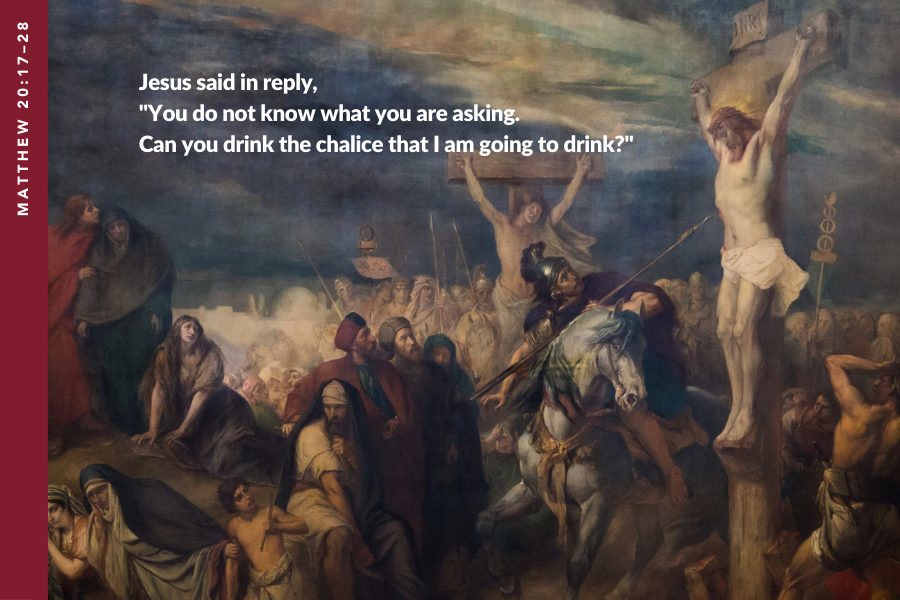
As Jesus was going up to Jerusalem, he took the Twelve disciples aside by themselves, and said to them on the way, “Behold, we are going up to Jerusalem, and the Son of Man will be handed over to the chief priests and the scribes, and they will condemn him to death, and hand him over to the Gentiles to be mocked and scourged and crucified, and he will be raised on the third day.” Then the mother of the sons of Zebedee approached Jesus with her sons and did him homage, wishing to ask him for something. He said to her, “What do you wish?” She answered him, “Command that these two sons of mine sit, one at your right and the other at your left, in your kingdom.” Jesus said in reply, “You do not know what you are asking. Can you drink the chalice that I am going to drink?” They said to him, “We can.” He replied, “My chalice you will indeed drink, but to sit at my right and at my left, this is not mine to give but is for those for whom it has been prepared by my Father.” When the ten heard this, they became indignant at the two brothers. But Jesus summoned them and said, “You know that the rulers of the Gentiles lord it over them, and the great ones make their authority over them felt. But it shall not be so among you. Rather, whoever wishes to be great among you shall be your servant; whoever wishes to be first among you shall be your slave. Just so, the Son of Man did not come to be served but to serve and to give his life as a ransom for many.”

Opening Prayer: Lord God, today I grapple with the weight of the cross. How it drags me down! Tell me once again—impress upon me more deeply—the truth of the Paschal law: One must die in order to have life. O God, give me resurrected life. You who did not spare your own Son, will you also not give me all the graces I ask for?

Encountering Christ:

  1. Prediction of the Passion: This is the third prophecy of Christ’s passion in Matthew’s Gospel. Christ had to suffer as the other servants of God suffered. The people wanted to kill Jeremiah. David had to flee from his own son into exile. Moses was prevented from entering the Promised Land. Elijah ran headlong into the desert to avoid the wrath of Jezebel. Yet, when Christ predicted his own suffering and death, he was met with incomprehension. They were slow to believe, as we sometimes can be. Christ chided the disciples on the road to Emmaus: “Oh, how foolish you are! How slow of heart to believe all that the prophets spoke! Was it not necessary that the Messiah should suffer these things and enter into his glory?” With the benefit of the Gospels and the teachings of the Church, let us reaffirm our faith in our suffering Savior and embrace our own suffering in imitation of Christ this Lent.


  2. “We Can”: Two brothers sought a special grace, a particular honor—to sit at Jesus’ right and at his left. They were bursting with enthusiasm—these “Sons of Thunder”—with high aspirations for life, and hearts full of loyalty. They asked Jesus for something good, and they asked together. They spoke but once in the whole passage, with a full-throated “We can!” Yet, what was in the cup that the brothers were invited to drink? Water, or wine, or… vinegar? The cup was Christ’s passion. They would have to suffer, and not only individually, but as brothers, as mutual friends of Jesus, as the Church.


  3. “He Will Be Raised”: “He will be raised on the third day.” The Son of Man will indeed rise from the dead after his sufferings—liturgically speaking, when the forty days of Lent have ended. Never forget Easter Sunday, even when it feels like Good Friday. Jesus underwent his Passion because he was passionate for us. He rose because death could no longer hold him. In the very act of his death, Jesus showed us that love means giving our life for others. When our personal sacrifice seems to lead to death, we can be confident that Christ will one day raise us up.

Conversing with Christ: Lord Jesus, give me the courage to reply “I can” whenever I am presented with the cross in my life. With you, Lord Jesus, all things are possible. With you, I can even accept the cross because I know it leads to life.

Resolution: Lord, today by your grace I will foster a spirit of gratitude for Christ who suffered out of love for me.

For Further Reflection: Meditate on the Suffering Servant chapters of Isaiah (Isa 42:1-4, Isa 49:1-6, Isa 50:4-7, and Isa 52:13-53:12).

Fr Erik Burckel, LC was ordained to the priesthood in 2022. He writes articles and short stories for diverse purposes and publications, and can be reached at eburckel@legionaries.org.

March 5, 2026 – The Poor You Always Have

26-03-05-DM

Thursday of the Second Week of Lent

Luke 16:19-31

Jesus said to the Pharisees: “There was a rich man who dressed in purple garments and fine linen and dined sumptuously each day. And lying at his door was a poor man named Lazarus, covered with sores, who would gladly have eaten his fill of the scraps that fell from the rich man’s table. Dogs even used to come and lick his sores. When the poor man died, he was carried away by angels to the bosom of Abraham. The rich man also died and was buried, and from the netherworld, where he was in torment, he raised his eyes and saw Abraham far off and Lazarus at his side. And he cried out, ‘Father Abraham, have pity on me. Send Lazarus to dip the tip of his finger in water and cool my tongue, for I am suffering torment in these flames.’ Abraham replied, ‘My child, remember that you received what was good during your lifetime while Lazarus likewise received what was bad; but now he is comforted here, whereas you are tormented. Moreover, between us and you a great chasm is established to prevent anyone from crossing who might wish to go from our side to yours or from your side to ours.’ He said, ‘Then I beg you, father, send him to my father’s house, for I have five brothers, so that he may warn them, lest they too come to this place of torment.’ But Abraham replied, ‘They have Moses and the prophets. Let them listen to them.’ He said, ‘Oh no, father Abraham, but if someone from the dead goes to them, they will repent.’ Then Abraham said, ‘If they will not listen to Moses and the prophets, neither will they be persuaded if someone should rise from the dead.’”

Opening Prayer: Lord God, I come before you today open to change. I ask you to turn my mind, my emotions, and my will toward you as I enter these few moments of prayer and strive to hear your voice.

Encountering Christ:

  1. Wealth and Duty: “There was a rich man who dressed in purple garments and fine linen and dined sumptuously each day.” In this parable, Jesus does not condemn wealth, per se, but reminds all of us that the wealthy have a serious moral obligation to help the poor. For generations, Catholic social teaching has emphasized this responsibility: “[…] Remember the aphorism of the Fathers, ‘Feed the man dying of hunger, because if you have not fed him, you have killed him…” (Gaudium et Spes, 69). “You are not making a gift of what is yours to the poor man, but you are giving him back what is his” (Populorum Progressio, 23). “Love for others, and in the first place love for the poor, in whom the Church sees Christ himself, is made concrete in the promotion of justice” (Centesimus Annus, 58). Let us examine our almsgiving this Lent in light of 1 Jn 3:17-18: “If someone who has worldly means sees a brother in need and refuses him compassion, how can the love of God remain in him? Children, let us love not in word or speech but in deed and truth.”


  2. “Warn My Brothers”: The rich man cared little for Lazarus, but he apparently loved his five brothers enough to ask that they be warned, “lest they too come to this place of torment.” Abraham replied that Moses and the prophets were enough warning. In fact, Abraham added, “If they will not listen to Moses and the prophets, neither will they be persuaded if someone should rise from the dead.”—which is precisely what Jesus did in order to save us all. How many of us go about our day-to-day duties, forgetful of the poor, distracted, worried, or simply refusing to acknowledge the prophets of our time—saints, good priests, holy friends—who remind us daily that Jesus Christ came back from the dead to save us from our sins?


  3. Christ Became Poor for Us: “For you know the gracious act of our Lord Jesus Christ, that for your sake he became poor although he was rich, so that by his poverty you might become rich” (2 Cor 8:9). Christ became poor so that we might be wealthy—not one day in heaven, but right here, right now. He bestowed on us a royal identity through our Baptism. He feeds us with bread from heaven to sustain us on our journey. He forgives our sins so that we can begin over and over. He also showers us with spiritual wealth by the love he sends us through others. Our hearts are full of gratitude, but are we willing to become poor for others in imitation of Our Lord? To give without counting costs? To serve the outcast? To defend the weak?

Conversing with Christ: Lord, please open my eyes and soften my heart so that I don’t trip over the poor you have placed in my path. This Lent, help me to reach out beyond my comfort zone to contribute to, feed, serve, and pray for the souls that I meet.

Resolution: Lord, today by your grace I will, in solidarity with the poor, abstain from my favorite food.

For Further Reflection: Mother Teresa of Calcutta was a great servant of the poor. Perhaps read the book Come Be My Light, or watch one of her speeches on YouTube if time is short.

Maribeth Harper celebrated paying the last tuition bill for her kids’ college by writing a book for parents who have college-aged young adults: A Spiritual Toolbox: Tips for Parenting through the First Year of College. She is a wife of thirty-five years, mother of four, and grandmother of twelve and counting.

March 6, 2026 – It Is Wonderful in Our Eyes

26-03-06-DM

Friday of the Second Week of Lent

Matthew 7:7-12

Matthew 21:33-43, 45-46

Jesus said to the chief priests and the elders of the people: “Hear another parable. There was a landowner who planted a vineyard, put a hedge around it, dug a wine press in it, and built a tower. Then he leased it to tenants and went on a journey. When vintage time drew near, he sent his servants to the tenants to obtain his produce. But the tenants seized the servants and one they beat, another they killed, and a third they stoned. Again he sent other servants, more numerous than the first ones, but they treated them in the same way. Finally, he sent his son to them, thinking, ‘They will respect my son.’ But when the tenants saw the son, they said to one another, ‘This is the heir. Come, let us kill him and acquire his inheritance.’ They seized him, threw him out of the vineyard, and killed him. What will the owner of the vineyard do to those tenants when he comes?” They answered him, “He will put those wretched men to a wretched death and lease his vineyard to other tenants who will give him the produce at the proper times.” Jesus said to them, “Did you never read in the Scriptures: ‘The stone that the builders rejected has become the cornerstone; by the Lord has this been done, and it is wonderful in our eyes’? Therefore, I say to you, the kingdom of God will be taken away from you and given to a people that will produce its fruit.” When the chief priests and the Pharisees heard his parables, they knew that he was speaking about them. And although they were attempting to arrest him, they feared the crowds, for they regarded him as a prophet.

Opening Prayer: Lord God, give me eyes to see and ears to hear your words. Teach me to see as you see, to listen as you listen, to love as you love.

Encountering Christ:

  1. Mirror, Mirror: The crowds regarded Jesus as a prophet, and so he was. The words of God proceeded from his mouth (cf. Jer 1:9), and the spirit of God dwelt within him (cf. Ezek 2:2). Jesus is a prophet who told us a parable about the historical prophets and their reception by the people of Israel: “One they beat, another they killed, and a third they stoned.” Jesus would suffer too. He was destined to be the stone rejected by the builders. Yet he was not only the Prophet preaching about the prophets, but also the Son preaching about himself, symbolized by the son of the landowner murdered outside his own vineyard. He foresaw his own death, and still he accepted it, because it was through this rejection that he would become the cornerstone.


  2. Eyes to See: In Matthew 11:15, Jesus says, “Whoever has ears ought to hear.” And again in Matthew 13:16, he says, “Blessed are your eyes, because they see, and your ears, because they hear.” His message is clear: eyes and ears open! In today’s passage, Jesus says directly, “Hear another parable.” And the parable concludes: “When the chief priests and the Pharisees heard his parables…” No doubt about it, they comprehended his meaning. Their understanding of Jesus’ message was, in fact, the basis for their hatred of him. And what did we find the tenants of the parable doing, just before they killed the son? They saw him. Seeing and hearing go both ways—one way to life and the other way to death. Choose life, choose the works of the Lord, for they are “wonderful in our eyes.”


  3. Vision of Love: The English word “respect” comes from Latin “respicio / respicere,” meaning “to look back at,” or more generally “to regard” or “to respect.” Both “regard” and “respect” appear in this passage; the landowner thinks, “They will respect my son,” and Jesus’ listeners “regarded him as a prophet.” How do we see Jesus? If we want to see as God sees, Jesus tells us where to look: “Did you never read in the Scriptures?” he asked. His listeners learned in the Scripture passage Jesus quoted that he is the cornerstone rejected by the builders. We also learn what God wants us to know when we read, reflect, and pray with the Scriptures.

Conversing with Christ: Lord Jesus, open the eyes of my heart! I want to see anew all that you have done and continue to do to help me, to bless me, to give me your grace, to save me. We are your vineyard, the apple of your eye.

Resolution: Lord, today by your grace I will let the things I see lead me to praise God. Earth and sky, bless the Lord! Fire and ice, bless the Lord!

For Further Reflection: Read St. Peter’s first apostolic speeches on God’s attempts to save his vineyard Israel by sending Jesus Christ: Acts 2:14-36 and Acts 3:11-4:12.

Fr Erik Burckel, LC was ordained to the priesthood in 2022. He writes articles and short stories for diverse purposes and publications, and can be reached at eburckel@legionaries.org.

March 7, 2026 – Suffering and Mercy

26-03-07-DM

Saturday of the Second Week of Lent

Luke 15:1-3, 11-32

Tax collectors and sinners were all drawing near to listen to Jesus, but the Pharisees and scribes began to complain, saying, “This man welcomes sinners and eats with them.” So to them he addressed this parable. “A man had two sons, and the younger son said to his father, ‘Father, give me the share of your estate that should come to me.’ So the father divided the property between them. After a few days, the younger son collected all his belongings and set off to a distant country where he squandered his inheritance on a life of dissipation. When he had freely spent everything, a severe famine struck that country, and he found himself in dire need. So he hired himself out to one of the local citizens who sent him to his farm to tend the swine. And he longed to eat his fill of the pods on which the swine fed, but nobody gave him any. Coming to his senses he thought, ‘How many of my father’s hired workers have more than enough food to eat, but here am I, dying from hunger. I shall get up and go to my father and I shall say to him, “Father, I have sinned against heaven and against you. I no longer deserve to be called your son; treat me as you would treat one of your hired workers.”’ So he got up and went back to his father. While he was still a long way off, his father caught sight of him, and was filled with compassion. He ran to his son, embraced him and kissed him. His son said to him, ‘Father, I have sinned against heaven and against you; I no longer deserve to be called your son.’ But his father ordered his servants, ‘Quickly bring the finest robe and put it on him; put a ring on his finger and sandals on his feet. Take the fattened calf and slaughter it. Then let us celebrate with a feast, because this son of mine was dead, and has come to life again; he was lost, and has been found.’ Then the celebration began. Now the older son had been out in the field and, on his way back, as he neared the house, he heard the sound of music and dancing. He called one of the servants and asked what this might mean. The servant said to him, ‘Your brother has returned and your father has slaughtered the fattened calf because he has him back safe and sound.’ He became angry, and when he refused to enter the house, his father came out and pleaded with him. He said to his father in reply, ‘Look, all these years I served you and not once did I disobey your orders; yet you never gave me even a young goat to feast on with my friends. But when your son returns who swallowed up your property with prostitutes, for him you slaughter the fattened calf.’ He said to him, ‘My son, you are here with me always; everything I have is yours. But now we must celebrate and rejoice, because your brother was dead and has come to life again; he was lost and has been found.’”

Opening Prayer: Lord God, author of our redemption, thank you for never giving up on me. No matter how far I have strayed, you have welcomed me back. I praise you for your saving mercy! When I suffer, please stay with me. Your grace is enough!

Encountering Christ:

  1. The Mystery of Suffering: The younger son’s decisions caused everyone in this parable to suffer. He suffered because, after he had spent all he had, a mysterious famine gripped the land, putting him in dire straits. He found himself “dying from hunger.” The father also suffered, although he had done no wrong. He did nothing to deserve the betrayal of his own son. The older son suffered when his brother left, and perhaps even more so when his brother returned. The parable repeats itself among many of today’s families broken by infidelity, addiction, or dysfunction. “Within each form of suffering endured by man, and at the same time at the basis of the whole world of suffering, there inevitably arises the question: why?… And he suffers in a humanly speaking still deeper way if he does not find a satisfactory answer,” says St. John Paul II. We may not answer the question “why” (in this life), but when we unite our suffering with Christ, “the riddles of sorrow and death grow meaningful” (Salvifici Doloris, 31).


  2. Unmysterious Suffering: Suffering (and even death) is the natural consequence of sin, unmysterious and predictable. The prodigal son took very specific actions to achieve his goals, and these actions, being sinful, bore in themselves the seeds of suffering. He unjustly demanded his inheritance, abandoned his family, squandered his funds, and lived hedonistically. Life admits only two models: first the fast, then the feast—or the other way around. Now, our conscience warns us that living from feast to feast, indulging our selfishness and egoism, is unsustainable. Famine will come, and we know it. The Scriptures testify to this by the manner in which the younger son began his path of conversion—by “coming to his senses.” He was taking stock of the nature of his suffering, of its self-evident causes, which led him to change his behavior. We, too, must be ready to turn away from our sins this Lent; when we do, we may find some of our suffering relieved.


  3. Indiscriminate Mercy: The greatest figure of the parable is the merciful father. His mercy was indiscriminate, showered on older son and younger son alike. Though he himself suffered, he was able to forgive the sins of his children and thereby alleviate their suffering. Perhaps it was precisely through his own suffering that he comprehended theirs. Now, God does not suffer as we suffer. But we can say, according to our human mode of speaking, that his greatest pain is to see us fall into sin. He knows that sin will not make us happy; he knows that to sin is to tend swine. And so, being the good God that he is, he has mercy on us. We are always welcome back home.

Conversing with Christ: Lord Jesus, preserve me from all sin today. Help me to avoid the suffering I can avoid, and to accept (by your grace) the suffering I cannot.

Resolution: Lord, today by your grace I will pray a prayer to St. Michael the Archangel, invoking his aid in my struggle against sin and the evil one.

For Further Reflection: Rembrandt’s painting The Return of the Prodigal Son.

Fr Erik Burckel, LC was ordained to the priesthood in 2022. He writes articles and short stories for diverse purposes and publications, and can be reached at eburckel@legionaries.org.

March 8, 2026 – The Woman at the Well

26-03-08-DM

Third Sunday of Lent

John 4:5-42

Jesus came to a town of Samaria called Sychar, near the plot of land that Jacob had given to his son Joseph. Jacob’s well was there. Jesus, tired from his journey, sat down there at the well. It was about noon. A woman of Samaria came to draw water. Jesus said to her, “Give me a drink.” His disciples had gone into the town to buy food. The Samaritan woman said to him, “How can you, a Jew, ask me, a Samaritan woman, for a drink?”—For Jews use nothing in common with Samaritans.—Jesus answered and said to her, “If you knew the gift of God and who is saying to you, ‘Give me a drink,’ you would have asked him and he would have given you living water.” The woman said to him, “Sir, you do not even have a bucket and the cistern is deep; where then can you get this living water? Are you greater than our father Jacob, who gave us this cistern and drank from it himself with his children and his flocks?” Jesus answered and said to her, “Everyone who drinks this water will be thirsty again; but whoever drinks the water I shall give will never thirst; the water I shall give will become in him a spring of water welling up to eternal life.” The woman said to him, “Sir, give me this water, so that I may not be thirsty
or have to keep coming here to draw water.” Jesus said to her, “Go call your husband and come back.” The woman answered and said to him, “I do not have a husband.” Jesus answered her, “You are right in saying, ‘I do not have a husband.’ For you have had five husbands, and the one you have now is not your husband. What you have said is true.” The woman said to him, “Sir, I can see that you are a prophet. Our ancestors worshiped on this mountain; but you people say that the place to worship is in Jerusalem.” Jesus said to her, “Believe me, woman, the hour is coming when you will worship the Father neither on this mountain nor in Jerusalem. You people worship what you do not understand; we worship what we understand, because salvation is from the Jews. But the hour is coming, and is now here, when true worshipers will worship the Father in Spirit and truth; and indeed the Father seeks such people to worship him. God is Spirit, and those who worship him must worship in Spirit and truth.” The woman said to him, “I know that the Messiah is coming, the one called the Christ; when he comes, he will tell us everything.” Jesus said to her, “I am he, the one speaking with you.” At that moment his disciples returned, and were amazed that he was talking with a woman, but still no one said, “What are you looking for?” or “Why are you talking with her?” The woman left her water jar and went into the town and said to the people, “Come see a man who told me everything I have done. Could he possibly be the Christ?” They went out of the town and came to him. Meanwhile, the disciples urged him, “Rabbi, eat.” But he said to them, “I have food to eat of which you do not know.” So the disciples said to one another, “Could someone have brought him something to eat?” Jesus said to them, “My food is to do the will of the one who sent me and to finish his work. Do you not say, ‘In four months the harvest will be here’? I tell you, look up and see the fields ripe for the harvest. The reaper is already receiving payment and gathering crops for eternal life, so that the sower and reaper can rejoice together. For here the saying is verified that ‘One sows and another reaps.’ I sent you to reap what you have not worked for; others have done the work, and you are sharing the fruits of their work.” Many of the Samaritans of that town began to believe in him because of the word of the woman who testified, “He told me everything I have done.” When the Samaritans came to him, they invited him to stay with them; and he stayed there two days. Many more began to believe in him because of his word, and they said to the woman, “We no longer believe because of your word; for we have heard for ourselves, and we know that this is truly the savior of the world.”

Opening Prayer: Heavenly Father, I come to the well to drink of your living water, so that I may not thirst for the things of this world but for your will only. Hydrate my soul with your grace, the source of life that fulfills all other desires. 

Encountering Christ:

  1.  Living Water: How is it that when we drink of the Lord’s living water we no longer thirst? To thirst is human nature. To thirst means we have human needs that require quenching. In our spiritual reality, however, the more we drink of the Lord’s living water—in prayer, in the Mass, before the Eucharist in Adoration, marveling at his creation in our loved ones and in nature—the more our desire for the Lord increases while the desire for worldly things decreases. Only the Lord’s living water—pure grace—can make that transformation in our soul.


  2. Leave the Water Jar: A water jar is a heavy vessel and, when filled with water, it is that much more difficult to carry. Reflecting on this can help us to realize that some of the very things we depend on daily, even those that are deemed “good for us” may actually be burdens too heavy to carry. When we feel overwhelmed by our “to dos” or even by the ordinary responsibilities of our vocation in life, we need the grace to see what’s weighing us down and have the courage to leave those water jars behind as we fall into the Lord’s capable arms.


  3. Reaping and Sowing: Like a vain and prideful child we sometimes want to lay claim to our work and shout, “Look at me! Come see what I did!” But the Lord shows us that it is not we who work, but he who works through us. Each one of us is merely a link in a chain of souls who reap and sow for the Kingdom. In the words of St. Frances de Sales, Lord, help us to “be who we are and be that well so that we may give glory to the master craftsman whose handiwork we are.”

Conversing with Christ: Lord Jesus, giver of life-giving water, help me to drink from your well. Each day, I want to attach more to you and heavenly things, and detach from the material world and its short-lived joys. 

Resolution: Lord, today by your grace I will check my attitude about the burdens in my life by taking ten minutes to examine the “burden behind the burden,” as Fr. Mike Schmitz identifies it.

Marjorie Davin is a lay member of Regnum Christi who has served as director of the Women’s Section in the Washington, D.C., area. She and her husband have been married for over 30 years and are the parents of four adult children.

Scroll to Top

Events

Looking for another country?

Contact Regnum Christi near you

News & Resources

News & Resources

The Regnum Christi Mission

The Regnum Christi Identity

Alex Kucera

Atlanta

Alex Kucera has lived in Atlanta, GA, for the last 46 years. He is one of 9 children, married to his wife Karmen, and has 3 girls, one grandson, and a granddaughter on the way. Alex joined Regnum Christi in 2007. Out of the gate, he joined the Helping Hands Medical Missions apostolate and is still participating today with the Ghana Friendship Mission.

In 2009, Alex was asked to be the Atlanta RC Renewal Coordinator for the Atlanta Locality to help the RC members with the RC renewal process. Alex became a Group Leader in 2012 for four of the Atlanta Men’s Section Teams and continues today. Running in parallel, in 2013, Alex became a Team Leader and shepherded a large team of good men.

Alex was honored to be the Atlanta Mission Coordinator between 2010 to 2022 (12 years), coordinating 5-8 Holy Week Mission teams across Georgia. He also created and coordinated missions at a parish in Athens, GA, for 9 years. Alex continues to coordinate Holy Week Missions, Advent Missions, and Monthly missions at Good Shepherd Catholic Church in Cumming, GA.

From 2016 to 2022, Alex also served as the Men’s Section Assistant in Atlanta. He loved working with the Men’s Section Director, the Legionaries, Consecrated, and Women’s Section leadership teams.

Alex is exceptionally grateful to the Legionaries, Consecrated, and many RC members who he’s journeyed shoulder to shoulder, growing his relationship with Christ and others along the way. He knows that there is only one way, that’s Christ’s Way, with others!