THE WEEKLY DIGEST
OF REGNUM CHRISTI
DAILY MEDITATIONS

September 14, 2025 – Behold the Cross

Feast of the Exaltation of the Holy Cross

John 3:13-17

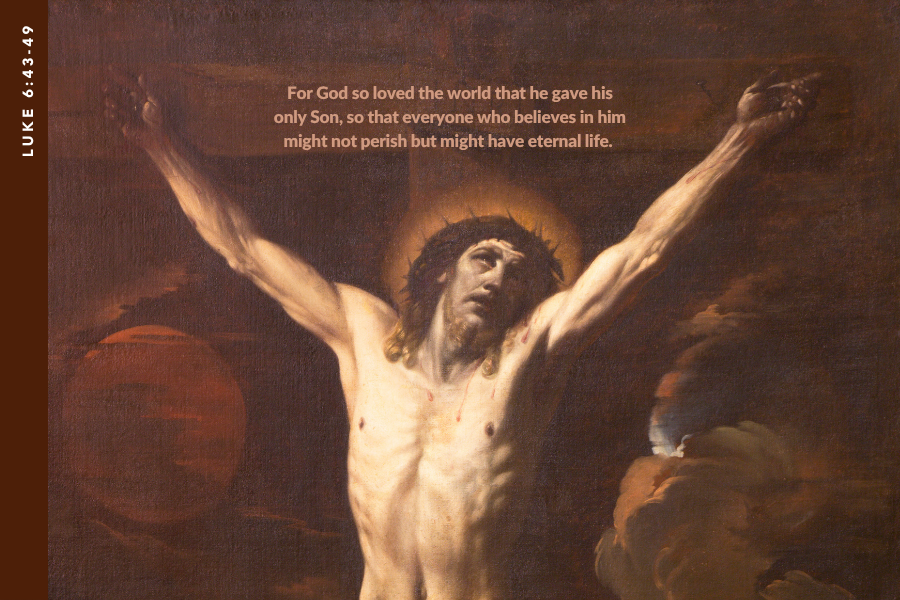
Jesus said to Nicodemus: “No one has gone up to Heaven except the one who has come down from Heaven, the Son of Man. And just as Moses lifted up the serpent in the desert, so must the Son of Man be lifted up, so that everyone who believes in him may have eternal life.” For God so loved the world that he gave his only Son, so that everyone who believes in him might not perish but might have eternal life. For God did not send his Son into the world to condemn the world, but that the world might be saved through him. 

Opening Prayer: We adore you, O Christ, and we bless you, because by your cross you have redeemed the world.

Encountering Christ:

  1. The Son of Man: “No one has gone up to Heaven except the one who has come down from Heaven, the Son of Man.” This language may seem strange to our ears, but Nicodemus, a learned Pharisee, clearly understood Jesus. To scholars like Nicodemus, “Son of Man” had two meanings. The first is human, mortal. The second is a prophetic king as described in the Book of Daniel (7:13-14): “As the visions during the night continued, I saw coming with the clouds of Heaven one like a son of man. When he reached the Ancient of Days (Old Testament term for God) and was presented before him, he received dominion, splendor, and kingship; all nations, peoples, and tongues will serve him. His dominion is an everlasting dominion that shall not pass away, his kingship, one that shall not be destroyed.” Jesus was telling Nicodemus not only that he is this Son of Man, King of an everlasting dominion, but he then revealed how he would achieve his victory.

  2. The Seraph Serpent: “And just as Moses lifted up the serpent in the desert, so must the Son of Man be lifted up, so that everyone who believes in him may have eternal life.” We look for context in this case to Numbers 21:4-9: “[…] the people’s patience was worn out by the journey; so the people complained against God and Moses, ‘Why have you brought us up from Egypt to die in the wilderness, where there is no food or water? We are disgusted with this wretched food!’ So the Lord sent among the people seraph serpents, which bit the people so that many of the Israelites died. Then the people came to Moses and said, ‘We have sinned in complaining against the Lord and you. Pray to the Lord to take the serpents from us.’ So Moses prayed for the people, and the Lord said to Moses: ‘Make a seraph and mount it on a pole, and everyone who has been bitten will look at it and recover.’ Accordingly Moses made a bronze serpent and mounted it on a pole, and whenever the serpent bit someone, the person looked at the bronze serpent and recovered.” The etymology of seraph is “fiery one” which can mean Satan, the evil one. The people, we hear, complained against both Moses (the one God gave the Israelites to lead them out of slavery) and against God himself. By telling Moses to lift the bronze serpent on the pole, he was lifting their sin in front of their eyes. This visible sign of their sinfulness caused them to repent. Jesus takes two well-known Scripture passages to explain to Nicodemus that the true enemy of the people is not their outside oppressors; it is the sin that dwells within their own hearts. What an impact these words of Jesus must have made on the heart of Nicodemus. We know from the Gospel of John (19:39) that Nicodemus became a disciple and helped take Jesus’ body from the cross.

  3. The Cross: “For God so loved the world that he gave his only Son, so that everyone who believes in him might not perish but might have eternal life. For God did not send his Son into the world to condemn the world, but that the world might be saved through him.” The Feast of the Exaltation of the Cross commemorates the Holy Cross on which our Lord, Savior, and King, Jesus Christ, was crucified. The history of this feast is explained, “Early in the fourth century, St. Helena, mother of the Roman Emperor Constantine, went to Jerusalem in search of the holy places of Christ’s life. She razed the second-century Temple of Aphrodite, which tradition held was built over the Savior’s tomb, and her son built the Basilica of the Holy Sepulcher on that spot. During the excavation, workers found three crosses. Legend has it that the one on which Jesus died was identified when its touch healed a dying woman. The cross immediately became an object of veneration. At a Good Friday celebration in Jerusalem toward the end of the fourth century, according to an eyewitness, the wood was taken out of its silver container and placed on a table together with the inscription Pilate ordered placed above Jesus’ head: Then “all the people pass through one by one; all of them bow down, touching the cross and the inscription, first with their foreheads, then with their eyes; and, after kissing the cross, they move on.” To this day, the Eastern Churches, Catholic and Orthodox alike, celebrate the Exaltation of the Holy Cross on the September anniversary of the basilica’s dedication. The feast entered the Western calendar in the seventh century after Emperor Heraclius recovered the cross from the Persians, who had carried it off in 614, fifteen years earlier. According to the story, the emperor intended to carry the cross back into Jerusalem himself, but was unable to move forward until he took off his imperial garb and became a barefoot pilgrim (Franciscan Media).

Conversing with Christ: Lord Jesus, in this encounter with Nicodemus, you spoke to him in ways that his scholarly mind could accept, understand, and embrace. He became your disciple. By your grace, help me, like Nicodemus, come to you, ask you questions, and, even in my confusion, follow you.

Resolution: Lord, today by your grace I will pray using the Gospels and spend time questioning and pondering the words so that I can grow in my faith.

Nan Balfour is an events coordinator for Pilgrim Center of Hope, a Catholic Evangelization Ministry that answers Christ’s call by guiding people to encounter him so as to live in hope as pilgrims in daily life. She is also a mother, writer, and speaker on Catholic topics.

September 15, 2025 – Behold Our Mother

Memorial of Our Lady of Sorrows

John 19:25-27

Standing by the cross of Jesus were his mother and his mother’s sister, Mary the wife of Clopas,

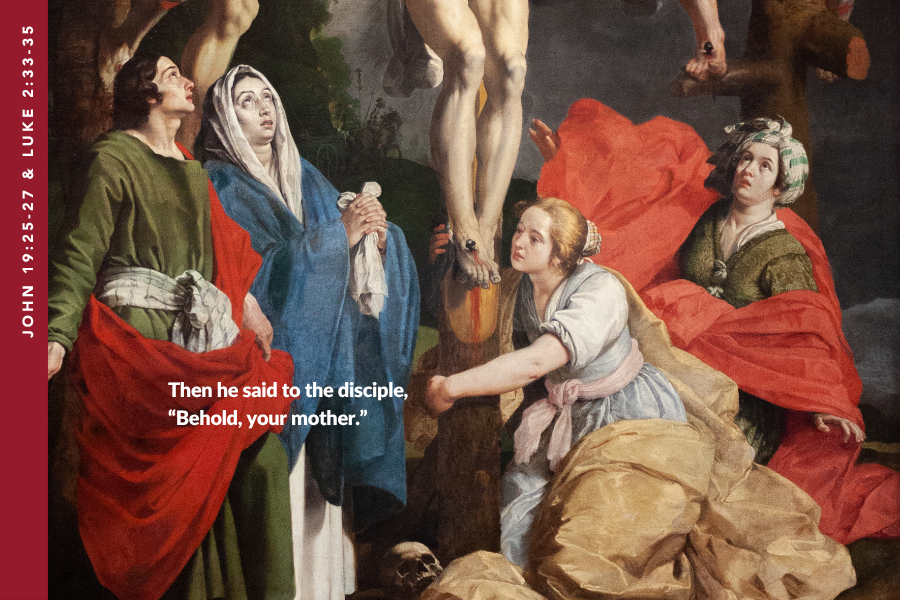
and Mary Magdalene. When Jesus saw his mother and the disciple there whom he loved he said to his mother, “Woman, behold, your son.” Then he said to the disciple, “Behold, your mother.”

And from that hour the disciple took her into his home.

Luke 2:33-35

Jesus’ father and mother were amazed at what was said about him; and Simeon blessed them and said to Mary his mother, “Behold, this child is destined for the fall and rise of many in Israel, and to be a sign that will be contradicted and you yourself a sword will pierce so that the thoughts of many hearts may be revealed.”

Opening Prayer: From Stabat Mater: O sweet Mother! font of love, touch my spirit from above, make my heart with yours accord… Christ, when you shall call me hence, be your Mother my defense, be your cross my victory.

Encountering Christ:

  1. Mary’s Crosses: How beautiful that the Church gives us the feast of Our Lady of Sorrows immediately following the Exaltation of the Cross. On this day, we can commemorate the seven sorrows of Mary as given to St. Bridget of Sweden in the thirteenth century: The prophecy of Simeon (cf. Lk 2:25-35); The flight into Egypt (cf. Mt 2:13-15); Loss of the Child Jesus for three days (cf. Lk 2:41-50); Mary meeting Jesus on his way to Calvary (cf. Lk 23:27-31; Jn 19:17); Crucifixion and Death of Jesus (cf. Jn 19:25-30); The body of Jesus being taken from the Cross (cf. Ps 130; Lk 23:50-54; Jn 19:31-37); and The burial of Jesus (cf. Isa 53:8; Lk 23:50-56; Jn 19:38-42; Mk 15:40-47). She endured each of these sorrows with perfect love, and Our Lady has promised many graces to anyone who meditates on these seven sorrows.

  2. Mary Knew Sorrow: On this Memorial, the Church offers two Gospels to contemplate the Mother of God. In the Gospel of Luke, we see the Blessed Mother, along with her husband, Joseph, presenting their son Jesus to God in the Temple in Jerusalem. Mary knew from the visit of the angel Gabriel and her miraculous conception that her son was the promise of salvation for her people. In the words of Simeon, Mary now heard that a sword would pierce her with sorrow. That sorrow came to its fulfillment as Mary stood at the foot of the cross brokenhearted. May we join her there, praying these two stanzas of Stabat Mater: Those Five Wounds on Jesus smitten, Mother! in my heart be written, Deep as in your own they be. You, your Savior’s Cross did bare, You, your Son’s rebuke did share. Let me share them both with Thee.

  3. Our Sorrowful Mother: As Jesus used his last breaths to bequeath his mother to John, this Son of God and son of Mary gave his mother to every Christian. St. John Paul II said, “On the cross Jesus did not proclaim Mary’s universal motherhood formally, but established a concrete maternal relationship between her and the beloved disciple. In the Lord’s choice we can see his concern that this motherhood should not be interpreted in a vague way, but should point to Mary’s intense, personal relationship with individual Christians.” How blessed we are to have such a compassionate Mother and perfect intercessor to care for our souls and the souls of those we love. Mother Mary, pray for us now and at the hour of our death, Amen.

Conversing with Christ: Lord Jesus, you were born of woman, lived as the son of Mary, and upon your Cross, gave your Mother to us. I would like to love your Mother as you do, Lord. Please give me the grace to know her better and love her more each day. You gave the Blessed Mother to me and I want to be her loving daughter.

Resolution: Lord, today by your grace I will reflect on the seven sorrows of Mary as I say the rosary for the intentions of my family.

Maribeth Harper celebrated paying the last tuition bill for her kids’ college by writing a book for parents who have college-aged young adults, A Spiritual Toolbox: Tips for Parenting through the First Year of College. She is a wife of thirty-five years, mother of four, and grandmother of twelve and counting.
September 16, 2025 - Do Not Weep… Arise!

Memorial of Saints Cornelius, Pope, and Cyprian, Bishop, Martyrs

Luke 7:11-17

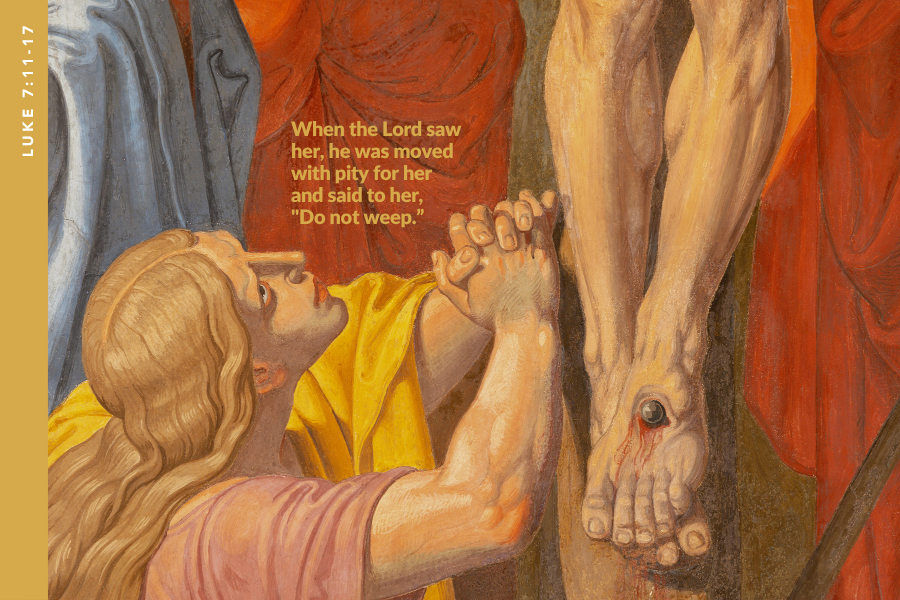
Jesus journeyed to a city called Nain, and his disciples and a large crowd accompanied him. As he drew near to the gate of the city, a man who had died was being carried out, the only son of his mother, and she was a widow. A large crowd from the city was with her. When the Lord saw her, he was moved with pity for her and said to her, “Do not weep.” He stepped forward and touched the coffin; at this the bearers halted, and he said, “Young man, I tell you, arise!” The dead man sat up and began to speak, and Jesus gave him to his mother. Fear seized them all, and they glorified God, exclaiming, “A great prophet has arisen in our midst” and “God has visited his people.” This report about him spread through the whole of Judea and in all the surrounding region.

Opening Prayer: “Sing joyfully to the Lord, all you lands; serve the Lord with gladness;

come before him with joyful song. Know that the Lord is God, he made us, we belong to him, we are his people, the flock he shepherds. Enter his gates with thanksgiving, his courts with praise. Give thanks to him, bless his name; good indeed is the Lord, His mercy endures forever, his faithfulness lasts through every generation” (Ps 100:1-5).

Encountering Christ:

  1. Moved with Pity: This Gospel passage is a wonderful reminder of how personally we are loved by God. Luke wrote that Jesus was on the move, surrounded by his disciples and a large crowd. This large crowd was met by another large crowd accompanying a woman, who because of her husband’s and son’s death, was now completely alone. Mixed with her grief was surely a deep anxiety about what would become of her. Even though she was one among many people surrounding Jesus, he came to her in her fear and was “… moved with pity for her.” In our own sorrow or grief, we are reminded that “The Lord is my helper, I will not be afraid. What can anyone do to me?” (Heb 13:6).

  2. God Moves: Every word of Scripture tells us about God. In this passage we read that Jesus journeyed, he drew near, he was moved, he stepped forward. In the image of Divine Mercy revealed by Our Lord to St. Faustina, we see the same. Jesus is walking toward us scarred by wounds he suffered for us. He opens his heart pierced to us, ever-flowing with mercy. In our pain we often fall into a false belief that God does not see nor care that we are suffering. Let this story remind us the opposite is true. God comes, he pities, he touches, he restores, he brings new life.

  3. Arise: It can be tempting to read this passage and exclaim, “Jesus did not bring my loved one back to life.” But that is not true. When Jesus willingly laid down his life and took it up again through his Passion and Crucifixion, he defeated death for all time. Jesus opened Heaven, which had been closed due to the original sin of Adam and Eve. Jesus died so we could live. Our loved ones are very much alive. The Catechism of the Catholic Church is very clear on this: “Those who die in God’s grace and friendship and are perfectly purified live forever with Christ” (1023). “All who die in God’s grace and friendship, but still imperfectly purified, are indeed assured of their eternal salvation; but after death they undergo purification, so as to achieve the holiness necessary to enter the joy of Heaven” (1030). Because we cannot know if our loved ones have achieved Heaven or are being purified in Purgatory, we can pray for them and ask them to pray for us. In this exchange, we stay spiritually united until we can one day be completely reunited where there will be no more weeping—all because Jesus died for our sins and rose again.

Conversing with Christ: Lord Jesus, the meaning of the word Nain, where you came to bring new life, means “Green Pastures.” You are the Good Shepherd. You know your sheep and you make it so we know you. Praise you, Jesus! Thank you, Jesus! Jesus, I trust in you!

Resolution: Lord, today by your grace I will pray for my deceased loved ones, “Eternal rest grant unto them O Lord and may perpetual light shine upon them. May the souls of all the faithfully departed through the mercy of God rest in peace with the saints and angels.”

Nan Balfour is an events coordinator for Pilgrim Center of Hope, a Catholic Evangelization Ministry that answers Christ’s call by guiding people to encounter him so as to live in hope as pilgrims in daily life. She is also a mother, writer, and speaker on Catholic topics.

September 17, 2025 - Two Ways to Repentance

Wednesday of the Twenty-Fourth Week in Ordinary Time

Luke 7:31-35

Jesus said to the crowds: “To what shall I compare the people of this generation? What are they like? They are like children who sit in the marketplace and call to one another, ‘We played the flute for you, but you did not dance. We sang a dirge, but you did not weep.’ For John the Baptist came neither eating food nor drinking wine, and you said, ‘He is possessed by a demon.’ The Son of Man came eating and drinking and you said, ‘Look, he is a glutton and a drunkard, a friend of tax collectors and sinners.’ But wisdom is vindicated by all her children.”

Opening Prayer: Thank you, Jesus, for coming to save sinners, because I am a poor sinner who needs saving! Open my heart to your wise and truthful word.

Encountering Christ:

  1. Popular Opinion: Jesus commented in today’s Gospel reading about just how quickly popular opinion can change. First, John the Baptist made people uncomfortable because they thought his message of conversion was too radical. They found some reason to discredit him by spreading rumors that he was possessed. When Jesus came, he made people uncomfortable because he ate and drank with the people he came to save, namely sinners. So they discredited Jesus by spreading rumors, calling him a glutton and a drunk. These days, everyone seems to have very strong opinions about a myriad of political and social issues. We know how divisive and fickle popular opinion can be, but we are still sometimes strangely compelled to live up to it. I ask myself, do I seek balance and wisdom by praying with the word of Christ, or do I let myself get swayed by popular opinion?

  2. Comfort Zones: Both John and Jesus made the crowds uncomfortable by their preaching. The fasting and repentance John the Baptist advocated was not popular, easy, or fun. The penitents who followed John’s call sought spiritual change, which challenged observers to reflect on their own lives, drawing them out of their comfort zone. Jesus fraternized with outcasts and the Pharisees were scandalized. They judged Jesus instead of trying to imitate him because eating with tax-collectors and sinners was outside their comfort zone. Living as a Christian often isn’t comfortable. I ask myself, am I too comfortable in my faith or am I being asked to step out of my comfort zone in some way on behalf of Christ?

  3. Repentance, Two Ways: The theme of this Gospel is repentance. Both John and Jesus sought to bring about repentance in the hearts of sinners. John called for repentance outwardly and publicly. He drew great crowds who prepared their hearts for the Lord’s coming. Jesus’s call for repentance was often interior and individual. He looked into hearts and forgave their sins. Jesus gave the Pharisees who complained about his methods this reasoning: “Those who are healthy do not need a physician, but the sick do. I have not come to call the righteous to repentance but sinners” (Lk 5:31-32). I ask myself, how am I responding to the invitation by the Great Physician to repent?

Conversing with Christ: Jesus, I want to see reality the way you see it. I know that other people have ways of doing things that are different from my own. Help me to not judge them rashly. Fill my mouth with praise for you and for others, especially when I feel like complaining. May I always be encouraging towards others, never judgmental. May I be constantly reminded of my own need for repentance and conversion.

Resolution: Lord, today by your grace I will catch myself when I’m about to complain and turn the moment into an opportunity to praise and thank you internally.

Carey Boyzuck is a wife, mother, freelance writer, and a lay member of Regnum Christi. She blogs at www.word-life-light.com.

September 18, 2025 - Grace of Repentance

Thursday of the Twenty-Fourth Week in Ordinary Time

Luke 7:36-50

A certain Pharisee invited Jesus to dine with him, and he entered the Pharisee’s house and reclined at table. Now there was a sinful woman in the city who learned that he was at table in the house of the Pharisee. Bringing an alabaster flask of ointment, she stood behind him at his feet weeping and began to bathe his feet with her tears. Then she wiped them with her hair, kissed them, and anointed them with the ointment. When the Pharisee who had invited him saw this he said to himself, “If this man were a prophet, he would know who and what sort of woman this is who is touching him, that she is a sinner.” Jesus said to him in reply, “Simon, I have something to say to you.” “Tell me, teacher,” he said. “Two people were in debt to a certain creditor; one owed five hundred days’ wages and the other owed fifty. Since they were unable to repay the debt, he forgave it for both. Which of them will love him more?” Simon said in reply,

“The one, I suppose, whose larger debt was forgiven.” He said to him, “You have judged rightly.” Then he turned to the woman and said to Simon, “Do you see this woman? When I entered your house, you did not give me water for my feet, but she has bathed them with her tears and wiped them with her hair. You did not give me a kiss, but she has not ceased kissing my feet since the time I entered. You did not anoint my head with oil, but she anointed my feet with ointment. So I tell you, her many sins have been forgiven; hence, she has shown great love. But the one to whom little is forgiven, loves little.” He said to her, “Your sins are forgiven.” The others at table said to themselves, “Who is this who even forgives sins?” But he said to the woman, “Your faith has saved you; go in peace.”

Opening Prayer: Lord, as I read these words today, let me be like the woman in this story: sorry for my sins and consumed with love for you.

Encountering Christ:

  1. A Sinful Woman: We can assume that Simon’s party was held in a gracious home. Suddenly, who should appear but this sinful woman? She was probably very humbly dressed and was certainly not someone that Simon, a Pharisee, would welcome to his home. When she fell at the feet of Jesus, crying over him, letting her hair down, anointing him with oil in front of the assembled guests, she had awkwardly interrupted Simon’s dinner for the celebrity preacher, Jesus, scandalizing Simon and the other guests. In fact, Simon thought to himself, “Jesus must not be a prophet after all since he didn’t even realize how sinful this woman was, and in fact allowed her to touch him.” How far Simon was from comprehending the beauty and holiness of this “sinful woman” who had repented and was worshiping her Lord. How often do we fail to recognize moments of grace among people in our own lives?

  2. A Graceless Host: Simon did not offer Jesus the basic courtesy that a host would extend to a guest in that time period. In fact, as Jesus pointed out, this “sinful woman” was more of a host than the host himself! What was Simon’s motive for inviting Jesus to dinner? Did he want to show Jesus off to his friends? Was he trying to have an intellectual dialogue with Jesus? How often do we invite Jesus to come close but end up keeping him at arm’s length because of fear or inconvenience?

  3. A Gracious Guest: Jesus showered an abundance of grace on both the sinful woman and the graceless host. Instead of condemning the woman, he told her that her faith had saved her and that she could go in peace. Instead of condemning Simon for his faults, Jesus answered his unspoken criticism with a question. When Jesus told the tale of two debtors, forgiven for two very different-sized debts, he asked which debtor would be the most grateful. Simon’s response showed that he clearly understood Jesus’s meaning. Jesus had given Simon a chance to reflect on and repent of his cold, judgmental attitudes. Jesus was indeed the most gracious of guests, using his host’s rudeness and condescension as a gentle teaching opportunity for those present and all of us today.

Conversation with Christ: Lord, how easy it can be to be like Simon—to look down on others and judge them. Please make me keenly aware of my own need for grace and salvation. Give me wisdom and charity in my dealings with others.

Resolution: Lord, today by your grace I will pray a decade of the rosary, asking Mary to intercede for me. I will pray to obtain the grace of seeing others as you see them: worthy of love. I will further pray to be aware of my own sinfulness.

For Further Reflection: A Meal with Jesus by Tim Chester.

Cathy Stamper lives in Maryland and has five adult children with her husband of thirty years. They owned and operated a family business for twenty-nine years. She is a member of Regnum Christi and has been active in the Leadership Training Program and Walking With Purpose.

September 19, 2025 - Accompanying Jesus

Memorial of Saints Cornelius, Pope, and Cyprian, Bishop, Martyrs

Luke 8:1-3

Jesus journeyed from one town and village to another, preaching and proclaiming the Good News of the Kingdom of God. Accompanying him were the Twelve and some women who had been cured of evil spirits and infirmities, Mary, called Magdalene, from whom seven demons had gone out, Joanna, the wife of Herod’s steward Chuza, Susanna, and many others who provided for them out of their resources.

Opening Prayer: Blessed are you, Father, Lord of Heaven and earth; you have revealed to little ones the mysteries of the Kingdom. Grant me the grace of humility to be a little one of God, the grace to understand what you reveal to me, and the grace to follow where you lead me.

Encountering Christ:

  1. The Women: To our modern ears, it is difficult to grasp how radical it was for women to be among Jesus and his disciples, especially women considered ritually impure due to their infirmities and sinful lifestyle. A Gospel commentary says, “Early rabbinic documents caution against speaking with women in public. The more common attitude of first-century Palestinian Judaism toward women is expressed in the Gospel of John (4:27): “At that moment his disciples returned, and were amazed that he (Jesus) was talking with a woman […].” To accompany means to be in association with, so Jesus not only spoke to women, he included them as his disciples. What could it have been about Jesus, an itinerant preacher, that encouraged women to break free of societal limitations and join him? In his Letter to Women, St. John Paul II explained, “Transcending the established norms of his own culture, Jesus treated women with openness, respect, acceptance, and tenderness. In this way he honored the dignity which women have always possessed according to God’s plan and in his love.” The Good News of the Kingdom of God proclaims every person possesses a dignity given by God in love. The bad news is many people do not know this. As disciples of Christ, may we be ambassadors of this Good News to our world.

  2. The Apostles: “Accompanying him were the Twelve and some women.” The Apostles had to learn, as the women did, to imagine a new way of being—what Jesus called the Kingdom of God. St. Cyprian, whose feast we celebrate today, said, “It may even be . . . that the Kingdom of God means Christ himself, whom we daily desire to come, and whose coming we wish to be manifested quickly to us. For as he is our resurrection, since in him we rise, so he can also be understood as the Kingdom of God, for in him we shall reign.” To set our minds and hearts on God, like the Apostles and the woman who accompanied Jesus did, we have to journey with him. Jesus took time with his disciples, teaching and witnessing to them about what life in God means. The presence of Jesus now dwells in the Church, through the Eucharist, the sacraments, Church teachings, and his word. Do we participate in the sacraments, especially the Mass and Reconciliation? Do we spend time with our Lord in Adoration of his Blessed Sacrament? Are we learning what our Church teaches? Are we spending time with Jesus, the Word, in Scripture?

  3. Christian Unity: From when Jesus walked among us, through the many centuries of the Church, and until today, men and women struggle with societal limitations. We continue to be disunified as a Church. St. Cyprian said, “You cannot have God for your Father if you do not have the Church for your mother…. God is one and Christ is one, and his Church is one; one is the faith, and one is the people cemented together by harmony into the strong unity of a body…. If we are the heirs of Christ, let us abide in the peace of Christ; if we are the sons of God, let us be lovers of peace.” The work of the Christian, as it was from the beginning, is to seek unity by lovingly accompanying each other, regardless of race, sex, religion, ideologies, politics, lifestyles, cultures, etc. It can be a daunting task, for which we need the strength of the sacraments.

Conversing with Christ: Lord Jesus, you came to unite all people to you. I continue to criticize, judge, and separate myself from others. I find strength and consolation in that, knowing our weakness, you gave us your Church to journey with us. I ask for the grace to persevere in helping you unite us all in your Kingdom.

Resolution: Lord, today by your grace I will spend some time praying for unity before Adoration of the Blessed Sacrament.

For Further Reflection: The United States Conference of Catholic Bishops’ Synod Prayer for Unity.

Nan Balfour is an events coordinator for Pilgrim Center of Hope, a Catholic Evangelization Ministry that answers Christ’s call by guiding people to encounter him so as to live in hope as pilgrims in daily life. She is also a mother, writer, and speaker on Catholic topics.

September 20, 2025 - The Seed Sower

Memorial of Saint Andrew Kim Tae-gŏn, Priest, and Paul Chŏng Ha-sang, and Companions, Martyrs

Luke 8:4-15

When a large crowd gathered, with people from one town after another journeying to Jesus, he spoke in a parable. “A sower went out to sow his seed. And as he sowed, some seed fell on the path and was trampled, and the birds of the sky ate it up. Some seed fell on rocky ground, and when it grew, it withered for lack of moisture. Some seed fell among thorns, and the thorns grew with it and choked it. And some seed fell on good soil, and when it grew, it produced fruit a hundredfold.” After saying this, he called out, “Whoever has ears to hear ought to hear.” Then his disciples asked him what the meaning of this parable might be. He answered, “Knowledge of the mysteries of the Kingdom of God has been granted to you; but to the rest, they are made known through parables so that they may look but not see, and hear but not understand. This is the meaning of the parable. The seed is the word of God. Those on the path are the ones who have heard, but the Devil comes and takes away the word from their hearts that they may not believe and be saved. Those on rocky ground are the ones who, when they hear, receive the word with joy, but they have no root; they believe only for a time and fall away in time of temptation. As for the seed that fell among thorns, they are the ones who have heard, but as they go along, they are choked by the anxieties and riches and pleasures of life, and they fail to produce mature fruit. But as for the seed that fell on rich soil, they are the ones who, when they have heard the word, embrace it with a generous and good heart, and bear fruit through perseverance.”

Opening Prayer: Dear Lord, create in me a heart only for you. May you say of me, “Blessed are you who have kept the word with a generous and good heart and have yielded a harvest through perseverance.” May your will in me be done. Thank you, Jesus.

Encountering Christ:

  1. Journeying to Jesus: “Large crowds” of people “journeying to Jesus” from “one town after another” came to him with a variety of abilities of understanding, levels of education, and beliefs about God. Despite their varied backgrounds, the truth Jesus came to preach was accessible to them because it was already written on our hearts; this truth resonates deeply when we’re open to hearing it. “I will place my law within them, and write it upon their hearts; I will be their God, and they shall be my people” (Jer 31:33). The parables Jesus told communicated profound truths in a simple way to the very diverse group of listeners gathered, and they have, throughout the ages, continued to help make these truths accessible to us. Then, and now, his message is for each of us to hear, and it will be understood as each of us chooses to receive it.

  2. Seeds of Grace: The sower in this parable seemed to sow randomly. He did not have a designated field he had prepared carefully for planting. He just sowed as he walked, scattering seed everywhere—some on trampled paths, some on rocky ground, some where thorns grew, and some on good soil. What a beautiful image of God the Father, who sows his grace widely and liberally in souls. Whether we are dusty and dried out, rocky, or full of weeds, God reaches out to us, inviting us to accept the seeds of his grace and allow them to fertilize the soil of our souls so that we can bear fruit for his Kingdom. To strengthen us, he offers the sacraments. To nurture us, he offers encounters through prayer. What grows in our souls from these seeds of grace is faith. The Catechism of the Catholic Church states, “Faith is a gift of God, a supernatural virtue infused by him. Before this faith can be exercised, man must have the grace of God to move and assist him; he must have the interior helps of the Holy Spirit, who moves the heart and converts it to God, who opens the eyes of the mind and ‘makes it easy for all to accept and believe truth’” (CCC 153).

  3. Divine Gardener: With the right amount of sunlight, water, and fresh air, a seed’s outer shell will break down and the kernel within it will take root. A soul also needs favorable conditions to flourish. A trampled path (works of the devil), rocky ground (times of temptations), and thorns (anxieties and riches and pleasures of life) can inhibit or prevent the growth of a soul. Jesus tells us what we need to do to blossom: we must embrace the word with a generous and good heart, persevere in faith, and stay close to the sacraments. By God’s grace, we can also help to bring about a great harvest in other souls by how we live our lives, treat others, and speak of God. “The witness of a Christian life and good works done in a supernatural spirit have great power to draw men to the faith and to God” (CCC 2044).

Conversing with Christ: Lord Jesus, you find every way to reach me so that I can follow you as you draw me to our Father. I will be your fruit bearer and I will help you bear fruit in others if you help me to cooperate with your grace. Thank you for your tender gardening in my soul and thank you for including me in your work of salvation.

Resolution: Lord, today by your grace I will contemplate the Gospel and allow you, the Divine Gardener, to sow your word in me.

Nan Balfour is an events coordinator for Pilgrim Center of Hope, a Catholic Evangelization Ministry that answers Christ’s call by guiding people to encounter him so as to live in hope as pilgrims in daily life. She is also a mother, writer, and speaker on Catholic topics.

September 21, 2025 - Stewardship, Investment, and Training

Twenty-Fifth Sunday in Ordinary Time

Luke 16:1-13

Jesus said to his disciples: “The person who is trustworthy in very small matters is also trustworthy in great ones; and the person who is dishonest in very small matters is also dishonest in great ones. If, therefore, you are not trustworthy with dishonest wealth, who will trust you with true wealth? If you are not trustworthy with what belongs to another, who will give you what is yours? No servant can serve two masters. He will either hate one and love the other, or be devoted to one and despise the other. You cannot serve both God and mammon.”

Opening Prayer: Dear Lord, you speak once again to me through today’s Gospel. Even though your parables are not always easy to understand, help me to have a childlike faith to trust in your words with simplicity and docility. I know you have a special message of love for me today as I contemplate your parables. I pray that they can soften my heart of stone and transform it into a heart of flesh that pulsates with passion and deep desire to do your will.

Encountering Christ: 

  1. God Calls Me to Be a Steward: The Gospel uses the image of a steward to describe our place in this world. A steward is entrusted to care for the master’s property until his return. Time on earth is limited, and we will eventually need to give an account of our stewardship. “In the end, everything has been entrusted to our protection, and all of us are responsible for it. Be protectors of God’s gifts!” (Pope Francis, March 19, 2013). What precious goods has the Creator placed in our care?

  2. Be a Smart Investor: We need to be wise and prudent with our worldly investments to provide for ourselves and those under our care. This Gospel challenges us to apply similar strategies to our spiritual lives. We have been given spiritual gifts by the Holy Spirit for our own growth and for the good of the Kingdom of Christ. “There are different kinds of spiritual gifts but the same Spirit; there are different forms of service but the same Lord; there are different workings but the same God who produces all of them in everyone. To each individual the manifestation of the Spirit is given for some benefit. […] But one and the same Spirit produces all of these, distributing them individually to each person as he wishes” (1 Cor 12:4-7, 11). No one has exactly the same gifts because all of us have been given unique and irreplaceable missions by God. May we properly evaluate our investment priorities so that we won’t gain the whole world but end up losing our soul. (cf. Mt 16:26)

  3. A Training Ground: Today’s parable invites us to train ourselves in the art of spiritual investment once we have set our priorities. The Church has left us with troves of spiritual treasures; we can learn from the lives of the saints, their spiritual writings, and commentaries on the Scriptures. We have recourse to the sacraments, different forms of prayer, retreats, and spiritual guidance. The resources are there. How is the Lord inviting us to deepen our relationship with him?

Conversing with Christ: Lord Jesus, thank you for enlightening me with your Gospel today. Your words are like a double-edged sword that pierces into my innermost being (cf. Heb 4:12). I know that I can be confused and lost, self-centered and rash. Make me brave so that I allow myself to be wounded by your love. I need your healing touch.

Resolution: Lord, today by our grace I promise to examine my spiritual habits and make changes to be a wiser investor of the wealth that truly matters.

For Further Reflection: Read Catechism of the Catholic Church 2013-2016, on the universal call to holiness. Lord Jesus Christ, you call us to be holy: “Be perfect, just as your heavenly Father is perfect” (Mt 5:48). You call us to experience the fullness of life and the perfection of charity, using all the gifts you have given us. May we devote ourselves wholeheartedly to your glory and serve our neighbors as responsible stewards. With the saints in Heaven, we hope to recount the abundant fruitfulness of our lives before your majesty. We ask this through Christ our Lord.

Fr. Joseph Tham, LC, was ordained in 2004 and currently teaches bioethics in Rome’s Regina Apostolorum University. He is the author of many books and articles on bioethics. In his free time, he enjoys Chinese painting and calligraphy.

Scroll to Top

Events

Looking for another country?

Contact Regnum Christi near you

News & Resources

News & Resources

The Regnum Christi Mission

The Regnum Christi Identity

Alex Kucera

Atlanta

Alex Kucera has lived in Atlanta, GA, for the last 46 years. He is one of 9 children, married to his wife Karmen, and has 3 girls, one grandson, and a granddaughter on the way. Alex joined Regnum Christi in 2007. Out of the gate, he joined the Helping Hands Medical Missions apostolate and is still participating today with the Ghana Friendship Mission.

In 2009, Alex was asked to be the Atlanta RC Renewal Coordinator for the Atlanta Locality to help the RC members with the RC renewal process. Alex became a Group Leader in 2012 for four of the Atlanta Men’s Section Teams and continues today. Running in parallel, in 2013, Alex became a Team Leader and shepherded a large team of good men.

Alex was honored to be the Atlanta Mission Coordinator between 2010 to 2022 (12 years), coordinating 5-8 Holy Week Mission teams across Georgia. He also created and coordinated missions at a parish in Athens, GA, for 9 years. Alex continues to coordinate Holy Week Missions, Advent Missions, and Monthly missions at Good Shepherd Catholic Church in Cumming, GA.

From 2016 to 2022, Alex also served as the Men’s Section Assistant in Atlanta. He loved working with the Men’s Section Director, the Legionaries, Consecrated, and Women’s Section leadership teams.

Alex is exceptionally grateful to the Legionaries, Consecrated, and many RC members who he’s journeyed shoulder to shoulder, growing his relationship with Christ and others along the way. He knows that there is only one way, that’s Christ’s Way, with others!