THE WEEKLY DIGEST
OF REGNUM CHRISTI
DAILY MEDITATIONS

September 7, 2025 – Conditions of Discipleship

Twenty-Third Sunday in Ordinary Time

Luke 14:25-33

Great crowds were traveling with Jesus, and he turned and addressed them, “If anyone comes to me without hating his father and mother, wife and children, brothers and sisters, and even his own life, he cannot be my disciple. Whoever does not carry his own cross and come after me cannot be my disciple. Which of you wishing to construct a tower does not first sit down and calculate the cost to see if there is enough for its completion? Otherwise, after laying the foundation and finding himself unable to finish the work the onlookers should laugh at him and say, ‘This one began to build but did not have the resources to finish.’ Or what king marching into battle would not first sit down and decide whether with ten thousand troops he can successfully oppose another king advancing upon him with twenty thousand troops? But if not, while he is still far away, he will send a delegation to ask for peace terms. In the same way, anyone of you who does not renounce all his possessions cannot be my disciple.”

Opening Prayer: Jesus, I trust in you! I believe your words and I desire to carry them out as your disciple. Come, Holy Spirit, grant me the gifts I need to live out this Gospel truth.

Encountering Christ:

  1. Detachment from the World: Earlier in Luke’s Gospel, Jesus called the first disciples at the Sea of Galilee. After they had a miraculous catch of fish, when “they brought their boats to the shore, they left everything and followed him” (Lk 5:11). In this passage, Jesus called the people gathered in the crowd to discipleship, inviting them to renounce all of their possessions. Jesus wants us to follow him with our whole hearts. It is part of the greatest commandment: “You shall love the Lord, your God, with all your heart, with all your being, with all your strength, and with all your mind, and your neighbor as yourself” (Lk 10:27). When worldly possessions take up space in our hearts that should belong to God, he cannot fully reside there. Becoming detached from worldly things is a process that God wants to guide us through. Do we allow him to work this way in our hearts?

  2. Self-Abnegation: Read these crucial words again: “Whoever does not carry his own cross and come after me cannot be my disciple” (Lk 14:27). When we practice self-abnegation, we deny ourselves the things of this world and turn away from things that can fill our egos with pride. We imitate Christ by emptying ourselves out for love of him and our neighbors (cf. Phil 2:6-8). We do not have to lift our crosses alone because Christ himself lifts them with us. We begin to see ourselves as children of God and his beloved disciples. St. Therese of Lisieux wrote, “He whose Kingdom is not of this world taught me that the only royalty to be coveted lies in being unknown and esteemed as not, and in the joy of self-abasement” (Story of a Soul). May we strive, like St. Therese, to be hidden and small and let go of our own glory so as to share in Christ’s true glory.

  3. Remain in the Lord: Detachment and self-abnegation are possible only when we trust in the Lord and allow him to strengthen us. We must be firmly attached to Christ to have the fortitude and temperance to live as his disciples. Jesus taught the disciples: “Remain in me, as I remain in you. Just as a branch cannot bear fruit on its own unless it remains on the vine, so neither can you unless you remain in me. I am the vine, you are the branches. Whoever remains in me and I in him will bear much fruit, because without me you can do nothing” (Jn 15:4-5). When we are attached to Christ, the true vine, we remain in his love and have everything we need. We learn to need the things of the world less and less. We learn to rely on him for all we need. When we are attached to Jesus, we have true humility and can deny ourselves and bear our crosses through his strength.

Conversing with Christ: Jesus, my King, I want to follow you with my whole heart. I am sorry for the times that I have fallen short of your call to full discipleship. Help me to let go of the things of this world that keep you from dwelling in my heart. Give me the strength to take up my own cross daily and bear it boldly out of love for you. Send your Holy Spirit to dwell in me and give me everything I need to be your disciple.

Resolution: Lord, today by your grace I will deny myself by making a small sacrifice out of love for you.

For Further Reflection: Read this chapter of The Imitation of Christ by Thomas à Kempis: “We Ought to Deny Ourselves and Imitate Christ through Bearing the Cross.”

Carey Boyzuck, MTS, is a wife, mother, freelance writer, pastoral assistant, and lay member of Regnum Christi. She blogs at www.word-life-light.com.

 

September 8, 2025 – Mary, Mother of Salvation

Feast of the Nativity of the Blessed Virgin Mary

Matthew 1:18-23

This is how the birth of Jesus Christ came about. When his mother Mary was betrothed to Joseph, but before they lived together, she was found with child through the Holy Spirit. Joseph her husband, since he was a righteous man, yet unwilling to expose her to shame, decided to divorce her quietly. Such was his intention when, behold, the angel of the Lord appeared to him in a dream and said, “Joseph, son of David, do not be afraid to take Mary your wife into your home. For it is through the Holy Spirit that this child has been conceived in her. She will bear a son and you are to name him Jesus, because he will save his people from their sins.” All this took place to fulfill what the Lord had said through the prophet: Behold, the virgin shall be with child and bear a son, and they shall name him Emmanuel, which means “God is with us.”

Opening Prayer: Come, Holy Spirit, send me your spirit of love and humility, the same spirit that filled Mary when she conceived Our Lord, Jesus Christ. Help me be so humble, completely detached from sin, and open to you that you can fill me completely. May the Spirit of Christ be conceived in me, and may I bear him to the world.

Encountering Christ:

  1. Happy Birthday to Our Mother! Today’s feast is a celebration of the birth of our Blessed Mother. The Church’s tradition of celebrating this feast comes from an early Christian writing, The Protoevangelium of James, written around 150 AD. Here we learn that St. Joachim and St. Anne were Mary’s parents. We do not celebrate Mary for her own merits, but for who she became through Christ: the Mother of God. Through her humility and her fiat, her “yes” to God, she participated in the salvation of the world. St. Augustine wrote of Mary, “She is the flower of the field from whom bloomed the precious lily of the valley.” Do we believe that God can do “great things” for us as he did for Mary (cf. Lk 1:48-49)?

  2. Salvation Has Come through Mary: The Hebrew word for salvation is yeshua. In Hebrew, Jesus’ name is Yeshua. Jesus is salvation! The Good News of his saving grace has been promised to Israel for all generations, ever since the very first proclamation of his coming at the fall of man when God the Father cursed Satan: “I will put enmity between you and the woman, and between your offspring and hers; they will strike at your head, while you strike at their heel” (Gen 3:15). Notice that God established Mary in his saving plan from the very beginning. She is the New Eve whose offspring, Jesus, struck at Satan’s head when he died to save us from sin and death. Because Jesus, our salvation, came through Mary, we can ask for her intercession for all of our needs, especially for the salvation of those we love. We can pray, as St. Louis de Monfort said, “to Jesus through Mary.”

  3. Confident Children: What confidence we should have as children of Mary! She is not only our Mother, she is the Mother of the King of the Universe, the Queen Mother. She stands next to the throne of her Son: “a princess arrayed in Ophir’s gold comes to stand at your right hand” (Ps 45:10). We can trust in her intercession because of her great love for us. Her Immaculate Heart blooms, bleeds, and is on fire for love of us, her children. We can rest in the safety of her spiritual protection when we face the evils of the world. Our confidence in her, again, is not due to her own merits, but because of her charity, humility, and identity as the Mother of salvation. With Mary we can sing, “God indeed is my salvation; I am confident and unafraid. For the Lord is my strength and my might, and he has been my salvation” (Isa 12:2).

Conversing with Christ: My Jesus, you chose your Blessed Mother for all time to become your first earthly home. Thank you for giving her to us, your disciples (cf. Jn 19:26). Jesus, sometimes it is hard to trust and be unafraid in this world. I believe that you are with me, just as today’s Gospel proclaims. Please remind me of this and send your Mother to my side when I am weak and afraid.

Resolution: Lord, today by your grace I will pray a rosary in thanksgiving for your Blessed Mother and mine. I will ask Mary to help me feel confident and unafraid. May she bring me ever closer to you, my Jesus.

For Further Reflection: Read an account of Mary’s birth and early life in The Protoevangelium of James on New Advent. This writing is not in the canon of Scripture, but it is considered an important early Christian writing.

Carey Boyzuck, MTS, is a wife, mother, freelance writer, pastoral assistant, and lay member of Regnum Christi. She blogs at www.word-life-light.com.

September 9, 2025 – Thy Kingdom Come

Memorial of Saint Peter Claver, Priest

Luke 6:12-19

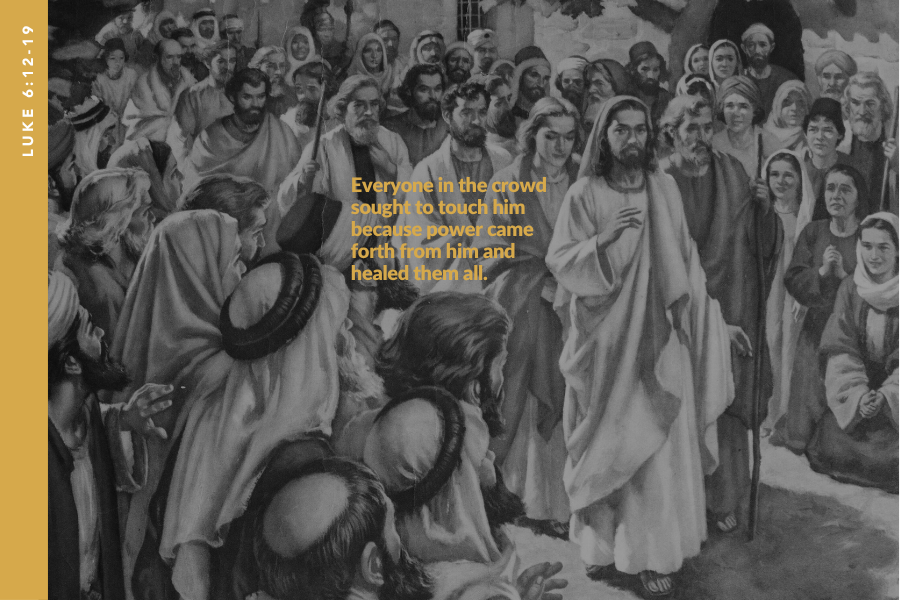
Jesus departed to the mountain to pray, and he spent the night in prayer to God. When day came, he called his disciples to himself, and from them he chose Twelve, whom he also named Apostles: Simon, whom he named Peter, and his brother Andrew, James, John, Philip, Bartholomew, Matthew, Thomas, James the son of Alphaeus, Simon who was called a Zealot, and Judas the son of James, and Judas Iscariot, who became a traitor. And he came down with them and stood on a stretch of level ground. A great crowd of his disciples and a large number of the people from all Judea and Jerusalem and the coastal region of Tyre and Sidon came to hear him and to be healed of their diseases; and even those who were tormented by unclean spirits were cured. Everyone in the crowd sought to touch him because power came forth from him and healed them all.

Opening Prayer: Come, Holy Spirit, open my heart and mind to encounter your truth. Imprint your truth and love into my heart so that I can continue the work of your Apostles in your Kingdom here on earth.

Encountering Christ:

  1. Called to Be Apostles: Jesus had been gone all night long, and when he returned in the morning, he “called his disciples to himself.” Jesus invited all who were there to hear the decisions he had made in prayer. Then he called each of the Twelve to apostleship by name. One by one they stepped forward, accepting the offer to build up the Kingdom of God in a unique and powerful way. These were called to a great service, a service of apostleship, to leadership. Like the Apostles, each of us has a unique vocation to follow him as his apostle of peace, his ambassador in the world today (cf. 2 Cor 5:20).

  2. The Twelve: The number twelve has a major significance in our Judeo-Christian tradition. For example, there were twelve tribes of Israel, symbolizing God’s power and the completeness of Israel’s government (1 Kgs 4:7). Speaking of the Twelve Apostles, St. Augustine wrote, “Twelve is a sacred number…These twelve were to make known the Trinity [three persons] throughout the whole world—that is throughout the four corners of the world. That is the reason of the three times four” (Tractates on the Gospel of John). This Gospel verse contains foreshadowing of Judas’s betrayal, which for a time reduced the Twelve to the Eleven. But even then, Peter knew that one would need to replace him to complete the Twelve, and the Holy Spirit directed them to choose Matthias to replace Judas (cf. Acts 1:12-26). The government in Christ’s Kingdom had to become complete again. Do we see ourselves as subjects of Christ the King, or are we self-reliant? How can we grow in trust and submission to Our Lord, who governs us through his Church?

  3. Kingdom of Mercy: In this Gospel passage, Luke is showing that the Kingdom of Christ has come. Christ established his majestic government of Apostles, then he went out to encounter the world filled with sickness and tormented souls. He brought the people his peace and healing through his power and glory. The world thinks of status and prestige as its marks of royalty, but Christ turned that idea upside down and showed that real power and majesty are manifested through works of mercy. This is how his Kingdom shall come: full of hesed, God’s merciful love. We are called to share God’s merciful love with whomever we meet.

Conversing with Christ: Jesus, I adore you as my Lord, my God, and my King. I am sorry for the times when I have rejected your authority through my sins. Thank you for establishing your Kingdom here on earth. Please give me the fortitude to be your apostle and extend your reign of mercy, compassion, and love. Christ our King, thy Kingdom come!

Resolution: Lord, today by your grace I will pray this scriptural decade of the rosary, focusing on the Proclamation of the Kingdom: USCCB Third Luminous Mystery.

Carey Boyzuck, MTS, is a wife, mother, freelance writer, pastoral assistant, and lay member of Regnum Christi. She blogs at www.word-life-light.com.

September 10, 2025 – The Heavenly Idea of Happiness

Wednesday of the Twenty-Third Week in Ordinary Time

Luke 6:20-26

Raising his eyes toward his disciples Jesus said: “Blessed are you who are poor, for the Kingdom of God is yours. Blessed are you who are now hungry, for you will be satisfied. Blessed are you who are now weeping, for you will laugh. Blessed are you when people hate you, and when they exclude and insult you, and denounce your name as evil on account of the Son of Man. Rejoice and leap for joy on that day! Behold, your reward will be great in Heaven. For their ancestors treated the prophets in the same way. But woe to you who are rich, for you have received your consolation. But woe to you who are filled now, for you will be hungry. Woe to you who laugh now, for you will grieve and weep. Woe to you when all speak well of you, for their ancestors treated the false prophets in this way.”

Opening Prayer: Jesus, sometimes your ways are hard to understand because they are so different from the ways of the world. Help me understand your blessings and warnings so that my heart and mind are conformed to yours.

Encountering Christ:

  1. A Blessed Paradox: St. Luke’s version of the beatitudes offers us the heavenly idea of happiness. To be “blessed” means to be happy. The beatitudes paint a picture of the abundant life he wants us to enjoy (cf. Jn 10:10). In the heavenly economy, those who are poor, hungry, weeping, and hated are happy. This is quite different from the world’s idea of happiness, which says “eat, drink, and be merry!” Jesus is teaching us that we will be truly happy only when we place him at the center of our life and let go of the temporal things that block our relationship with him.

  2. Heavenly Rewards: Notice that each of these beatitudes have a heavenly reward attached to them. The poor here on earth will inherit the Kingdom. The hungry will be filled and those in mourning will rejoice. Those who are persecuted will be great in Heaven. As Mary sang of God in her Magnificat, “He has shown might with his arm, dispersed the arrogant of mind and heart. He has thrown down the rulers from their thrones but lifted up the lowly. The hungry he has filled with good things; the rich he has sent away empty” (Lk 1:51-53). As Christian disciples, we are subjects of Christ’s Kingdom, called to live differently from the rest of the world. Jesus exhorts us to “store up treasures in heaven, where neither moth nor decay destroys, nor thieves break in and steal. For where your treasure is, there also will your heart be” (Mt 6:20-21). By trying to live the beatitudes, we store up treasures in Heaven.

  3. Everyday Holiness: Each of the different versions of the beatitudes in the Gospels give us a blueprint for everyday holiness. By being detached from earthly pleasures and keeping our lives rightly ordered with Jesus at the center, we participate in God’s holiness. Pope Francis wrote, “Do not be afraid of holiness. It will take away none of your energy, vitality, or joy. On the contrary, you will become what the Father had in mind when he created you, and you will be faithful to your deepest self” (Gaudete et Exsultate [Rejoice and Be Glad] 32). Focusing on things that are eternal helps us to stop striving so much and brings us peace, little by little. When we live this way, we become increasingly dependent on God to provide for us. We proclaim: “Blessed are those who trust in the Lord; the Lord will be their trust” (Jer 17:7).

Conversing with Christ: Jesus, rule my heart and establish the values of your Kingdom in me so that I desire the things you desire. By your grace, grant me the virtues I need to live out the detachment that your beatitudes teach. Order my life so that you are in the center. Jesus, you are the source and summit of my life.

Resolution: Lord, today by your grace I will pray the Litany of Humility, asking you to make me poor in spirit and unafraid of persecution.

For Further Reflection: Read Mary’s Magnificat in Luke 1:46-55, keeping in mind the beatitudes. Consider how Mary is called “blessed” for all generations and how she lived out the beatitudes in her earthly life.

Carey Boyzuck, MTS, is a wife, mother, freelance writer, pastoral assistant, and lay member of Regnum Christi. She blogs at www.word-life-light.com.

September 11, 2025 – Eternal Blessedness

Thursday of the Twenty-Third Week in Ordinary Time

Luke 6:27-38

Jesus said to his disciples: “To you who hear I say, love your enemies, do good to those who hate you, bless those who curse you, pray for those who mistreat you. To the person who strikes you on one cheek, offer the other one as well, and from the person who takes your cloak, do not withhold even your tunic. Give to everyone who asks of you, and from the one who takes what is yours do not demand it back. Do to others as you would have them do to you. For if you love those who love you, what credit is that to you? Even sinners love those who love them. And if you do good to those who do good to you, what credit is that to you? Even sinners do the same.

If you lend money to those from whom you expect repayment, what credit is that to you? Even sinners lend to sinners, and get back the same amount. But rather, love your enemies and do good to them, and lend expecting nothing back; then your reward will be great and you will be children of the Most High, for he himself is kind to the ungrateful and the wicked. Be merciful, just as also your Father is merciful. Stop judging and you will not be judged. Stop condemning and you will not be condemned. Forgive and you will be forgiven. Give and gifts will be given to you; a good measure, packed together, shaken down, and overflowing, will be poured into your lap. For the measure with which you measure will in return be measured out to you.”

Opening Prayer: Lord, I open my heart before you in this moment of prayer. I believe that you are here with me and that you have something to say to me. Help me to hear and receive your word with trust and love.

Encountering Christ:

  1. “I Say to You…”: Jesus had something new and impactful to say in today’s passage. Up until this point, the governing rule had been, “eye for eye, tooth for tooth” (Exod 21:24). Indeed, something in our fallen human nature feels satisfied with that justice. Yet that is not the justice that satisfies the heart of God. For what in this passage did Jesus not practice himself? In his very person, he came to establish the New Law and to write it upon our hearts (cf. Ezek 36:27), making us capable of living it out by his grace in union with him.

  2. A Daily Work of Love: Jesus came to show us that the nature of love is always merciful, rooted in the truth, and free. It is not love if it does not forgive. It is not love if it is stingy or judgmental. There are no cutting corners in the love to which we as Christians are called. And though we experience our imperfections daily, our God is, in his very self, the mercy and love to which he calls us. Patiently and lovingly, he wants us to strive a bit more towards the purity of love that he knows will be our only authentic fulfillment.

  3. Love for God, Love for Others: Christ makes it clear that the treatment we show to others will determine the treatment we ourselves receive. What a clear reminder that God lives within those around us, even our enemies, and that the way we treat them can impact our own capacity to receive God’s love. Where might the Lord be inviting us to open our hearts toward others? Where might he wish to make himself present to others through us?

Conversing with Christ: Lord Jesus, you ask no small thing of me when you invite me to love as you do, to let my heart be configured to yours, and learn to give, live, and forgive like you. Grant that I may always live in openness before you, receiving your love, so that I can give it and so that you can make yourself present in the world through me.

Resolution: Lord, today by your grace I will strive to put into practice a specific expression of charity described in this passage.

For Further Reflection: Read this passage hand in hand with John 13:1-20 to contemplate how Jesus lives this true charity in his own Passion.

Beth Van de Voorde is a Regnum Christi Consecrated Woman, currently serving in pastoral ministry to families in Madrid, Spain. When she’s not reading Ratzinger or humming along to some song or another, you may find her making her pilgrim way through Spain’s timeless history of faith, walking alongside the beautiful families she’s there to serve.

September 12, 2025 – Conformed to Christ

Friday of the Twenty-Third Week in Ordinary Time

Luke 6:39-42

Jesus told his disciples a parable: “Can a blind person guide a blind person? Will not both fall into a pit? No disciple is superior to the teacher; but when fully trained, every disciple will be like his teacher. Why do you notice the splinter in your brother’s eye, but do not perceive the wooden beam in your own? How can you say to your brother, ‘Brother, let me remove that splinter in your eye,’ when you do not even notice the wooden beam in your own eye? You hypocrite! Remove the wooden beam from your eye first; then you will see clearly to remove the splinter in your brother’s eye.”

Opening Prayer: Holy Spirit, send me your wisdom, knowledge, and understanding so that I might become like you. Help me imitate you in my thoughts, words, and actions. Open the meaning of these words to me and press them deeply into my heart.

Encountering Christ:

  1. Imitate the Teacher: Christ calls us, his disciples, to become “fully trained” in order to be conformed to him. We become like the teacher par excellence, Jesus, by imitating him (cf. Eph 5:1). To apply this to our everyday lives, we can practice pausing in prayer in the various circumstances we experience, asking Jesus how he would approach the situations at hand and then imitating him. This can especially be helpful in difficult situations or trials, as Jesus “was spurned and avoided by men, a man of suffering, knowing pain” (Isa 53:3). During trials, we can pray for faith and wisdom to guide us so we see the meaning in our suffering and persevere (cf. Jas 1:2-7). By imitating Jesus in and enduring our sufferings, we will grow to maturity, “to the extent of the full stature of Christ” (Eph 4:13).

  2. Pruned for Maturity: Scripture reading is essential to understanding how to imitate Christ. St. Jerome said, “ignorance of Scripture is ignorance of Christ.” How can we understand what Jesus taught and how he lived, let alone imitate him, without being intimately familiar with the firsthand accounts of his earthly life in the Gospels and apostolic Christian teaching of the early Church? Not only does reading Scripture give us knowledge of Christ, it changes us as we read it: “Indeed, the word of God is living and effective, sharper than any two-edged sword, penetrating even between soul and spirit, joints and marrow, and able to discern reflections and thoughts of the heart” (Heb 4:12). It prunes away what is sinful and unfruitful in us (cf. Jn 15:3). Pruning with the word is one way that we can “remove the splinter” from our own eyes before helping others to do so. Being pruned from sinful patterns is necessary for becoming “pefect and complete” in Christ (Jas 1:4).

  3. Removing Beams and Splinters: Since we are all children of God the Father, we are brothers and sisters with Christ as well. Christ is the only brother who can rightly say to us, “Let me take the beam from your eye,” because he knows us more perfectly than anyone else. He knows beams from splinters and can extract either with precision, causing us the least amount of pain and the most complete healing. Let us surrender to our Divine Physician, trusting in his gentle care for our soul.

Conversing with Christ: Christ, I open my heart before you. You see the beams that keep me from seeing what you see, and you are the Brother who has the power to remove them. Enlighten my mind and strengthen my heart to act on what you show me in this moment of prayer and in the circumstances of my life. I ask you for the grace to see with your eyes and heart.

Resolution: Lord, today by your grace I will strive to focus on promptly answering what you’re asking of me, following your inspirations with purity of intention.

Carey Boyzuck, MTS, is a wife, mother, freelance writer, pastoral assistant, and lay member of Regnum Christi. She blogs at www.word-life-light.com.
September 13, 2025 – Producing Good Fruits

Memorial of Saint John Chrysostom, Bishop and Doctor of the Church

Luke 6:43-49

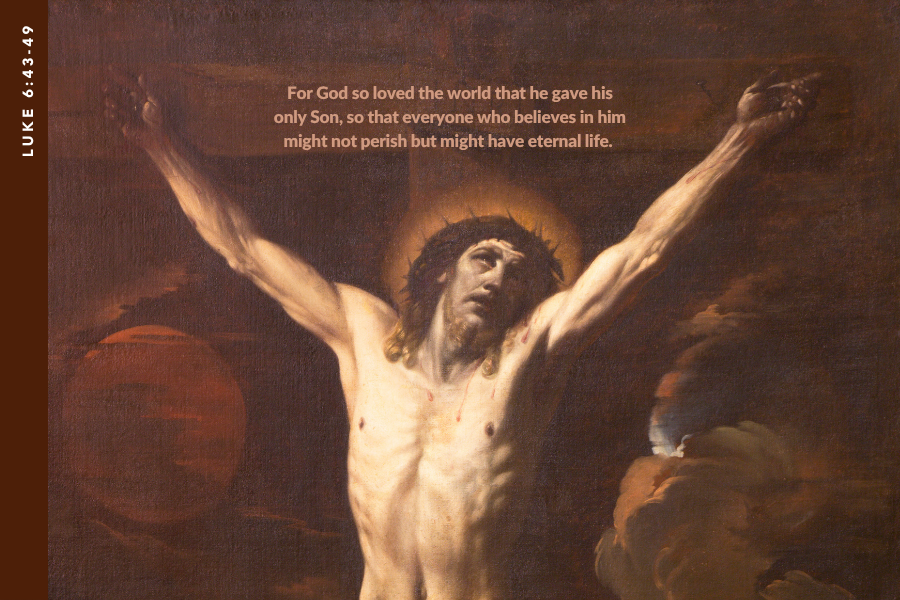
Jesus said to his disciples: “A good tree does not bear rotten fruit, nor does a rotten tree bear good fruit. For every tree is known by its own fruit. For people do not pick figs from thornbushes, nor do they gather grapes from brambles. A good person out of the store of goodness in his heart produces good, but an evil person out of a store of evil produces evil; for from the fullness of the heart the mouth speaks. Why do you call me, ‘Lord, Lord,’ but not do what I command? I will show you what someone is like who comes to me, listens to my words, and acts on them. That one is like a man building a house, who dug deeply and laid the foundation on rock; when the flood came, the river burst against that house but could not shake it because it had been well built. But the one who listens and does not act is like a person who built a house on the ground without a foundation. When the river burst against it, it collapsed at once and was completely destroyed.”

Opening Prayer: Come, Holy Spirit, bless me with understanding of your word. Give me the desire to build up goodness in my heart and then share that goodness with others. Help me make your love manifest in this world and so build up your Kingdom.

Encountering Christ:

  1. Good Fruits Are Good Works: A tree bearing good fruit has likely been cared for, has a strong trunk and branches, and is free from pests. It gets plenty of water, nutrients, and sun. A tree bearing rotten fruit likely suffers from neglect of some kind. It may be surrounded by weeds or pests, or perhaps it does not get enough water, nutrients, or sun. The tree is an apt image of our spiritual health. Weeds and pests represent anxiety, temptation, and sin. Water, nutrients, and sun feeding the good tree are the sacraments, worship, and prayer. When our soul is healthy and well nourished, we produce good fruits. As St. James taught, true faith is active and “completed by works” (Jas 2:22). By our faith, may we produce good works that give glory to God.

  2. Goodness in the Heart = Virtue: A “store of goodness in [the] heart” is another way to speak about virtue. According to the Catechism, “A virtue is a habitual and firm disposition to do the good. It allows the person not only to perform good acts, but to give the best of himself. The virtuous person tends toward the good with all his sensory and spiritual powers; he pursues the good and chooses it in concrete actions” (CCC 1803). There are four cardinal human virtues: prudence, justice, temperance, and fortitude. We can practice these virtues in our everyday lives to give glory to God. The three theological virtues are faith, hope, and love. God gives us these virtues as a gift through grace; we can pray for and activate these in our lives. As imitators of Christ, we are called to practice the cardinal virtues, and pray for the grace of the three theological virtues for ourselves and those we love.

  3. Building on a Solid Foundation: Living virtuously is akin to building our lives on a solid foundation. When we “dig deeply” and lay this strong foundation by infusing our thoughts and actions with virtue, we fortify ourselves against temptation so that we cannot be shaken. By our cooperation with grace, we will have prepared ourselves to “enter through the narrow gate” (Mt 7:13). May our mouths speak only words pleasing to the Lord, so that by our lives we give glory to him and merit eternal life.

Conversing with Christ: My Jesus, I believe that, by living according to your word, my life can be pleasing to you. I am sorry for the times when my faith has failed to produce good fruits, thus becoming stagnant. Help me to build up a store of virtue in my heart so I can bless others with the fruits of your Kingdom. I believe that I am saved by your grace (cf. Eph 2:8), but I know to enter your Kingdom I must activate my faith by cooperating with your grace, your life in me. I will strive to keep your commands and bear good fruit. Strengthen me so my faith is active and alive, not dead due to inaction (cf. Jas 2:17). Help me to always offer my good works in and through your power and for your glory, not my own.

Resolution: Lord, today by your grace I will engage in a work of mercy out of love for my neighbor.

For Further Reflection: Read this apologetic article on Catholic Answers that addresses the connection between faith and works: “Galatians 2:16 and Sola Fide.”

Carey Boyzuck, MTS, is a wife, mother, freelance writer, pastoral assistant, and lay member of Regnum Christi. She blogs at www.word-life-light.com.

September 14, 2025 – Behold the Cross

Feast of the Exaltation of the Holy Cross

John 3:13-17

Jesus said to Nicodemus: “No one has gone up to Heaven except the one who has come down from Heaven, the Son of Man. And just as Moses lifted up the serpent in the desert, so must the Son of Man be lifted up, so that everyone who believes in him may have eternal life.” For God so loved the world that he gave his only Son, so that everyone who believes in him might not perish but might have eternal life. For God did not send his Son into the world to condemn the world, but that the world might be saved through him. 

Opening Prayer: We adore you, O Christ, and we bless you, because by your cross you have redeemed the world.

Encountering Christ:

  1. The Son of Man: “No one has gone up to Heaven except the one who has come down from Heaven, the Son of Man.” This language may seem strange to our ears, but Nicodemus, a learned Pharisee, clearly understood Jesus. To scholars like Nicodemus, “Son of Man” had two meanings. The first is human, mortal. The second is a prophetic king as described in the Book of Daniel (7:13-14): “As the visions during the night continued, I saw coming with the clouds of Heaven one like a son of man. When he reached the Ancient of Days (Old Testament term for God) and was presented before him, he received dominion, splendor, and kingship; all nations, peoples, and tongues will serve him. His dominion is an everlasting dominion that shall not pass away, his kingship, one that shall not be destroyed.” Jesus was telling Nicodemus not only that he is this Son of Man, King of an everlasting dominion, but he then revealed how he would achieve his victory.

  2. The Seraph Serpent: “And just as Moses lifted up the serpent in the desert, so must the Son of Man be lifted up, so that everyone who believes in him may have eternal life.” We look for context in this case to Numbers 21:4-9: “[…] the people’s patience was worn out by the journey; so the people complained against God and Moses, ‘Why have you brought us up from Egypt to die in the wilderness, where there is no food or water? We are disgusted with this wretched food!’ So the Lord sent among the people seraph serpents, which bit the people so that many of the Israelites died. Then the people came to Moses and said, ‘We have sinned in complaining against the Lord and you. Pray to the Lord to take the serpents from us.’ So Moses prayed for the people, and the Lord said to Moses: ‘Make a seraph and mount it on a pole, and everyone who has been bitten will look at it and recover.’ Accordingly Moses made a bronze serpent and mounted it on a pole, and whenever the serpent bit someone, the person looked at the bronze serpent and recovered.” The etymology of seraph is “fiery one” which can mean Satan, the evil one. The people, we hear, complained against both Moses (the one God gave the Israelites to lead them out of slavery) and against God himself. By telling Moses to lift the bronze serpent on the pole, he was lifting their sin in front of their eyes. This visible sign of their sinfulness caused them to repent. Jesus takes two well-known Scripture passages to explain to Nicodemus that the true enemy of the people is not their outside oppressors; it is the sin that dwells within their own hearts. What an impact these words of Jesus must have made on the heart of Nicodemus. We know from the Gospel of John (19:39) that Nicodemus became a disciple and helped take Jesus’ body from the cross.

  3. The Cross: “For God so loved the world that he gave his only Son, so that everyone who believes in him might not perish but might have eternal life. For God did not send his Son into the world to condemn the world, but that the world might be saved through him.” The Feast of the Exaltation of the Cross commemorates the Holy Cross on which our Lord, Savior, and King, Jesus Christ, was crucified. The history of this feast is explained, “Early in the fourth century, St. Helena, mother of the Roman Emperor Constantine, went to Jerusalem in search of the holy places of Christ’s life. She razed the second-century Temple of Aphrodite, which tradition held was built over the Savior’s tomb, and her son built the Basilica of the Holy Sepulcher on that spot. During the excavation, workers found three crosses. Legend has it that the one on which Jesus died was identified when its touch healed a dying woman. The cross immediately became an object of veneration. At a Good Friday celebration in Jerusalem toward the end of the fourth century, according to an eyewitness, the wood was taken out of its silver container and placed on a table together with the inscription Pilate ordered placed above Jesus’ head: Then “all the people pass through one by one; all of them bow down, touching the cross and the inscription, first with their foreheads, then with their eyes; and, after kissing the cross, they move on.” To this day, the Eastern Churches, Catholic and Orthodox alike, celebrate the Exaltation of the Holy Cross on the September anniversary of the basilica’s dedication. The feast entered the Western calendar in the seventh century after Emperor Heraclius recovered the cross from the Persians, who had carried it off in 614, fifteen years earlier. According to the story, the emperor intended to carry the cross back into Jerusalem himself, but was unable to move forward until he took off his imperial garb and became a barefoot pilgrim (Franciscan Media).

Conversing with Christ: Lord Jesus, in this encounter with Nicodemus, you spoke to him in ways that his scholarly mind could accept, understand, and embrace. He became your disciple. By your grace, help me, like Nicodemus, come to you, ask you questions, and, even in my confusion, follow you.

Resolution: Lord, today by your grace I will pray using the Gospels and spend time questioning and pondering the words so that I can grow in my faith.

Nan Balfour is an events coordinator for Pilgrim Center of Hope, a Catholic Evangelization Ministry that answers Christ’s call by guiding people to encounter him so as to live in hope as pilgrims in daily life. She is also a mother, writer, and speaker on Catholic topics.

Scroll to Top

Events

Looking for another country?

Contact Regnum Christi near you

News & Resources

News & Resources

The Regnum Christi Mission

The Regnum Christi Identity

Alex Kucera

Atlanta

Alex Kucera has lived in Atlanta, GA, for the last 46 years. He is one of 9 children, married to his wife Karmen, and has 3 girls, one grandson, and a granddaughter on the way. Alex joined Regnum Christi in 2007. Out of the gate, he joined the Helping Hands Medical Missions apostolate and is still participating today with the Ghana Friendship Mission.

In 2009, Alex was asked to be the Atlanta RC Renewal Coordinator for the Atlanta Locality to help the RC members with the RC renewal process. Alex became a Group Leader in 2012 for four of the Atlanta Men’s Section Teams and continues today. Running in parallel, in 2013, Alex became a Team Leader and shepherded a large team of good men.

Alex was honored to be the Atlanta Mission Coordinator between 2010 to 2022 (12 years), coordinating 5-8 Holy Week Mission teams across Georgia. He also created and coordinated missions at a parish in Athens, GA, for 9 years. Alex continues to coordinate Holy Week Missions, Advent Missions, and Monthly missions at Good Shepherd Catholic Church in Cumming, GA.

From 2016 to 2022, Alex also served as the Men’s Section Assistant in Atlanta. He loved working with the Men’s Section Director, the Legionaries, Consecrated, and Women’s Section leadership teams.

Alex is exceptionally grateful to the Legionaries, Consecrated, and many RC members who he’s journeyed shoulder to shoulder, growing his relationship with Christ and others along the way. He knows that there is only one way, that’s Christ’s Way, with others!