
October 19, 2026

Regnum Christi Spirituality Center Uncle Eddy

St Isaac Jogues and St John de Brebeuf and Companions

Dear Isis, I had a bit of free time on my hands, so I was hacking around the Web (in accordance with the limits that are imposed on me here in my cozy little prison, of course).  Guess what I came across?  Yes indeedy, I ran across your current credit card balances.  My, my, haven’t we been the big spender lately!  Well, here’s your wake up call.  I am certain your conscience is already bothering you about whimsically spending hundreds (need I be more accurate?) of dollars (that you don’t have) on trivialities.  And rightly so.  Irresponsible use of our material resources has repercussions not only for our financial stability (excessive debt causes misery and anxiety, sooner or later), but it also saps our spiritual vitality.  The material things of life are wonderful gifts, and they can help us know and praise God (and we need them to keep on existing), but they are also seductive.  They can easily convince us that if we only have enough of them (or the right ones), we will be happy – that’s a lie.  By your current credit card tallies, one would conclude that you are buying into the deception.   Perhaps reflecting a bit on today’s saint can help de-consumerize you. These pioneers set out for the “new world” out of motives differing sharply from most of their fellow Europeans.  In fact, one of their first tasks in preaching the gospel to the Native Americans in eastern Canada and the eastern Great Lakes Region was convincing them that they had no interest at all in furs and skins and fish and game, but only in teaching them about Jesus Christ.  They showed this by taking up residence with the Indians themselves, learning their languages (which was no easy task), and returning to their villages time and again, even after European politics (the British were actively trying to wrest Canada from the French) repeatedly forced them to abandon their missions.  Their ability to sacrifice every material comfort and reward was the precondition for bringing Christ to these souls. But it didn’t stop there.  Besides living in filthy huts, traveling by canoe through dense wilderness (whenever they took a trip they had to carry their canoes and other supplies across pathless land bridges as often as they were able to paddle through clear waters), and putting their lives in continual danger by tending the chronic illnesses (mostly due to pestilence) suffered by their charges, they each ended up being taken prisoner, tortured, and brutally killed by enemies of the faith.  Just as their years of missionary work among the Hurons (and some other tribes) began to produce a steady stream of baptisms and sincere conversions (they even started a seminary for young Indians), inter-tribal violence broke out.  The Iroquois renewed an old war against the Hurons. Added to the long-standing tribal rivalry was a new suspicion, kindled by their superstitious and magical religious practices, that certain recent natural disasters (plagues and droughts) were due to the incursion of this new Christian religion.  Thus the missionaries became prime targets in the war effort.  As the fierce Iroquois attacked village after village, these Jesuit priests and lay brothers encouraged the Christian Hurons to hold fast to the faith, and baptized many of their catechumens just before the slaughter began.  Consequently, they themselves were captured.  Even as they were tortured, they continued to preach the good news.  St John de Brebeuf, for example, was tied naked to a pole, awarded a necklace of red hot spearheads, and girdled with a belt of burning pitch and resin.  With his face set like stone, he began to speak to his captors about the heavenly kingdom, at which point they gagged him, cut of his nose, tore off his lips, and performed a mock baptism by pouring boiling water over his head.  Only years later did the blood of martyrs like St John yield its results: almost all of the tribes they had ministered to were eventually won over to the faith. So you see, my dear niece, it is important to have a healthy detachment from material comforts, and to practice self-discipline instead of self-indulgence in money matters.  Otherwise, we Christians will not be free enough to give our lives to advance Christ’s Kingdom. God bless, Uncle Eddy Uncle Eddy

St Isaac Jogues and St John de Brebeuf and Companions Read More »
26-10-19-DM

October 19, 2026 – Planning The Future?

Memorial of Saints John de Brébeuf and Isaac Jogues, Priests, and Companions, Martyrs


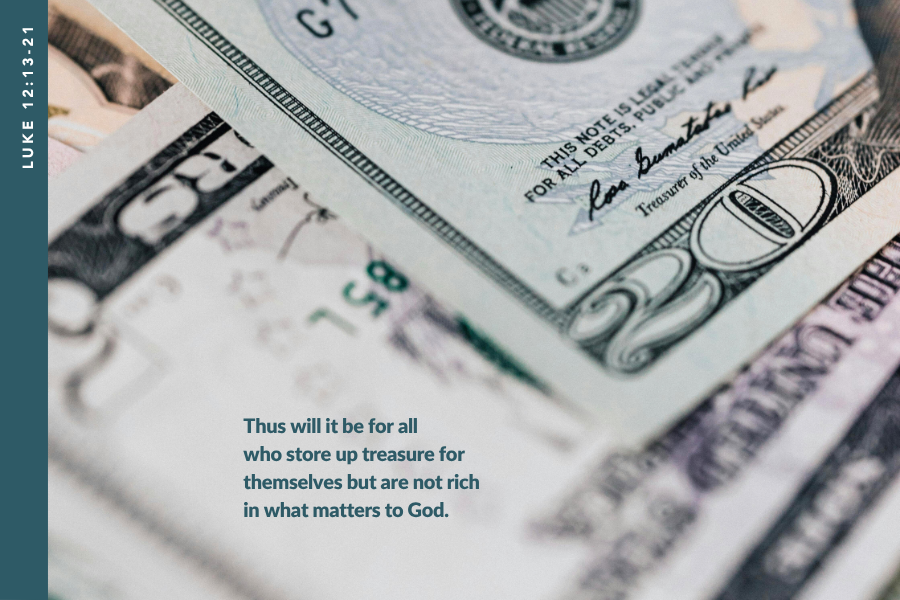
Luke 12:13-21

Someone in the crowd said to Jesus, “Teacher, tell my brother to share the inheritance with me.” He replied to him, “Friend, who appointed me as your judge and arbitrator?” Then he said to the crowd, “Take care to guard against all greed, for though one may be rich, one’s life does not consist of possessions.” Then he told them a parable. “There was a rich man whose land produced a bountiful harvest. He asked himself, ‘What shall I do, for I do not have space to store my harvest?’ And he said, ‘This is what I shall do: I shall tear down my barns and build larger ones. There I shall store all my grain and other goods and I shall say to myself, “Now as for you, you have so many good things stored up for many years, rest, eat, drink, be merry!”’ But God said to him, ‘You fool, this night your life will be demanded of you; and the things you have prepared, to whom will they belong?’ Thus will it be for the one who stores up treasure for himself but is not rich in what matters to God.”

Opening Prayer: Holy Spirit, take away from me now everything that distracts me from praying. I am here, and I am yours.

Encountering Christ:

  1. The Desire to Possess Things: When a person faces a good of any kind—an object, a value, another person—they not only experience the desire to enjoy it, but to possess it. It seems that this is related to the human capacity for reaching out beyond the present moment into the future. I call that projection. We understand ourselves not simply in the light of what is, but, at least as much, in the light of what will be. That is why people build barns: to guarantee that they will be able to rejoice in their goods in the future. The Gospel prompts us to reflect about our tendency to look ahead. Quite compellingly, Jesus points out that our future is really not as much in our control as we like to believe it is. I don’t think he wants us to be indifferent about the future. On the contrary, the capacity to project is crucial when it comes to living our lives and becoming who we are called to be. But, on the other hand, we have to check our urge to indiscriminately grab and store up the goods put before us. What barns have I built for the future, and what kinds of things am I storing there?


  2. The Temptation to Greed: God often presents us with goods that he wants us to share, invest, or even give up. Putting everything into a dark barn may feel safe for the moment, but it’s only appropriate if that’s what God has intended for us to do with it. We have to be discerning regarding our drive for possession. What feels “right” can be deceiving, and can turn into greed, compromising the goods that we were hoping to protect. We’re called to recognize that everything we have comes from God, and that we are merely stewards of these gifts. “As each one has received a gift, use it to serve one another as good stewards of God’s varied grace” (1 Pet 4:10).


  3. Life Does Not Consist of Possessions: We can all sometimes fall prey to the desire to measure our self-worth by our possessions. In our culture, we often idolize those with great wealth. Wealthy people seem to have it all. But Christ warns us in the Gospel to reject this assumption. Life does not consist of possessions. What matters is how well we love. As Mother Teresa told us, “There are many in the world who are dying for a piece of bread but there are many more dying for a little love” (A Simple Path). Our ultimate success will be measured by the love we share with others. “If I give away everything I own, and if I hand my body over so that I may boast but do not have love, I gain nothing” (1 Cor 13:3).

Conversing with Christ: Jesus, my life is filled with goods. Above all, I want to thank you for this “bountiful harvest.” I realize that many of these gifts are fundamental for my life, and I also acknowledge that none of them is guaranteed to last. In fact, what of it will last for eternity, Lord? My heart relishes the goods that make me happy. My nature urges me to continue to provide for that happiness. And yet I know nothing can guarantee it but you. I beg you, yes, I beg you, Lord: Fill me with the theological virtue of hope, so that I really rely completely on you when it comes to the future. I hope in you, and that means you alone are what I want to hold on to. I want to fill the barns of my heart with your goods alone.

Resolution: Lord, today by your grace I will look over my possessions and ask: “Among everything that I have received, what is the most precious in the light of eternity?”

For Further Reflection: “Romano Guardini relates in his autobiography how, at a critical moment on his journey, when the faith of his childhood was shaken, the fundamental decision of his entire life—his conversion—came to him through an encounter with the saying of Jesus that only the one who loses himself finds himself (cf. Mk 8:34ff.; Jn 12:25); without self-surrender, without self-loss, there can be no self-discovery or self-realization. But then the question arose: to what extent it is proper to lose myself? To whom can I give myself? It became clear to him that we can surrender ourselves completely only if by doing so we fall into the hands of God. Only in him, in the end, can we lose ourselves and only in him can we find ourselves. […] It is all summed up in the prayer of Saint Ignatius of Loyola—a prayer which always seems to me so overwhelming that I am almost afraid to say it, yet one which, for all its difficulty, we should always repeat: ‘Take O Lord, and receive all my liberty, my memory, my understanding, and my entire will. All that I have and all that I possess you have given me: I surrender it all to you; it is all yours, dispose of it according to your will. Give me only your love and your grace; with these I will be rich enough and will desire nothing more’” (Pope Benedict XVI during vespers on September 8, 2007).

Father Gabriel von Wendt, LC, is a priest who works as a professor at the Pontifical Athenaeum Regina Apostolorum. He has a passion for philosophy and the role of Catholic faith in contemporary culture. He is a co-founding member of the Catholic Worldview Fellowship, a study-abroad program for talented college students who want to evangelize culture.

October 19, 2026 – Planning The Future? Read More »

Scroll to Top

Events

Looking for another country?

Contact Regnum Christi near you

News & Resources

News & Resources

The Regnum Christi Mission

The Regnum Christi Identity

Alex Kucera

Atlanta

Alex Kucera has lived in Atlanta, GA, for the last 46 years. He is one of 9 children, married to his wife Karmen, and has 3 girls, one grandson, and a granddaughter on the way. Alex joined Regnum Christi in 2007. Out of the gate, he joined the Helping Hands Medical Missions apostolate and is still participating today with the Ghana Friendship Mission.

In 2009, Alex was asked to be the Atlanta RC Renewal Coordinator for the Atlanta Locality to help the RC members with the RC renewal process. Alex became a Group Leader in 2012 for four of the Atlanta Men’s Section Teams and continues today. Running in parallel, in 2013, Alex became a Team Leader and shepherded a large team of good men.

Alex was honored to be the Atlanta Mission Coordinator between 2010 to 2022 (12 years), coordinating 5-8 Holy Week Mission teams across Georgia. He also created and coordinated missions at a parish in Athens, GA, for 9 years. Alex continues to coordinate Holy Week Missions, Advent Missions, and Monthly missions at Good Shepherd Catholic Church in Cumming, GA.

From 2016 to 2022, Alex also served as the Men’s Section Assistant in Atlanta. He loved working with the Men’s Section Director, the Legionaries, Consecrated, and Women’s Section leadership teams.

Alex is exceptionally grateful to the Legionaries, Consecrated, and many RC members who he’s journeyed shoulder to shoulder, growing his relationship with Christ and others along the way. He knows that there is only one way, that’s Christ’s Way, with others!
