June 30, 2026

The Way Community Graduates Its First Cohort!

On Saturday, June 27th, The Way community celebrated the graduation of its first cohort after a two-year journey of formation and apostolate. The beautiful evening of fellowship was hosted by Sal and Josephine Caruso.

Graduates shared how the program reshaped their faith and self-worth:

  • Monique realized her worth isn’t tied to her accomplishments:  “…God can love us despite our unloveliness… we are worthy, without even having to showcase all of these accomplishments.”
  • AJ found foundational confidence and purpose:  “I learned that our lives only made sense when they are ordered through love, vocation, and through the will of God.”

When asked what is next, AJ recalled Fr. Andrés’ reminder that their formal formation may be over, but their “life pilgrimage” is just beginning. AJ feels confident following God’s will wherever it leads. Monique expressed her readiness to step forward by sharing “God’s compassion” and embracing others with forgiveness.

The core team, composed of Fr. Andres Orellana, Fr. Simon Devereux, Nathalie Ghantous, and Marcela Brockmann, gave thanks to God for the privilege of preparing these young adults for their life vocations. The evening concluded with joyous singing, dancing, and praising the Lord.

The Way Community Graduates Its First Cohort! Read More »

Regnum Christi Spirituality Center Uncle Eddy

First Martyrs of the Church of Rome

Dear Romeo, Funny that your folks named you after the Shakespearean tragic hero, whose name just happens to coincide with today’s saints (you should have heard what they were going to name you – thanks to good old Uncle Eddy you don’t have to carry an extra ink cartridge around so you can sign your name “Durostrumorrus”… it’s a long story).  The only difference is that Shakespeare’s impetuous and passionate youth is famous, while many of the first martyrs of Rome (those who were martyred under Emperor Nero, after he attributed the terrible fire that devastated the city to Christian malice) are anonymous – at least on this side of eternity. Oh, wait a minute, I guess there is another difference as well.  Romeo privately took his own life, because he was unable to suffer the tortures that his family’s sinful quarrels inflicted upon his impassioned heart. Whereas the martyrs of Rome died publicly, covered with tar and burned as living torches, or wrapped in animal skins and thrown to the lions or hunted for sport, simply because they refused to pay allegiance to any god except the One God, Jesus Christ.   I guess you can say that love was at the root of both deaths: Romeo loved Juliet too much to endure life without her, and the martyrs loved Jesus too much to abandon him to save their lives.  And whose footsteps will you follow in, my dear nephew? What love will you live and die for? What will you be willing to suffer in order to be faithful to your Lord? Will his love keep you strong in the face of life’s challenges (which, if I‘m not mistaken, you have already begun to face)?  Or will you tie the meaning of your life to something perishable, something that someday you will lose: money, fame, pleasure, a relationship? You are not much older than Shakespeare’s Romeo, and you are the same age as many of the Roman martyrs; it could be that your time will soon come to make a choice.  As you ready yourself, count on my prayers. God bless, Uncle Eddy

First Martyrs of the Church of Rome Read More »

WM_Martyrs

Over the horizon

Dear Friends,


June 30th on the liturgical calendar celebrates a memorial for the first martyrs of the Holy Roman Church.

The witnesses died for the faith under the emperor Nero, who blamed them for starting a fire that ravaged half of Rome.

Never mind that Nero was suspected of being the one who started the blaze. The Christians were an easy target and quickly became scapegoats.

It wouldn’t be the last time that Christians were persecuted in Rome—or elsewhere in the world, for that matter.

Persecution is part of the DNA of Christianity. A genuinely Christian life goes against the grain of the world.

It leaves the world feeling uncomfortable because it challenges its values—and pricks more than a few consciences. “The light came into the world, but people preferred darkness to light, because their works were evil” (Jn 3:19).

Persecution and even martyrdom can be signs of a healthy Christian community, in contrast to the not-so-healthy wider culture.

If ever we feel ostracized because of our Catholic faith, that can be a reason, paradoxically, for joy. For Jesus told us, “If the world hates you, realize that it hated me first” (Jn 15:18).

Our Lord’s words are sobering: To imitate him invites opposition from the world.

If that seems intimidating, it might be a theme worth pondering in prayer. Our retreat guide on Heroic Youth might be a good place to start.

It could help people of all ages to recall that we are travelers in a fallen world and shouldn’t expect perfect comfort here.

True happiness, with our Creator and all the saints, lies on the other side of a higher horizon.

In Christ,

Father Edward McIlmail, LC

Ask a Priest contributor

Over the horizon Read More »

Must We Be Perfect to Offer Fraternal Correction?

Q: I was reading the Summa Theologica entry on fraternal correction and I’m a bit confused. If we struggle with any sin whatsoever, does that make us ineligible to fraternally correct someone? I always thought that if we actively struggled with a certain sin, we were in no position to correct someone for that same sin, but the entry makes it seem like anyone who’s a sinner whatsoever is in no place to correct. But who can then? Does it have to do with whether you’re in a state of grace? For example, I found out that my younger brother has cheated on his fiancée, and he and his mistress wanted to stay at my house. I sat him down and told him that that was unacceptable for him to bring her into my home, and that he needed to come clean to his fiancée. But I will readily admit that I have my own sins I’m guilty of, such as struggling with alcohol overuse and being lazy at work. Does this mean that I sinned in having tried to correct my brother? — Michael

Answered by Fr. Edward McIlmail, LC:

Fraternal correction can be an important part of Christian life.

The Catechism in No. 1435 says:

“Conversion is accomplished in daily life by gestures of reconciliation, concern for the poor, the exercise and defense of justice and right, by the admission of faults to one’s brethren, fraternal correction, revision of life, examination of conscience, spiritual direction, acceptance of suffering, endurance of persecution for the sake of righteousness. Taking up one’s cross each day and following Jesus is the surest way of penance.”

Notice that “admission of faults to one’s brethren” comes right before mention of fraternal correction.

The key here is balance. We need to be willing to admit our mistakes. And we don’t need to be perfect in order to correct one another.

If perfection were required, parents could never discipline their children, nor could spouses ever correct each other. Nor for that matter could any priest or bishop correct his flock.

We are all a work in progress, and some of that progress will depend on others’ calling us out at times.

We need to discern when and how to offer fraternal correction. We need to be humble and recognize our own faults; this can help us bring up an issue with someone charitably and prudently.

In the case of your brother, it was good that you challenged him for his infidelity. If he is cheating now, that might be a warning sign that he is not ready for marriage. That is a bigger issue that needs attention.

Must We Be Perfect to Offer Fraternal Correction? Read More »

26-06-30-DM

June 30, 2026 – Lessons in a Storm

Tuesday of the Thirteenth Week in Ordinary Time


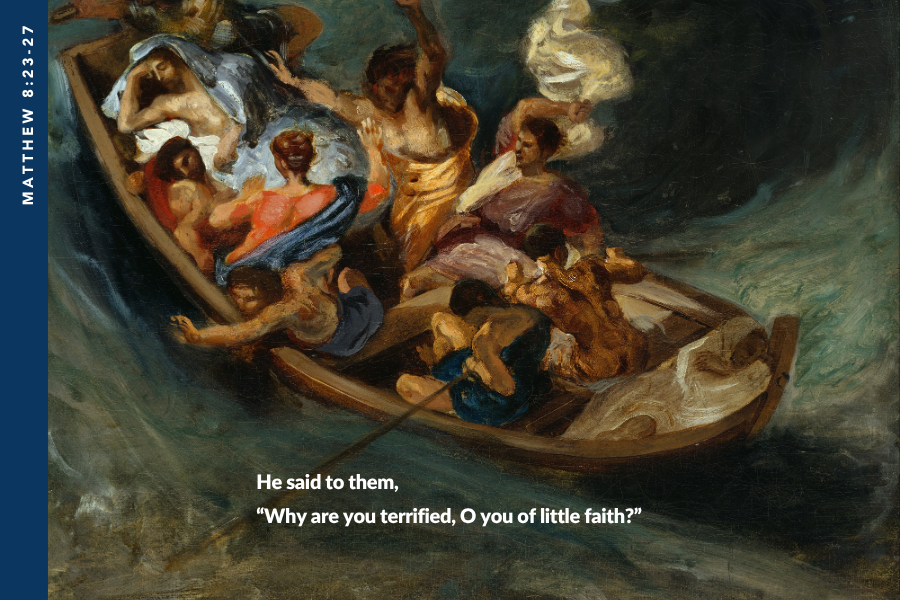
Matthew 8:23-27

As Jesus got into a boat, his disciples followed him. Suddenly a violent storm came up on the sea, so that the boat was being swamped by waves; but he was asleep. They came and woke him, saying, “Lord, save us! We are perishing!” He said to them, “Why are you terrified, O you of little faith?” Then he got up, rebuked the winds and the sea, and there was great calm. The men were amazed and said, “What sort of man is this, whom even the winds and the sea obey?”

Opening Prayer: I know you are here with me right now, Lord. I know you are thinking of me and eager to give me the graces I need to live this day to the full. I know you are looking at me with a gaze of personal and determined love. You created me, Lord, and you redeemed me, and you accompany me each moment through your Holy Spirit. Please open my mind and my heart so that I can receive the light and strength of your grace through this time I spend with you in prayer.

Encountering Christ:

  1. The Opportunities Storms Give Us: Why does Jesus permit storms in our lives? He didn’t have to let that storm come up as he and his Apostles were making their way across the sea. He shows clearly later on that he has power over the forces of nature at work in the storm. Why didn’t he exercise that power ahead of time, so that the storm wouldn’t even come up in the first place? At least one reason for permitting storms is that they give us opportunities to get to know Jesus better. At the end of this passage, after the crisis is over, St. Matthew tells us: “The men were amazed and said, ‘What sort of man is this, whom even the winds and the sea obey?’” Up to this point, Christ’s followers had witnessed amazing things: marvelous healings, dramatic exorcisms, and powerful preaching. This experience, however, shows them another side of Christ’s lordship: his power over the forces of nature. Their understanding, their knowledge of Jesus, still had room to grow. Maybe Jesus permitted this storm precisely so that through the experience, and through what he would show them in that experience, they would come to know him better. Maybe that’s why Jesus permits storms in our lives too. Somehow, being in a boat with Jesus as the storm rages on gives us a chance to know him more fully, and thus to love him more deeply.


  2. The Mystery of Faith: When his disciples wake him to share their panic with him, Jesus responds with a strange question: “Why are you terrified, O you of little faith?” The disciples must have looked at him as if he were crazy. Or maybe they looked at each other questioningly, wondering if their Lord had lost his marbles. A good number of Christ’s followers were fishermen, familiar with boats and storms. And those expert navigators were fearing for their very lives in the midst of this storm: “Lord, save us!” they cried out, “We are perishing!” From a normal, human standpoint their situation was clearly and obviously dire. But Jesus doesn’t chastise them for failing to make an accurate human evaluation of the situation. He challenges them on a different level, the level of All his teaching, all his miracles—they have had the single purpose of stirring up in his followers faith. We must encounter Jesus and believe in him, trust in him. Only then can his grace penetrate and transform us. This is because God is a real person, and so our relationship with him must be based on something besides mathematical computations. We must throw in our lot with him, believing and trusting, as we must do with any friend if we want the friendship to grow and flourish. Jesus has given us all many direct and indirect experiences of his goodness and his trustworthiness. How deeply have they nourished our faith? Our reaction during life’s storms can tell us.


  3. In the Same Boat: Jesus and his disciples were in the same boat. Jesus isn’t a Savior who redeems us from a distance. Jesus wants to be close to us. The whole Christian mystery broadcasts that amazing truth. In the Incarnation God himself becomes a human being and walks with us here in this fallen world. On the Cross, God himself absorbs into his own body and soul all the many types of suffering that we can’t seem to avoid in our journey through life. He travels the dusty roads of Galilee with his disciples. He speaks with Nicodemus around the fire at night. He touches lepers and weeps with those who mourn. In Jesus God shows us that he truly is with us. He is in our boat. Jesus is “Emmanuel”—God with us. The problem, from our perspective, is that we so easily forget this. The storms of life throw us into a panic. The noise of life drowns out the voice of truth. The distractions of life obstruct our view of the bigger picture as God has revealed it. When will I decide to live according to the truths that I believe? When will I decide to accept the truth of God’s unlimited, unconditional, unmitigated love for me and interest in my life? Will it be today?

Conversing with Christ: Thank you for coming into my boat, Lord. Thank you for caring enough about me to walk with me and protect and enlighten me. Today I just want to savor this gift of your presence. I am never alone. Even the storms that batter me are part of your plan for my life. Nothing can separate you from me, because you are all in for me. Please teach me, Lord, to live with a greater and greater awareness of your presence. Grant me the grace never to forget that even when the storms rage, you are with me in my boat, and with a mere word you can rebuke the winds and calm the sea. You are my Lord and my brother, and I never want to leave your side.

Resolution: Lord, today by your grace I will put some kind of faith-reminder (crucifix, image, rosary, post-it with a verse) in a place where I tend to feel more acutely the stresses and anxieties of life (desk, car, kitchen). Whenever I see it, I will make a little act of faith, telling Jesus that I do believe in him and asking him to increase my faith.

For Further Reflection: Navigating Stormy Seas: A Do-It-Yourself Retreat on Jesus Calming the Storm

Fr. John Bartunek, LC, is an author, speaker, and Creative Director at RCSpirituality, an online spirituality center providing a variety of resources for spiritual growth.

June 30, 2026 – Lessons in a Storm Read More »

Scroll to Top

Events

Looking for another country?

Contact Regnum Christi near you

News & Resources

News & Resources

The Regnum Christi Mission

The Regnum Christi Identity

Alex Kucera

Atlanta

Alex Kucera has lived in Atlanta, GA, for the last 46 years. He is one of 9 children, married to his wife Karmen, and has 3 girls, one grandson, and a granddaughter on the way. Alex joined Regnum Christi in 2007. Out of the gate, he joined the Helping Hands Medical Missions apostolate and is still participating today with the Ghana Friendship Mission.

In 2009, Alex was asked to be the Atlanta RC Renewal Coordinator for the Atlanta Locality to help the RC members with the RC renewal process. Alex became a Group Leader in 2012 for four of the Atlanta Men’s Section Teams and continues today. Running in parallel, in 2013, Alex became a Team Leader and shepherded a large team of good men.

Alex was honored to be the Atlanta Mission Coordinator between 2010 to 2022 (12 years), coordinating 5-8 Holy Week Mission teams across Georgia. He also created and coordinated missions at a parish in Athens, GA, for 9 years. Alex continues to coordinate Holy Week Missions, Advent Missions, and Monthly missions at Good Shepherd Catholic Church in Cumming, GA.

From 2016 to 2022, Alex also served as the Men’s Section Assistant in Atlanta. He loved working with the Men’s Section Director, the Legionaries, Consecrated, and Women’s Section leadership teams.

Alex is exceptionally grateful to the Legionaries, Consecrated, and many RC members who he’s journeyed shoulder to shoulder, growing his relationship with Christ and others along the way. He knows that there is only one way, that’s Christ’s Way, with others!