June 24, 2026

12-10 Papal Audience

In the Eucharist, “we become what we receive.”: Pope Leo’s Words Today

In the Eucharist, “we become what we receive.”

In this week’s Wednesday audience, Pope Leo XIV returns to his catechesis on the Second Vatican Council, reflecting on the Mystery of the Eucharist.

For Christians, taking part at the Lord’s table means being “instructed by God’s word and … nourished … [giving] thanks to God” (Sacrosanctum Concilium).

Thus, at Mass, we are not meant to be passive spectators. When we participate in the Eucharist, we are invited to listen to the Word of God and to be nourished at the Lord’s table, where he offers himself to the Father. In this way, the Eucharist is a form of spiritual sacrifice in which we offer ourselves in union with Jesus Christ—we become the Body whose Head is the risen Christ.

“As we seek our nourishment from this abundant source of divine life, let us allow ourselves to be transformed by the mystery we celebrate.”

To read more of Pope Leo XIV’s General Audience reflection, click here.

In the Eucharist, “we become what we receive.”: Pope Leo’s Words Today Read More »

Regnum Christi Spirituality Center Uncle Eddy

The Birth of John the Baptist

Dear Biff, How propitious that you are entering seminary on the Solemnity of the Birth of St John the Baptist!  I detect the hand of Providence in the unanticipated delay. Why? Simple reason. You know how hard it is to be a faithful priest and religious in today’s world, so aggressively anti-Christian.  Therefore, you will need something to keep you on track, not only during your years of formation and preparation, but also after you are ordained and serving the Church full time with all your heart, with all your mind, and with all your strength.  In today’s feast, you can find that something, a motto, a theme, if you will, for your life of loving service to the glory of God and the salvation of souls. I refer to the haunting summary of the life of St John the Baptist, which he himself gives us in the Gospel of John.   Maybe you remember the scene.  John’s disciples (of whom there were many) come to him complaining about the growing number of followers of Jesus; it appears that they are a bit envious.  John patiently explains to them that that is exactly what is supposed to happen. He was only the precursor, the messenger sent to get people ready to welcome Christ the Lord, to introduce everyone to the Messiah, so that the Messiah could then enter into their hearts and transform their lives.  So he sums up his mission with the following phrase: “He [Jesus] must increase; I must decrease.” Does that not summarize the life-mission of every baptized Christian, and even more so the life of a priest? If you keep that phrase in your heart, meditate on it, mull it around over and over again, and try to live its inspired truth, I guarantee you will discover the “pearl of great price” that will fill your privileged vocation with radiant joy and fathomless meaning. You can be sure that I will be praying for you in a special way as you start up the narrow path to the priesthood, and I will ask St John the Baptist to take you under his spiritual care, since you are making that start on his day. Your devoted Uncle Eddy

The Birth of John the Baptist Read More »

26-06-24-DM

June 24, 2026 – God Is Gracious

Solemnity of the Nativity of Saint John the Baptist


Luke 1:57-66, 80

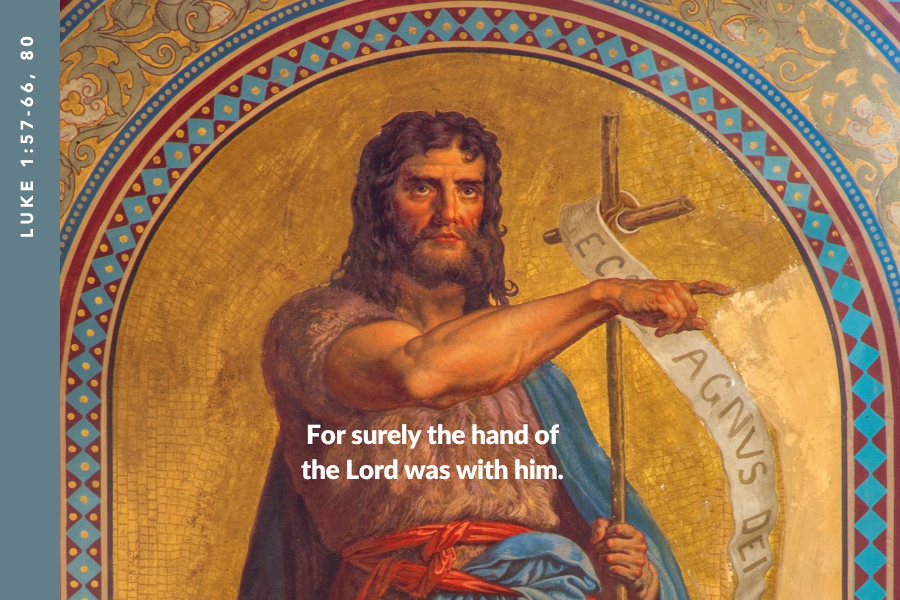
When the time arrived for Elizabeth to have her child she gave birth to a son. Her neighbors and relatives heard that the Lord had shown his great mercy toward her, and they rejoiced with her. When they came on the eighth day to circumcise the child, they were going to call him Zechariah after his father, but his mother said in reply, “No. He will be called John.” But they answered her, “There is no one among your relatives who has this name.” So they made signs, asking his father what he wished him to be called. He asked for a tablet and wrote, “John is his name,” and all were amazed. Immediately his mouth was opened, his tongue freed, and he spoke blessing God. Then fear came upon all their neighbors, and all these matters were discussed throughout the hill country of Judea. All who heard these things took them to heart, saying, “What, then, will this child be?” For surely the hand of the Lord was with him. The child grew and became strong in spirit, and he was in the desert until the day of his manifestation to Israel.

Opening Prayer: I come to you today wanting to hear your voice, but knowing that at times other voices seem to drown you out. I come to you wanting to follow where you lead me, but knowing that I am easily tempted to go down other paths. I come to you seeking true wisdom and courage, knowing full well that I often do foolish things and turn away from golden spiritual opportunities. I am a bundle of contradictions. I place myself in your presence and humbly ask you, Lord, to teach me and heal me. You promised that everyone who searches will find; I am searching, Lord, please help me to find in you all that I am looking for.

Encountering Christ:

  1. The Precursor: John the Baptist was the precursor to Jesus, the one sent to prepare the way for Jesus. He bridges the Old Testament and the New Testament. He is in a sense the fulfillment of the long tradition of patriarchs and prophets, and in another sense the first evangelist. His conception was announced miraculously to Zechariah in the Temple, and signs and wonders accompanied his birth in today’s Gospel. Zechariah was struck dumb when he doubted the angel’s message nine months earlier, but now he shows his repentance and renewed faith by freely choosing the prophesied name for his son—John—contrary to all custom and propriety. Why so much attention on the precursor, the one who would prepare the way for Jesus? It’s because God really wants us to recognize and accept Jesus Christ in our lives. At the time of the incarnation, he sent John the Baptist to open the hearts and minds of the Jewish people so that they would have a better chance of accepting Jesus. God still does this in our lives. He prepares us to receive the graces he wants us to experience. He is still the Lord of history, and that means he is the Lord of our own personal histories. Everything he does or permits in our lives has one goal: to bring us closer to Christ, and thus closer to the fullness of life that we yearn for. Who or what are the John the Baptists in my life? What are they saying to me? How am I responding?


  2. The Fruits of Courage: Elizabeth and Zechariah had to go against custom, risking the misunderstanding of their relatives and neighbors, in order to be faithful to what God was asking of them. The angel had told Zechariah that the promised child should be named John— which means “God is gracious.” But Jewish custom and tradition required parents to name their children according to names already present in the family tree (naming them after the father or mother, the grandfather or grandmother, or some other worthy relative). At the time of Christ, Jewish social customs and traditions were especially important, because their country was being occupied by a foreign invader, the Romans. Preserving their cultural identity depended upon preserving their customs. Contradicting this custom, therefore, meant taking a major social risk for Zechariah and Elizabeth; it meant exposing themselves to possible isolation, stigma, and rejection. But in this case they knew for certain what God was asking them. Together, they acted courageously and obeyed the Lord’s will. And the result was magnificent: healing for Zechariah and spiritual enlightenment for the people of Israel. We are often faced with the same predicament. God often invites us, through his commandments, through Church teaching, or simply through insistent inspirations given to us in the quiet of our hearts and prudently confirmed by good advice, to go against other people’s expectations. When we are faced with those challenges, we can ask St. Elizabeth and St. Zechariah to pray for us to find the courage they found, so as to enjoy in our lives the magnificent fruits of courageous obedience they experienced in theirs.


  3. John the Baptist and Me: The history of Christian spirituality sees in St. John the Baptist, whose birthday is commemorated in today’s liturgy, a model for each one of us. He announced Christ’s coming, pointed out Christ to those who didn’t know or recognize him, and explained the meaning of Christ’s identity and mission to those who didn’t understand. In art, he is most often depicted pointing away from himself toward Jesus. This is, in a sense, every Christian’s mission. Each one of us was, like John the Baptist, created directly by God and given a unique personality and genius. Then, when we were baptized, we were made partners with Christ in making his Kingdom present in this world, in spreading the Gospel to our little corner of the globe. We do this with our words, but also with the example of our lives and the deeds and works we perform. All that we are and all that we do can be, in a sense, a pointing toward Christ, a unique revelation of God’s goodness and love, an invitation to follow Jesus’ path to a more abundant life (cf. Jn 10:10). And the amazing thing is, the more we live our lives aware of and faithful to this calling, the more we ourselves will experience that very abundance of life.

Conversing with Christ: Thank you, Lord, for gently but surely guiding the history of humanity according to your plan of salvation. Thank you for sending John the Baptist and involving him in the work of redemption. Thank you for choosing me to carry the torch of the Christian faith and pass it on to others. You know my name—in fact, you gave me my deepest identity, just as you did with John the Baptist. Please help me to live each day keenly aware of who I am in your eyes, and eager to carry out my unique life-mission through you, with you, and in you.

Resolution: Lord, today by your grace I will reach out to someone who needs encouragement and somehow remind them that they are not alone and that you have a wonderful dream for their lives.

For Further Reflection: Uncle Eddy: The Birth of John the Baptist

Fr John Bartunek, LC, is an author, speaker, and Creative Director at RCSpirituality, an online spirituality center providing a variety of resources for spiritual growth.

June 24, 2026 – God Is Gracious Read More »

Scroll to Top

Events

Looking for another country?

Contact Regnum Christi near you

News & Resources

News & Resources

The Regnum Christi Mission

The Regnum Christi Identity

Alex Kucera

Atlanta

Alex Kucera has lived in Atlanta, GA, for the last 46 years. He is one of 9 children, married to his wife Karmen, and has 3 girls, one grandson, and a granddaughter on the way. Alex joined Regnum Christi in 2007. Out of the gate, he joined the Helping Hands Medical Missions apostolate and is still participating today with the Ghana Friendship Mission.

In 2009, Alex was asked to be the Atlanta RC Renewal Coordinator for the Atlanta Locality to help the RC members with the RC renewal process. Alex became a Group Leader in 2012 for four of the Atlanta Men’s Section Teams and continues today. Running in parallel, in 2013, Alex became a Team Leader and shepherded a large team of good men.

Alex was honored to be the Atlanta Mission Coordinator between 2010 to 2022 (12 years), coordinating 5-8 Holy Week Mission teams across Georgia. He also created and coordinated missions at a parish in Athens, GA, for 9 years. Alex continues to coordinate Holy Week Missions, Advent Missions, and Monthly missions at Good Shepherd Catholic Church in Cumming, GA.

From 2016 to 2022, Alex also served as the Men’s Section Assistant in Atlanta. He loved working with the Men’s Section Director, the Legionaries, Consecrated, and Women’s Section leadership teams.

Alex is exceptionally grateful to the Legionaries, Consecrated, and many RC members who he’s journeyed shoulder to shoulder, growing his relationship with Christ and others along the way. He knows that there is only one way, that’s Christ’s Way, with others!