June 23, 2026

WM_footprints

God’s Footprints

Dear Friends,


Pope Leo’s recent visit to Spain left us with much to ponder and pray about. He visited Madrid, Barcelona, and the Canary Islands, but the words that have most touched me personally were his responses to the testimonies of the young people at the prayer vigil in Barcelona, and his concluding homily.

                  A young man shared his journey of conversion and being baptized this past Easter, and ended by asking the Holy Father: “How can we keep our gaze lifted up toward what really matters, when society pressures us constantly to look at the ground or only at ourselves? How can we discover our true vocation in the midst of this strong current?”

                  The Pope thanked him for sharing this story and expressed his joy in taking “this significant step”. Then, he made reference to our experience of thirst, which we may try to satisfy with finite things, but “our deepest thirst will only be quenched by a different kind of water.” To encounter this water we must “cultivate that healthy sense of restlessness,” resisting the urge to numb it with profit, performance, success, self-image, and other forms of modern idolatry that serve as anesthetics. We need to “look within… cultivate moments of silence, and walk this inner path with others.”  This will allow us to discover God’s footprints in our current reality. (Dialogue of the Holy Father with Young People, June 9, 2026)

                  The theme of looking back to discover God’s footprints in our lives, how he was present in all that has happened to us, has a long tradition in salvation history. Often, we are not able to behold God’s glory, how he was present and at work, until he has passed, and we are able to see it in retrospect. Moses asked God, “If I have found favor in thy sight… show me thy glory,” to which God replies, “You cannot see my face… I will cover you with my hand until I have passed by, then I will take away my hand, and you shall see my back” (Ex 33: 17–23). Perhaps this image of seeing God’s back is a spiritual experience for all of us. It builds up our confidence, and we are able to face the present realities of our lives with greater theological hope. This prayer of “remembering the good things the Lord has done” (Ps 77:11) provides us comfort and hope.

Yours in the heart of Jesus,

Glory Darbellay

God’s Footprints Read More »

Why Don’t We Pray More for the Unborn?

Q: The Church recognizes the unborn baby as a person made in the image of God, with an immortal soul like you and me. So why then do we never pray at Mass for the over 73 million innocent human beings that are killed by abortion each year in the world? We pray for victims of natural disasters and wars, why do the unborn not get our prayers? Even on Respect Live Sunday our priest talked about respecting the lives of the immigrants (rightly so) but not a word for the unborn. Why is the Church silent on the subject? Is it because it is an unpopular position to take? — Tom

Answered by Fr. Edward McIlmail, LC:

A: You are right to be concerned about the horrific number of abortions in the world.

But you are overstating the point about the Church: Catholics do pray for the unborn. Almost daily, for instance, Ask a Priest hears a public rosary at a church that includes petitions for the unborn.

The Church, in fact, has long defended the unborn. See this U.S. bishops’ conference post.

Your basic point, however, has some validity. Perhaps more parishes need to make the appeal for the unborn more pronounced. Discussion about the pro-life cause seems to have faded a bit in the wake of the Supreme Court decision to overturn Roe v. Wade.

You might consider reaching out to the priest in your parish and let him know you’d appreciate more mention of the unborn.

Better yet, see if you can organize pro-life efforts at your parish, such as prayers for the unborn and material support for crisis pregnancy centers.

I hope some of this helps. Count on my prayers.

Why Don’t We Pray More for the Unborn? Read More »

Regnum Christi Spirituality Center Uncle Eddy

St Etheldreda

Dear Audrey, How they ever derived “Audrey” from “Etheldreda” I’ll never grasp, but derive it they did.  When I was younger (and still free), I had the opportunity (which I will savor forever) of visiting the English island of Ely, which this saint received as her wedding gift, and to which she retired when her first husband died after they had been married only three years.  She would fain have stayed there in prayer and solitude for the rest of her life, but family troubles obliged her to marry again (for diplomatic reasons), even though she had made a private vow of virginity (she and her first husband had lived together as brother and sister, offering themselves body and soul to God).  Her new husband was only a boy-king when they married, but when he had grown up to take full possession of his crown and his manhood, he demanded that she put aside her vow of virginity. They appealed to the local bishop, who upheld her cause and permitted her to separate from her husband and start a double monastery (men on one side of the property and women on the other), over which she ruled for the rest of her life, giving her monks and nuns a lasting example of spiritual rigor and intense love for God. Such a tale may have an odd ring to it for our ears (understandable, since it took place in a culture 1500 years older than our own), but wouldn’t you say there is a beautiful lesson hidden within it?  What strikes me most is the respect with which St Etheldreda – as well as the others – viewed her sexuality. Even before all the modern theological speculation concerning the philosophical and anthropological significance of gender, she understood profoundly that her sexuality was a call to love, a call to total self-giving.  She felt that God was asking her to give her whole self to him directly, and so she did not want to give herself to another man. I bet that if she had felt God calling her to give herself to a man in marriage, she would have been the best wife and mother one could imagine… In any case, she treated her own sexuality with reverence and with care.  What a contrast to today’s sex-saturated culture, where sex is cheap, a mere pastime, an entertainment! How the devil must relish the carelessness and casualness with which we treat our own and one another’s sexuality! Intimacy is meant to be at the service of true love, not a selfish indulgence. May God grant you the grace to understood the secrets of love as deeply as Etheldreda did, and may he grant you the gift of purity, so that when the time comes for you to give yourself away (either to him directly, or to a husband whom he gives you) you will still have something to give. Love, Uncle Eddy

St Etheldreda Read More »

26-06-23-DM

June 23, 2026 – Tough Love

Tuesday of the Twelfth Week in Ordinary Time


Matthew 7:6, 12-14

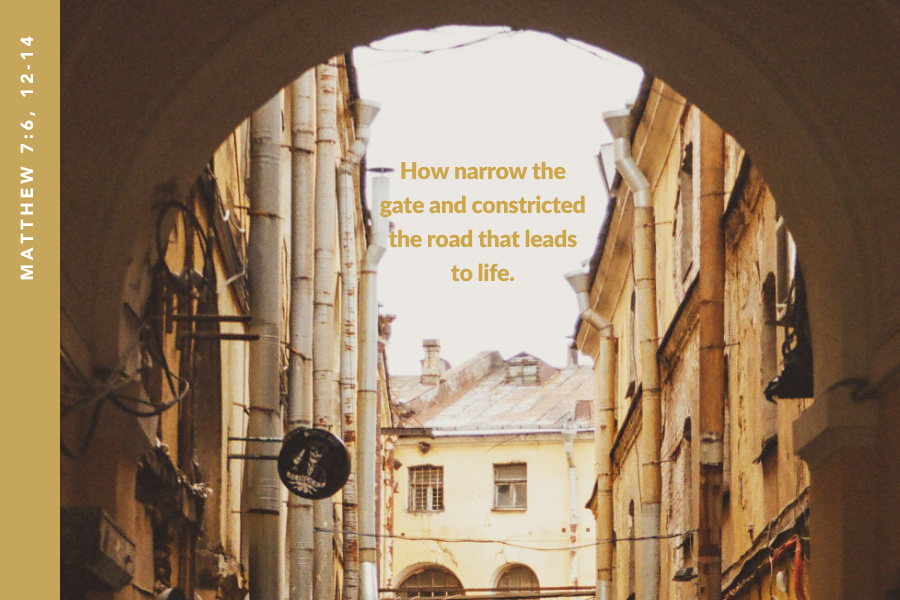
Jesus said to his disciples: “Do not give what is holy to dogs, or throw your pearls before swine, lest they trample them underfoot, and turn and tear you to pieces. Do to others whatever you would have them do to you. This is the Law and the Prophets. Enter through the narrow gate; for the gate is wide and the road broad that leads to destruction, and those who enter through it are many. How narrow the gate and constricted the road that leads to life. And those who find it are few.”

Opening Prayer: Dear Lord, I believe in you, in your goodness and your interest in me. I am coming into your presence right now full of a desire to know you better, to praise you, and to receive whatever grace you want to give me today.

Encountering Christ:

  1. Christian Creativity: When Jesus commands us to “do to others whatever you would have them do to you,” he is enhancing a commandment in use among other rabbis during his lifetime. The other version said, “Do not do to others what you would not like them to do to you.” The common version uses the negative—“do not do”—and Jesus uses the positive: “do.” The underlying sentiment in both versions is the same: Other people, every other person, is worthy of my respect and consideration. I cannot treat other people as if they were less important or less worthy than myself. I must see others as brothers and sisters, as fellow human beings and companions who share my same dignity. And the way I treat them must flow from that realization. This is the underlying sentiment in both versions of the Golden Rule. But Jesus’ positive version adds a dimension absent in the negative version. When we “do to others whatever you would have them do to you,” we keep our eyes open for opportunities to serve, encourage, and support. We actually seek opportunities to make a positive impact on the lives of others. The negative version is more limited, encouraging us to avoid causing others damage or putting obstacles in their path. The positive version actually includes the negative version, but not vice versa. Jesus is inviting us not only to avoid causing problems, but to be creative contributors to the world around us, to the people we encounter, live with, and work with. This is an essential element in our Christian identity. Wherever a true Christian can be found, the world and the lives of others will be better because of that Christian’s presence. Love is always looking for ways to build up, help, serve, improve, and beautify. If every Christian simply lived this one commandment to the full, imagine how different the world would be. How fully am I living it?


  2. Christ’s Challenge: Jesus tells us that the road that leads to life is constricted, the gate that leads to life is narrow, whereas the path leading to destruction is wide and popular. In this one comparison he gives us a sketch of life in a fallen world. The default position of our fallen human nature is contrary to our true good. In other words, it is easier for us to fall into self-centeredness, self-indulgence, self-pity, and self-absorption than it is for us to live with generosity, courage, kindness, charity, and creativity. This is the real core of what is often referred to as “spiritual warfare.” A battle rages within us. Our tendencies to sin pull us in one direction, while our faith invites us to travel in another direction. It is hard to accept faith’s invitation and curb our worldly desires. It would be easier to give in to those worldly desires—they seem so easy, they promise a quick satisfaction, and everyone else is doing it anyway. That’s the wide gate that leads us towards the frustration of our real calling. Choosing to follow the invitation of our faith—entering in by the narrow gate—means, at times, going against popular trends and fads, delaying the gratification of some of our desires, and just plain working hard to do what is right and good. Jesus knows that his way can be hard. But he encourages us to follow it anyway. He believes in us. He knows that he made our hearts to find their fulfillment—the fullness of life—in our relationship with him, in obeying the commandments that reveal the authentic requirements of our human nature. How willing am I to battle against the destructive tendencies of my human nature in order to nourish and release the full potential of the life within me? Jesus wants me to be willing, and he will help me. I just have to decide.


  3. Sagacious Disciples: When Jesus warns us about the danger of giving our pearls to swine, he is teaching to be Christian realists. Jesus understands better than any of us just how broken our world is, just how fallen our human nature is. He knows that it is not enough for us simply to want to do good, to be a positive influence in the world. No, we also have to learn how to do that. We have to learn to be sagacious about choosing the right time, place, and manner for sharing with others the pearls of truth and grace we have received from the Lord. When a space capsule reenters the earth’s atmosphere, it has to do so at just the right angle and speed. Otherwise, it may bounce off the atmosphere and drift irretrievably back into space. Or it may enter too sharply and incinerate completely, instead of navigating toward a safe landing. It is similar with our attempts to share with others the Good News and the wisdom of Jesus Christ through our words and deeds. The right word spoken at the wrong time can worsen situations rather than improving them. A good deed done with the right intention but in the wrong circumstances can actually cause damage instead of promoting healing. In a certain sense, this fallen world is like a battlefield strewn with landmines. Jesus wants us to learn to identify where those mines are hidden and develop the ability to avoid setting them off. This doesn’t need to make us timid—after all, he also instructed us to shout from the rooftops what the Lord whispers to our hearts—but Jesus wants it to help make us wise and discerning.

Conversing with Christ: Your teaching challenges me, Lord. I don’t always feel like doing to others what I would want them to do to me. I don’t always feel like following the narrow path through the narrow gate. I don’t always feel like taking time to reflect and discern about how I should behave. But here you are, teaching me that it is well worth it to do all those things, even if at times I don’t feel like it. I want to trust you, Lord, and to follow your teachings, these teachings. I want to be your faithful disciple, so that my life can bear fruit and bring me the fulfillment I yearn for. But I need your help, Lord. Grant me your grace, Lord: light to know what you want me to do, and strength to carry it out.

Resolution: Lord, today by your grace I will go out of my comfort zone in order to do something for someone else that can help them. Afterwards, I will spend some time in prayer, talking with you about what it felt like and what I learned from it.

For Further Reflection: The Complete Christian: A Retreat Guide on the Calling of the Twelve Apostles

Fr John Bartunek, LC, is an author, speaker, and Creative Director at RCSpirituality, an online spirituality center providing a variety of resources for spiritual growth.

June 23, 2026 – Tough Love Read More »

Scroll to Top

Events

Looking for another country?

Contact Regnum Christi near you

News & Resources

News & Resources

The Regnum Christi Mission

The Regnum Christi Identity

Alex Kucera

Atlanta

Alex Kucera has lived in Atlanta, GA, for the last 46 years. He is one of 9 children, married to his wife Karmen, and has 3 girls, one grandson, and a granddaughter on the way. Alex joined Regnum Christi in 2007. Out of the gate, he joined the Helping Hands Medical Missions apostolate and is still participating today with the Ghana Friendship Mission.

In 2009, Alex was asked to be the Atlanta RC Renewal Coordinator for the Atlanta Locality to help the RC members with the RC renewal process. Alex became a Group Leader in 2012 for four of the Atlanta Men’s Section Teams and continues today. Running in parallel, in 2013, Alex became a Team Leader and shepherded a large team of good men.

Alex was honored to be the Atlanta Mission Coordinator between 2010 to 2022 (12 years), coordinating 5-8 Holy Week Mission teams across Georgia. He also created and coordinated missions at a parish in Athens, GA, for 9 years. Alex continues to coordinate Holy Week Missions, Advent Missions, and Monthly missions at Good Shepherd Catholic Church in Cumming, GA.

From 2016 to 2022, Alex also served as the Men’s Section Assistant in Atlanta. He loved working with the Men’s Section Director, the Legionaries, Consecrated, and Women’s Section leadership teams.

Alex is exceptionally grateful to the Legionaries, Consecrated, and many RC members who he’s journeyed shoulder to shoulder, growing his relationship with Christ and others along the way. He knows that there is only one way, that’s Christ’s Way, with others!