June 2, 2026

SHN_header

2026 Novena to the Sacred Heart Begins June 3

The world-wide Regnum Christ Novena in preparation for the Solemnity of the Sacred Heart of Jesus begins tomorrow, June 3rd and ends June 11th, on the eve of the feast day. You can pray it daily on our website, app, and social media, or sign up for daily emails.

With this novena we begin nine days of preparation for the Solemnity of the Sacred Heart on June 12. We want to respond to the request that Pope Francis made of the whole Church when he wrote the encyclical dedicated to this mystery of the Sacred Heart that we celebrate, asking for the grace to go deeper into the Heart of Jesus Christ as the place where we experience and live our mission.

Our spirituality is centered above all on Jesus Christ and born from experiencing his love. (SRCF 12); therefore, to return to the Heart of Christ is to return to the source of our spiritual and apostolic life.

“I ask our Lord Jesus Christ to grant that his Sacred Heart may continue to pour forth the streams of living water that can heal the hurt we have caused, strengthen our ability to love and serve others, and inspire us to journey together towards a just, solidary and fraternal world. Until that day when we will rejoice in celebrating together the banquet of the heavenly kingdom in the presence of the risen Lord, who harmonizes all our differences in the light that radiates perpetually from his open heart.”

(Pope Francis, Dilexit nos, no. 220)
 

About the design of the Novena

The illustrative art for this novena is intended to represent the pilgrim Church that walks united towards Christ, with its gaze fixed on his Sacred Heart. In the center appears the Risen Jesus showing the wounds of his passion and his open Heart, a sign of the love with which he loved us to the point of giving his life for us and the source from which flows the grace that heals, sustains, and guides the Church’s journey. His outstretched arms evoke the invitation of the Gospel: “Come to me, all you who labor and are burdened  and I will give you rest” (Mt 11:28), as well as the call to “remain in his love” (Jn 15:9), a theme that runs through the entire novena.

The whole composition is constructed as a common pilgrimage to God. The different groups represent the richness and diversity of the People of God: families, young adults, priests, consecrated persons, children, and different charisms. Regnum Christi walks together with others, as a spiritual family within the greater ecclesial communion. Everyone moves forward looking towards Christ, because He is the origin, the way, and the goal. The presence of Mary and St. Joseph reminds us that the pilgrim Church never walks alone: they intercede, accompany, and continuously point to Jesus. Also inspired by the early Christian tradition of the Good Shepherd and the people he leads to eternal life, the illustration is intended to evoke the Lord who leads his people to the meadows of rest and the rivers of living water: “The Lord is my shepherd, there is nothing I lack… in green pastures he makes me lie down” (Ps 23). Thus, this novena becomes an invitation to return to the Heart of Christ, to entrust our burdens to him, and to learn from him, “who is meek and humble of heart”.

2026 Novena to the Sacred Heart Begins June 3 Read More »

Regnum Christi Spirituality Center Uncle Eddy

St Pothinus and Companions

Dear Patty, Nothing pains me more than hearing about the plague of gossip and backbiting that’s so widespread among your peers.  Our tongues were made for building up, not for breaking down! St James put it best: “Consider how small a fire can set a huge forest ablaze. The tongue is also a fire. It exists among our members as a world of malice, defiling the whole body and setting the entire course of our lives on fire, itself set on fire by Gehenna [hell].” (James 3:6-7)  If you want to take the fast lane to holiness and peace of mind, to lasting joy and satisfying relationships, learn to control the words that escape your lips. Neither participate in sterile criticism (let alone detraction [maliciously pointing out someone’s bad points to other people] or slander [telling damaging lies about someone]), nor tolerate it in others, and you will be pleasing to God and a fountain of light for the Church. How careless we are with words!  We should take a lesson from today’s saints.  All the Christians in the area around these two towns were gathered up during Marcus Aurelius’s brutal persecution.  After suffering social ostracism, they were imprisoned and tortured. Their non-Christian servants and companions, frightened at the prospect of torture, spewed out horrible accusations to justify the official persecution, “[They] accused us of feeding on human flesh… and of committing incest… as well as other abominations which it is unlawful for us even to think of, and which we can scarcely believe ever to have been perpetrated by men.  When these things were made public, all were exasperated against us, including some who had formerly shown friendliness…” Oh the power of evil words! Some of these Christians denied their faith in order to avoid the humiliating and excruciating tortures of the red-hot iron chair, of being made sport for wild beasts in the amphitheatre, of being singed with searing plates on the most sensitive parts of their bodies… But those who remained faithful, and gave up their lives rather than deny their faith, prayed for their persecutors, and vocally forgave their fellow Christians who had abjured.  So filled with charity were their words of encouragement and pardon, that the Christians who had given in at first regained their courage, and the governor had to re-arrest them and seal their martyrs’ fate. Oh the power of the good and gentle words! Hold fast, my brave young niece, and positively deny the devil entrance to your speech.  Avoid self-satisfying criticism in all its forms, and make every word that comes out of your mouth – that same mouth that receives the very body and blood of Christ our Lord – be a flower of truth and beauty, justice and mercy.  Thus you will spread the fire of love, and not the fires of hell. Your devoted Uncle Eddy  

St Pothinus and Companions Read More »

Good_Potter

The Good Potter

Dear Friends,


Several years ago, during a lengthy silent retreat, I realized that I was frustrated with God. I’d just gone to confession, and found myself thinking about how many times I’d been to confession in the last twenty years (it numbered in the hundreds). The question—and the frustration—arose spontaneously. “Lord, why do I still need to go to confession? I’ve been to confession so many times—why haven’t you changed me? What, exactly, are you doing?”

God’s answer was simple. The goal of our lives is not sinlessness or self-perfection. The goal of our lives is not to never need God again. The whole purpose of our lives is union with the Lord: “Father… In this is eternal life. That they know you the only true God, and Jesus Christ whom you have sent” (John 17:1-3).  This is, from beginning to end, a work of grace. And therefore, God asks us to trust him. 

In the Old Testament, the Lord queries: “Does the clay say to him who fashions it, What are you making? or Your work has no handles?” (Isaiah 45:9).  When we don’t understand what the Lord is doing—or not doing—how much can we trust him? When “his work has no handles,” when we simply cannot grasp his purpose, how much can we trust him?

Then in John 5:17, Jesus promises us that he and the Father are always at work. He does not, however, promise us that we will see his work or understand it when, and as, we might wish.

When we find ourselves at a loss, when we cannot understand, when we realize that we are frustrated with God, might he be calling us to trustingly accept that he is the good potter, and we are the clay? And can we then share our inner world with him, and decide to say “yes” right now, with faith, with hope, and with love?

God bless,

Fr. John Pietropaoli  

The Good Potter Read More »

26-06-02-DM

June 2, 2026 – Moral Versus Civic Duty

Tuesday of the Ninth Week in Ordinary Time


Mark 12:13-17

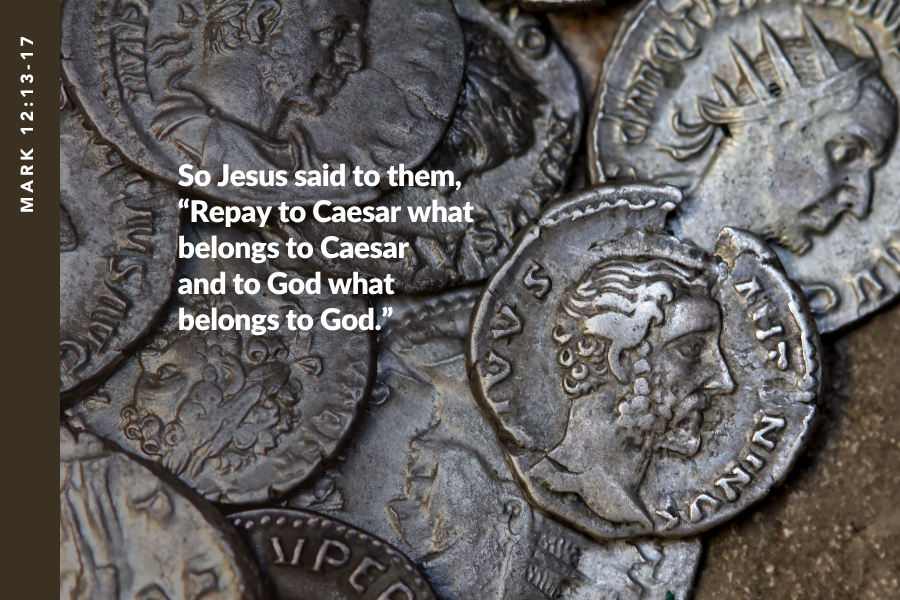
Some Pharisees and Herodians were sent to Jesus to ensnare him in his speech. They came and said to him, “Teacher, we know that you are a truthful man and that you are not concerned with anyone’s opinion. You do not regard a person’s status but teach the way of God in accordance with the truth. Is it lawful to pay the census tax to Caesar or not? Should we pay or should we not pay?” Knowing their hypocrisy he said to them, “Why are you testing me? Bring me a denarius to look at.” They brought one to him and he said to them, “Whose image and inscription is this?” They replied to him, “Caesar’s.” So Jesus said to them, “Repay to Caesar what belongs to Caesar and to God what belongs to God.” They were utterly amazed at him.

Opening Prayer: Dear Lord Jesus, I thank you for the grace of coming before you in prayer. I thank you for the faith that has made me desire to pray, but I also ask you to increase my faith. May my contact with your word help me to rely ever more deeply on you and less on my own strength. Please open my mind and heart to hear what you wish to tell me.

Encountering Christ:

  1. Knowing Their Hypocrisy: The Pharisees called Jesus a good teacher, but they had no desire to learn. The Pharisees and the Herodians were laying a trap for Jesus—and a clever one it was. If Jesus affirmed that they should pay the Roman tax, he would lose the favor of the people who resented Roman rule. If he declared it unnecessary to pay the tax, they could accuse him before the Romans of being an insurrectionist. Either answer would serve their purpose of undermining Jesus’s message. Their flattery was insulting. However, their indifference to truth was the real tragedy. If we want to encounter Jesus and learn from him, we must approach him with a sincere heart.


  2. Bring Me a Denarius: Hypocrites are often guilty of the very thing for which they blame others. Jesus asked for a denarius, a Roman coin. He had none; they did. Carrying a regime’s currency is an implicit sign of support, even if begrudgingly. The Pharisees and the Herodians did not like the Romans; however, they did like the power the Romans allowed them to retain. Jesus was a threat to their moral authority, and thus ultimately to their power. That is why they wanted to be rid of him; hence their clever trap. Eventually, they would even cry, “We have no king but Caesar” (Jn 19:15). Conversely, Jesus in his poverty showed neither a dependence upon nor a fear of the Romans. He accepted the generosity and support of others, such as the holy women who provided for him, but his focus was elsewhere (cf. Lk 8:3). He even went so far as to forget to eat as long as he fulfilled his mission; that is, providing “food” of which the Apostles knew not (Jn 4:32).


  3. Repay to Caesar What Belongs to Caesar: Our Lord’s answer to his adversaries not only brilliantly foiled their clever trap, but it also laid the foundation for the Church’s relationship with temporal powers. The Church, following the model of her Lord, has always taught us to obey legitimate civil authority (cf. Rom 13:1-3). We should even pray for those in power (cf. 1 Tim 2:2). However, obedience to God must always take precedence over civil law when the two are in conflict. That is why, when commanded by the Sanhedrin to stop preaching in the name of Jesus, St. Peter replied, “We must obey God rather than men” (Acts 5:29). In the encyclical “God is Love,” Pope Benedict XVI teaches that Catholic social doctrine does not seek power over the state; rather, it seeks to contribute to society’s ethical formation (cf. n. 28). The Church does not so much seek to overthrow Caesar as to convert him from within.

Conversing with Christ: Lord Jesus Christ, help me to approach you repeatedly with a sincere heart. May I confess my sins to receive your mercy, and may I implore your help to receive your grace. Also, help me to be a good citizen who honestly and responsibly fulfills my civic duties. Let me remember that to serve my country well, I must first obey you. Help me to love my country and community while keeping my heart firmly rooted in heaven.

Resolution: Lord, today by your grace I will pray for the political leaders of my country.

For Further Reflection: Read the “Doctrinal Note on Some Questions Regarding the Participation of Catholics in Political Life” (Ratzinger, Dicastery for the Doctrine of the Faith).

Fr John Bullock, LC, was ordained in 2002 and works with Regnum Christi in Houston, Texas, his hometown. He has worked in youth work, college campus ministry, and as a chaplain to the Regnum Christi movement. He loves his faith, enjoys working with people, and loves riding his bike.

June 2, 2026 – Moral Versus Civic Duty Read More »

How Can a Man See Himself as Part of Christ’s Bride, the Church?

Q: I have been reading and listening to much commentary on the Song of Songs and other stories in the Bible about God and Christ being the groom and Israel and the Church being the bride. This is confusing to me as a straight male. How can I reconcile these images with being a heterosexual male. There is also much in the writings of the saints about intimacy with God. Please help. I feel as if my faith could be shaken. — Scott

Answered by Fr. Edward McIlmail, LC:

You raise a very interesting point.

The first thing worth noting is that this language about bride and groom comes from Scripture, which is inspired text. That means that these images are in the Bible because God wanted them there.

Now, there are four ways to read Scripture. Taken together, they help us to unpack the layers of truth that God transmits to us.

One of the ways of reading the Bible is the allegorical. Allegories are extended metaphors.

The case in point is God’s relation to his chosen people and Christ’s relationship to his Church.

This relationship is meant to be binding and permanent, similar to marriage. This is what leads to the “bride” metaphor in Scripture.

The idea here isn’t to focus on husbands and wives, per se, but to emphasize that the human soul is always “receptive” or “bridal” before the Lord, who seeks a marriage covenant with his people.

During the Middle Ages more commentaries were written about the Song of Songs than any other part of the Old Testament. Male religious, not just females, had no problem understanding that notion of receptiveness and the use of bridal imagery.

In modernity, by contrast, it might be harder for some people to accept this level of interpretation because they are used to a rationalistic view of communication; frankly, they might find it absurd to talk about the Church and the soul in bridal terms.

The key is to see these terms in an allegorical, not literalistic, way.

The upshot: There is no need to fret about the image of Israel and the Church as a bride.

For related reading, see this Aleteia post.

I hope that some of this helps.

How Can a Man See Himself as Part of Christ’s Bride, the Church? Read More »

Scroll to Top

Events

Looking for another country?

Contact Regnum Christi near you

News & Resources

News & Resources

The Regnum Christi Mission

The Regnum Christi Identity

Alex Kucera

Atlanta

Alex Kucera has lived in Atlanta, GA, for the last 46 years. He is one of 9 children, married to his wife Karmen, and has 3 girls, one grandson, and a granddaughter on the way. Alex joined Regnum Christi in 2007. Out of the gate, he joined the Helping Hands Medical Missions apostolate and is still participating today with the Ghana Friendship Mission.

In 2009, Alex was asked to be the Atlanta RC Renewal Coordinator for the Atlanta Locality to help the RC members with the RC renewal process. Alex became a Group Leader in 2012 for four of the Atlanta Men’s Section Teams and continues today. Running in parallel, in 2013, Alex became a Team Leader and shepherded a large team of good men.

Alex was honored to be the Atlanta Mission Coordinator between 2010 to 2022 (12 years), coordinating 5-8 Holy Week Mission teams across Georgia. He also created and coordinated missions at a parish in Athens, GA, for 9 years. Alex continues to coordinate Holy Week Missions, Advent Missions, and Monthly missions at Good Shepherd Catholic Church in Cumming, GA.

From 2016 to 2022, Alex also served as the Men’s Section Assistant in Atlanta. He loved working with the Men’s Section Director, the Legionaries, Consecrated, and Women’s Section leadership teams.

Alex is exceptionally grateful to the Legionaries, Consecrated, and many RC members who he’s journeyed shoulder to shoulder, growing his relationship with Christ and others along the way. He knows that there is only one way, that’s Christ’s Way, with others!