April 28, 2026

DMU_2026

#HumansOverAlgorithms: DMU explores generative AI’s role in therapy and mental health care

May is Mental Health Awareness Month, and Divine Mercy University (DMU) is gearing up for its yearly MHAM campaign with a series of free webinars that will explore the intersection, use, and limitations of generative AI in the field of therapy and mental health care.

Digital systems are optimized for engagement, not for care.

Generative AI is emerging as a significant presence in the conversation surrounding mental health, prompting important questions about the future of therapeutic practice and authentic care. This year’s MAHM campaign—#HumansOverAlgorithms—was chosen based on the statistics on AI usage recently published by the National Institute of Health (November 2025):

  • Approximately 13.1% of adolescents and young adults (12–25) use generative AI for mental health advice, with 65.5% of those users seeking advice monthly or more often. Young adults (18-21) have even higher adoption rates (22.2%).
  • Daily, 31% of teens aged 15–17, and 24% of 13–14-year-olds use AI chatbots.
  • Over 50% of US adults use AI to manage stress, anxiety, or other mental health needs.
  • Only 8% of adults aged 60 and older use AI for mental health. Roughly 50% of those over 50, particularly those with poor physical health, are not confident in their ability to identify incorrect AI information.

The online series offered by DMU explores the use of generative AI and the importance of traditional therapy grounded in connection, empathy, and presence—features all lacking in digital systems that are optimized for engagement rather than care. All presentations are open to the public and free to register.

Check out DMU’s upcoming webinars:

“Technology & Social Media Addiction”

May 7th, 6:00 p.m. EST

In this webinar, Nkechi Juwah (DMU MSP 2020) will present on the important and urgent topic of the impacts of technology and social media on mental health.

Nkechi Juwah is an experienced HR Resource Professional whose specialty is in the areas of Talent Management, Leadership Development, and Organizational Effectiveness. She has worked in five multinational organizations, mostly in the consumer goods sector in West Africa. She is passionate about implementing organizational high-performance strategies that respect the dignity and psyche of the human person, and this is what attracted her to DMU.

Register here

“You Are Not Data”

May 13th, 7:00 p.m. EST

Dr. Garrett Boyer (DMU PsyD 2020) and Dr. Laura Cusumano (DMU PsyD 2017), husband and wife alumni of DMU, will present on the reality that people are complex emotional beings, not datasets that algorithms can fully interpret.

Garrett Boyer was born and raised in North Dakota. He completed his undergraduate studies at North Dakota State University and graduate studies at Mount St. Mary’s University in Emmitsburg, Maryland. He worked as a music teacher in the National Capital Region before completing doctoral studies in clinical psychology in 2020.

Dr. Boyer enlisted in the United States Army in 2017 and was commissioned in 2019. He completed his internship and residency at Womack Army Medical Center in North Carolina and currently serves as a staff psychologist at Winn Army Community Hospital at Fort Stewart, Georgia.

Dr. Laura Cusumano completed her undergraduate studies in psychology and theater at the College of William and Mary, and she earned her doctorate in clinical psychology at the Institute for the Psychological Sciences at Divine Mercy University in 2017. Her areas of interest and specialization include the treatment and prevention of eating disorders. She is intensively trained in radically open dialectical behavior therapy for disorders of overcontrol. In addition to her clinical interests, Dr. Cusumano enjoys teaching, and she served as an adjunct professor for Divine Mercy University’s Master of Science in Psychology program between 2022 and 2024.

Dr. Cusumano currently resides in Georgia with her husband, Dr. Garrett Boyer, and their four young children. At present, she devotes her time to homeschooling and raising the children. She is also involved in faith formation at her parish and is a Level 1 Catechesis of the Good Shepherd catechist.

Register here

“Augmenting Care, Not Replacing It”

May 21st, 7:00 p.m. EST

In this webinar, Jerome Placido (DMU MSP 2020) will be presenting on how technology can be used as a tool to support, rather than replace, mental health care.

Jerome Placido is an engineering leader and builder working at the intersection of artificial intelligence, human behavior, and real-world systems. With over a decade of experience in software engineering and leadership, he has led teams from early-stage startups to large-scale organizations, building products that serve millions of users.

His work today focuses on designing and evaluating AI systems, particularly agent-based and generative AI applications, and understanding how these technologies shape human decision-making, productivity, and behavior. He has led the development of AI-driven tools ranging from internal productivity systems to large-scale evaluation platforms used to assess how AI systems act in complex, real-world environments.

Outside of his professional work, Jerome has contributed to a range of initiatives at the intersection of technology and the Catholic faith, including collaborations with SacredSpark, Catholic Polytechnic University, Tabella, and other mission-driven organizations. His work in these contexts has focused on designing systems that promote trust, intentionality, and authentic human connection in an increasingly digital world.

More broadly, he is interested in how technology can be developed to support, not replace, human relationships, personal formation, and long-term well-being.

As both a technologist and a person of faith, Jerome is particularly interested in the ethical and psychological implications of AI: how systems influence attention, motivation, and identity, and how we can design technology that respects the dignity of the human person.

Register here

“Algorithms and Therapeutic Awareness: Essentials for Help and Hope in Counseling”

May 28th, 7:00 p.m. EST

Dr. Kathie Erwin (MS Clinical Mental Health Counseling Professor) will present the final talk of this month-long series.

Dr. Kathie Erwin is a Professor at Divine Mercy University School of Counseling, and Green Cross Academy Certified Master Traumatologist. She is a Licensed Mental Health Counselor with a doctorate in Counseling Psychology, National Certified Counselor, National Certified Gerontological Counseling, and AMHCA Diplomate in Geriatric Counseling.

Dr. Erwin was appointed Fulbright Specialist, teaching at the University of Iceland. She has served as Secretary/Board Member and President of Florida Mental Health Counselors Association. She is also a Board Member of Green Cross Academy of Traumatology. As a Master Field Traumatologist, Dr. Erwin has served as team leader in Trinidad, India, and Romania. She taught trauma counseling for the Ukraine Project, including distant support for Ukrainian counselors remaining in the country. Dr. Erwin is the author of six professional books.

Register here

Divine Mercy University is a Catholic graduate institution of higher education offering degree programs in psychology and counseling, founded in 1999 as the Institute for the Psychological Sciences (IPS). The university offers a Doctoral (PsyD) degree in Clinical Psychology, Doctoral (PhD) degree in Counselor Education and Supervision (CES), Master of Science (MS) in Clinical Mental Health Counseling, Master of Science (MS) in Psychology, and a certificate in Spiritual Direction.

For more information, visit their website at divinemercy.edu.

#HumansOverAlgorithms: DMU explores generative AI’s role in therapy and mental health care Read More »

WM_Frankenstein

Frankenstein, Fatherhood, & Forgiveness

Dear Friends,


Guillermo del Toro’s movie Frankenstein (2025) is a retelling of Mary Shelley’s classic novel of the same name. Compared to the countless horror-movie-genre versions of the same story, del Toro’s film is closer to the novel. There are, however, some important differences—and it could be said improvements—to Shelley’s version.  

The basic outline of Shelley’s novel is reflected in del Toro’s movie [spoiler alert ahead]. Frankenstein, a medical genius, decides he can “create” a human being from the assembled parts of cadavers by infusing them with electricity. He succeeds, but quickly rejects his creature, which has the mind of a small child within a large and powerful body with a disfigured face. The doctor tries to destroy his “monster” by destroying his castle with his creation still inside. The monster escapes and remains hidden on a farm with a simple family. He dares not show himself to the family until everyone leaves the blind grandfather alone in the house for a season. This gives the monster a chance for human contact and friendship.  Here, he learns to read, and reveals that he is quite intelligent. However, when the family returns, the monster is thought to be guilty of the old man’s death, when he was actually killed by wolves. Now the monster becomes both the hunted and the hunter. He begins to attack all that Frankenstein, the doctor, holds dear. The climax of their encounter comes near the north pole, where they meet. The doctor is mortally wounded, but, unlike the novel, Frankenstein apologizes to his creature for having rejected him. The creature, almost indestructible, goes off into the cold alone and sad, but also with a sense of resolution and peace. The anger and resentment have left him.

While the movie touches upon many themes, this reflection will focus on fatherhood: the desire for a father’s love, the tragedy of rejection, and the peace that comes from reconciliation.

The importance of a father’s love is central to the story. The creature simply wants to be loved by his creator, or father. This is poignantly reflected in how much Frankenstein’s creature begins to thrive with the loving attention of the blind man, a substitute father. In Fathered by God, John Eldridge comments on how a boy simply wants to be cherished by, provided for, and protected by his father. Eldridge quotes George MacDonald, “The hardest gladdest thing in the world is to cry ‘Father!’ from a full heart.” Jesus, in the very marrow of his being, understood that before anything else, he was the Son of the Eternal Father. “Jesus answered and said to them, ‘Amen, amen, I say to you, a son cannot do anything on his own, but only what he sees his father doing; for what he does, his son will do also. For the Father loves his Son and shows him everything that he himself does.’” (Jn 5:19–20)

Tragedy ensues when that relationship is broken, particularly when the father rejects the son, as is the case in Frankenstein. The world, from its most important representative—one’s own father—has declared the son unworthy of love. Such a rejection, intentional or not, crushes the son, often making him either self-destructive, vindictive, or both. Now, Frankenstein’s creature truly becomes a monster in his vindictive rage. A battle between the two ensues, and there are numerous innocent victims. How often has society seen such a tragic pattern—a son abandoned by his father, lashing out at the world.

Moments before dying, Frankenstein asks for forgiveness from his creature, his son. The creature’s rage dissipates. He is no longer a monster but a man again, and his goodness begins to revive. He even helps the sailors dislodge their stranded ship from the ice with his superhuman strength. Sadly, however, he is not a man who can live among other men and be accepted. Nevertheless, having reconciled with his father renews him interiorly. Forgiveness is perhaps man’s most powerful action. It is necessary because we live in a fallen world, powerful because it rejects evil and renews love. It is particularly important in families, our closest bonds. Forgiveness heals relationships and hearts.

For those who never received a father’s love or affirmation, Christ offers communion with his Heavenly Father. For those in need of forgiveness and in need of forgiving—which would be all of us—Christ offers his grace. Let us thank Christ for the gift of our earthly fathers in all their goodness and weaknesses, and let us also thank Christ for sharing his own Heavenly Father with us.

God bless,

Fr. John Bullock, LC

Frankenstein, Fatherhood, & Forgiveness Read More »

Regnum Christi Spirituality Center Uncle Eddy

St Peter Mary Chanel

Dear Pete, I daresay there is an easy explanation of why your COMPASS group is not growing so quickly as you would like.  As a matter of fact, I can put it in one word: charity. I don’t mean just putting a few coins into the Salvation Army box outside the grocery store, but giving yourself to meet the needs of those around you.  This is “caritas,” real Christian love. “This is how all will know that you are my disciples, if you have love for one another.” (John 13:35) Sometimes we get so caught up in our activities (apostolic or other) that we forget what they are all about – or what they should be about.  A big COMPASS group means nothing; free meals and fun activities will get you that. But a big COMPASS group full of young men and women who are finding meaning through Christ and his Church, now that’s worthwhile – finding meaning. I think that’s the greatest need that people have today.  What is life all about? How do I make sense out of all these personal and social problems I am running up against? What can I do with my life that’s worthwhile? Christian charity reaches out to meet our neighbors’ needs. When we do that, when we really care about our neighbor (and not just our attendance sheet), we become instruments of grace, living “sacraments” of God’s own care and concern.  Then, as a result, we will draw more and more people into Christ’s orbit. St Peter Chanel exemplifies this principle magnificently. From his very first assignment at a parish in France near the Franco-Swiss border, he opened hearts by his kindness and energetic care for this sick. Families that had long since abandoned the faith opened their doors to him when he came to tend them in their sickness, and ended up coming back to God.  When he joined the Marist Missionaries and was sent to the islands off the eastern coast of Australia, he and his companion followed the same pattern. By their sincere attention to the real needs of the natives, they began to gather a crowd of followers. Later, once they had mastered the language, they began to preach to them about Christ and won over a steady stream of converts. Unfortunately, the tribal king got jealous and had a band of warriors murder Peter with clubs and knives (which only increased conversions, by the way, and within a few months the whole island of Futuna was Christian).  So remember, we do everything to glorify Christ and further his Kingdom, not to satisfy our thirst for personal glory. God bless, Uncle Eddy  

St Peter Mary Chanel Read More »

Ask a Priest: “What If I Practice My Faith Alone?”

Q: I have recently turned to the Lord, but I do not associate myself with any specific religious denomination. I do not consider myself Christian, Catholic, or anything else — I simply say that I am with the Lord. I feel that different beliefs are often in conflict, each claiming to be right while others are wrong, when in reality, we are all meant to be united. Lately, I have been having dreams about a particular person, as well as other people visiting me in my dreams. I do not understand their meaning, but I would like to share them with someone who can help me uncover their significance. I also want to grow stronger in my relationship with the Lord. However, I do not wish to attend church, religious school, or any formal gatherings. I practice my faith privately, in my own home, alone in my room. — Alejandro

Answered by Fr. Edward McIlmail, LC:

A: It’s good that you are turning more to the Lord.

Part of Our Lord’s plan for us, however, is that we worship him within the Church.

He doesn’t want us to be lone wolves. It’s too easy to fall into subjectivism, too easy to start making our own rules. Besides, where do we go for guidance?

Deep down, you are seeking truth, and there is a truth. The different interpretations among Christians doesn’t mean that there is no true way to interpret the way God wanted to reveal himself.

This is where the affirmations of the Catholic Church are of great interest.

For the Church has spent 2,000 years meditating on Scripture and the mystery of Jesus. A fruit of that is reflected in the Catechism of the Catholic Church. Its teachings all fit together.

My short advice is to dedicate time to prayer each day.

And think of getting a copy of the Youth Catechism (an easier read than the Catechism mentioned above).

The Holy Spirit seems to be working in you. Our Lord doesn’t want you to remain alone in your room.

Count on my prayers.

Ask a Priest: “What If I Practice My Faith Alone?” Read More »

26-04-28-DM

April 28, 2026 – Believing the Words of Jesus

Tuesday of the Fourth Week of Easter


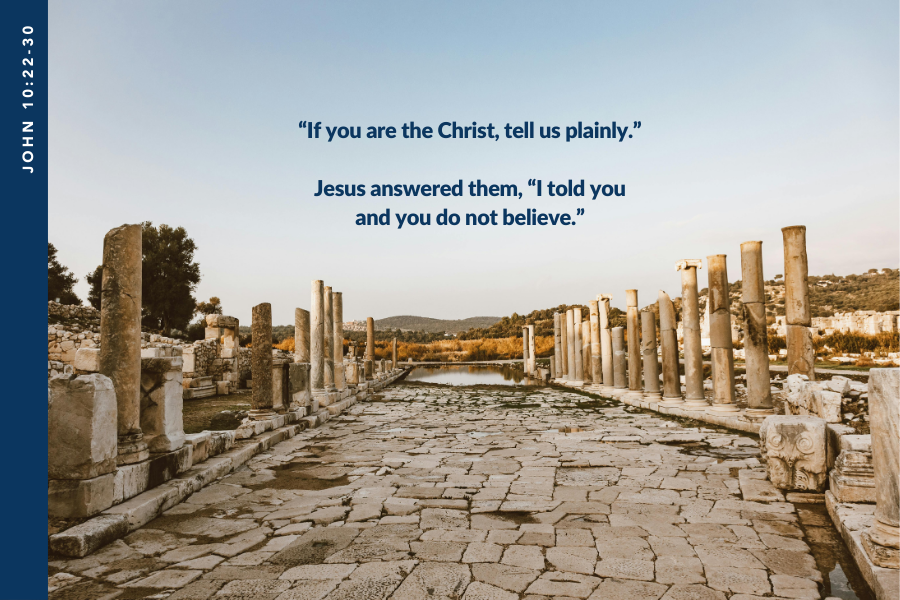
John 10:22-30

The feast of the Dedication was taking place in Jerusalem. It was winter. And Jesus walked about in the temple area on the Portico of Solomon. So the Jews gathered around him and said to him, “How long are you going to keep us in suspense? If you are the Christ, tell us plainly.” Jesus answered them, “I told you and you do not believe. The works I do in my Father’s name testify to me. But you do not believe, because you are not among my sheep. My sheep hear my voice; I know them, and they follow me. I give them eternal life, and they shall never perish. No one can take them out of my hand. My Father, who has given them to me, is greater than all, and no one can take them out of the Father’s hand. The Father and I are one.”

Opening Prayer: Lord Jesus, you are the eternal Son of the Father, and I look to you for direction, salvation, and guidance in my life. I ask for a deep faith to believe all that you reveal, even when it is hard for me.

Encountering Christ:

  1. “I Told You and You Do Not Believe”: Why did the Jews not believe Jesus? Did Jesus preach a difficult message? Were they unwilling to give up some habit they were attached to? How willing are we to believe Jesus? I can think of a great number of converts, St. John Henry Newman among them, who suffered tremendously when converting to Catholicism. These converts lost friends, prestige, jobs; yet they gained much more and were joyful in the midst of their suffering because they had found the truth. Daring to believe implies authentic conversion, and it is rewarded by a joyful heart overflowing with God’s grace.


  2. “The Works I Do in My Father’s Name Testify to Me”: Jesus did not flinch at the lack of belief among the Jews. He did not back down or change his message. He called to mind the works that he had done, miracles that included raising a man from the dead, curing the blind and sick, and feeding five thousand people with five loaves and two fish, among others. He stood by the radical mission he had been given and said that if they did not believe his words alone, then they should believe his actions. Our actions speak louder than our words. As Christians, do we live what we preach, what we say we believe? Only then will our words be trustworthy. Then we are authentic followers of the Lord.


  3. “My Sheep Hear My Voice; I Know Them, And They Follow Me”: Even though the Jews did not believe Jesus, many of his followers did. They gave up houses, brothers or sisters, mother or father, land or other things for the sake of Jesus and his Gospel (cf. Mk 10:29). To these, Jesus promised eternal life. Belief in Christ means living in accord with the Gospel, following him when it is hard to believe or when persecution ensues. It is all worthwhile because this life is passing. That which we do on earth is valuable when it is done for a supernatural goal: to love the Lord and his people.

Conversing with Christ: Lord, I try to do things well. With good intentions, I seek to provide for my family, to make ends meet, to enjoy time with those I love. Help me to worry less about things and more about people. Teach me to love them in your name.

Resolution: Lord, today by your grace I will seek to set aside something I want to do for the sake of quality time with someone I love.

Renee Pomarico, CRC, is Communications Director for the Consecrated Women of Regnum Christi. She is from Philadelphia, Pennsylvania, has been consecrated to God since 2000, and is currently stationed in Rome.

April 28, 2026 – Believing the Words of Jesus Read More »

Scroll to Top

Events

Looking for another country?

Contact Regnum Christi near you

News & Resources

News & Resources

The Regnum Christi Mission

The Regnum Christi Identity

Alex Kucera

Atlanta

Alex Kucera has lived in Atlanta, GA, for the last 46 years. He is one of 9 children, married to his wife Karmen, and has 3 girls, one grandson, and a granddaughter on the way. Alex joined Regnum Christi in 2007. Out of the gate, he joined the Helping Hands Medical Missions apostolate and is still participating today with the Ghana Friendship Mission.

In 2009, Alex was asked to be the Atlanta RC Renewal Coordinator for the Atlanta Locality to help the RC members with the RC renewal process. Alex became a Group Leader in 2012 for four of the Atlanta Men’s Section Teams and continues today. Running in parallel, in 2013, Alex became a Team Leader and shepherded a large team of good men.

Alex was honored to be the Atlanta Mission Coordinator between 2010 to 2022 (12 years), coordinating 5-8 Holy Week Mission teams across Georgia. He also created and coordinated missions at a parish in Athens, GA, for 9 years. Alex continues to coordinate Holy Week Missions, Advent Missions, and Monthly missions at Good Shepherd Catholic Church in Cumming, GA.

From 2016 to 2022, Alex also served as the Men’s Section Assistant in Atlanta. He loved working with the Men’s Section Director, the Legionaries, Consecrated, and Women’s Section leadership teams.

Alex is exceptionally grateful to the Legionaries, Consecrated, and many RC members who he’s journeyed shoulder to shoulder, growing his relationship with Christ and others along the way. He knows that there is only one way, that’s Christ’s Way, with others!