
April 1, 2026
St Melito
Dear Mel, Your recent postcard made me think of today’s saint, St Melito, bishop of Sardis (not Sardis, Ohio, mind you, but Sardis, Germany). We barely know anything at all about the poor fellow. He died around 180 (we don’t know how), so I guess we can assume that he lived back then as well. Supposedly he wrote a lot of wonderful works on the faith, but none have survived the long excursion through time. We only know one thing for sure about him: he wrote an explanation of Christianity and sent it to the Roman Emperor Marcus Aurelius (the same fellow who dies at the beginning of “The Gladiator”). That’s why your postcard card reminded me of him. A lot of people spend Spring Break at the beach (lovely choice of photograph on the postcard, by the way – the dark gold of the sand and the bright gold of the sunset contrast powerfully with the deep blue of the ocean; I commend your taste), but very few spend it EVANGELIZING at the beach. Just as St Melito’s attempt to convert the Emperor seems a bit naïve, so might your attempt to bring Christ’s light into the darkened, hung-over heads of your peers. But we still remember St Melito for his bold and courageous faith, and God will certainly not forget you for yours. Ciao. Uncle Eddy.
40 Days to Peace and Union with God: Day 43 – The Taste of Love
“I am the same under each of the species, but not every soul receives me with the same living faith as you do, my daughter, and therefore I cannot act in their souls as I do in yours.”
- JESUS TO ST. FAUSTINA KOWALSKA
READ: MATTHEW 26:17–35
Now on the first day of Unleavened Bread the disciples came to Jesus to say, “Where do you want us to make the preparations for you to eat the passover?” “Go to a certain man in the city,” he replied, “and say to him, ‘The Master says: My time is near. It is at your house that I am keeping Passover with my disciples.’” The disciples did what Jesus told them and prepared the Passover. When evening came he was at table with the twelve disciples. And while they were eating he said, “I tell you solemnly, one of you is about to betray me.” They were greatly distressed and started asking him in turn, “Not I, Lord, surely?” He answered, “Someone who has dipped his hand into the dish with me, will betray me. The Son of Man is going to his fate, as the scriptures say he will, but alas for that man by whom the Son of Man is betrayed! Better for that man if he had never been born!” Judas, who was to betray him; asked in his turn, “Not I, Rabbi, surely?” “They are your own words,” answered Jesus.
Now as they were eating, Jesus took some bread, and when he had said the blessing he broke it and gave it to the disciples. “Take it and eat,” he said, “this is my body.” Then he took a cup, and when he had returned thanks he gave it to them. “Drink all of you from this,” he said, “for this is my blood, the blood of the covenant, which is to be poured out for many for the forgiveness of sins. From now on, I tell you, I shall not drink wine until the day I drink the new wine with you in the kingdom of my Father.” After psalms had been sung they left for the Mount of Olives.
Then Jesus said to them, “You will all lose faith in me this night, for the scripture says: I shall strike the shepherd and the sheep of the flock will be scattered, but after my resurrection I shall go before you to Galilee.” At this, Peter said, “Though all lose faith in you, I will never lose faith.” Jesus answered him, “I tell you solemnly, this very night, before the cock crows, you will have disowned me three times.” Peter said to him, “Even if I have to die with you, I will never disown you.” And all the disciples said the same.
YOUR THREE-STEP GUIDE TO DAILY MENTAL PRAYER
REFLECT
When Jesus and His disciples celebrate this first Eucharist, the New Covenant is established. In the biblical context, a covenant is a family bond, a mutual commitment that links two parties so that they become one thing. Marriage, for example, is a covenant. God’s promise to Abraham is a covenant. In establishing the New Covenant, Jesus abrogates the Mosaic Covenant, which was written on stone tablets, and fulfills Jeremiah’s prophecy that after Israel’s infidelity to the Old Covenant, God would make a new one — deeper, everlasting, and written on His people’s hearts (see Jer. 31:31). How curious it is that St. Matthew locates the establishment of this everlasting covenant right between two predictions of betrayal, Judas’s and Peter’s. Jesus is willing to commit Himself to us, body and soul; He offers us His undying fidelity, even knowing we will betray Him. When He predicts the betrayals, we can hear the sadness in His voice; dipping into the same dish was a sign of close friendship, and that is how Jesus describes His betrayer, as someone close to Him, someone trusted by Him. And yet He wants His disciples to realize that He knows what will happen, so that later they will reflect on it, seeing that He loves them no matter what, even knowing their weakness. He wants to remove even the last speck of doubt from our hearts: in Christ, we have found an undying, untiring love, the firmest of anchors in the stormy sea of life.
RESPOND
Will I abandon You too, Lord? You know that I already have. So many times I have failed to trust You, I have ignored Your voice speaking in the depths of my soul. I am weak, Lord, and I am inconsistent. Be my rock; be my shield! With the fortitude of Your heart, strengthen my heart.
Your generosity humbles me, Lord! Do I deserve the great gift You give me in the Eucharist? Do I deserve the forgiveness You offer me, even before I am aware of all my sins? Do I deserve Your friendship, which You promise never to take back, even if I betray You? Do I deserve to be permitted just to speak Your Holy Name, the name that says everything? Jesus: “God saves.” Lord Jesus, have mercy on me.
REST
I cannot receive You in the Blessed Sacrament right now, but at least come into my heart. Come to me, my Lord, and make me like You. You give without counting the cost. You love and forgive without ever demanding Your rights. I am so slow to give, so reluctant to forgive. But I know that with You I can do all things. Jesus, I trust in You.
RESOLVE
How can I carry this encounter with me into the day? (Write / Journal)
CLOSING PRAYER OF THANKSGIVING
Most Blessed and Holy Trinity, Father, Son, and Holy Spirit, thank You for Your love and Your grace in allowing me this time of prayer with You.
The world, the flesh, and the devil will all propose things I should focus on and run after today. I beg You to fill me with Your Holy Spirit and help me instead to know and embrace Your will. Help me to see what You desire of me each moment of this day. Give me the wisdom, strength, and fortitude I need to avoid distractions, discern Your will, and focus on and carry out that which Wisdom reveals. Help me to work and live at a pace of peace and prayerfulness, always attentive to You, able to hear Your voice and to say no to anything that hinders my journey to You and a complete yes to every Holy prompting from You.
Help me to humbly and purposefully live, light, and lead others to the path of union with You and to tell everyone about this way of life. Amen.
About the Author
Fr. John Bartunek was ordained in 2003. He has taught moral theology at various ecclesiastical institutions at the graduate and undergraduate levels, and has authored many books, including the Gospel companion, The Better Part, and Inside the Passion, the only authorized behind-the-scenes look at the film, for which he provided on-set spiritual support. His online retreat guides are available in multiple formats at RCSpirituality.org. Fr. John currently resides in Atlanta, where he is serving as territorial vicar for the Legionaries of Christ.
40 Days to Peace and Union with God: Day 43 – The Taste of Love Read More »
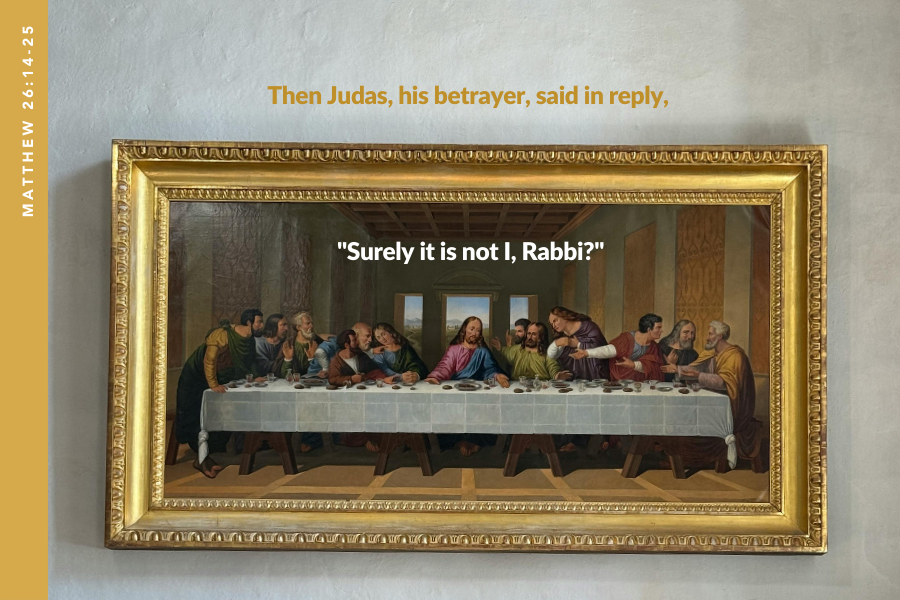
April 1, 2026 – The Tragedy of Judas
Wednesday of Holy Week
Matthew 26:14-25
One of the Twelve, who was called Judas Iscariot, went to the chief priests and said, “What are you willing to give me if I hand him over to you?” They paid him thirty pieces of silver, and from that time on he looked for an opportunity to hand him over. On the first day of the Feast of Unleavened Bread, the disciples approached Jesus and said, “Where do you want us to prepare for you to eat the Passover?” He said, “Go into the city to a certain man and tell him, ‘The teacher says, “My appointed time draws near; in your house I shall celebrate the Passover with my disciples.”’” The disciples then did as Jesus had ordered, and prepared the Passover. When it was evening, he reclined at table with the Twelve. And while they were eating, he said, “Amen, I say to you, one of you will betray me.” Deeply distressed at this, they began to say to him one after another, “Surely it is not I, Lord?” He said in reply, “He who has dipped his hand into the dish with me is the one who will betray me. The Son of Man indeed goes, as it is written of him, but woe to that man by whom the Son of Man is betrayed. It would be better for that man if he had never been born.” Then Judas, his betrayer, said in reply, “Surely it is not I, Rabbi?” He answered, “You have said so.”
Opening Prayer: Jesus, I am filled with sadness when I remember how Judas betrayed you. I’m sorry for all the times when my own sins have caused you pain. Help me to trust in your Divine Mercy when I fall and come to you with a contrite heart.
Encountering Christ:
- The Wages of Sin: Judas was called to be an Apostle, one of Christ’s chosen Twelve. What a tragedy that a man who was so close to Christ became his betrayer. Judas looked to gain something from his relationship with Christ: “What are you willing to give me if I hand him over to you?” (Mt 26:15). Sin causes us to trade our most priceless gift—everlasting life—for fleeting pleasures. In the end, Judas got thirty pieces of silver, such a pittance for the Son of Man. As St. Paul asks, “What profit did you get then from the things of which you are now ashamed? […] For the wages of sin is death, but the gift of God is eternal life in Christ Jesus our Lord” (Rom 6:21, 23). What do we want to gain from our relationship with Christ? Are the things we do meant to build up his kingdom in thanksgiving for the gift of everlasting life, or are they for our own glory?
- Denial and Despair: Judas answered Jesus’ question about who would betray him with a deceitful question: “Surely it is not I, Rabbi?” (Mt 26:25). Judas is clearly lying here, but could he also be in denial about his betrayal? Later Judas despaired for his sin, and he committed suicide (cf. Mt 27:5). Denial and despair can be common reactions when we realize the gravity of our sin. The greatest tragedy of Judas was that he forgot God’s merciful love. St. John Paul II wrote, “Mercy is the greatest of the attributes and perfections of God” (Dives in Misericordia,13). When we have sinned, may we always look to God’s mercy in the Sacrament of Reconciliation.
- The Hour of Divine Mercy: Jesus announced, “My appointed time draws near” (Mt 26:18). The hour of his Divine Mercy was approaching. It was the hour of his Passion and Death on the Cross when he fulfilled his mission of salvation for all who believe in him (cf. Rom 10:9-11). The holiest days of the year, the Easter Triduum, draw near. Let us prepare our hearts to enter into the mystery of our King and Savior’s hour. May we honor his most merciful gift to us: his life that he gave “as a ransom for many” (Mk 10:45).
Conversing with Christ: O my Jesus, I marvel at your mercy. You, for whom all things were made, gave us everything because of your immense love for us. I am struck with wonder and gratitude. Please help me to trust in your Divine Mercy.
Resolution: Lord, today by your grace I will plan to go to the Sacrament of Reconciliation this week if I have not already done so during Lent.
Carey Boyzuck is a wife, mother, freelance writer, and a lay member of Regnum Christi. She blogs at www.word-life-light.com.
April 1, 2026 – The Tragedy of Judas Read More »


