Weekly Digest of the Regnum Christi Daily Meditations: Mar 29 – Apr 5, 2026
WEEKLY DIGEST OF rc
DAILY MEDITATIONS
Week of March 29 - April 5, 2026
Sunday, March 29, 2026 – The Law of Love
Monday, March 30, 2026 – A Fragrant Sacrifice
Tuesday, March 31, 2026 – Draw Close to Christ
Wednesday, April 1, 2026 – The Tragedy of Judas
Thursday, April 2, 2026 – The Washing of the Feet
Friday, April 3, 2026 – The Suffering Servant
March 29, 2026 – The Law of Love
Palm Sunday of the Lord’s Passion
Matthew 26:14 – 27:66
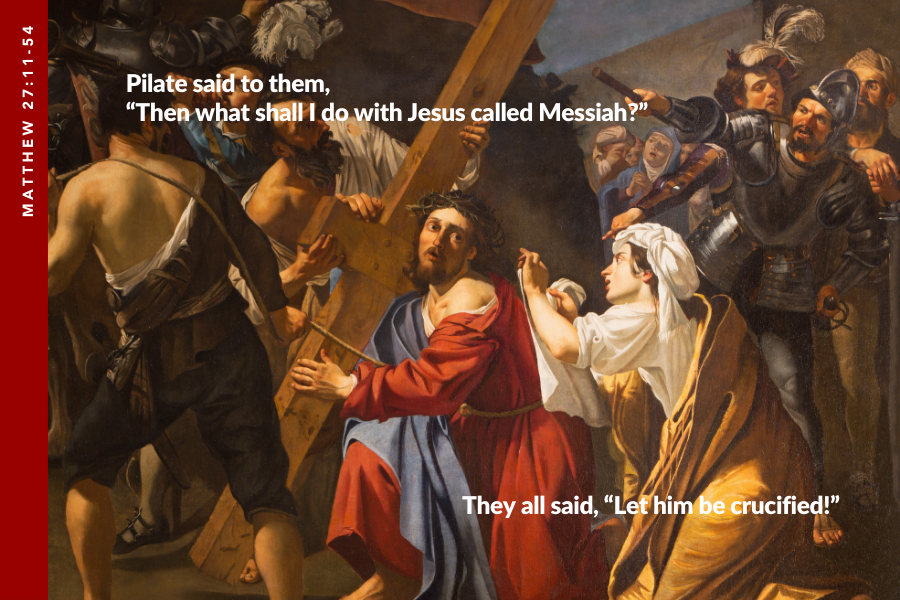
One of the Twelve, who was called Judas Iscariot, went to the chief priests and said, “What are you willing to give me if I hand him over to you?” They paid him thirty pieces of silver, and from that time on he looked for an opportunity to hand him over. On the first day of the Feast of Unleavened Bread, the disciples approached Jesus and said, “Where do you want us to prepare for you to eat the Passover?” He said, “Go into the city to a certain man and tell him, ‘The teacher says, “My appointed time draws near; in your house I shall celebrate the Passover with my disciples.”’” The disciples then did as Jesus had ordered, and prepared the Passover. When it was evening, he reclined at table with the Twelve. And while they were eating, he said, “Amen, I say to you, one of you will betray me.” Deeply distressed at this, they began to say to him one after another, “Surely it is not I, Lord?” He said in reply, “He who has dipped his hand into the dish with me is the one who will betray me. The Son of Man indeed goes, as it is written of him, but woe to that man by whom the Son of Man is betrayed. It would be better for that man if he had never been born.” Then Judas, his betrayer, said in reply, “Surely it is not I, Rabbi?” He answered, “You have said so.” While they were eating, Jesus took bread, said the blessing, broke it, and giving it to his disciples said, “Take and eat; this is my body.” Then he took a cup, gave thanks, and gave it to them, saying, “Drink from it, all of you, for this is my blood of the covenant, which will be shed on behalf of many for the forgiveness of sins. I tell you, from now on I shall not drink this fruit of the vine until the day when I drink it with you new in the kingdom of my Father.” Then, after singing a hymn, they went out to the Mount of Olives. Then Jesus said to them, “This night all of you will have your faith in me shaken, for it is written: I will strike the shepherd, and the sheep of the flock will be dispersed; but after I have been raised up, I shall go before you to Galilee.” Peter said to him in reply, “Though all may have their faith in you shaken, mine will never be.” Jesus said to him, “Amen, I say to you, this very night before the cock crows, you will deny me three times.” Peter said to him, “Even though I should have to die with you, I will not deny you.” And all the disciples spoke likewise. Then Jesus came with them to a place called Gethsemane, and he said to his disciples, “Sit here while I go over there and pray.” He took along Peter and the two sons of Zebedee, and began to feel sorrow and distress. Then he said to them, “My soul is sorrowful even to death. Remain here and keep watch with me.” He advanced a little and fell prostrate in prayer, saying, “My Father, if it is possible, let this cup pass from me; yet, not as I will, but as you will.” When he returned to his disciples he found them asleep. He said to Peter, “So you could not keep watch with me for one hour? Watch and pray that you may not undergo the test. The spirit is willing, but the flesh is weak.” Withdrawing a second time, he prayed again, “My Father, if it is not possible that this cup pass without my drinking it, your will be done!” Then he returned once more and found them asleep, for they could not keep their eyes open. He left them and withdrew again and prayed a third time, saying the same thing again. Then he returned to his disciples and said to them, “Are you still sleeping and taking your rest? Behold, the hour is at hand when the Son of Man is to be handed over to sinners. Get up, let us go. Look, my betrayer is at hand.” While he was still speaking, Judas, one of the Twelve, arrived, accompanied by a large crowd, with swords and clubs, who had come from the chief priests and the elders of the people. His betrayer had arranged a sign with them, saying, “The man I shall kiss is the one; arrest him.” Immediately he went over to Jesus and said, “Hail, Rabbi!” and he kissed him. Jesus answered him, “Friend, do what you have come for.” Then stepping forward they laid hands on Jesus and arrested him. And behold, one of those who accompanied Jesus put his hand to his sword, drew it, and struck the high priest’s servant, cutting off his ear. Then Jesus said to him, “Put your sword back into its sheath, for all who take the sword will perish by the sword. Do you think that I cannot call upon my Father and he will not provide me at this moment with more than twelve legions of angels? But then how would the Scriptures be fulfilled which say that it must come to pass in this way?” At that hour Jesus said to the crowds, “Have you come out as against a robber, with swords and clubs to seize me? Day after day I sat teaching in the temple area, yet you did not arrest me. But all this has come to pass that the writings of the prophets may be fulfilled.” Then all the disciples left him and fled. Those who had arrested Jesus led him away to Caiaphas the high priest, where the scribes and the elders were assembled. Peter was following him at a distance as far as the high priest’s courtyard, and going inside he sat down with the servants to see the outcome. The chief priests and the entire Sanhedrin kept trying to obtain false testimony against Jesus in order to put him to death, but they found none, though many false witnesses came forward. Finally two came forward who stated, “This man said, ‘I can destroy the temple of God and within three days rebuild it.’“ The high priest rose and addressed him, “Have you no answer? What are these men testifying against you?” But Jesus was silent. Then the high priest said to him, “I order you to tell us under oath before the living God whether you are the Christ, the Son of God.” Jesus said to him in reply, “You have said so. But I tell you: From now on you will see ‘the Son of Man seated at the right hand of the Power’ and ‘coming on the clouds of heaven.’” Then the high priest tore his robes and said, “He has blasphemed! What further need have we of witnesses? You have now heard the blasphemy; what is your opinion?” They said in reply, “He deserves to die!” Then they spat in his face and struck him, while some slapped him, saying, “Prophesy for us, Christ: who is it that struck you?” Now Peter was sitting outside in the courtyard. One of the maids came over to him and said, “You too were with Jesus the Galilean.” But he denied it in front of everyone, saying, “I do not know what you are talking about!” As he went out to the gate, another girl saw him and said to those who were there, “This man was with Jesus the Nazorean.” Again he denied it with an oath, “I do not know the man!” A little later the bystanders came over and said to Peter, “Surely you too are one of them; even your speech gives you away.” At that he began to curse and to swear, “I do not know the man.” And immediately a cock crowed. Then Peter remembered the word that Jesus had spoken: “Before the cock crows you will deny me three times.” He went out and began to weep bitterly. When it was morning, all the chief priests and the elders of the people took counsel against Jesus to put him to death. They bound him, led him away, and handed him over to Pilate, the governor. Then Judas, his betrayer, seeing that Jesus had been condemned, deeply regretted what he had done. He returned the thirty pieces of silver to the chief priests and elders, saying, “I have sinned in betraying innocent blood.” They said, “What is that to us? Look to it yourself.” Flinging the money into the temple, he departed and went off and hanged himself. The chief priests gathered up the money, but said, “It is not lawful to deposit this in the temple treasury, for it is the price of blood.” After consultation, they used it to buy the potter’s field as a burial place for foreigners. That is why that field even today is called the Field of Blood. Then was fulfilled what had been said through Jeremiah the prophet, And they took the thirty pieces of silver, the value of a man with a price on his head, a price set by some of the Israelites, and they paid it out for the potter’s field just as the Lord had commanded me. Now Jesus stood before the governor, and he questioned him, “Are you the king of the Jews?” Jesus said, “You say so.” And when he was accused by the chief priests and elders, he made no answer. Then Pilate said to him, “Do you not hear how many things they are testifying against you?” But he did not answer him one word, so that the governor was greatly amazed. Now on the occasion of the feast the governor was accustomed to release to the crowd one prisoner whom they wished. And at that time they had a notorious prisoner called Barabbas. So when they had assembled, Pilate said to them, “Which one do you want me to release to you, Barabbas, or Jesus called Christ?” For he knew that it was out of envy that they had handed him over. While he was still seated on the bench, his wife sent him a message, “Have nothing to do with that righteous man. I suffered much in a dream today because of him.” The chief priests and the elders persuaded the crowds to ask for Barabbas but to destroy Jesus. The governor said to them in reply, “Which of the two do you want me to release to you?” They answered, “Barabbas!” Pilate said to them, “Then what shall I do with Jesus called Christ?” They all said, “Let him be crucified!” But he said, “Why? What evil has he done?” They only shouted the louder, “Let him be crucified!” When Pilate saw that he was not succeeding at all, but that a riot was breaking out instead, he took water and washed his hands in the sight of the crowd, saying, “I am innocent of this man’s blood. Look to it yourselves.” And the whole people said in reply, “His blood be upon us and upon our children.” Then he released Barabbas to them, but after he had Jesus scourged, he handed him over to be crucified. Then the soldiers of the governor took Jesus inside the praetorium and gathered the whole cohort around him. They stripped off his clothes and threw a scarlet military cloak about him. Weaving a crown out of thorns, they placed it on his head, and a reed in his right hand. And kneeling before him, they mocked him, saying, “Hail, King of the Jews!” They spat upon him and took the reed and kept striking him on the head. And when they had mocked him, they stripped him of the cloak, dressed him in his own clothes, and led him off to crucify him. As they were going out, they met a Cyrenian named Simon; this man they pressed into service to carry his cross. And when they came to a place called Golgotha—which means Place of the Skull—, they gave Jesus wine to drink mixed with gall. But when he had tasted it, he refused to drink. After they had crucified him, they divided his garments by casting lots; then they sat down and kept watch over him there. And they placed over his head the written charge against him: This is Jesus, the King of the Jews. Two revolutionaries were crucified with him, one on his right and the other on his left. Those passing by reviled him, shaking their heads and saying, “You who would destroy the temple and rebuild it in three days, save yourself, if you are the Son of God, and come down from the cross!” Likewise the chief priests with the scribes and elders mocked him and said, “He saved others; he cannot save himself. So he is the king of Israel! Let him come down from the cross now, and we will believe in him. He trusted in God; let him deliver him now if he wants him. For he said, ‘I am the Son of God.’” The revolutionaries who were crucified with him also kept abusing him in the same way. From noon onward, darkness came over the whole land until three in the afternoon. And about three o’clock Jesus cried out in a loud voice, “Eli, Eli, lema sabachthani?” which means, “My God, my God, why have you forsaken me?” Some of the bystanders who heard it said, “This one is calling for Elijah.” Immediately one of them ran to get a sponge; he soaked it in wine, and putting it on a reed, gave it to him to drink. But the rest said, “Wait, let us see if Elijah comes to save him.” But Jesus cried out again in a loud voice, and gave up his spirit. And behold, the veil of the sanctuary was torn in two from top to bottom. The earth quaked, rocks were split, tombs were opened, and the bodies of many saints who had fallen asleep were raised. And coming forth from their tombs after his resurrection, they entered the holy city and appeared to many. The centurion and the men with him who were keeping watch over Jesus feared greatly when they saw the earthquake and all that was happening, and they said, “Truly, this was the Son of God!” There were many women there, looking on from a distance, who had followed Jesus from Galilee, ministering to him. Among them were Mary Magdalene and Mary the mother of James and Joseph, and the mother of the sons of Zebedee. When it was evening, there came a rich man from Arimathea named Joseph, who was himself a disciple of Jesus. He went to Pilate and asked for the body of Jesus; then Pilate ordered it to be handed over. Taking the body, Joseph wrapped it in clean linen and laid it in his new tomb that he had hewn in the rock. Then he rolled a huge stone across the entrance to the tomb and departed. But Mary Magdalene and the other Mary remained sitting there, facing the tomb. The next day, the one following the day of preparation, the chief priests and the Pharisees gathered before Pilate and said, “Sir, we remember that this impostor while still alive said, ‘After three days I will be raised up.’ Give orders, then, that the grave be secured until the third day, lest his disciples come and steal him and say to the people, ‘He has been raised from the dead.’ This last imposture would be worse than the first.” Pilate said to them, “The guard is yours; go, secure it as best you can.” So they went and secured the tomb by fixing a seal to the stone and setting the guard.
Opening Prayer: Jesus, thank you for dying to save me from my sins. Open my heart to hear your law of love and then write it on my heart.
Encountering Christ:
- Food for Disciples: Jesus and his disciples gathered for Passover, the Jewish Feast of Unleavened Bread. There at the Last Supper, Jesus offered his own precious Body and Blood and became our feast of unleavened bread, the Most Holy Eucharist. Christ himself became our Passover: “For our paschal lamb, Christ, has been sacrificed” (1 Cor 5:7). Jesus not only provides the feast; he is the feast. Just as Jesus provided himself as food for his first disciples, he feeds his disciples today in the same way so that we might have the strength and virtue to carry out the new commandment he gave us at the Last Supper: “… love one another. As I have loved you, so you also should love one another” (Jn 13:34). Love has become the law. When we love one another as Jesus commands, we fulfill the law of the new covenant.
- Blood of the Covenant: The Blood of Christ is the seal of our new covenant with God. Jeremiah foretold this everlasting covenant, the laws of which would be written on human hearts (cf. Jer 31:31-34). This covenant means that our sins have been forgiven through Christ’s death. St. Paul tells us, “When Christ came as high priest […] he entered once for all into the sanctuary, not with the blood of goats and calves but with his own blood, thus obtaining eternal redemption. […] For this reason he is mediator of a new covenant” (Heb 9:11-15). We live in a way that shows that this new covenant is written on our hearts when we are faithful and obedient, and, most of all, by loving one another as God has loved us.
- Stay With Jesus: What courageous love that the Blessed Virgin Mary, St. Mary Magdalene, and St. John showed when they stood at the foot of the Cross. Imagine the fear and grief that they had to overcome in order to stand in devotion to Christ at his Crucifixion. They stayed with him through his death and followed his body to be buried, keeping vigil: “Mary Magdalene and the other Mary remained sitting there, facing the tomb” (Mt 27:61). As we enter into this Holy Week, may God give us the grace to be loving, constant disciples. May we stay with Jesus as he travels from Bethany to Jerusalem to Gethsemane and to Calvary. Finally, may we sit with the women, filled with hope, and bravely face the tomb.
Conversing with Christ: Jesus, please replace my stony heart with a new heart of flesh, and then write your law of love deep inside it. Holy Spirit, come to me that I can follow the law of love by loving others as you love me (cf. Ezek 36:26-27 and Jn 13:34). Father, help me remain constant in my love for you, especially in this Holy Week.
Resolution: Lord, today by your grace I will strive to carry out your commandment to love others through my thoughts, words, and actions.
Carey Boyzuck is a wife, mother, freelance writer, and a lay member of Regnum Christi. She blogs at www.word-life-light.com.
March 30, 2026 – A Fragrant Sacrifice
Monday of Holy Week
John 12:1-11
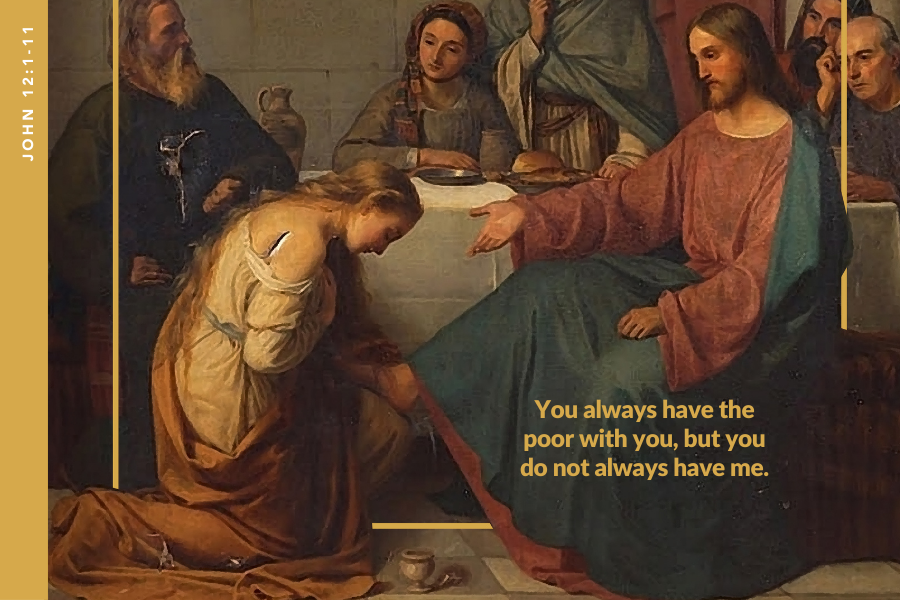
Six days before Passover Jesus came to Bethany, where Lazarus was, whom Jesus had raised from the dead. They gave a dinner for him there, and Martha served, while Lazarus was one of those reclining at table with him. Mary took a liter of costly perfumed oil made from genuine aromatic nard and anointed the feet of Jesus and dried them with her hair; the house was filled with the fragrance of the oil. Then Judas the Iscariot, one of his disciples, and the one who would betray him, said, “Why was this oil not sold for three hundred days’ wages and given to the poor?” He said this not because he cared about the poor but because he was a thief and held the money bag and used to steal the contributions. So Jesus said, “Leave her alone. Let her keep this for the day of my burial. You always have the poor with you, but you do not always have me.” The large crowd of the Jews found out that he was there and came, not only because of him, but also to see Lazarus, whom he had raised from the dead. And the chief priests plotted to kill Lazarus too, because many of the Jews were turning away and believing in Jesus because of him.
Opening Prayer: St. Mary Magdalene, you poured out your costly oil for Jesus. Pray for me that I may hold nothing back from Our Lord.
Encountering Christ:
- Mary Who?: Just who is St. Mary Magdalene? Is she Martha and Lazarus’ sister from our readings today? Is she the sinful but repentant woman whom Jesus forgives (cf. Lk 7:36-50)? Is she a wealthy woman from Magdala whom Jesus freed from seven demons and who then followed him even to his Cross (cf. Lk 8:2 and Jn 19:25)? Western Church tradition holds that St. Mary Magdalene is actually the woman portrayed in each of these scriptural accounts. We learn from these stories how the Magdalene’s conversion, repentance, and healing lead to her generous, love-filled discipleship. An example of the generosity of her spirit is shown in our reading today when she used the costly nard to anoint Jesus.
- A Fragrant Sacrifice: St. Mary Magdalene generously poured out the fragrant, expensive oil to anoint Christ’s feet. Nothing we do for the love of Christ, no time we spend, no act of charity is ever wasted. Everything belongs to him, so whatever we return to him as a holy sacrifice is just. On the Cross, Jesus became a fragrant sacrifice for us: “[Christ] handed himself over for us as a sacrificial offering to God for a fragrant aroma” (Eph 5:2). Our own sacrifices also become a delightful fragrance that is pleasing to God (cf. Phil 4:18). During this Holy Week, what can we offer God as a pleasing sacrifice? Like the aroma of the perfumed oil filling the room, how can our loving actions fill our homes with the fragrance of our offerings? As St. John Henry Newman and St. Teresa of Calcutta prayed, “Dear Jesus, help me to spread your fragrance everywhere that I go.”
- Let Her Keep This: In this scene at Bethany, Jesus knew that his hour was approaching. He also knew that St. Mary Magdalene would be there with him at the foot of the Cross. Why else would he say, “Let her keep this for the day of my burial” (Jn 12:7)? He knew that only a precious few would stay with him during his Passion, and that she would be one of them. St. Mary Magdalene was there with the Blessed Virgin Mary and St. John as Jesus was crucified, died, and was buried. She was the first witness to the Resurrection as well. Let us pray for the courage and “the endurance of Christ” (cf. 2 Thess 3:5) that we will need to follow Jesus to Calvary this week.
Conversing with Christ: Lord Jesus, help me realize that every act of love that I offer you out of the purity of my heart is a fragrant offering. Help me find ways to lavish my love on you and on my neighbor.
Resolution: Lord, today by your grace I will offer a generous act of charity out of my love for you.
Carey Boyzuck is a wife, mother, freelance writer, and a lay member of Regnum Christi. She blogs at www.word-life-light.com.
March 31, 2026 – Draw Close to Christ

Tuesday of Holy Week
John 13:21-33, 36-38
Reclining at table with his disciples, Jesus was deeply troubled and testified, “Amen, amen, I say to you, one of you will betray me.” The disciples looked at one another, at a loss as to whom he meant. One of his disciples, the one whom Jesus loved, was reclining at Jesus’ side. So Simon Peter nodded to him to find out whom he meant. He leaned back against Jesus’ chest and said to him, “Master, who is it?” Jesus answered, “It is the one to whom I hand the morsel after I have dipped it.” So he dipped the morsel and took it and handed it to Judas, son of Simon the Iscariot. After Judas took the morsel, Satan entered him. So Jesus said to him, “What you are going to do, do quickly.” Now none of those reclining at table realized why he said this to him. Some thought that since Judas kept the money bag, Jesus had told him, “Buy what we need for the feast,” or to give something to the poor. So Judas took the morsel and left at once. And it was night. When he had left, Jesus said, “Now is the Son of Man glorified, and God is glorified in him. If God is glorified in him, God will also glorify him in himself, and he will glorify him at once. My children, I will be with you only a little while longer. You will look for me, and as I told the Jews, ‘Where I go you cannot come,’ so now I say it to you.” Simon Peter said to him, “Master, where are you going?” Jesus answered him, “Where I am going, you cannot follow me now, though you will follow later.” Peter said to him, “Master, why can I not follow you now? I will lay down my life for you.” Jesus answered, “Will you lay down your life for me? Amen, amen, I say to you, the cock will not crow before you deny me three times.”
Opening Prayer: Come, Holy Spirit, open my heart to hear what you want me to hear. Help me to draw close to Christ always.
Encountering Christ:
- Worth The Cost?: Judas’ betrayal was spiteful and greedy. He had been looking for an opportunity to hand Jesus over so he could collect his meager thirty pieces of silver (cf. Mt 26:14-16). When we reflect on Judas’ betrayal, we can ask ourselves when we have betrayed Our Lord through our sins. What do we have to gain when we sin? Is it momentary pleasure, a fleeting grasp at money or power, or simply foolish pride? No matter what momentary gain we think we receive, it is never worth the cost of the pain it causes Jesus, others, and ourselves.
- The Law of the Gift: As soon as Judas left, Jesus announced, “Now is the Son of Man glorified, and God is glorified in him” (Jn 13:31). Christ was glorified when his Passion had begun, the hour when he offered his Blood to save us from our sins. God the Father was also glorified in Christ’s Passion because the Son obediently did his will. God the Father sent Jesus to die for our sins; this was Christ’s mission. Jesus spoke earlier of glorifying God the Father through his death: “Unless a grain of wheat falls to the ground and dies, it remains just a grain of wheat; but if it dies, it produces much fruit” (Jn 12:24). This is the Law of the Gift. Christ gave his life for us in the ultimate act of self-giving love. We too live by the Law of the Gift, for we are most fulfilled when we lovingly give ourselves to others. St. Paul VI wrote: “Man […] cannot fully find himself except through a sincere gift of himself” (Gaudium et Spes, 24).
- Draw Close to Christ: Peter’s denial later in the Passion narrative was driven by fear (cf. Mt 26:69-75). He desired to follow Jesus even unto death: “I will lay down my life for you” (Jn 13:37), but Peter’s fear caused him to distance himself from Jesus. Peter felt threatened, so he disguised his Christian identity by denying Christ; he even cursed and swore to prove it. Notice how St. John drew so close to Christ that “he leaned back against Jesus’ chest” (Jn 13:25) at the Last Supper. He was also the only Apostle that stayed with Jesus through his entire Passion. Who do we choose to imitate this Holy Week? Peter, who was ashamed of being “too Christian,” or John who always remained close to his Savior?
Conversing with Christ: Jesus, may I never betray or deny you, but instead always draw ever closer to you. I know that, with you near me, guiding me day by day, I can learn to give myself to others through acts of selfless love. Help me die to myself so that it is no longer I who live, but you who live in me (cf. Gal 2:20).
Resolution: Lord, today by your grace I will offer an act of selfless love for someone.
Carey Boyzuck is a wife, mother, freelance writer, and a lay member of Regnum Christi. She blogs at www.word-life-light.com.
April 1, 2026 – The Tragedy of Judas
Wednesday of Holy Week
Matthew 26:14-25
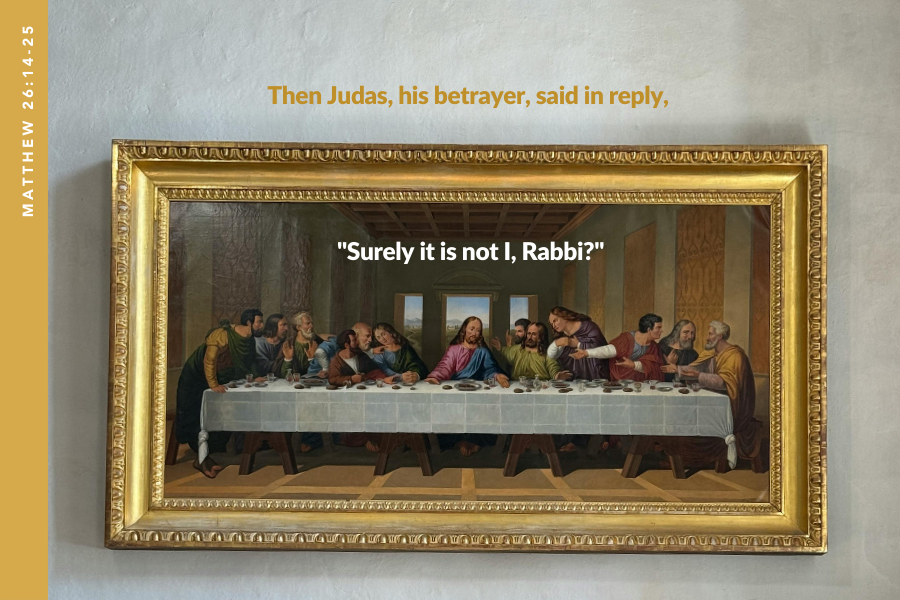
One of the Twelve, who was called Judas Iscariot, went to the chief priests and said, “What are you willing to give me if I hand him over to you?” They paid him thirty pieces of silver, and from that time on he looked for an opportunity to hand him over. On the first day of the Feast of Unleavened Bread, the disciples approached Jesus and said, “Where do you want us to prepare for you to eat the Passover?” He said, “Go into the city to a certain man and tell him, ‘The teacher says, “My appointed time draws near; in your house I shall celebrate the Passover with my disciples.”’” The disciples then did as Jesus had ordered, and prepared the Passover. When it was evening, he reclined at table with the Twelve. And while they were eating, he said, “Amen, I say to you, one of you will betray me.” Deeply distressed at this, they began to say to him one after another, “Surely it is not I, Lord?” He said in reply, “He who has dipped his hand into the dish with me is the one who will betray me. The Son of Man indeed goes, as it is written of him, but woe to that man by whom the Son of Man is betrayed. It would be better for that man if he had never been born.” Then Judas, his betrayer, said in reply, “Surely it is not I, Rabbi?” He answered, “You have said so.”
Opening Prayer: Jesus, I am filled with sadness when I remember how Judas betrayed you. I’m sorry for all the times when my own sins have caused you pain. Help me to trust in your Divine Mercy when I fall and come to you with a contrite heart.
Encountering Christ:
- The Wages of Sin: Judas was called to be an Apostle, one of Christ’s chosen Twelve. What a tragedy that a man who was so close to Christ became his betrayer. Judas looked to gain something from his relationship with Christ: “What are you willing to give me if I hand him over to you?” (Mt 26:15). Sin causes us to trade our most priceless gift—everlasting life—for fleeting pleasures. In the end, Judas got thirty pieces of silver, such a pittance for the Son of Man. As St. Paul asks, “What profit did you get then from the things of which you are now ashamed? […] For the wages of sin is death, but the gift of God is eternal life in Christ Jesus our Lord” (Rom 6:21, 23). What do we want to gain from our relationship with Christ? Are the things we do meant to build up his kingdom in thanksgiving for the gift of everlasting life, or are they for our own glory?
- Denial and Despair: Judas answered Jesus’ question about who would betray him with a deceitful question: “Surely it is not I, Rabbi?” (Mt 26:25). Judas is clearly lying here, but could he also be in denial about his betrayal? Later Judas despaired for his sin, and he committed suicide (cf. Mt 27:5). Denial and despair can be common reactions when we realize the gravity of our sin. The greatest tragedy of Judas was that he forgot God’s merciful love. St. John Paul II wrote, “Mercy is the greatest of the attributes and perfections of God” (Dives in Misericordia,13). When we have sinned, may we always look to God’s mercy in the Sacrament of Reconciliation.
- The Hour of Divine Mercy: Jesus announced, “My appointed time draws near” (Mt 26:18). The hour of his Divine Mercy was approaching. It was the hour of his Passion and Death on the Cross when he fulfilled his mission of salvation for all who believe in him (cf. Rom 10:9-11). The holiest days of the year, the Easter Triduum, draw near. Let us prepare our hearts to enter into the mystery of our King and Savior’s hour. May we honor his most merciful gift to us: his life that he gave “as a ransom for many” (Mk 10:45).
Conversing with Christ: O my Jesus, I marvel at your mercy. You, for whom all things were made, gave us everything because of your immense love for us. I am struck with wonder and gratitude. Please help me to trust in your Divine Mercy.
Resolution: Lord, today by your grace I will plan to go to the Sacrament of Reconciliation this week if I have not already done so during Lent.
Carey Boyzuck is a wife, mother, freelance writer, and a lay member of Regnum Christi. She blogs at www.word-life-light.com.
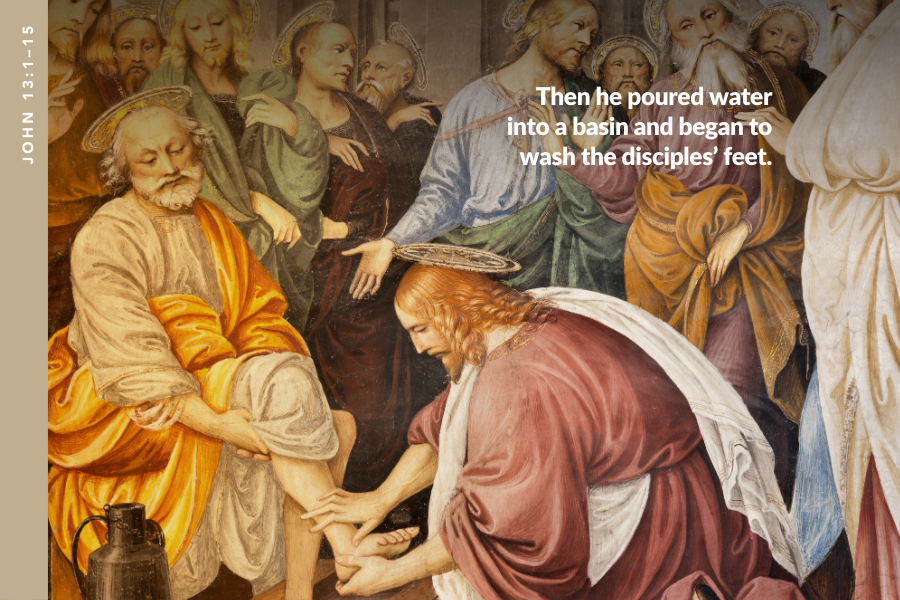
April 2, 2026 – The Washing of the Feet
Holy Thursday
John 13:1-15
Before the feast of Passover, Jesus knew that his hour had come to pass from this world to the Father. He loved his own in the world and he loved them to the end. The devil had already induced Judas, son of Simon the Iscariot, to hand him over. So, during supper, fully aware that the Father had put everything into his power and that he had come from God and was returning to God, he rose from supper and took off his outer garments. He took a towel and tied it around his waist. Then he poured water into a basin and began to wash the disciples’ feet and dry them with the towel around his waist. He came to Simon Peter, who said to him, “Master, are you going to wash my feet?” Jesus answered and said to him, “What I am doing, you do not understand now, but you will understand later.” Peter said to him, “You will never wash my feet.” Jesus answered him, “Unless I wash you, you will have no inheritance with me.” Simon Peter said to him, “Master, then not only my feet, but my hands and head as well.” Jesus said to him, “Whoever has bathed has no need except to have his feet washed, for he is clean all over; so you are clean, but not all.” For he knew who would betray him; for this reason, he said, “Not all of you are clean.” So when he had washed their feet and put his garments back on and reclined at table again, he said to them, “Do you realize what I have done for you? You call me ‘teacher’ and ‘master,’ and rightly so, for indeed I am. If I, therefore, the master and teacher, have washed your feet, you ought to wash one another’s feet. I have given you a model to follow, so that as I have done for you, you should also do.”
Opening Prayer: Dear Jesus, help me to realize what you have done for me by washing the disciples’ feet. Help me to accept your love and then humbly pour that love out to others.
Encountering Christ:
- Let Jesus Wash Your Feet: Jesus washed his disciples’ feet as a sign of love and service, and as an outward sign of their cleansing. When Peter refused to let Christ wash his feet, Jesus said, “Unless I wash you, you will have no inheritance with me” (Jn 13:8). Let’s face it, our feet can sometimes be unpleasant. Here, Jesus calls us to be vulnerable and allow him to love us by washing our feet. Let us be humble so that we can show him the ugliest, most unpleasant parts of our lives. Let him gently hold, cleanse, and restore the parts of ourselves that we want to hide from the world. Let us offer him our shame, failures, and faults so that he can redeem them. If we are to be Jesus’ disciples, we must allow him to wash our feet.
- Imitating Christ: In Jesus’ time, washing people’s feet was usually a task for the lowliest of servants. Jesus exhorted his disciples to wash one another’s feet (cf. Jn 13:14). We are called to imitate Christ and serve one another in the same way. May we seek to humbly serve others in Christ’s name. Let us search for the face of Christ in all people, so that when we serve others, we fulfill God’s command to love him by loving our neighbors: “Whatever you did for one of these least brothers of mine, you did for me” (Mt 25:40). If we are to be Jesus’ disciples, we must wash each others’ feet.
- Gracious Receptivity: If we are to wash one another’s feet, that means sometimes we will be the ones receiving the foot washing. Are we too prideful to allow others to minister to us? Let us seek to humble ourselves and allow others to help us in our daily struggles. May we give others the honor of serving Christ in us. We can practice this by doing small things, such as receiving compliments graciously, accepting others’ offers of help with gratitude, or asking friends to pray for us when we are in need. If we are to be Jesus’ disciples, we must allow others to wash our feet.
Conversing with Christ: Jesus, please wash my feet. I offer you my faults, failures, hurts, anxieties, and sins. Dear Lord, please redeem these parts of me. I am ashamed of them, but I trust in your tender mercy and love. Help me to wash other people’s feet through my humble service to them. Finally, grant me the humility to allow other people the honor of ministering to me when I am in need.
Resolution: Lord, today by your grace I will take on humble or unpleasant tasks willingly out of love for you and others.
Carey Boyzuck is a wife, mother, freelance writer, and a lay member of Regnum Christi. She blogs at www.word-life-light.com.
April 3, 2026 – The Suffering Servant
Good Friday
John 18:1-40, 19:1-42
Jesus went out with his disciples across the Kidron valley to where there was a garden, into which he and his disciples entered. Judas his betrayer also knew the place, because Jesus had often met there with his disciples. So Judas got a band of soldiers and guards from the chief priests and the Pharisees and went there with lanterns, torches, and weapons. Jesus, knowing everything that was going to happen to him, went out and said to them, “Whom are you looking for?” They answered him, “Jesus the Nazorean.” He said to them, “I AM.” Judas his betrayer was also with them. When he said to them, “I AM, “ they turned away and fell to the ground. So he again asked them, “Whom are you looking for?” They said, “Jesus the Nazorean.” Jesus answered, “I told you that I AM. So if you are looking for me, let these men go.” This was to fulfill what he had said, “I have not lost any of those you gave me.” Then Simon Peter, who had a sword, drew it, struck the high priest’s slave, and cut off his right ear. The slave’s name was Malchus. Jesus said to Peter, “Put your sword into its scabbard. Shall I not drink the cup that the Father gave me?” So the band of soldiers, the tribune, and the Jewish guards seized Jesus, bound him, and brought him to Annas first. He was the father-in-law of Caiaphas, who was high priest that year. It was Caiaphas who had counseled the Jews that it was better that one man should die rather than the people. Simon Peter and another disciple followed Jesus. Now the other disciple was known to the high priest, and he entered the courtyard of the high priest with Jesus. But Peter stood at the gate outside. So the other disciple, the acquaintance of the high priest, went out and spoke to the gatekeeper and brought Peter in. Then the maid who was the gatekeeper said to Peter, “You are not one of this man’s disciples, are you?” He said, “I am not.” Now the slaves and the guards were standing around a charcoal fire that they had made, because it was cold, and were warming themselves. Peter was also standing there keeping warm. The high priest questioned Jesus about his disciples and about his doctrine. Jesus answered him, “I have spoken publicly to the world. I have always taught in a synagogue or in the temple area where all the Jews gather, and in secret I have said nothing. Why ask me? Ask those who heard me what I said to them. They know what I said.” When he had said this, one of the temple guards standing there struck Jesus and said, “Is this the way you answer the high priest?” Jesus answered him, “If I have spoken wrongly, testify to the wrong; but if I have spoken rightly, why do you strike me?” Then Annas sent him bound to Caiaphas the high priest. Now Simon Peter was standing there keeping warm. And they said to him, “You are not one of his disciples, are you?” He denied it and said, “I am not.” One of the slaves of the high priest, a relative of the one whose ear Peter had cut off, said, “Didn’t I see you in the garden with him?” Again Peter denied it. And immediately the cock crowed. Then they brought Jesus from Caiaphas to the praetorium. It was morning. And they themselves did not enter the praetorium, in order not to be defiled so that they could eat the Passover. So Pilate came out to them and said, “What charge do you bring against this man?” They answered and said to him, “If he were not a criminal, we would not have handed him over to you.” At this, Pilate said to them, “Take him yourselves, and judge him according to your law.” The Jews answered him, “We do not have the right to execute anyone,” in order that the word of Jesus might be fulfilled that he said indicating the kind of death he would die. So Pilate went back into the praetorium and summoned Jesus and said to him, “Are you the King of the Jews?” Jesus answered, “Do you say this on your own or have others told you about me?” Pilate answered, “I am not a Jew, am I? Your own nation and the chief priests handed you over to me. What have you done?” Jesus answered, “My kingdom does not belong to this world. If my kingdom did belong to this world, my attendants would be fighting to keep me from being handed over to the Jews. But as it is, my kingdom is not here.” So Pilate said to him, “Then you are a king?” Jesus answered, “You say I am a king. For this I was born and for this I came into the world, to testify to the truth. Everyone who belongs to the truth listens to my voice.” Pilate said to him, “What is truth?” When he had said this, he again went out to the Jews and said to them, “I find no guilt in him. But you have a custom that I release one prisoner to you at Passover. Do you want me to release to you the King of the Jews?” They cried out again, “Not this one but Barabbas!” Now Barabbas was a revolutionary. Then Pilate took Jesus and had him scourged. And the soldiers wove a crown out of thorns and placed it on his head, and clothed him in a purple cloak, and they came to him and said, “Hail, King of the Jews!” And they struck him repeatedly. Once more Pilate went out and said to them, “Look, I am bringing him out to you, so that you may know that I find no guilt in him.” So Jesus came out, wearing the crown of thorns and the purple cloak. And he said to them, “Behold, the man!” When the chief priests and the guards saw him they cried out, “Crucify him, crucify him!” Pilate said to them, “Take him yourselves and crucify him. I find no guilt in him.” The Jews answered, “We have a law, and according to that law he ought to die, because he made himself the Son of God.” Now when Pilate heard this statement, he became even more afraid, and went back into the praetorium and said to Jesus, “Where are you from?” Jesus did not answer him. So Pilate said to him, “Do you not speak to me? Do you not know that I have power to release you and I have power to crucify you?” Jesus answered him, “You would have no power over me if it had not been given to you from above. For this reason the one who handed me over to you has the greater sin.” Consequently, Pilate tried to release him; but the Jews cried out, “If you release him, you are not a Friend of Caesar. Everyone who makes himself a king opposes Caesar.” When Pilate heard these words he brought Jesus out and seated him on the judge’s bench in the place called Stone Pavement, in Hebrew, Gabbatha. It was preparation day for Passover, and it was about noon. And he said to the Jews, “Behold, your king!” They cried out, “Take him away, take him away! Crucify him!” Pilate said to them, “Shall I crucify your king?” The chief priests answered, “We have no king but Caesar.” Then he handed him over to them to be crucified. So they took Jesus, and, carrying the cross himself, he went out to what is called the Place of the Skull, in Hebrew, Golgotha. There they crucified him, and with him two others, one on either side, with Jesus in the middle. Pilate also had an inscription written and put on the cross. It read, “Jesus the Nazorean, the King of the Jews.” Now many of the Jews read this inscription, because the place where Jesus was crucified was near the city; and it was written in Hebrew, Latin, and Greek. So the chief priests of the Jews said to Pilate, “Do not write ‘The King of the Jews,’ but that he said, ‘I am the King of the Jews’.” Pilate answered, “What I have written, I have written.” When the soldiers had crucified Jesus, they took his clothes and divided them into four shares, a share for each soldier. They also took his tunic, but the tunic was seamless, woven in one piece from the top down. So they said to one another, “Let’s not tear it, but cast lots for it to see whose it will be,” in order that the passage of Scripture might be fulfilled that says: They divided my garments among them, for my vesture they cast lots. This is what the soldiers did. Standing by the cross of Jesus were his mother and his mother’s sister, Mary the wife of Clopas, and Mary of Magdala. When Jesus saw his mother and the disciple there whom he loved he said to his mother, “Woman, behold, your son.” Then he said to the disciple, “Behold, your mother.” And from that hour the disciple took her into his home. After this, aware that everything was now finished, in order that the Scripture might be fulfilled, Jesus said, “I thirst.” There was a vessel filled with common wine. So they put a sponge soaked in wine on a sprig of hyssop and put it up to his mouth. When Jesus had taken the wine, he said, “It is finished.” And bowing his head, he handed over the spirit. Now since it was preparation day, in order that the bodies might not remain on the cross on the sabbath, for the sabbath day of that week was a solemn one, the Jews asked Pilate that their legs be broken and that they be taken down. So the soldiers came and broke the legs of the first and then of the other one who was crucified with Jesus. But when they came to Jesus and saw that he was already dead, they did not break his legs, but one soldier thrust his lance into his side, and immediately blood and water flowed out. An eyewitness has testified, and his testimony is true; he knows that he is speaking the truth, so that you also may come to believe. For this happened so that the Scripture passage might be fulfilled: Not a bone of it will be broken. And again another passage says: They will look upon him whom they have pierced. After this, Joseph of Arimathea, secretly a disciple of Jesus for fear of the Jews, asked Pilate if he could remove the body of Jesus. And Pilate permitted it. So he came and took his body. Nicodemus, the one who had first come to him at night, also came bringing a mixture of myrrh and aloes weighing about one hundred pounds. They took the body of Jesus and bound it with burial cloths along with the spices, according to the Jewish burial custom. Now in the place where he had been crucified there was a garden, and in the garden a new tomb, in which no one had yet been buried. So they laid Jesus there because of the Jewish preparation day; for the tomb was close by.
Opening Prayer: Jesus, who died on the Cross for me, have mercy on me, a sinner. Your Passion and Death overwhelm me with grief and sorrow for my sins. Grant me the grace to hear and respond to your word.
Encountering Christ:
- The New Adam: Jesus our Savior has died for us. In his life and death, he became the new Adam. In the Garden of Gethsemane, Jesus began to undo Adam’s original sin in the Garden of Eden. There Jesus bore the punishment God gave to Adam, who was cursed to toil by the sweat of his brow (cf. Gen 3:19). Jesus toiled and sweat until he bled: “He was in such agony and he prayed so fervently that his sweat became like drops of blood falling on the ground” (Lk 22:44). The thorns that the ground yielded because of Adam’s sin (cf. Gen 3:18) rose up to crown Jesus’ head in mockery. Finally, Jesus destroyed the eternal punishment for our sins, starting with the first sin when our first parents ate the fruit of the forbidden tree. Christ Our Lord became sin itself, hanging on a tree in a garden (cf. 2 Cor 5:21).
- Lamb of God: There on the Cross, Jesus reigns as our King. Throughout his Passion, he was interrogated, mocked, scourged, and vilified. The soldiers crowned him with thorns and wrapped him in a purple robe of nobility to mock him, but just as Isaiah prophesied, Jesus, the Suffering Servant, was meek and endured their abuse: “Though harshly treated, he submitted and did not open his mouth; Like a lamb led to slaughter or a sheep silent before shearers, he did not open his mouth” (Isa 53:7). Jesus, led like a lamb to slaughter, became our Paschal Lamb.
- Signs of Mercy: Christ’s final words from the Cross were a proclamation of his victory: “It is finished” (Jn 19:30). His mission of salvation through his Passion and Death was complete. Jesus, the Suffering Servant, “was pierced for our sins, crushed for our iniquity. He bore the punishment that makes us whole, by his wounds we were healed” (Isa 53:5). Immediately after he handed over his spirit, he was pierced, and the signs of God’s Divine Mercy were released: “One soldier thrust his lance into his side, and immediately blood and water flowed out” (Jn 19:34). Just as Adam’s bride was taken from a rib from his side during a deep sleep (cf. Gen 2:21-22), the bride of Christ—the Church—was born from the Blood of the new covenant and the waters of Baptism that gushed from his side when he was in the deep sleep of death.
Conversing with Christ: Jesus, today we roll the stone across your tomb. Grant us the courage to be stouthearted and wait, facing your tomb in the hope of your Resurrection and our salvation. Thank you for coming to save us and for dying for our sins in our place. Help us, your Church, to be your sign of mercy in the world.
Resolution: Lord, today by your grace I will conduct today’s fast and abstinence with prayerfulness, reverence, and contrition.
Carey Boyzuck is a wife, mother, freelance writer, and a lay member of Regnum Christi. She blogs at www.word-life-light.com.
April 4, 2026 – Do Not Be Afraid
Holy Saturday
Matthew 28:1-10
After the sabbath, as the first day of the week was dawning, Mary Magdalene and the other Mary came to see the tomb. And behold, there was a great earthquake; for an angel of the Lord descended from heaven, approached, rolled back the stone, and sat upon it. His appearance was like lightning and his clothing was white as snow. The guards were shaken with fear of him and became like dead men. Then the angel said to the women in reply, “Do not be afraid! I know that you are seeking Jesus the crucified. He is not here, for he has been raised just as he said. Come and see the place where he lay. Then go quickly and tell his disciples, ‘He has been raised from the dead, and he is going before you to Galilee; there you will see him.’ Behold, I have told you.” Then they went away quickly from the tomb, fearful yet overjoyed, and ran to announce this to his disciples. And behold, Jesus met them on their way and greeted them. They approached, embraced his feet, and did him homage. Then Jesus said to them, “Do not be afraid. Go tell my brothers to go to Galilee, and there they will see me.”
Opening Prayer: Jesus, like the women in today’s reading, I can be both fearful and overjoyed in this life of faith. Please increase my faith so that I can bring you my fears.
Encountering Christ:
- Easter People: On this Holy Saturday, we wait with prayerful perseverance and hope during these dark hours while we remember Christ in the tomb. But a new day is about to dawn. St. John Paul II said, “Do not abandon yourself to despair. We are Easter people and Alleluia is our song.” As Easter people, hope is our Christian identity. We are beloved sons and daughters of God who are called to believe that Christ is truly risen—to feel it deep in our bones—and then live this truth.
- Do Not Be Afraid: The first disciples did not have the gift of hindsight, as we do. Jesus said that he would rise again (cf. Mk 9:31), but they had to live through his Crucifixion and those deathly quiet hours afterward without knowing what would happen next and armed with only their faith. When the women came to see the tomb, they must have been wondering and perhaps a little afraid of what they would find. The first words we hear from both the angel and from the resurrected Christ are, “Do not be afraid.” As Christians, we can be unafraid of death because we stand firm in our faith that Christ has won the victory for us. Jesus told John, “Do not be afraid. I am the first and the last, the one who lives. Once I was dead, but now I am alive forever and ever” (Rev 1:17-18). May we, like the women, hear those words of comfort from our King, the One who lived and died for us. May we go to see Christ’s tomb in the dark of the Easter Vigil as hopeful disciples who firmly believe that he lives.
- Humble Worship: “How beautiful upon the mountains are the feet of the one bringing good news” (Isa 52:7). Scripture tells us that St. Mary Magdalene had a special devotion to Christ’s precious feet. She wept over and anointed his feet in contrition for her sins (cf. Lk 7:37-38). She stood courageously at the foot of his cross (cf. Jn 19:25). What a humble devotion, to worship at the feet of Our Lord. In this story, we hear how St. Mary Magdalene again worshiped at his feet: “They approached, embraced his feet, and did him homage” (Mt 28:9). May we humbly worship our Lord as St. Mary Magdalene did.
Conversing with Christ: Dear Jesus, I want to possess an unshakable faith, but I can be so easily shaken. Doubts creep in, and I find it difficult to trust in your providence. Root me in my identity as your beloved child, and then grant me the virtues I need to live out of this place of dignity. Help me proclaim like Isaiah, “God indeed is my salvation; I am confident and unafraid” (Isa 12:2).
Resolution: Lord, today by your grace I will examine my fears and bring them to you so that you might redeem them.
Carey Boyzuck is a wife, mother, freelance writer, and a lay member of Regnum Christi. She blogs at www.word-life-light.com.
April 5, 2026 – A Witness to Resurrected Life
Easter Sunday: The Resurrection of the Lord
John 20:1-9
On the first day of the week, Mary of Magdala came to the tomb early in the morning, while it was still dark, and saw the stone removed from the tomb. So she ran and went to Simon Peter and to the other disciple whom Jesus loved, and told them, “They have taken the Lord from the tomb, and we don’t know where they put him.” So Peter and the other disciple went out and came to the tomb. They both ran, but the other disciple ran faster than Peter and arrived at the tomb first; he bent down and saw the burial cloths there, but did not go in. When Simon Peter arrived after him, he went into the tomb and saw the burial cloths there, and the cloth that had covered his head, not with the burial cloths but rolled up in a separate place. Then the other disciple also went in, the one who had arrived at the tomb first, and he saw and believed. For they did not yet understand the scripture that he had to rise from the dead.
Opening Prayer: Jesus, grant me a more profound hope in your powerful and creative love, a hope that never gives up or is overcome, so that I may always acknowledge your grace at work for good in all circumstances.
Encountering Christ:
- Making Sense of Confusion: No one saw it happen. Yet, the Resurrection of Jesus, in the words of Pope Benedict, is “a cosmic event linking heaven and earth.” Contrast the silence of the empty tomb on that early spring morning with the chaos experienced by the people who encountered it. Some would recall Jesus mentioning he would rise from death and wonder. Others would feel disheartened, let down, or just lost by the apparent absence of Jesus. Neither Mary Magdalene nor the two Apostles came to believe in the Resurrection without first experiencing confusion and uncertainty. Their running to and from the tomb suggested their inner turmoil. We learn from them that amidst the chaos in our lives we need to keep seeking Christ and await clarity.
- Thankful Hope: The empty tomb can only mean that Jesus is truly alive. The empty tomb speaks to the truth that nothing is final in this life. Jesus has kept his promise, showing us that God’s love is stronger than any human power, violence, or cruelty. This understanding came slowly for Peter. We also saw Mary and the other Apostles struggling to fully realize that Jesus’ promise to be raised on the third day was real. Gradually joy would come to them, and a strengthened faith would turn into thanksgiving. The truth of the Resurrection is realized by each of us in God’s time according to his plan. As we look into the empty tomb this morning, no matter what our vantage point, let’s allow our faith to express thanksgiving and hope in the Lord. He is making all things new even when we can’t see it.
- Witnesses of the Resurrection: Jesus’ Resurrection is an everlasting sign of hope that gives us meaning and shapes how we live out our Christian lives. We are witnesses to the Resurrection of Christ “when his light illuminates the dark moments of our existence, and we are able to share it with others; when we know when to smile with those who smile, and weep with those who weep; when we accompany those who are sad and at risk of losing hope; when we recount our experience of faith to those who are searching for meaning and happiness… and there—with our attitude, with our witness, with our life—we say ‘Jesus is Risen,’ with our soul” (Pope Francis, Easter message for 2019). Where is the Lord inviting you to see the signs of the Resurrection at work in your life?
Conversing with Christ: Although no one saw the marvel of the Father’s power to raise the Lord from the dead, everyone is subject to its impact. Mary and the Apostles each arrived at the empty tomb with their dazed and troubled hearts. They saw, they believed, and they were transformed into courageous, joyous apostles, spreading the news of your Resurrection far and wide. Help me to see, believe, and share the Good News as well!
Resolution: Lord, today by your grace I will spend a moment praying about who in my life I need to reach out to and offer encouragement. With whom you are calling me to share the joy of your Resurrection?
For Further Reflection: Delve deeper into the glorious Easter Mystery with “The Tomb and the Pearl: A Retreat Guide for Easter,” a free, do-it-yourself retreat available in video, audio, and PDF formats.
Lucy Honner is a Consecrated Woman of Regnum Christi and the Assistant Director of Campus Ministry at University Catholic, a community of students in the Nashville area who are serious about their faith. Since 1998, she has exercised her apostolate as a speaker, spiritual director, integrated health coach, and retreat director throughout North America.
- LATEST ARTICLES

View this profile on InstagramRegnum Christi (@regnumchristi_english) • Instagram photos and videos
- RELATED POSTS
Weekly Digest of the Regnum Christi Daily Meditations: Mar 29 – Apr 5, 2026 Read More »

 Fr. John Bartunek was ordained in 2003. He has taught moral theology at various ecclesiastical institutions at the graduate and undergraduate levels, and has authored many books, including the Gospel companion, The Better Part, and Inside the Passion, the only authorized behind-the-scenes look at the film, for which he provided on-set spiritual support. His online retreat guides are available in multiple formats at RCSpirituality.org. Fr. John currently resides in Atlanta, where he is serving as territorial vicar for the Legionaries of Christ.